
Staurikosaurus
Staurikosaurus pricei
"Southern Cross lizard, honoring Llewellyn Ivor Price"
About this species
Staurikosaurus pricei is one of the most primitive carnivores known, living approximately 233 to 225 million years ago in what is now Rio Grande do Sul, Brazil. At roughly 2.1 meters long and 30 kilograms, it was a medium-sized bipedal predator for its time. Its serrated, backward-curving teeth indicate an active carnivorous diet. Described by Edwin Colbert in 1970 from holotype MCZ 1669, its phylogenetic position remains debated: sometimes classified in Herrerasauridae, sometimes as an even more basal dinosaur. It is one of the most important animals for understanding the earliest stages of dinosaur evolution.
Geological formation & environment
The Santa Maria Formation, specifically the Alemoa Member, is a Late Triassic (Carnian, ca. 233 Ma) geological unit outcropping in Rio Grande do Sul, Brazil. Deposited in a fluvial and lacustrine environment, it preserved a rich Triassic vertebrate fauna including rauisuchians, rhynchosaurs, dicynodonts, cynodonts, and some of the most primitive known dinosaurs: Staurikosaurus pricei, Saturnalia tupiniquim, Gnathovorax cabreirai, and possibly others. The Carnian climate was hot and seasonal, with open forests dominated by ferns and cycads. Rio Grande do Sul was located near the south pole of the supercontinent Gondwana during the Triassic.
Image gallery
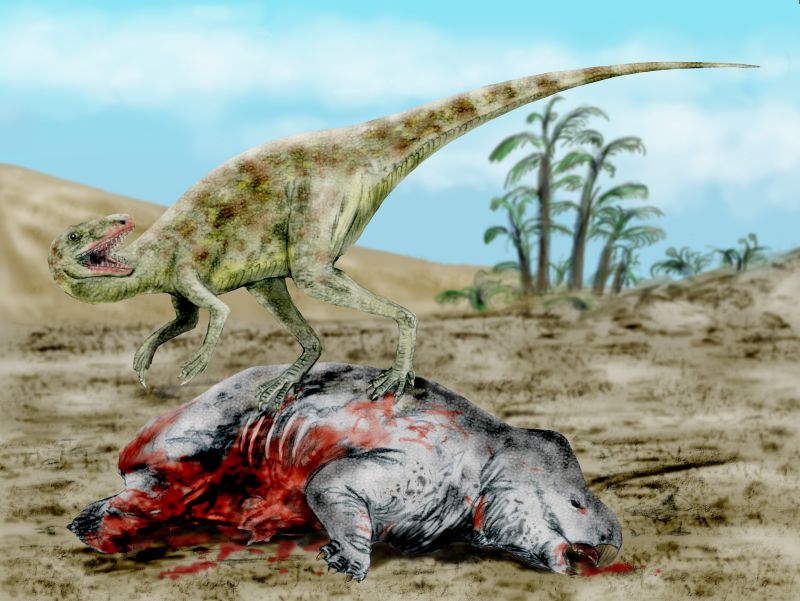


Artistic reconstruction of Staurikosaurus pricei by Nobu Tamura (2008), showing the animal actively hunting a dicynodont in the Triassic environment of Rio Grande do Sul. White background, scientific style.
Nobu Tamura, CC BY 3.0
Ecology and behavior
Habitat
Staurikosaurus inhabited the alluvial plains and open forests of the Santa Maria Formation (Alemoa Member) in present-day Rio Grande do Sul, Brazil, approximately 233 to 225 million years ago. The environment was arid to semi-arid, with vegetation of ferns, seed ferns, cycads, and primitive conifers. Seasonal streams and rivers crossed the landscape. The climate was hot with pronounced dry seasons. Associated fauna included rauisuchians (large predators), rhynchosaurs, dicynodonts, cynodonts, and primitive dinosaurs such as Saturnalia and Gnathovorax.
Feeding
Staurikosaurus was an active carnivore that hunted small to medium-sized vertebrates available in the Triassic ecosystem. Its laterally compressed, backward-curving serrated teeth prevented prey from escaping once caught, a feature shared with Herrerasaurus. Likely prey included herbivorous rhynchosaurs (abundant in the Santa Maria Formation), cynodonts, and small dicynodonts. At only 30 kg, Staurikosaurus could not compete with rauisuchians for large prey, preferring animals proportional to its own size.
Behavior and senses
Staurikosaurus was likely a solitary or paired predator, given its small-bodied nature. The long tail, with more than 40 vertebrae, served as a counterbalance during running and abrupt changes of direction, suggesting superior agility. The pelvic and hindlimb musculature study (Grillo and Azevedo 2011) indicates that locomotion was efficient and adapted to active pursuit. The backward-curving teeth suggest the animal held struggling prey rather than just biting and releasing, a behavior still seen in modern snakes and some crocodilians.
Physiology and growth
Staurikosaurus's phylogenetic position near the base of Dinosauria makes the question of its metabolism especially interesting. While more derived dinosaurs developed endothermic (warm-blooded) metabolism, it is still debated whether herrerasaurids like Staurikosaurus already possessed this feature or were more ectothermic like their reptilian ancestors. The reduced number of sacral vertebrae (only two) is extremely primitive, being one of the main characters distinguishing Staurikosaurus from more derived dinosaurs. Rapid bipedal running was possible thanks to an upright posture with limbs vertically under the body.
Paleogeography
Continental configuration

Scotese & Vérard · CC BY 4.0 · Triassic, ~225 Ma
Fossil sites

Martinelli et al. 2016, CC BY 4.0
During the Carniano (~233–225 Ma), Staurikosaurus pricei inhabited Pangea, the single supercontinent joining all modern continents. Climate was dry and hot across much of the continental interior.
Bone Inventory
Holotype MCZ 1669 preserves partial elements of the vertebral column, hindlimbs, and lower jaw. Parts of the skull, forelimbs, and pectoral girdle are absent or incomplete. Additional preparation of the specimen in the 2000s revealed new anatomical details, but the material remains fragmentary.
Found elements
Inferred elements
Scientific Literature
15 papers in chronological order — from the original description to recent research.
A saurischian dinosaur from the Triassic of Brazil
Colbert, E.H. · American Museum Novitates
The founding paper establishing the genus and species Staurikosaurus pricei. Edwin Colbert describes holotype MCZ 1669 from Harvard's Museum of Comparative Zoology, collected in 1936 by Llewellyn Ivor Price from the Santa Maria Formation of Rio Grande do Sul. The animal is characterized as a small, primitive bipedal saurischian with serrated backward-curving teeth, a 23 cm femur, and a long tail. Colbert discusses its position within Saurischia and suggests affinities with Triassic forms from Argentina. The name Staurikosaurus refers to the Southern Cross constellation, visible in Rio Grande do Sul's sky where the fossil was found, while pricei honors paleontologist Price.
On Staurikosaurus pricei, an early saurischian dinosaur from the Triassic of Brazil, with notes on the Herrerasauridae and Poposauridae
Galton, P.M. · Paläontologische Zeitschrift
Peter Galton provides the first detailed systematic redescription of Staurikosaurus pricei seven years after Colbert's original description. The work corrects and expands knowledge of the specimen's anatomy: Galton counts nine or ten cervical vertebrae (instead of Colbert's six), 15 dorsals, and only two sacrals — the latter an extremely primitive character absent in more derived dinosaurs. Galton proposes a new family exclusively for the taxon, Staurikosauridae, separating it from Herrerasauridae, and repositions both families as Saurischia incertae sedis. The paper also discusses the relationship with Poposauridae, non-dinosaurian archosaur groups previously misassociated with Staurikosaurus.
Phylogenetic relationships of the basal dinosaurs, the Herrerasauridae
Novas, F.E. · Palaeontology
Fernando Novas presents the first rigorous cladistic analysis of herrerasaurid phylogenetic relationships, placing Staurikosaurus and Herrerasaurus as sister taxa within a monophyletic group. Novas identifies shared synapomorphies in the dorsal, sacral, and caudal bones, and in the pectoral and pelvic girdles. The result positions Herrerasauridae as the sister group of all other dinosaurs — a hypothesis that influenced decades of research. This work establishes Herrerasauridae as a valid monophyletic family, contrasting with the exclusive family Staurikosauridae proposed by Galton (1977). It is the starting point of modern debates on Staurikosaurus's phylogenetic position.
The skull and neck of the basal theropod Herrerasaurus ischigualastensis
Sereno, P.C. & Novas, F.E. · Journal of Vertebrate Paleontology
Sereno and Novas provide a detailed description of the skull and neck of Herrerasaurus ischigualastensis based on recently excavated specimens from the Ischigualasto Formation, Argentina. The paper places Herrerasaurus as a basal theropod, uniting it with Staurikosaurus in Herrerasauridae within Theropoda. The skull description is particularly relevant for Staurikosaurus: since the latter's skull is partially preserved, Herrerasaurus cranial morphology serves as a comparative model. The work identifies key features such as the intramandibular joint, laterally compressed serrated teeth, and the peculiar hook system on the dentary that prevents prey from escaping.

Early dinosaurs: a phylogenetic study
Langer, M.C. & Benton, M.J. · Journal of Systematic Palaeontology
Max Langer and Michael Benton conduct one of the most comprehensive phylogenetic analyses of early dinosaurs, including Staurikosaurus, Herrerasaurus, Eoraptor, and Saturnalia. The result challenges Sereno's classification: Herrerasauridae emerges as basal saurischians, outside Theropoda, positioned at the base of Saurischia before the split between Theropoda and Sauropodomorpha. Staurikosaurus is confirmed as a herrerasaurid. The work presents a matrix of 400 characters and 51 taxa, making it the reference analysis for Triassic basal dinosaurs for years. It is especially relevant for the study of Staurikosaurus as it directly addresses the topology of the clade in which the species is placed.

The anatomy and phylogenetic position of the Triassic dinosaur Staurikosaurus pricei Colbert, 1970
Bittencourt, J.S. & Kellner, A.W.A. · Zootaxa
This is the most comprehensive work ever published on Staurikosaurus pricei, resulting from additional preparation of holotype MCZ 1669 that revealed previously unknown anatomical features. Bittencourt and Kellner systematically redescribe each preserved bone element and propose a revised diagnosis for the species. The resulting phylogenetic analysis firmly places Staurikosaurus within Herrerasauridae. The paper evaluates all proposed synapomorphies for Dinosauria and less inclusive clades, testing whether Staurikosaurus possesses them. Published as a 56-page monograph, this is the primary anatomical reference for any future study on the species, partially superseding Colbert's (1970) original work.

A new herrerasaurid (Dinosauria, Saurischia) from the Upper Triassic Ischigualasto Formation of northwestern Argentina
Alcober, O.A. & Martínez, R.N. · ZooKeys
Alcober and Martínez describe Sanjuansaurus gordilloi, a new herrerasaurid from the Ischigualasto Formation (Carnian, Argentina), based on a well-preserved partial skeleton. Phylogenetic analysis recovers Sanjuansaurus, Herrerasaurus, and Staurikosaurus as a monophyletic clade, strengthening the concept of Herrerasauridae. The work is relevant to the study of Staurikosaurus because the skeletal reconstruction published in the paper includes Staurikosaurus for comparison, and the positioning of Sanjuansaurus within the clade confirms the group's monophyly. This is the paper from which the most-cited recent skeletal reconstruction of Staurikosaurus originates.

The origin and early evolution of dinosaurs
Langer, M.C. et al. · Biological Reviews
Encyclopedic review of the origin and initial diversification of dinosaurs, led by Max Langer with contributions from Ezcurra, Bittencourt, and Novas. The work synthesizes the oldest records of Dinosauria (ca. 230 Ma) from rocks of southwestern Pangea, covering phylogenetics, biogeography, systematics, and paleoenvironment. Staurikosaurus is treated in depth as one of the most primitive known dinosaurs, with revision of its position in the phylogenetic tree, temporal distribution, and fossil records. The review spans 55 pages and cites all relevant works on the animal up to 2010. It is the reference synthesis for any researcher wishing to understand the evolutionary context of Staurikosaurus pricei.

Pelvic and hind limb musculature of Staurikosaurus pricei (Dinosauria: Saurischia)
Grillo, O.N. & Azevedo, S.A.K. · Anais da Academia Brasileira de Ciências
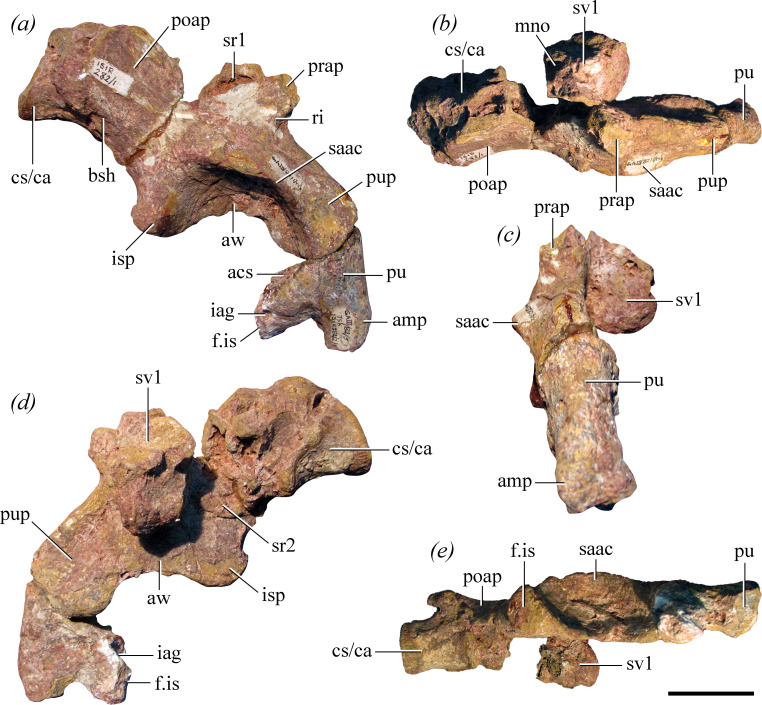
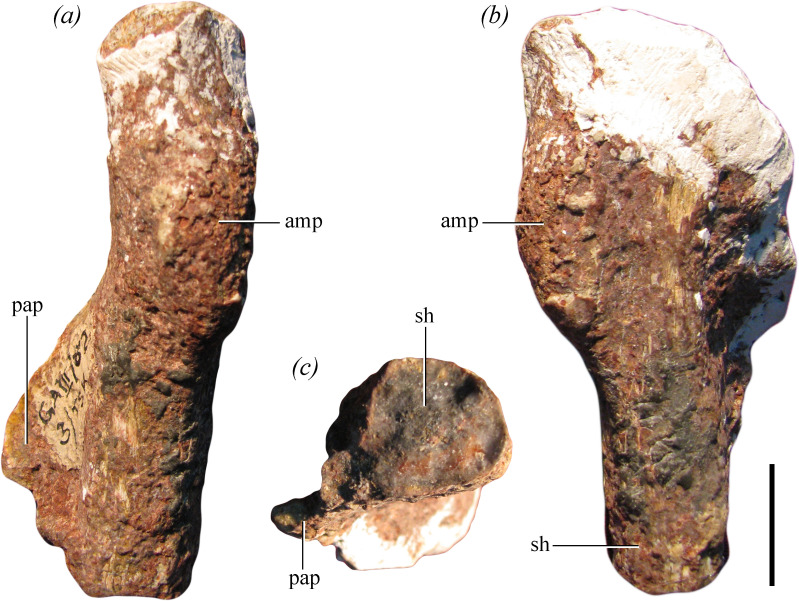
Grillo and Azevedo perform the first systematic reconstruction of the pelvic and hindlimb musculature of Staurikosaurus pricei using the extant phylogenetic bracket method. The work identifies two large concavities in the lateral surface of the ilium as muscle origins, determines that the ambiens muscle has only one head (originating from the pubic tubercle), and characterizes the origin of puboischiofemoralis internus 1 in a fossa on the ventral margin of the pre-acetabular iliac process. This muscular reconstruction is fundamental for understanding herrerasaurid bipedal locomotion and inferring Staurikosaurus biomechanics in life. The paper was published in the Anais da Academia Brasileira de Ciências, a national reference journal.

On the taxonomic status of Teyuwasu barberenai Kischlat, 1999 (Archosauria: Dinosauriformes), a challenging taxon from the Upper Triassic of southern Brazil
Garcia, M.S. et al. · Zootaxa
Garcia and colleagues examine the taxonomic status of Teyuwasu barberenai Kischlat, 1999, a dinosauriform from the Upper Triassic of Rio Grande do Sul whose name had been proposed in a symposium abstract (without formal nomenclatural validity). After analysis of the holotype and comparison with MCZ 1669, the authors conclude that the specimen represents a second individual of Staurikosaurus pricei, making it the only known second specimen attributable to the species. This discovery is significant because it increases available morphological knowledge and confirms intraspecific variation. The paper resolves problematic nomenclature and expands the fossil record of Staurikosaurus beyond the single holotype described by Colbert in 1970.


Gnathovorax cabreirai: a new early dinosaur and the origin and initial radiation of predatory dinosaurs
Pacheco, C. et al. · PeerJ
Pacheco and colleagues describe Gnathovorax cabreirai, a new herrerasaurid from the Santa Maria Formation of Rio Grande do Sul, based on a virtually complete and articulated skeleton, found in association with rhynchosaurs and cynodonts. Gnathovorax is the third herrerasaurid from Brazil (alongside Staurikosaurus and the 'Big Saturnalia' specimen), and its description greatly strengthens anatomical knowledge of the group. Phylogenetic analysis recovers Herrerasauridae as a monophyletic clade including Staurikosaurus as a basal member. The work also includes morphological disparity analysis and geochronological distribution, contextualizing Staurikosaurus within the initial radiation of predatory dinosaurs.

Taxonomic and phylogenetic reassessment of a large-bodied dinosaur from the earliest dinosaur-bearing beds (Carnian, Upper Triassic) from southern Brazil
Garcia, M.S. et al. · Journal of Systematic Palaeontology
Garcia and colleagues reassessed the specimen informally known as 'Big Saturnalia', collected from the Cerro da Alemoa outcrop in Santa Maria (RS). Previously interpreted as a large sauropodomorph, phylogenetic analysis revealed herrerasaurid affinities, making it the largest herrerasaurid from the Candelária Sequence and the second herrerasaurid cranial material from Brazil. This work is directly relevant to Staurikosaurus by demonstrating that the Santa Maria Formation hosted multiple contemporary herrerasaurids of different sizes, suggesting ecological niche partitioning. The large size of this specimen contrasts with Staurikosaurus (2.1 m), indicating diversity of forms within the family.


New cynodont from the Santa Maria Formation, south Brazil, improves Late Triassic probainognathian diversity
Martinelli, A.G. et al. · Papers in Palaeontology
Martinelli and colleagues describe a new probainognathian cynodont from the Santa Maria Formation of Rio Grande do Sul, enriching knowledge of the Late Triassic paleoecosystem that Staurikosaurus inhabited. The paper presents detailed biostratigraphic data and discusses the faunal composition of the Santa Maria Formation during the Carnian. Although it does not directly address Staurikosaurus, it contextualizes its ecosystem: the dinosaur coexisted with cynodonts (potential prey), dicynodonts, rhynchosaurs, rauisuchians, and basal dinosauromorphs such as Saturnalia. The work includes the chrono- and biostratigraphic diagram of the Santa Maria Formation published on Wikimedia Commons.


A new herrerasaurian dinosaur from the Upper Triassic Upper Maleri Formation of south-central India
Ezcurra, M.D. et al. · Royal Society Open Science
Ezcurra and colleagues describe Maleriraptor kuttyi, the first herrerasaurid from India and the most geographically distant from South American herrerasaurids. Phylogenetic analysis places the new taxon within Herrerasauridae alongside Staurikosaurus, Herrerasaurus, Sanjuansaurus, and Gnathovorax, suggesting that the group's original distribution was broadly Gondwanan. This work has direct implications for the biogeography of Staurikosaurus: it confirms that herrerasaurids were not restricted to southern South America but occupied large expanses of Gondwana during the Late Triassic. Published in 2025, it represents the most current state of knowledge about the family.

![Geographic and stratigraphic occurrence and preserved bones of Maleriraptor kuttyi . ( a ) Palaeomap of the Late Triassic depicting the occurrences of the herrerasaurs. ( b ) Overview of the Gondwana basins in India, with the Pranhita-Godavari valley highlighted (modified from [ 32 ]). ( c ) Detailed geological map of a portion of the Pranhita-Godavari valley indicating the type localities of the nominal dinosaur species of the Upper Maleri Formation. ( d ) Reconstruction of the skeleton of Male](/images/species/staurikosaurus-pricei/papers/387fe460ad-10.jpg)
Review of the fossil record of early dinosaurs from South America, and its phylogenetic implications
Novas, F.E. et al. · Journal of South American Earth Sciences
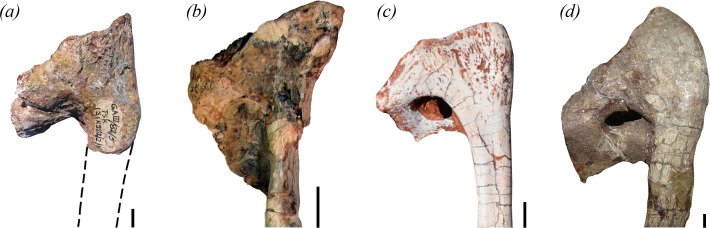
Novas, Agnolin, Ezcurra, Müller, Martinelli, and Langer conduct the most updated review of the early dinosaur fossil record from South America, with direct phylogenetic implications for Staurikosaurus. Triassic beds from Argentina and Brazil provide the most relevant sequence for understanding dinosaur origins in terms of numerical abundance and taxonomic diversity. The work reviews all Carnian dinosaurs from the continent, discussing non-dinosaurian Triassic precursors and dinosaur evolution on other continents. Staurikosaurus is treated as one of the central records, with analysis of its phylogenetic position in light of the most recent data. The work brings together the leading specialists in South American Triassic dinosaurs.


Famous museum specimens
MCZ 1669 (Holótipo)
Museum of Comparative Zoology, Harvard University, Cambridge, Massachusetts, EUA
Type specimen of the species, collected by Llewellyn Ivor Price from the Santa Maria Formation of Rio Grande do Sul in 1936 and described by Colbert in 1970. Preserves elements of the vertebral column, hindlimbs, and lower jaw. Additional preparation in the 2000s revealed new anatomical details, as described by Bittencourt and Kellner (2009).
Segundo espécime (ex-Teyuwasu barberenai)
Repositório institucional brasileiro (Rio Grande do Sul)
Specimen originally described as Teyuwasu barberenai by Kischlat in a 1999 symposium abstract. Garcia et al. (2019) reassessed the material and concluded it belongs to Staurikosaurus pricei, making it the only known second specimen attributable to the species. Expands morphological knowledge of the animal.
Réplica exposta (Museu Eça, Santa Maria, RS)
Museu Eça, Santa Maria, Rio Grande do Sul, Brasil
Reconstructed replica of Staurikosaurus pricei on display at Museu Eça in Santa Maria, Rio Grande do Sul, a city near the discovery site of the holotype. The replica depicts the animal based on data from holotype MCZ 1669 and subsequent studies, being the main point of public contact with the dinosaur in Brazil.
In cinema and popular culture
Staurikosaurus pricei occupies a peculiar niche in popular culture: it is one of Brazil's most primitive dinosaurs, but its limited scientific fame contrasts with an almost total absence from major film and television productions. The animal has never appeared in the Jurassic Park franchise, likely due to its small size (2.1 m) and low public recognition compared to iconic species. Its main media presence is in scientific documentaries, such as Planet Dinosaur (BBC, 2011) and Prehistoric Planet (Apple TV+, 2022), where herrerasaurids are shown in a Triassic context but Staurikosaurus is rarely named directly. Educational children's series such as Dino Dana (2017) and Dinosaur Train are exceptions: both depict the animal with reasonable fidelity, highlighting its Brazilian origin. The absence of Staurikosaurus from mainstream productions is an unjust gap for an animal that was one of the first major terrestrial predators in the history of life on Earth.
Classification
Discovery
Fun fact
Staurikosaurus pricei was collected in 1936 but only described 34 years later: the specimen sat in Harvard's Museum of Comparative Zoology waiting for a specialist to study it. When Edwin Colbert finally described it in 1970, it revealed to the world one of the most primitive dinosaurs ever discovered, with only two sacral vertebrae, a number so small it is absent in all more evolved dinosaurs. Its name celebrates the sky of Rio Grande do Sul: Staurikosaurus means 'Southern Cross lizard', the famous constellation visible in the southern hemisphere.
Last reviewed: April 24, 2026