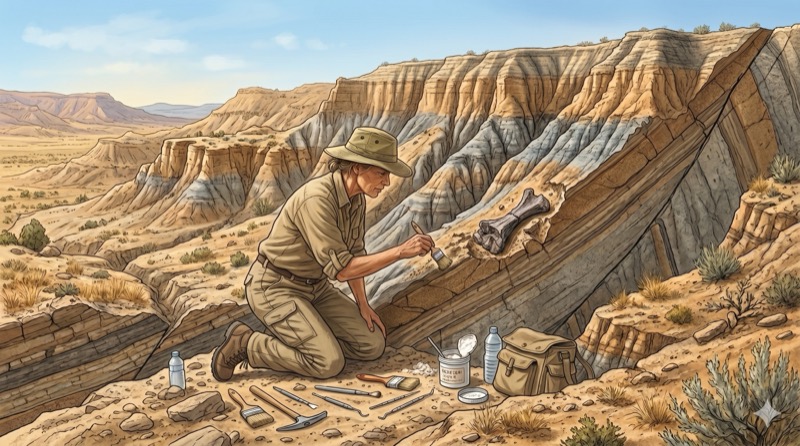
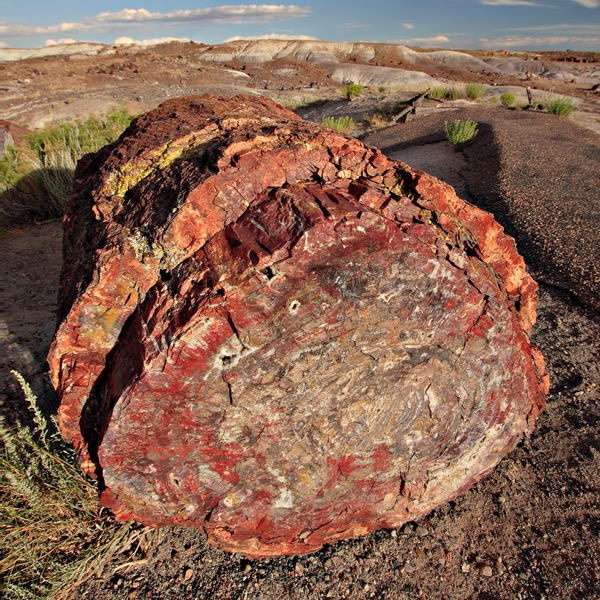
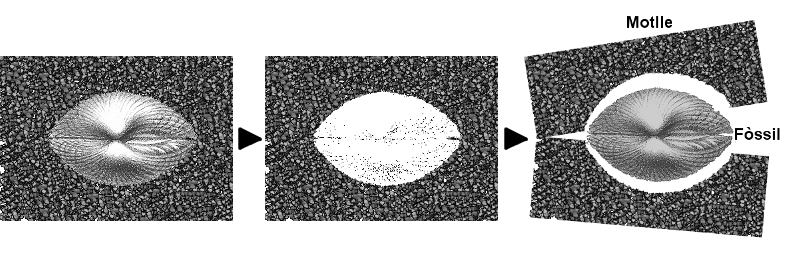
Everything we know about dinosaurs comes from rock. But how does a rock reveal that an animal extinct 76 million years ago had cancer, slept like a bird, or hunted at night? The 30 discoveries below show three things for each case: what was peculiar about the fossil, what technique allowed the inference, and what the limits of the conclusion really are.
#01 The Centrosaurus that had bone cancer
Definitive diagnosis of osteosarcoma (the same aggressive type of bone cancer that affects humans today) in a 76-million-year-old fossil. Shows that neoplastic disease is not a modern phenomenon: it has accompanied vertebrates for over 70 million years.
Technique
High-resolution computed tomography combined with histopathology. Thin sections of the bone analyzed under optical microscopy revealed the tissue disorganization characteristic of the tumor.
Limits of what we know
It is a unique case to date. Diagnosing cancer in a fossil requires ruling out post-mortem deformation, infection, and a poorly healed fracture, and the team spent years comparing the specimen with human clinical cases. Replication in other fossils has not yet been achieved.
#02 The Microraptor with a whole bird in its stomach
Skeleton of an enantiornithine bird preserved articulated inside the abdominal cavity of a Microraptor, with the feet positioned at the entrance of the stomach. Indicates the prey was swallowed whole and head-first, just like modern raptorial birds.
Technique
Direct analysis of the preserved abdominal contents, compared with ingestion patterns of living birds of prey.
Limits of what we know
The favored interpretation is active hunting in trees, but scavenging is not entirely ruled out. The degree of digestion suggests recent ingestion, which reinforces hunting, but does not close the case.
#03 The real color of Anchiornis huxleyi
First complete reconstruction of a dinosaur's coloration based on direct evidence. Dark gray to black body, white-striped wings, and a russet crest on top of the head with freckles on the face. End of the era of "artistic guesses" for dinosaur colors.
Technique
Analysis of the shape and density of melanosomes (pigment-storing organelles) in 29 samples from the fossil, compared with modern birds of known colors.
Limits of what we know
Melanosomes only reveal black, brown, and russet. Colors based on carotenoids (yellows, vivid reds) and structural colors (blues, iridescent greens) do not fossilize, so the actual palette may have been more vibrant.
#04 The T. rex poop that proved it crushed bone
A 2.4-liter coprolite (fossilized feces), more than double any other known carnivore coprolite, containing 30% to 50% crushed bone fragments of juvenile Triceratops and Edmontosaurus. Bone crushing is rare among living carnivores; today only hyenas do it routinely.
Technique
Petrographic and compositional analysis of the coprolite, with histological identification of the bone fragments to determine the prey species.
Limits of what we know
Attribution to T. rex is by exclusion (size, geography, age of the rock), with no direct identification of the producer. Another giant tyrannosaurid could, in theory, be the author.
#05 Which dinosaurs were nocturnal
The scleral ring (bone surrounding the pupil) predicts the daily activity habits of living animals with high accuracy. Applied to 33 fossils: small Velociraptor-like carnivores hunted at night, pterosaurs were diurnal, large herbivores were cathemeral (active day and night, with a pause during the hottest hours).
Technique
Measurement of the inner and outer dimensions of the scleral ring plus orbit size, calibrated against 164 living species of birds, lizards, and mammals.
Limits of what we know
The method was contested by Hall et al. 2011, who pointed out that some living reference species have more flexible habits than assumed. The separation between nocturnal and cathemeral becomes especially blurred.
#06 The dinosaur fossilized sleeping like a bird
Mei long preserved in a posture identical to the "tuck-in" of modern birds: head tucked under the arm, legs folded under the body, neck curved. Avian behavior documented in a 130-million-year-old dinosaur.
Technique
Analysis of the preservation posture and comparison with stereotyped postures of living birds in sleep or rest states.
Limits of what we know
The posture may represent sudden death (burial by volcanic ash, common in the Yixian), not necessarily sleep. But the second specimen described in 2012 in the same posture reinforces that this was real behavior, not an accidental pose.
#07 The hadrosaur vertebra with an embedded T. rex tooth and bone healed around it
Settled a decades-long argument: T. rex hunted actively, was not just a scavenger. The prey was bitten on the tail, escaped, and survived, and the bone grew around the tooth like a bony scar — proof of healing time after the attack.
Technique
Analysis of bite marks with histological signs of healing (bony callus). Only marks with healing signs can be distinguished from post-mortem bites made during feeding.
Limits of what we know
Sample of a single vertebra, but the phenomenon is categorical: an embedded tooth with healed bone around it can only have occurred while the victim was still alive. The frequency of hunting (vs. scavenging) is still debated.
#08 The literal fossil of a fight
Velociraptor with its foot claw lodged in the neck of a Protoceratops, right hand caught in the prey's jaws, buried together by a sandstorm 75 million years ago. The only direct and undeniable record of agonistic behavior in non-avian dinosaurs.
Technique
Taphonomic analysis (study of burial) of the sediments around the pair. The relative position of the bodies excludes the possibility of post-mortem mixing.
Limits of what we know
There is debate over whether it was hunting (Velociraptor attacking) or accidental predation (Protoceratops surprised by the dromaeosaurid while defending itself). The burial scenario (collapsing dune or storm) is also discussed.
#09 The Citipati that died brooding its eggs
Adult skeleton sitting on the nest with arms extended covering the eggs, posture identical to a brooding bird's gesture. Before this fossil, these dinosaurs were believed to be stealing eggs from other species, which is why the group received the name "Oviraptor" (egg thief), an error never corrected.
Technique
Analysis of the preservation posture over a clutch of identifiable eggs (oofamily Elongatoolithidae), compared with modern birds in incubation posture.
Limits of what we know
It is not possible to distinguish regular incubation behavior from "death while trying to protect." But multiple specimens of Citipati and relatives were found in the same position, which suggests a pattern.
Medullary tissue (temporary calcium-rich bone that female birds produce only during egg laying) identified inside the femur of specimen MOR 1125. Allows sexing of dinosaur fossils for the first time, and confirms that the reproductive strategy was analogous to that of birds.
Technique
Bone histology (thin sections analyzed under microscope) combined with chemical analysis using monoclonal antibodies for keratan sulfate, compared with medullary tissue of ostrich and chicken.
Limits of what we know
The interpretation was questioned by later works that pointed out that pathological tissue can mimic medullary bone. In 2016 the original team published a new study confirming the identification by chemical analysis, but the debate persists in part of the community.
#11 How long it took a T. rex to grow up
For 20 years the consensus (Erickson 2004) was: it became an adult at 20 years old, lived to about 30, with a peak growth of 2 kg per day in adolescence. In 2026, a new study reanalyzed 17 specimens with expanded histological technique and concluded maturity at 35 to 40 years, with slower and longer growth. Horner, co-author of both papers, changed his mind about his own 2004 work.
Technique
Histology of cross sections of femur and tibia, counting LAGs (lines of arrested growth, similar to tree rings) and annual birefringent bands visible under crossed polarized light. Statistical modeling using sigmoidal curves.
Limits of what we know
The 2026 paper still needs independent replication. Each counting technique (one mark per year vs. multiple marks per dry season) changes the result. This case is the perfect example of how paleontological consensus can shift when the sample grows and the technique improves.
#12 How we calculate the speed of an extinct dinosaur
Formula that uses only footprint length and the distance between successive footprints to estimate walking speed. Applied to several trackways: most dinosaurs walked between 3.6 and 13 km/h. Movie running speeds (T. rex chasing a jeep at 50 km/h) have no support in the footprints.
Technique
Biomechanics applied to ichnofossils (tracks). The formula v = 0.25 × √g × SL^1.67 × h^(-1.17) uses stride length (SL) and hip height (h, estimated as 4× footprint length).
Limits of what we know
Footprints show only the instant. The animal could have been hungry, thirsty, fleeing, or walking slowly. Soft substrates (mud) also distort the estimate. The formula gives a snapshot, not a video.
#13 The embryo inside the egg, curled up like a baby bird
"Baby Yingliang", a 70-million-year-old oviraptorosaur embryo preserved inside an intact egg, with its head under its body and feet at its sides. Posture identical to the pre-hatching "tucking" of modern birds, behavior previously thought to be exclusive to birds.
Technique
Tomographic analysis of the intact egg, without destroying it, compared with embryonic postures of living birds close to hatching.
Limits of what we know
Single sample. The preserved posture may reflect the moment of death, not active tucking behavior. But the similarity is too strong to be a taphonomic coincidence.
#14 The Spinosaurus tail that proved swimming dinosaurs existed
Rudder-shaped tail with very tall neural spines, distinct from any other theropod. A life-sized robotic model in water showed that this tail generates propulsion equivalent to that of modern fish and crocodiles. Rewrote what was thought about the habitat of large theropods.
Technique
Life-sized physical modeling and comparative computational biomechanics across tail shapes of terrestrial theropods and modern aquatic animals.
Limits of what we know
Active controversy. Sereno et al. 2022 contested the conclusion, arguing that Spinosaurus was a wader (hunting from the margin), not a full swimmer, and that the animal's buoyancy would be too unstable for diving. The debate is still open.
#15 The "good mother lizard" colony of Montana
Maiasaura found in a collective nesting site, with hatchlings showing underdeveloped legs (unable to walk) and worn teeth (a sign that they were eating). A combination that only makes sense if adults brought food to the nest. First evidence of parental care in a dinosaur.
Technique
Analysis of the fossil set: nest taphonomy, ontogeny (development) of the hatchlings, and early dental wear.
Limits of what we know
Hatchling dependence does not directly prove adult care: some authors suggest the hatchlings simply rarely left the nest while adults kept watch without direct feeding. But the body of evidence converges on active care.
#16 The striped tail of Sinosauropteryx
Color pattern identified: russet body with a tail striped in light and dark rings. Probable disruptive camouflage, common in modern mammals such as raccoons. Showed that avian fur-like patterns existed before birds.
Technique
Spatial distribution of melanosomes throughout the body of the fossil, compared with color patterns of living animals.
Limits of what we know
The pattern depends on the orientation of melanosomes. Some regions of the body may have degraded unevenly, distorting the reading.
#17 The real bite force of T. rex, calculated not measured
About 35,000 newtons at the back of the jaw, five times a lion's bite force and equivalent to the pressure of a small car falling on the object. The number was not measured (impossible), it was computed by finite element modeling.
Technique
Finite element modeling (FEM) applied to a 3D model of the skull, simulating the contraction of the jaw muscles to calculate the force generated.
Limits of what we know
The number depends heavily on the muscle model assumed. Different studies arrive at values ranging from 18,000 to 60,000 newtons. The order of magnitude is robust, the exact number is not.
#18 The "vesicles" on Concavenator's forearm
Regular bumps on the ulna interpreted as feather anchor points, just like the quill knobs of modern birds. If the interpretation is correct, it indicates feathers were present in non-avian theropods long before the appearance of dromaeosaurids.
Technique
Morphological analysis and comparison with feather insertion points in living birds.
Limits of what we know
Contested interpretation. Foth, Tischlinger and Rauhut 2014 suggest that the bumps may be intermuscular ligaments, not feather supports. The debate is still open.
#19 Footprints show that theropods could swim
Sets of toe-tip-only footprints, in parallel sequences, found in sandstones of ancient shallow lakes. They were made by theropods floating, pushing the bottom with their claws to propel the body. Kills the stereotype that dinosaurs were aquaphobic.
Technique
Taphonomic analysis of ichnofossils: depth, spacing, and absence of heel marks distinguish walking footprints (whole body supported) from swimming footprints (body floating, only toes touching the bottom).
Limits of what we know
Identifying the trackmaker species is by exclusion (size, age of the rock, local fauna), with no direct identification. Some debated sites may be artifacts of normal footprint depth variation, not swimming.
#20 The real color of oviraptorosaur eggs: blue-green
Direct chemical identification of protoporphyrin (red-brown) and biliverdin (blue-green) in eggshells of the oviraptorosaur Heyuannia huangi. Shows that colored eggs are not an avian novelty, but an inheritance from non-avian dinosaurs. Every time you see a quail or tinamou egg, you are seeing 70-million-year-old biochemistry.
Technique
Non-destructive Raman spectroscopy, capable of identifying molecular signatures of pigments preserved in calcareous shell without dissolving the material.
Limits of what we know
Raman can yield false positives from organic contamination of the sediment. The exact intensity of the color (more or less saturated blue) is not reconstructible, only the presence of the pigment is.
#21 Borealopelta: the ankylosaur with skin and color preserved in 3D
Three-dimensional mummified fossil of a nodosaurid, with scales, keratin, and color pattern preserved. Chemical analysis reveals countershading: dark reddish back, light belly. This pattern (just like a modern deer) only evolves in animals that need to camouflage against predators. A 1,300-kg animal with full armor that was still hunted.
Technique
Surface imaging + chemical analysis (mass spectrometry) of melanosomes and keratin degradation products preserved in the fossilized skin.
Limits of what we know
Countershading is inferred from the pattern of melanosomes. Some authors note that differential post-mortem pigment distribution can mimic countershading. Predation pressure is an ecological inference, not direct evidence.
#22 The preserved cloaca of Psittacosaurus
The only fossil of a non-avian dinosaur reproductive orifice described to date. Shape and contour suggest a single cloaca (combined excretion and reproduction), and intense pigmentation at the edges indicates a probable visual display, like in modern birds and reptiles. The individual cannot be sexed, but the basic anatomy is visible.
Technique
Morphological analysis of the 3D fossil combined with chemical mapping of residual melanosomes at the edges of the orifice.
Limits of what we know
Single sample to date. Preservation is partially two-dimensional, which makes complete 3D reconstruction difficult. It does not allow identifying sex or confirming use as display.
#23 The herd of a thousand Centrosaurus drowned at Hilda
A giant bone bed (2.3 km²) in Alberta with the remains of hundreds to thousands of Centrosaurus apertus killed together by a catastrophic flood 76 million years ago. Largest known dinosaur cemetery, and categorical proof of herd behavior in ceratopsids: solitary animals do not die en masse together.
Technique
Stratigraphic mapping of 14 sub-bonebeds + taphonomic analysis of bone state (minimal transport, simultaneous mortality) + sedimentology indicating a tropical coastal flood.
Limits of what we know
The exact cause (a specific tropical storm vs. a sequence of events) is informed speculation. Whether the herd was migrating, resting, or gathering for reproduction cannot be inferred from the bones.
Comparative analysis of dental wear and facial bone texture of tyrannosaurids against living monitor lizards, alligators, and crocodilians. Conclusion: smooth teeth without exposed wear, facial foramina in a lizard pattern and not a crocodile pattern. The teeth were covered by lips at rest, just like modern lizards. The grinning T. rex of Jurassic Park is zoologically wrong.
Technique
Morphological comparison of facial tissue and dental wear between fossils and a sample of modern reptiles. Phylogenetic analysis of anatomical characters.
Limits of what we know
It is an extrapolation from monitor lizards to tyrannosaurids based on homology. Critics argue that crocodilians would be a better analogy due to ecological proximity (despite phylogenetic distance). The debate is still hot.
#25 Parasaurolophus had a trumpet on its head
Computed tomography of the hadrosaur's hollow crest shows anatomy identical to a wind instrument. Digital modeling reconstructed the sound: bass between 30 and 720 Hz (similar to a trombone). Adults made bass notes for long-distance communication, juveniles made high notes. They probably communicated reproduction, alarm, and individual identity.
Technique
Computed tomography of the skull + computational acoustic modeling of the nasal channels as resonators.
Limits of what we know
The acoustic reconstruction assumes that the soft tissue of the nasal passages was analogous to that of living birds. The social function of the sound (alarm vs. courtship vs. identification) is inference by analogy, not direct data.
#26 The actual body temperature of sauropods
Chemical analysis of dental enamel from sauropods and theropods shows body temperature between 32 and 38 °C. Sauropods around 36 °C, close to mammals. Settled decades of "endothermic vs. ectothermic" arguments by showing that dinosaurs were mesothermic (an intermediate metabolic strategy with no perfect living analog).
Technique
Clumped isotope thermometry: the proportion of specific isotope pairs (¹³C bound to ¹⁸O) in the enamel carbonate depends on the temperature at which the mineral formed, which reflects body temperature.
Limits of what we know
The calibration equation has been refined several times since 2011, changing the absolute numbers by a few degrees. Relative values across groups are robust; absolute values carry uncertainty.
#27 The actual speed of an adult T. rex: trot, not run
Multibody simulation (musculoskeletal model + computational dynamics) reveals that an adult T. rex could not run. At most, an accelerated trot of 18 to 20 km/h. Above that, the stress on the leg bones would exceed mechanical resistance and the animal would break its own femur. Confirms previous studies (Hutchinson 2002) and definitively kills the jeep scene from Jurassic Park.
Technique
Multibody dynamic simulation with bone-stress constraints. The model tests every possible speed and computes the peak force on each bone, comparing it with the known resistance of fossilized bone.
Limits of what we know
Depends on assumptions about muscle mass, load distribution, and properties of living bone extrapolated from modern animals. A juvenile T. rex (lighter) probably actually ran, and that changes the ecology of the genus.
#28 Majungasaurus ate Majungasaurus
Bite marks on bones of Majungasaurus crenatissimus in Madagascar match perfectly, in spacing and shape, the teeth of the same Majungasaurus. First documented case of cannibalism in a non-avian dinosaur. Behavior probably opportunistic, not regular.
Technique
Comparative analysis of bite marks on Majungasaurus bones against the teeth of Majungasaurus itself, ruling out other species present in the local fauna.
Limits of what we know
Bite marks do not distinguish active predation from cannibalism, or from scavenging on a conspecific carcass. The first is extremely rare among vertebrates, the second is more common. The paper accepts the ambiguity.
#29 Pterosaurs had feathers, and before dinosaurs
Four distinct morphological types of pycnofibers (filamentous structures) in anurognathids analyzed with electron microscopy reveal a branched structure identical to primitive feathers. Pushes the origin of feathers back by 70 million years: the common ancestor of pterosaurs and dinosaurs already had feather-like structures ~240 million years ago.
Technique
Scanning electron microscopy (SEM) of filamentous structures preserved in the skin of pterosaurs, compared with primitive feathers known in theropods.
Limits of what we know
Identifying these structures as "homologous" to dinosaur feathers is contested by morphologists who see evolutionary convergence (similar structures that evolved independently), not common inheritance. Resolving this will require more specimens.
#30 The Apatosaurus tail could whip at the speed of sound
Mechanical modeling of the diplodocid tail (75 vertebrae, ~13 meters of tapering whip) shows that the tip could reach Mach 1, generating a sonic boom audible for kilometers. Probable use: intra-herd communication or acoustic intimidation, not defense against predators (the tip is too fragile to impact).
Technique
Mathematical modeling of the tail as a series of articulated pendulums, calculating tip speed as a function of base motion.
Limits of what we know
The model assumes a specific mass and flexibility distribution. Later studies pointed out that the required traction would exceed the strength of known caudal tendons, so the tail might fracture before reaching Mach. A plausible hypothesis, not confirmed.