
Spinosaurus
Spinosaurus aegyptiacus
"Egyptian spine lizard"
About this species
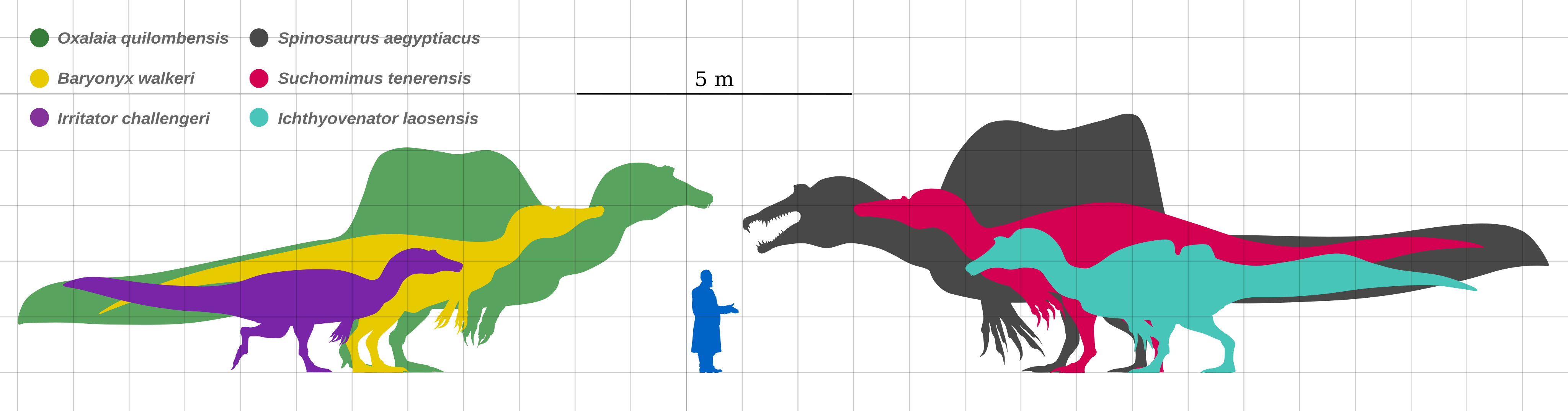
Spinosaurus aegyptiacus was the largest theropod ever recorded, surpassing Tyrannosaurus rex in length. At up to 15 meters and an estimated mass between 6,000 and 7,400 kg, it dominated the river systems of northern Africa during the Cenomanian (99 to 93 million years ago). Its most striking feature was the dorsal sail supported by neural spines up to 1.65 meters tall, whose function is still debated: thermoregulation, sexual display, or fat storage. The snout was elongated and narrow, with conical teeth adapted for catching fish, resembling the morphology of modern crocodilians. Pressure receptors in the snout, similar to those in crocodiles, allowed it to detect prey underwater. In 2020, Ibrahim and colleagues described a paddle-like tail with tall neural spines and expanded chevrons, confirming adaptations for propulsive swimming. Spinosaurus is the only non-avian dinosaur with robust evidence of aquatic habits. The original fossils, collected by Markgraf in Egypt in 1912, were destroyed in the Allied bombing of the Munich Museum in 1944, making rediscoveries in Morocco essential for reconstructing the animal.
Geological formation & environment
The Bahariya Formation (Egypt) and Kem Kem beds (Morocco) are the main sources of Spinosaurus fossils. Both represent Cenomanian deposits (99 to 93 Ma) from fluvial and deltaic environments in North Africa. The Bahariya Formation in Egypt's Western Desert was explored by Ernst Stromer between 1911 and 1914, producing the original fossils destroyed in 1944. The Kem Kem beds in southeastern Morocco are the source of all modern Spinosaurus material, including the 2014 neotype and the 2020 tail. The fossilized ecosystem was dominated by predators, with an abnormally high carnivore-to-herbivore ratio that is still debated.
Image gallery
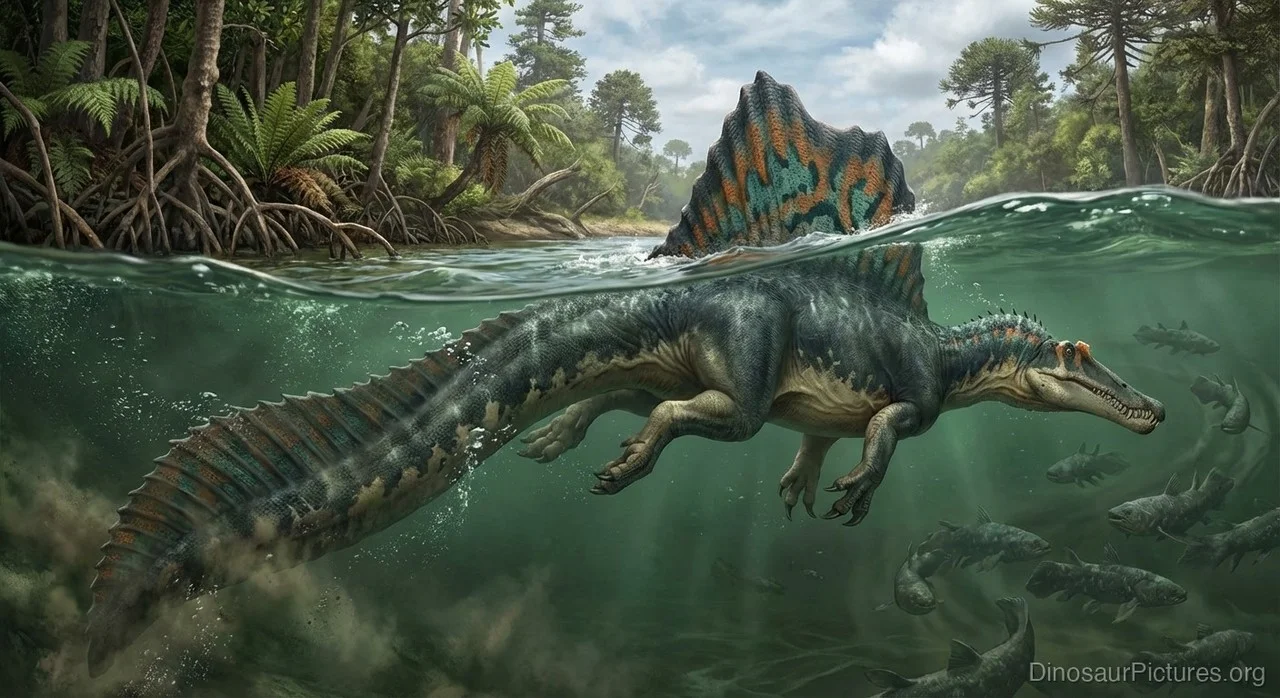
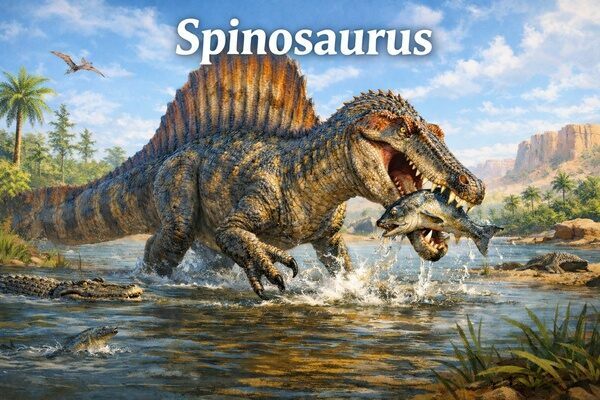
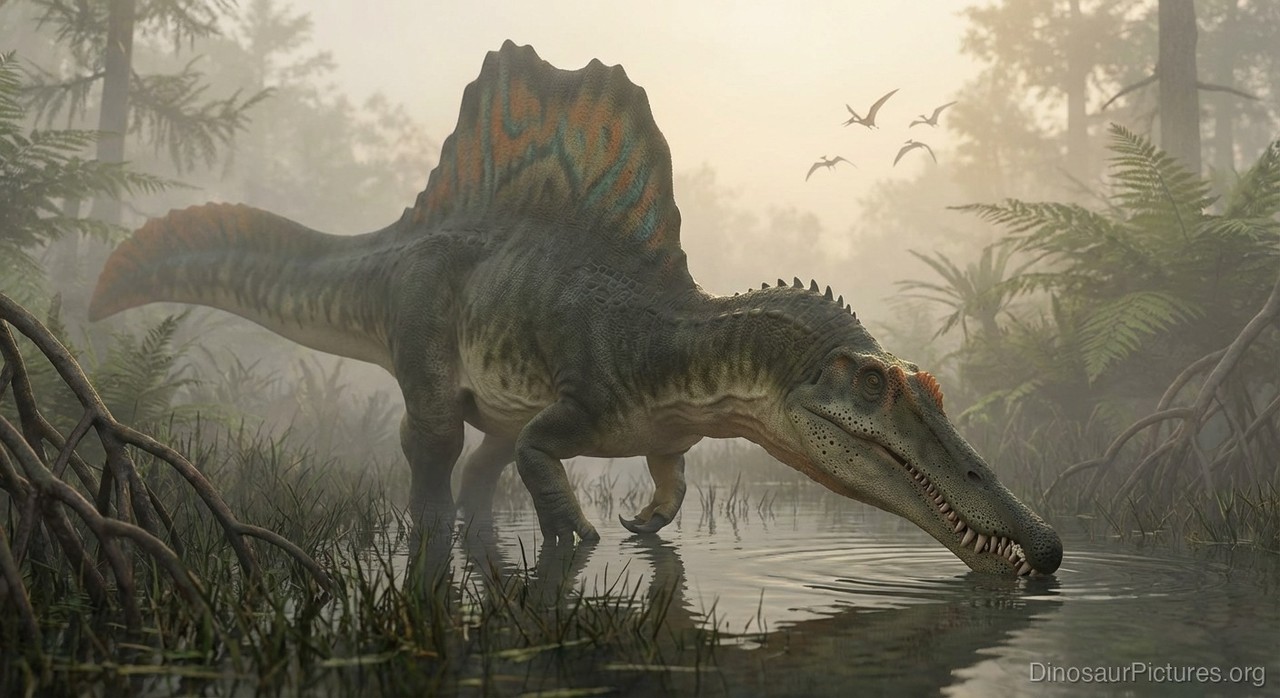
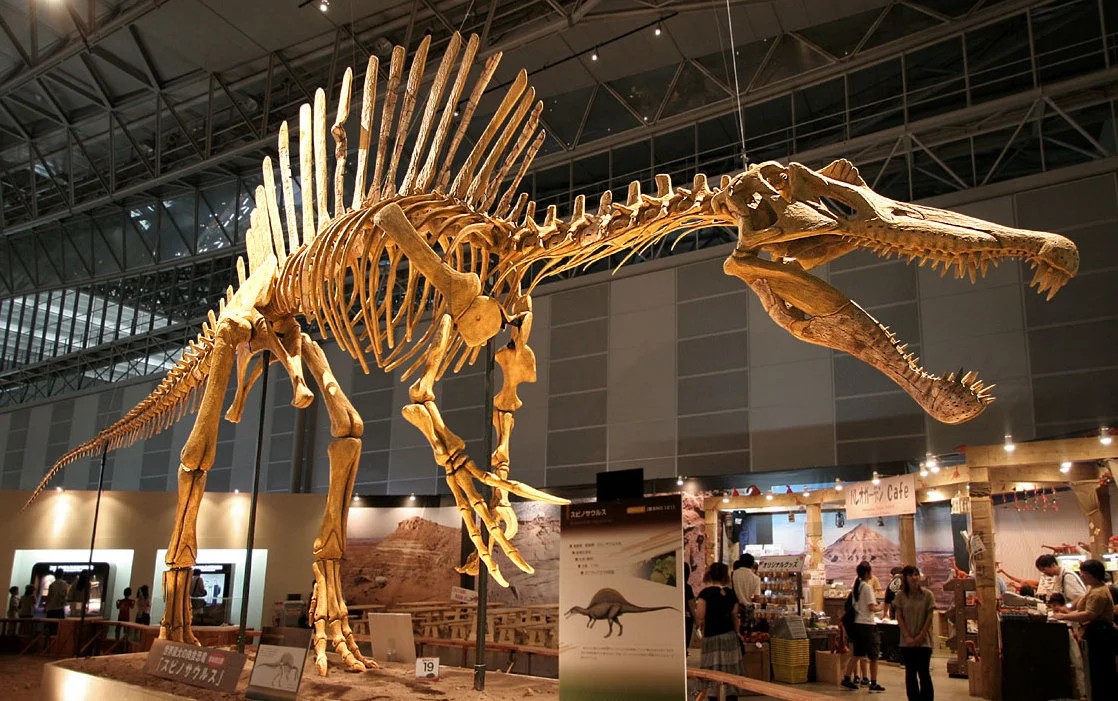
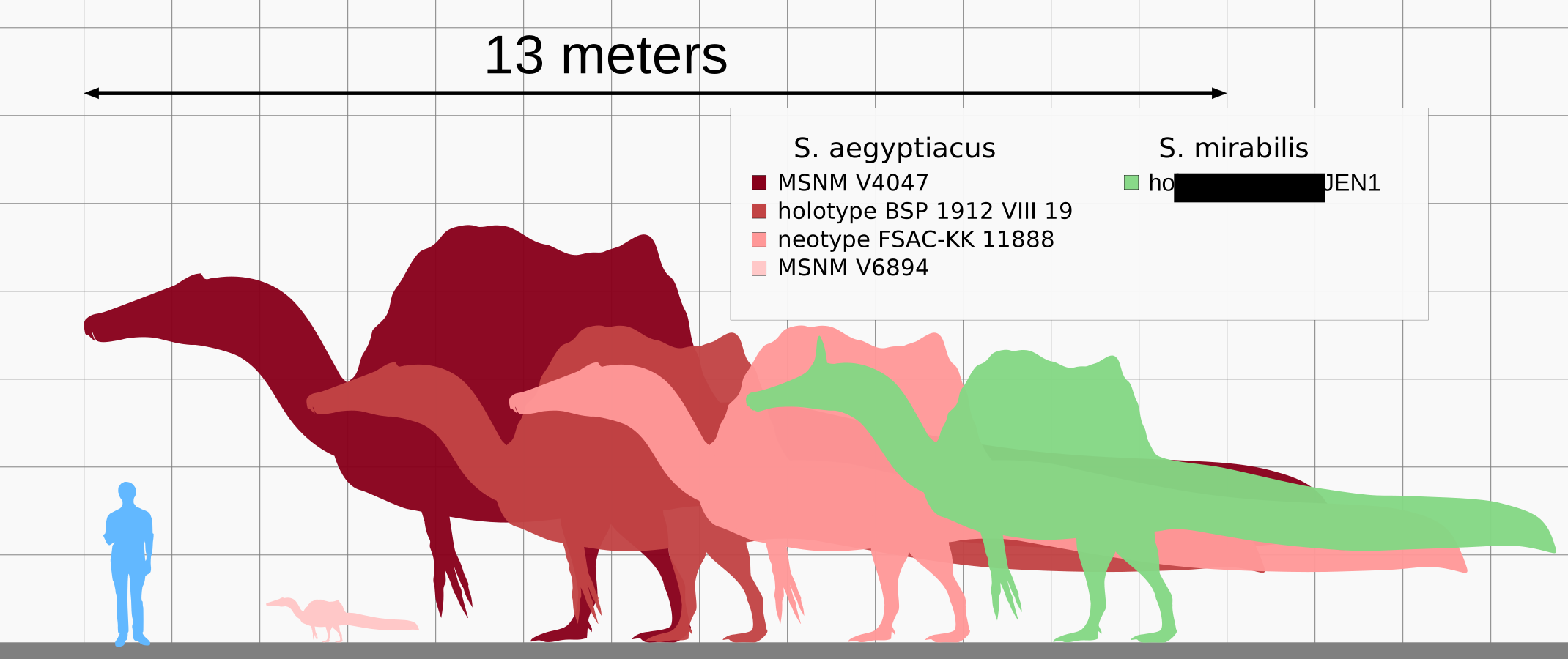
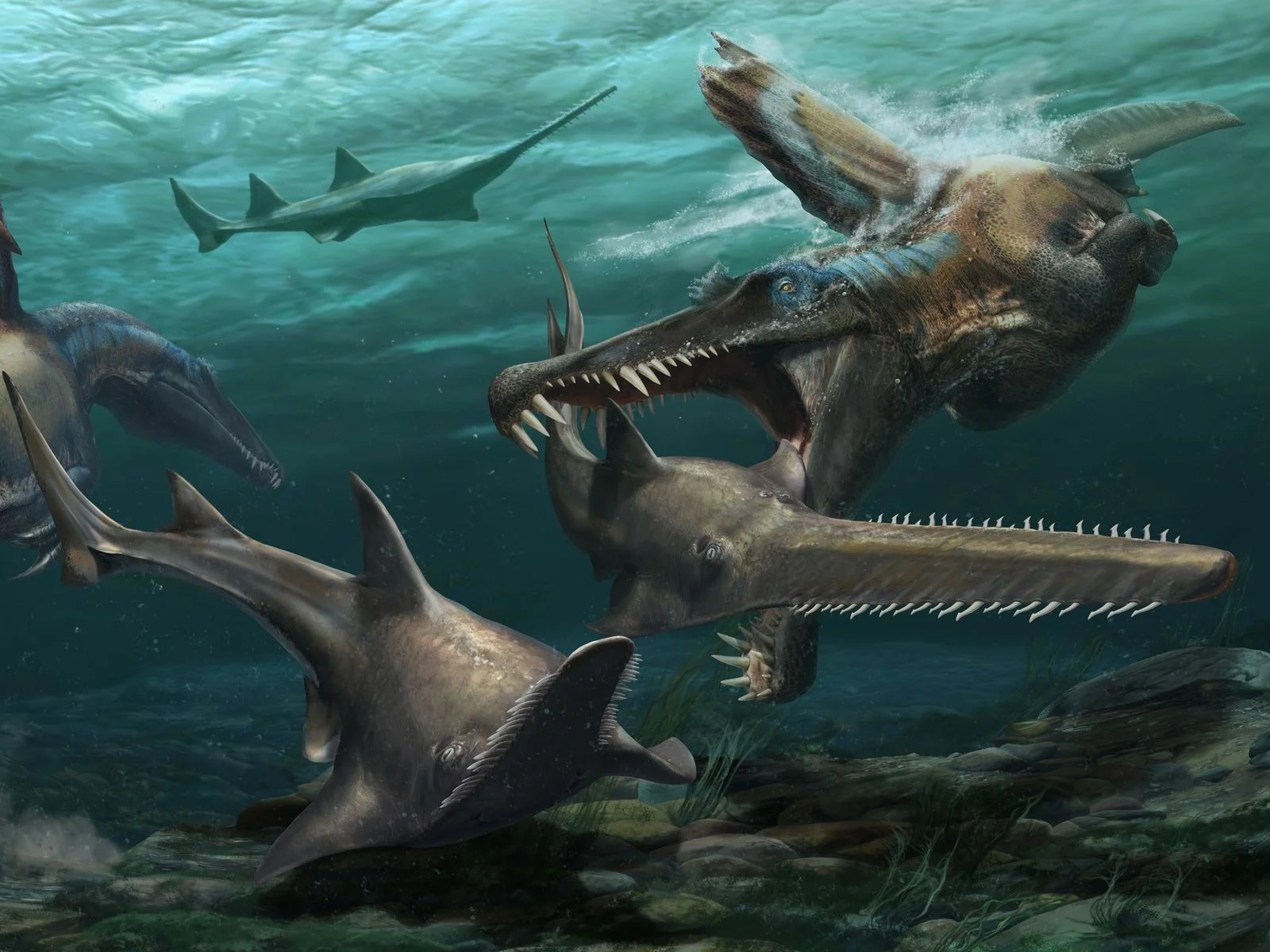
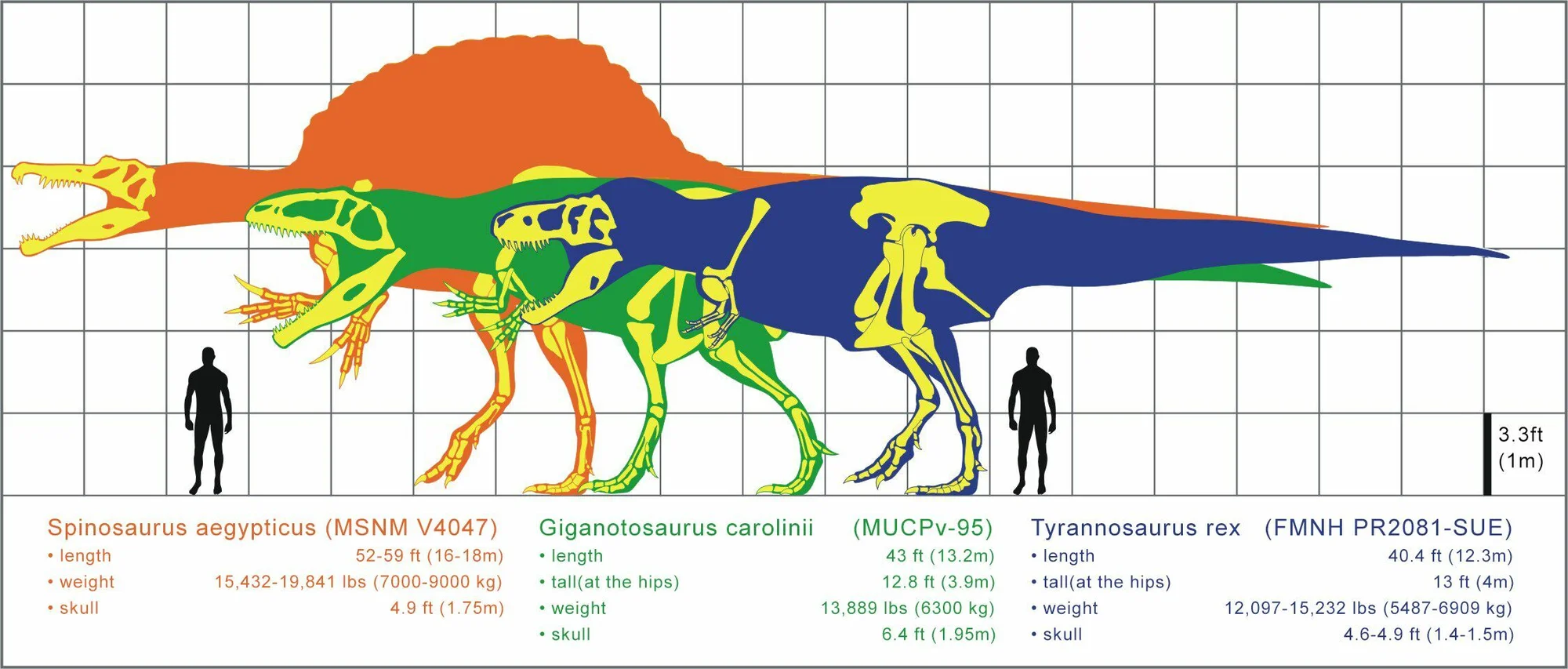
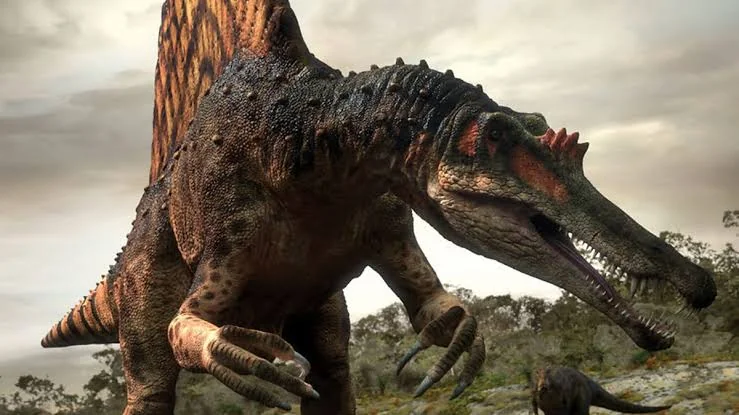
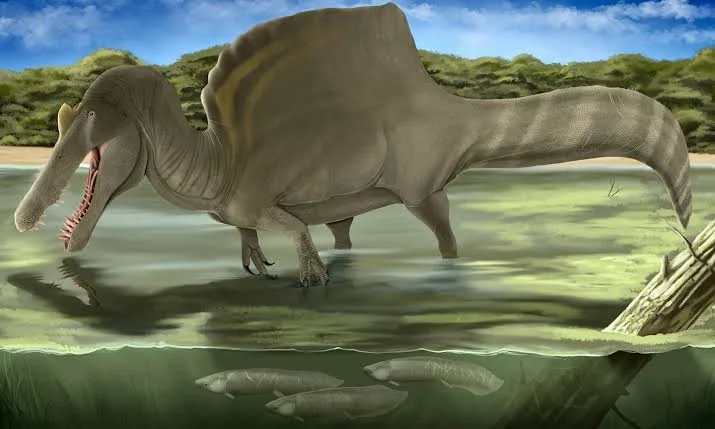
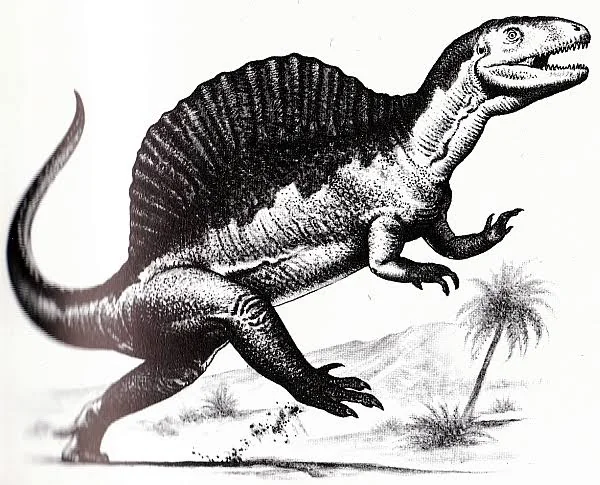
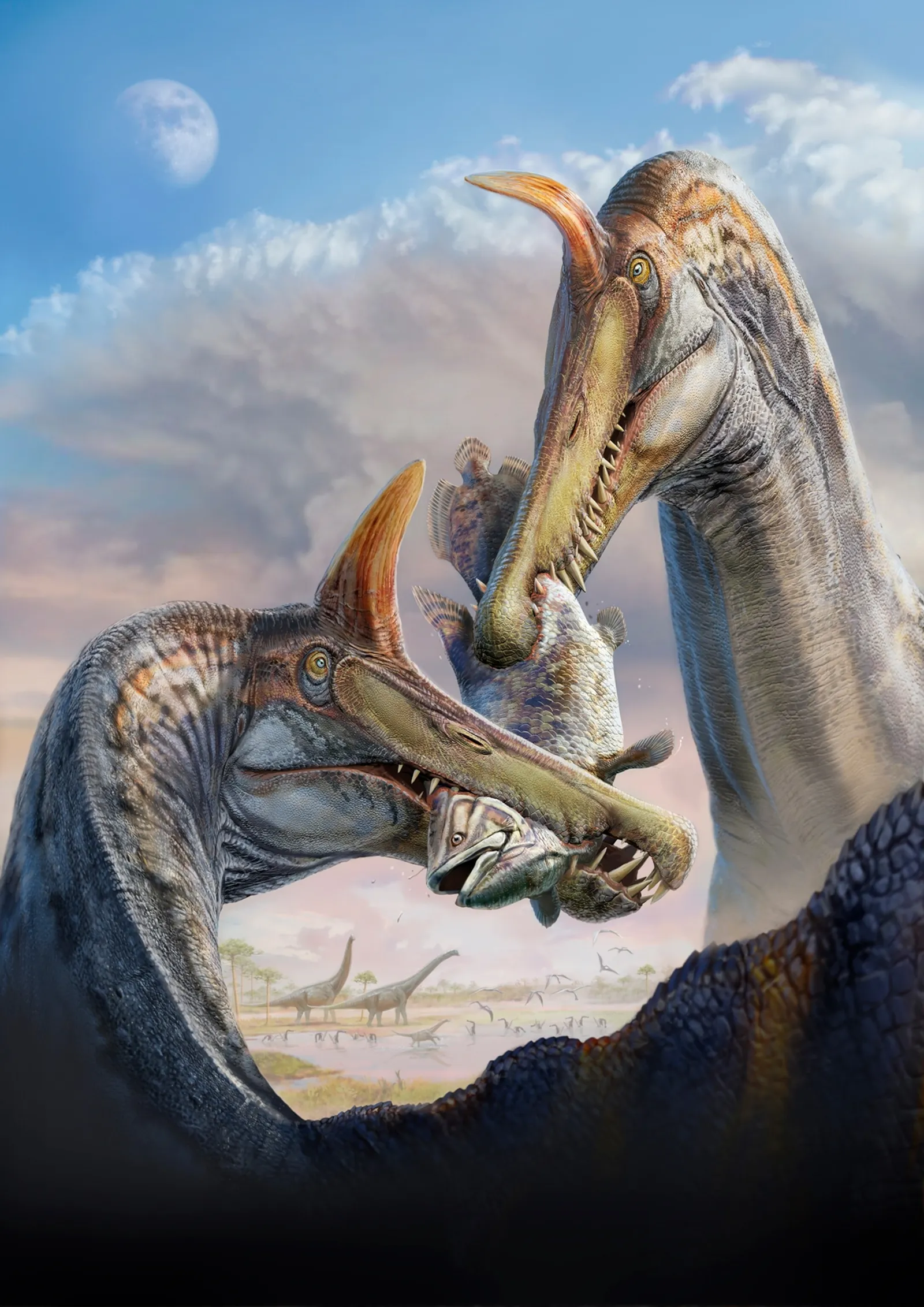
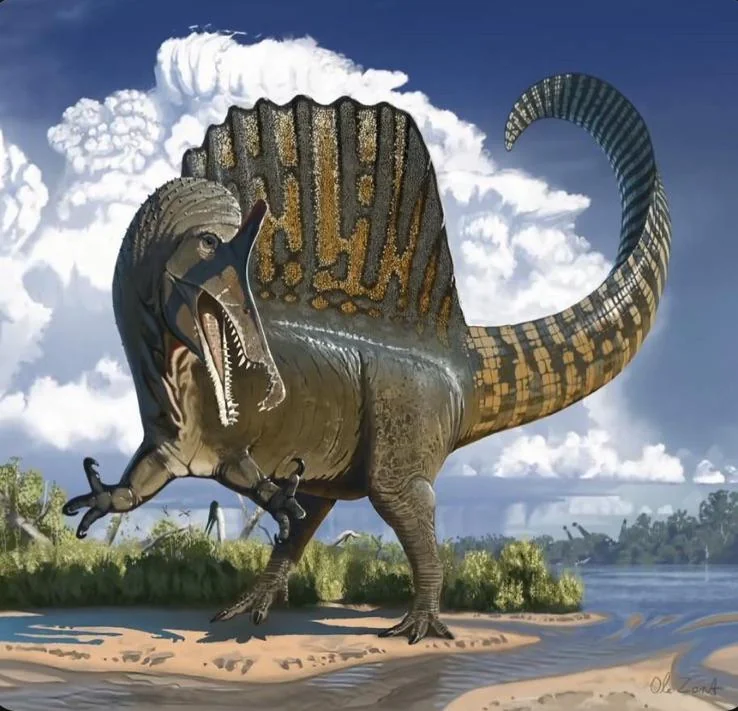
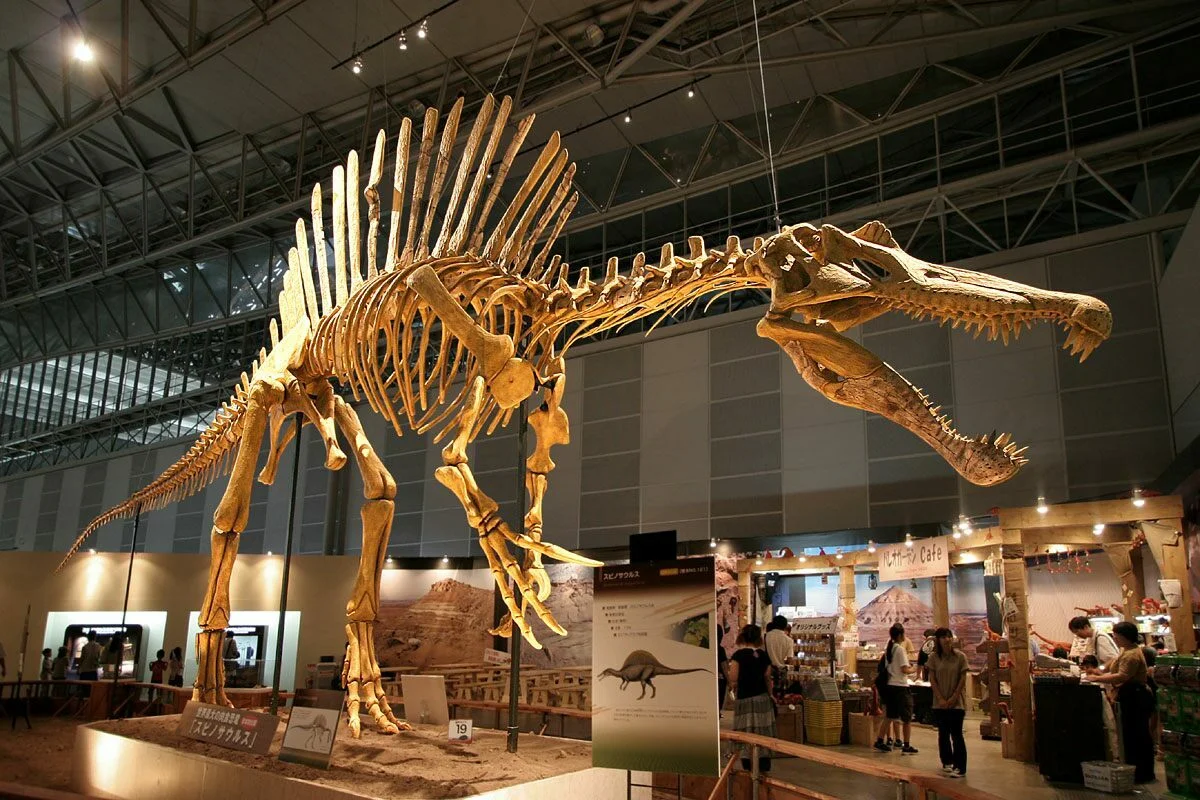
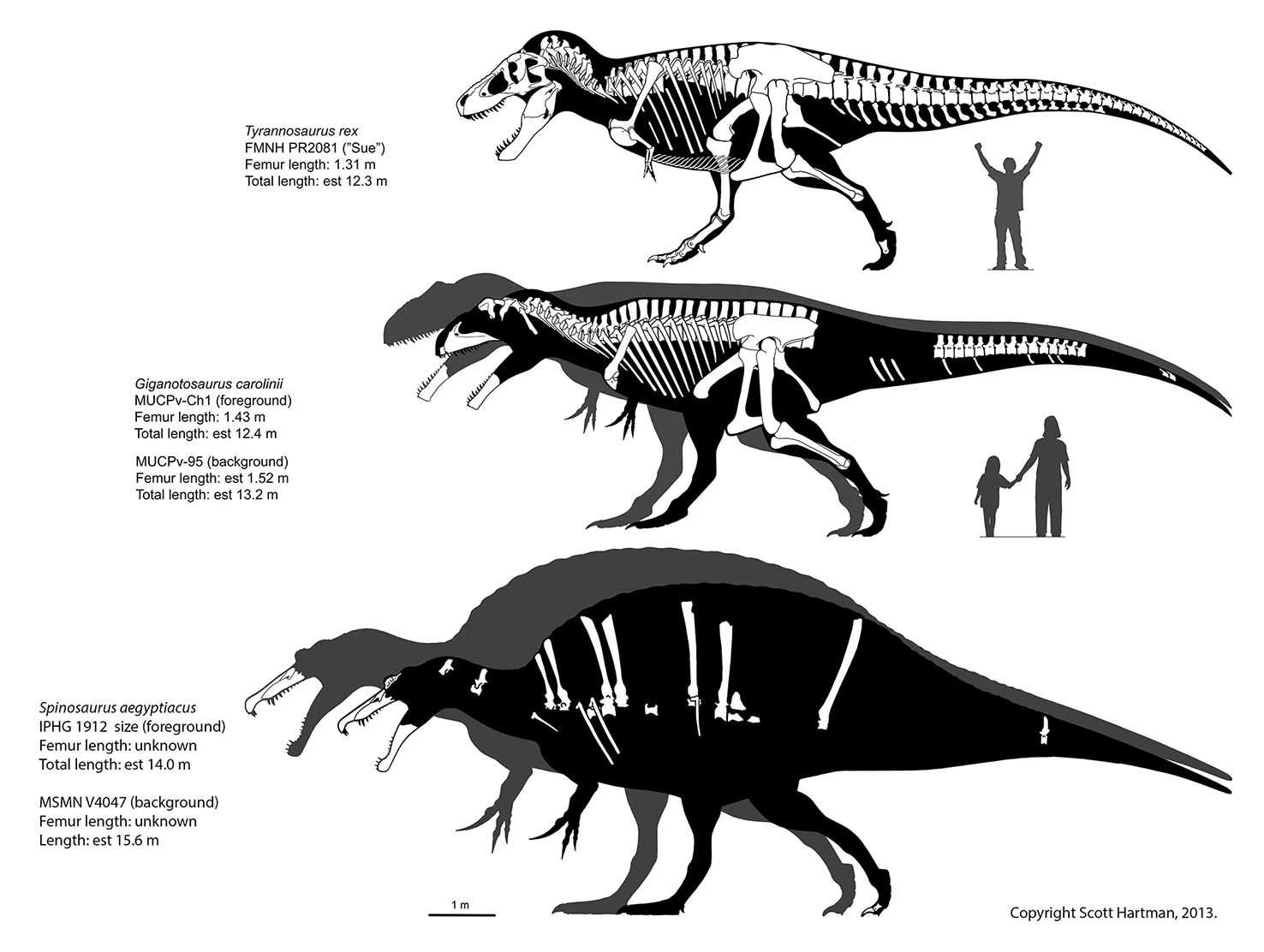
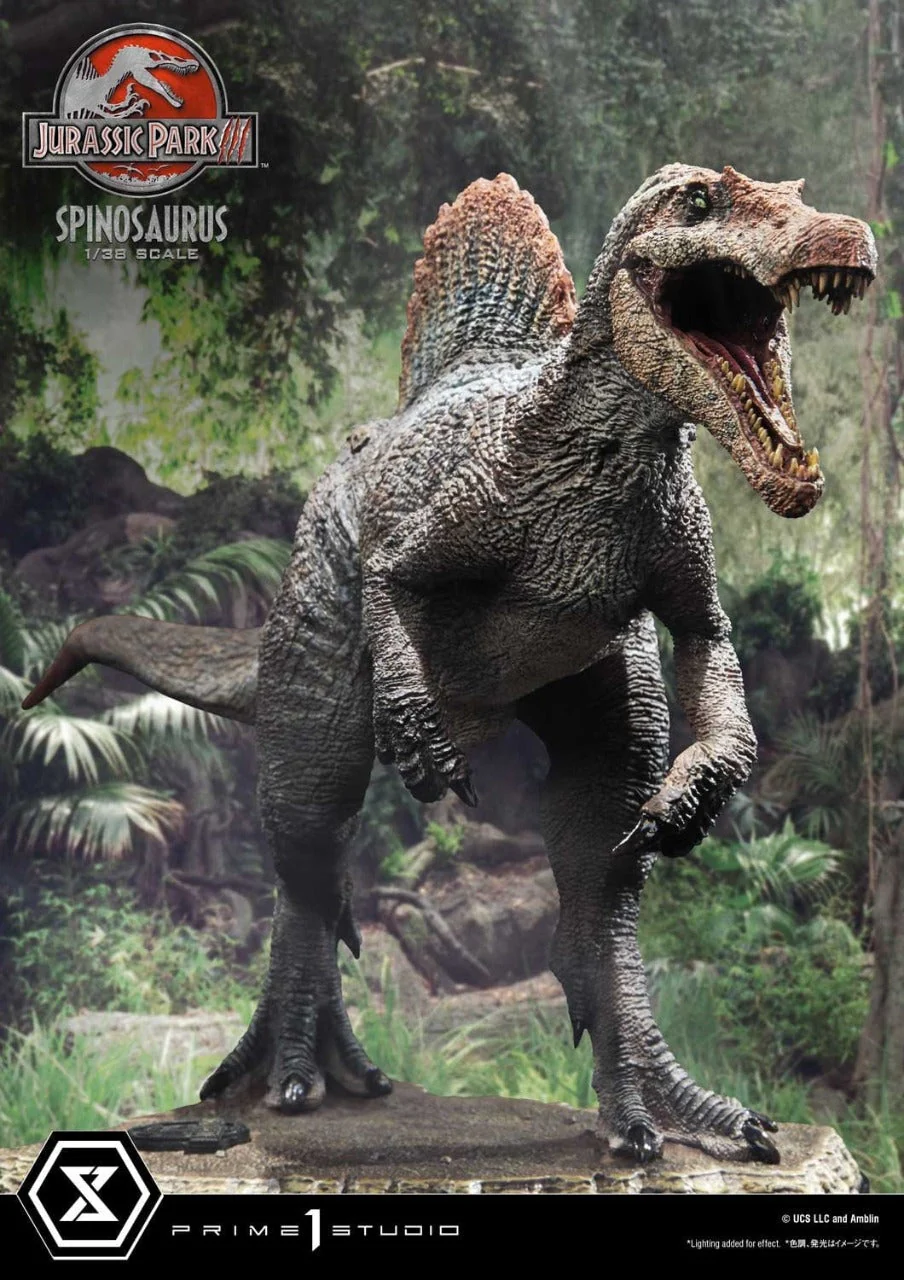
Spinosaurus reconstruction showing the characteristic dorsal sail supported by neural spines up to 1.65 meters tall.
Paleoart
Ecology and behavior
Habitat
Spinosaurus inhabited the extensive river systems of North Africa during the Cenomanian (99 to 93 Ma), in a region corresponding to modern Egypt and Morocco. The Bahariya Formation and Kem Kem beds represent floodplain and river delta environments with wide shallow rivers, lakes, and coastal mangroves. The climate was hot and humid, with average temperatures significantly higher than today. The ecosystem was exceptionally rich in predators: besides Spinosaurus, it included Carcharodontosaurus (12-meter terrestrial theropod), Deltadromeus, the giant crocodilian Sarcosuchus (12 meters), and large fish like the coelacanth Mawsonia (up to 4 meters). The coexistence of so many apex predators is explained by niche partitioning: Spinosaurus occupied the aquatic niche, while Carcharodontosaurus dominated the terrestrial.
Feeding
Spinosaurus was a specialized piscivore with multiple adaptations for catching aquatic prey. The elongated, narrow snout with conical, unserrated teeth (unlike all other large theropods) was ideal for grasping slippery fish. Pressure receptors in the snout, similar to crocodilian neuromasts, allowed detection of water movements without direct vision. Oxygen isotope analyses of Spinosaurus teeth confirm a predominantly aquatic diet, with isotopic values similar to crocodiles and turtles from the same deposit. The paddle-shaped tail (Ibrahim et al., 2020) generated eight times more propulsive force than terrestrial theropod tails, enabling active pursuit of prey in water. The main food item was likely the coelacanth Mawsonia and other large fish from Cenomanian rivers.
Behavior and senses
Spinosaurus behavior is inferred from its extremely specialized morphology and comparison with modern semiaquatic animals. High bone density (similar to penguins and hippos) indicates the animal spent significant time submerged, using dense bones as ballast. The position of eyes and nostrils, situated at the top of the skull, is consistent with an animal that kept only the top of its head above water while stalking prey. There is no evidence of social behavior or pack hunting. The dorsal sail may have served as sexual display or species recognition, visible above the water surface. Bone density studies (Fabbri et al., 2022) position Spinosaurus as an animal that actively dived, not merely waded in shallow water.
Physiology and growth
Spinosaurus physiology combines features unique among dinosaurs. Bones were exceptionally dense, lacking the pneumatic cavities typical of theropods, serving as ballast for submersion. Bone histology suggests rapid growth in the juvenile phase, similar to other large theropods. The dorsal sail, supported by neural spines up to 1.65 meters tall, may have functioned as a thermoregulator: the large surface area facilitated heat exchange with the environment. Nostrils positioned at the top of the skull allowed breathing while the body remained partially submerged. The tail had reduced caudofemoralis musculature (consistent with short hind limbs) but robust axial musculature for lateral undulation during swimming. Estimated swimming speed is comparable to modern crocodilians of similar size.
Paleogeography
Continental configuration

Scotese & Vérard · CC BY 4.0 · Cretaceous, ~105 Ma
During the Cenomaniano (~99–93 Ma), Spinosaurus aegyptiacus inhabited Laramidia, the western half of present-day North America, separated from the east by the Western Interior Seaway, a shallow sea dividing the continent. The continents were in very different positions: India was drifting toward Asia, Antarctica was still connected to Australia, and South America was an isolated island.
Bone Inventory
The original holotype (BSP 1912 VIII 19), collected by Markgraf in Egypt in 1912, consisted of maxilla fragments, dorsal vertebrae with neural spines, and limb elements. All material was destroyed in the British bombing of the Munich Paleontological Museum on April 24, 1944. Modern reconstruction depends on Stromer's drawings and descriptions (1915, 1934), the neotype FSAC-KK 11888 described by Ibrahim et al. (2014) found in the Kem Kem beds of Morocco, and additional material described in 2020 including the tail. Combined completeness from multiple specimens allows reasonable reconstruction, but no single individual is more than 50% complete.
Found elements
Inferred elements
Scientific Literature
5 papers in chronological order — from the original description to recent research.
Ergebnisse der Forschungsreisen Prof. E. Stromers in den Wusten Agyptens. II. Wirbeltier-Reste der Baharije-Stufe (unterstes Cenoman). 3. Das Original des Theropoden Spinosaurus aegyptiacus nov. gen., nov. spec.
Stromer, E. · Abhandlungen der Koniglichen Bayerischen Akademie der Wissenschaften
Founding paper in which Stromer describes Spinosaurus aegyptiacus based on material collected by Markgraf at the Bahariya Oasis, Egypt. Stromer recognizes the animal as a large theropod distinct from all previously known, defining the genus by the presence of extraordinarily elongated neural spines on the dorsal vertebrae. The material included maxilla fragments with conical teeth, dorsal vertebrae, ribs, and limb elements. This material would be destroyed in 1944.
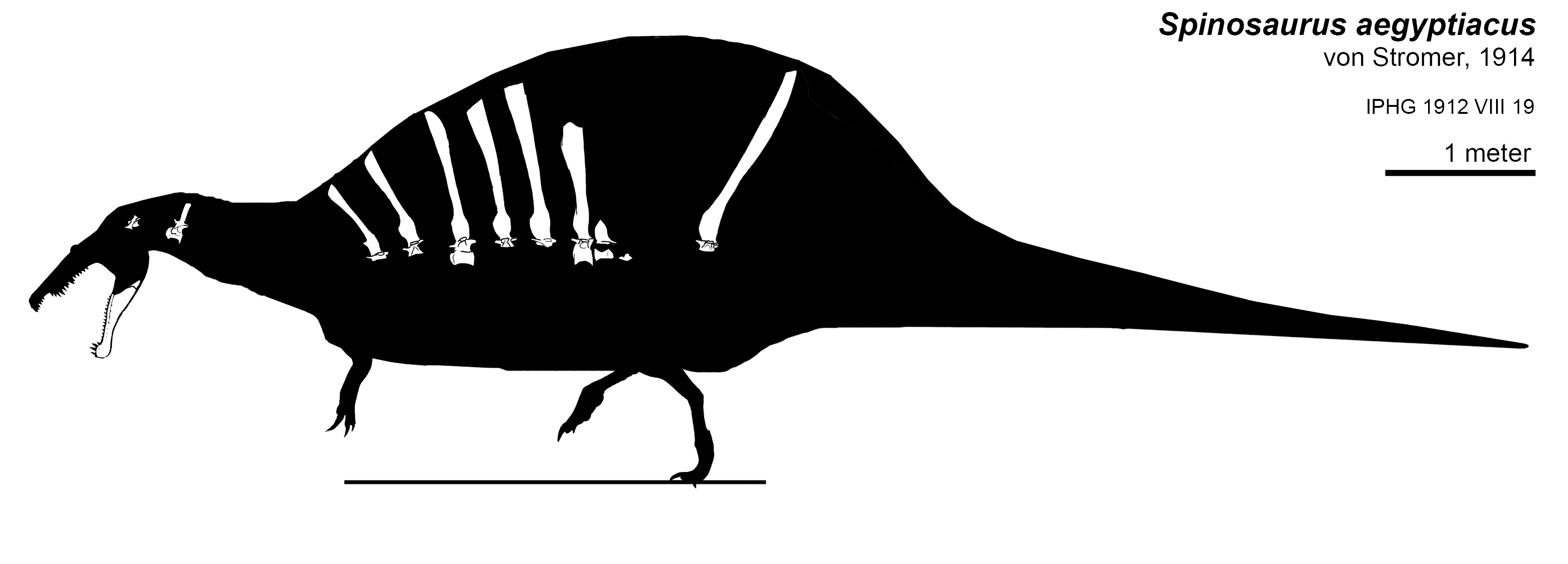

Semiaquatic adaptations in a giant predatory dinosaur
Ibrahim, N., Sereno, P.C., Dal Sasso, C., Maganuco, S., Fabbri, M., Martill, D.M., Zouhri, S., Myhrvold, N. & Iurino, D.A. · Science
Ibrahim and colleagues describe a new partial skeleton (neotype FSAC-KK 11888) from the Kem Kem beds of Morocco, revealing unprecedented semiaquatic adaptations in dinosaurs: dense bones without medullary cavities (like hippos), short hind limbs, broad flat pedal unguals, and the famous dorsal sail. The work proposes Spinosaurus spent much of its time in water, wading in river and lake beds to catch fish. This discovery revolutionized understanding of the animal and launched the debate on the degree of aquatic adaptation in spinosaurids.


Tail-propelled aquatic locomotion in a theropod dinosaur
Ibrahim, N., Maganuco, S., Dal Sasso, C., Fabbri, M., Auditore, M., Bindellini, G., Martill, D.M., Zouhri, S., Mattarelli, D.A., Unwin, D.M., Wiemann, J., Bonadonna, D., Amane, A., Jakubczak, J., Joger, U., Lauder, G.V. & Pierce, S.E. · Nature
Ibrahim and colleagues describe a virtually complete tail of Spinosaurus aegyptiacus with unexpected morphology: tall neural spines and expanded chevrons create a paddle or fin shape. Hydrodynamic tests with robotic models demonstrated this tail generated eight times more propulsive force than tails of terrestrial theropods. The work provides the first unambiguous evidence for tail-propelled aquatic locomotion in a non-avian dinosaur, consolidating Spinosaurus as an active aquatic predator, not merely a wading animal.


Subaqueous foraging among carnivorous dinosaurs
Fabbri, M., Navalón, G., Benson, R.B.J., Pol, D., O'Connor, J., Bhullar, B.A.S., Erickson, G.M., Norell, M.A., Orkney, A., Lamanna, M.C., Zouhri, S., Becker, J., Emke, A., Dal Sasso, C., Bindellini, G., Maganuco, S., Auditore, M. & Ibrahim, N. · Nature
Fabbri and colleagues use bone density data from over 250 living and extinct species to demonstrate that Spinosaurus and its relative Baryonyx had bone density consistent with subaqueous foraging, similar to penguins and hippos. Suchomimus, however, had lighter bones consistent with wading. The study uses a phylogenetically informed approach to distinguish aquatic, semiaquatic, and terrestrial animals, placing Spinosaurus firmly in the group of animals that actively dived to capture prey.

Evaluating the ecology of Spinosaurus: shoreline generalist or aquatic pursuit predator?
Hone, D.W.E. & Holtz, T.R. · Palaeontologia Electronica
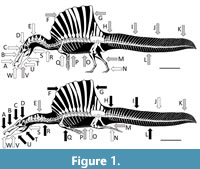
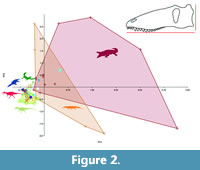
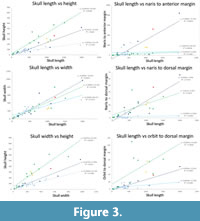
Hone and Holtz critically evaluate claims of aquatic specialization in Spinosaurus, arguing that much of the evidence is ambiguous. The authors propose that a heron-like wading model better fits the combined morphological and ecological data than the active aquatic predator model. The work highlights that short hind limbs, dorsal sail, and elongated snout are not exclusive to aquatic animals and may have alternative functions. This paper represents the main dissenting voice in the Spinosaurus ecology debate.


Famous museum specimens
Neotipo FSAC-KK 11888
Universidade Hassan II, Casablanca, Marrocos
Neotype designated by Ibrahim et al. (2014). Included vertebrae, ribs, limbs, and partial pelvis. Material from the Kem Kem beds, Morocco. This is the most complete known specimen and the basis for the semiaquatic reconstruction.
In cinema and popular culture
Spinosaurus gained enormous popularity after Jurassic Park III (2001), where it defeats the T. rex in an iconic scene that sparked controversy among paleontologists and fans. It has since appeared in Planet Dinosaur (BBC, 2011), which depicted it as an aquatic predator for the first time in popular media, and in Jurassic World: Camp Cretaceous (2020). The JP III Spinosaurus was portrayed as an oversized terrestrial predator, which does not reflect the modern scientific reconstruction of a semiaquatic animal. Nevertheless, the film is responsible for making Spinosaurus one of the most recognizable dinosaurs among the public.
Classification
Discovery
Fun fact
The original Spinosaurus fossils, collected in Egypt between 1912 and 1914, were completely destroyed when British bombs hit the Munich Paleontological Museum on April 24, 1944, during World War II. For nearly 70 years, all that remained of Spinosaurus were the drawings and descriptions published by Ernst Stromer. Only in 2014, with the discovery of a new skeleton in Morocco, could scientists finally see real Spinosaurus bones again.
Last reviewed: April 24, 2026