Ouranosaurus
Ouranosaurus nigeriensis
"Brave lizard from Niger"
About this species
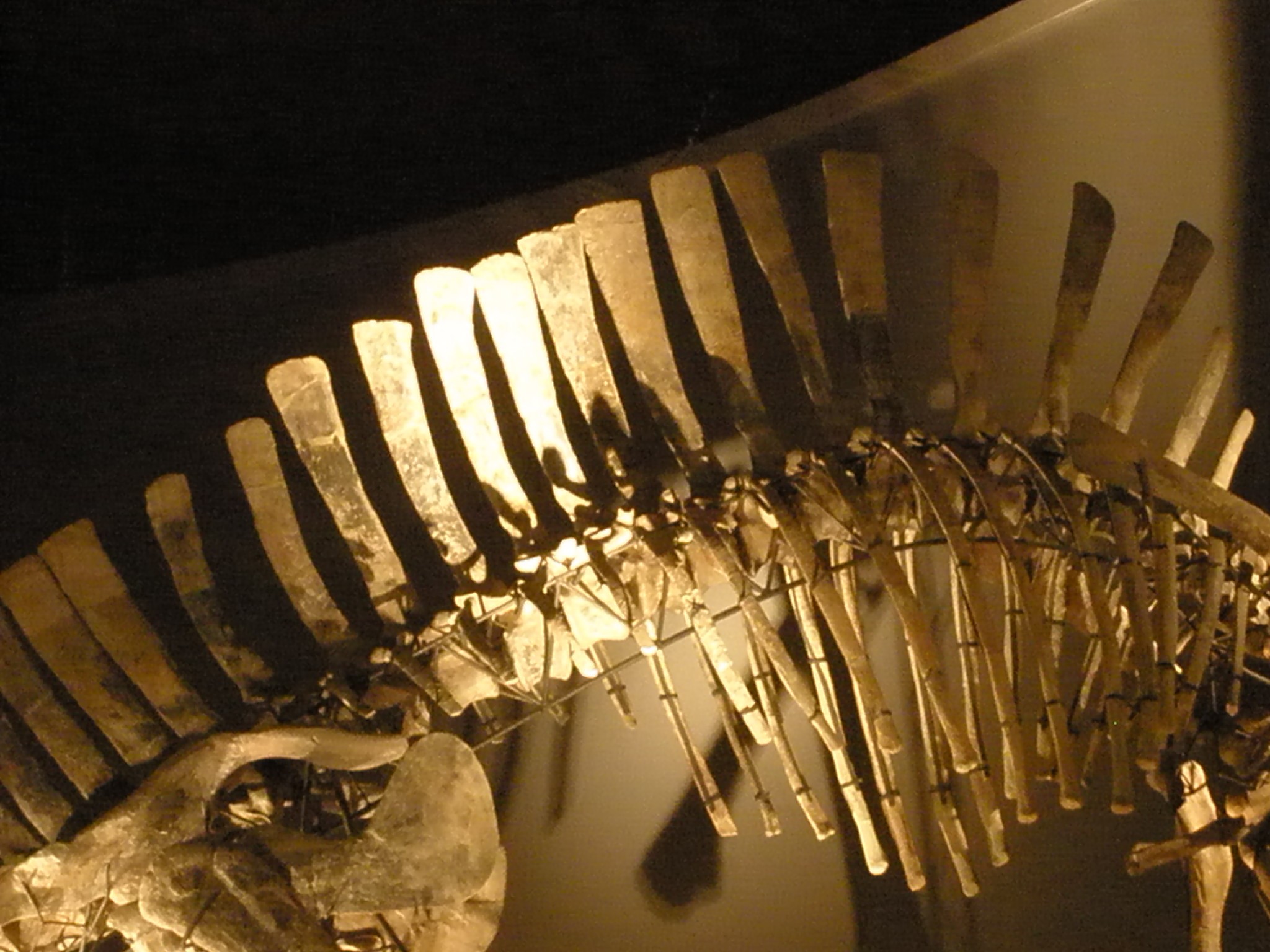
Ouranosaurus nigeriensis is one of the most distinctive ornithopods of the Early Cretaceous, famous for its dorsal crest formed by extraordinarily elongated neural spines. It lived approximately 125 to 112 million years ago in the region that now corresponds to Niger, on a warm and humid fluvial floodplain. About 8 meters long and over 2 tonnes, it was a robust herbivore equipped with battery teeth and a uniquely low and elongated skull among iguanodontids. Described by French paleontologist Philippe Taquet in 1976 based on two nearly complete skeletons, it is considered a close relative of hadrosaurs.
Geological formation & environment
The Elrhaz Formation is part of the Tegama Group in Niger, with Aptian-Albian deposits (approximately 125 to 112 Ma). It is composed mainly of medium-grained fluvial sandstones with intercalated clays and limestones, reaching 80 to 120 meters in thickness. The depositional environment was continental, characterized by fluvial channels and floodplains in a semi-arid to tropical climate. The Gadoufaoua site, in the Ténéré desert, is one of the richest Early Cretaceous sites in Africa, with excellently preserved fossils of terrestrial and aquatic vertebrates. In addition to Ouranosaurus, the formation has produced Nigersaurus, Lurdusaurus, Suchomimus, Eocarcharia, Kryptops, and the giant Sarcosuchus.
Image gallery
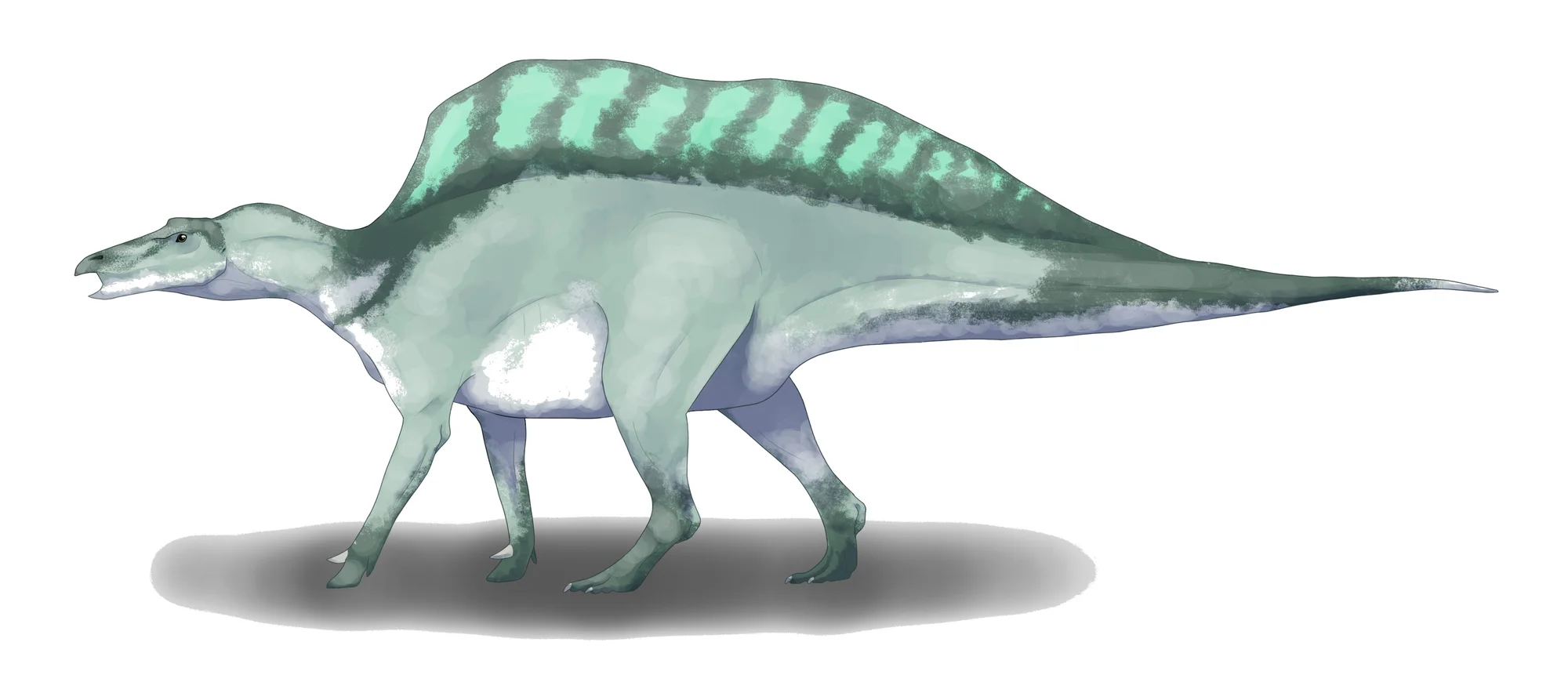




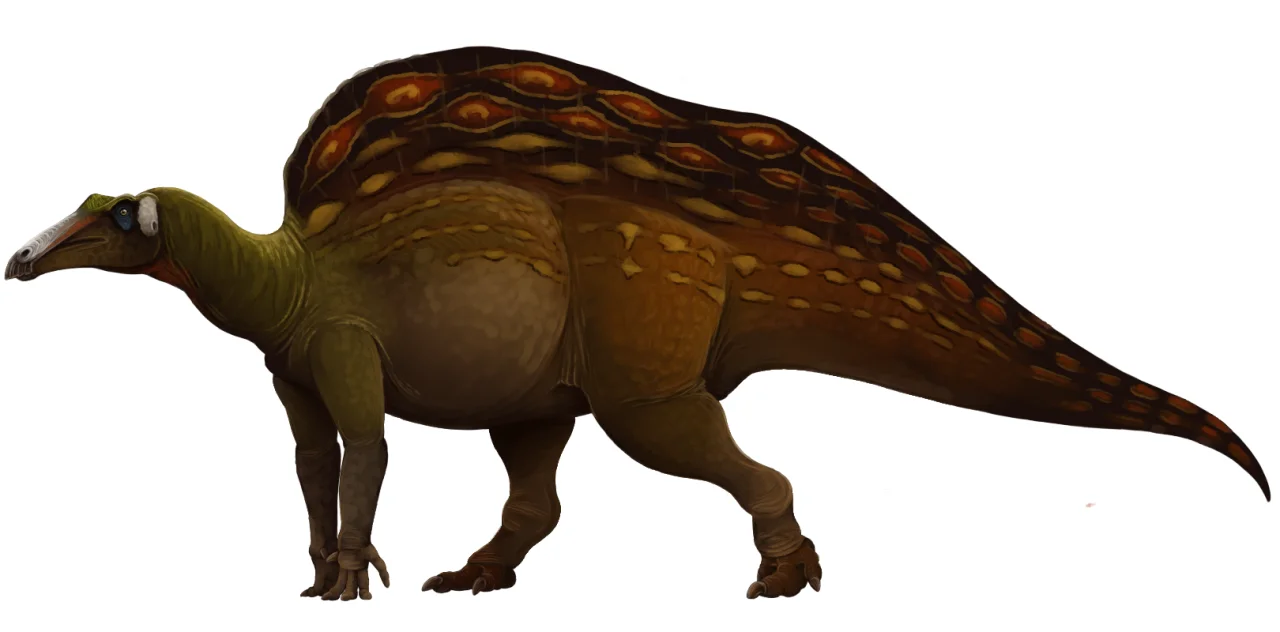
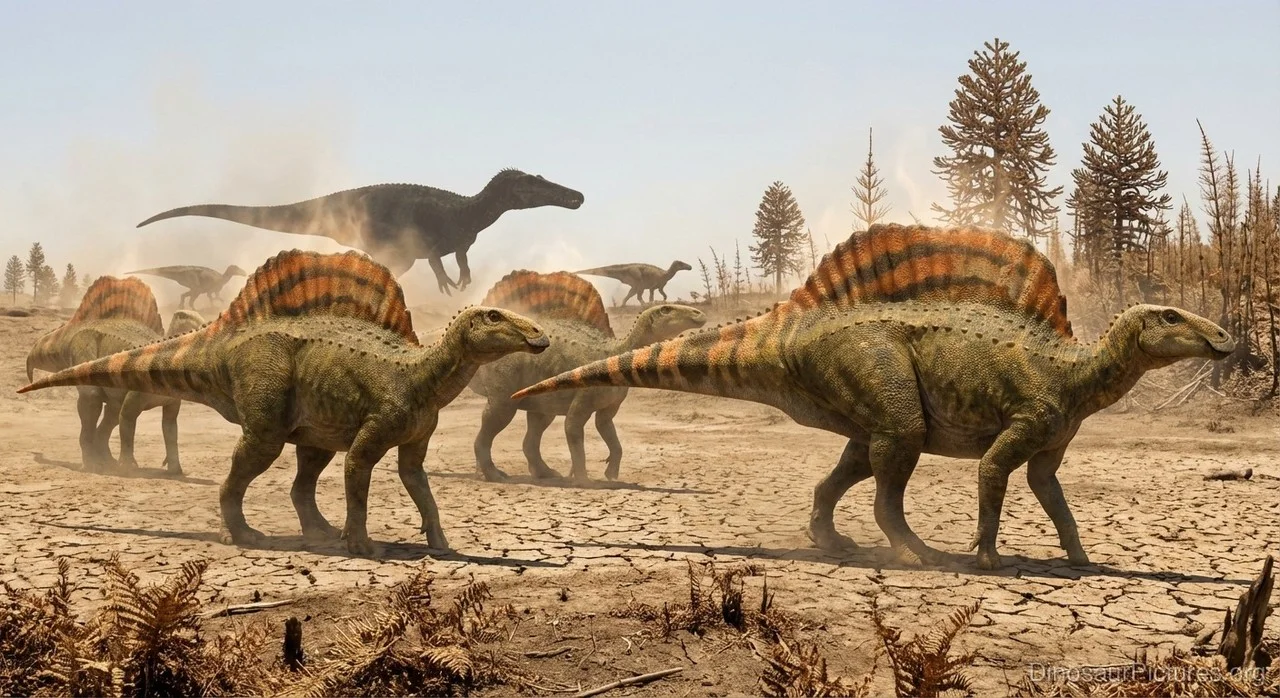
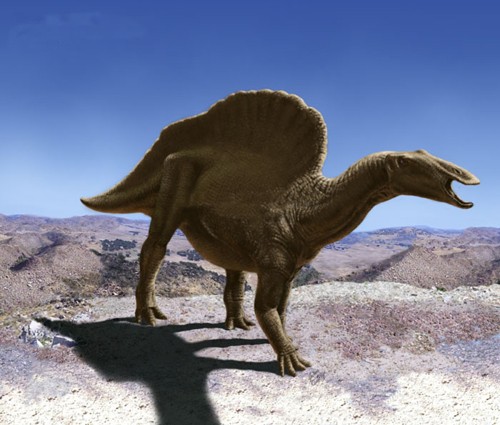
Life restoration of Ouranosaurus nigeriensis by Audrey M. Horn, a sail-backed iguanodontian from the Early Cretaceous of Niger.
Audrey M. Horn, Wikimedia Commons, CC BY-SA 4.0
Ecology and behavior
Habitat
Ouranosaurus inhabited the fluvial floodplains of the Elrhaz Formation, in what is now the Ténéré Desert in Niger. During the Aptian (~115 Ma), the region was a humid tropical river delta with lush vegetation of ferns, cycads, and primitive conifers. The climate was warmer and wetter than today, with no polar ice cover. The ecosystem was shared with the sauropod Nigersaurus, the ornithopods Lurdusaurus and Elrhazosaurus, and a diversified predator fauna including Suchomimus, Eocarcharia, Kryptops, and the giant crocodyliform Sarcosuchus.
Feeding
A specialized herbivore, Ouranosaurus fed on medium-height vegetation on floodplains. Its 88 teeth organized in continuous replacement batteries allowed constant processing of leaves, fruits, and fibrous vegetation. The low and broad skull with relatively weak temporal muscles indicates it was not adapted for hard or woody vegetation, but rather for foraging softer plant material at medium level. It could alternate between bipedal posture (reaching higher vegetation) and quadrupedal (low grazing).
Behavior and senses
The dorsal crest formed by neural spines, with low vascular density that refutes thermoregulation, points to a sexual display or intraspecific communication function. The crest was likely colorful and used in dominance displays, courtship, or species recognition. The presence of multiple specimens at Gadoufaoua suggests gregarious behavior. Juveniles likely had smaller spines that grew progressively, making adult crests more elaborate, a pattern consistent with sexual selection.
Physiology and growth
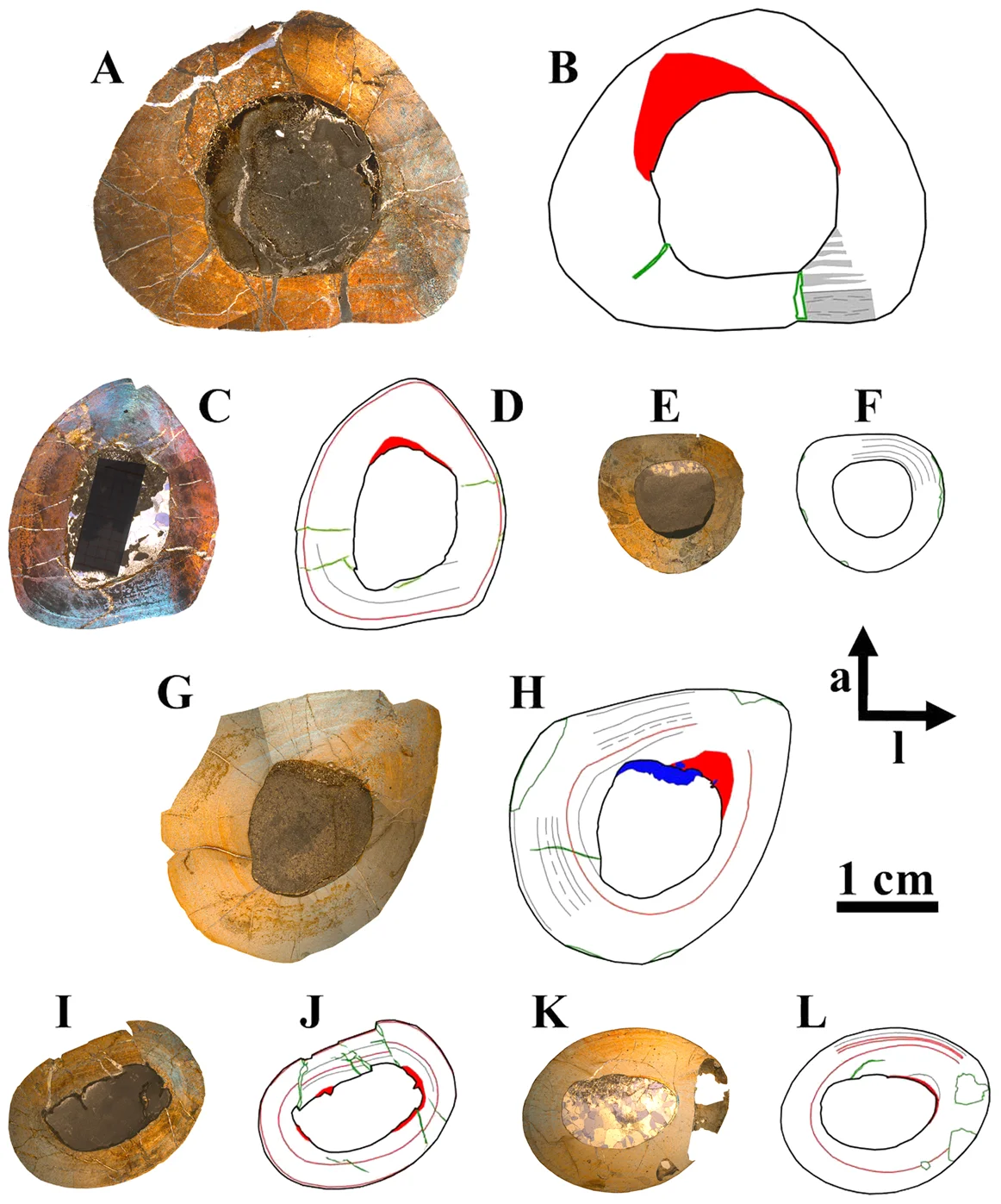
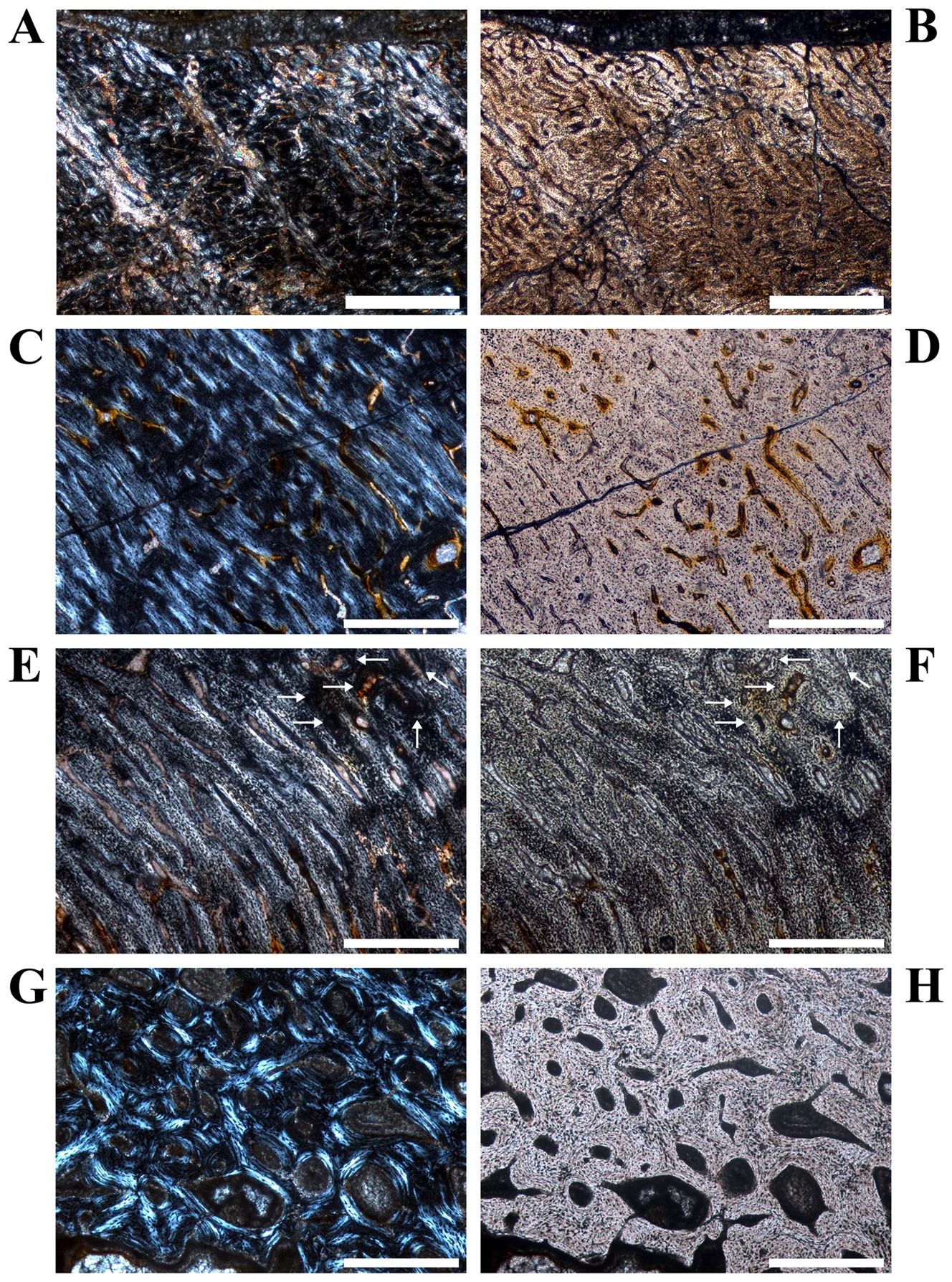
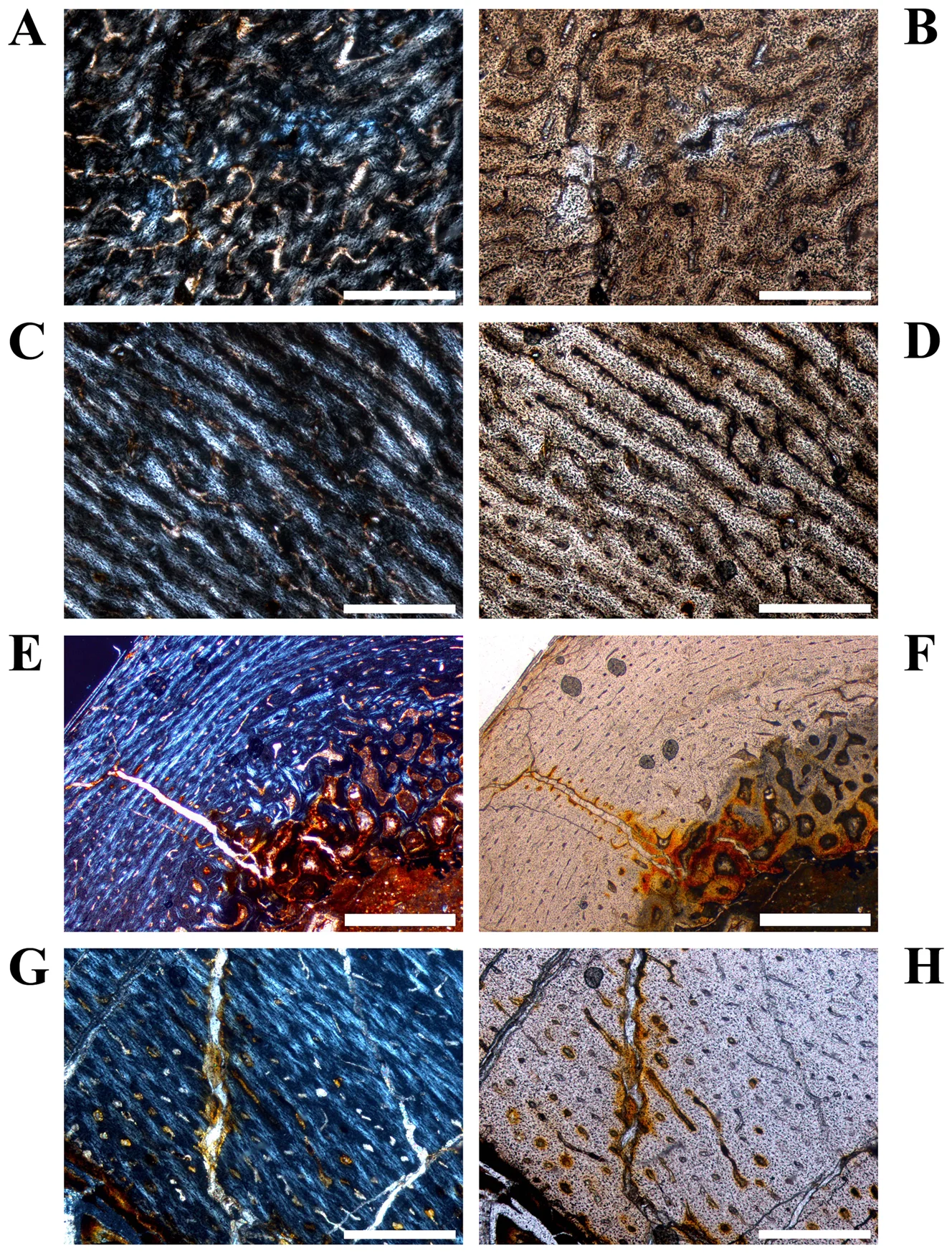
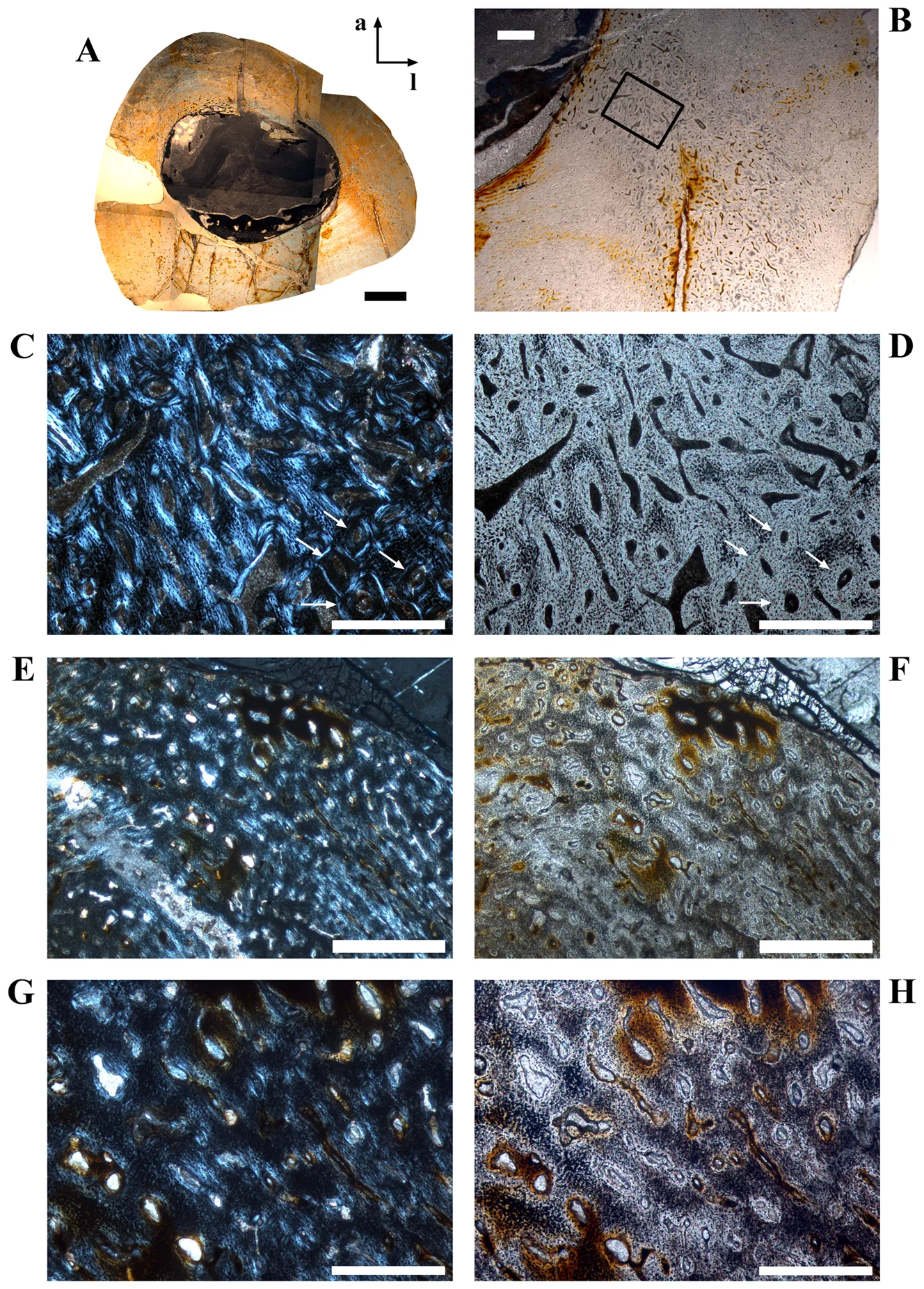
The bone histology of the Venice specimen, analyzed by Bertozzo et al. (2017), reveals fibrolamellar tissue with high vascular density in long bones, indicating rapid growth characteristic of ornithischian dinosaurs. The Venice subadult still showed active growth zones, suggesting the adult Ouranosaurus was considerably larger. Metabolism was likely partially or fully endothermic, as suggested for most non-avian dinosaurs. The dorsal crest with low vascularization rules out active thermoregulatory function, but could passively act as a heat dissipation surface.
Paleogeography
Continental configuration

Scotese & Vérard · CC BY 4.0 · Cretaceous, ~105 Ma
Fossil sites

Scotese et al. · CC BY 4.0 · PALEOMAP Project (Zenodo)
During the Aptiano (~125–112 Ma), Ouranosaurus nigeriensis inhabited Laramidia, the western half of present-day North America, separated from the east by the Western Interior Seaway, a shallow sea dividing the continent. The continents were in very different positions: India was drifting toward Asia, Antarctica was still connected to Australia, and South America was an isolated island.
Bone Inventory
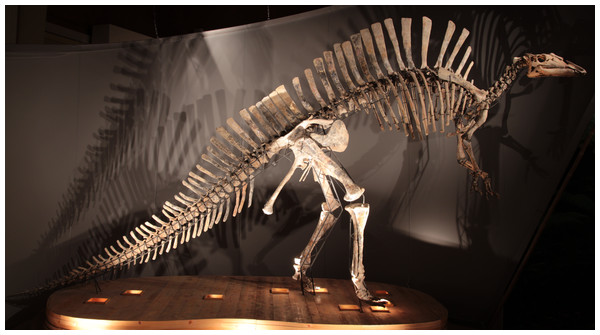
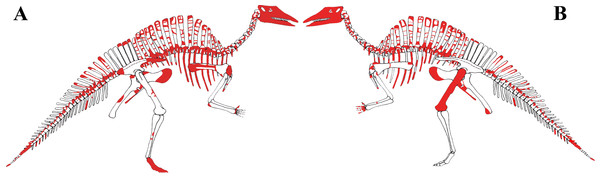
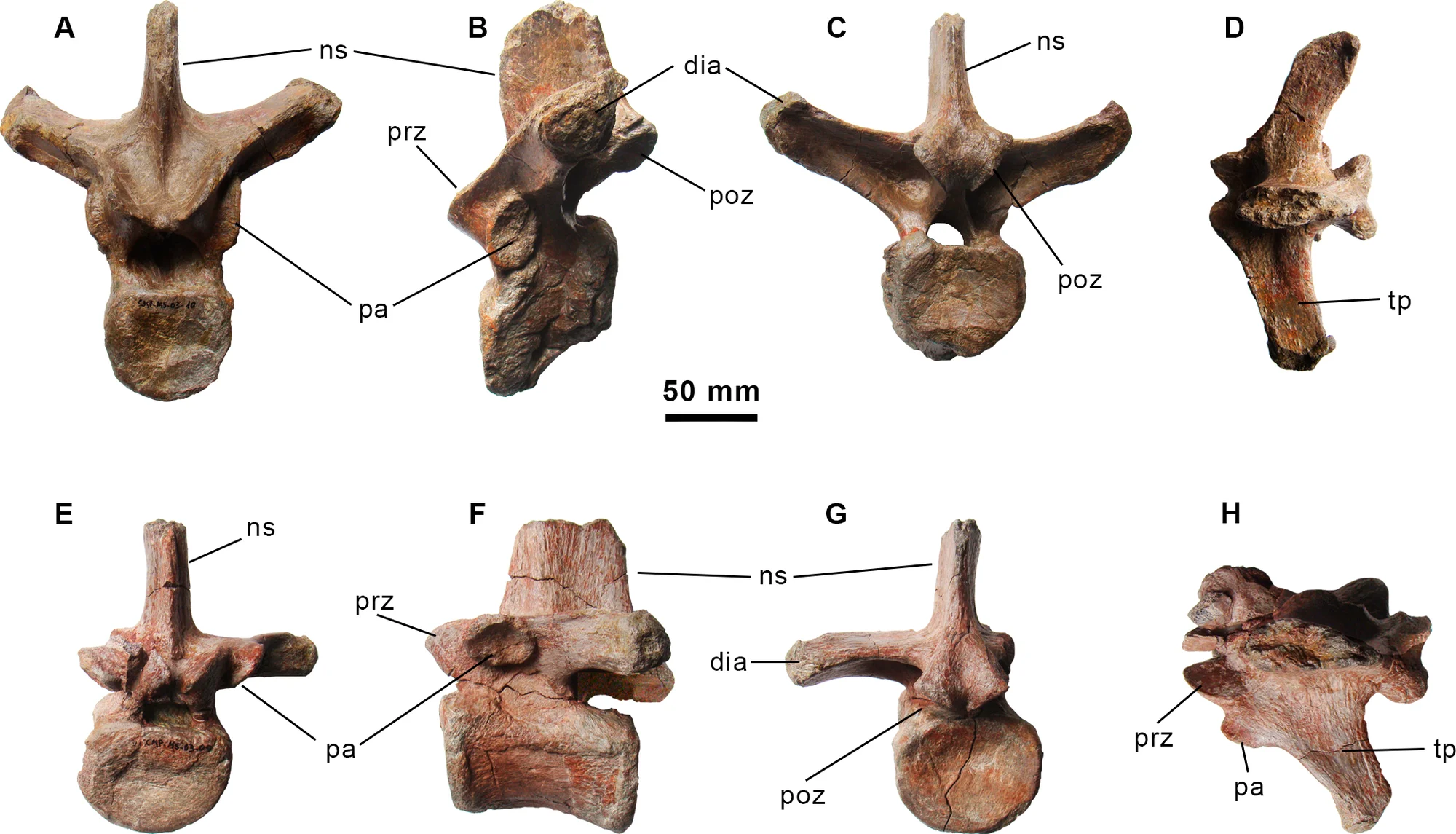
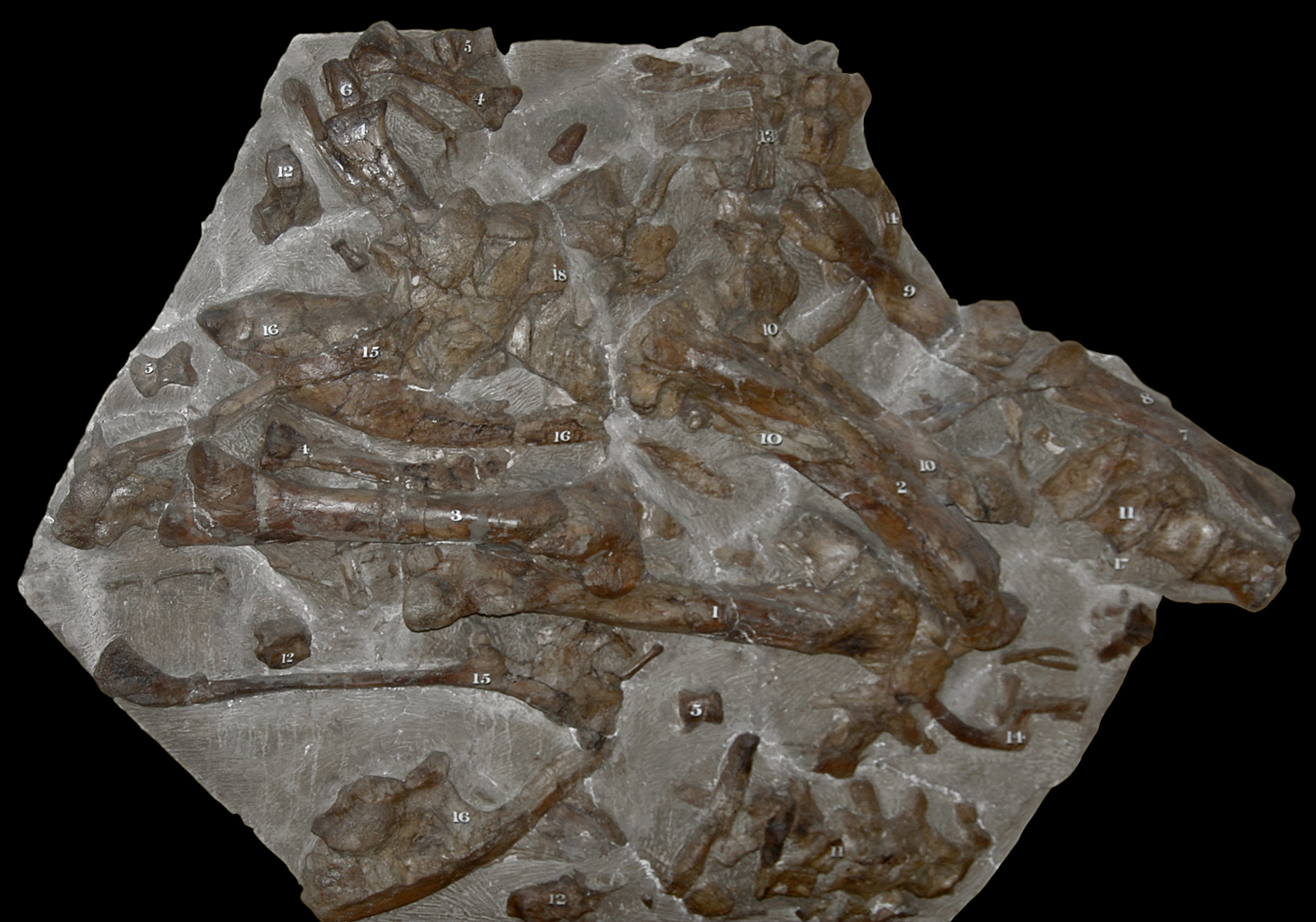
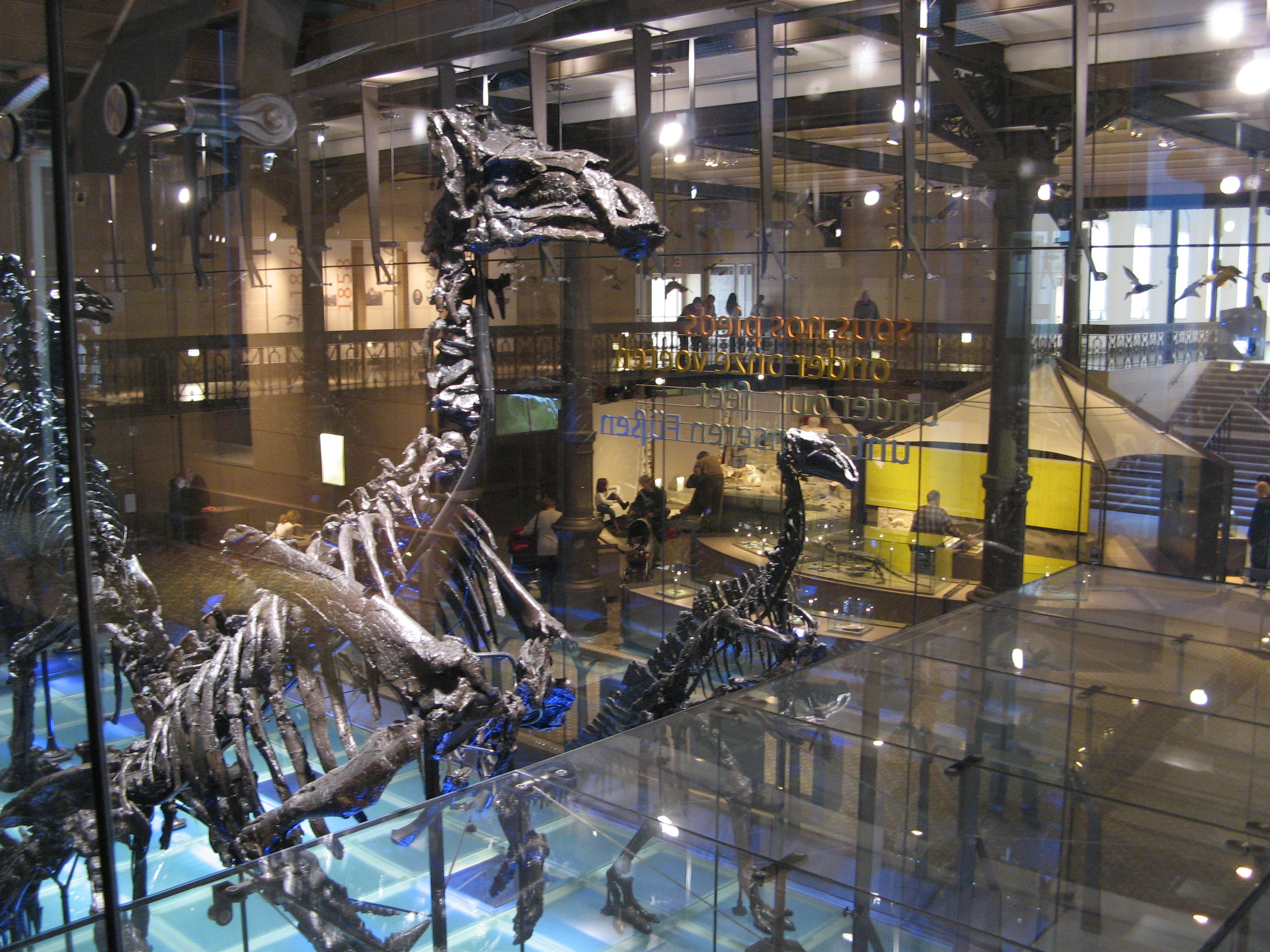
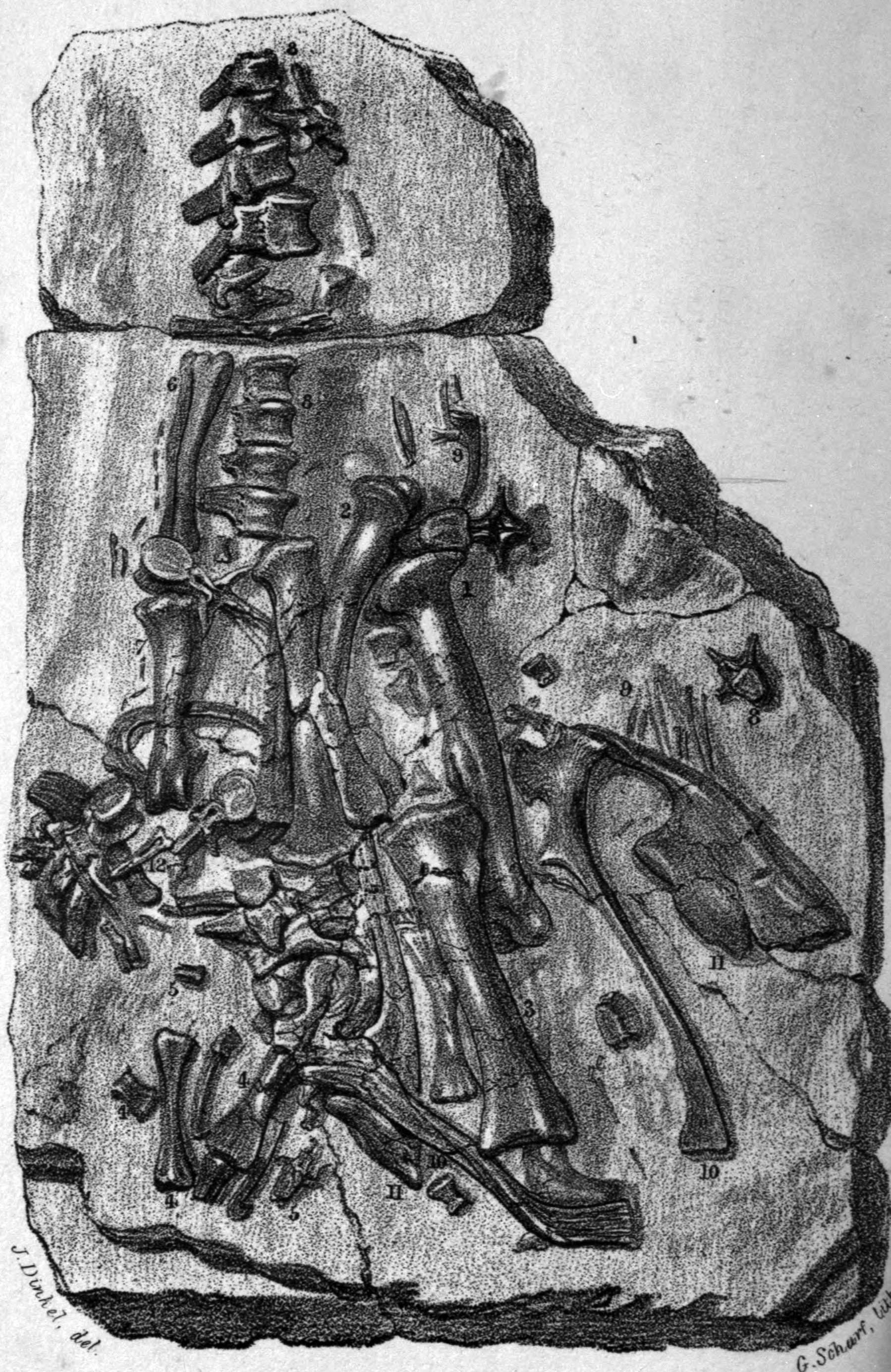
Known from two nearly complete skeletons. The holotype MNHN GDF 300 includes a semi-articulated skull, nearly complete vertebral column, forelimbs, and most of the right hindlimb. The paratype MNHN GDF 381, mounted at the Venice Natural History Museum (MSNVE 3714), was studied in detail by Bertozzo et al. (2017) and classified as a subadult.
Found elements
Inferred elements
Scientific Literature
15 papers in chronological order — from the original description to recent research.
Géologie et paléontologie du gisement de Gadoufaoua (Aptien du Niger)
Taquet, P. · Cahiers de Paléontologie, CNRS
The founding work for the study of Ouranosaurus. Philippe Taquet presents detailed anatomical description of the two skeletons recovered during French expeditions to the Ténéré Desert between 1965 and 1972. The holotype MNHN GDF 300 and paratype MNHN GDF 381 are meticulously described: a low and elongated skull with fused nasals forming a dorsal protrusion, a vertebral column with dorsal neural spines up to 63 cm tall, robust limbs, and battery teeth. Taquet proposes the dorsal structure functioned as a thermoregulator or energy reserve, like a bison's hump. The taxonomic position is defined within Iguanodontia. The monograph remains the primary anatomical reference for the species, as no other complete anatomical description was published until 2017.
A long-snouted predatory dinosaur from Africa and the evolution of spinosaurids
Sereno, P.C. et al. · Science
Although centered on Suchomimus tenerensis, this article defines the Aptian ecosystem of the Elrhaz Formation at Gadoufaoua, the environment in which Ouranosaurus lived. Sereno et al. describe a long-snouted spinosaurid with giant thumb claws specialized in piscivory. The work contextualizes the predator fauna that coexisted with Ouranosaurus: in addition to Suchomimus, the ecosystem included Kryptops palaios, Eocarcharia dinops, and the giant crocodyliform Sarcosuchus imperator. The phylogenetic analysis of spinosaurids, based on 30 characters, places the new genus as sister group to Spinosaurus. The paper provides a detailed map of the faunas associated with Ouranosaurus, essential for understanding the predation pressure the ornithopod faced in the Early Cretaceous fluvial delta of Niger.
Basal abelisaurid and carcharodontosaurid theropods from the Lower Cretaceous Elrhaz Formation of Niger
Sereno, P.C. & Brusatte, S.L. · Acta Palaeontologica Polonica
This paper describes two new predators from the same formation and period as Ouranosaurus: Eocarcharia dinops, a carcharodontosaurid with a prominent supraorbital ridge, and Kryptops palaios, an abelisaurid with a keratinized face mask. Both are described based on cranial and dental material collected at Gadoufaoua. Phylogenetic analysis places Eocarcharia as the most primitive African carcharodontosaurid, confirming a dispersal route between northern Gondwana and Laurasia. The work demonstrates that Ouranosaurus coexisted with at least two large distinct theropods besides Suchomimus, implying ecological niche sharing and diversified predation pressure. Kryptops, with relatively small teeth, may have specialized as a scavenger, while Eocarcharia would have been the apex predator actively attacking large herbivores like Ouranosaurus.
The giant crocodyliform Sarcosuchus from the Cretaceous of Africa
Sereno, P.C. et al. · Science
Sarcosuchus imperator, described in this paper as the largest known crocodyliform (11-12 m, ~8 t), inhabited the same rivers and floodplains as Ouranosaurus in the Elrhaz Formation. Sereno et al. analyze multiple specimens discovered in 1997 and 2000 at Gadoufaoua, determining growth patterns through bone histology (lines of arrested growth, or LAGs), revealing longevity of 50-60 years and indeterminate growth. Phylogenetic analysis places Sarcosuchus as a basal crocodyliform, before the divergence between modern crocodiles and alligators. The work indicates that Ouranosaurus faced significant risks not only from large theropods but also from this aquatic giant when approaching water bodies — a fundamental ecological factor for understanding the behavior and habitat of the African ornithopod.
Structural extremes in a Cretaceous dinosaur
Sereno, P.C. et al. · PLOS ONE
Nigersaurus taqueti, a co-inhabitant of Ouranosaurus in the Elrhaz Formation, shows radical herbivory adaptations. This PLOS ONE paper describes an extremely lightly built skull, dental batteries positioned at the distal end of the jaws (replacement every month), snout directed directly toward the ground, and presacral vertebrae with more air sac space than bone. The cranial endocast reveals reduced olfactory bulbs and cerebellum. Comparison between the feeding strategies of Nigersaurus (low browsing) and Ouranosaurus (shrub and medium vegetation foraging) demonstrates niche partitioning between the two contemporary ornithopods, allowing different megaherbivores to exploit different resources in the same Aptian Nigerian ecosystem.
The Venice specimen of Ouranosaurus nigeriensis (Dinosauria, Ornithopoda)
Bertozzo, F., Dalla Vecchia, F.M. & Fabbri, M. · PeerJ
This is the most comprehensive study on Ouranosaurus since Taquet's (1976) monograph. Bertozzo et al. identify the skeleton mounted at the Venice Natural History Museum (MSNVE 3714) as the official paratype of the species, clarifying a historical confusion about the specimen's provenance. Osteohistological analysis of long bones, ribs, and neural spines reveals that the specimen is a subadult with active growth still ongoing. Vertebral count is corrected: the animal possessed approximately 15 dorsal vertebrae, not 17 as Taquet had proposed. The phylogenetic revision places Ouranosaurus as a basal hadrosauroid more derived than British genera Mantellisaurus and Hypselospinus, but more primitive than Altirhinus and Jinzhousaurus. Low vascular density in the neural spines refutes the thermoregulatory hypothesis, favoring a sexual display function.


![Figure 2: Ouranosaurus nigeriensis , the two sheets with the field maps drawn by P Taquet, redrawn and modified. Part of sheet 1 with the writing “ Ouranosaurus nig[eriensis ]—Airfield—1970—(specimen Venice Museum pro parte)” was omitted. Some original handwritten notes have been translated into English and typewritten in dark gray. The author of the map marked with zig-zag lines some elements that he supposed to have wrongly drawn; those zig-zag lines are also in dark gray. When it is not possi](/images/species/ouranosaurus-nigeriensis/papers/4197a2c676-01.jpg)
A New Sail-Backed Styracosternan (Dinosauria: Ornithopoda) from the Early Cretaceous of Morella, Spain
Gasulla, J.M. et al. · PLOS ONE
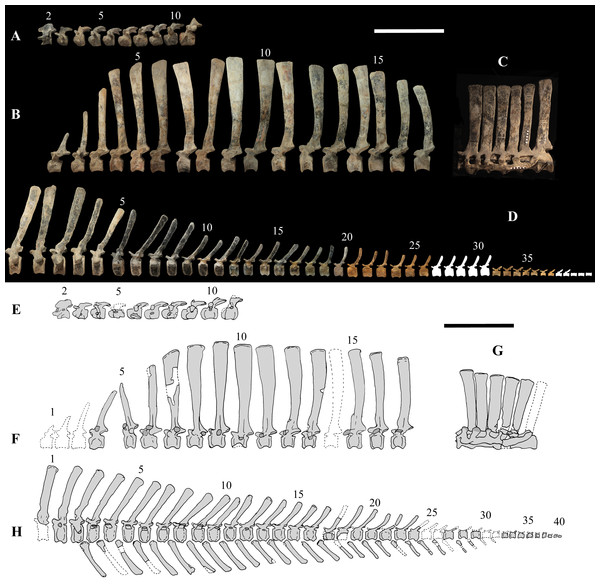
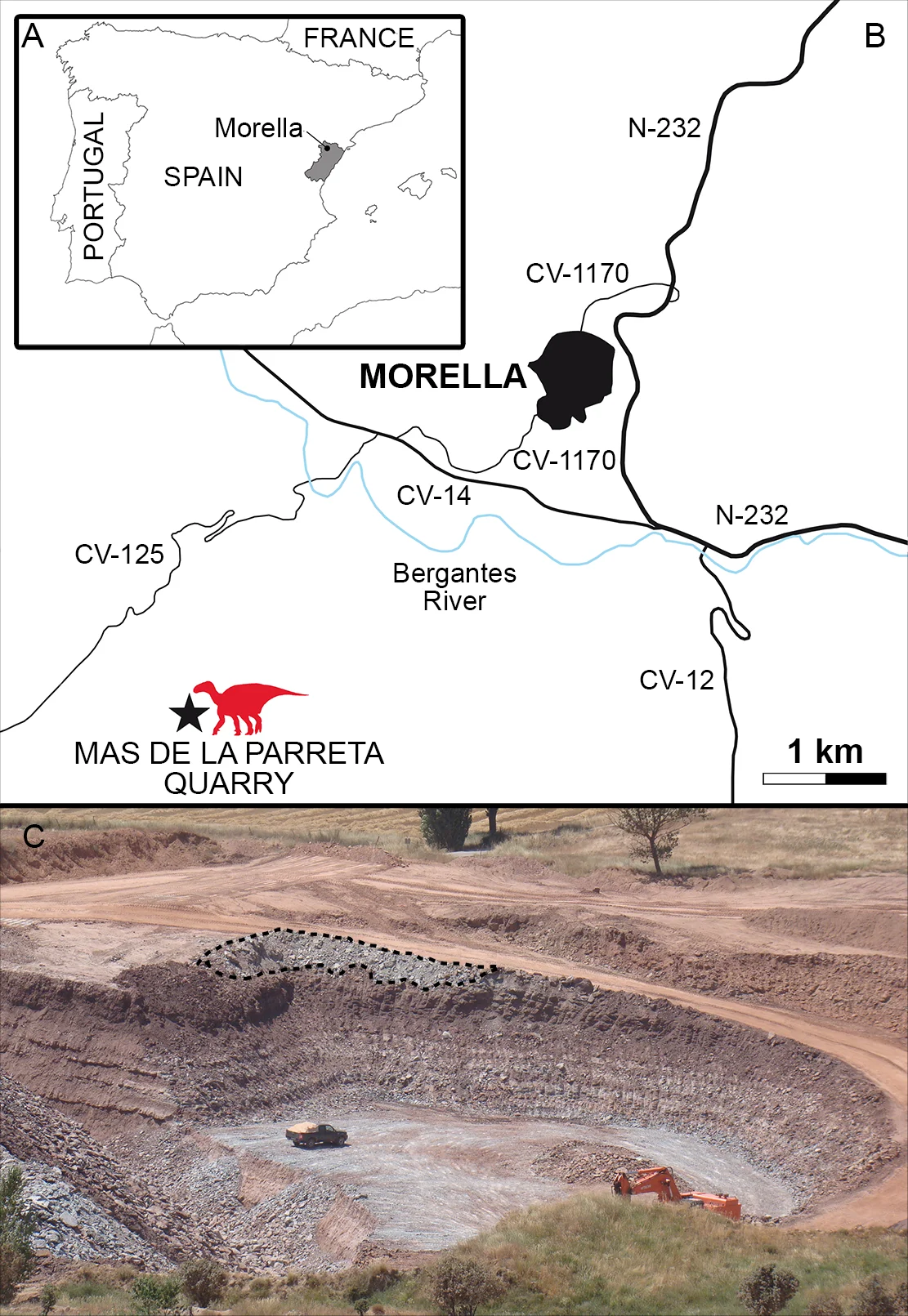
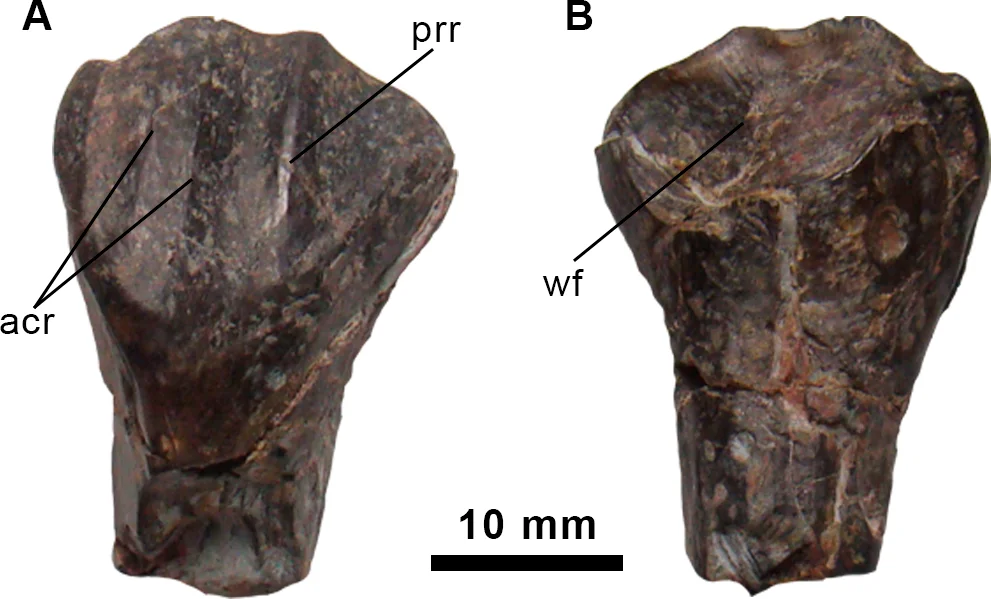
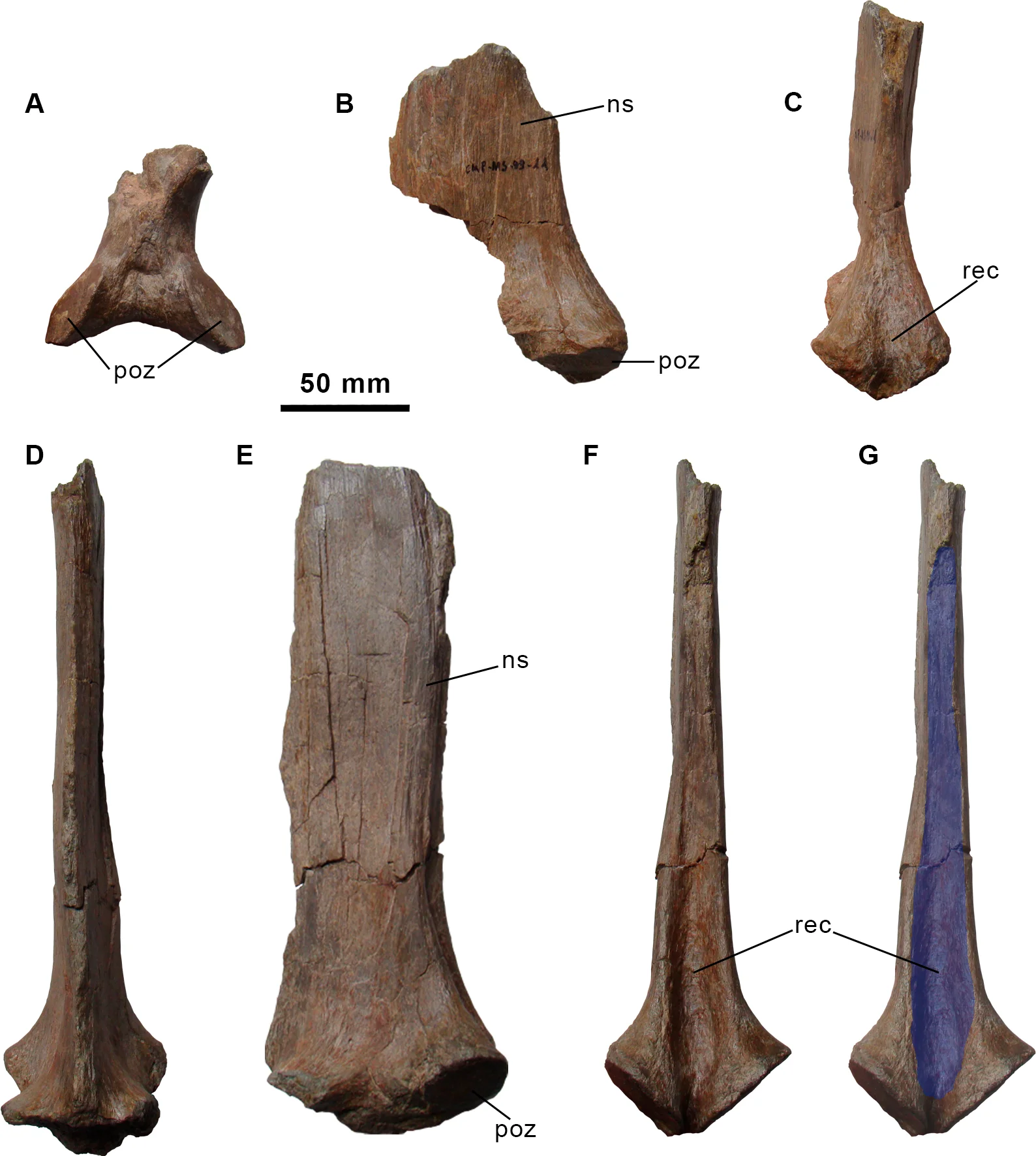
The discovery of Morelladon beltrani in Spain, an ornithopod with very elongated neural spines convergently similar to those of Ouranosaurus, allows important phylogenetic and functional comparisons. Gasulla et al. diagnose eight autapomorphies of the new taxon, including extremely elongated vertical dorsal neural spines. Phylogenetic analysis recovers Morelladon as a styracosternan, more derived than Iguanodon bernissartensis and Mantellisaurus, but basal relative to Ouranosaurus. This result, combined with the disjunct geographic distribution between Europe and Early Cretaceous Africa, raises questions about dispersal routes and biogeography of dorsal-crested ornithopods. The paper includes direct morphological comparison of neural spines of Morelladon and Ouranosaurus, confirming that the structures are anatomically distinct despite superficial morphological convergence.

Early and 'Middle' Cretaceous Iguanodonts in Time and Space
Carpenter, K. & Ishida, Y. · Journal of Iberian Geology
This review article offers the most complete biogeographic context available for Ouranosaurus nigeriensis within Iguanodontia. Carpenter & Ishida document the distribution of iguanodontids across all continents during the Early and Middle Cretaceous, demonstrating how this clade of ornithopod herbivores diversified globally following the initial fragmentation of Pangaea. Ouranosaurus appears as the unique representative of North Africa during the Aptian, at a time of relative continental isolation between Africa and Europe. The work analyzes dispersal patterns between Gondwana and Laurasia, discussing possible land bridges or rafting events that enabled faunal interchange. Ouranosaurus's position as a basal African iguanodontid, more primitive than typical Laurasian hadrosaurs, is consistent with a pattern of vicariant isolation during the Early Cretaceous.
Bone Histology in Dysalotosaurus lettowvorbecki (Ornithischia: Iguanodontia) – Variation, Growth, and Implications
Hübner, T.R. · PLOS ONE
This bone histology study of Dysalotosaurus, a small iguanodontian from the Tendaguru Formation of Tanzania, provides the methodological reference framework for interpreting the Ouranosaurus histological data published by Bertozzo et al. (2017). Hübner examines intraskeletal variation in vascularization density and LAG (lines of arrested growth) development in hundreds of bones from different ontogenetic stages. The study demonstrates that larger ornithopods tend to have higher growth rates with fewer regular LAGs in subadults, while smaller species develop more consistent LAGs. This pattern provides the comparative basis for understanding why the Ouranosaurus paratype in Venice, with evidence of active growth, represents a subadult — a central result of the Bertozzo et al. (2017) study.


Phylogeny of Basal Iguanodonts (Dinosauria: Ornithischia): An Update
McDonald, A.T. · PLOS ONE
This McDonald paper offers the most updated phylogenetic analysis of basal iguanodontids available at the time Bertozzo et al. (2017) conducted their Ouranosaurus revision. With 66 operational taxonomic units analyzed by maximum parsimony, the work demonstrates that Camptosauridae and Iguanodontidae are not monophyletic groups, and that multiple basal taxa have unstable phylogenetic positions. Although Ouranosaurus is not directly included in this publication's analysis, its results form the matrix basis that Bertozzo et al. (2017) modified to accommodate new anatomical data from the Venice specimen. The paper confirms the close relationship between Probactrosaurus gobiensis and Eolambia, lineages that diverged shortly before true hadrosaurs — and which define the evolutionary context of Ouranosaurus as a basal member of Hadrosauriformes.


A new basal hadrosauroid dinosaur (Dinosauria: Ornithopoda) with transitional features from the Late Cretaceous of China
Xing, H. et al. · PLOS ONE
The description of Zhanghenglong yangchengensis, with transitional morphological features between basal iguanodontids and true hadrosaurs, provides a crucial comparison point for understanding Ouranosaurus's evolutionary position. Xing et al. conduct a comprehensive phylogenetic analysis of Hadrosauroidea that includes Ouranosaurus as a basal representative from Gondwana. Results confirm that Ouranosaurus diverged before the main diversification of Asian and North American hadrosaurs, but shares several key synapomorphies with them. The paper discusses how the paleobiogeographic gap between Early Cretaceous Africa and Late Cretaceous Asia may explain Ouranosaurus's unique features, especially the distinctive skull and dorsal structure, which have no exact parallel in derived hadrosaurs.


Les découvertes de dinosaures dans le Sahara nigérien
Taquet, P. · Bulletin du Museum National d'Histoire Naturelle
This preliminary article by Philippe Taquet reports on discoveries made during the first French paleontological expeditions to the Nigerian Sahara between 1965 and 1970. It is the first scientific publication to mention specimens of what would be formally described as Ouranosaurus nigeriensis six years later. Taquet describes the Gadoufaoua site — a Tuareg name meaning 'the place where camels fear to go' — at the eastern edge of the Ténéré desert, and reports the exceptional richness of vertebrate fossils from the Elrhaz Formation (Aptian). The paper contextualizes the field working conditions in the Sahara, the excavation and transport methods used, and provides the first morphological descriptions of the recovered materials, including cranial fragments, vertebrae, and limb bones that Taquet already identified as belonging to a large ornithopod with exceptionally long dorsal spines.


Ontogenetic osteohistology of Syntarsus rhodesiensis (Dinosauria: Theropoda)
Hone, D.W.E. et al. · Palaeontologia Electronica
The ontogenetic bone histology analysis of Syntarsus rhodesiensis (Coelophysis rhodesiensis) by Hone et al. provides an essential comparative methodological framework for interpreting Bertozzo et al.'s (2017) results regarding the ontogenetic stage of the Venice Ouranosaurus specimen. The study demonstrates how LAGs, rapid growth zones, and fibrolamellar tissue are distributed differently at different ontogenetic stages, and how these markers can be used to estimate the relative age of specimens. The methodology validated in this paper for theropods is analogous to that applied by Bertozzo et al. to classify the Venice Ouranosaurus as a subadult, based on the presence of active growth zones without marked peripheral LAGs — a pattern consistent with an individual that had not yet completed somatic growth.

Iguanodontian phylogeny
Palaeo-Electronica Editors · Palaeo-Electronica
This phylogenetic review of Iguanodontia consolidates decades of cladistic analyses and provides the most updated positioning of Ouranosaurus within the ornithopod evolutionary tree. The work revises the morphological matrices of McDonald (2012), Norman (2015), and Bertozzo et al. (2017), integrating additional anatomical characters described in new taxa. Ouranosaurus is consistently recovered as a basal hadrosauroid more derived than European iguanodontids (Mantellisaurus, Hypselospinus) but more primitive than Asian genera (Altirhinus, Jinzhousaurus). The analysis discusses the paleobiogeographic implications of this positioning: North Africa during the Aptian would have been a refuge for basal Hadrosauriformes lineages that evolved independently from their European and Asian relatives, explaining Ouranosaurus's unique morphological features, especially the low-profile skull with nasal protrusion and extremely developed dorsal neural spines.

Philippe Taquet and the discovery of dinosaurs from the Ténéré Desert (Niger): a retrospective
Taquet, P. · Comptes Rendus Palevol
In this retrospective article, Philippe Taquet — the very discoverer and describer of Ouranosaurus — reflects on the expeditions to the Ténéré Desert, the extreme field conditions in the Sahara, and the discoveries that resulted in the description of Ouranosaurus nigeriensis in 1976. The text offers firsthand information about the discovery history: how the bones were found weathering on the desert surface, the logistical methods of the expeditions, and the difficulties of specimen preparation and transport in remote conditions. Taquet also discusses the evolution of his interpretation of Ouranosaurus's dorsal crest: initially proposed as a thermoregulatory structure, he acknowledges that subsequent histological evidence favors a sexual display function. The paper serves as a unique historical document on African Cretaceous paleontology and the contributions of French expeditions to Niger.

Famous museum specimens
MNHN GDF 300 (Holótipo)
Museu Nacional de História Natural, Paris
Official holotype of the species, collected on Taquet's first expedition to Gadoufaoua in 1966. Includes a semi-articulated skull, nearly complete vertebral column, forelimbs, and most of the right hindlimb. It remains in Paris and is the anatomical basis for the formal 1976 description.
MSNVE 3714 / MNHN GDF 381 (Parátipo)
Museu de História Natural de Veneza, Veneza
Paratype of the species, formally identified by Bertozzo et al. (2017) as the specimen mounted at the Venice Museum. Histological analysis revealed that the individual was a subadult. The mounted skeleton is the most publicly accessible and most frequently photographed of the species.
In cinema and popular culture
Ouranosaurus entered popular culture primarily through British documentaries: in the BBC's Planet Dinosaur (2011), the animal appears in two episodes as the central prey of a food web dominated by giant predators like Spinosaurus and Carcharodontosaurus. The depiction is scientifically reasonable, though the crest is shown as a rigid sail when evidence suggests a fleshier structure. Curiously, the animal was absent from the Jurassic Park and Jurassic World franchise for decades, finally appearing in the Camp Cretaceous animated series (Netflix, 2021) and in the Jurassic World: Evolution and Evolution 2 videogames. In the animated series, it is portrayed as territorial and aggressive, which contrasts with fossil evidence of a likely gregarious herbivore. In the games, the depiction is more balanced, with relatively accurate biological data about the unusual skull and characteristic crest. The animal remains less famous than contemporaries like Spinosaurus, but has an immediately recognizable silhouette thanks to its imposing dorsal crest.
Classification
Discovery
Fun fact
Ouranosaurus's dorsal crest may have been colorful like a modern chameleon's dewlap, used to impress mates and intimidate rivals — but histological evidence shows that juveniles were born without the crest and it grew progressively during adolescence, much like a lion's mane.
Last reviewed: April 24, 2026