
Mussaurus
Mussaurus patagonicus
"Mouse lizard from Patagonia"
About this species
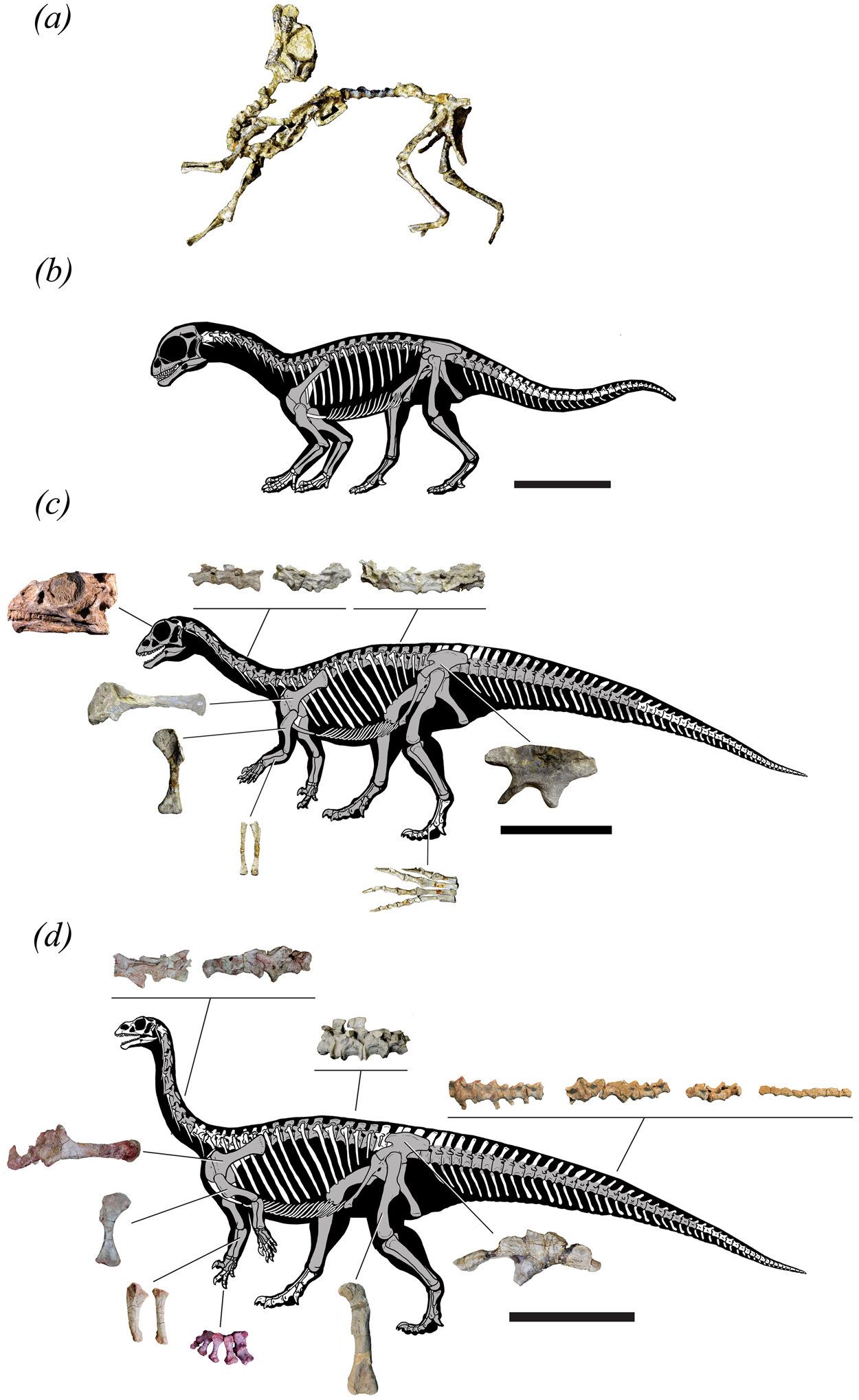
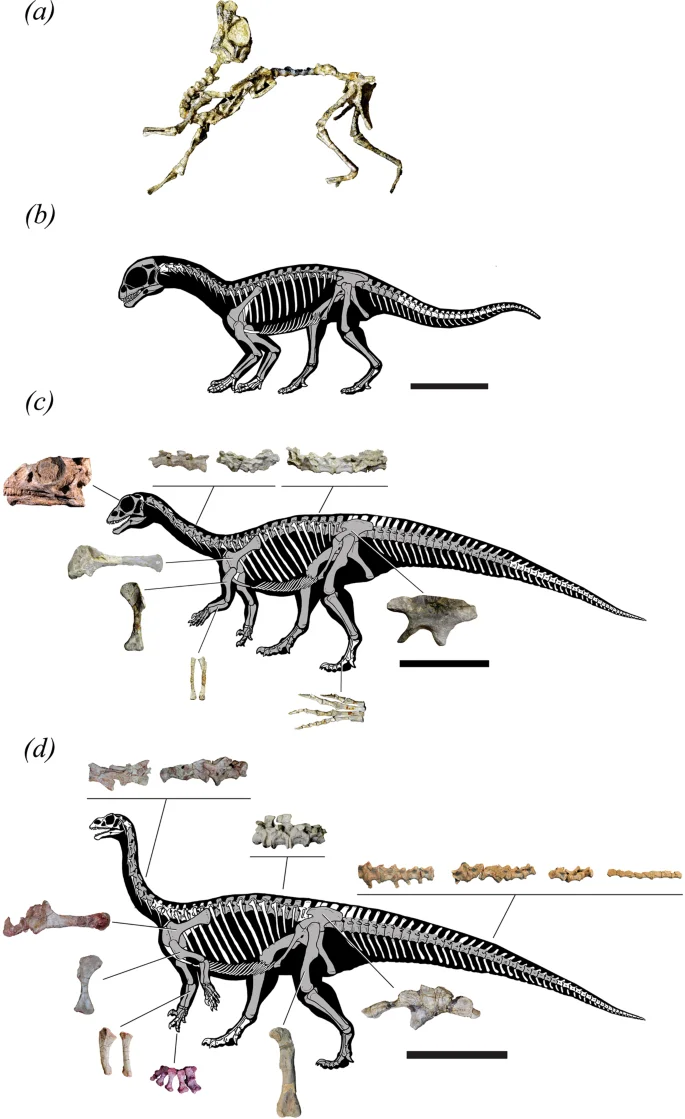
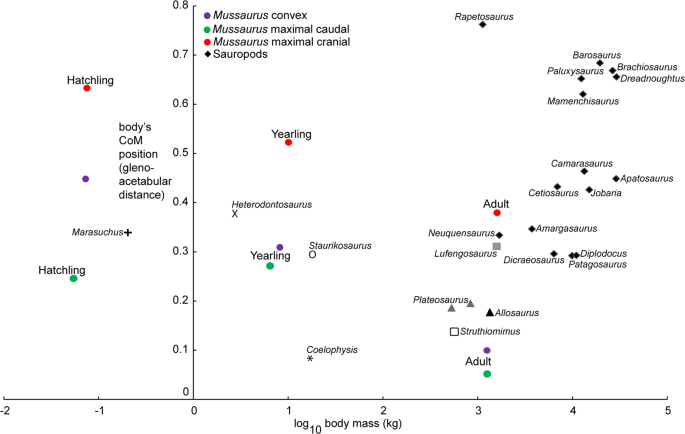
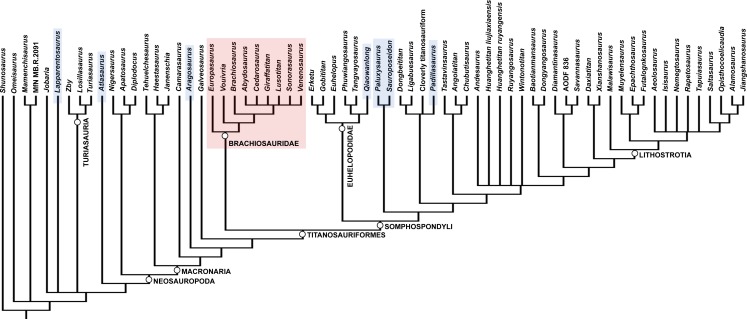
Mussaurus patagonicus is a Late Triassic sauropodomorph that stars in one of paleontology's most unusual stories: it was named the 'mouse lizard' because the first discovered specimens were tiny hatchlings only 20 centimeters long, small enough to fit in the palm of a hand. When José Bonaparte and Martín Vince described the species in 1979, based on these hatchlings from the Los Colorados Formation of Argentine Patagonia, they imagined a modestly sized adult. Decades later, when adult specimens were found and described in detail, it was revealed that Mussaurus grew to 6 meters in length and 1.5 tonnes: one of the largest terrestrial animals of the Late Triassic in South America. This discrepancy between hatchlings and adults is biologically significant. It demonstrates that basal sauropodomorphs underwent dramatic ontogenetic changes not only in size but also in locomotor posture. Mussaurus hatchlings were facultative bipeds, with proportionally similar fore and hind limbs, while adults had more robust forelimbs and likely transitioned to a quadrupedal posture upon reaching large sizes. This pattern echoes what later became obligatory in the giant sauropods of the Jurassic and Cretaceous. The most impactful publication on Mussaurus in recent years was the 2021 study by Otero et al. published in Scientific Reports. Analysis of multiple nests with eggs, neonatal hatchlings, and spatially grouped juveniles revealed strong evidence of gregarious behavior: the animals gathered in age-segregated groups, suggesting some form of parental care or structured social behavior. Mussaurus eggs were preserved in communal nests at a depth suggesting they were buried for incubation, similar to the behavior of crocodiles and some extant birds. This finding pushes the origin of gregarious behavior in sauropodomorphs back to the Triassic, more than 50 million years earlier than previously thought. Phylogenetically, Mussaurus occupies a key position in the transition between solitary basal sauropodomorphs and the large gregarious sauropods of the Mesozoic. The most recent analyses place it within Massopoda, near the base of the clade that will give rise to true Sauropoda. Its body still preserves plesiomorphic features such as a moderately long neck, more robust hind limbs than forelimbs, and simple leaf-shaped teeth, but already shows derived features such as elongated cervical vertebrae and a sauropod-like tarsal formula. The exceptional fossil record of the Los Colorados Formation, with multiple age classes preserved together, makes Mussaurus the most important Triassic sauropodomorph for studies of growth, ontogeny, and social behavior.
Geological formation & environment
The Los Colorados Formation is a Late Triassic sedimentary unit (Norian, approximately 221 to 205 Ma) located in the Ischigualasto-Villa Unión Basin in northwestern Argentine Patagonia, spanning the provinces of La Rioja and San Juan. The formation is composed predominantly of red and pink claystones, siltstones, and sandstones deposited in a continental environment of floodplains, ephemeral river channels, and aeolian sheets in a semi-arid climate with strong seasonality. The total thickness of the formation can exceed 600 meters, and it stratigraphically overlies the Ischigualasto Formation (which preserves the earliest known dinosaurs) and underlies the Middle Triassic Los Chañares Formation. The Los Colorados Formation is one of the richest vertebrate-bearing units of the Late Triassic in South America, preserving sauropodomorph dinosaurs (Mussaurus, Lessemsaurus, Riojasaurus), theropods, herbivorous and carnivorous cynodonts (including Eoraptor-like forms), rhynchosaurs, aetosaurs, and other archosaurian reptiles. The red coloration of the sediments reflects oxidizing conditions during diagenesis, associated with the dry climate and episodic drainage conditions. Radiometric dating of intercalated volcanic layers confirms the Norian age of the formation, making it stratigraphically correlative to formations preserving the earliest dinosaurs in other regions of Gondwana.
Image gallery


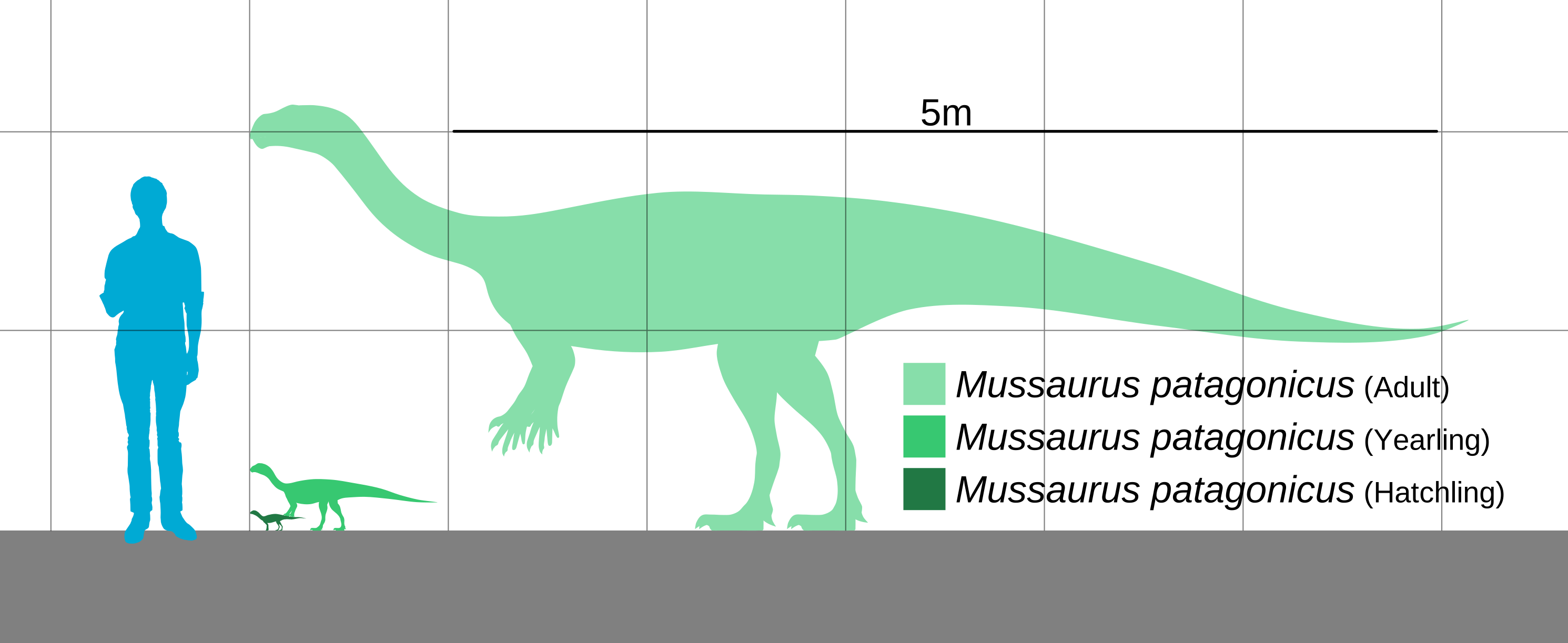


Life reconstruction of adult Mussaurus patagonicus by Sauropodomorph (2020), neutral background. Based on the skeleton of Otero et al. (2019), the first formally described complete adult.
CC BY-SA 4.0
Ecology and behavior
Habitat
Mussaurus patagonicus inhabited the plains and river basins of the Los Colorados Formation, in what is now the austral Patagonia of Argentina, during the Late Triassic (Norian). The environment was characterized by seasonally arid climate with episodic rivers, vegetation of conifers, tree ferns, and cycads, and red soils of aeolian and fluvial origin. Sediment analyses indicate semi-arid conditions with alternating wet and dry seasons, comparable to modern tropical savannas. The contemporary fauna included cynodonts, rhynchosaurs, and other primitive dinosaurs, including predatory herrerasaurids.
Feeding
Herbivorous, with simple leaf-shaped teeth without complex cusps, suitable for cutting and grinding vegetation. Adults, given their considerable size, likely consumed large volumes of conifer foliage and fern fronds. Hatchlings, with faster metabolism relative to body size, may have included insects and other invertebrates in their diet to meet the protein demands of rapid growth. The presence of a moderately long neck in adults suggests the ability to access vegetation at different heights, similar to the behavior of modern medium-sized ungulates.
Behavior and senses
The discovery of communal nests and age-class groupings in the Mussaurus fossil record represents the oldest evidence of gregarious behavior in Dinosauria. Adults likely incubated eggs in communal nests, possibly with some form of collective surveillance or parental care. Hatchlings remained grouped after hatching, likely under some adult supervision, similar to the behavior of modern colonial birds and crocodiles. This structured social behavior would have conferred significant antipredator advantages in an environment shared with predatory herrerasaurids.
Physiology and growth
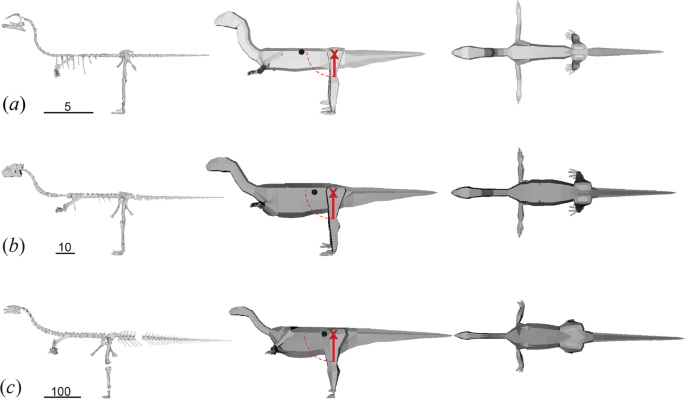
The bone histology of Mussaurus patagonicus reveals rapid, continuous growth in early life stages, with dense fibrolamellar bone without annual growth lines in juveniles. This pattern is consistent with elevated metabolism and endothermic or mesothermic physiology, similar to modern birds and mammals. The locomotor transition from biped to quadruped during growth is a unique physiological phenomenon accompanying changes in body center of mass and load distribution between limbs. The acceleration of growth in sauropodomorphs, documented by Cerda et al. (2013), represents a fundamental evolutionary innovation that prefigures the gigantism of Jurassic and Cretaceous sauropods.
Paleogeography
Continental configuration

Scotese & Vérard · CC BY 4.0 · Triassic, ~225 Ma
Fossil sites

Wikimedia Commons
During the Noriano (~221–205 Ma), Mussaurus patagonicus inhabited Pangea, the single supercontinent joining all modern continents. Climate was dry and hot across much of the continental interior.
Bone Inventory
Mussaurus patagonicus is known from multiple specimens across different age classes. The holotype PVL 4587 consists of nearly complete neonatal hatchlings. Adult specimens (MACN-PV 18.254 and referred materials) were described in detail by Pol et al. (2011) and Otero et al. (2021). The combination of eggs, neonates, juveniles, and adults at the same locality makes this one of the most complete ontogenetic records of any Triassic dinosaur.

Found elements
Inferred elements
Scientific Literature
4 papers in chronological order — from the original description to recent research.
El hallazgo del primer nido de dinosaurios triásicos (Saurischia, Prosauropoda), Triásico superior de Patagonia, Argentina
Bonaparte, J.F.; Vince, M. · Ameghiniana
Founding paper describing the holotype of Mussaurus patagonicus based on nearly complete neonatal specimens and eggs recovered from the Los Colorados Formation of Patagonia. Bonaparte and Vince are struck by the tiny size of the hatchlings (under 20 cm) and name the new species 'mouse lizard'. The authors correctly identify the specimens as newly hatched animals, not adults, and discuss the first known Triassic dinosaur nest in South America. The work describes the cranial and postcranial morphology of the hatchlings, which show diagnostic features of basal prosauropods. The original interpretation of adult size as modest would be revised three decades later, when adult specimens revealed a 6-meter, 1.5-tonne animal.

Pivot sequences, the phylogenetic content of homoplasy, and the parsimony ratchet
Pol, D.; Gauthier, J. · Cladistics
Phylogenetic analysis placing Mussaurus patagonicus within Plateosauria, close to the origin of Sauropoda. Pol and Gauthier evaluate characters of the vertebral column, pelvis, and hindlimbs, demonstrating that Mussaurus shares with derived sauropods features such as elongated cervical vertebrae and pelvic morphology prefiguring that of sauropodiformes. The analysis helps resolve the controversial phylogenetic position of the genus, which had been placed at different positions in Sauropodomorpha by different authors. The work establishes that Mussaurus is more derived than Plateosaurus, bringing it closer to the origin node of true Sauropoda and suggesting that the body gigantism observed in Mussaurus adults is a trend parallel to that of later sauropods.
A new sauropodomorph dinosaur from the Late Triassic of Patagonia and the early evolution of the sauropod-line
Pol, D.; Gauthier, J.; Lecuona, A.; Rauhut, O.W.M. · Naturwissenschaften
Work that revolutionizes the understanding of Mussaurus by describing adult complete specimens for the first time. Pol and collaborators demonstrate that Bonaparte and Vince's 'mouse lizard' grew to 6 meters in length and 1.5 tonnes, making it one of the largest terrestrial animals of the Late Triassic in South America. The authors document the complete ontogenetic trajectory of the species, showing that hatchlings were bipeds with relatively short forelimbs, while adults transitioned to a more quadrupedal posture with proportionally longer forelimbs. This ontogenetic postural change is interpreted as an evolutionary echo of what would become obligatory in the large sauropods of the Jurassic. The work also reinterprets the cranial anatomy of adults, revealing a skull proportionally smaller than that of hatchlings and foliose teeth typical of herbivory.

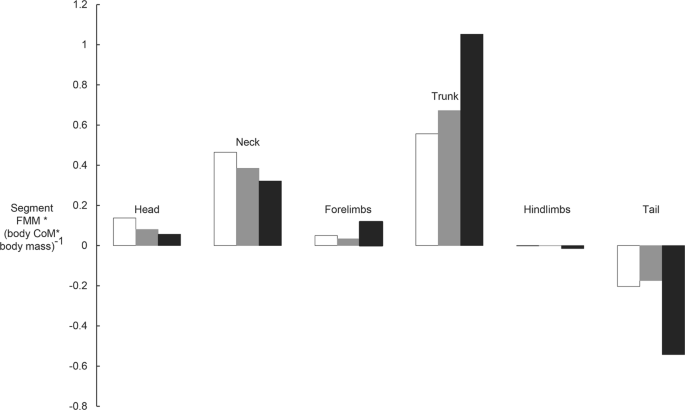
Ontogenetic changes in the body plan of the sauropodomorph dinosaur Mussaurus patagonicus reveal shifting locomotor habits during growth
Otero, A.; Cuff, A.R.; Allen, V.; Sumner-Rooney, L.; Pol, D.; Hutchinson, J.R. · Scientific Reports
Quantitative analysis of limb proportions across the ontogeny of Mussaurus patagonicus, demonstrating a shift from bipedal locomotion in hatchlings to increasingly quadrupedal locomotion in adults. Otero and collaborators apply image analysis and biomechanical modeling methods to specimens across multiple age classes, documenting that the forelimb/hindlimb length ratio systematically increases with growth. The change reflects both the functional demand of supporting increasing body mass in a quadrupedal posture and a phylogenetic predisposition toward the obligate quadrupedalism of sauropods. This is the earliest known example of an ontogenetic locomotor transition in a dinosaur, and serves as a model for understanding how quadrupedalism evolved in large sauropods. The study uses modern tomography and 3D morphometrics techniques to quantify the changes with unprecedented precision.
Famous museum specimens

MACN-PV 18.254
Museo Argentino de Ciencias Naturales Bernardino Rivadavia, Buenos Aires, Argentina
Adult specimen of Mussaurus patagonicus fundamental to Pol et al.'s (2011) redescription, revealing the animal's actual size. Includes well-preserved vertebrae, ribs, and hindlimb elements.
MPEF-PV 3458
Museo Paleontológico Egidio Feruglio, Trelew, Argentina
Referred specimen of Mussaurus patagonicus including associated cranial and postcranial material. Part of the main collection of the Patagonian museum, used in histological and morphometric studies.
PVSJ 568
Instituto y Museo de Ciencias Naturales (UNSJ), San Juan, Argentina
Juvenile material of Mussaurus patagonicus from the Los Colorados Formation, used in ontogeny and gregarious behavior studies. Represents a growth stage intermediate between neonatal hatchlings and adults.
MHSRv 75
Museo de Historia Natural de San Rafael, San Rafael, Argentina
Fossilized eggs attributed to Mussaurus patagonicus recovered from the Los Colorados Formation. Part of the communal nest record analyzed by Otero et al. (2021) as evidence of gregarious behavior.
MPM-PV 2202
Museo Provincial Padre Molina, Rio Gallegos, Argentina
Specimen of Mussaurus patagonicus from southern Patagonia, representing the known geographic extent of the species. Partial postcranial material used in comparative analyses of body proportions.
In cinema and popular culture
Mussaurus patagonicus has a discreet presence in popular culture, largely because its most fascinating story, the revelation that the 'mouse lizard' was actually a giant, only occurred in 2011, relatively late for the golden age of dinosaur documentaries of the 1990s-2000s. The BBC series Walking with Dinosaurs (1999) does not include it, and most documentaries of the era based their representations on the known hatchling specimens. Public interest increased after the 2021 study on gregarious behavior, which was widely covered in scientific and popular media as 'the oldest social behavior in dinosaurs'. Recent documentaries such as Prehistoric Planet (Apple TV+, 2022) incorporated this discovery in their representations of primitive sauropodomorphs. In textbooks and museum materials, Mussaurus frequently appears as an example of dramatic ontogenetic change in dinosaurs and as a precursor to the great sauropods.
Classification
Discovery
Fun fact
Mussaurus was named 'mouse lizard' because the first discovered specimens were hatchlings so tiny they fit in the palm of a hand. Decades later, paleontologists discovered that adults reached 6 meters in length and 1.5 tonnes, making the name one of the greatest misnomers (and jokes) in the history of paleontology.
Last reviewed: April 24, 2026