
Megaraptor
Megaraptor namunhuaiquii
"Giant thief of Namunhuaiqui"
About this species
Megaraptor namunhuaiquii was a large-bodied theropod of the mid-to-late Cretaceous (Turonian-Coniacian, ~93-88 Ma) found in the Portezuelo Formation of Neuquén, Argentina. Estimated at ~8 meters long and about 1000 kg, Megaraptor was one of the largest predators of its time in South America. The most notable feature — and the one that generated decades of taxonomic debate — is its manual claw: an extraordinarily developed sickle-shaped claw on the first finger of the hand, over 30 cm long, which initially led researchers to interpret the animal as a giant dromaeosaurid (with the claw on the foot), before its true position as a megaraptorid was clarified. The specific name namunhuaiquii refers to Namunhualqui hill, a locality near the discovery site in Neuquén.
Geological formation & environment
The Portezuelo Formation (Turonian-Coniacian, ~93-88 Ma) is a member of the Neuquén Group of the Neuquén Basin, Argentina. It represents a fluvial and alluvial plain environment with meandering rivers, swamps, and tropical to subtropical riparian forests, with a warm and humid climate. The formation is extraordinarily rich in dinosaurs, preserving some of the largest known titanosaur sauropods such as Futalognkosaurus dukei, along with large theropods such as Megaraptor namunhuaiquii, Murusraptor barrosaensis, and abelisaurids. The Neuquén Basin in the mid-Cretaceous was an extensive sedimentary basin on the eastern margin of the forming Andes, with deposition of fluvial and eolian sediments. It is considered by many researchers as the most productive dinosaur paleontological site in the world in terms of gigantism: here were found the largest sauropods and some of the largest theropods ever discovered.
Image gallery

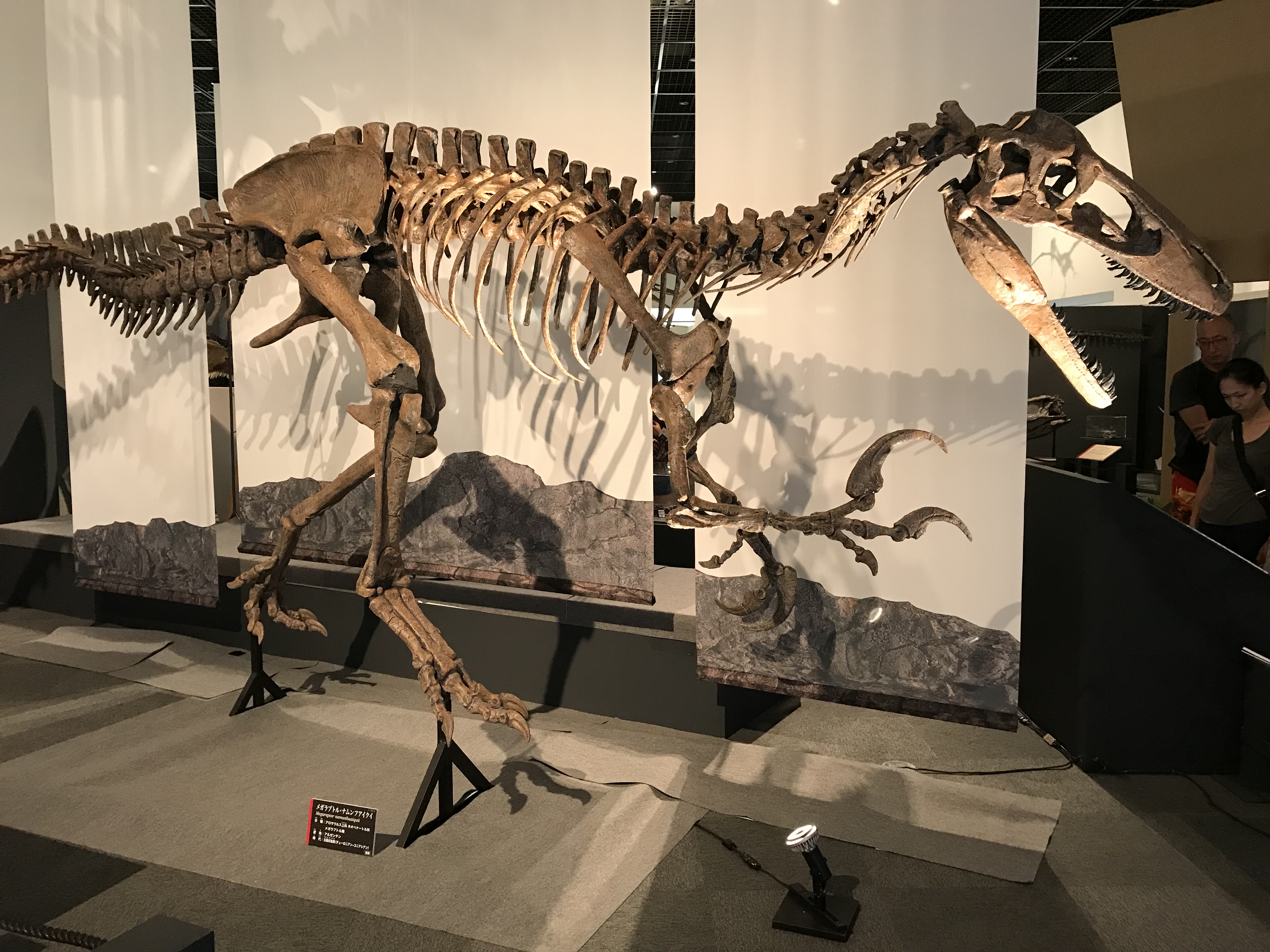


Scientific reconstruction of Megaraptor namunhuaiquii by TotalDino (2024), clean background. Lateral view showing the powerful forelimbs with developed claws.
CC BY 4.0
Ecology and behavior
Habitat
Megaraptor namunhuaiquii inhabited the fluvial plains and coastal plain environments of the Neuquén Basin during the Turonian-Coniacian (~93-88 Ma), in what is now Argentine Patagonia. The Portezuelo Formation environment was dominated by meandering rivers, alluvial plains with angiosperm vegetation, palms, and conifers, with a warm and humid climate. The Neuquén Basin in the mid-Cretaceous was one of the world's richest ecosystems in dinosaur biodiversity: giant titanosaurs like Patagotitan, abelisaurids, carcharodontosaurids, and megaraptorids themselves shared this environment. Megaraptor likely occupied an apex or sub-apex predator position, below the larger carcharodontosaurids like Mapusaurus.
Feeding
Megaraptor was an active predator that used powerful manual claws as the primary prey-capturing tool, in contrast to large Northern Hemisphere tyrannosaurids that primarily relied on the skull. Manual claw I, over 30 cm long, could penetrate and fix large prey, while relatively long arms provided reach and force to bring down large animals. Possible prey included young and medium-sized sauropods, ornithopods, and other medium-sized dinosaurs of the Neuquén fauna. Hindlimb morphology, with long legs and developed musculature, suggests active pursuit hunting combined with ambush.
Behavior and senses
Direct behavioral evidence for Megaraptor is scarce due to fragmentary fossil material. Forelimb morphology, with a robust humerus and extraordinarily developed manual claws, suggests the animal relied on its arms to immobilize prey — a strategy analogous to large modern felids such as lions, but implemented by forelimbs rather than jaws. Rapid bone growth structure documented in the juvenile specimen (Porfiri et al. 2014) indicates accelerated growth during the juvenile phase, a typical pattern of large predators that need to reach adult size quickly to reduce predation vulnerability.
Physiology and growth
Megaraptor was endothermic, as indicated by its phylogenetic position within Coelurosauria and the bone histology of the juvenile specimen described by Porfiri et al. (2014), which shows rapidly growing fibrolamellar tissue consistent with endothermy. Growth estimates based on histology suggest individuals reached adult size in approximately 15-20 years, growing at rates of several kilograms per year during the active growth phase — a pace similar to other large coelurosaurs. The uncertain phylogenetic position between Tyrannosauroidea and Allosauroidea has implications for physiological interpretation: both groups were endothermic, but specific metabolic strategies may have differed.
Paleogeography
Continental configuration

Scotese & Vérard · CC BY 4.0 · Cretaceous, ~105 Ma
Fossil sites

CC BY-SA 4.0
During the Turoniano-Coniaciano (~93–88 Ma), Megaraptor namunhuaiquii inhabited Laramidia, the western half of present-day North America, separated from the east by the Western Interior Seaway, a shallow sea dividing the continent. The continents were in very different positions: India was drifting toward Asia, Antarctica was still connected to Australia, and South America was an isolated island.
Bone Inventory
The original material described by Novas (1998) is fragmentary: it mainly includes the giant manual claw, manual phalanges, ulna, radius, fragments of tibia and fibula, metatarsals, and some vertebral elements. Additional material referred to the species, including more complete cranial and post-cranial elements, was described in subsequent publications. Completeness is estimated at ~25% based on material directly attributed to the holotype and referred specimens.

Found elements
Inferred elements
Scientific Literature
5 papers in chronological order — from the original description to recent research.
Megaraptor namunhuaiquii gen. et sp. nov., a large-clawed, Late Cretaceous theropod from Patagonia
Novas, F.E. · Journal of Vertebrate Paleontology
Founding paper of Megaraptor namunhuaiquii, published in Journal of Vertebrate Paleontology 18(1): 4-9, in which Fernando Novas describes the holotype material from the Portezuelo Formation of Neuquén. The material includes an enormous sickle-shaped claw and associated elements that Novas interprets as pedal (foot), leading to provisional classification within Dromaeosauridae — a gigantic 'raptor' analogously comparable to the North American Utahraptor, but potentially larger. The name Megaraptor ('giant thief') and the epithet namunhuaiquii (reference to the local hill) are established in this work. Although the original classification was later refuted, this article remains the primary descriptive reference for the taxon and documented for the first time the existence of a large extreme-clawed theropod in mid-Cretaceous South America.
On a new maniraptoran dinosaur (Theropoda) from the Upper Cretaceous of Neuquén, Patagonia, Argentina
Calvo, J.O., Porfiri, J.D. & Kellner, A.W.A. · Arquivos do Museu Nacional
Calvo, Porfiri, and Kellner describe new theropod material from the Upper Cretaceous of Neuquén Province referred to the megaraptoran lineage, published in Arquivos do Museu Nacional, Rio de Janeiro. The work begins to question Megaraptor's position as a dromaeosaurid and provides additional anatomical data demonstrating that the enormous claw belonged to the forelimb, not the hindlimb. This article represents an important step in correcting Megaraptor's original classification and in recognizing the group as a distinct entity within Coelurosauria, separate from dromaeosaurids. The authors propose for the first time that the material may represent a new group of Gondwanan theropods.
A new clade of archaic large-bodied predatory dinosaurs (Theropoda: Allosauroidea) that survived to the latest Mesozoic
Benson, R.B.J., Carrano, M.T. & Brusatte, S.L. · Naturwissenschaften
Benson, Carrano, and Brusatte publish a phylogenetic analysis positioning Megaraptor and related taxa as a new clade of derived allosauroids that survived into the Late Cretaceous, informally termed 'megaraptors'. Published in Naturwissenschaften 97(1): 71-78, the work confirms that Megaraptor was not a dromaeosaurid, but proposes alternative position within Allosauroidea rather than Tyrannosauroidea. The discovery that megaraptors occurred in Argentina, Asia, and Australia (Australovenator wintonensis) reveals a shared Gondwanan-Laurasian distribution suggesting the group was cosmopolitan in the Cretaceous. This hypothesis would later be contested by analyses placing the group within Tyrannosauroidea.
A new Patagonian Cretaceous theropod with remarkable forelimbs and the identification of a new theropod clade
Novas, F.E., Pol, D., Canale, J.I., Porfiri, J.D. & Calvo, J.O. · Comptes Rendus Palevol
Novas, Pol, Canale, Porfiri, and Calvo present new Patagonian material and phylogenetic analysis supporting the position of Megaraptora within Tyrannosauroidea, published in Comptes Rendus Palevol 12(3): 153-162. The work describes forelimb elements including the humerus and large manual unguals, and the analysis recovers the specimens within Tyrannosauroidea — positioning Megaraptor as a derived tyrannosauroid with still well-developed forelimbs, in contrast with the arm reduction of Tyrannosaurus rex. This hypothesis suggests megaraptorids may represent a lineage of tyrannosauroids that colonized South America and diverged from Northern Hemisphere tyrannosaurids, maintaining functional forelimbs while developing powerful manual claws as the primary predation tool.
Juvenile specimen of Megaraptor (Dinosauria, Theropoda) sheds light about tyrannosauroid radiation
Porfiri, J.D., Novas, F.E., Calvo, J.O., Agnolin, F.L., Ezcurra, M.D. & Cerda, I.A. · Cretaceous Research
Porfiri et al. describe a juvenile specimen of Megaraptor namunhuaiquii from the Portezuelo Formation, published in Cretaceous Research 48: 14-26. Bone histology confirms the juvenile ontogenetic stage and provides data on growth rates: Megaraptor grew rapidly, like other tyrannosauroids, with rapidly growing fibrolamellar tissue. Phylogenetic analysis supports the position of Megaraptora within Tyrannosauroidea. The juvenile specimen is important for revealing ontogenetic characteristics of megaraptorids: less developed cranial and post-cranial elements, different proportions from adults, and growth data allowing estimation of the species's developmental biology.
Famous museum specimens

MCF-PVPH 79
Museo Carmen Funes, Plaza Huincul, Argentina
Holotype material of Megaraptor namunhuaiquii, including the giant manual claw and associated elements described by Novas in 1998. The Museo Carmen Funes of Plaza Huincul, Neuquén, is the depository institution for material from the Neuquén region where the taxon was found.
MML-195 e outros
Museo Argentino de Ciencias Naturales Bernardino Rivadavia, Buenos Aires, Argentina
The Museo Argentino de Ciencias Naturales holds material referred to Megaraptor and related megaraptorids in its paleontological collection. The institution is the main repository for Cretaceous Patagonian dinosaurs and houses research material of Fernando Novas and collaborators.
MUCPv-341
Museo de la Universidad Nacional del Comahue, Neuquén, Argentina
The Universidad Nacional del Comahue holds Megaraptor specimens and related megaraptorids from the Neuquén Basin in its collection. The university museum is one of the main research institutions on Cretaceous Patagonian dinosaurs and houses collaborations with researchers like Juan Calvo.
In cinema and popular culture
Megaraptor namunhuaiquii remains a rare presence in popular entertainment, despite its scientific importance and evocative name. Unlike Tyrannosaurus, Velociraptor, or Spinosaurus, Megaraptor has not achieved prominence in major film franchises or high-audience series, partly because it was described relatively late (1998) and because its confusing taxonomy made it difficult to create a consistent image for dissemination. The animal's story is itself a cinematically rich narrative: discovered as 'the largest raptor in the world', revealed to be something completely different — possibly a Gondwanan tyrannosaur with giant arms. This narrative of scientific discovery and revision appears occasionally in paleontological documentaries, especially those produced for South American broadcasters such as Argentina's Canal Encuentro, which documented Patagonian dinosaur excavations including megaraptorids.
Classification

Discovery
Fun fact
When Megaraptor namunhuaiquii was described in 1998, Fernando Novas identified it as a giant dromaeosaurid — essentially a bus-sized Velociraptor — based on an enormous claw he interpreted as being from the foot. It took years of research and additional material to reveal the truth: the claw was from the hand, not the foot. The 'largest raptor ever discovered' was actually a completely different type of theropod — possibly even a tyrannosauroid — that had independently evolved manual claws convergently similar to dromaeosaurid pedal claws.
Last reviewed: April 24, 2026