
Majungasaurus
Majungasaurus crenatissimus
"Mahajanga lizard with serrated teeth"
About this species
Majungasaurus crenatissimus was the apex predator of Late Cretaceous Madagascar, living 70 to 66 million years ago. Measuring around 7 meters long and over one metric ton, it was a robust-skulled abelisaurid with a unique cranial horn on top of its snout and extremely reduced, vestigial arms. It belonged to a group of Gondwanan theropods that diversified in isolation from the rest of the world. It is notable for being the only non-avian theropod with direct evidence of cannibalism: bones of its own species bear tooth marks identical to those of its jaws.
Geological formation & environment
The Maevarano Formation is an Upper Cretaceous (Maastrichtian, 70-66 Ma) unit exposed in the Mahajanga Basin in northwestern Madagascar. The environment was a semi-arid coastal alluvial plain, cut by sandy river channels and dominated by alternating wet and dry seasons. Oxidized calcareous paleosols with carbonate nodules evidence intense seasonal aridity. The fauna is exceptionally diverse and well-preserved, including Majungasaurus crenatissimus (apex predator), Rapetosaurus krausei (titanosaur), Masiakasaurus knopfleri (noasaurid), Rahonavis ostromi (paravian), Vorona berivotrensis (primitive bird), multiple crocodilians, the snake Madtsoia, and the giant frog Beelzebufo. The formation belongs to the Anembalemba Member and has been extensively explored by the Mahajanga Basin Project since 1993.
Image gallery


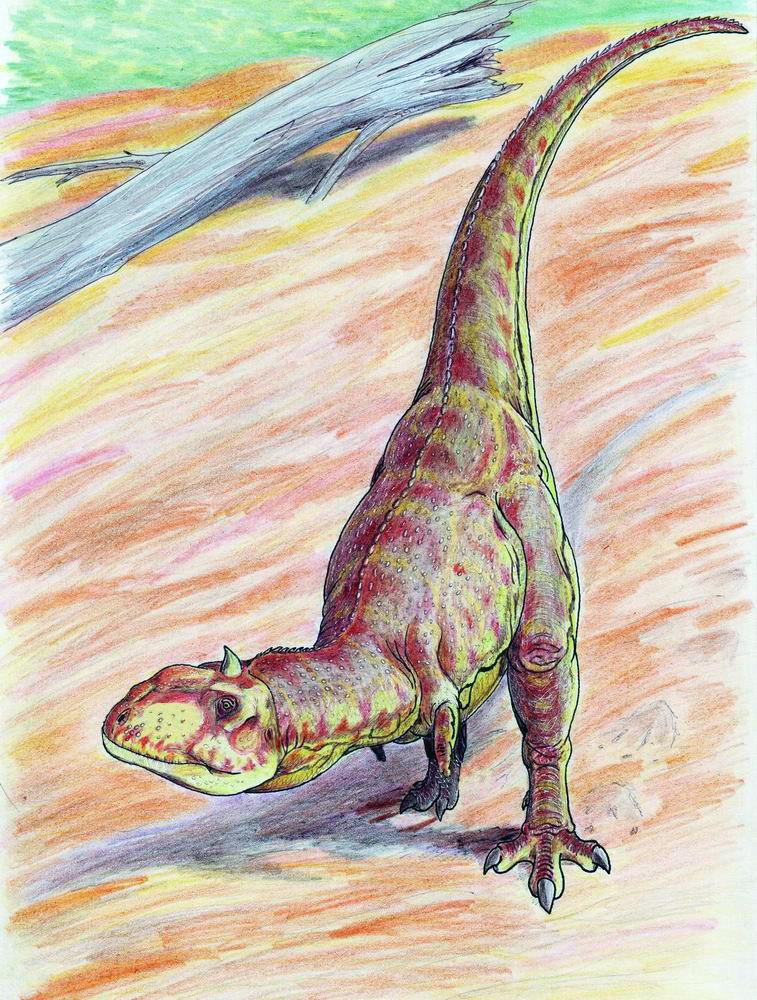


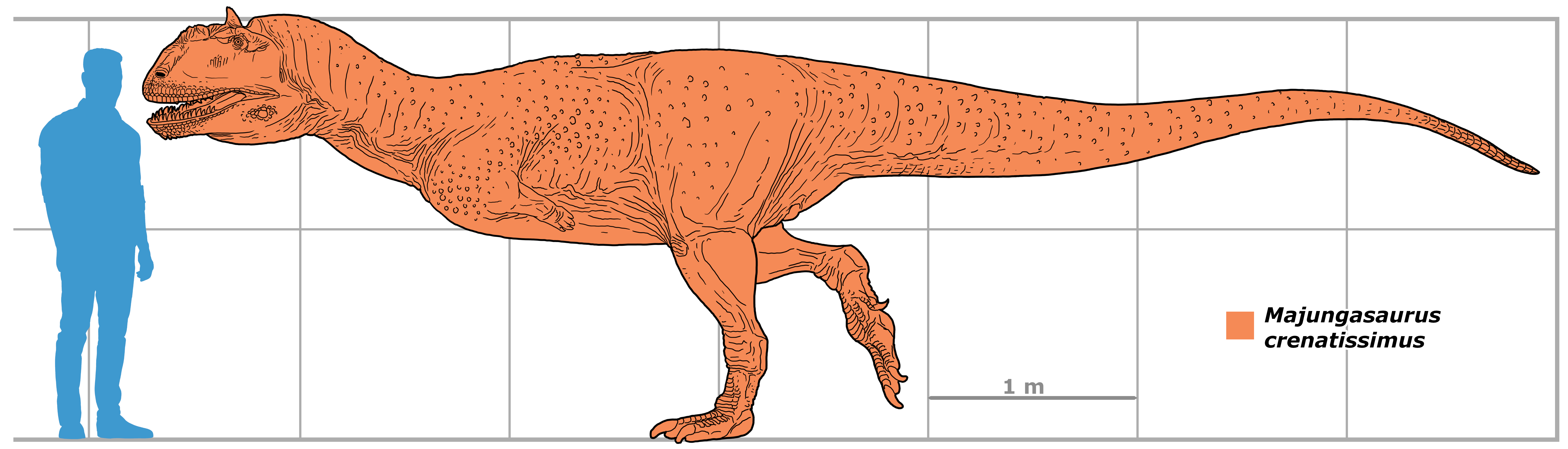


3D model of Majungasaurus crenatissimus showing the general abelisaurid morphology: broad, robust skull with rugose nasal horn, vestigial arms, and robust hindlimbs.
Wikimedia Commons — CC BY-SA 4.0
Ecology and behavior
Habitat
Majungasaurus crenatissimus inhabited the coastal floodplain of the Mahajanga Basin in northwestern Madagascar 70 to 66 million years ago. The Maevarano Formation paleoenvironment was semi-arid, with pronounced wet and dry seasons, evidenced by oxidized calcareous paleosols with carbonate nodules and sandy river channels. The climate was hot and seasonal, with no polar ice caps. Coexisting fauna included the titanosaur sauropod Rapetosaurus krausei (primary prey), the noasaurid Masiakasaurus knopfleri, the primitive bird Vorona berivotrensis, the paravian Rahonavis ostromi, crocodilians (Mahajangasuchus, Trematochampsa), the giant snake Madtsoia madagascariensis, and the giant frog Beelzebufo ampinga.
Feeding
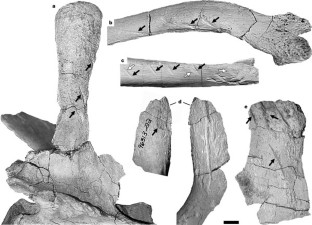
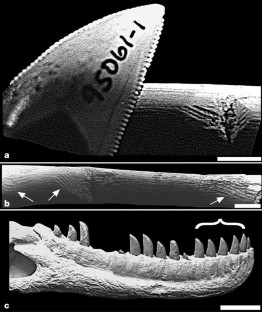
Majungasaurus was the absolute apex predator of the Maevarano Formation ecosystem. Its primary documented prey from tooth marks on bones was the sauropod Rapetosaurus krausei, which it attacked preferentially in the muscular axial region. Majungasaurus' teeth were serrated and laterally compressed, adapted for slicing flesh. Estimated bite force reached ~7,845 N at the posterior mandible (Gignac et al., 2022). Unique among theropods, Majungasaurus also practiced demonstrated cannibalism: bones of conspecific individuals bear tooth marks identical to those of its own jaws (Rogers et al., 2003). Cannibalism may have been opportunistic, during intense dry periods when other prey was scarce.
Behavior and senses
Majungasaurus was likely solitary as an adult. Evidence of intraspecific combat includes bite marks on cervical vertebrae of some specimens (Farke & O'Connor, 2007). The extensive paleopathology documented in specimen FMNH PR 2836 — facial infections, healed rib fractures, and forelimb arthritis — reveals a physically demanding lifestyle with multiple traumatic events (Gutherz et al., 2020). The documented cannibalism may reflect opportunistic behavior during periods of seasonal scarcity as well as resource competition.
Physiology and growth
Bone growth rings (lines of arrested growth) of Majungasaurus reveal a much slower growth rate than basal ceratosaurs like Ceratosaurus, with growth similar to or slower than living crocodilians, possibly reaching maturity after 20 years. This slower metabolism may be an adaptation to the semi-arid and seasonally stressful Maevarano Formation environment. The extensive postcranial pneumatization system documented by O'Connor (2007) is consistent with a flow-through respiratory system similar to modern birds, with air sacs reducing body weight. The rugose nasal horn was supported by internally hollow bone, as demonstrated by CT scanning.
Paleogeography
Continental configuration

Scotese & Vérard · CC BY 4.0 · Cretaceous, ~105 Ma
Fossil sites

Wikimedia Commons — CC BY-SA 4.0
During the Maastrichtiano (~70–66 Ma), Majungasaurus crenatissimus inhabited Laramidia, the western half of present-day North America, separated from the east by the Western Interior Seaway, a shallow sea dividing the continent. The continents were in very different positions: India was drifting toward Asia, Antarctica was still connected to Australia, and South America was an isolated island.
Bone Inventory
Based on multiple specimens. Virtually all skeletal elements are known, except for parts of the pectoral and pelvic girdles, and most of the forelimb distal to the humerus. Four skulls and three partial postcranial skeletons have been recovered, along with thousands of isolated teeth.
Found elements
Inferred elements
Scientific Literature
15 papers in chronological order — from the original description to recent research.
Note sur les dinosauriens sauropodes et théropodes du Crétacé supérieur de Madagascar
Depéret, C. · Bulletin de la Société Géologique de France
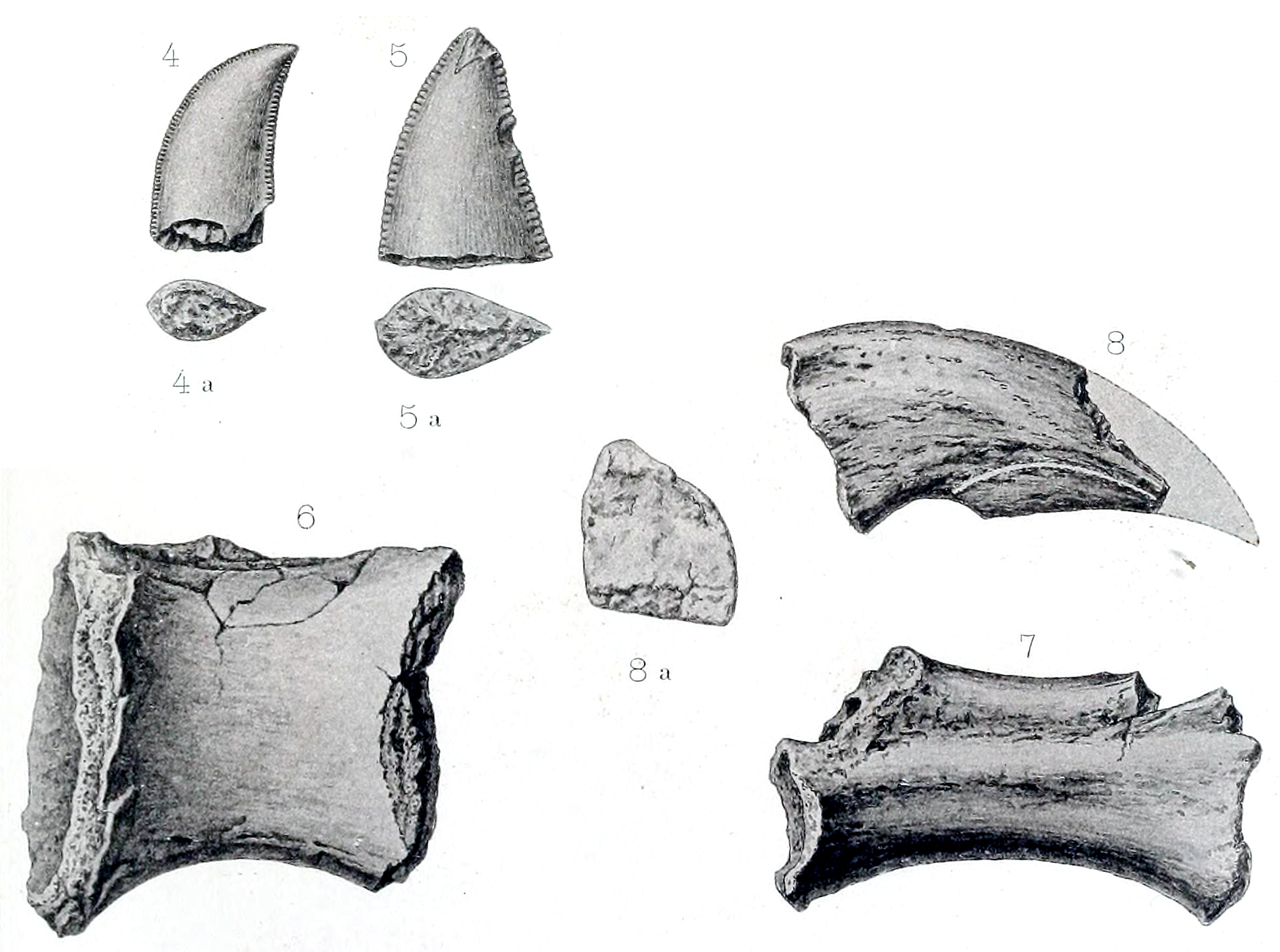
The founding paper for the study of Majungasaurus crenatissimus. Charles Depéret describes the first theropod material recovered from Madagascar, collected near the Betsiboka River in Mahajanga Province. The material, consisting of serrated teeth, an ungual phalanx, and vertebral fragments, was initially assigned to the genus Megalosaurus as M. crenatissimus. Although the specimens were fragmentary and the taxonomic identification was revised multiple times over the following century, this work established the foundation for all subsequent research on Madagascar's Late Cretaceous apex predator. The species epithet 'crenatissimus' refers to the highly serrated pattern of the teeth, a diagnostic feature that remains valid today.
Craniofacial anatomy of Majungasaurus crenatissimus (Theropoda: Abelisauridae) from the Late Cretaceous of Madagascar
Sampson, S.D. & Witmer, L.M. · Journal of Vertebrate Paleontology
Fundamental monograph describing the craniofacial anatomy of Majungasaurus from skulls recovered in the Maevarano Formation field campaigns. The study systematically describes each skull and mandible bone, revealing unique diagnostic features: the skull is broader than any other known abelisaurid, the bones are extensively pneumatized (hollow), and the nasal forms a unique rugose thickening that likely supported keratinous tissue in life. CT analysis revealed neural canals and pneumatic sinuses never before documented in ceratosaurs. The unique cranial horn, initially described as belonging to a distinct pachycephalosaur ('Majungatholus atopus'), is confirmed as part of the Majungasaurus skull.

The postcranial axial skeleton of Majungasaurus crenatissimus (Theropoda: Abelisauridae) from the Late Cretaceous of Madagascar
O'Connor, P.M. · Journal of Vertebrate Paleontology
First comprehensive description of the postcranial axial skeleton of Majungasaurus crenatissimus, based on exceptionally preserved specimens. The study documents serial vertebral transformation along the column and, crucially, extensive postcranial pneumatization, with air sac diverticula invading cervical, dorsal, and even rib elements. This pneumatization, previously undocumented in non-tetanuran ceratosaurs, implies Majungasaurus possessed a flow-through respiratory system similar to modern birds, with air sacs reducing body weight and increasing respiratory efficiency. The work also documents the absence of a furcula (bird-like wishbone) and ossified sternum, basal ceratosaur characteristics.
The appendicular skeleton of Majungasaurus crenatissimus (Theropoda: Abelisauridae) from the Late Cretaceous of Madagascar
Carrano, M.T. · Journal of Vertebrate Paleontology
Detailed description of the appendicular skeleton of Majungasaurus, including the pectoral girdle, forelimb, and hindlimb. Carrano documents that Majungasaurus forelimbs were extremely reduced, with a short, robust humerus and distal elements (radius, ulna, hand) known only partially. The abelisaurid synapomorphies identified in the appendicular skeleton independently confirm the phylogenetic position of the species, previously established based only on cranial anatomy. The hindlimb is relatively well preserved and allows locomotion estimates, revealing Majungasaurus was likely a relatively robust biped with a more vertical posture than more derived theropods.
Overview of the history of discovery, taxonomy, phylogeny, and biogeography of Majungasaurus crenatissimus (Theropoda: Abelisauridae) from the Late Cretaceous of Madagascar
Krause, D.W. et al. · Journal of Vertebrate Paleontology
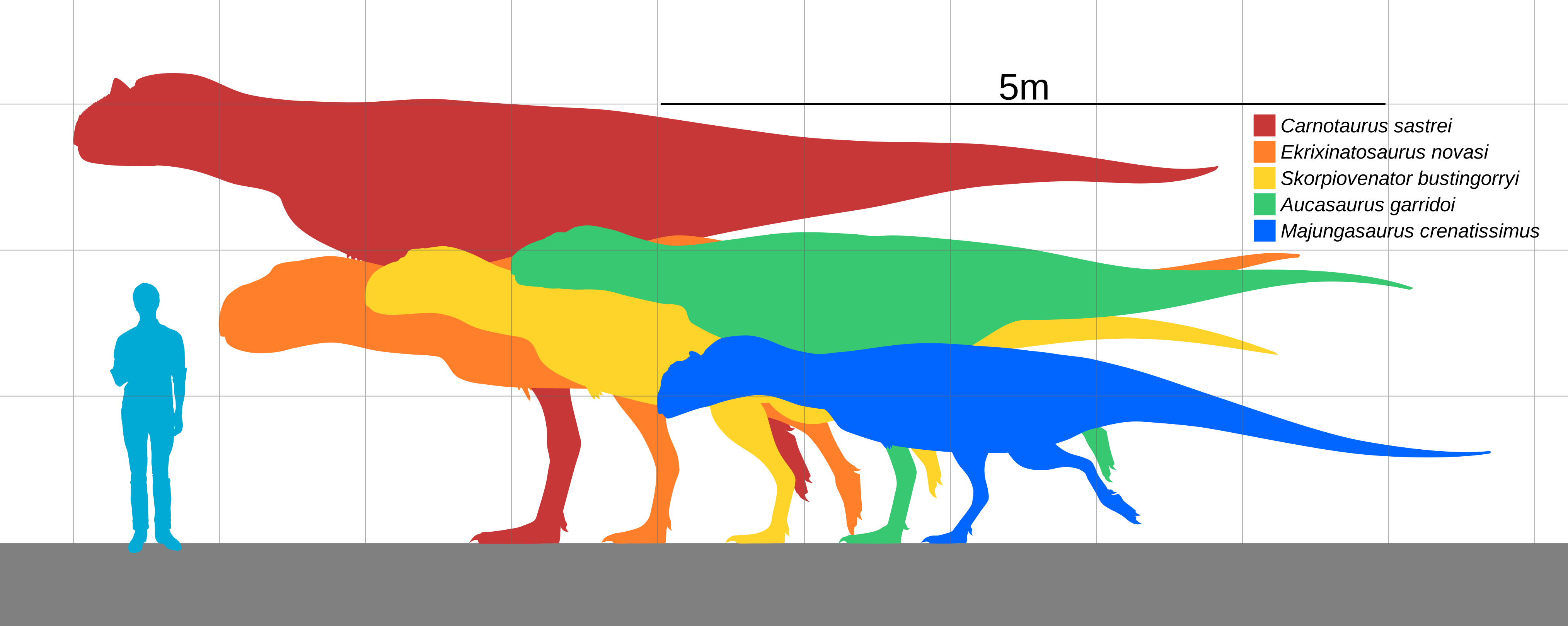
Comprehensive monograph revisiting the entire discovery history and taxonomy of Majungasaurus crenatissimus since 1896. Krause and colleagues document the redescription sequence: from Megalosaurus crenatissimus (Depéret, 1896) to Dryptosaurus crenatissimus, then Majungasaurus crenatissimus (Lavocat, 1955), and finally the resolution of the long debate over the cranial dome — initially described as pachycephalosaur 'Majungatholus atopus' by Sues & Taquet (1979) and later recognized as part of the Majungasaurus skull. Phylogenetic analysis places Majungasaurus as sister taxon of Rajasaurus and Indosaurus from India, suggesting an Indo-Madagascan clade distinct from South American forms like Carnotaurus. This topology has profound biogeographic implications: faunal connections between Madagascar and India persisted until at least the Maastrichtian.


Paleoenvironment and paleoecology of Majungasaurus crenatissimus (Theropoda: Abelisauridae) from the Late Cretaceous of Madagascar
Rogers, R.R. et al. · Journal of Vertebrate Paleontology
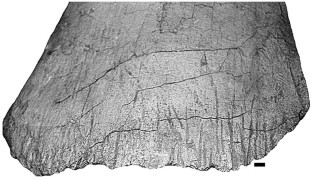
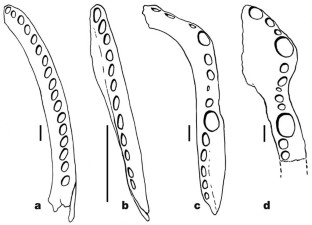
Fundamental study on the paleoenvironment and paleoecology of Majungasaurus crenatissimus in the Maevarano Formation. Rogers and colleagues analyze the formation's sedimentology — oxidized calcareous paleosols with carbonate nodules, indicative of a semi-arid climate with pronounced seasonality — and bonebed patterns. The most impactful finding is direct documentation of cannibalism: Majungasaurus bones bearing tooth marks whose spacing, diameter, and serration pattern exactly match Majungasaurus jaws, identified in two distinct conspecific individuals. Majungasaurus focused on the muscular axial skeleton of its prey. This evidence makes Majungasaurus the only non-avian theropod with cannibalistic behavior directly proven by the fossil record.

Cannibalism in the Madagascan dinosaur Majungatholus atopus
Rogers, R.R., Krause, D.W. & Curry Rogers, K. · Nature
Published in Nature, this paper presented to the world the direct proof of cannibalism in Majungasaurus crenatissimus (then known as Majungatholus atopus). Rogers, Krause, and Curry Rogers analyzed Majungasaurus bones bearing tooth marks and demonstrated through detailed morphometric comparison that the marks were identical to those left on sauropod bones from the same formation: same inter-mark spacing (matching inter-tooth intervals in Majungasaurus jaws), same perforation diameter, and same pattern of lateral striations consistent with the species' serrated teeth. Since Majungasaurus was the only large theropod known from the region, the most parsimonious explanation is that members of the species fed on other members of the species. This paper made Majungasaurus world-famous and is one of the most cited in behavioral paleontology.

An articulated pectoral girdle and forelimb of the abelisaurid theropod Majungasaurus crenatissimus from the Late Cretaceous of Madagascar
Burch, S.H. & Carrano, M.T. · Journal of Vertebrate Paleontology
Study based on a newly discovered articulated Majungasaurus skeleton that preserved a virtually complete pectoral girdle and forelimb for the first time. Burch & Carrano provide the first comprehensive description of these elements, documenting that Majungasaurus forelimbs were even more reduced and morphologically distinct than previously recognized. The scapulocoracoid exhibits unique crests and tubercles that allow inferences about muscle attachment sites. The humerus is short and robust with well-developed muscle insertion processes, suggesting that the forelimbs, despite being vestigial in length, retained robust functional musculature. Antebrachial and manual elements are described for the first time for the species, revealing extreme degrees of reduction.

Jaw biomechanics and the evolution of biting performance in theropod dinosaurs
Sakamoto, M. · Proceedings of the Royal Society B
Sakamoto develops an innovative biomechanical profiling method, computing mechanical advantage at each tooth row position along the entire mandible, and applies it to 41 theropod taxa including Majungasaurus. Results reveal strong phylogenetic signal in biting performance: abelisaurids, including Majungasaurus, display distinct biomechanical profiles reflecting unique skull morphology, with relatively high mechanical advantage at posterior mandibular positions. For Majungasaurus, estimates based on Sakamoto's data were later refined to approximately 3,140 N at the anterior jaw and 7,845 N at the posterior jaw, values corresponding to a predator specialized in large prey like sauropods. The study demonstrates that bite performance evolution in theropods does not depart from Brownian motion, suggesting absence of disruptive selective pressure.


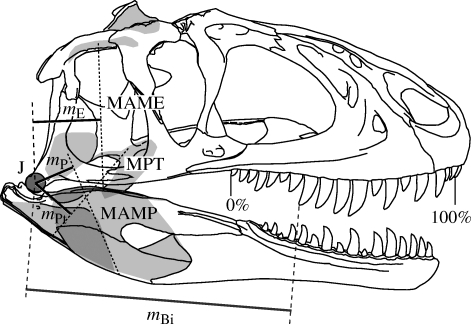
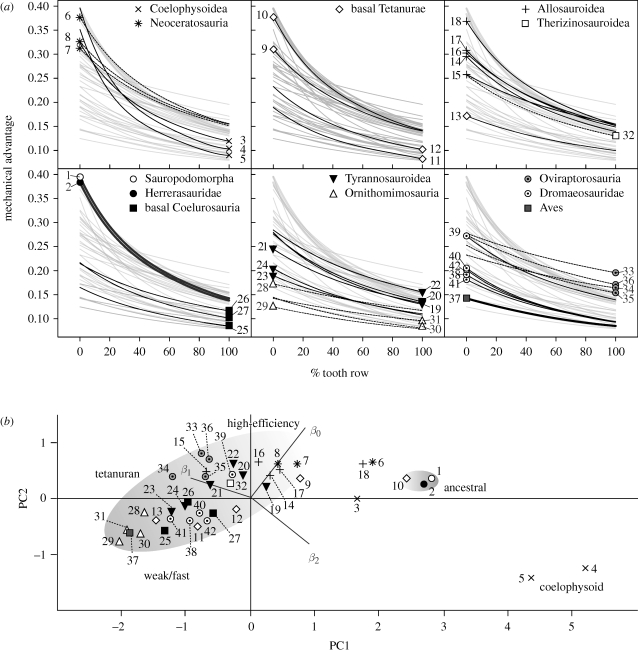
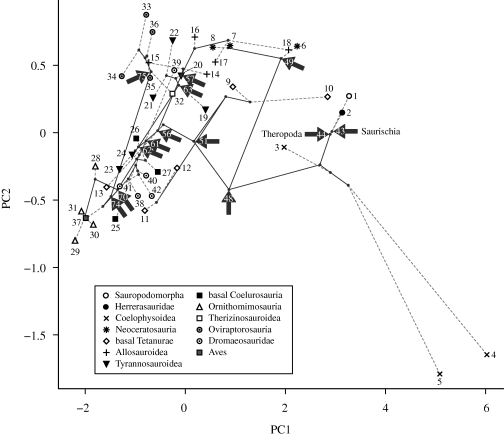
Pathology in Majungasaurus crenatissimus (Theropoda: Abelisauridae) from the Late Cretaceous of Madagascar
Farke, A.A. & O'Connor, P.M. · Journal of Vertebrate Paleontology
First systematic paleopathology study in Majungasaurus crenatissimus, identifying pathological conditions in multiple specimens from the Maevarano Formation collection. Farke & O'Connor document healed fractures, osteomyelitis (bone infection), and stress reactions in vertebrae, ribs, gastralia, and limb elements. The distribution of pathologies suggests these injuries accumulated throughout individual lives from multiple separate traumatic events, not from a single injury. The relatively high frequency of pathologies in Majungasaurus is comparable to that observed in large theropods like T. rex and Allosaurus, possibly reflecting an active lifestyle and violent intraspecific competition. Bite marks on cervical vertebrae of some specimens suggest attacks to the neck region during intraspecific combat.


The paranasal air sinuses of predatory and armored dinosaurs (Archosauria: Ornithodira) and their contribution to cephalic structure
Witmer, L.M. & Ridgely, R.C. · The Anatomical Record
Witmer & Ridgely use computed tomography to investigate paranasal air sinuses in predatory and armored dinosaurs including Majungasaurus crenatissimus. The study reveals that the Majungasaurus skull was internally far more complex than its outer surface indicates: paranasal sinuses extensively invaded facial bones — nasal, maxillary, lacrimal, and prefrontal — creating an air chamber that substantially reduced head weight. This extensive pneumatization may have served multiple functions: weight reduction, possible cranial thermoregulation, and amplification of vocal signals. The rugose nasal horn of Majungasaurus was supported by internally hollow bone, ruling out the hypothesis that it was an intraspecific combat structure and suggesting a display or sexual selection function.


A new abelisaurid dinosaur from the Late Cretaceous of southern France: palaeobiogeographical implications
Tortosa, T. et al. · Annales de Paléontologie
Tortosa and colleagues describe a new abelisaurid from the Late Cretaceous of southern France (Arcovenator escotae) and perform comprehensive phylogenetic analysis resulting in formal recognition of Majungasaurinae as a distinct subfamily within Abelisauridae. Majungasaurinae includes Majungasaurus from Madagascar along with Rajasaurus and Indosaurus from India, and possibly European forms. This analysis has significant biogeographic implications: if Majungasaurus-type abelisaurids were present in Europe and India in addition to Madagascar, much more complex dispersal patterns need to be invoked to explain the global distribution of the group at the end of the Cretaceous. The formal definition of subfamily Majungasaurinae by Tortosa et al. is widely adopted in subsequent literature.


Ontogenetic changes in the craniomandibular skeleton of the abelisaurid dinosaur Majungasaurus crenatissimus from the Late Cretaceous of Madagascar
Canale, J.I. et al. · Acta Palaeontologica Polonica
Canale and colleagues examine morphological changes in the craniomandibular elements of Majungasaurus crenatissimus across a partial ontogenetic growth series, from juveniles to full adults. The study reveals significant intraspecific ontogenetic variability: juveniles have taller and narrower skulls with proportions distinct from the robust, wide adult form; the nasal horn was not fully developed in young individuals. These ontogenetic changes are fundamental for correctly interpreting intraspecific diversity within Majungasaurus and for avoiding juveniles being mistakenly described as distinct species. The work also demonstrates that changes in cranial proportions during growth would imply different biomechanical bite capacities at different ontogenetic stages, suggesting juveniles and adults could exploit different food resources.


Paleopathology in a nearly complete skeleton of Majungasaurus crenatissimus (Theropoda: Abelisauridae)
Gutherz, S.B. et al. · Cretaceous Research
Gutherz and colleagues examine a nearly complete Majungasaurus crenatissimus skeleton (FMNH PR 2836) and identify evidence of multiple pre-mortem pathologies in various bones. Documented conditions include jugal and quadratojugal infection (possibly osteomyelitis), healed fractures and hypertrophic bone growth on dorsal ribs and gastralia, septic arthritis in the forelimb, and bite marks on a cervical vertebra. The authors interpret these injuries as resulting from multiple non-fatal events over the individual's lifetime, rather than a single traumatic event. The pattern — an individual accumulating multiple pathologies — is observed in other large theropods like T. rex and may reflect individual longevity, intense intraspecific competition, or the physical cost of predating large prey.

Myology of the forelimb of Majungasaurus crenatissimus (Theropoda, Abelisauridae) and the morphological consequences of extreme limb reduction
Burch, S.H. · Journal of Anatomy
Sara Burch performs the phylogenetic muscular reconstruction of the Majungasaurus crenatissimus forelimb, using the crests, tubercles, and muscle attachment scars preserved on the humerus (FMNH PR2836), ulna (UA 9860), and humerus (FMNH PR 2423). The most surprising result is that despite extreme length reduction, Majungasaurus forelimbs retained robust and functional musculature — they were not simply non-functional vestiges. Comparison with living tetrapods with analogous vestigial limbs (snakes with pelvic spurs, whales with residual pelvic limbs, lizards with reduced limbs) reveals that extreme limb reduction evolves through predictable morphological pathways. The detailed muscle maps produced by Burch constitute the definitive reference for biomechanical reconstructions of abelisaurid forelimbs.


Famous museum specimens
FMNH PR 2100
Field Museum of Natural History, Chicago, Illinois, EUA
Virtually complete and disarticulated skull of Majungasaurus crenatissimus, the most complete and best-preserved abelisaurid skull ever found. It is the primary specimen for Sampson & Witmer's (2007) craniofacial monograph and remains the global anatomical reference for the species.
FMNH PR 2836
Royal Ontario Museum / Field Museum of Natural History
Nearly complete skeleton including articulated skull with neck, also preserving articulated pectoral girdle and forelimb — unique in the history of the species. This specimen is the object of multiple anatomical studies, including Burch & Carrano's (2012) forelimb study, Burch's (2017) myology, and Gutherz et al.'s (2020) paleopathology study documenting multiple pre-mortem injuries.
MNHN.MAJ 1
Muséum National d'Histoire Naturelle, Paris, França
Official neotype of Majungasaurus crenatissimus, consisting of a partial dentary collected by Depéret in 1895-96 near the Betsiboka River. Although fragmentary, it is historically the founding specimen of the species and is deposited in the paleontological collection of France's national natural history museum.
In cinema and popular culture
Majungasaurus crenatissimus came to screens later than more famous dinosaurs, but since its first notable television appearance in the series When Dinosaurs Ruled (2000, Discovery Channel), narrated by Jeff Goldblum, it has maintained a constant presence in paleontology documentaries. The watershed moment was the 2003 publication in Nature of cannibalism evidence, which made Majungasaurus globally recognizable as the 'cannibal dinosaur'. From this point on, it became a frequent character in documentaries exploring extreme behaviors: Planet Dinosaur (BBC, 2011) dedicated an entire episode to evidence of cannibalism and sauropod predation. Dinosaur Revolution (Discovery/Science, 2011) portrayed it with complex and physically convincing ecological behaviors. The most scientifically accurate depiction to date is Prehistoric Planet (Apple TV+, 2022-2023), which based its version directly on specimen FMNH PR 2836 and pathologies documented by modern researchers, producing an animal that seems to leap from the pages of scientific publications. Majungasaurus did not appear in blockbuster science fiction films like Jurassic Park, preserving its predominantly scientific rather than popular image.
Classification

Discovery
Fun fact
Majungasaurus crenatissimus is the only non-avian theropod dinosaur with direct, proven evidence of cannibalism: its own fossil bones bear tooth marks whose spacing, diameter, and serration pattern exactly match the jaws of its own species.
Last reviewed: April 24, 2026