
Maiasaura
Maiasaura peeblesorum
"Good mother lizard of Peebles"
About this species
Maiasaura peeblesorum was a large hadrosaurid that lived during the Late Cretaceous, approximately 77 to 74 million years ago, on the coastal plains of what is now Montana, USA. Described by Jack Horner and Robert Makela in 1979, its name means 'good mother lizard', a direct reference to nesting colonies discovered at Egg Mountain, where eggs, hatchlings, and adults were found together, providing evidence of parental care. With over 200 known specimens across all age ranges, it is one of the best-documented dinosaurs. It is also notable for being the first dinosaur to travel to space.
Geological formation & environment
The Two Medicine Formation, deposited between approximately 83 and 74 million years ago in the Campanian, outcrops mainly in northwestern Montana. It represents an inland environment of alluvial plains, meandering rivers, and seasonal lakes, distant from the Western Interior Seaway. The climate was seasonally semi-arid with intense volcanic episodes from the magmatic arc to the west. Besides Maiasaura, the formation preserved one of the most diverse faunas of the North American Cretaceous, including ceratopsids (Einiosaurus, Achelousaurus), tyrannosaurids (Daspletosaurus horneri), ornithomimosaurs, dromaeosaurids, and multiple hadrosaurid taxa. Egg Mountain, within this formation, is one of the world's most important paleontological sites.
Image gallery
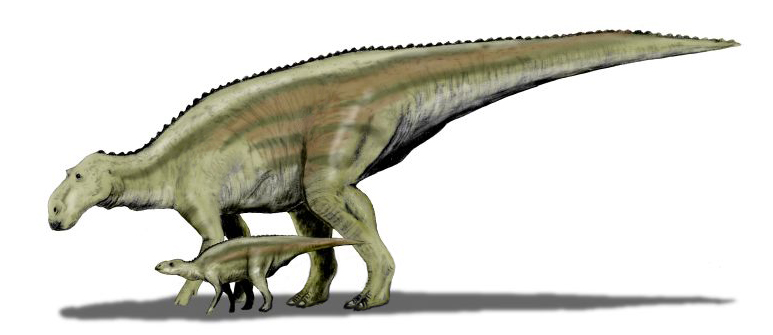




Life reconstruction of Maiasaura peeblesorum by Nobu Tamura (2008), based on adult specimens from the Two Medicine Formation of Montana.
Nobu Tamura — CC BY 3.0
Ecology and behavior
Habitat
Maiasaura peeblesorum inhabited coastal plains and river valleys of what is now Montana during the late Campanian (77 to 74 Ma). The environment was dominated by conifer and cycad forests with seasonal floodplains. The Two Medicine Formation represents an inland environment, distant from the Western Interior Seaway, with a seasonal semi-arid climate. The associated fauna included the tyrannosaurid Daspletosaurus horneri as the main predator, ceratopsids such as Einiosaurus and Achelousaurus, the dromaeosaurid Bambiraptor, and multiple hadrosaurid species coexisting in the same ecosystem.
Feeding
As a herbivore, Maiasaura used its sophisticated dental battery to process large volumes of tough vegetation, including palm leaves, conifers, and low-growing flowering plants. The hadrosaurid dental battery is the most advanced of all reptiles, with hundreds of continuously replaced teeth forming an efficient grinding surface. The toothless horny beak at the front of the jaw was used to cut branches. The diet was probably opportunistic, varying with the seasonal availability of plants.
Behavior and senses
Maiasaura has the most robust evidence of parental behavior and complex social life of any dinosaur. Egg Mountain nesting colonies contained nests spaced about 7 meters apart, with juveniles remaining in the nest until reaching at least twice their birth size, being fed by adults. Herds with potentially thousands of individuals migrated seasonally. Bone beds with multiple age classes indicate cohesive family groups. Nesting site fidelity, with return to the same colony over several generations, is comparable to the behavior of modern seabirds.
Physiology and growth
Maiasaura bone histology reveals extremely rapid growth for an animal of its size, reaching adult dimensions of approximately 7 to 9 meters in only 6 to 8 years. The vascularized fibrolamellar tissue is identical to that of high-metabolic-rate mammals and birds, providing robust evidence of endothermy or mesothermy. Annual growth rings (LAGs) allow precise age determination. Maiasaura's growth rate is comparable to that of modern bird species of similar size, such as emus or ostriches. The high juvenile mortality of nearly 90% in the first year contrasted with significantly higher survival after that critical phase.
Paleogeography
Continental configuration

Scotese & Vérard · CC BY 4.0 · Cretaceous, ~105 Ma
Fossil sites

Fowler & Horner, 2015 — CC BY 2.5
During the Campaniano (~77–74 Ma), Maiasaura peeblesorum inhabited Laramidia, the western half of present-day North America, separated from the east by the Western Interior Seaway, a shallow sea dividing the continent. The continents were in very different positions: India was drifting toward Asia, Antarctica was still connected to Australia, and South America was an isolated island.
Bone Inventory
Species known from over 200 specimens covering all age ranges, from embryos and hatchlings to complete adults. The Egg Mountain locality yielded articulated skeletons, nests, eggs, and preserved embryos. Several adult specimens are nearly complete. Bone histology has been extensively studied using samples from different ages, making Maiasaura one of the dinosaurs with the best-documented ontogeny in the fossil record.
Found elements
Inferred elements
Scientific Literature
15 papers in chronological order — from the original description to recent research.
Nest of juveniles provides evidence of family structure among dinosaurs
Horner, J.R. & Makela, R. · Nature
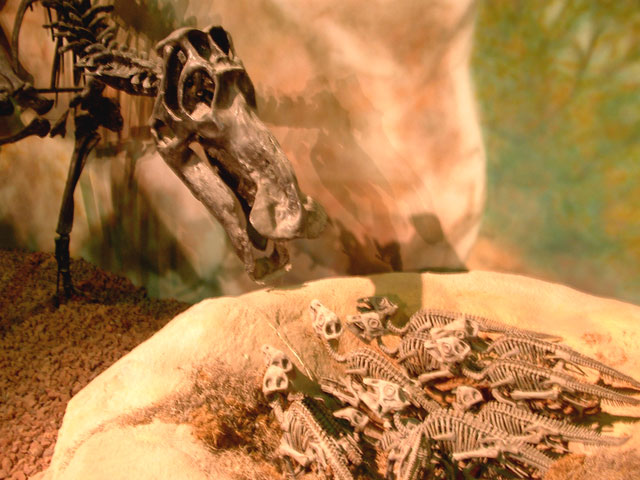
The founding paper of the species: Jack Horner and Robert Makela describe Maiasaura peeblesorum based on a nest with 15 juveniles discovered by Marion Brandvold at Egg Mountain, Montana. The hatchlings showed tooth wear indicating they were feeding within the nest before leaving it, interpreted as evidence of active parental care by adults. The name 'good mother lizard' was chosen to honor this unprecedented behavior documented in the dinosaur fossil record. The work fundamentally transformed scientific perception of dinosaur reproductive behavior and was published in Nature.
Evidence of colonial nesting and 'site fidelity' among ornithischian dinosaurs
Horner, J.R. · Nature
Horner documents colonial nesting behavior in Maiasaura peeblesorum based on localities discovered at Egg Mountain, Montana. Nests were spaced approximately 7 meters apart, a distance compatible with adult body length, suggesting a sophisticated degree of social organization. Evidence of site fidelity indicates that colonies returned to the same nesting grounds in different reproductive seasons, a behavior comparable to modern birds. The paper established Maiasaura as a fundamental model for studies of social behavior in non-avian dinosaurs.

A comparative embryological study of two ornithischian dinosaurs
Horner, J.R. & Weishampel, D.B. · Nature
Horner and Weishampel compare embryonic specimens of Maiasaura peeblesorum and Hypacrosaurus altispinus to assess the degree of maturity at hatching (altricial versus precocial). Results indicate that Maiasaura hatchlings were born with poorly ossified bone joints, requiring prolonged parental care in the nest before acquiring mobility. Comparison with hypsilophodontid embryos reveals diverse reproductive strategies within ornithischians. The study inaugurated the field of dinosaur embryology as a tool for inferring parental behavior from the fossil record.


The nesting behavior of dinosaurs
Horner, J.R. · Scientific American
Horner presents to the general public the synthesis of discoveries from Egg Mountain, describing in detail the nesting behavior of Maiasaura peeblesorum. The article describes colony organization, the structure of earth nests with decomposing vegetation for incubation, and evidence of juveniles being fed by adults. The analogy with modern birds such as ibis and herons is explored in detail. The work consolidated Maiasaura's image as a symbol of parental care among dinosaurs and spurred a generation of paleobiological research on reproductive behavior.

Long bone histology of the hadrosaurid dinosaur Maiasaura peeblesorum: growth dynamics and physiology based on an ontogenetic series of skeletal elements
Horner, J.R., de Ricqlès, A. & Padian, K. · Journal of Vertebrate Paleontology
Horner, de Ricqlès, and Padian carry out the most comprehensive histological analysis ever performed for Maiasaura peeblesorum, using a growth series of tibiae and femora from individuals of different ages. The bone is dominated by vascularized fibrolamellar tissue identical to that of fast-growing mammals, indicating elevated metabolism. Annual growth rings (LAGs) allow estimation that Maiasaura reached adult size of approximately 7 meters in only 6 to 8 years. The growth rate is comparable to modern birds and mammals, providing robust evidence of endothermy or mesothermy in hadrosaurids.
New information on the cranium of Brachylophosaurus canadensis (Dinosauria, Hadrosauridae), with a revision of its phylogenetic position
Prieto-Márquez, A. · Journal of Vertebrate Paleontology
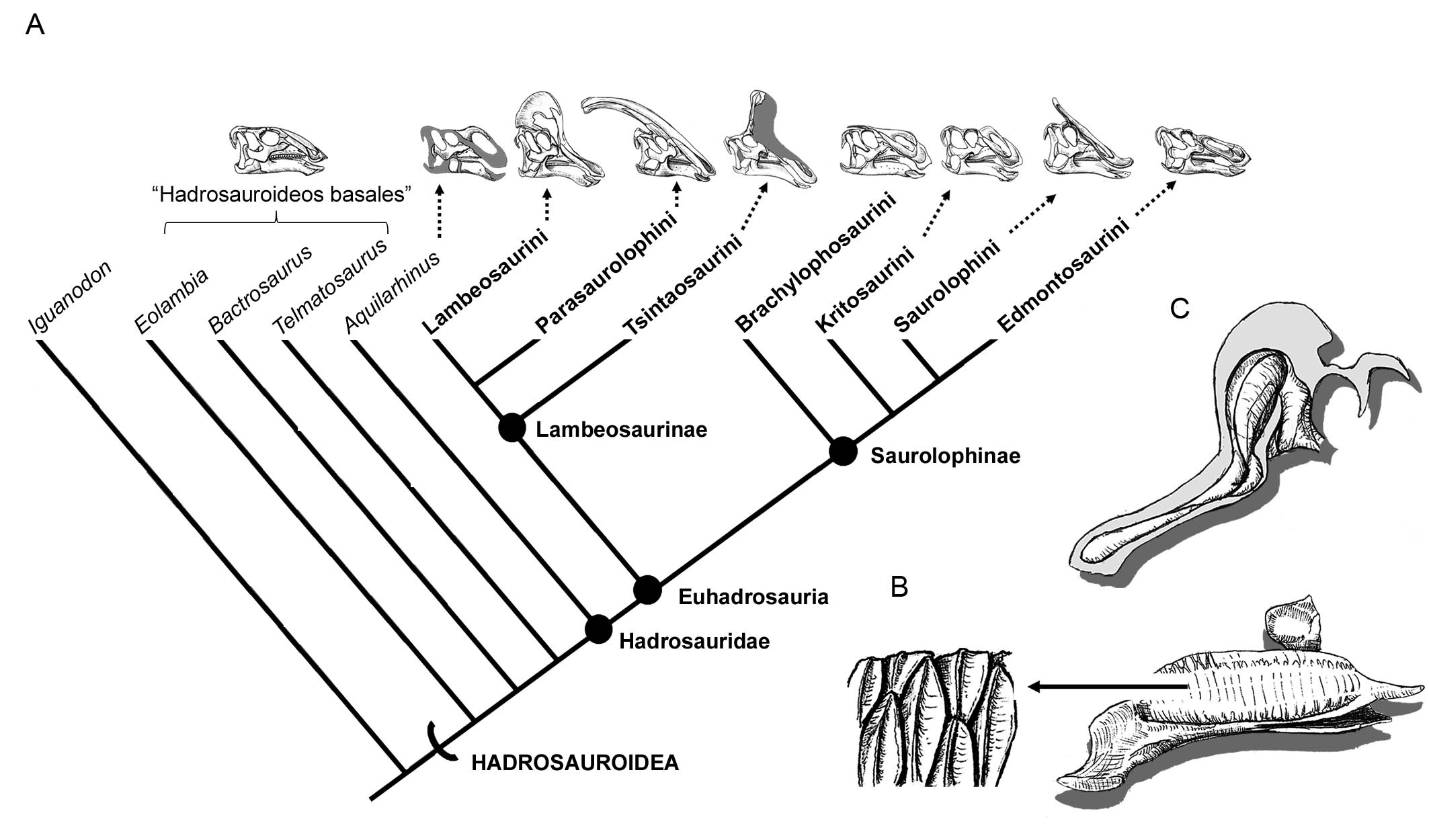
Prieto-Márquez redescribes the cranium of Brachylophosaurus canadensis and performs a phylogenetic analysis positioning it as the sister taxon of Maiasaura peeblesorum within Hadrosaurinae. This work is essential for understanding the phylogenetic context of Maiasaura, which emerges as a basal representative of the clade Brachylophosaurini. The character matrix includes over 150 cranial and postcranial characters, providing the most robust definition of the clade and the synapomorphies uniting Maiasaura with other brachylophosaurines. The synonymization of B. goodwini with B. canadensis simplifies the taxonomy of Maiasaura's sister group.


New unadorned hadrosaurine hadrosaurid (Dinosauria, Ornithopoda) from the Campanian of North America
Gates, T.A., Horner, J.R., Hanna, R.R. & Nelson, C.R. · Journal of Vertebrate Paleontology
Gates et al. describe Acristavus gagslarsoni, a new crestless hadrosaurid from the Two Medicine Formation of Montana, the same formation where Maiasaura peeblesorum was found. Acristavus is positioned as the oldest member of clade Brachylophosaurini, implying that the common ancestor of Maiasaura and Brachylophosaurus lacked cranial ornamentation. The formalization of clade Brachylophosaurini provides the precise evolutionary context to interpret Maiasaura's position as a member without elaborate crest within a group that evolved diverse crests.

A New Brachylophosaurin Hadrosaur (Dinosauria: Ornithischia) with an Intermediate Nasal Crest from the Campanian Judith River Formation of Northcentral Montana
Freedman Fowler, E.A. & Horner, J.R. · PLOS ONE
Freedman Fowler and Horner describe Probrachylophosaurus bergei, a new brachylophosaurine with a nasal crest intermediate between the crestless Acristavus and the paddle-crested Brachylophosaurus. The analysis positions Maiasaura peeblesorum as a member of the clade with a moderate crest, representing an alternative evolutionary stage in the diversification of nasal crests. Histology confirms the holotype's maturity. The discovery demonstrates that Brachylophosaurini, Maiasaura's group, experienced multiple evolutionary experiments in cranial morphology throughout the Campanian.


Hadrosaurid and lambeosaurid bone beds from the Upper Cretaceous Two Medicine Formation of Montana: taphonomic and biologic implications
Varricchio, D.J. & Horner, J.R. · Canadian Journal of Earth Sciences
Varricchio and Horner taphonomically and biologically analyze bone beds of hadrosaurids from the Two Medicine Formation, including the large Maiasaura peeblesorum bonebed with thousands of specimens. Taphonomic analysis indicates mass mortality of gregarious herds, possibly caused by extreme climatic events such as droughts or volcanism. Demographic data reveal populations structured by age classes, with high juvenile mortality. The study is the basis for estimates of Maiasaura herd size potentially reaching tens of thousands of individuals in seasonal migrations.

An ontogenetic perspective on locomotion in the Late Cretaceous dinosaur Maiasaura peeblesorum (Ornithischia: Hadrosauridae)
Dilkes, D.W. · Canadian Journal of Earth Sciences
Dilkes analyzes limb proportions of Maiasaura peeblesorum in a complete ontogenetic series to reconstruct locomotor transition during development. Juveniles under 4 years show limb proportions closer to bipeds, while adults show relative reduction of hindlimbs and increased anterior body mass, favoring quadrupedal locomotion. The study documents that the bipedal-to-quadrupedal transition was gradual and body-size related, not a discrete ontogenetic switch. This analysis is a fundamental reference for postural and locomotor reconstructions of Maiasaura.
Marine transgressions and the evolution of Cretaceous dinosaurs
Horner, J.R., Varricchio, D.J. & Goodwin, M.B. · Nature
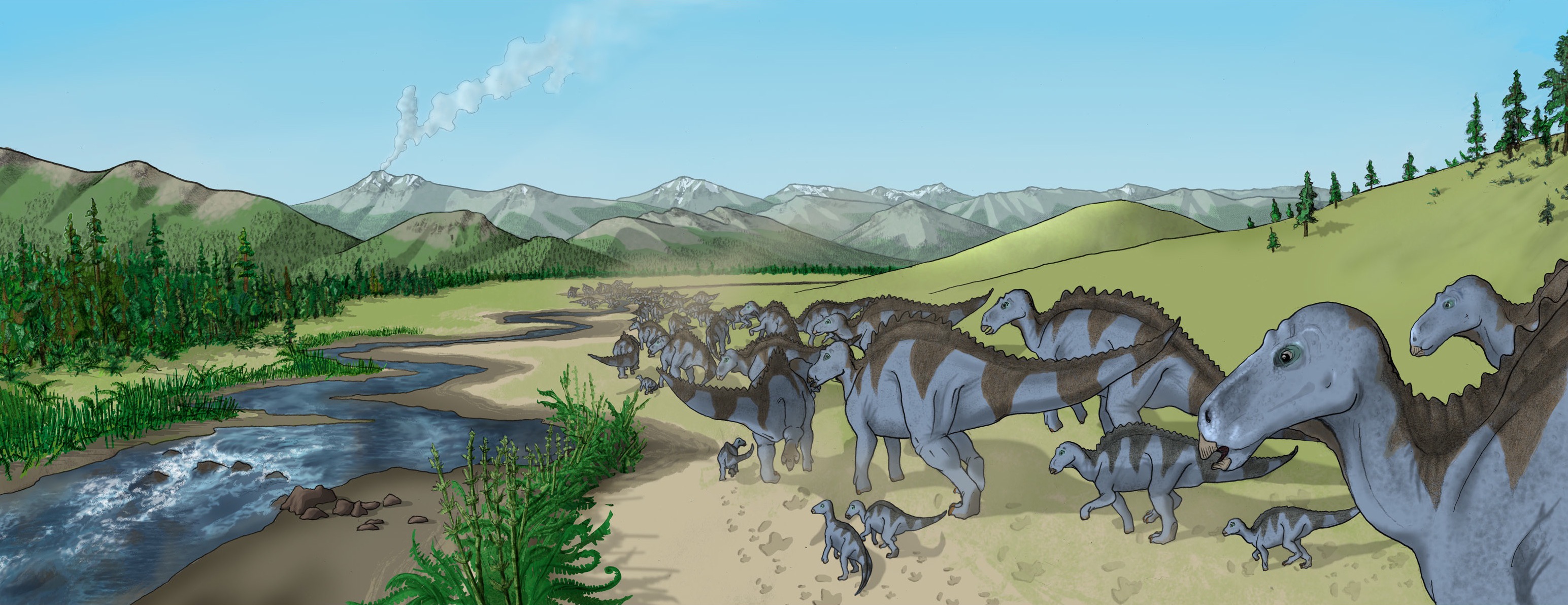
Horner, Varricchio, and Goodwin investigate the relationship between marine transgressions of the Western Interior Seaway and dinosaur faunal turnover in the Two Medicine Formation. The work demonstrates that sea level fluctuations directly influenced habitat availability and evolutionary patterns of hadrosaurids, including Maiasaura peeblesorum. Transgressions created habitat islands that favored allopatric speciation and rapid diversification. The study provides the essential paleogeographic and paleoenvironmental context for understanding why such high hadrosaurid diversity coexisted in the Two Medicine Formation.


The postcranial skeleton of the hadrosaur Maiasaura peeblesorum
Forster, C.A. · Journal of Vertebrate Paleontology
Forster publishes the first detailed osteological description of the postcranial skeleton of Maiasaura peeblesorum, complementing the original description by Horner and Makela (1979) which had focused mainly on the skull and juveniles. The work systematically documents the vertebral column, pectoral girdle, forelimbs, pelvic girdle, and hindlimbs, identifying postcranial autapomorphies that distinguish Maiasaura from other hadrosaurids. The description became an indispensable reference for subsequent comparative and phylogenetic studies involving the species.

Dinosaurian growth rates and bird origins
Padian, K., de Ricqlès, A.J. & Horner, J.R. · Nature
Padian, de Ricqlès, and Horner compare bone histology of multiple dinosaur taxa, including Maiasaura peeblesorum, to evaluate growth rates in evolutionary perspective. Data demonstrate that non-avian dinosaurs grew rapidly like modern birds and mammals, contradicting the slow-growth model of ectothermic reptiles. Maiasaura is presented as a central case study, with growth rates indicating maturity attainment in less than a decade. The Nature paper was one of the most influential contributions to the paradigm shift on dinosaur physiology.


Dinosaur origin of egg color: oviraptors to modern birds
Wiemann, J., Fabbri, M., Yang, T.R., Bhullar, B.A.S., Norell, M.A. & Vinther, J. · PeerJ
Wiemann et al. perform chemical analysis of eggshells from various dinosaurs, including hadrosaurid material related to Maiasaura, detecting preserved biliverdin and protoporphyrin pigments. Results suggest egg coloration evolved multiple times in dinosaurs and was present in hadrosaurids. The work has direct implications for interpreting Maiasaura's reproductive biology: nests with colored eggs could have served for camouflage or species recognition in dense colonies like those at Egg Mountain. Published in PeerJ, it is one of the most innovative studies on hadrosaurid reproductive paleobiology.

Morphological and taxonomic diversity of Hadrosauriformes and the origin of duck-billed dinosaurs
Stubbs, T.L., Benton, M.J., Elsler, A. & Prieto-Márquez, A. · Paleobiology
Stubbs et al. perform quantitative analysis of morphological disparity and diversification rates in Hadrosauriformes using geometric morphometrics and phylogenetic comparative methods. Results reveal a burst of morphological innovation at the origin of Hadrosauridae, with Maiasaura and relatives diversifying body forms and cranial structures at significantly elevated rates during the Campanian. The work provides the macroevolutionary context for understanding why Maiasaura, without elaborate crest, was so ecologically successful in coexisting with heavily ornamented hadrosaurids.

Famous museum specimens
MOR 005 (holótipo) e série de Egg Mountain
Museum of the Rockies, Bozeman, Montana, EUA
The Museum of the Rockies holds the world's largest collection of Maiasaura specimens, including the holotype and hundreds of specimens from Egg Mountain covering all age ranges from embryos to complete adults. It is the reference collection for all studies of the species.
IRSNB R 2062 (esqueleto montado)
Institut Royal des Sciences Naturelles de Belgique, Bruxelas, Bélgica
Adult specimen mounted in quadrupedal position, one of the few complete Maiasaura skeletons displayed outside the United States. The Brussels mount was instrumental in popularizing the species in Europe and has been photographed for various scientific publications.
Espécime do Experimentarium
Experimentarium, Copenhague, Dinamarca
Skeleton mounted on public display at Copenhagen's science museum, serving as an educational reference for the European public. The specimen demonstrates the typical postural and morphological characteristics of an adult Maiasaura.
In cinema and popular culture
Maiasaura peeblesorum never achieved the cinematic fame of Tyrannosaurus rex or Velociraptor, but its influence on popular culture is profound and understated. The image of the dinosaur as a devoted parent, popularized by Jack Horner's books and articles since the 1980s, permeates productions depicting herbivore herds and dinosaur parental care. BBC's Walking with Dinosaurs (1999) was the first major television production to show Maiasaura with realistic nesting behavior. In the Jurassic World franchise, the species appears as part of the island's herbivore diversity without a central role. Apple TV+'s Prehistoric Planet (2022) offers the most sophisticated portrait: complex social behavior based on research by Horner, de Ricqlès, and Padian. Maiasaura's designation as Montana's official state fossil (1985) consolidated its iconic status in the USA. The tragedy of the Columbia mission (2003), which carried fragments of the species to space, added a unique emotional dimension to Maiasaura's legacy in contemporary culture.
Classification
Discovery
Fun fact
Maiasaura peeblesorum was the first dinosaur to travel to space: a bone fragment and a fossilized egg were carried by astronaut Loren Acton aboard the Space Shuttle Columbia on mission STS-107 in 2003. Tragically, this mission ended in disaster when Columbia disintegrated during atmospheric reentry on February 1, 2003, killing all seven astronauts aboard. The Maiasaura fragments that survived reentry are currently at the Museum of the Rockies in Bozeman, Montana.
Last reviewed: April 24, 2026