
Kosmoceratops
Kosmoceratops richardsoni
"Richardson's ornate horned face"
About this species
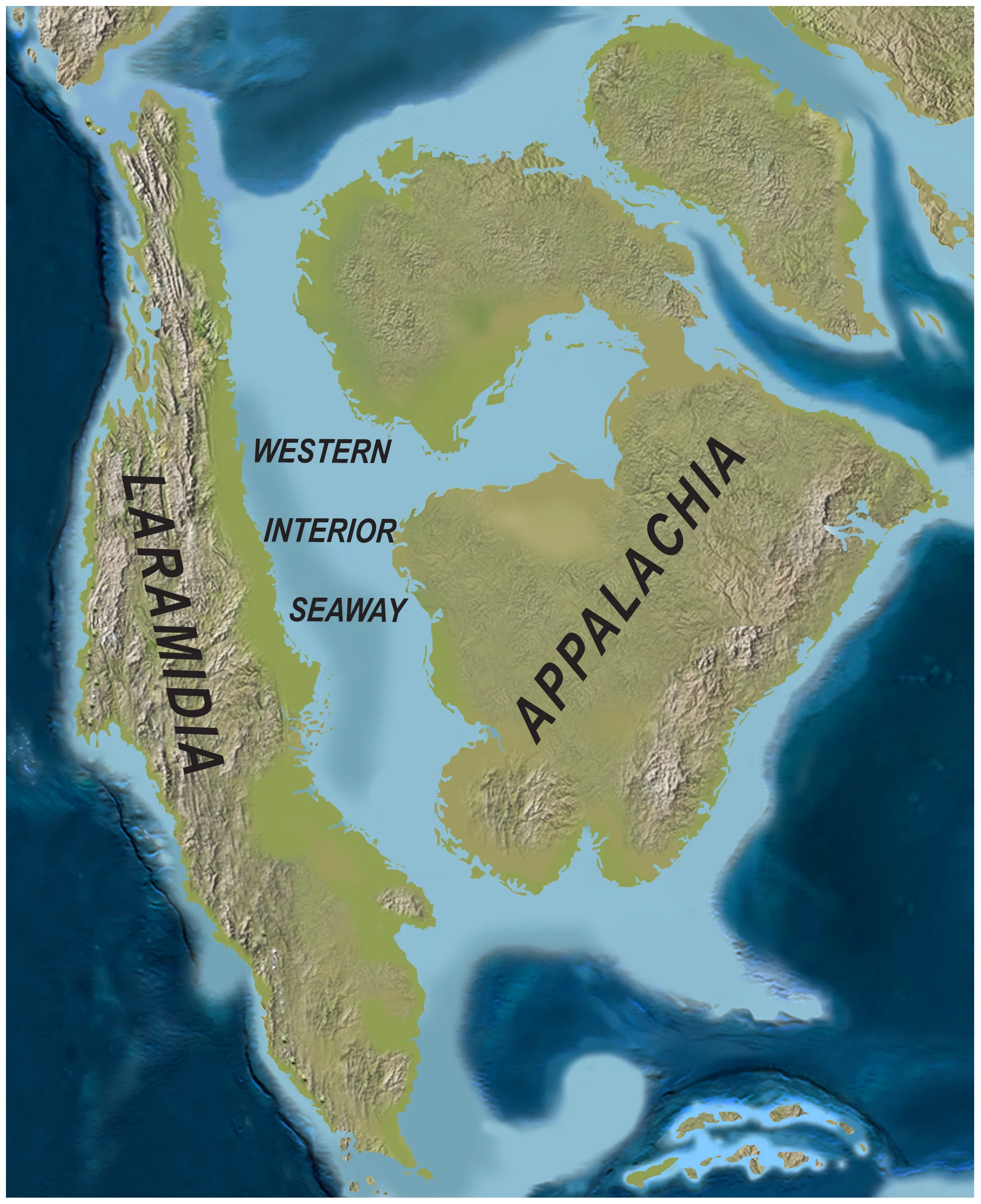
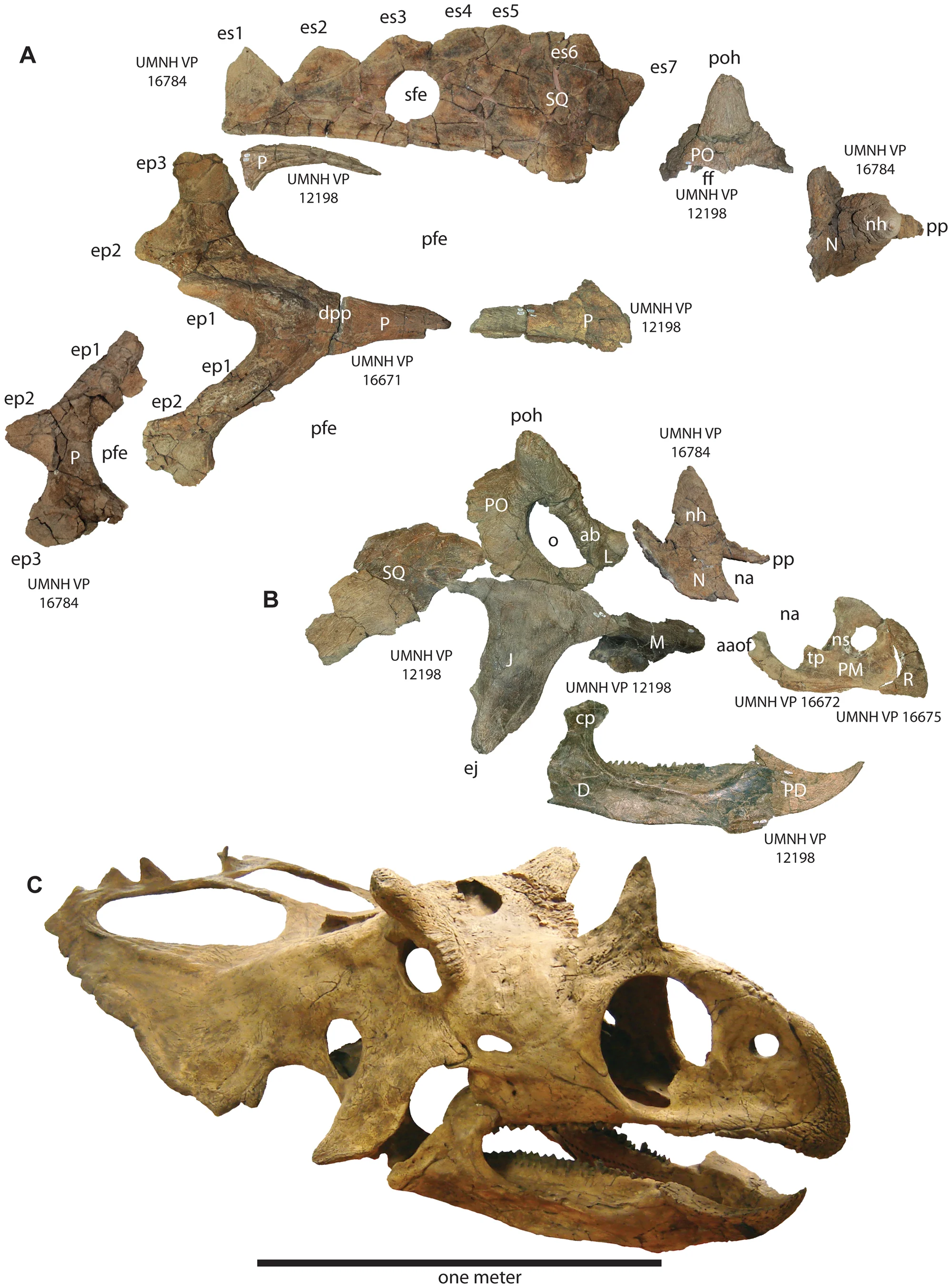
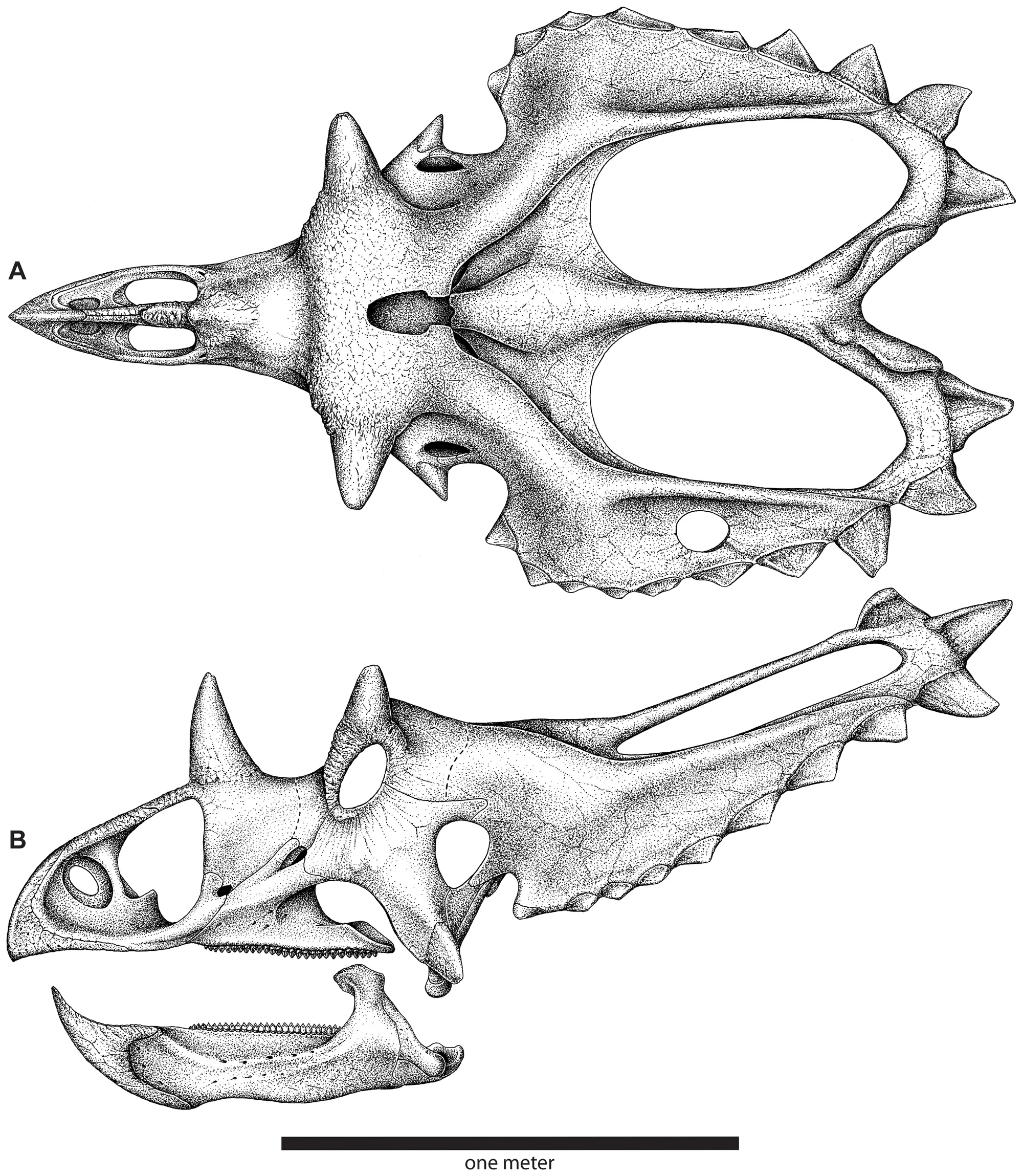
Kosmoceratops richardsoni is the ceratopsian with the most elaborate cranial ornamentation ever documented in dinosaur history: a total of 15 horns and bony structures on the skull, including a large downward-curved nasal horn, two supraorbital horns above the eyes, two jugal horns, two laterally-directed epijugal horns, and ten forward-curving apical processes on the parieto-squamosal frill. No other known dinosaur or fossil vertebrate has such dense and diversified cranial ornamentation. The animal lived approximately 76 to 75.5 million years ago during the late Campanian stage of the Cretaceous, in the region corresponding to the present-day state of Utah in the United States. Kosmoceratops belonged to the fauna of the southern portion of Laramidia Island, a large continental island that existed during the Late Cretaceous when the Western Interior Seaway divided North America into two landmasses. Notably, the southern and northern portions of Laramidia were separated by a shallow internal sea and presented completely distinct dinosaur faunas: while the south (where Kosmoceratops lived) had short-frilled ceratopsians with elaborate ornamentation, the north produced forms with longer frills. This geographic faunal difference was one of the central arguments presented by Sampson et al. (2010) in the paper describing the species. The holotype and referred specimens were collected from the Kaiparowits Formation in southern Utah, one of the most productive Late Cretaceous geological units in North America. The formation dates from the late Campanian (~76.6 to 74.5 Ma) and preserves a rich subtropical ecosystem with multiple species of dinosaurs, crocodilians, turtles, lizards, mammals, and amphibians. Kosmoceratops fossils were collected by the Utah Museum of Natural History between 2004 and 2006 at sites within the Grand Staircase-Escalante National Monument. The function of the extravagant cranial ornamentation is a subject of ongoing scientific debate. Sampson et al. (2010) argue that the structures were primarily for intraspecific display and species recognition, analogous to the horns of modern antelopes and cervids. The fact that the supraorbital horns and frill processes face laterally and forward rather than forward in combat position supports the display hypothesis over the defensive one. Later biomechanical analyses by Mallon and Anderson (2013) suggest that ceratopsids used their horns in ritualized intraspecific combat, not as defense against large predators.
Geological formation & environment
The Kaiparowits Formation is a Late Campanian (~76.6-74.5 Ma) geological unit located in southern Utah, outcropping mainly within Grand Staircase-Escalante National Monument. It represents a subtropical alluvial plain environment with dense angiosperm forests, meandering rivers, and lakes, with a warm and humid climate without pronounced cold seasons. It is considered one of the most diverse formations of the Late Cretaceous in North America, preserving hundreds of specimens of dozens of species of dinosaurs, crocodilians, turtles, lizards, mammals, and amphibians. Fluvial and lacustrine sedimentation favored the preservation of complete or near-complete skeletons in many cases. The Kaiparowits Formation is especially important for the debate about Laramidian faunal endemism because its fauna is radically different from contemporaneous faunas of Alberta and Montana, despite the relatively small geographic distance. Kosmoceratops richardsoni and Utahceratops gettyi are southern endemics, while Chasmosaurus and Anchiceratops are exclusively northern. This faunal difference has been interpreted as evidence of a habitat barrier that divided Laramidia into at least two biogeographic provinces during the late Campanian.
Image gallery
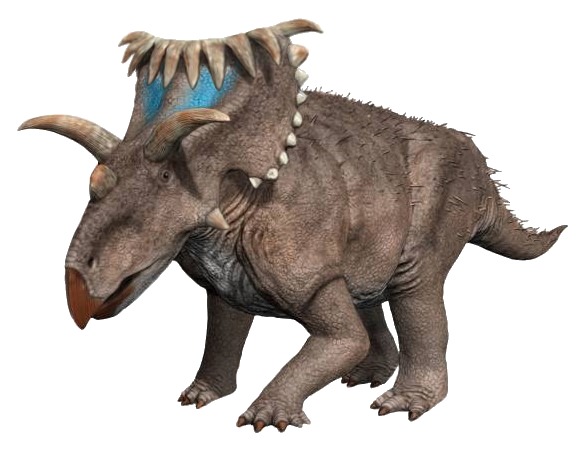


Life reconstruction of Kosmoceratops richardsoni by Nobu Tamura, an ornate Late Cretaceous ceratopsian from Utah, showing its 15 characteristic cranial horns.
Nobu Tamura, Wikimedia Commons, CC BY-SA 4.0
Ecology and behavior
Habitat
Kosmoceratops richardsoni inhabited the southern part of Laramidia Island, in the region corresponding to present-day Utah, during the late Campanian (76-75 Ma). The environment of the Kaiparowits Formation was warm and humid subtropical, with dense angiosperm forests, palms, ferns, and conifers in riparian areas. The climate was without pronounced seasons, with an average annual temperature of ~19-22°C and high precipitation. Associated fauna included Utahceratops gettyi (another ceratopsid), the tyrannosaurid Teratophoneus curriei, hadrosaurids, ankylosaurids, crocodilians, aquatic turtles, multituberculate mammals, and a high diversity of lizards and amphibians. It was one of the most diverse dinosaur ecosystems of the Late Cretaceous in North America.
Feeding
Like all ceratopsids, Kosmoceratops was herbivorous with a powerful chewing apparatus based on tooth batteries with shearing surfaces. The wide horny beak was used to cut low-to-medium vegetation, likely angiosperms, ferns, and cycads. Well-developed temporal and adductor muscles provided high bite force. Ecomorphological analyses suggest that different ceratopsid species partitioned the feeding niche by feeding height: Kosmoceratops, being smaller than Utahceratops, may have specialized on lower vegetation. Plant material processing was efficient and continuous, with constant replacement of functional teeth.
Behavior and senses
The elaborate cranial ornamentation of Kosmoceratops, with 15 distinct elements, strongly points to intraspecific display behavior as the primary function. The lateral position of the frill apical processes maximizes visibility during lateral displays, analogous to those of modern bovids. Evidence of lesions in Triceratops specimens suggests that ceratopsids engaged in ritualized intraspecific combat using the front horns. Kosmoceratops likely lived in gregarious groups, behavior inferred from multi-specimen deposits in other ceratopsid species. The extreme degree of ornamentation may indicate pronounced sexual dimorphism, with more elaborately ornamented individuals having greater reproductive success.
Physiology and growth
Like all Late Cretaceous ornithischians, Kosmoceratops was likely mesothermic to endothermic, with a metabolism higher than that of modern ectothermic reptiles. Ceratopsid bone histology shows fibrolamellar bone tissue with relatively rapid growth rates during juvenile development, slowing at maturity. The presence of tooth batteries with continuous replacement and well-developed masticatory muscles implies high metabolic activity. The large skull, possibly weighing 100-150 kg with the frill, would have required powerful cervical musculature for support. The obligate quadrupedal posture and anteriorly positioned center of mass (due to the large head) imply relatively slow but stable locomotion.
Paleogeography
Continental configuration

Scotese & Vérard · CC BY 4.0 · Cretaceous, ~105 Ma
Fossil sites

Domínio público
During the Campaniano (~76.4–75.5 Ma), Kosmoceratops richardsoni inhabited Laramidia, the western half of present-day North America, separated from the east by the Western Interior Seaway, a shallow sea dividing the continent. The continents were in very different positions: India was drifting toward Asia, Antarctica was still connected to Australia, and South America was an isolated island.
Bone Inventory
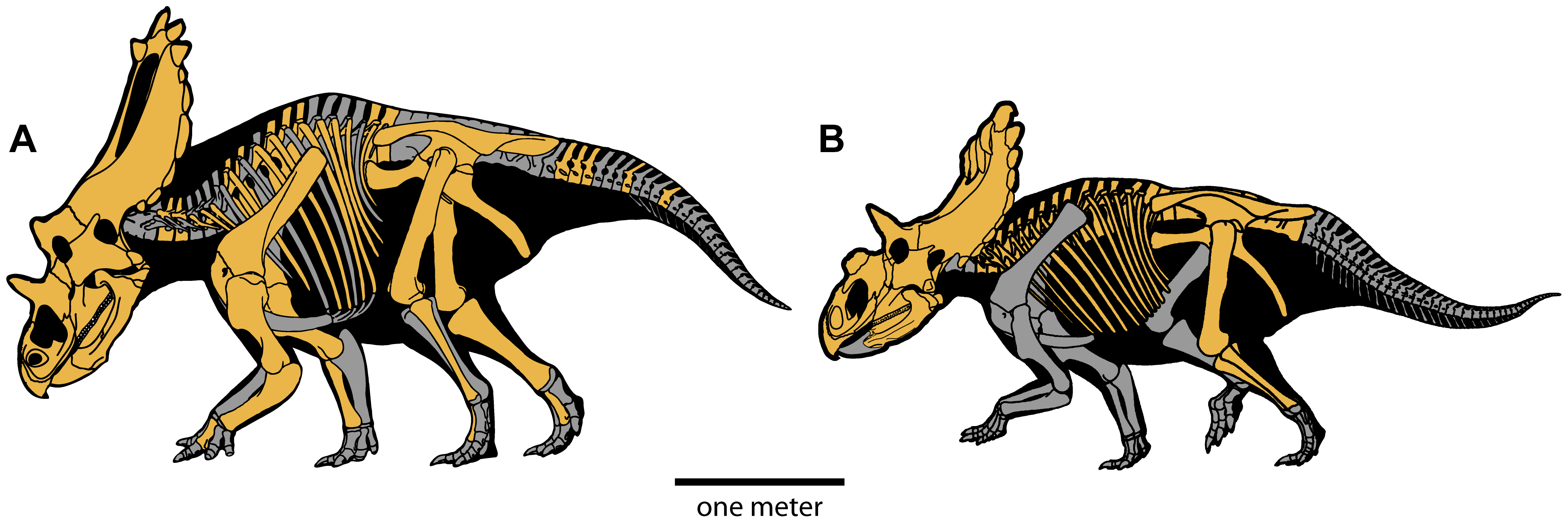
Based on two main specimens (holotype UMNH VP 17000 and referred specimen UMNH VP 20525). The holotype includes a near-complete skull with frill, articulated mandible, and partial post-cranial elements. The referred specimen added pectoral girdle and limb elements. The skull is exceptionally complete, allowing detailed characterization of all 15 ornamental elements. Distal limb elements and complete tail are inferred by comparison with closely related ceratopsids.

Found elements
Inferred elements
Scientific Literature
8 papers in chronological order — from the original description to recent research.
New horned dinosaurs from Utah provide evidence for intracontinental dinosaur endemism
Sampson, S.D., Loewen, M.A., Farke, A.A., Roberts, E.M., Forster, C.A., Smith, J.A. & Titus, A.L. · PLOS ONE
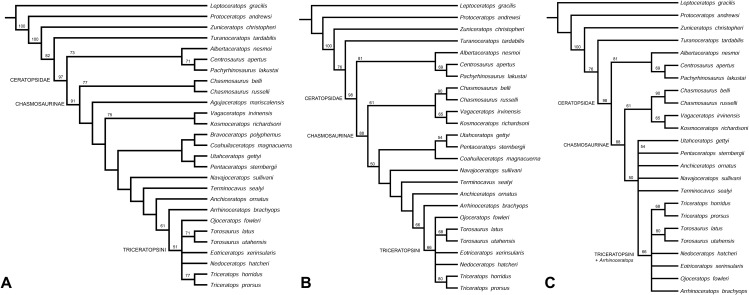
Original description paper for Kosmoceratops richardsoni and Utahceratops gettyi, published in PLOS ONE. Sampson and colleagues present two new ceratopsids from the Campanian Kaiparowits Formation of Utah. Phylogenetic analysis positions both taxa within Chasmosaurinae. The paper documents in detail the 15 cranial ornamentation elements of Kosmoceratops, including the ten anteriorly curved apical processes on the frill, an absolute record among known vertebrates. The central argument of the paper is biogeographic: the southern Laramidia fauna (Utah) was clearly distinct from the northern fauna (Alberta, Montana), suggesting that a geographic barrier of unsuitable habitat divided the island into at least two biogeographic provinces during the late Campanian. This pattern of intracontinental endemism parallels that observed in Madagascar and other large islands today.
Biogeography of terrestrial and freshwater vertebrates from the Late Cretaceous (Campanian) Western Interior of North America
Gates, T.A., Sampson, S.D., Zanno, L.E., Roberts, E.M., Eaton, J.G., Nydam, R.L., Hutchison, J.H., Smith, J.A., Loewen, M.A. & Getty, M.A. · Palaeogeography, Palaeoclimatology, Palaeoecology
Gates and colleagues examine biogeographic patterns of terrestrial and freshwater vertebrates from the Late Cretaceous Western Interior of North America, using faunal similarity indices. The work quantifies the difference between northern and southern Laramidia faunas, demonstrating that Jaccard similarity values between Utah and Alberta are remarkably low for geographically contiguous regions. The paper discusses proposed mechanisms for endemism: latitudinal climatic barriers, vegetation barriers, and gene flow restrictions imposed by Western Interior Seaway topography. Kosmoceratops is used as an exemplar of southern Laramidia endemism. The work was published jointly with the description paper by Sampson et al. (2010) and provides quantitative biogeographic context for interpreting the new Utah species.
Mojoceratops perifania, a new chasmosaurine ceratopsid from the late Campanian of western Canada
Longrich, N.R. · Journal of Paleontology
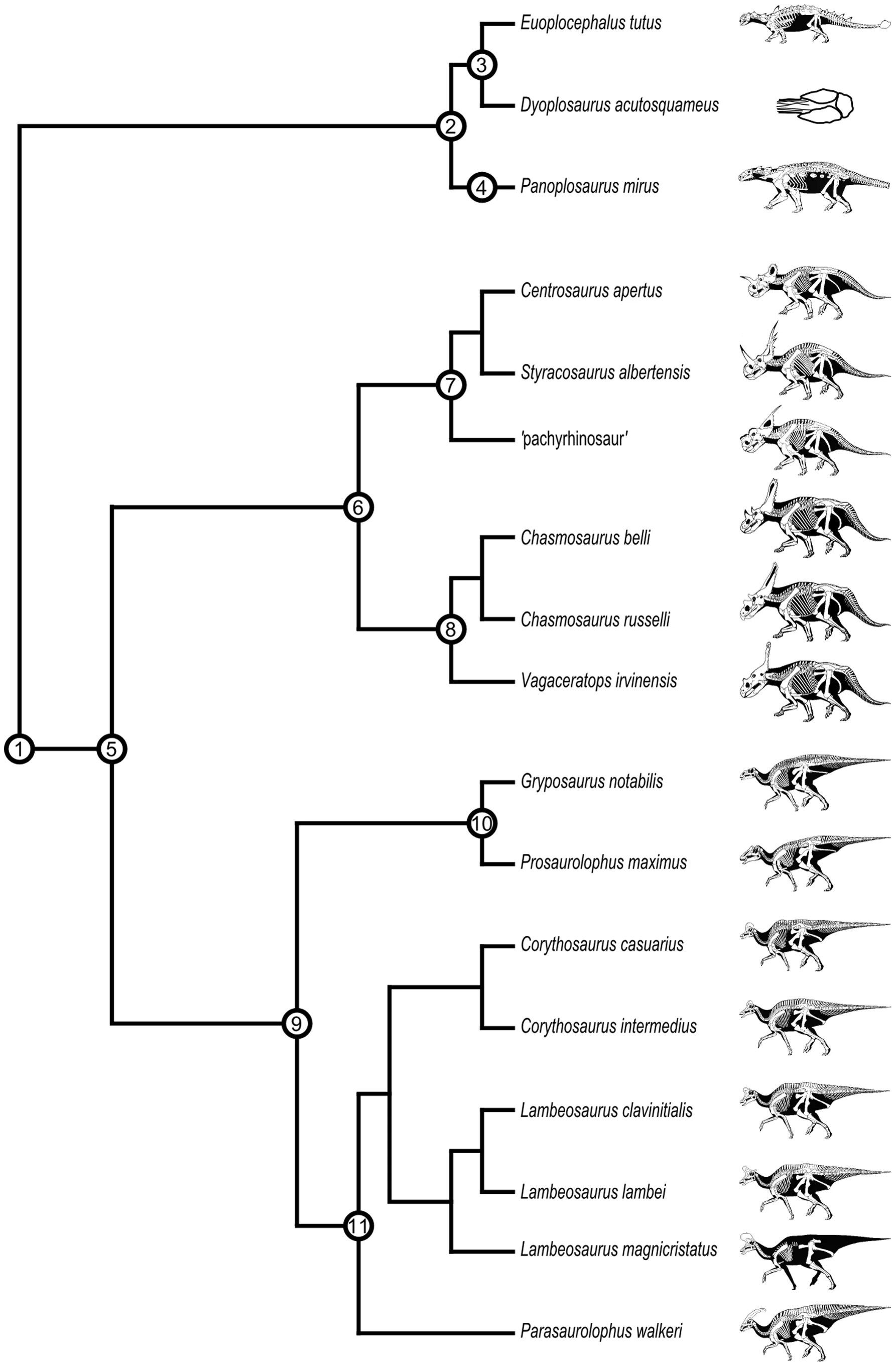
Longrich describes Mojoceratops perifania, a new chasmosaurine ceratopsid from the Campanian of Alberta and Saskatchewan, and conducts a detailed phylogenetic analysis of Chasmosaurinae that includes Kosmoceratops richardsoni as a comparison taxon. The work provides essential phylogenetic context for understanding cranial ornamentation evolution within Chasmosaurinae, positioning Kosmoceratops as one of the most derived members of the group in terms of frill elaboration. The analysis demonstrates that the anteriorly curved apical processes of Kosmoceratops represent an extreme autapomorphy with no parallel in any other ceratopsid. The paper is important for understanding the rapid diversification of chasmosaurines in the late Campanian of Laramidia.
Skull ecomorphology of megaherbivorous dinosaurs from the Dinosaur Park Formation (upper Campanian) of Alberta, Canada
Mallon, J.C. & Anderson, J.S. · PLOS ONE
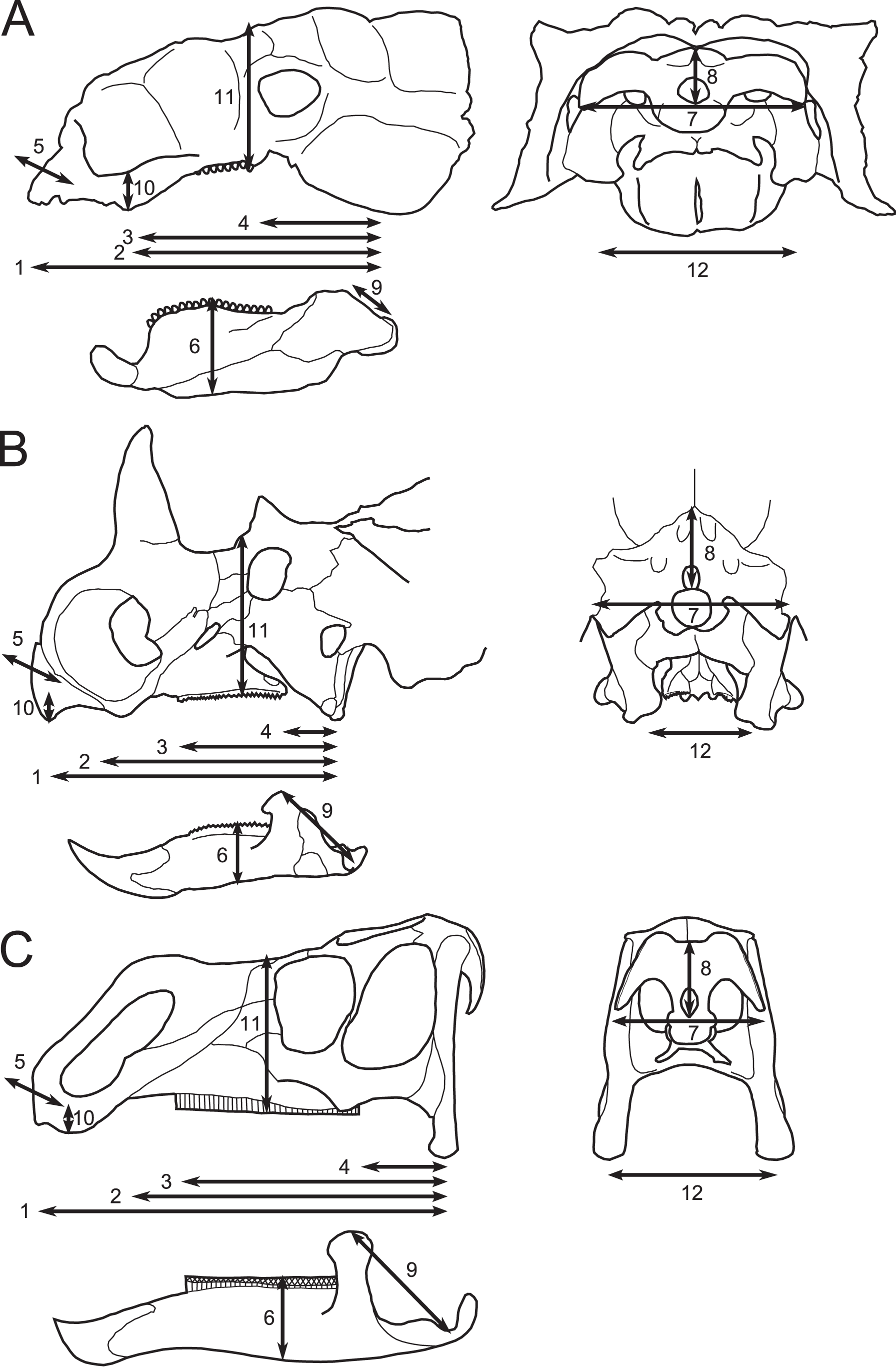
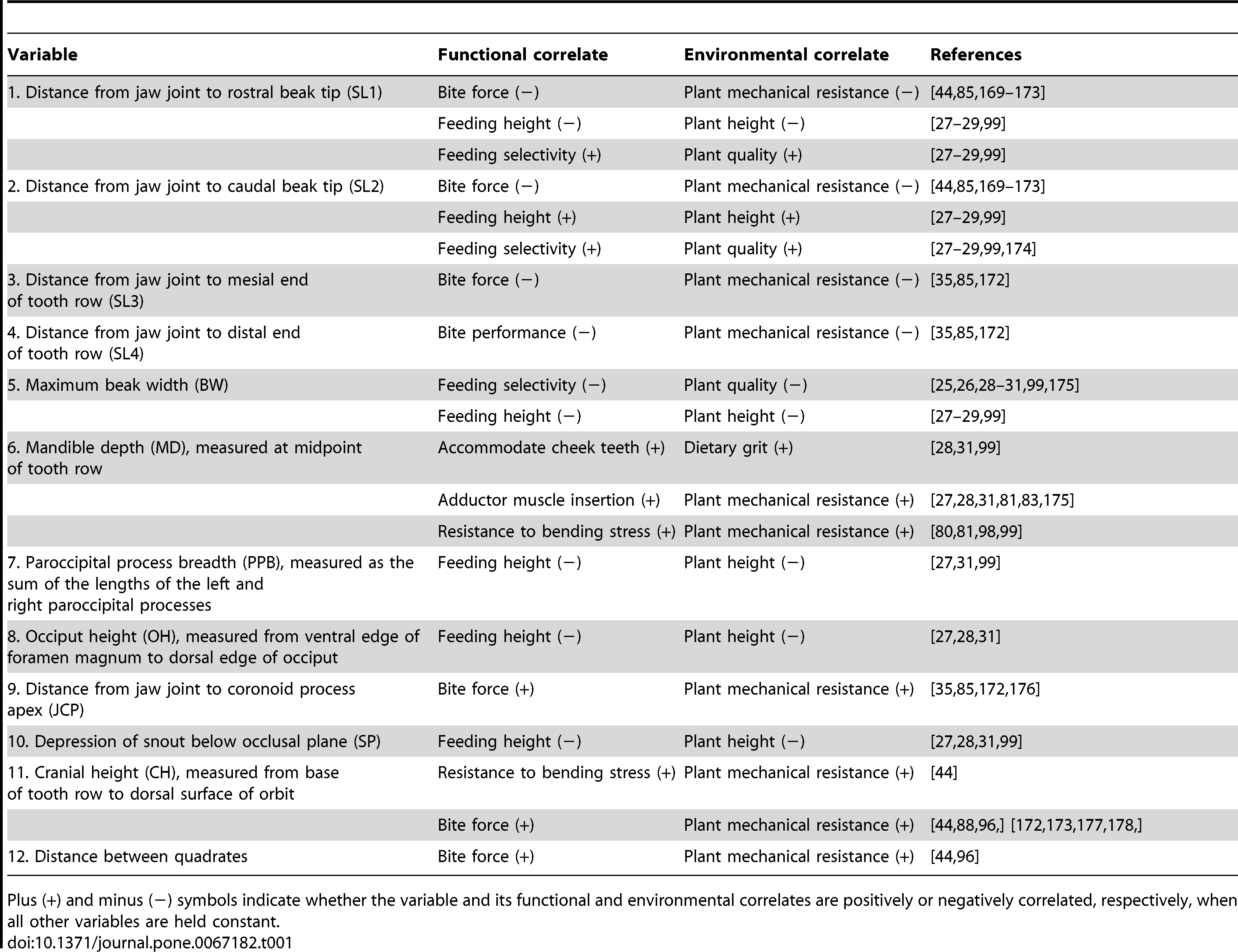
Mallon and Anderson apply ecomorphological methods to examine skull shape in megaherbivorous dinosaurs from the Dinosaur Park Formation of Alberta. Although focused on Alberta, the work establishes methodology and functional interpretations directly relevant to understanding Kosmoceratops. The authors demonstrate that cranial ornamentation in ceratopsids served primarily intraspecific signaling, not interspecific competition or predator defense. Biomechanical analysis shows that ceratopsid horns were not efficient as weapons against predators like Tyrannosaurus, but were suitable for ritualized lateral combat between conspecifics, analogous to that of modern antelopes. Results support the sexual selection hypothesis as the driving force behind the extreme ornamental elaboration of Kosmoceratops.
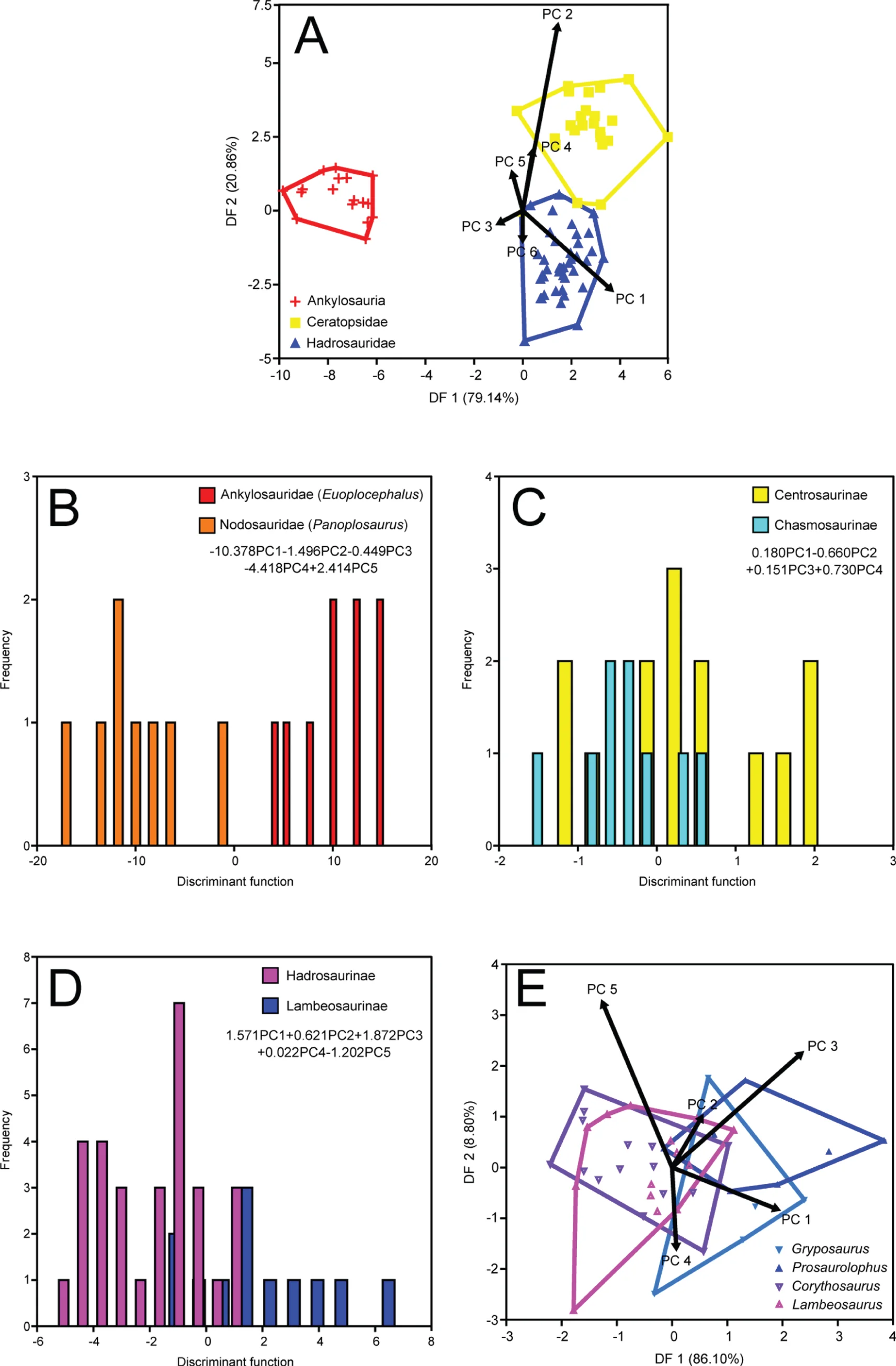
40Ar/39Ar age of the Kaiparowits Formation, southern Utah, and correlation of contemporaneous Campanian-stage rocks and vertebrate faunas along the margin of the Western Interior Basin
Roberts, E.M., Deino, A.L. & Chan, M.A. · Cretaceous Research
Roberts, Deino, and Chan provide precise radiometric dating of the Kaiparowits Formation using the 40Ar/39Ar method, establishing that the formation was deposited between approximately 76.6 and 74.5 Ma. These data are fundamental for chronologically situating the Kosmoceratops richardsoni fauna within the late Campanian and correlating it with other contemporaneous faunas from the North American Western Interior. The work allows direct comparisons with the Dinosaur Park Formation of Alberta (~76.5-75 Ma), helping to establish the contemporaneity of the two biogeographically distinct faunas. Precise temporal resolution is essential for the intracontinental endemism arguments presented by Sampson et al. (2010).
Evidence of combat in Triceratops
Farke, A.A., Wolff, E.D.S. & Tanke, D.H. · PLOS ONE
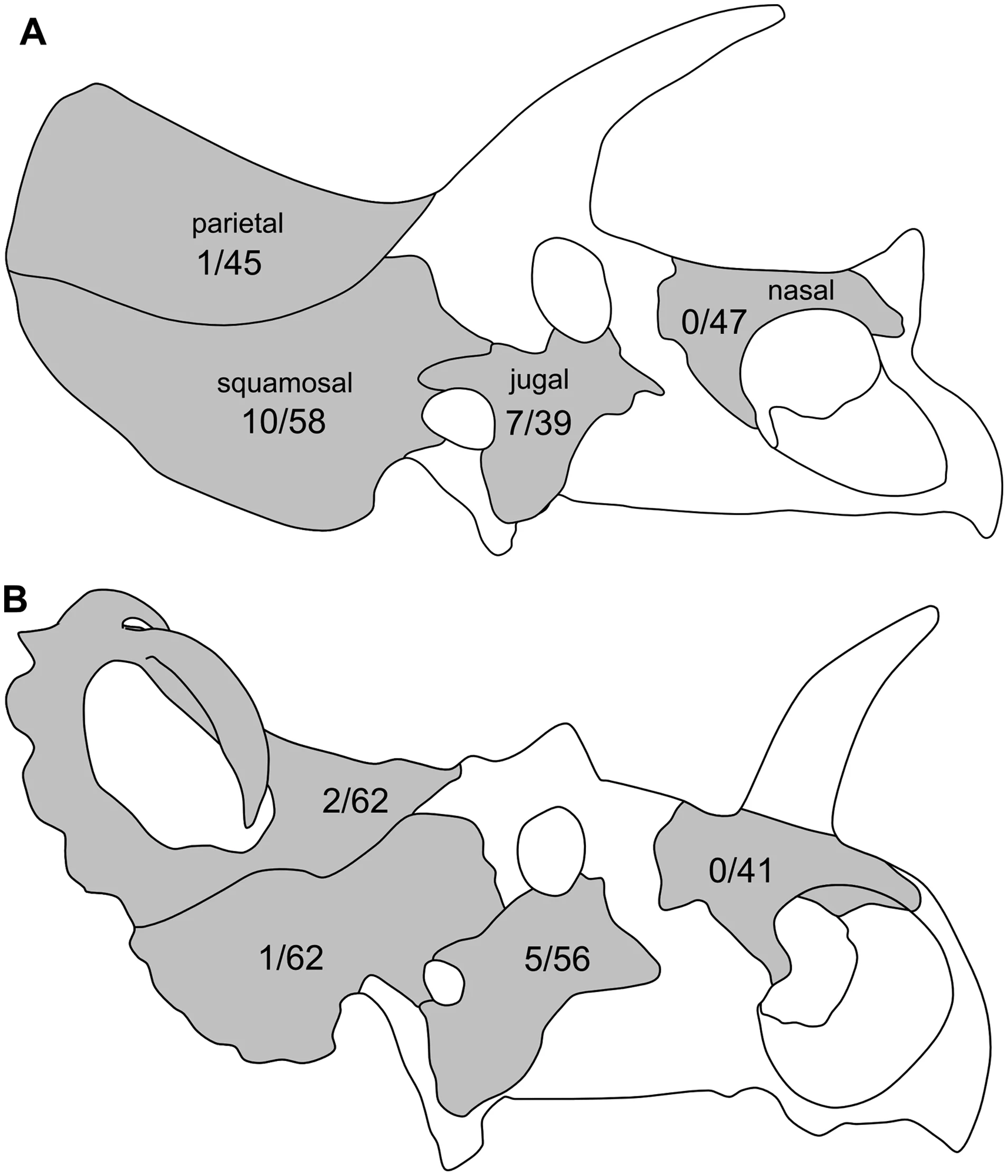
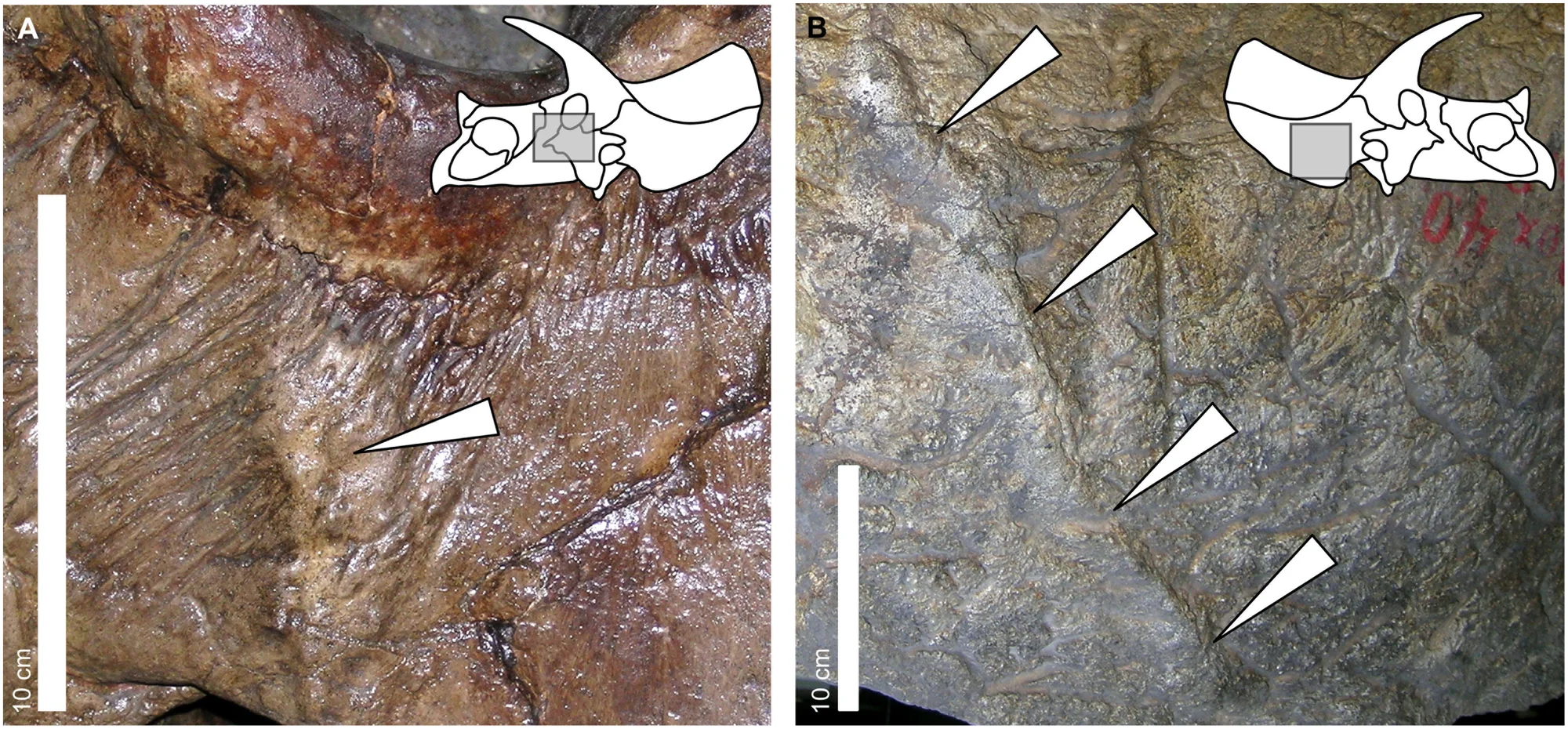
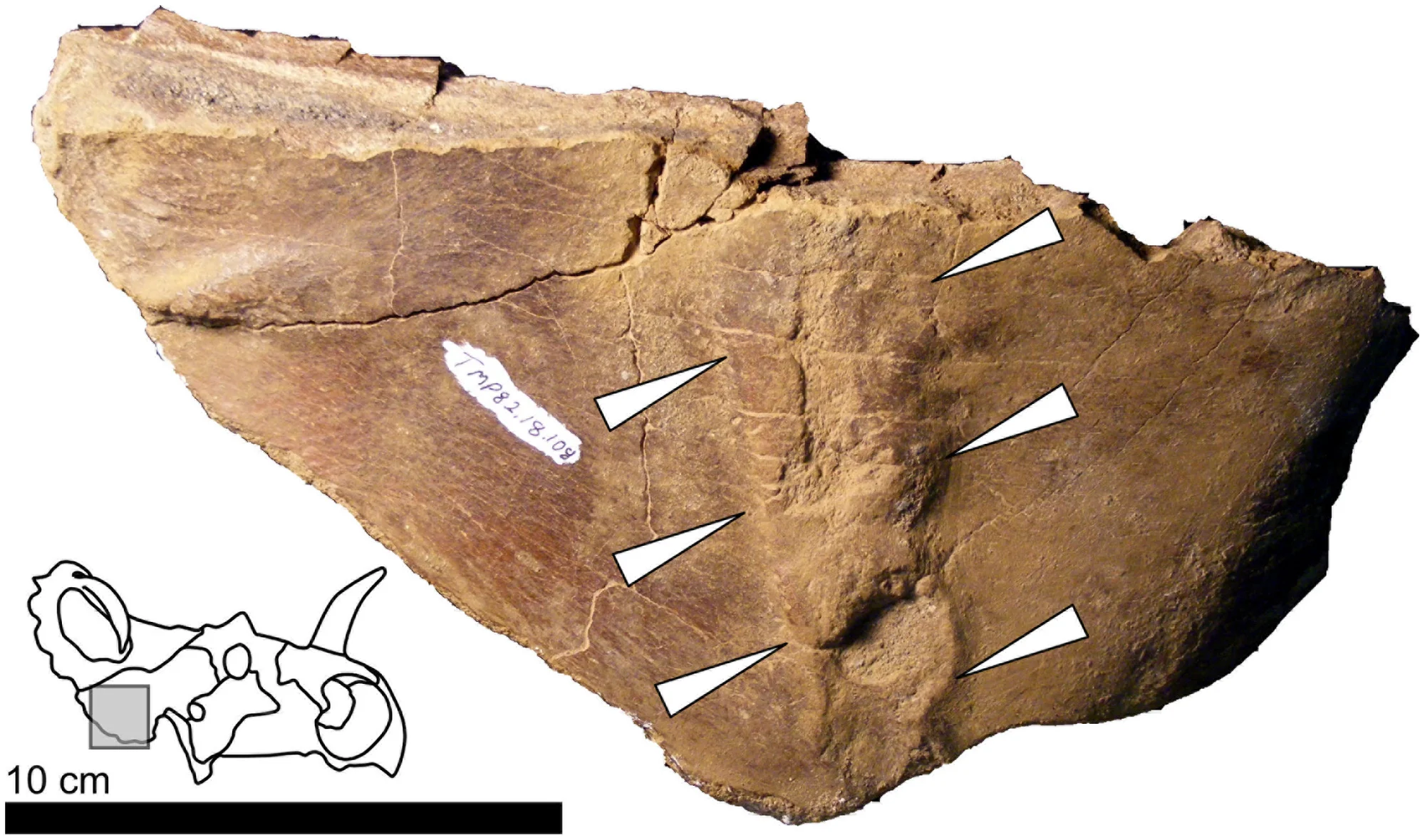
Farke, Wolff, and Tanke document lesions on squamosal bones of Triceratops horridus consistent with wounds inflicted by conspecific horn tips, providing the strongest direct evidence of intraspecific combat in ceratopsids. Although focused on Triceratops, the work has direct implications for interpreting Kosmoceratops ornamentation: the ten anteriorly directed apical processes on the frill would be positionally equivalent to the squamosal elements of Triceratops that show lesions. The work supports the hypothesis that the extreme cranial ornamentation elaboration of Kosmoceratops evolved under selective pressure from sexual selection and intraspecific competition rather than antipredatory defense.

Ceratopsidae
Dodson, P., Forster, C.A. & Sampson, S.D. · The Dinosauria, 2nd Edition (Weishampel, Dodson & Osmólska, eds.) — University of California Press
Dodson, Forster, and Sampson provide a comprehensive review of Ceratopsidae in the second edition of The Dinosauria, covering systematics, phylogenetics, anatomy, and paleobiology of all ceratopsids known as of 2004. This foundational chapter establishes the reference framework for Chasmosaurinae evolution and defines diagnostic characters that allow identification and positioning of new taxa like Kosmoceratops. The review documents that the parieto-squamosal frill of chasmosaurines tends to be more elaborate than that of centrosaurines, prefiguring the discovery of the extreme elaboration degree in Kosmoceratops. The work also summarizes the paleogeographic distribution of ceratopsids in North America, providing the basis for the Laramidia endemism arguments.


The facial integument of centrosaurine ceratopsids: morphological and histological correlates of novel skin structures
Hieronymus, T.L., Witmer, L.M., Tanke, D.H. & Currie, P.J. · The Anatomical Record
Hieronymus and colleagues examine histologically and morphologically centrosaurine ceratopsid skulls to identify correlates of diverse integumentary structures on the bone surface. The work documents evidence of scales, tubercles, cornified pads, and possibly display structures overlying the bony skeleton. Although focused on centrosaurines, the results have direct implications for reconstructing the frill and horns of Kosmoceratops richardsoni: the surface of the apical processes and epicondyles may have supported keratinous display structures not preserved in the fossils, potentially further amplifying the visual ornamentation of the living animal.

Famous museum specimens

UMNH VP 17000
Natural History Museum of Utah, Salt Lake City, Estados Unidos
Holotype of Kosmoceratops richardsoni. Includes near-complete skull with frill, articulated mandible, and partial post-cranial elements. Collected in 2006 from the Kaiparowits Formation of Grand Staircase-Escalante National Monument, Utah. On permanent display at the museum.
UMNH VP 20525
Natural History Museum of Utah, Salt Lake City, Estados Unidos
Referred specimen of Kosmoceratops richardsoni. Includes pectoral girdle elements, partial forelimbs, and vertebrae. Collected in 2004 from the Kaiparowits Formation. Complements the holotype in post-cranial characterization of the species.
Molde em exposição
Smithsonian National Museum of Natural History, Washington D.C., Estados Unidos
High-fidelity cast of holotype skull UMNH VP 17000, displayed in the museum's dinosaur gallery. Allows the public to observe the details of the 15 cranial ornamentation elements.
In cinema and popular culture
Kosmoceratops richardsoni is a latecomer to pop culture, having been described only in 2010, decades after the most famous ceratopsids like Triceratops and Styracosaurus had entered the collective imagination. Even so, its extreme ornamentation, with 15 bony structures on the skull, made it immediately recognizable and popular in paleontology and science communication communities. The appearance in Apple TV+'s Prehistoric Planet series in 2022 represented the animal's most visible debut in mass media, with a scientifically rigorous reconstruction showing the ornamented frill in an intraspecific display context. In entertainment franchise universes, Kosmoceratops appears in the animated series Jurassic World: Camp Cretaceous (Netflix), exposing the animal to a generation of children who might never have heard of the genus. The series' design reasonably maintains the characteristic morphology, with the frill processes visible. On the internet, the 2010 article headline about being 'the world's most ornamented dinosaur' circulated widely, making Kosmoceratops a frequently cited example of how bizarre dinosaur adaptations could be.
Classification
Discovery
Fun fact
Kosmoceratops richardsoni holds the absolute record among all known vertebrates, fossil or living: 15 horns and bony structures on the skull. For comparison, the modern white rhinoceros has 2, and Triceratops had 3. Science still debates whether all this ornamentation served for species recognition, sexual selection, or both, but one thing is certain: no animal, before or after, was so extravagant in this regard.
Last reviewed: April 24, 2026