
Concavenator
Concavenator corcovatus
"Hunchbacked hunter from Cuenca"
About this species
Concavenator corcovatus is a carcharodontosaurid from the Early Cretaceous of Spain, described in 2010 by Ortega, Escaso, and Sanz from a nearly complete skeleton found at the Las Hoyas site in Cuenca. Its most striking feature is a dorsal hump formed by the extreme elongation of the last two dorsal vertebrae, creating a short crest or sail above the hip region. The specimen also shows small bumps on the ulna interpreted as possible quill knob attachment points, making it the most basal non-avian theropod known with this evidence. Measuring approximately 6 meters long and weighing around 400 kg, it was the apex predator of its lacustrine ecosystem in Cretaceous Iberia.
Geological formation & environment
The La Huérguina Formation (upper Barremian, ~125 Ma) is one of the world's most important Cretaceous Konservat-Lagerstätten. Located in the Serranía de Cuenca, Spain, the formation consists of finely laminated limestones deposited in shallow subtropical lakes and swamps. Exceptional fossil preservation, including soft tissues, is due to the development of microbial mats on lake bottoms that rapidly sealed dead organisms, inhibiting decay. Besides Concavenator, the formation produced primitive birds (Iberomesornis, Eoalulavis), pterosaurs, crocodilians, fish, and the primitive aquatic angiosperm Montsechia vidalii, the world's oldest known flower.
Image gallery


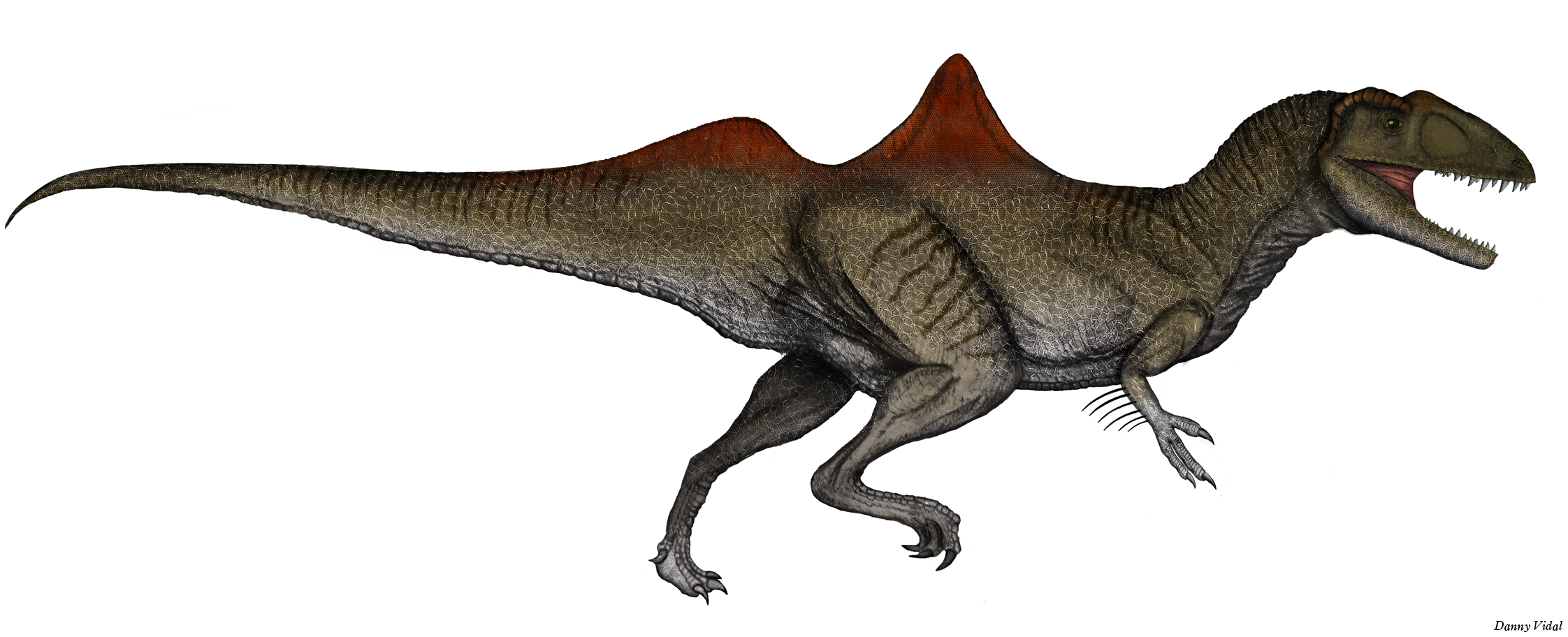


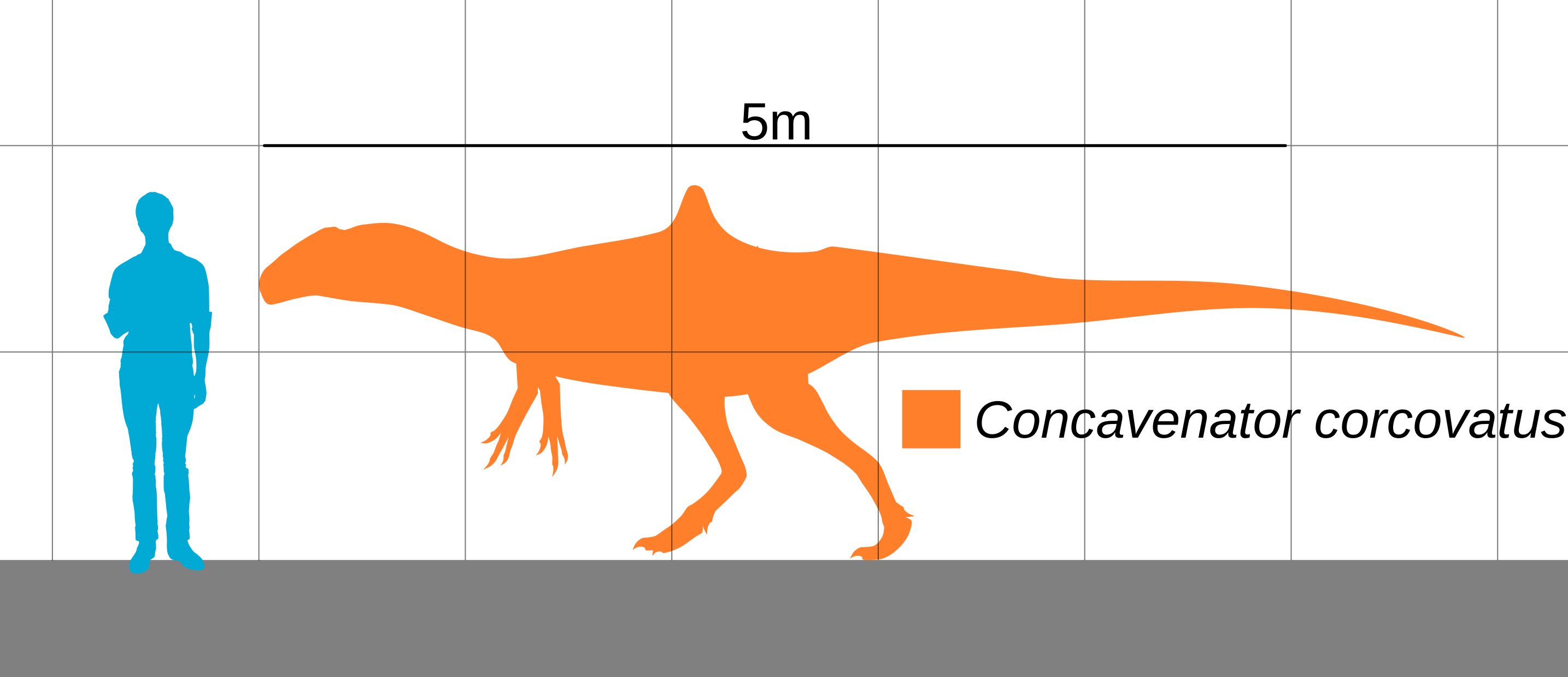


Holotype MCCM-LH 6666 of Concavenator corcovatus — the most complete carcharodontosaurid specimen in the world, on display at the Museo de Ciencias de Castilla-La Mancha.
UNED / Santiago Torralba — CC BY 2.0
Ecology and behavior
Habitat
Concavenator inhabited the subtropical paleoenvironment of the La Huérguina Formation in what is now Cuenca Province, Spain. The Las Hoyas site was a seasonal wetland with shallow lakes, swamps, and temporary rivers. The climate was warm and seasonal, with drought periods alternating with floods. The ecosystem included fish (Lepidotes), turtles, crocodilians (Goniopholis), lizards, amphibians, primitive birds (Iberomesornis, Eoalulavis), pterosaurs, and small theropods like Pelecanimimus. Concavenator was the apex terrestrial predator of this ecosystem.
Feeding
As the apex terrestrial predator of Las Hoyas, Concavenator likely hunted a variety of prey available in the lacustrine ecosystem. Probable prey included the ornithomimosaurid Pelecanimimus and other medium-sized dinosaurs, as well as crocodilians, turtles, and possibly fish. Its teeth were serrated and recurved, typical of active carnivores. Ichnological evidence from Las Hoyas (large theropod trackways) suggests animals of Concavenator's size crossed shallow water areas, potentially pursuing aquatic prey or drinking water.
Behavior and senses
There is no direct evidence of Concavenator social behavior, given that only one specimen is known. The dorsal hump formed by vertebrae D11 and D12 may have served intraspecific display, species identification, thermoregulation, or fat storage functions. The trackway described by Herrera-Castillo et al. (2022) at Las Hoyas, attributable to a Concavenator-sized theropod with a pathological foot, suggests that injured or malformed animals remained active in the ecosystem. The possible quill knobs on the forearm are debated: they may indicate vestigial secondary feathers used in display or intraspecific recognition.
Physiology and growth
Analysis of Concavenator vertebrae reveals extensive pneumatization, consistent with an avian-style air sac respiratory system typical of derived theropods. This implies elevated metabolism consistent with endothermy. Bone growth of the holotype, based on available histology, suggests the found specimen was subadult or young adult. The possible presence of filamentous structures (quill knobs) indicates at least parts of the body may have had non-scaly covering. Scale impressions preserved on the feet show a pattern similar to modern birds (avian podotheca), reflecting the close evolutionary relationship between theropods and birds.
Paleogeography
Continental configuration

Scotese & Vérard · CC BY 4.0 · Cretaceous, ~105 Ma
Fossil sites

Keeble — CC BY-SA 4.0
During the Barremiano (~130–125 Ma), Concavenator corcovatus inhabited Laramidia, the western half of present-day North America, separated from the east by the Western Interior Seaway, a shallow sea dividing the continent. The continents were in very different positions: India was drifting toward Asia, Antarctica was still connected to Australia, and South America was an isolated island.
Bone Inventory
The holotype MCCM-LH 6666, housed at the Museo de Ciencias de Castilla-La Mancha (Cuenca), is an articulated and nearly complete skeleton including skull, ten cervical vertebrae, thirteen dorsals, five sacrals, thirty caudals, partial pectoral girdle, arms, pelvic girdle, and legs. It is the most complete carcharodontosaurid specimen ever found.

Found elements
Inferred elements
Scientific Literature
15 papers in chronological order — from the original description to recent research.
A bizarre, humped Carcharodontosauria (Theropoda) from the Lower Cretaceous of Spain
Ortega, F., Escaso, F. & Sanz, J.L. · Nature
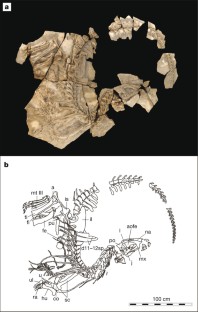
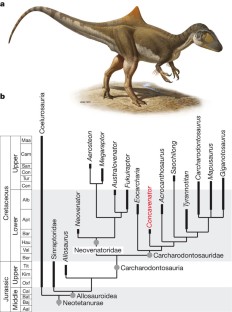
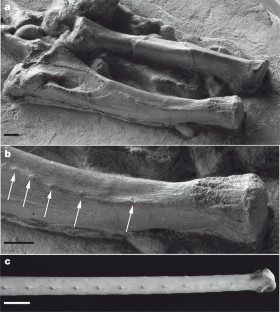
The founding paper describing Concavenator corcovatus from holotype MCCM-LH 6666, a nearly complete skeleton from Barremian-age Las Hoyas deposits. Ortega, Escaso, and Sanz identify two anatomical characters unprecedented in carcharodontosaurids: dorsal vertebrae D11 and D12 with extremely elongated neural spines forming a hump- or sail-like structure; and small bumps on the ulna morphologically comparable to avian quill knobs. Phylogenetic parsimony analysis recovers Concavenator as a basal member of Carcharodontosauridae, close to Neovenator. The paper was published in Nature to wide scientific and media attention, as possible feather evidence in a carcharodontosaurid challenges the hypothesis that secondary feathers evolved only in more derived theropods. The analysis inaugurated a series of dedicated anatomical studies on the specimen in the following decades.
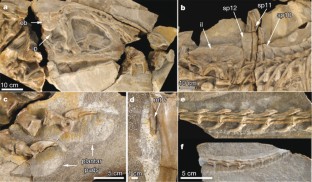
Did all theropods have chicken-like feet? First evidence of a non-avian dinosaur podotheca
Cuesta, E., Díaz-Martínez, I., Ortega, F. & Sanz, J.L. · Cretaceous Research
Cuesta et al. describe in detail the scale impressions preserved on the feet of the Concavenator holotype, the first confirmed podotheca (scaly foot covering) evidence in a non-avian dinosaur. Comparative analysis with modern birds and crocodilians reveals a pattern of rectangular scales on the underside of the tail, bird-like scutes on the feet, and plantar pads on the undersides of the toes. The work discusses phylogenetic implications: the integumentary pattern is closer to birds than to squamate reptiles, suggesting avian-style foot covering is a synapomorphy of a broader clade including Concavenator. The study reinforces Las Hoyas as one of the world's most exceptional soft-tissue preservation sites for dinosaurs.
The cranial osteology of Concavenator corcovatus (Theropoda; Carcharodontosauria) from the Lower Cretaceous of Spain
Cuesta, E., Ortega, F. & Sanz, J.L. · Cretaceous Research
Cuesta, Ortega, and Sanz present the most comprehensive revision of Concavenator cranial osteology ever published, based on additional preparation of the holotype and 3D modeling. The study systematically describes each bone of the skull, mandible, and temporal region, cataloging new diagnostic characters not recognized in the original 2010 description. The revised phylogenetic analysis with new cranial data confirms Concavenator as a basal member of Carcharodontosauridae, close to Neovenator and Lusovenator, but recovers a slightly different topology for internal family nodes. The paper documents for the first time the detailed cranial fenestration of the specimen, discussing functional implications of pneumatic air chambers in the skull for mass reduction and possible cranial thermoregulation.


Axial osteology of Concavenator corcovatus (Theropoda; Carcharodontosauria) from the Lower Cretaceous of Spain
Cuesta, E., Ortega, F. & Sanz, J.L. · Cretaceous Research
This study provides a detailed description of Concavenator's axial skeleton, focusing on dorsal vertebrae D11 and D12 whose neural spines are extremely elongated. Cuesta, Ortega, and Sanz measure and compare these spines with those of other theropods, sauropods, and ornithischians with similar structures (such as Spinosaurus and Ouranosaurus), ruling out a true sail and proposing the structure was a compact hump, possibly containing fat reserves or serving thermoregulation. Analysis of vertebral pneumatization reveals air sacs penetrated deeply into the vertebral column, evidencing a sophisticated avian-style respiratory system in a basal carcharodontosaurid. The paper includes description of cervical, dorsal, and gastralia ribs, and discusses biomechanical implications of the vertebral column for locomotion and posture.

Appendicular osteology of Concavenator corcovatus (Theropoda: Carcharodontosauridae) from the Lower Cretaceous of Spain
Cuesta, E., Ortega, F. & Sanz, J.L. · Journal of Vertebrate Paleontology
The third paper in Cuesta, Ortega, and Sanz's monographic series on Concavenator, dedicated to appendicular osteology: pectoral and pelvic girdles, humerus, radius, ulna, hand, femur, tibia, fibula, and foot. The most discussed aspect is the re-analysis of the ulnar bumps described by Ortega et al. (2010) as possible quill knobs. Using additional preparation techniques and scanning electron microscopy, the authors describe the structures with greater precision and discuss whether they represent follicular ligament insertions (as in birds), muscle scars, or both. The paper also describes functional foot morphology, showing adaptations consistent with bipedal locomotion on semi-solid substrate, coherent with Las Hoyas' lacustrine environment. Femur and tibia morphology is compared with other carcharodontosaurids, providing new data for locomotor speed inferences.
New giant carnivorous dinosaur reveals convergent evolutionary trends in theropod arm reduction
Canale, J.I. et al. · Current Biology
Canale et al. describe Meraxes gigas, a new giant carcharodontosaurid from Argentina, and perform the most comprehensive phylogenetic analysis of the family through 2022. Concavenator is recovered as a basal member of Carcharodontosauridae, positioned close to Neovenator and Lusovenator in a clade of small-to-medium carcharodontosaurids. One of the study's most important findings is the demonstration that forelimb reduction in large theropods (T. rex, Giganotosaurus, Carnotaurus) occurred convergently and independently in multiple lineages, not through inheritance from a common ancestor. Concavenator, with relatively well-developed arms for its size, represents a plesiomorphic condition within the family. The paper provides the current reference phylogenetic framework for Carcharodontosauridae and is the most-cited analysis for Concavenator positioning.


Re-evaluation of the Bahariya Formation carcharodontosaurid (Dinosauria: Theropoda) and its implications for allosauroid phylogeny
Kellermann, M., Cuesta, E. & Rauhut, O.W.M. · PLOS ONE
Kellermann, Cuesta, and Rauhut re-evaluate a partial carcharodontosaurid specimen from Egypt destroyed in World War II, proposing the new genus Tameryraptor markgrafi for the Egyptian fauna and rejecting its synonymy with Carcharodontosaurus saharicus from Morocco. Phylogenetic analysis includes Concavenator and, in some scenarios, recovers it as a taxon of uncertain position outside Carcharodontosauridae sensu stricto, positioned as sister clade to Siamraptor within Carcharodontosauria. The paper is relevant to Concavenator because it is co-authored by Elena Cuesta, the researcher who produced the entire monographic series on the specimen, and because it directly questions the traditional monophyly of Carcharodontosauridae as conceived since Sereno et al. (1996). The publication represents the most current state of the phylogenetic debate on Concavenator's position.

Exceptional coprolite association from the Early Cretaceous continental Lagerstätte of Las Hoyas, Cuenca, Spain
Barrios-de Pedro, S., Poyato-Ariza, F.J., Moratalla, J.J. & Buscalioni, A.D. · PLOS ONE
Barrios-de Pedro et al. describe over 2,000 fossil coprolites from the Las Hoyas site, the same Early Cretaceous ecosystem that produced Concavenator. Morphological analysis of 433 specimens reveals an assemblage dominated by cylindrical and lace-thin morphotypes, attributable to carnivores with fish-based diets. The paper provides direct evidence of trophic interactions in the ecosystem: the most likely producers of the largest coprolites are large theropods such as Concavenator. Exceptional coprolite preservation at Las Hoyas, related to microbial mat development on lake bottoms, is the same phenomenon that preserved Concavenator's articulated skeleton. The study integrates ichnological, sedimentological, and paleobiological data to reconstruct the Barremian Iberian food web, positioning Concavenator at the apex of the terrestrial trophic pyramid.
A holistic approach to the palaeoecology of Las Hoyas Konservat-Lagerstätte (La Huérguina Formation, Lower Cretaceous, Iberian Ranges, Spain)
Buscalioni, A.D. & Fregenal-Martínez, M.A. · Journal of Iberian Geology
Buscalioni and Fregenal-Martínez present the most complete paleoecological synthesis of the Las Hoyas Konservat-Lagerstätte, the site that produced Concavenator. The paper interprets the depositional environment as a subtropical seasonal wetland with strong, climatically driven cyclical water level oscillations at a regional scale. This scenario explains exceptional fossil preservation: during drought phases, microbial mats developed on the muddy bottoms of shallow lakes; when water levels rose again, dead organisms — including large vertebrates like Concavenator — were rapidly engulfed and sealed by the mats, inhibiting decay. The reconstructed ecosystem includes fish, turtles, crocodilians, lizards, primitive birds (Iberomesornis, Eoalulavis), pterosaurs, small theropods (Pelecanimimus), and Concavenator at the apex of the terrestrial food chain.
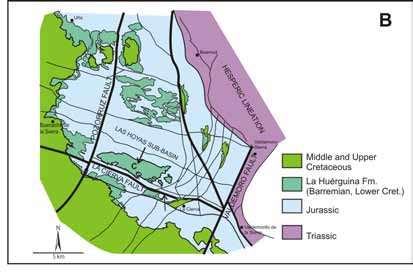
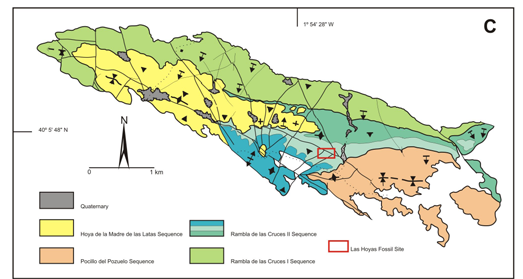
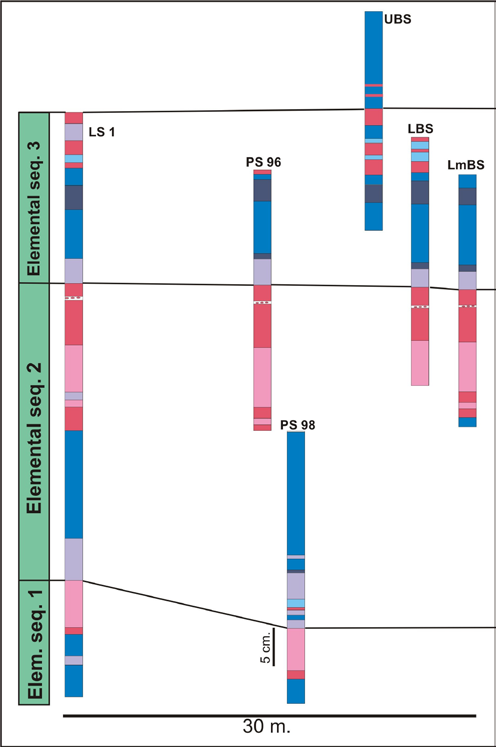
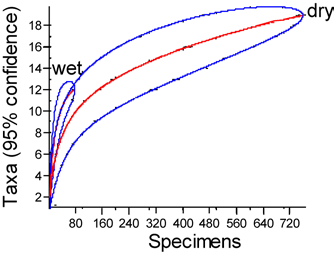
A theropod trackway providing evidence of a pathological foot from the exceptional locality of Las Hoyas (upper Barremian, Serranía de Cuenca, Spain)
Herrera-Castillo, C.M. et al. · PLOS ONE
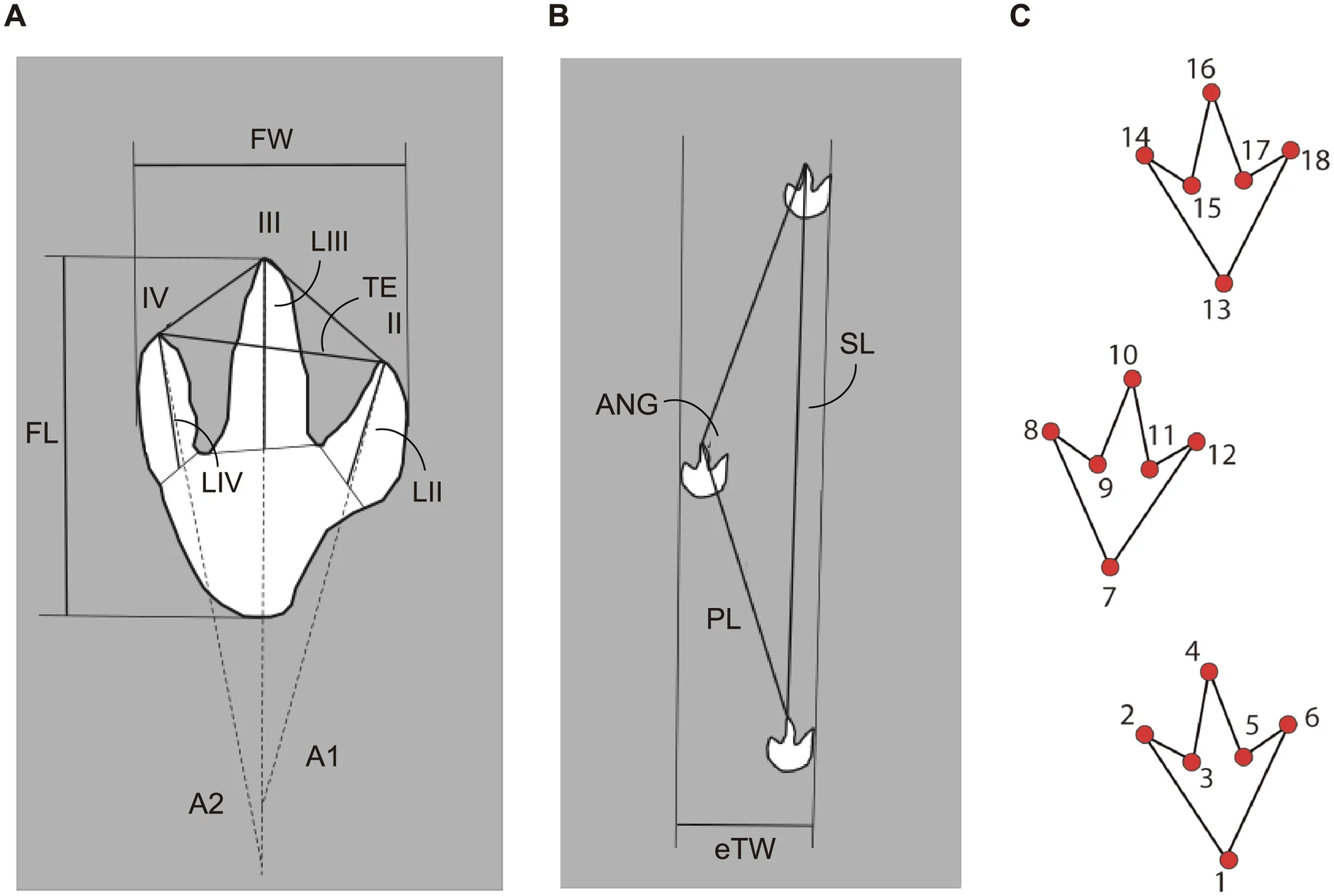
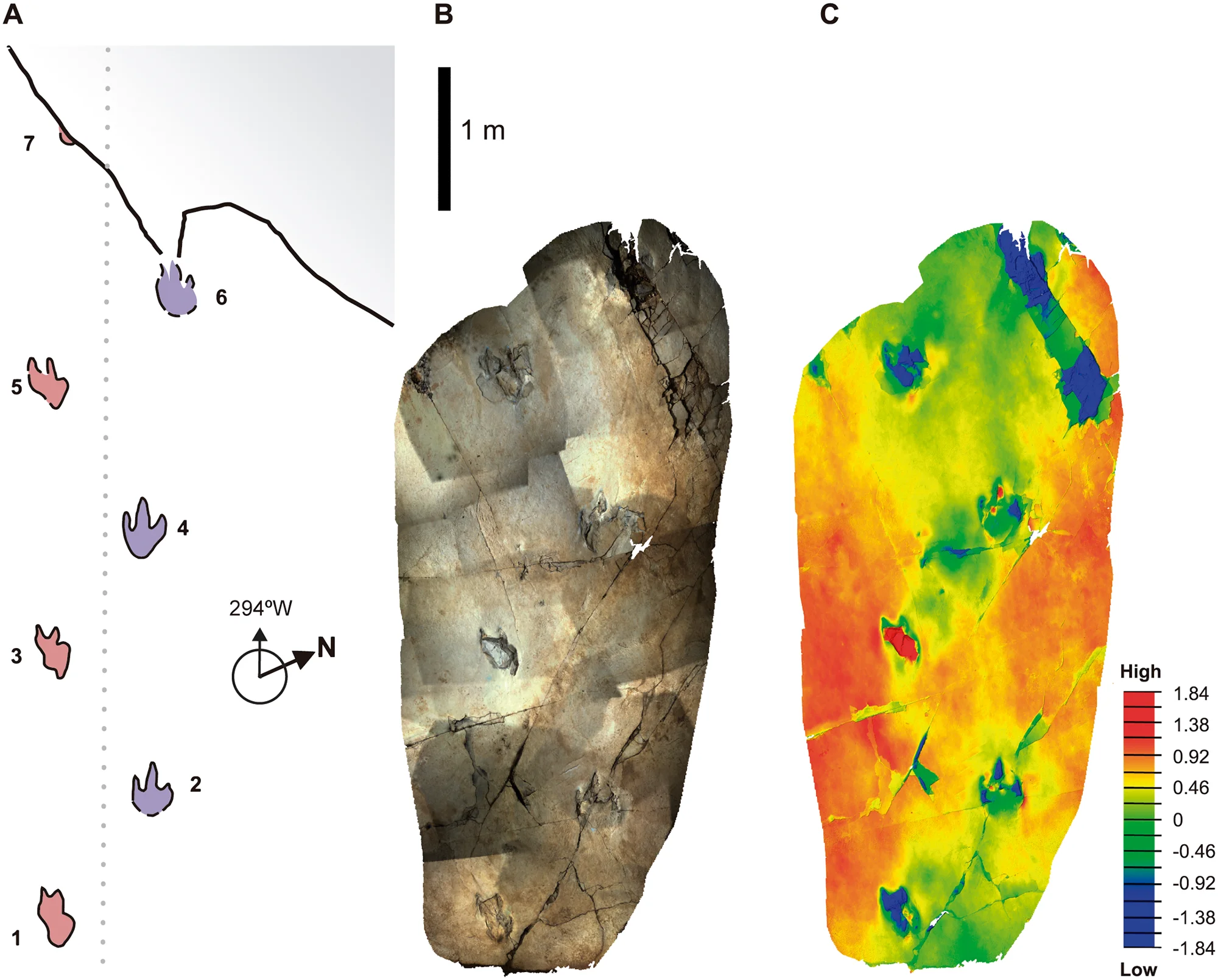
Herrera-Castillo et al. describe a trackway (LH-Mg-10-16) from Las Hoyas with unusual features: wide steps and a set of equally deformed left footprints with a dislocated digit. Using ichnological analysis, 3D scanning, thin sections, and geometric morphometrics compared with 75 bipedal dinosaur trackways, the authors conclude the prints were made by a single large theropod with a pathological foot, estimating hip height at approximately 2 meters. This size is compatible with Concavenator, the only large theropod known from Las Hoyas. The paper provides ichnological evidence of behavior and pathology in a theropod that may be Concavenator, complementing anatomical data from the skeletal holotype. The trackway suggests the animal crossed a shallow water area walking slowly toward the main water source.

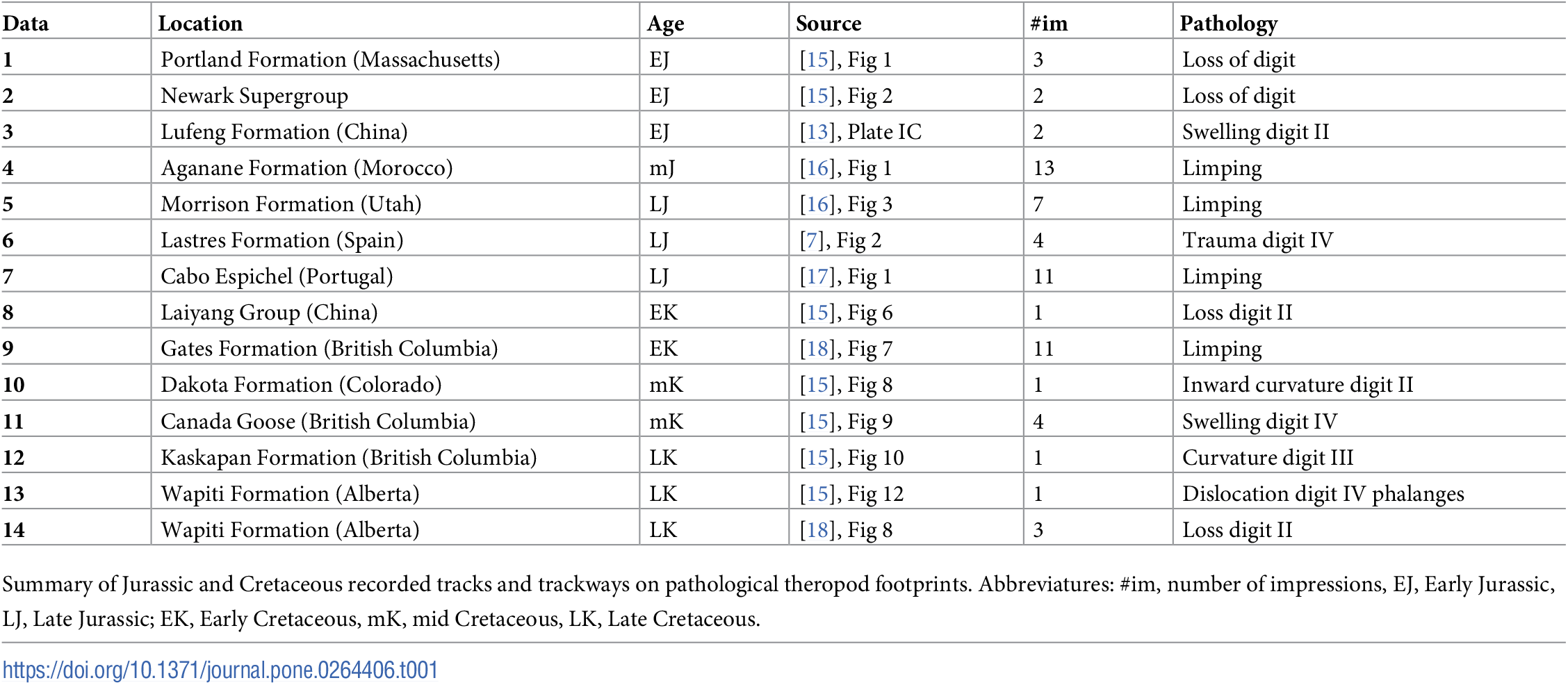
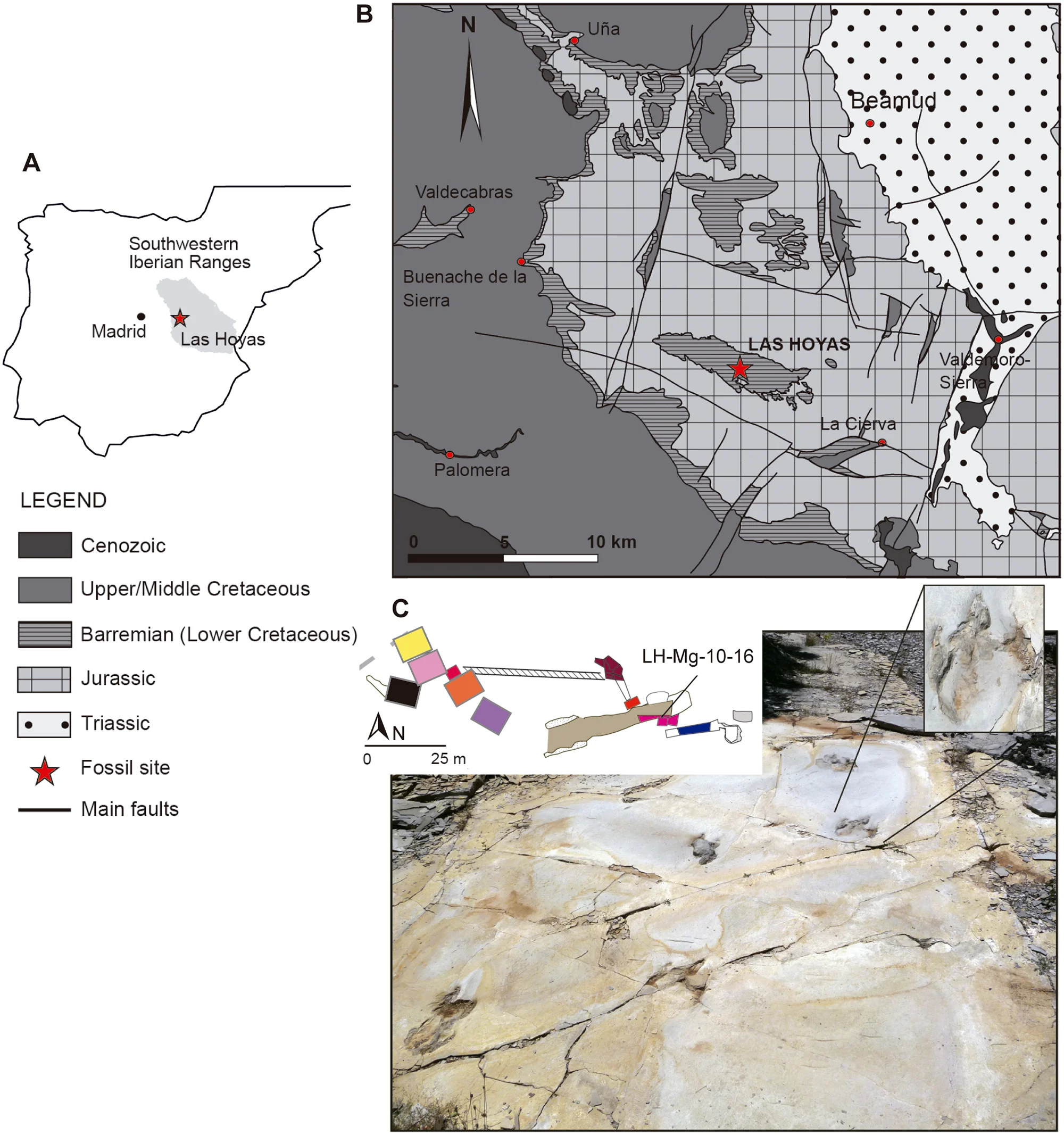
Morphology and distribution of scales, dermal ossifications, and other non-feather integumentary structures in non-avialan theropod dinosaurs
Hendrickx, C. et al. · Biological Reviews
Hendrickx et al. produce the most comprehensive review ever published on integumentary structures in non-avian theropods, cataloging and analyzing scale impressions, dermal ossifications, quill knobs, and other structures in dozens of taxa. Concavenator occupies a central position in the analysis: it is cited as the most basal non-avian theropod with possible quill knobs (ulnar bumps) and as the only carcharodontosaurid with preserved scale impressions. The paper discusses the phylogenetic distribution of integumentary structures, concluding that reptilian scales and feathers coexisted in many Mesozoic theropods and that Concavenator's evidence is consistent with a mixed covering of scales and filamentous structures on parts of the body. The authors critically evaluate the interpretation of the ulnar bumps as true quill knobs versus muscle scars, leaving the question open.

Evolution of the carnivorous dinosaurs during the Cretaceous: the evidence from Patagonia
Novas, F.E. et al. · Cretaceous Research
Novas et al. synthesize the evolution of carnivorous dinosaurs in Cretaceous Patagonia, discussing the origin and dispersal of large carcharodontosaurids between supercontinents. Concavenator is discussed in biogeographic context: its discovery in Spain suggests medium-sized carcharodontosaurids inhabited Europe in the Barremian before the South American giants (Giganotosaurus, Mapusaurus, Tyrannotitan) diversified in the Albian-Cenomanian. The paper proposes that the lineage leading to Concavenator and Neovenator originated in Western Laurasia and eventually gave rise, through dispersal, to the ancestors of Gondwanan carcharodontosaurids. Phylogenetic and biogeographic analysis discusses the time window and possible dispersal corridors between Barremian Europe and Albian South America, including connections via Africa.
Torvosaurus sp. (Dinosauria: Theropoda) in the Late Jurassic of Portugal
Mateus, O. & Antunes, M.T. · CIM 2000 abstracts
Mateus and Antunes report the presence of the large theropod Torvosaurus in the Late Jurassic of Portugal, one of the ecological predecessors of the large predators that would dominate Europe in the Cretaceous. This work contextualizes the long history of large European theropods: the lineage leading to Concavenator in the Barremian (~130 Ma) has roots in the Iberian Jurassic theropod fauna represented by Torvosaurus and Allosaurus. The Iberian Peninsula was a biodiversity hotspot for large theropods for tens of millions of years, culminating with Concavenator as the last known large European carcharodontosaurid before the dominance of abelisaurids in the Late Cretaceous. The study helps trace the historical biogeography of large European predators and faunal heterogeneity of Western Laurasia during the Mesozoic.

Dinosaurs of Great Britain and the role of the Geological Society of London in their discovery and description
Naish, D. & Martill, D.M. · Journal of the Geological Society
Naish and Martill review British dinosaur discoveries and their historical and scientific significance, including Neovenator salerii from the Isle of Wight, the closest known relative of Concavenator and also from the European Early Cretaceous. Neovenator, described in 1996, preceded the discovery of Concavenator and provided the taxonomic context for interpreting the Spanish specimen as a member of a medium-sized carcharodontosaurid fauna that inhabited Western Europe in the Barremian. The relationship between Neovenator and Concavenator is central for reconstructing European carcharodontosaurid biogeography and understanding how the family originated and dispersed worldwide during the Early Cretaceous. The historical work on Neovenator provides essential comparative data for studying Concavenator's anatomy and phylogeny.


Feather quill knobs in the dinosaur Velociraptor
Turner, A.H. et al. · Science
Turner et al. describe quill knobs on the ulna of Velociraptor mongoliensis, the first confirmed occurrence of this structure in a non-avian dinosaur. Quill knobs are ligament attachment bumps that anchor the calamus (quill) of flight feathers to the ulna in modern birds. The discovery in Velociraptor demonstrates that at least some dromaeosaurids had functional (or vestigial) secondary flight feathers despite not flying. This paper is fundamental for understanding Concavenator because the debate over the Spanish carcharodontosaurid's ulnar bumps derives directly from comparison with the structure described by Turner et al. (2007) in Velociraptor. The crucial difference is that dromaeosaurids are much closer to birds than carcharodontosaurids: if Concavenator truly had quill knobs, it would represent a much deeper and more surprising evolutionary record.


Famous museum specimens
MCCM-LH 6666 (Holótipo)
Museo de Ciencias de Castilla-La Mancha, Cuenca, Espanha
The only known specimen of Concavenator corcovatus. It is the most complete carcharodontosaurid skeleton ever discovered, articulated and including skull, nearly complete vertebral column, ribs, limbs, and skin impressions. It is on permanent display at the Museo de Ciencias de Castilla-La Mancha in Cuenca.
Réplica em exposição (Makuhari Messe, Japão, 2017)
Exposição itinerante — Makuhari Messe, Chiba, Japão
Full skeleton replica of Concavenator on special display in Japan in 2017. The skeletal mount clearly shows the hump formed by vertebrae D11 and D12, making it one of the most educational exhibits of the specimen available outside Spain.
In cinema and popular culture
Concavenator corcovatus is an unusual case among dinosaurs: described in 2010, it gained pop culture presence with surprising speed for such a recently discovered species. The Spanish documentary El Valle de Concavenator (2023), directed by Víctor Matellano, is the most complete work dedicated to the animal, connecting Las Hoyas paleontology with Ray Harryhausen's science fiction cinema and featuring José Luis Sanz, one of the original describers. In the gaming universe, Concavenator appears in Jurassic World Alive (2018), Jurassic World Evolution 2 (2021, in the Cretaceous Predator Pack), and Jurassic World: The Game (2015). In all these depictions, the dorsal hump is the most striking visual element and is relatively well reproduced. Games tend to exaggerate the possible bristles or feathers on the arms, a still-controversial scientific evidence. In ARK Additions (ARK: Survival Evolved mod), the animal receives fictional ground-digging abilities. Concavenator's media history reflects the speed with which impactful paleontological discoveries migrate to popular culture when combining unique visual features with fascinating scientific debates.
Classification
Discovery
Fun fact
Concavenator is the only known non-avian dinosaur with feather evidence (quill knobs) outside the lineage that led directly to modern birds. If the ulnar bumps are confirmed as true quill knobs, it would mean feathers evolved (or were retained) in a group of dinosaurs far more distant from birds than previously thought, pushing the evolutionary history of feathers back approximately 40 million years within Carcharodontosauria.
Last reviewed: April 24, 2026