
Compsognathus
Compsognathus longipes
"Elegant jaw"
About this species
Compsognathus longipes was for more than a century the smallest known non-avian dinosaur, an agile and delicate theropod of the Late Jurassic (Tithonian, ~150-145 Ma) that inhabited the margins of shallow archipelagos in what is now central Europe. The holotype BSP AS I 563, preserved in the Solnhofen lithographic limestones of Bavaria, revealed an animal approximately 89 cm long with very short forelimbs, a long flexible neck, and a gracile skull with small pointed teeth. A lizard preserved inside the holotype's torso provided direct evidence of feeding behavior: Compsognathus actively hunted small prey, swallowing them whole or in large pieces. The second known specimen, MNHN CNJ 79, recovered at Canjuers in the French Provence, is substantially larger — about 1.25 m long — which generated decades of debate about whether it represented adults of C. longipes or a distinct species (Compsognathus corallestris, proposed by Bidar et al. in 1972), a question now resolved in favor of ontogenetic variation within a single species.
Geological formation & environment
The Solnhofen Lithographic Limestone Formation (Tithonian, ~150-145 Ma) is one of the world's most famous geological units, known for exceptional preservation of organisms that rarely fossilize, including feathers, soft tissues, and behavioral patterns. The environment was of shallow, hypersaline marine lagoons with anoxic bottoms, part of the Late Jurassic Tethyan archipelago. Fine, slow sedimentation combined with anoxic conditions that prevented bacterial decomposition created ideal preservation conditions. Besides Compsognathus, the lagerstatten preserved all known specimens of Archaeopteryx lithographica, Juravenator starki, dozens of pterosaur species, fish, crocodiles, lizards, and exceptionally detailed marine invertebrates.
Image gallery


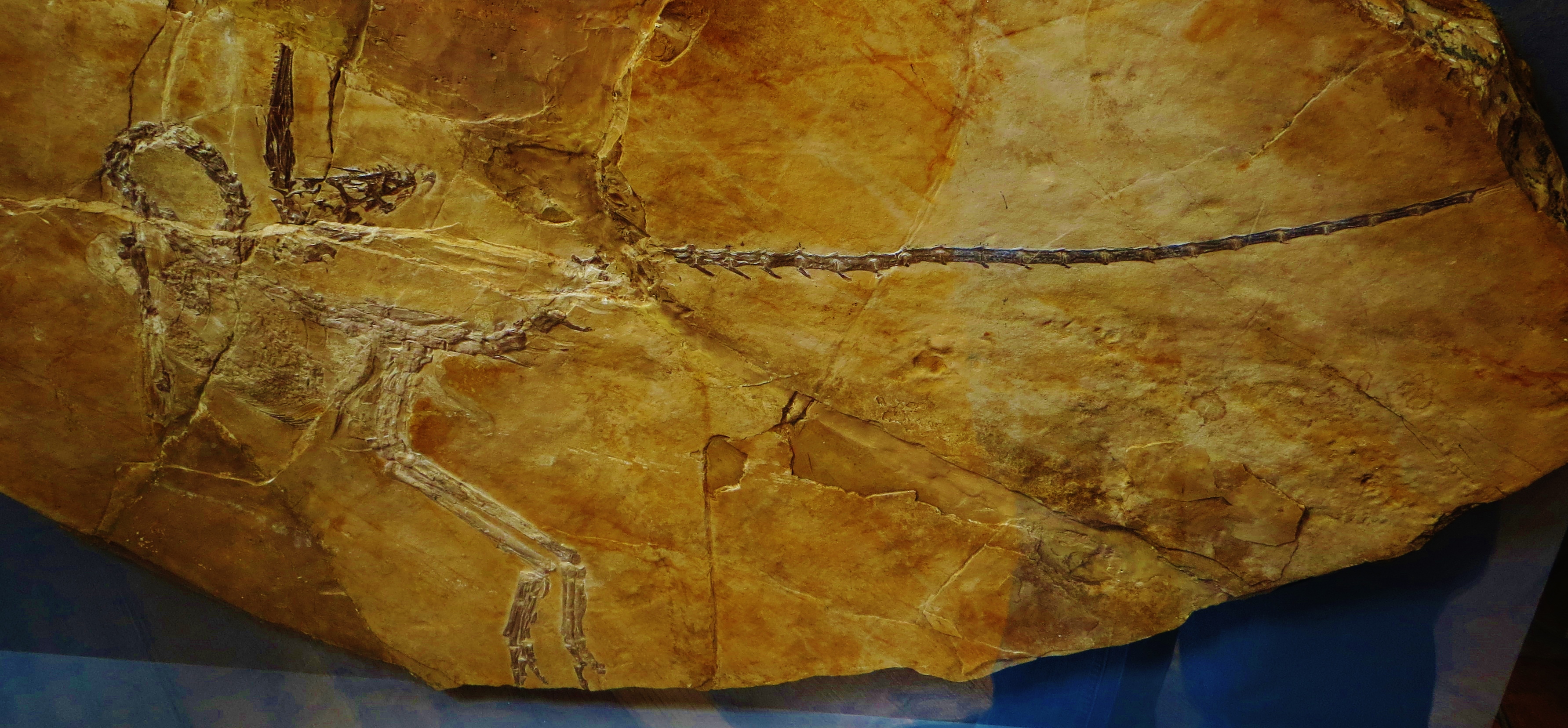


Scientific reconstruction of Compsognathus longipes by TotalDino (2024), white background. Lateral view showing the gracile body plan of this Late Jurassic theropod from Solenhofen.
CC BY 4.0
Ecology and behavior
Habitat
Compsognathus longipes inhabited the margins and small islands of the Tethyan archipelago in the Late Jurassic (Tithonian, ~150-145 Ma), in what is now southern Germany and southeastern France. The Solnhofen environment consisted of shallow marine lagoons with anoxic bottoms, surrounded by limestone islands with sparse xerophytic vegetation. The climate was warm and semi-arid, with pronounced dry seasons. Associated fauna included Archaeopteryx lithographica, pterosaurs such as Rhamphorhynchus and Pterodactylus, lizards, small Mesozoic mammals, crocodiles, and abundant marine fauna of fish, cephalopods, and crustaceans.
Feeding
Compsognathus was an active carnivore specialized in small prey. Holotype BSP AS I 563 preserves a lizard (Bavarisaurus macrodactylus, later identified) in the abdominal cavity, providing direct evidence of diet. The French specimen preserves a fish. The small, recurved, pointed teeth without marked serration were suitable for gripping and puncturing small prey such as lizards, small mammals, eggs, large insects, and possibly small birds or juvenile pterosaurs. The morphology of long, agile hindlimbs suggests a high-speed hunter in open or semi-open terrain.
Behavior and senses
Direct behavioral evidence for Compsognathus is scarce but significant: preservation of whole prey within the abdominal cavity suggests it swallowed considerably sized prey whole or in few pieces, behavior similar to modern small raptors. There is no evidence of pack hunting, and the skull morphology, with large orbits, suggests good visual acuity. The animal's position in an island ecosystem of limited resources implies possibly opportunistic habits and broad diet. The very small body size may indicate active foraging over extensive areas of island margins.
Physiology and growth
Compsognathus was almost certainly endothermic with elevated metabolism, as indicated by basal coelurosaur bone histology (rapidly growing fibrolamellar tissue) and its phylogenetic position within Coelurosauria. The small size (3.5 kg) implies a high relative metabolic rate and need for frequent feeding. The absence of direct feather evidence in the fossil record — unlike its relative Sinosauropteryx — leaves its integument an open question: the animal may have had a mosaic distribution of scales and filaments like Juravenator, proto-feathers over the entire body like Sinosauropteryx, or both conditions in different body regions.
Paleogeography
Continental configuration

Scotese & Vérard · CC BY 4.0 · Jurassic, ~155 Ma
Fossil sites

CC BY-SA 3.0
During the Titoniano (~150–145 Ma), Compsognathus longipes inhabited the fragmenting Pangea. North America and Europe were still close, and the North Atlantic was just beginning to open. Climate was warm and humid globally, with no polar ice caps.
Bone Inventory
Holotype BSP AS I 563 (Munich) is a nearly complete, articulated skeleton preserved in lithographic limestone. It includes skull, mandible, nearly complete vertebral column, pectoral and pelvic girdles, and limbs. The second specimen, MNHN CNJ 79 (Paris), is equally well preserved. Both are treated as belonging to the same species with ontogenetic size variation.

Found elements
Inferred elements
Scientific Literature
6 papers in chronological order — from the original description to recent research.
Neue Beiträge zur Kenntnis der urweltlichen Fauna des lithographischen Schiefers
Wagner, J.A. · Abhandlungen der Bayerischen Akademie der Wissenschaften
Founding paper establishing the genus and species Compsognathus longipes based on holotype BSP AS I 563 collected by Joseph Oberndorfer from the lithographic limestones of Solenhofen, Bavaria. Johann Andreas Wagner describes the animal as a gracile 'reptile' with elongated hindlimbs and a delicate mandible — hence the name 'elegant jaw'. Wagner did not recognize the animal's affinity with dinosaurs, which would only be established by Thomas Henry Huxley in 1868. The work is notable for documenting a lizard preserved within the abdominal cavity of the specimen, providing direct evidence of feeding behavior. Published in Abhandlungen der Bayerischen Akademie der Wissenschaften, vol. 9(1): 30-38, it is the starting point for all subsequent study of Compsognathus.
On the animals which are most nearly intermediate between birds and reptiles
Huxley, T.H. · Annals and Magazine of Natural History
Seminal article in which Thomas Henry Huxley presents Compsognathus longipes as central evidence for the hypothesis of dinosaurian origin of birds. Huxley compares in detail the hindlimbs of Compsognathus with those of Archaeopteryx and modern ratite birds, demonstrating morphological continuity suggesting common ancestry. The work, published in Annals and Magazine of Natural History, series 4, vol. 2: 66-75, is one of the most important of 19th-century paleontology and launched the debate that would persist until the late 20th century. Huxley was the first scientist to formally recognize Compsognathus's intermediate position between reptiles and birds, anticipating by more than a century the modern phylogenetic confirmation that birds are theropod dinosaurs.
Compsognathus corallestris, une nouvelle espèce de dinosaurien théropode du Portlandien de Canjuers
Bidar, A., Demay, L. & Thomel, G. · Annales du Muséum d'Histoire Naturelle de Nice
Bidar, Demay, and Thomel describe the second Compsognathus specimen, MNHN CNJ 79, collected at Canjuers, Provence, from the Portlandian (Tithonian) lithographic limestones, and assign it to a new species: Compsognathus corallestris. The specimen is significantly larger than the German holotype, about 1.25 m long, and has a fish preserved in the abdominal cavity. The authors interpret size differences and some anatomical features as specific-level distinctions. Published in Annales du Muséum d'Histoire Naturelle de Nice 1: 9-40. The validity of C. corallestris was later questioned by Ostrom (1978) and Peyer (2006), who concluded it was an adult individual of the same species C. longipes, with differences explained by ontogenetic and individual variation.
The osteology of Compsognathus longipes
Ostrom, J.H. · Zitteliana
John H. Ostrom provides the most detailed osteological analysis of Compsognathus longipes published to that date, examining both the German holotype BSP AS I 563 and the French specimen from Canjuers (MNHN CNJ 79). The work, published in Zitteliana 4: 73-118, concludes that the French specimen represents an adult of C. longipes, invalidating Compsognathus corallestris of Bidar et al. (1972). Ostrom systematically documents each skeletal element and compares Compsognathus with other coelurosaurs, clarifying the phylogenetic position of the animal. The work is the reference osteological foundation for all subsequent studies of the taxon and consolidated Compsognathus's position as a basal coelurosaur theropod, anatomically relevant to the discussion on the origin of birds.
An exceptionally well-preserved theropod dinosaur from the Yixian Formation of China
Chen, P.J., Dong, Z.M. & Zhen, S.N. · Nature
Chen, Dong, and Zhen describe Sinosauropteryx prima, a compsognathid from the Early Cretaceous Yixian Formation, China, with filamentous integumentary structures interpreted as proto-feathers or feather precursors — the first dinosaur proto-feathers ever found. Published in Nature 391: 147-152, the work is revolutionary for demonstrating that a close relative of Compsognathus had feather-like integumentary coverings, raising the hypothesis that Compsognathus longipes itself might have had analogous structures, not preserved in the Solnhofen limestone. The work was fundamental to consolidating the dinosaurian origin of birds hypothesis and placed compsognathids at the center of the debate on feather evolution.
A reconsideration of Compsognathus from the Upper Tithonian of Canjuers, southeastern France
Peyer, K. · Journal of Vertebrate Paleontology
Karin Peyer redescribes the French specimen MNHN CNJ 79 with detailed osteological analysis and conducts a phylogenetic analysis of Compsognathidae. The work, published in Journal of Vertebrate Paleontology 26(4): 865-880, confirms that Compsognathus corallestris of Bidar et al. (1972) is a junior synonym of C. longipes, definitively closing the debate on the validity of the second species. The phylogenetic analysis recovers Compsognathidae as a monophyletic group within Coelurosauria, with Compsognathus as its most basal member. The work is the modern phylogenetic reference for the genus and family Compsognathidae, and includes a new description of the Canjuers specimen's elements with systematic comparison to the German holotype.
Famous museum specimens

BSP AS I 563
Bayerische Staatssammlung für Paläontologie und Geologie, Munique, Alemanha
Holotype of Compsognathus longipes, nearly complete and articulated skeleton preserved in a lithographic limestone slab from Solnhofen. Includes skull, mandible, vertebral column, and limbs. An unidentified lizard is preserved in the abdominal cavity, providing direct evidence of feeding behavior. Collected by Joseph Oberndorfer in 1859 at Kelheim, Bavaria.
MNHN CNJ 79
Muséum National d'Histoire Naturelle, Paris, França
Second known specimen of Compsognathus longipes, recovered at Canjuers, Provence, in Tithonian limestones. Significantly larger than the German holotype at ~1.25 m, and preserves a fish in the abdominal cavity. Originally described as a separate species C. corallestris by Bidar et al. (1972), today recognized as an adult of C. longipes.
NHMUK (molde)
Natural History Museum, Londres, Reino Unido
The Natural History Museum in London holds high-quality casts of holotype BSP AS I 563 and the French specimen. The museum displays Compsognathus in the context of bird evolution, alongside Archaeopteryx, illustrating Huxley's hypothesis on the dinosaur-to-bird transition.
Molde expositivo
Museum für Naturkunde, Berlim, Alemanha
The Berlin Natural History Museum displays a Compsognathus longipes cast in proximity to the famous Berlin Archaeopteryx lithographica specimen, allowing direct comparison between the two Late Jurassic contemporaries that were central to Huxley's hypothesis on the origin of birds.
In cinema and popular culture
Compsognathus gained unexpected popular fame with Steven Spielberg's The Lost World: Jurassic Park (1997), in a memorable opening scene where a British girl is attacked by a group of small dinosaurs on the beach of Isla Sorna. The scene established Compsognathus as the 'piranhas of the Jurassic' in popular imagination: small individually, deadly dangerous in packs. This depiction is dramatically exaggerated — the fossil record shows individual hunting of lizards, not collective attacks on humans. The film, however, got the size right: unlike most dinosaurs in Jurassic Park, Compsognathus is represented at approximately correct scale for an adult of the species. Its presence in the Jurassic Park franchise in two films (1997 and 2001) gave the small theropod cultural visibility that few dinosaurs of its size have achieved, making it recognizable to the general public even without the dramatic appeal of larger animals such as Tyrannosaurus or Velociraptor.
Classification

Discovery
Fun fact
For more than a century, Compsognathus was considered the smallest known non-avian dinosaur — a title it only lost with the discovery of species such as Microraptor and Anchiornis in the 21st century. The holotype was long interpreted as a juvenile animal, but subsequent bone histology studies confirmed it was an adult: an adult of only 89 cm and 3.5 kg. Preserved inside its abdominal cavity was a lizard it had swallowed shortly before dying 150 million years ago.
Last reviewed: April 24, 2026