
Albertosaurus
Albertosaurus sarcophagus
"Flesh-eating lizard of Alberta"
About this species
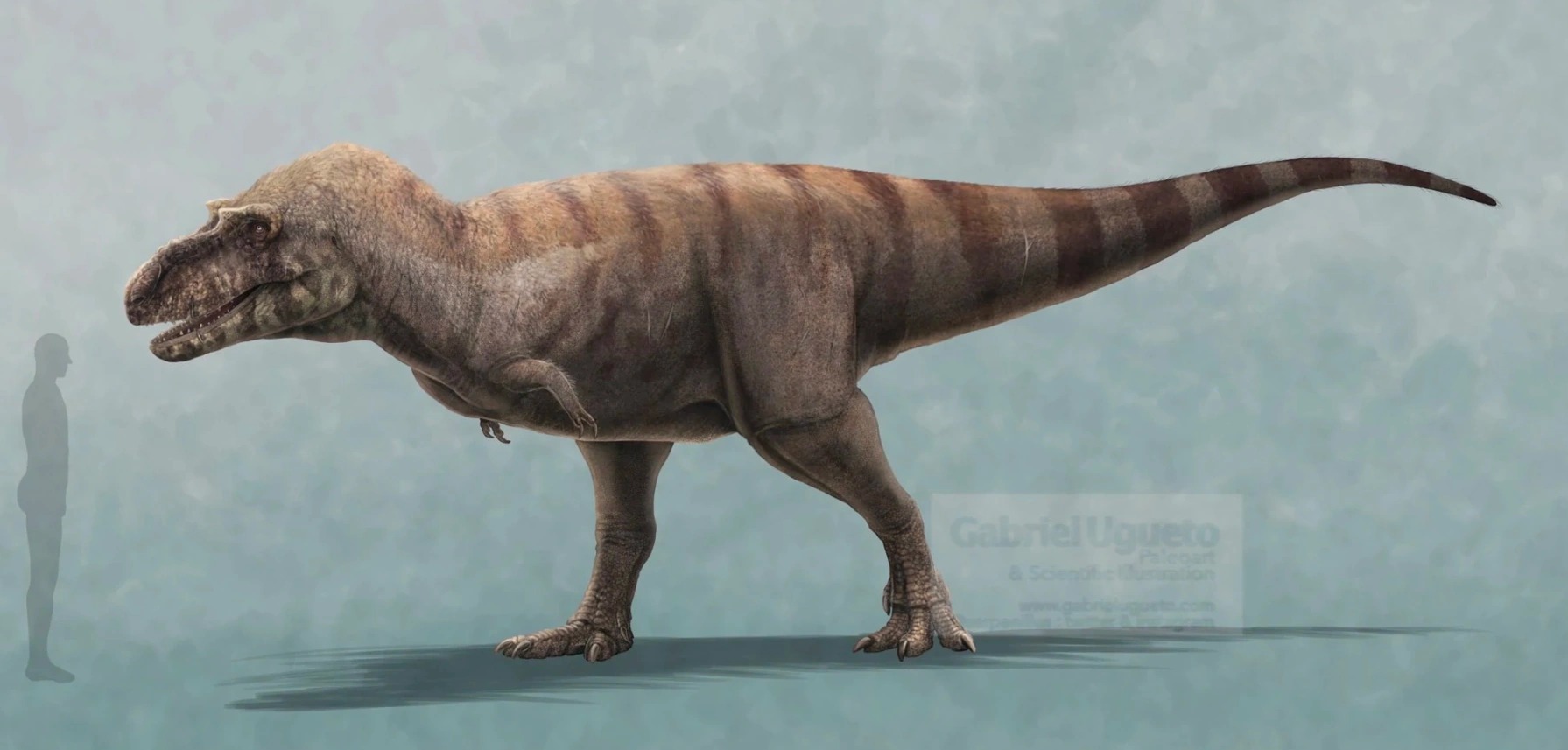
Albertosaurus sarcophagus was a medium-sized tyrannosaurid that lived during the late Campanian, 70 to 68 million years ago, in what is now the Canadian province of Alberta. At around 8 to 9 meters long and between 1,300 and 1,700 kg, it was smaller and more agile than its later relative Tyrannosaurus rex. It is distinguished by a relatively narrower skull, proportionally longer hindlimbs, and an estimated locomotor speed of 14 to 21 km/h. The discovery of a bonebed at Dry Island containing at least 26 individuals of different ages provided the strongest evidence of gregarious behavior among tyrannosaurids.
Geological formation & environment
The Horseshoe Canyon Formation in southern Alberta, Canada, represents sediments from the late Campanian to early Maastrichtian, deposited approximately 70 to 68 million years ago in a coastal plain environment at high paleolatitude. The formation is known for its temperate to cool-climate fauna, distinct from more southerly faunas of the same age. In addition to Albertosaurus sarcophagus, the formation preserves hadrosaurs such as Edmontosaurus and Saurolophus, basal ceratopsians, ornithomimids, troodontids, ankylosaurs, and a rich assemblage of invertebrates and smaller vertebrates.
Image gallery


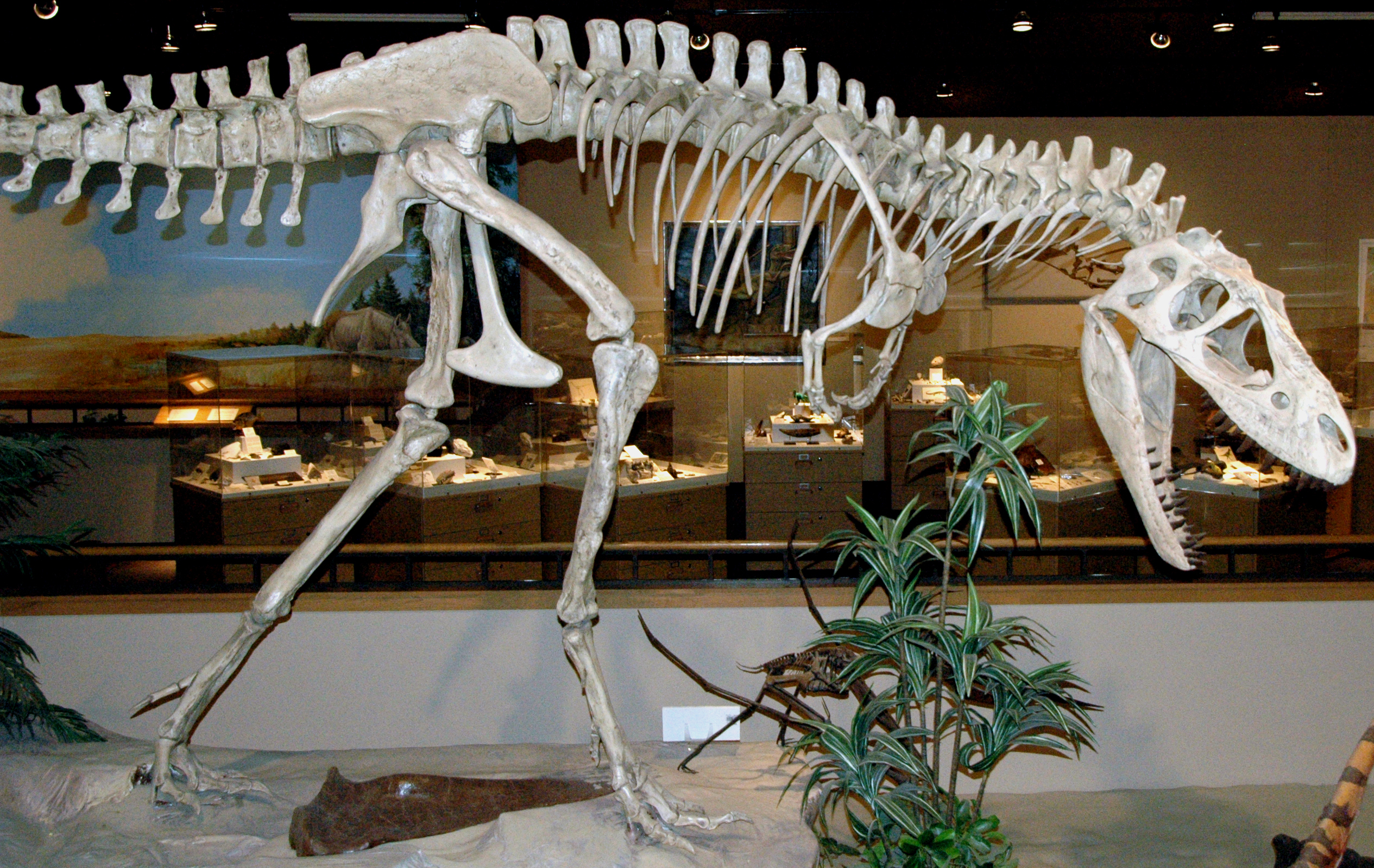
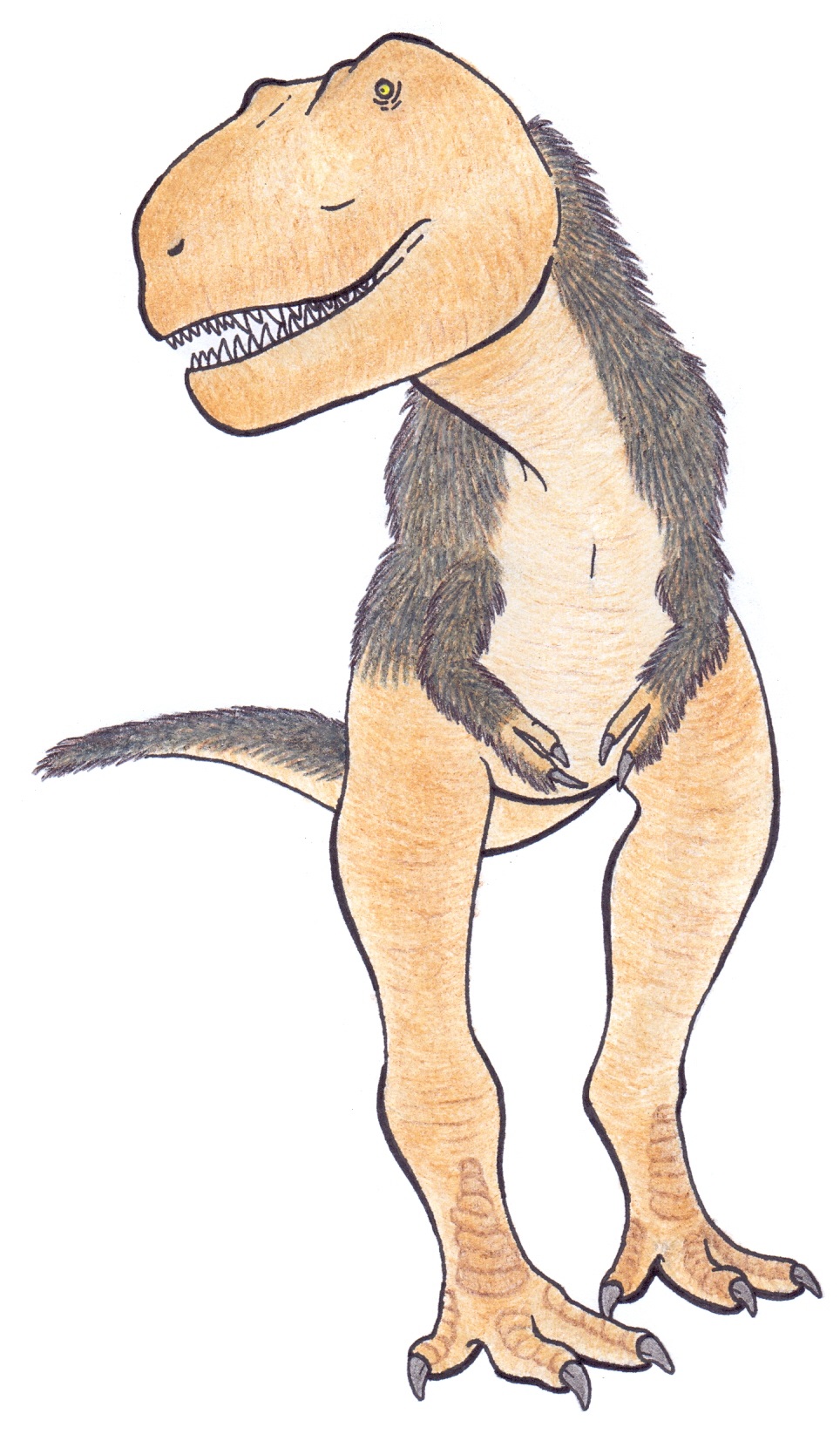
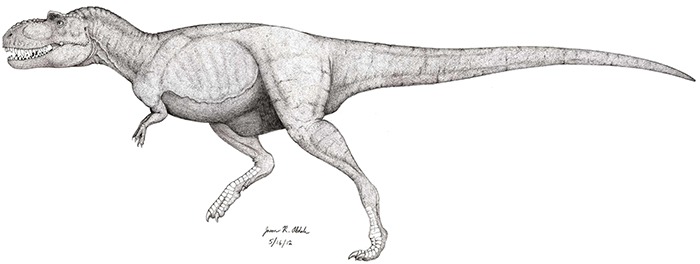
_1_(15390316746).jpg)



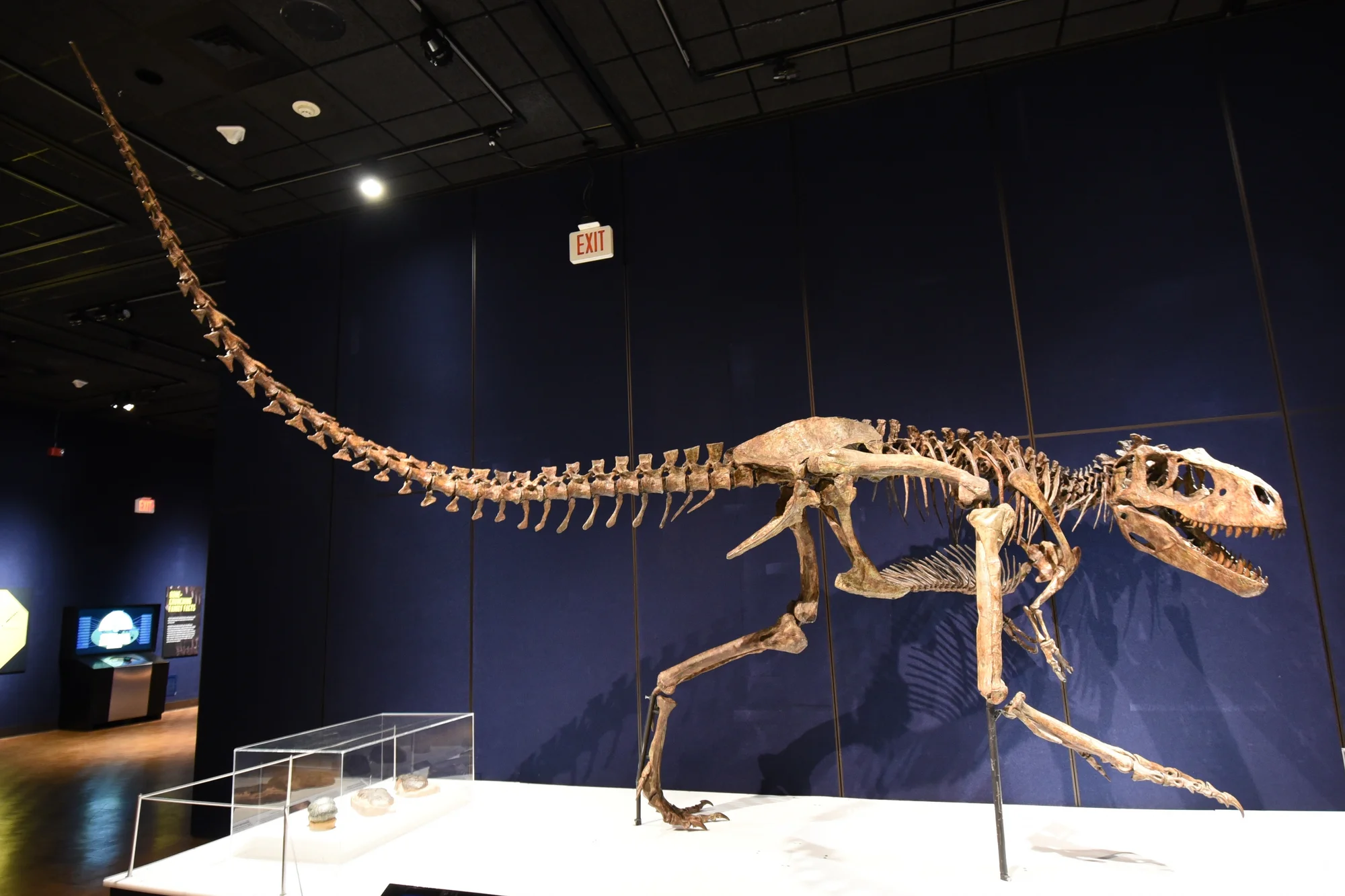
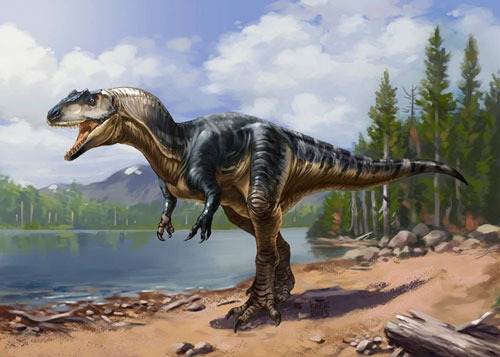
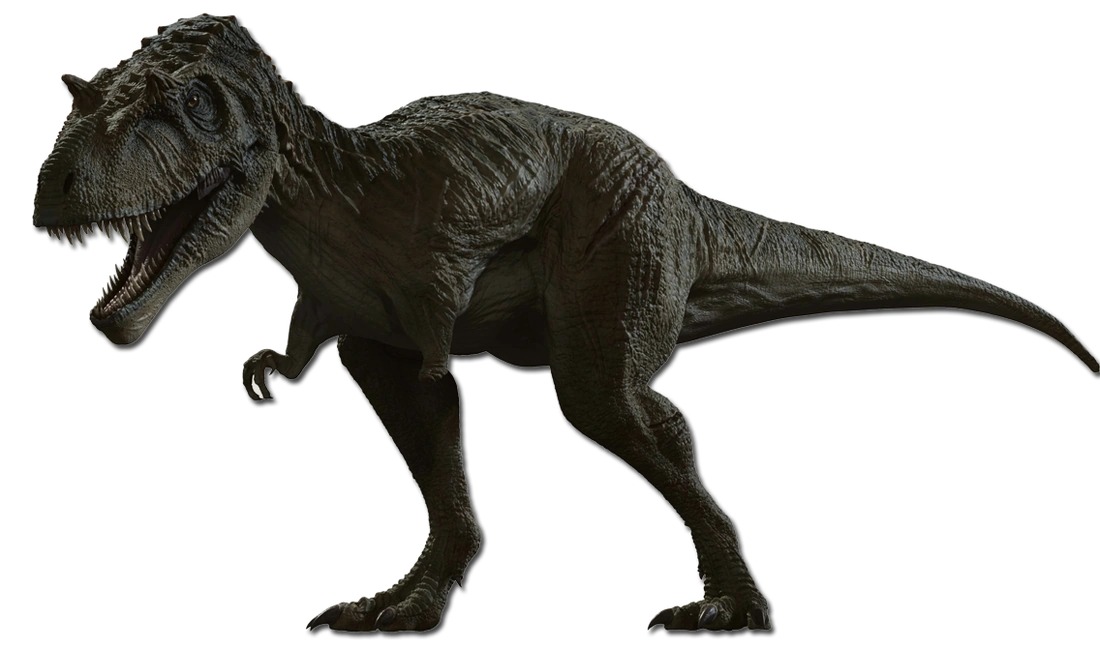
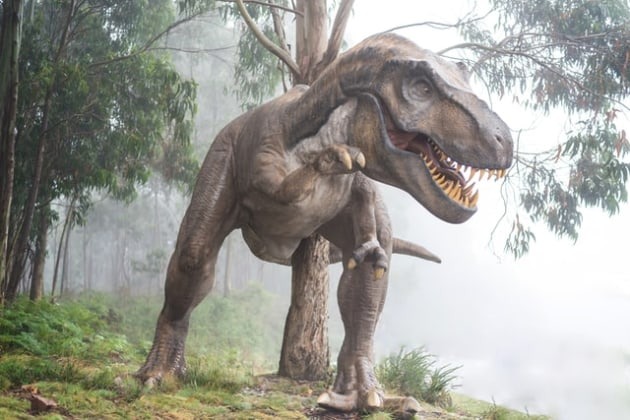
Size comparison between Albertosaurus sarcophagus and human silhouette.
Gabriel Ugueto — paleoarte
Ecology and behavior
Habitat
Albertosaurus sarcophagus inhabited the seasonal floodplains of the Horseshoe Canyon Formation in Alberta, approximately 70 to 68 million years ago. The paleoenvironment was a coastal plain at high paleolatitude (approximately 58 degrees north), with temperate to subpolar climate, lacking the extensive crocodilians and diverse turtles found in more southerly faunas. Vegetation included low angiosperms, ferns, and some conifers. Meandering rivers and seasonal swamps dotted the landscape, providing water resources and attracting potential prey.
Feeding
As the apex predator of its ecosystem, Albertosaurus primarily hunted hadrosaurs such as Edmontosaurus and Saurolophus, as well as ceratopsians and ornithomimids available in the Horseshoe Canyon Formation. Mandibular biomechanics studies (Therrien et al., 2021) demonstrate that juveniles had more slender teeth adapted for smaller, soft-tissue prey, while adults developed more robust dentition for handling larger prey. Bite marks identified on bones from the Dry Island bonebed suggest the species consumed carcasses down to the bone, possibly including opportunistic cannibalism.
Behavior and senses
The most striking evidence for Albertosaurus behavior comes from the Dry Island bonebed, which contains at least 26 individuals of different age classes: juveniles, subadults, and adults. This monodominant assemblage is interpreted by Currie and Eberth (2010) as evidence of gregarious behavior, suggesting Albertosaurus could move and potentially hunt in age-heterogeneous groups. Ontogenetic niche partitioning (juveniles hunting smaller prey, adults larger prey) could have facilitated peaceful coexistence within the group. Evidence of cannibalism (Coppock and Currie, 2024) indicates complex intraspecific interactions.
Physiology and growth
Bone histology studies integrated into the life table of Erickson et al. (2010) demonstrate that Albertosaurus exhibited rapid growth characteristic of endothermic (warm-blooded) dinosaurs. The species reached adult size around 10 to 12 years, with peak growth during the subadult phase. The high metabolism is consistent with other coelurosaurs and corroborates the endothermy hypothesis in tyrannosaurids. Proportionally longer hindlimbs relative to T. rex suggest greater locomotor speed, estimated at 14 to 21 km/h, making Albertosaurus one of the most agile known tyrannosaurids.
Paleogeography
Continental configuration

Scotese & Vérard · CC BY 4.0 · Cretaceous, ~105 Ma
Fossil sites

Anky-man · CC BY-SA 3.0
During the Campaniano (~70–68 Ma), Albertosaurus sarcophagus inhabited Laramidia, the western half of present-day North America, separated from the east by the Western Interior Seaway, a shallow sea dividing the continent. The continents were in very different positions: India was drifting toward Asia, Antarctica was still connected to Australia, and South America was an isolated island.
Bone Inventory
Known from more than 30 specimens of varying ages, including the holotype CMN 5600 (partial skull) and paratype CMN 5601, both at the Canadian Museum of Nature. The Dry Island bonebed (TMP) provided 26 individuals representing a wide age range, making it one of the best-represented tyrannosaurids in the fossil record.

Found elements
Inferred elements
Scientific Literature
15 papers in chronological order — from the original description to recent research.
Tyrannosaurus and other Cretaceous carnivorous dinosaurs
Osborn, H.F. · Bulletin of the American Museum of Natural History
This founding paper is the starting point of all Albertosaurus research. Henry Fairfield Osborn describes the Alberta material collected during Joseph Burr Tyrrell's 1884 expedition, including the partial skull CMN 5600, and establishes the genus Albertosaurus with the type species sarcophagus. The generic name honors the newly created province of Alberta, while the specific epithet derives from ancient Greek meaning 'flesh-eater'. Osborn distinguishes Albertosaurus from other North American Cretaceous carnivores, establishing the first diagnostic characters: fenestrated skull, serrated teeth, and robust bipedal stance. The work is brief, as Lambe had already described the material in detail the previous year, but Osborn's nomenclature prevailed formally.
A history of Albertosaurus discoveries in Alberta, Canada
Tanke, D.H. e Currie, P.J. · Canadian Journal of Earth Sciences
This panoramic paper documents over 125 years of Albertosaurus discoveries in Alberta, from Tyrrell's first collection in 1884 to modern excavations. The authors reveal that only 13 skulls and skeletons of varying completeness are known outside the bonebed, and that many specimens were compromised by inadequate collection techniques, vandalism, political conflicts, and loss of stratigraphic data. The work is fundamental for understanding the incomplete fossil record and knowledge gaps about the species. Tanke and Currie also document the expedition histories of the AMNH, Canadian Museum of Nature, and Royal Tyrrell Museum.

A taxonomic assessment of the type series of Albertosaurus sarcophagus and the identity of Tyrannosauridae (Dinosauria, Coelurosauria) in the Albertosaurus bonebed from the Horseshoe Canyon Formation (Campanian-Maastrichtian, Late Cretaceous)
Carr, T.D. · Canadian Journal of Earth Sciences
Carr conducts a complete reassessment of the type series of Albertosaurus sarcophagus, examining holotype CMN 5600 and paratype CMN 5601, whose taxonomic relationship had been questioned. The study identifies a diagnostic autapomorphy shared by all specimens: an enlarged pneumatic recess on the posterior margin of the palatine, a unique structure distinguishing A. sarcophagus from all other tyrannosaurids. Carr also evaluates the identity of individuals from the Dry Island bonebed, confirming all belong to A. sarcophagus. The work consolidates the taxonomic validity of the species and establishes the modern diagnostic benchmark for its identification.


Quantifying tooth variation within a single population of Albertosaurus sarcophagus (Theropoda: Tyrannosauridae) and implications for identifying isolated teeth of tyrannosaurids
Buckley, L.G., Larson, D.W., Reichel, M. e Samman, T. · Canadian Journal of Earth Sciences
This paper analyzes the largest dataset of teeth from a single Albertosaurus sarcophagus population: 140 dissociated and 7 in-situ teeth from the Dry Island bonebed, representing adults and juveniles. The authors quantify intraspecific variation in size, curvature, carina angle, and denticle morphology, revealing that variation within the species is smaller than between different species. The study provides objective morphometric criteria for identifying isolated tyrannosaurid teeth, a recurring problem in field paleontology. Results also inform interpretations of dental ontogeny and feeding strategies across development.


The heterodonty of Albertosaurus sarcophagus and Tyrannosaurus rex: biomechanical implications inferred through 3-D models
Reichel, M. · Canadian Journal of Earth Sciences
Reichel uses three-dimensional models obtained by CT scanning of six well-preserved Albertosaurus sarcophagus teeth from the Dry Island bonebed to analyze the biomechanical implications of heterodonty. Comparison with T. rex reveals that both taxa exhibited morphological variation between teeth of different skull regions, but Albertosaurus had proportionally more slender teeth with sharper carinae. Finite element analysis suggests A. sarcophagus teeth were optimized for precise cutting, contrasting with T. rex's more robust teeth designed for bone crushing. This is the first 3D dental biomechanics study specifically focused on Albertosaurus.
Stratigraphy, sedimentology, and taphonomy of the Albertosaurus bonebed (upper Horseshoe Canyon Formation; Maastrichtian), southern Alberta, Canada
Eberth, D.A. e Currie, P.J. · Canadian Journal of Earth Sciences
Eberth and Currie analyze in detail the stratigraphy, sedimentology, and taphonomy of the Albertosaurus bonebed at Dry Island, located in the upper Maastrichtian beds of the Horseshoe Canyon Formation. The study evaluates depositional environments and the mechanisms responsible for the mass accumulation of at least 26 individuals. The authors document evidence of a catastrophic single-event death, possibly related to flooding or severe drought, in a floodplain environment. The taphonomic analysis includes bone orientation, degree of articulation, and trampling marks, providing crucial context for interpreting the gregarious behavior of the species.
On gregarious behavior in Albertosaurus
Currie, P.J. e Eberth, D.A. · Canadian Journal of Earth Sciences
This central paper analyzes the evidence for gregarious behavior in Albertosaurus sarcophagus, synthesizing morphological, phylogenetic, taphonomic, and ecological data. Currie and Eberth evaluate the Dry Island bonebed containing 26 individuals of different age classes (juveniles, subadults, and adults), concluding that geological and taphonomic evidence does not rule out a behavioral component in the mass death. The study compares with tyrannosaurid trackway sites and mono-dominant assemblages of other social carnivores, arguing that Albertosaurus likely hunted in groups. This is the most robust evidence for gregarious behavior in any non-avian tyrannosaurid.
Palaeopathological changes in a population of Albertosaurus sarcophagus from the Upper Cretaceous Horseshoe Canyon Formation of Alberta, Canada
Bell, P.R. · Canadian Journal of Earth Sciences
Bell documents the skeletal pathologies present in the Dry Island bonebed population, examining evidence of physical trauma in at least 26 Albertosaurus sarcophagus individuals. The study identifies healed fractures, exostoses (bone spurs), periostitis, and bite marks on various skeletal elements. The presence of bite marks on adult bones raises questions about cannibalism or intraspecific combat. Bone pathology is compared with other tyrannosaurids, suggesting A. sarcophagus lived in a high physical and social competition environment. This is the first systematic paleopathology study of an entire tyrannosaur population.


A revised life table and survivorship curve for Albertosaurus sarcophagus based on the Dry Island mass death assemblage
Erickson, G.M., Currie, P.J., Inouye, B.D. e Winn, A.A. · Canadian Journal of Earth Sciences
This pioneering study uses the age distribution of the Dry Island population, with 26 individuals ranging from juveniles to adults, to construct the first revised life table and survivorship curve for a non-avian dinosaur. The authors estimate mean annual mortality rates averaged 3.47% between ages two and thirteen, increasing to 19.5% prior to cohort extinction after 28 years. Mean life expectancy for individuals surviving to two years of age was 15.19 years. Bone histology data were integrated to estimate individual ages. The work demonstrated that Albertosaurus exhibited rapid growth characteristic of endothermic dinosaurs, reaching adult size around 10-12 years of age.

Faunal assemblages from the upper Horseshoe Canyon Formation, an early Maastrichtian cool-climate assemblage from Alberta, with special reference to the Albertosaurus sarcophagus bonebed
Larson, D.W., Brinkman, D.B. e Bell, P.R. · Canadian Journal of Earth Sciences
Larson, Brinkman, and Bell describe the vertebrate fauna from four new microfossil localities and the Albertosaurus bonebed in the upper Horseshoe Canyon Formation. The study characterizes a cool-climate Maastrichtian ecosystem at approximately 58 degrees north paleolatitude, notably different from more southerly faunas of the same age. The fauna includes taxa with northern affinities, such as holosteans, champsosaurs, Troodon, and toothed birds, while warm-climate elements such as crocodilians and diverse turtles are absent. These contextual data are fundamental for understanding the ecological niche of Albertosaurus sarcophagus in its original environment.

The phylogeny and evolutionary history of tyrannosauroid dinosaurs
Brusatte, S.L. e Carr, T.D. · Scientific Reports
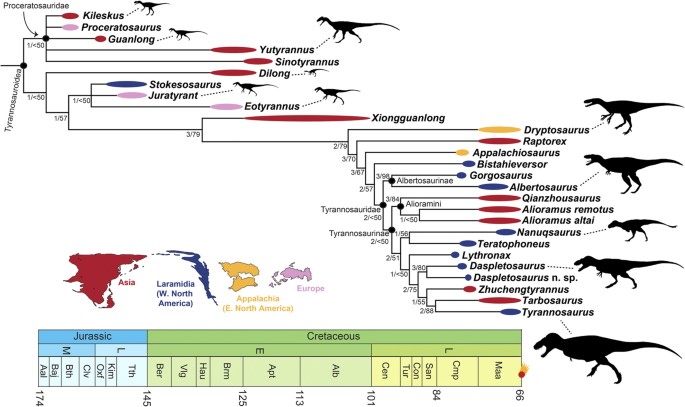
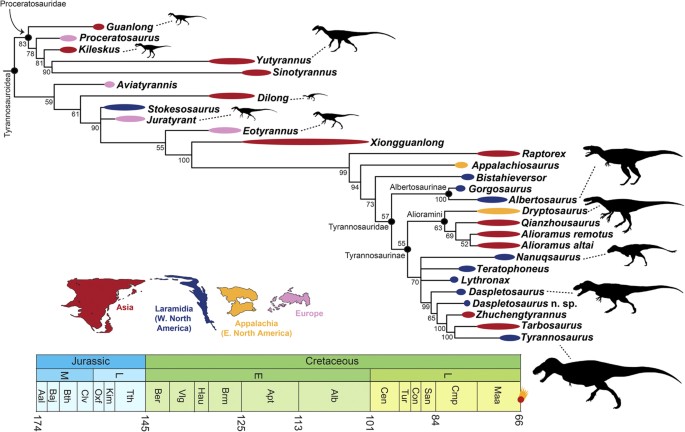
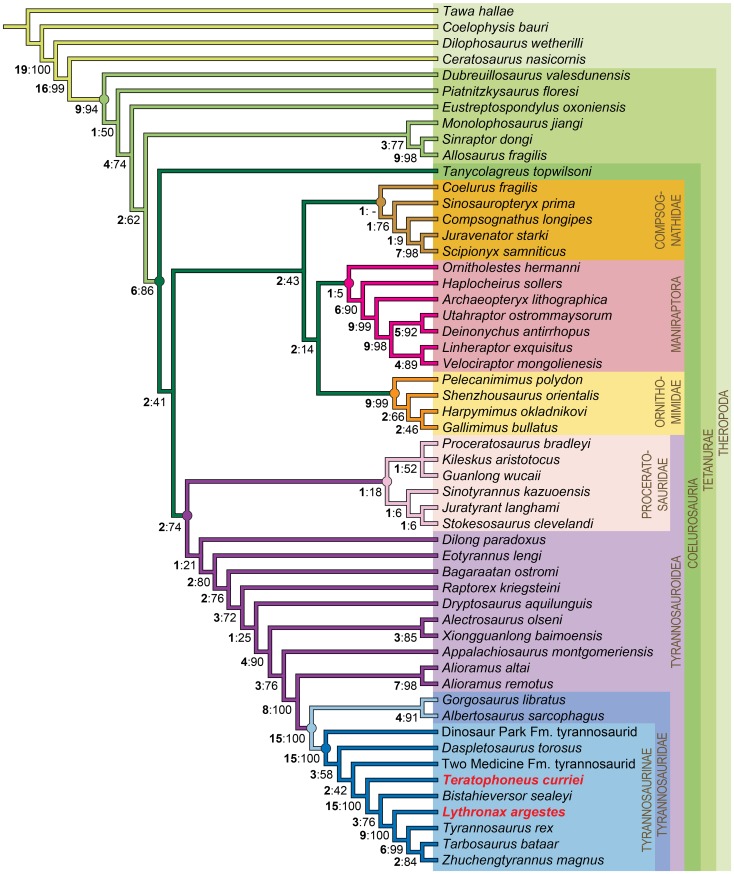
Brusatte and Carr present the most comprehensive phylogenetic analysis of tyrannosauroid dinosaurs to that date, merging published datasets and incorporating newly discovered taxa. The parsimony and Bayesian analysis, the first time Bayesian methods were applied to tyrannosauroids, recovers the position of Albertosaurus sarcophagus within Albertosaurinae as sister to Gorgosaurus libratus. The study demonstrates that the colossal body plan of derived tyrannosaurids evolved piecemeal, that there is no clear division between northern and southern species in North America, and that T. rex may have been an Asian immigrant. The stable position of Albertosaurus confirms the monophyly of Albertosaurinae.
Mandibular force profiles and tooth morphology in growth series of Albertosaurus sarcophagus and Gorgosaurus libratus (Tyrannosauridae: Albertosaurinae) provide evidence for an ontogenetic dietary shift in tyrannosaurids
Therrien, F., Zelenitsky, D.K., Voris, J.T. e Tanaka, K. · Canadian Journal of Earth Sciences
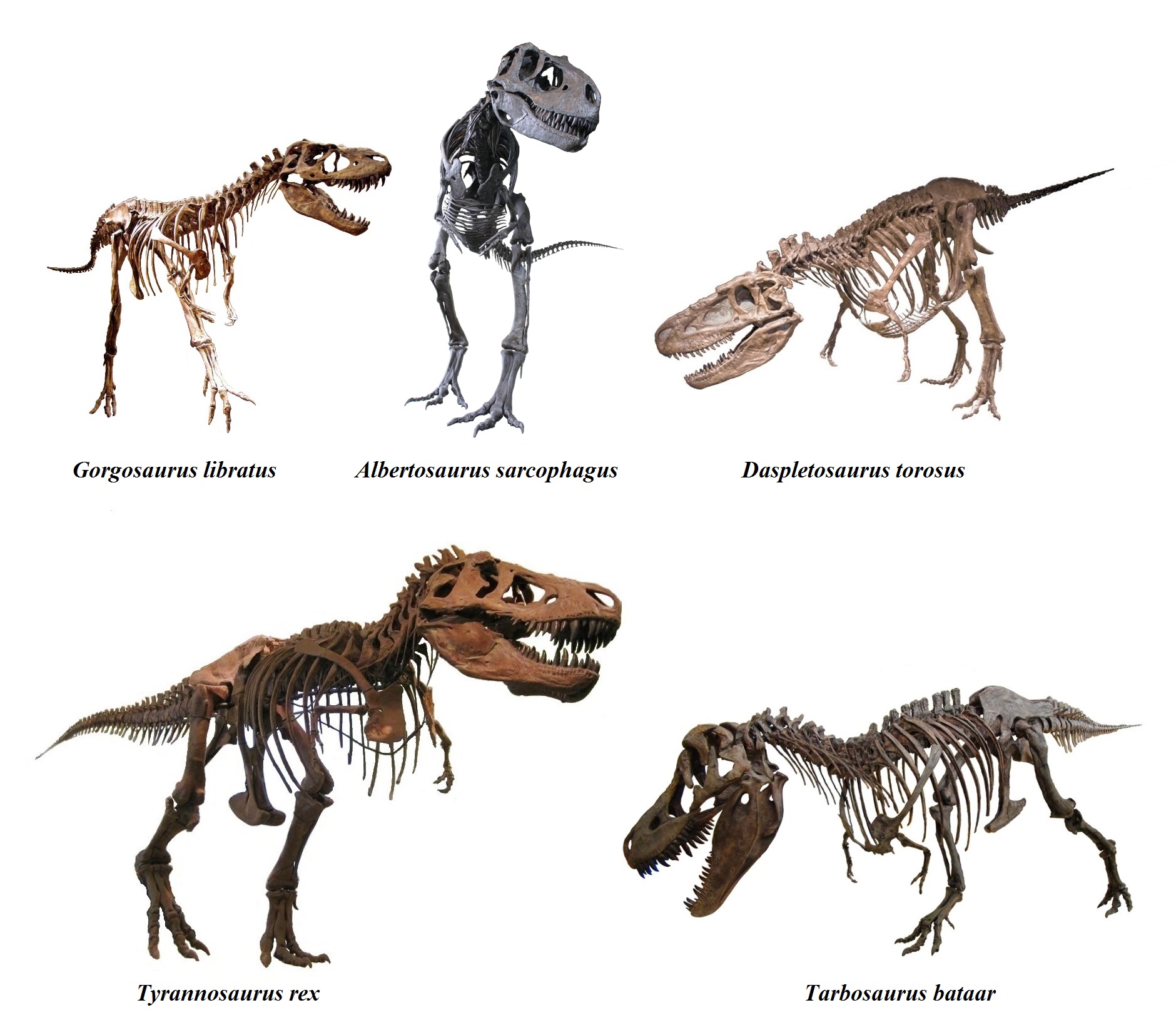
Therrien and colleagues analyze mandibular force profiles and tooth morphology across ontogenetic series of Albertosaurus sarcophagus and Gorgosaurus libratus. Results demonstrate that A. sarcophagus juveniles had more gracile jaws with sharper teeth, optimized for smaller, soft-tissue prey, while adults developed more robust jaws and harder-wearing teeth adapted for larger prey including bone. This pattern of ontogenetic dietary shift is consistent with niche partitioning between different age classes, which could explain the coexistence of multiple individuals of different ages in the same pack, as observed in the Dry Island bonebed.

A Problematic Tyrannosaurid (Dinosauria: Theropoda) Skeleton and Its Implications for Tyrannosaurid Diversity in the Horseshoe Canyon Formation (Upper Cretaceous) of Alberta
Mallon, J.C., Bura, J.R., Schumann, D. e Currie, P.J. · The Anatomical Record
Mallon and colleagues describe a problematic tyrannosaurid skeleton (CMN 11315) from the Horseshoe Canyon Formation, whose anatomical characteristics showed ambiguous affinities with Albertosaurus sarcophagus and other tyrannosaurids. Phylogenetic analysis indicates the specimen shares with Albertosaurinae a caudally concave ischium and with A. sarcophagus specifically a lobe-like flange of the postacetabular process of the ilium, concluding it likely represents a young A. sarcophagus. The paper discusses tyrannosaurid diversity in the Horseshoe Canyon Formation, documenting the process of identifying juvenile individuals whose diagnostic characters differ from adults.

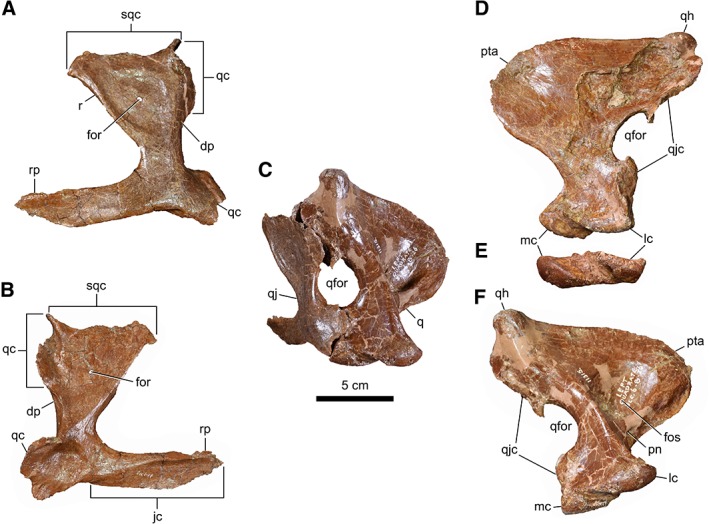
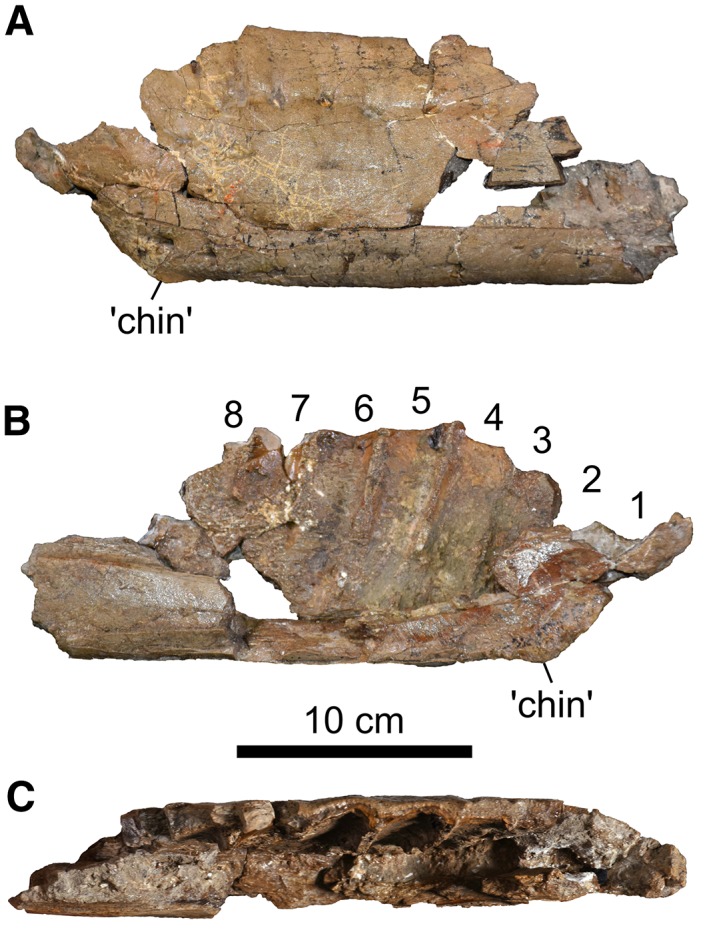
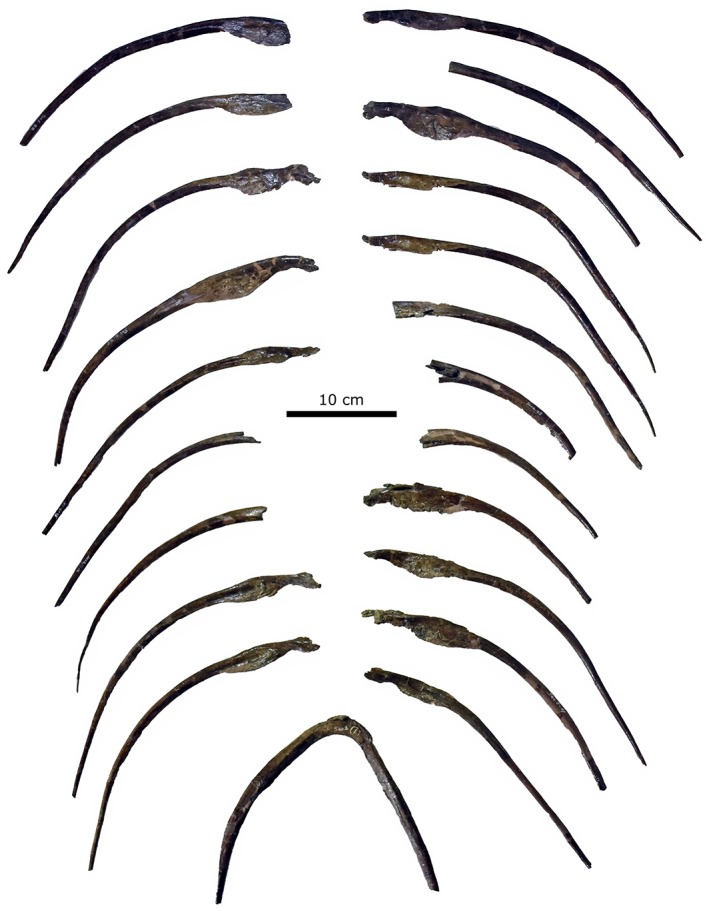
Electron and focused ion beam microscopy of fossilized Albertosaurus sarcophagus (Dinosauria: Theropoda) bone reveals nano to microscale features
Williams, A., Schumann, D., Mallon, J.C., Phaneuf, M.W., Bassi, N. e Grandeld, K. · Scientific Reports
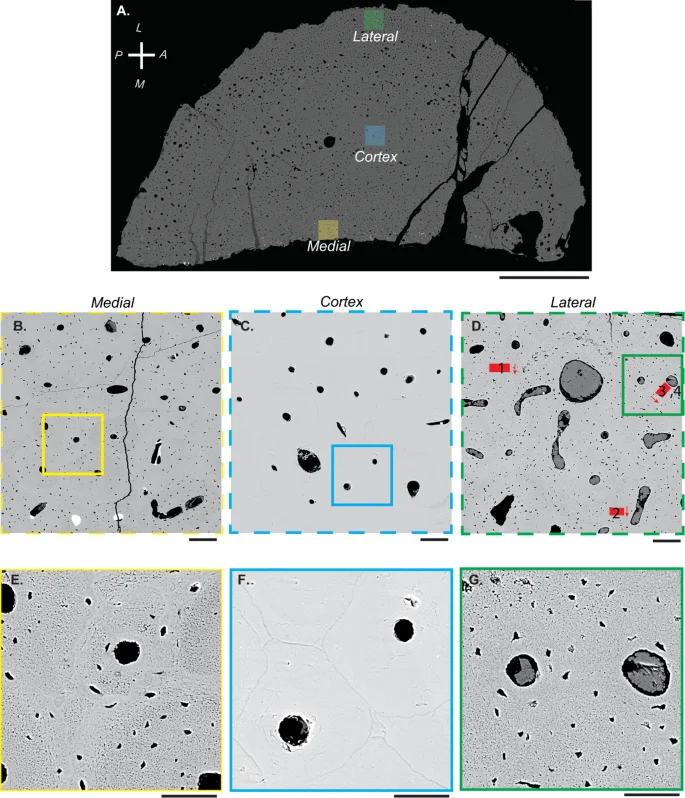
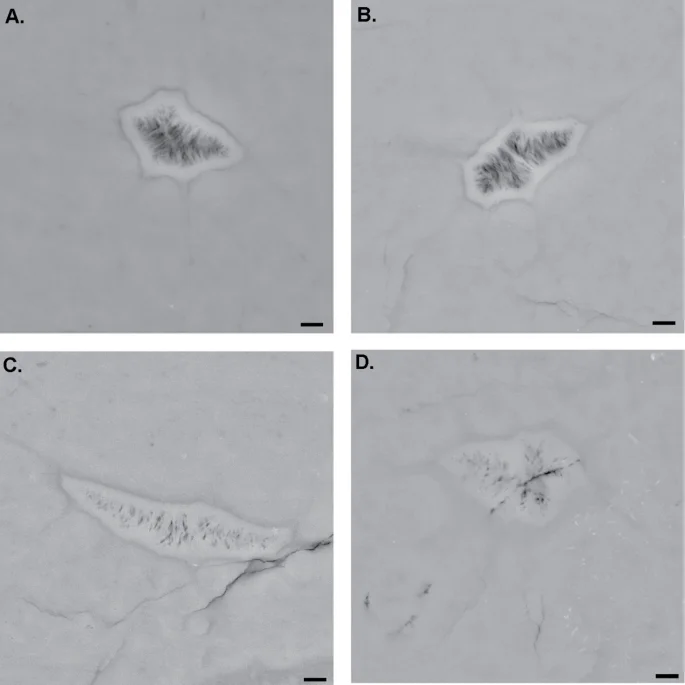
Williams and colleagues applied scanning electron microscopy (SEM) and focused ion beam (FIB-SEM) tomographic imaging to a petrographic thin section of the left fibula of Albertosaurus sarcophagus (specimen CMN FV 11315), 71.5 million years old. The study revealed that the 67 nm banding periodicity of collagen fibrils was remarkably preserved, and documented the first extensive record of a three-dimensional collagen fibril network and prolate ellipsoidal mineral clusters in a fossilized bone of this age. The results have direct implications for understanding fossilization mechanisms and biomolecule preservation in dinosaurs. This is the finest-scale study ever conducted specifically on A. sarcophagus material.

Additional Albertosaurus sarcophagus (Tyrannosauridae, Albertosaurinae) material from the Danek bonebed of Edmonton, Alberta, Canada with evidence of cannibalism
Coppock, C.C. e Currie, P.J. · Canadian Journal of Earth Sciences
Coppock and Currie describe new Albertosaurus sarcophagus material from the Danek bonebed in Edmonton, Alberta, including tooth traces on tyrannosaurid bones that provide the first evidence of cannibalism in an albertosaurine. The study documents the expanded geographic distribution of the species to the Edmonton area, complementing records from the Horseshoe Canyon Formation. Bite marks were analyzed in relation to A. sarcophagus tooth morphology to confirm intraspecific identification. This is the most recent record of cannibalistic behavior in tyrannosaurids and opens new questions about social interactions and feeding ecology of the species.

Famous museum specimens
CMN 5600 (Holótipo)
Canadian Museum of Nature, Ottawa, Canadá
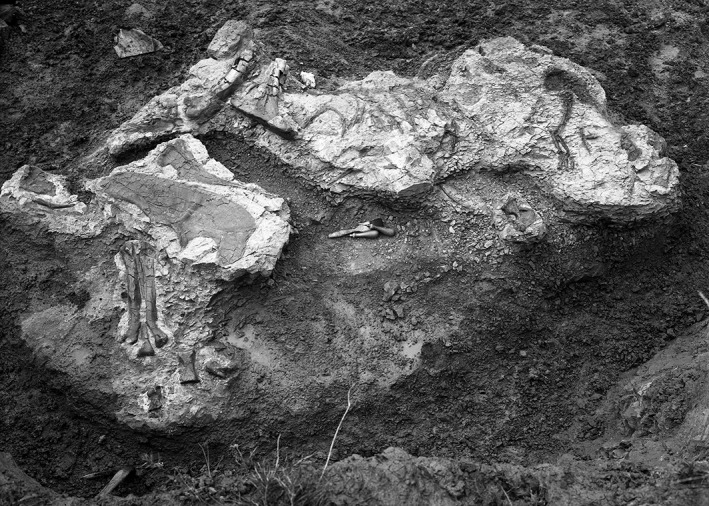
Holotype of Albertosaurus sarcophagus, collected during Tyrrell's geological expedition to the Red Deer River Valley on June 9, 1884. Consists primarily of a partial skull. This specimen was the basis for Lambe's 1904 description and Osborn's formal naming in 1905.
TMP 1985.098.0001
Royal Tyrrell Museum of Palaeontology, Drumheller, Alberta, Canadá
One of the most complete and well-preserved Albertosaurus sarcophagus specimens, constituting the original skull (not a cast) displayed at the Royal Tyrrell Museum. Includes cranial elements and part of the postcranial skeleton. This specimen has been widely used in anatomical and biomechanical studies.
ROM 807
Royal Ontario Museum, Toronto, Canadá
One of the most complete adult specimens of Albertosaurus sarcophagus, with a 970 mm lower jaw and estimated body length of 9.3 meters. ROM 807 is the second largest known individual of the species and has been widely studied for adult morphology analyses and interspecific comparisons.
In cinema and popular culture
Albertosaurus sarcophagus occupies a curious space in popular culture: recognizable enough to appear in important productions, but frequently eclipsed by the colossal Tyrannosaurus rex. In television documentary, it stands out in March of the Dinosaurs (2011), where it appears hunting in packs, and in Prehistoric Park (2006), with Nigel Marven. The cultural highlight of its representation arrives with Walking with Dinosaurs (BBC, 2025), where it stars in the episode 'The Pack', directly inspired by the Dry Island bonebed discoveries. The series features 'Rose', an adult female leading her group, representing the most modern scientific evidence on gregarious behavior. In animation, Albertosaurus appears in the expanded Jurassic World universe and in the Primeval series. Unlike T. rex, which is often portrayed as a solitary and omnipotent predator, Albertosaurus has been progressively associated with complex social behaviors, becoming a symbol of advances in behavioral paleontology.
Classification
Discovery
Fun fact
The Dry Island bonebed in Alberta contains at least 26 Albertosaurus sarcophagus individuals of different ages, from hatchlings to old adults, representing the strongest evidence of gregarious behavior in any tyrannosaurid. Curiously, Barnum Brown discovered the site in 1910 during an American Museum of Natural History expedition, but it took nearly a century, until 1997, for systematic excavations to reveal the true extent of the site.
Last reviewed: April 24, 2026