Convergent evolution
Why did these predators have such tiny arms?
Everyone looks at a T-Rex, a Carnotaurus or a Majungasaurus and asks the same question: why does an animal that large carry such tiny arms? A study published in May 2026 in Proceedings of the Royal Society B analyzed 82 species of non-avian carnivorous theropods and offered the most convincing explanation so far. The arms shrank because the head took over as the main weapon.
The classic question
The paradox of the tiny arms
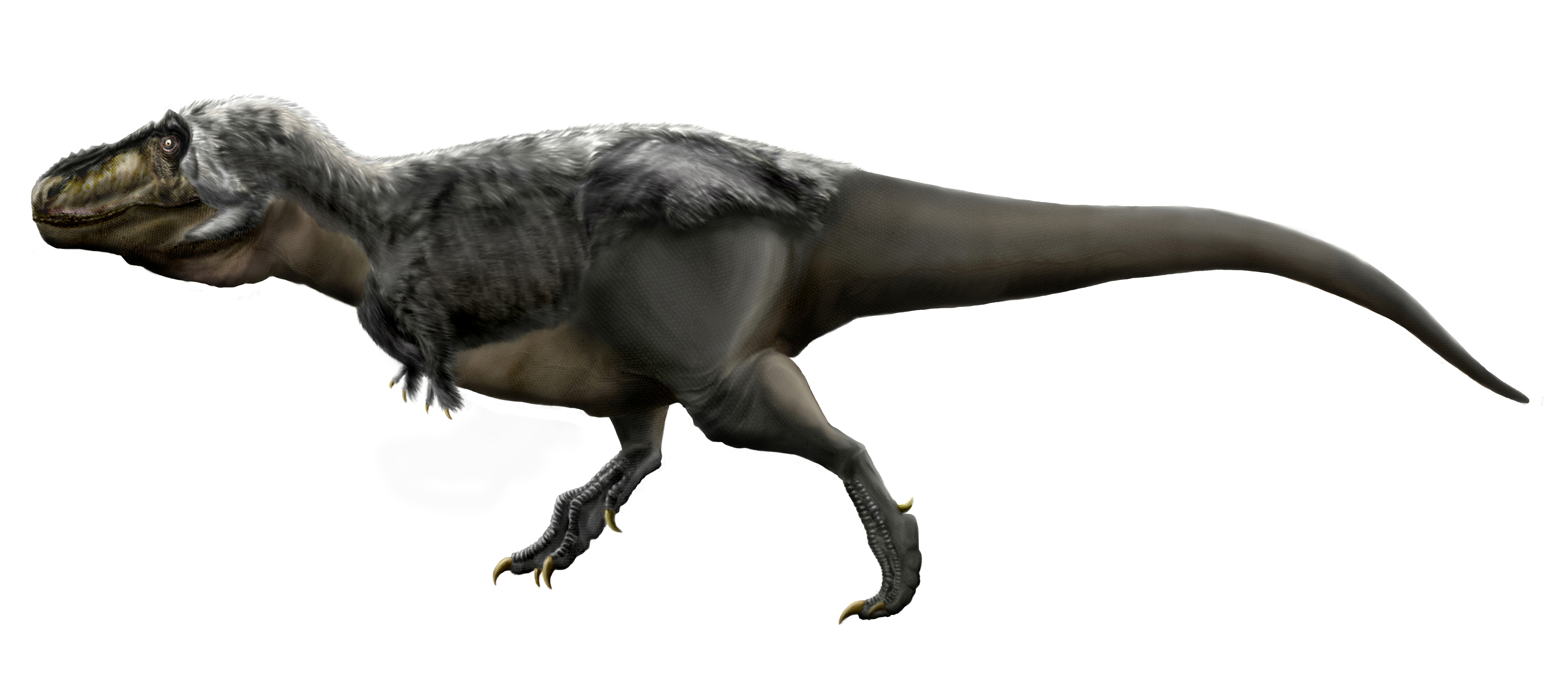
An adult Tyrannosaurus rex reached 12 meters in length, 4 meters at the hip and around 8 tonnes in mass. The skull alone is over 1.5 meters long. The arms? About 1 meter. They could not reach the mouth. They could not bring food to the snout. At first glance, they look like a design flaw.
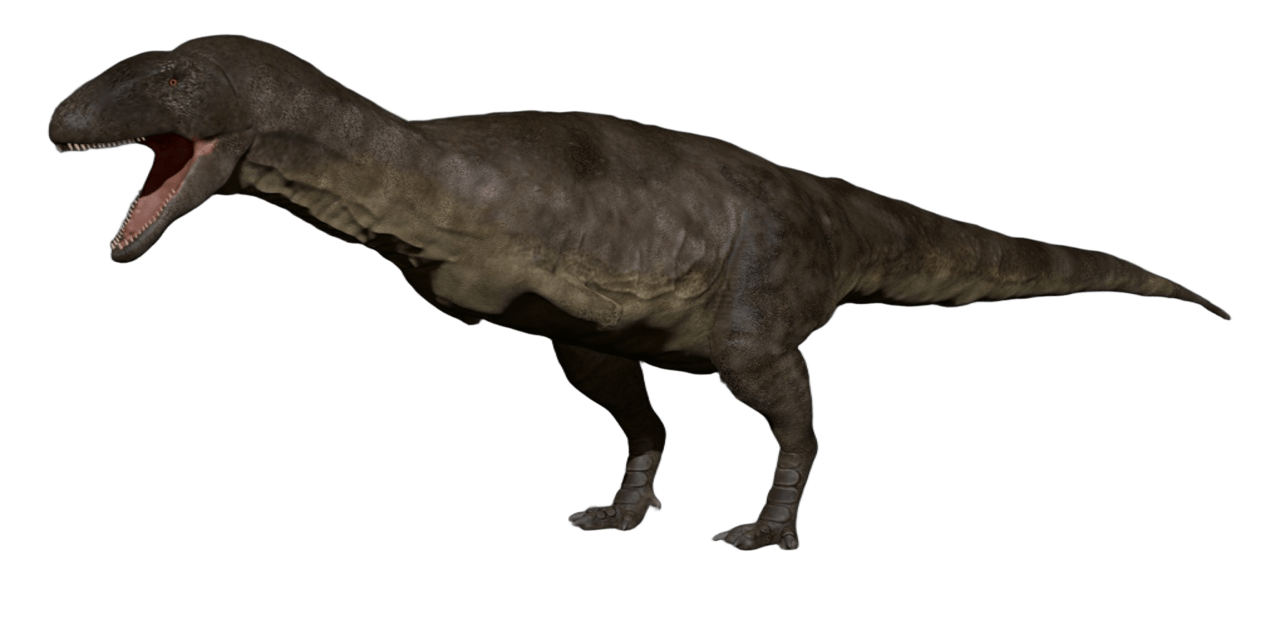
T-Rex is the most famous case, but it is far from alone. Carnotaurus sastrei, an Argentinian abelisaurid from the Late Cretaceous, had even more ridiculous arms: about 40 centimeters on an 8-meter body, with vestigial hands almost lacking functional fingers. Majungasaurus crenatissimus, an abelisaurid from Madagascar, was the same. Carcharodontosaurus saharicus, a giant African theropod, also carried proportionally short arms. The pattern repeats in groups without close kinship.
For decades, paleontologists proposed competing explanations. Reduction by disuse. Vestige from a common ancestor. Allometric byproduct of gigantism (large animals carry different proportions). Adaptation for mating display, communication or processing prey already brought down. None of those hypotheses, on its own, explained the full pattern. On 20 May 2026, a paper by Charlie Roger Scherer, Elizabeth Steell and Paul Upchurch (University College London) took a decisive step toward the answer.
The study
82 species, five lineages, one convergent pattern
The authors gathered anatomical measurements from 82 extinct non-avian theropod species. They measured forelimb length, hindlimb length, skull length and robustness (bone thickness of the braincase and jaw), estimated body mass and long-bone diameter. They then applied phylogenetic comparative analyses, which control for kinship among species to isolate changes that occurred independently.
The five groups with convergent forelimb reduction
- Tyrannosaurids (T-Rex, Tarbosaurus, Albertosaurus). Late Cretaceous of North America and Asia.
- Abelisaurids (Carnotaurus, Majungasaurus, Aucasaurus, Skorpiovenator). Cretaceous of Gondwana.
- Carcharodontosaurids (Carcharodontosaurus, Giganotosaurus, Mapusaurus). Middle Cretaceous.
- Megalosaurids (Torvosaurus, Megalosaurus). Middle and Late Jurassic.
- Ceratosaurids (Ceratosaurus, Limusaurus). Late Jurassic and Early Cretaceous.
In each of these five groups, the shrinking of the arms happened independently, at different points in the Mesozoic, from ancestors with arms of reasonable size. When the same pattern shows up five times in unrelated lineages, the technical term is convergent evolution. It is not coincidence: some selective pressure pushes those species toward the same design. Finding that pressure was the research question.
The decisive finding
What correlates with small arms is a robust skull
This is the piece that previous explanations were missing. The authors tested which variable correlates best with forelimb reduction. They compared three candidates: total body mass, skull length and skull robustness (bone thickness of the braincase and jaw). The result is statistically clear.
Why this rules out gigantism
The correlation between arm reduction and skull robustness was stronger than the correlation with body size. That is what statisticians call a competing-variables test. If small arms were just an allometric byproduct of large animals, body mass would be the best predictor. It was not.
The Majungasaurus case, at 1.6 tonnes, closes the argument: tiny arms in an animal five times smaller than T-Rex. In return, the Majungasaurus skull is disproportionately robust for its body size, with reinforced jaws and short teeth designed to bite and hold prey through a struggle.
It is not the size of the animal that shrinks the arms. It is the evolution of the skull as the main weapon.
The ecological explanation
The head replaced the arms
The central hypothesis of the study is simple and powerful. In each of the five identified groups, the skull became the primary tool of attack. Powerful bites replaced claws and hands in subduing prey. When the skull takes over as a weapon, the arms lose their role in hunting. Hands and forearms become free, in an evolutionary sense, to shrink. Features without selective pressure tend to regress over time, like eyes in cavefish or extra toes in ungulates.
The important detail is the sequence. The authors argue that robust skulls emerged before the arms shrank, not the other way around. The reverse sequence would make no evolutionary sense: no predator would abandon its main attack mechanism before having another one ready to take its place. Animals that lost useful arms before the mouth became a weapon would simply die without hunting and without leaving descendants.
Why the mouth beats claws against giant prey
Imagine trying to kill a 30-meter, 50-tonne sauropod with two hands. The arms of a bipedal theropod give a short lever, far from the predator's center of mass, and a small contact area compared with the prey. Thin claws can pierce skin and muscle, but they do not bring the animal down.
The mouth, by contrast, offers three advantages: neck musculature (far more powerful than arm musculature in a biped); broad contact (all teeth aligned at once); and a geometry that recruits the predator's body mass. When a T-Rex bit the flank of an Edmontosaurus, it transferred hundreds of kilos of body mass concentrated in the maxillary teeth. The arm could never generate that force.
For predators that fed on very large prey, such as sauropods or hadrosaurs, this was the only viable strategy. South American abelisaurids hunted giant titanosaurs. African carcharodontosaurids attacked long-necked sauropods. North American tyrannosaurids brought down Triceratops and Edmontosaurus. In every one of those scenarios, the arm was useless. The mouth was everything.
In the author's words
"We found a strong relationship between short arms and large, robust heads. The head replaced the arms as a method of attack, fostering an evolutionary process of reduction of these limbs. Although our study identifies correlations and therefore cannot establish cause and effect, it is highly likely that robust skulls arose before shorter forelimbs. The reverse would make no evolutionary sense, with these predators abandoning their attack mechanism without an alternative."
Charlie Roger Scherer, lead author of the study (2026).
Extreme cases
Three portraits of the same process
It is worth looking case by case. Each of the five groups followed the same road, but with important nuances. Tyrannosaurids shrank the arm in a moderate way and kept two functional fingers. Abelisaurids took reduction to the extreme, with hands almost erased. Carcharodontosaurids ended up in an intermediate state. The three portraits below sketch the range of the phenomenon.
Tyrannosaurus rex
Late Cretaceous (~68 to 66 Ma), North America. The most famous case.
Arm length: about 1 meter. Body length: about 12 meters. Arm-to-body ratio: just over 8 percent. The fingers are two (tyrannosaurids lost the third finger during their evolutionary history). The hand could not reach the mouth and could not be used to pull food.
In return, the T-Rex skull is the most extreme case in the robustness continuum. Width, height, bone thickness and jaw-muscle insertion area were pushed to the limit. Bite force estimated by Bates and Falkingham (2012) and Gignac and Erickson (2017) sits between 3,500 and 6,400 kg-f, the highest of any land animal known, alive or extinct. The teeth are incrassate (thickened), able to bite bone without fracturing.
The combination of giant head plus reinforced neck musculature makes tyrannosaurids the archetypal expression of the pattern. The arm lost function because the head was already doing everything.
Carnotaurus sastrei
Late Cretaceous (~72 to 70 Ma), Argentinian Patagonia. The limit case.
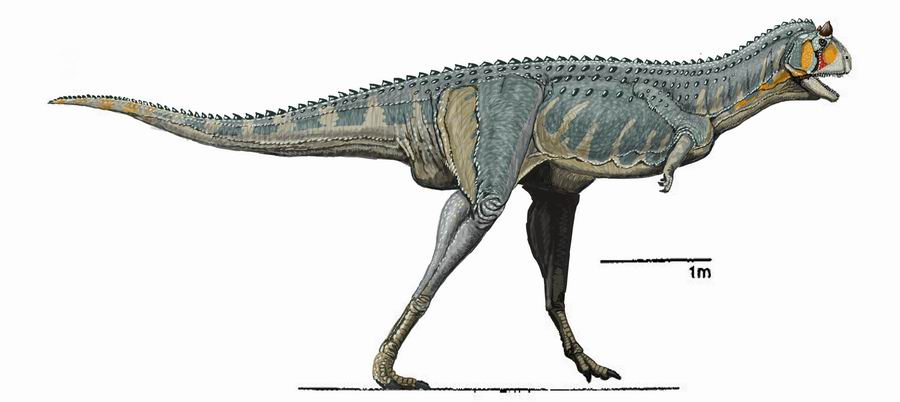
Carnotaurus arms are so small that paleontologists still debate whether they had any function at all. About 40 centimeters in an 8-meter body, with a short humerus and an almost absent forearm. The hands carry four fingers, but three of them are vestigial, without functional claws.
The skull is short and deep, with horns above the eyes. Through the muscular neck and the estimates of Mazzetta et al. (2009), Carnotaurus delivered fast bites on the move, using speed and neck mass to generate impact. For that strategy, the arm served no purpose.
Carnotaurus and close relatives (Majungasaurus, Aucasaurus, Skorpiovenator) are the limit cases of the pattern: arm reduction taken almost to complete erasure. In some abelisaurids, hand and forearm appear as vestigial appendages without functional articulation.
Carcharodontosaurus saharicus
Middle Cretaceous (~99 to 94 Ma), North Africa. The intermediate version of the pattern.
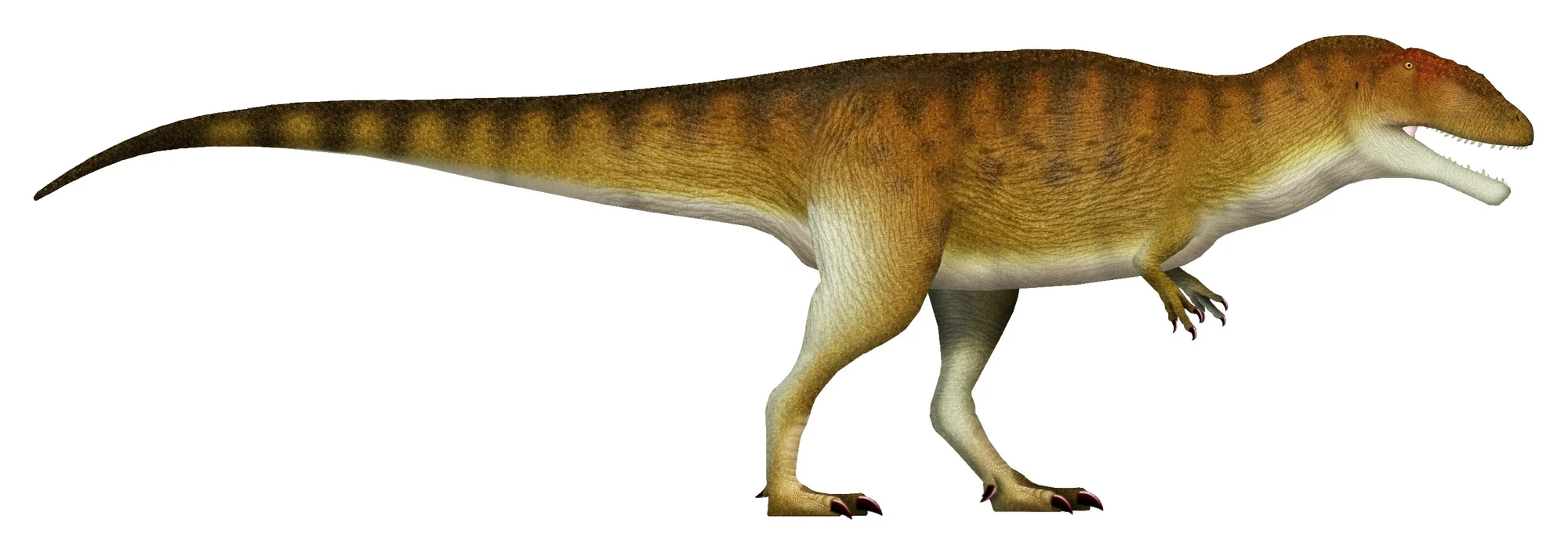
Carcharodontosaurids sit in the middle of the spectrum. Carcharodontosaurus reached about 13 meters and 7 tonnes, with proportionally short arms but not as reduced as those of tyrannosaurids or abelisaurids. The hands kept three fingers with partially functional claws.
The skull was enormous, around 1.6 meters long, and the teeth followed the serrated-blade pattern, specialized for slicing flesh in deep cuts. The bite did not reach the brute-force level of T-Rex, but it was enough to pierce the thick skin of titanosaur sauropods.
As the study shows, variation fits inside the same general pattern. In some lineages, hand and forearm shrank together. In others (especially among abelisaurids), the lower arm was the first to vanish, leaving an elongated humerus and the rest vestigial. The shared destination is the same, but the steps can differ.
What the study still does not answer
Correlation is not cause
The authors make a point of marking the limit themselves. The study identifies a strong correlation between arm reduction and skull robustness across five lineages. Strong correlations in phylogenetically controlled data are powerful evidence, but they are not direct proof of cause and effect. To speak of causation, you would need to reconstruct the exact temporal sequence in each lineage, showing that the robust skull came before the arm shrank in every case. That depends on intermediate fossils, and not every group has a complete record.
Other open questions: did the arms retain any residual function? Some hypotheses suggest they served for communication during mating (visual signaling), to stabilize the predator while mounting prey, or to manipulate eggs in the nest. None of those functions requires long arms, and they may have coexisted with reduction.
And there are lineages that did not reduce their arms: dromaeosaurids (Velociraptor, Deinonychus) kept long arms and functional hands with large claws; spinosaurids (Spinosaurus, Baryonyx) also kept robust arms, possibly for fishing. In both cases, the skull took on a different role: in Velociraptor it is light and weakly muscled (the weapon was the foot claw), and in Spinosaurus it is long and narrow, specialized for catching live fish. When the head does not become the main weapon for attacking large prey, the arm survives.
Conclusion
T-Rex does not have small arms because of a design flaw, a useless vestige or a byproduct of gigantism. It has small arms because the head took over as the main weapon, and that happened five times, independently, in five different groups of carnivorous theropods over the Mesozoic. The selective pressure that pushed the skull toward extreme robustness is the same one that freed the arm to shrink. In evolution, what is not used is not kept.
Sources
- Scherer, C. R., Steell, E. & Upchurch, P. (2026). Drivers and mechanisms of convergent forelimb reduction in non-avian theropod dinosaurs. Proceedings of the Royal Society B, 293(2071): 20260528. doi:10.1098/rspb.2026.0528
- Bates, K. T. & Falkingham, P. L. (2012). Estimating maximum bite performance in Tyrannosaurus rex. Biology Letters, 8(4), 660-664.
- Gignac, P. M. & Erickson, G. M. (2017). The biomechanics behind extreme osteophagy in Tyrannosaurus rex. Scientific Reports, 7, 2012.
- Mazzetta, G. V., Cisilino, A. P., Blanco, R. E. & Calvo, N. (2009). Cranial mechanics and functional interpretation of the horned carnivorous dinosaur Carnotaurus sastrei. Journal of Vertebrate Paleontology, 29(3), 822-830.
- Snively, E. et al. (2011). Lower rotational inertia and larger leg muscles indicate more rapid turns in tyrannosaurids than in other large theropods. PeerJ.
- Carrano, M. T. & Sampson, S. D. (2008). The phylogeny of Ceratosauria (Dinosauria: Theropoda). Journal of Systematic Palaeontology, 6(2), 183-236.