
Vega Bird
Vegavis iaai
"Bird of Vega Island"
About this species
Vegavis iaai is a Late Cretaceous bird discovered on Vega Island, in the Antarctic Peninsula, and formally described by Julia Clarke and colleagues in 2005 in Nature. The fossil is considered the first indisputable evidence of a modern bird (crown-group Aves) preserved in the Mesozoic, around 68 to 66.5 million years old. Vegavis belongs to Anseriformes, the order that includes ducks, geese and swans, and held a phylogenetic position close to the family Anatidae. It was about the size of a modern duck or teal, with around 60 centimeters in length and an estimated mass of 1.5 kilograms. In 2016 a second specimen, also described by Clarke and team in Nature, revealed the first preserved syrinx (avian vocal organ) in the Mesozoic fossil record, proving that modern birds already vocalized before the Cretaceous-Paleogene mass extinction. Vegavis lived in an Antarctica still covered by forests, at high latitude but with a temperate to cold climate.
Geological formation & environment
The López de Bertodano Formation and the overlying Sandwich Bluff Formation crop out on Vega Island, at the northeastern tip of the Antarctic Peninsula, and correspond to a shallow marine to coastal sequence of the latest Maastrichtian, with ages between about 70 and 66 million years. The unit preserves fossils of modern and archaic birds, non-avian dinosaurs, turtles, fishes, ammonites, mosasaurs and plesiosaurs, indicating that Antarctica was still habitable up to the K-Pg boundary, with temperate forests on land and a rich marine fauna in coastal waters. The paleoenvironmental description is synthesized by Reguero et al. (2002) and subsequent references.
Image gallery


Life reconstruction of Vegavis iaai by Nobu Tamura, in lateral view. The paleoart synthesizes the anatomy described by Clarke et al. (2005, 2016), with plumage and bill similar to a modern duck, and body proportions compatible with crown-group Anseriformes.
Nobu Tamura / Wikimedia Commons, CC BY-SA 4.0
Ecology and behavior
Habitat
Vegavis iaai inhabited latest-Maastrichtian Antarctica, around 68 to 66.5 million years ago, in a still forested and habitable region with a temperate to cold climate. The forests were dominated by Nothofagus and conifers, with lakes, rivers and coastal zones associated with a shallow marine system. The terrestrial fauna included non-avian dinosaurs such as hadrosaurids and ankylosaurids, archaic birds and marine reptiles such as mosasaurs and plesiosaurs in coastal zones. Reguero et al. (2002) synthesize the paleoenvironment of the Antarctic Peninsula in this interval.
Feeding
The anseriform morphology of Vegavis suggests an omnivorous or piscivorous diet, comparable to that of modern teals and ducks. The beak probably filtered small aquatic invertebrates, small fish and plant material in lacustrine and fluvial environments. The absence of teeth and the anatid body plan support this interpretation. The exact diet remains indirect, based on functional homology with living Anseriformes, in the absence of preserved stomach contents or applicable tooth wear marks.
Behavior and senses
Vegavis iaai was probably an aquatic bird occupying lakes, rivers and forested coastal zones. The discovery of the preserved syrinx by Clarke et al. (2016) shows that the genus vocalized in a manner comparable to modern anatids, with calls applicable to social communication, territorial defense and mate attraction. Group behavior in small flocks is inferred by analogy with living anseriform birds and has been adopted by recent reconstructions such as that of Prehistoric Planet 2 (2023).
Physiology and growth
Vegavis was endothermic, with modern avian physiology typical of Neornithes, including elevated metabolism, insulating plumage, pneumatic bones and flight capacity. The presence of the syrinx described by Clarke et al. (2016) proves active vocalization in frequencies comparable to those of living ducks. The modest size, on the order of 1.5 kilograms, and the anseriform body plan indicate adaptation to high-latitude aquatic environments, with efficient thermoregulation in seasonally cold climate and dense plumage cover.
Paleogeography
Continental configuration

Scotese & Vérard · CC BY 4.0 · Cretaceous, ~105 Ma
During the Maastrichtiano (~68–66.5 Ma), Vegavis iaai inhabited Laramidia, the western half of present-day North America, separated from the east by the Western Interior Seaway, a shallow sea dividing the continent. The continents were in very different positions: India was drifting toward Asia, Antarctica was still connected to Australia, and South America was an isolated island.
Bone Inventory
Vegavis iaai is known from two main specimens. The holotype MLP 93-I-3-1, housed at the Museo de La Plata, Argentina, preserves a partial articulated skeleton with vertebrae, ribs, sternum, furcula, forelimb and hindlimb bones, pelvis and cranial elements. The second specimen, MACN-PV 19748, was described by Clarke and colleagues in 2016 and preserves, besides much of the skeleton, the first avian fossil syrinx recorded in the Mesozoic. The combination of both materials provided the anatomical basis for the position of Vegavis within basal Anseriformes.
Found elements
Inferred elements
Scientific Literature
15 papers in chronological order — from the original description to recent research.
Preliminary description of Hesperornis regalis, with notices of four other new species of Cretaceous birds
Marsh, O.C. · American Journal of Science, ser. 3, vol. 3
Othniel Charles Marsh published the preliminary description of Ichthyornis and Hesperornis, toothed Cretaceous birds from Kansas, founding the systematic study of Mesozoic birds. Although Vegavis was not known until 1992, this work sets the historical frame in which Cretaceous birds were interpreted as toothed and archaic forms, distinct from modern birds. The 2005 description of Vegavis would change that frame by showing that modern birds, toothless and with an anseriform body plan, already existed in the Maastrichtian. Marsh remains a required reference for placing Vegavis within the history of paleornithology.


A Late Cretaceous Presbyornithidae (Aves: Anseriformes) from Vega Island, Antarctic Peninsula: paleobiogeographic implications
Noriega, J.I. & Tambussi, C.P. · Ameghiniana 32(1)
Jorge Noriega and Claudia Tambussi published the first preliminary description of the avian material collected in 1992 on Vega Island, Antarctic Peninsula, during an Argentine expedition. The fossil was initially assigned to the family Presbyornithidae, within Anseriformes, and the authors stressed the paleobiogeographic importance of a modern bird in the latest Cretaceous at high southern latitude. This publication founded the record of Vegavis in the paleornithological debate, although formal description as a new species only came ten years later with Clarke and colleagues in 2005. The paper is a required reference for the history of the discovery and for the biogeographic discussion of the origin of modern birds in Gondwana.
Mesozoic Birds: Above the Heads of Dinosaurs
Chiappe, L.M. & Witmer, L.M. (eds.) · University of California Press
Luis Chiappe and Lawrence Witmer edited the reference volume on Mesozoic birds, integrating specialist chapters on anatomy, phylogeny and paleobiology of the main Cretaceous lineages, including Enantiornithes, Hesperornithes and basal Ornithurae. Although published three years before the formal description of Vegavis, the book fixed the cladistic vocabulary and phylogenetic framework in which the position of Vegavis would be assessed by Clarke and colleagues in 2005. The chapter on the origin of Neornithes explicitly discusses the lack of Mesozoic records of modern birds, a problem that Vegavis would come to solve. It remains a required reference for any modern work on Vegavis.


Definitive fossil evidence for the extant avian radiation in the Cretaceous
Clarke, J.A., Tambussi, C.P., Noriega, J.I., Erickson, G.M. & Ketcham, R.A. · Nature 433
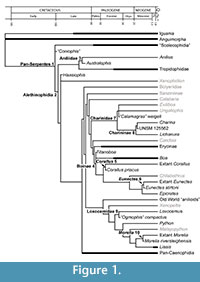
Julia Clarke, Claudia Tambussi, Jorge Noriega, Gregory Erickson and Richard Ketcham published in Nature the formal description of Vegavis iaai, based on the holotype MLP 93-I-3-1 collected in 1992 on Vega Island. The authors applied high-resolution computed tomography to reconstruct the skeleton encased in matrix and performed a cladistic analysis that placed Vegavis within crown-group Anseriformes, close to the family Anatidae. The result provided the first indisputable evidence of a modern bird preserved in the Cretaceous, around 66 to 68 million years old. The work transformed understanding of Neornithes diversification, indicating that modern birds already existed before the Cretaceous-Paleogene boundary and survived the mass extinction.
Paleogene Fossil Birds
Mayr, G. · Springer
Gerald Mayr published a reference synthesis on the Paleogene fossil bird record, integrating anatomical descriptions, phylogenetic analyses and biogeographic discussions of the main Neornithes lineages that diversified after the Cretaceous-Paleogene boundary. The chapter on Anseriformes explicitly discusses Vegavis as the most robust Mesozoic record of the order and contextualizes its position in relation to Presbyornithidae, Anhimidae and Anatidae. Mayr emphasizes that Vegavis is empirical evidence for the Clarke et al. (2005) hypothesis that modern birds were already diversified in the Maastrichtian. The book remains a required reference for any work that places Vegavis within the evolutionary history of Anseriformes.
Mass extinction of birds at the Cretaceous-Paleogene (K-Pg) boundary
Longrich, N.R., Tokaryk, T. & Field, D.J. · Proceedings of the National Academy of Sciences 108(37)
Nicholas Longrich, Tim Tokaryk and Daniel Field published a quantitative analysis of the Maastrichtian bird fossil record from North America, based on material from the Hell Creek Formation and equivalents. The authors concluded that the Cretaceous-Paleogene mass extinction was highly selective among birds: enantiornithines and most archaic lineages were wiped out, while only taxa close to Neornithes, such as Vegavis, crossed the boundary. The paper strengthens the role of Vegavis as a representative of a surviving lineage and as a phylogenetic bridge to post-K-Pg modern birds. It is required reading for discussing the evolutionary significance of the genus in the context of the mass extinction.
Phylogenetically vetted and stratigraphically constrained fossil calibrations within Aves
Ksepka, D.T. & Clarke, J.A. · Palaeontologia Electronica 18.1.3FC
Daniel Ksepka and Julia Clarke published a critical review of fossil calibrations used in molecular phylogenies of birds, assessing the stratigraphic and cladistic support of each taxon. Vegavis iaai receives detailed attention as one of the few Mesozoic calibrations for Neornithes, with discussion of the anatomical characters that support its position in crown-group Anseriformes and of possible alternative criticisms. The authors conclude that Vegavis is a valid minimum calibration for the divergence between Anhimidae and Anatidae, providing a lower bound for the diversification of Anseriformes. The paper is a required reference for any molecular clock study in birds that includes Vegavis as a calibration point.
Fossil evidence of the avian vocal organ from the Mesozoic
Clarke, J.A., Chatterjee, S., Li, Z., Riede, T., Agnolín, F., Goller, F., Isasi, M.P., Martinioni, D.R., Mussel, F.J. & Novas, F.E. · Nature 538
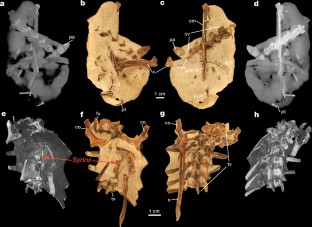
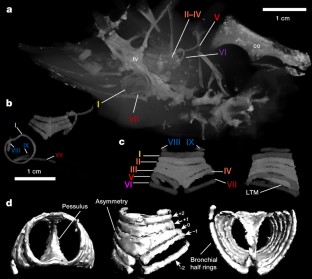
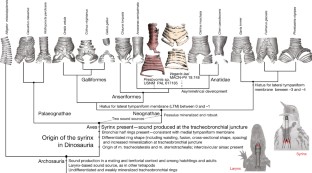
Julia Clarke and international team published in Nature the description of the first avian fossil syrinx recorded in the Mesozoic, identified by computed tomography in specimen MACN-PV 19748 of Vegavis iaai. The syrinx is the vocal organ unique to birds, located at the base of the trachea, and its preservation shows that Vegavis was capable of producing vocalizations comparable to those of modern ducks and geese. The work answers the long-standing question of when the ancestors of birds began to vocalize like modern birds, and establishes that this capacity was already present before the Cretaceous-Paleogene mass extinction. The result is one of the most unexpected and important contributions of paleontology in the last decade.

Early evolution of modern birds structured by global forest collapse at the end-Cretaceous mass extinction
Field, D.J., Bercovici, A., Berv, J.S., Dunn, R., Fastovsky, D.E., Lyson, T.R., Vajda, V. & Gauthier, J.A. · Current Biology 28(11)
Daniel Field and colleagues proposed that the global forest collapse after the Cretaceous-Paleogene impact was a decisive evolutionary filter in selecting the modern bird lineages that survived. Arboreal birds would have been wiped out en masse, while terrestrial and aquatic forms, such as anseriforms close to Vegavis, crossed the boundary. The paper discusses Vegavis as pre-K-Pg evidence of modern avian diversity in non-arboreal environments, supporting the proposed paleoecological scenario. The work broadened understanding of the selectivity of the extinction and reinforced the role of Vegavis as a central piece in the debate on the ecological origin of modern Neornithes.


Late Cretaceous neornithine from Europe illuminates the origins of crown birds
Field, D.J., Benito, J., Chen, A., Jagt, J.W.M. & Ksepka, D.T. · Nature 579
Daniel Field and team described Asteriornis maastrichtensis, a Maastrichtian bird collected in Belgium, with a nearly complete skull preserved in three dimensions. The phylogenetic analysis placed Asteriornis at the base of Galloanserae, close to the divergence between Anseriformes and Galliformes. Vegavis appears in direct comparison as the other most robust Mesozoic record of Neornithes, and the authors discuss the similarities and differences between the two taxa. The discovery extends the record of modern birds from the latest Cretaceous into the northern hemisphere, complementing the southern Antarctic case of Vegavis and strengthening the hypothesis of a diversification of Neornithes already underway in the Maastrichtian.

An overview of non-avian theropod discoveries and classification
Hendrickx, C., Hartman, S.A. & Mateus, O. · PalArch's Journal of Vertebrate Palaeontology 12(1)
Christophe Hendrickx, Scott Hartman and Octávio Mateus published a broad synthesis on the classification of non-avian theropods, integrating recent discoveries and cladistic revisions. The paper discusses the transition between non-avian Maniraptora and Avialae, with reference to Mesozoic taxa close to Neornithes such as Vegavis. Although the focus is on non-avian theropods, the work establishes the phylogenetic framework in which Vegavis appears as one of the derived Avialae representatives already included in the clade of modern birds. It is a useful reference to place Vegavis in the broader Theropoda tree and to understand how the definition of Aves intersects with that of Avialae in modern schemes.


Paleobotanical proxies for early Eocene climates and ecosystems in northern North America from middle to high latitudes
West, C.K., Greenwood, D.R., Reichgelt, T., Lowe, A.J., Vachon, J.M. & Basinger, J.F. · Climate of the Past 16
Christopher West and colleagues reconstructed the paleoclimate and paleoecology of high-latitude forests of northern North America in the early Eocene, based on paleobotanical proxies. The work provides a direct comparative framework for the type of high-latitude temperate forest that covered Antarctica in the Maastrichtian and that served as habitat for Vegavis. The authors discuss the stability of polar forest ecosystems in the Cenozoic and their approximate continuity with those of the latest Cretaceous, supporting the interpretation that Vegavis lived in an analogous forested environment. The paper is an indirect but relevant reference for any paleoenvironmental reconstruction of the genus.
Antarctic Peninsula and South America (Patagonia) Paleogene terrestrial faunas and environments: biogeographic relationships
Reguero, M.A., Marenssi, S.A. & Santillana, S.N. · Palaeogeography, Palaeoclimatology, Palaeoecology 179(3-4)
Marcelo Reguero, Sergio Marenssi and Sergio Santillana published a synthesis on the terrestrial faunas and environments of the Antarctic Peninsula and Patagonia in the latest Cretaceous and the Paleogene, with emphasis on the biogeographic relationships between the two southern domains. The work discusses the Maastrichtian Antarctic paleoclimate, then temperate to cold, with forests dominated by Nothofagus and mixed terrestrial and marine fauna. Vegavis iaai is placed in this context as a modern bird inhabiting forests and coastal zones of Vega Island before the K-Pg boundary. The paper is a required reference for any paleoenvironmental reconstruction involving the genus, by integrating sedimentary, paleobotanical and paleontological data.

Avian evolution, Gondwana biogeography and the Cretaceous-Tertiary mass extinction event
Cracraft, J. · Proceedings of the Royal Society B 268(1466)
Joel Cracraft proposed the Gondwanan origin hypothesis for Neornithes, with initial diversification in the southern hemisphere before the Cretaceous-Paleogene boundary and dispersal to the northern hemisphere after the mass extinction. Although published four years before the formal description of Vegavis, the Cracraft model frames precisely the kind of evidence that the Antarctic taxon would come to provide: modern birds present at high southern latitude in the Maastrichtian. The 2005 discovery of Vegavis and its repositioning within crown-group Anseriformes turned the Cracraft hypothesis into an empirically supported scenario, and the paper remains a required reference for discussing the southern biogeography of modern birds.

The deep divergences of neornithine birds: a phylogenetic analysis of morphological characters
Mayr, G. & Clarke, J.A. · Cladistics 19(6)
Gerald Mayr and Julia Clarke published a cladistic analysis of the main Neornithes lineages based on morphological characters, with a broad matrix of living and fossil taxa. The work establishes the diagnostic characters of each modern order, in particular Anseriformes and Galliformes, and provides the methodological framework that would be applied two years later by Clarke and colleagues in the formal description of Vegavis in 2005. The character matrix allows the position of fossil taxa within Galloanserae to be assessed with precision, and was reused and expanded by subsequent analyses. Mayr and Clarke (2003) is therefore the immediate methodological starting point for the recognition of Vegavis as a crown-group anseriform.


Famous museum specimens
Holótipo MLP 93-I-3-1
Museo de La Plata, La Plata, Argentina
Holotype of Vegavis iaai, a partial articulated skeleton collected in 1992 on Vega Island, Antarctica, in an outcrop of the López de Bertodano Formation. Formally described by Clarke, Tambussi, Noriega, Erickson and Ketcham in 2005 in Nature. The material preserves vertebrae, ribs, sternum, furcula, pelvis and bones of the forelimb and hindlimb, and underpins the position of the taxon in crown-group Anseriformes.
Espécime referido MACN-PV 19748 (com siringe)
Museo Argentino de Ciencias Naturales Bernardino Rivadavia, Buenos Aires, Argentina
Referred specimen of Vegavis iaai described by Clarke et al. (2016) in Nature. Also collected on Vega Island, this material preserves, besides much of the skeleton, the first avian fossil syrinx from the Mesozoic, identified by high-resolution computed tomography. The discovery proved that modern birds vocalized before the Cretaceous-Paleogene boundary and established the status of the genus as an icon of recent paleornithology.
In cinema and popular culture
Vegavis iaai entered popular culture in 2023 with the Antarctica Forests episode of the Prehistoric Planet 2 series on Apple TV+, narrated by David Attenborough. The production depicted the genus in temperate forests of latest-Cretaceous Antarctica, in small flocks, with vocalizations inspired by the syrinx described by Clarke and colleagues in 2016. The series was the first major media production to visually integrate the fossil evidence of pre-K-Pg song into the typical behavior of the animal. Before that, Vegavis appeared sporadically in BBC documentaries on fossil Antarctica and in PBS Eons YouTube episodes dedicated to the evolution of Cretaceous birds. The genus is scientifically important but obscure in pop media, partly because it was described recently, in 2005, and partly because it occupies a geographic region historically underrepresented in dominant North American and European cinema. The presence in Prehistoric Planet marks a turning point in the public visibility of the taxon.
Classification
Discovery
Fun fact
The most spectacular Vegavis iaai fossil revealed in 2016, through high-resolution computed tomography, the first syrinx (avian vocal organ) preserved in the entire fossil record. Before this Nature work by Julia Clarke and team, nobody knew whether Cretaceous birds could already produce vocalizations like modern birds. The discovery proved they could: Vegavis sang like a duck before the Cretaceous-Paleogene meteor ended the non-avian dinosaurs.
Last reviewed: April 25, 2026