Unaysaurus
Unaysaurus tolentinoi
"Black-water lizard (Tolentino)"
About this species
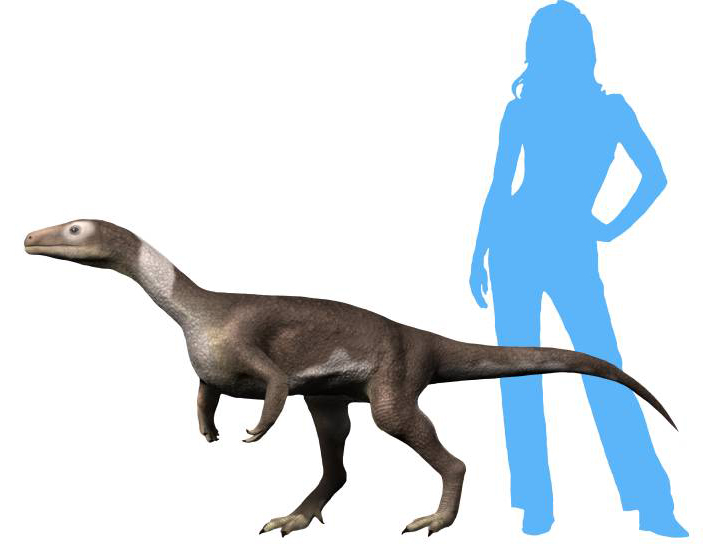
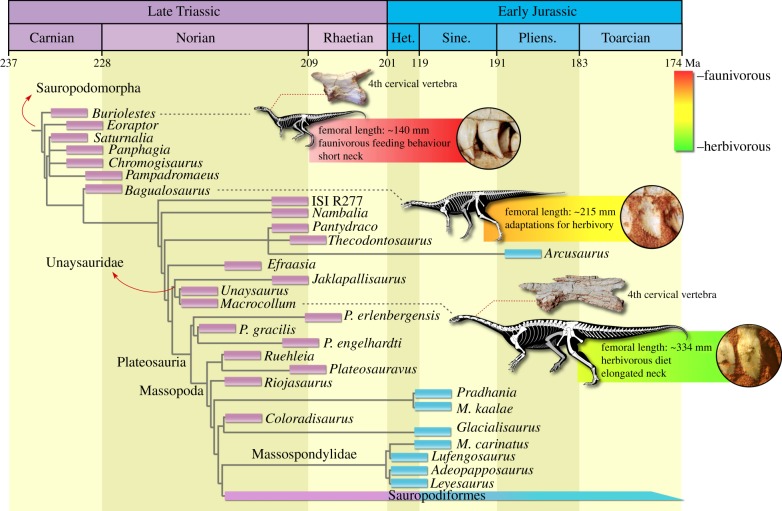
Unaysaurus tolentinoi is a small basal sauropodomorph from the Late Triassic (early Norian, around 225 million years ago) Caturrita Formation of the Paraná Basin in southern Brazil. About 2.5 m long and 70 kg, it is one of the most complete early sauropodomorphs known from South America, with a nearly intact skull and partially articulated postcranium. Leal and colleagues described holotype UFSM 11069 in 2004 and recovered it as a plateosaurid close to European Plateosaurus. In 2018 Müller, Langer and Dias-da-Silva erected the family Unaysauridae to accommodate Unaysaurus, Brazilian Macrocollum itaquii, and Indian Jaklapallisaurus asymmetricus, while Beccari et al. (2021) and Pretto et al. (2019) returned the taxon to the Plateosauridae orbit. The species is a global reference for studying the transition from small, opportunistic early sauropodomorphs to the large long-necked herbivores that would dominate the Jurassic.
Geological formation & environment
Caturrita Formation, upper part of the Candelaria Sequence of the Santa Maria Supersequence, Paraná Basin, Rio Grande do Sul. Early Norian age, about 225.42 +/- 0.37 Ma by U-Pb zircon dating (Langer et al. 2018). The unit is 30 to 60 m thick and consists of fine to medium sandstones and siltstones (red beds) deposited in perennial braided river systems and flood plains under a more humid climate than the underlying Alemoa Member. It overlies Hyperodapedon-bearing beds (Santa Maria, Alemoa Member) and is overlain by the Mata Sandstone. The biota includes cynodonts (Brasilodon, Riograndia, Jachaleria), dinosaurs (Unaysaurus, Guaibasaurus, Macrocollum), rhynchosaurs and sphenodontians, constituting the second great stage of the southern Brazilian Triassic radiation, already after exiting the Hyperodapedon Assemblage Zone (Carnian records) and at the beginning of the Ictidosauria/Mammaliamorpha Zone. Key references: Langer, Ribeiro, Schultz and Ferigolo (2007), Langer et al. (2018) for dating, Bittencourt and Langer (2011) and Novas et al. (2021) for regional context.
Image gallery


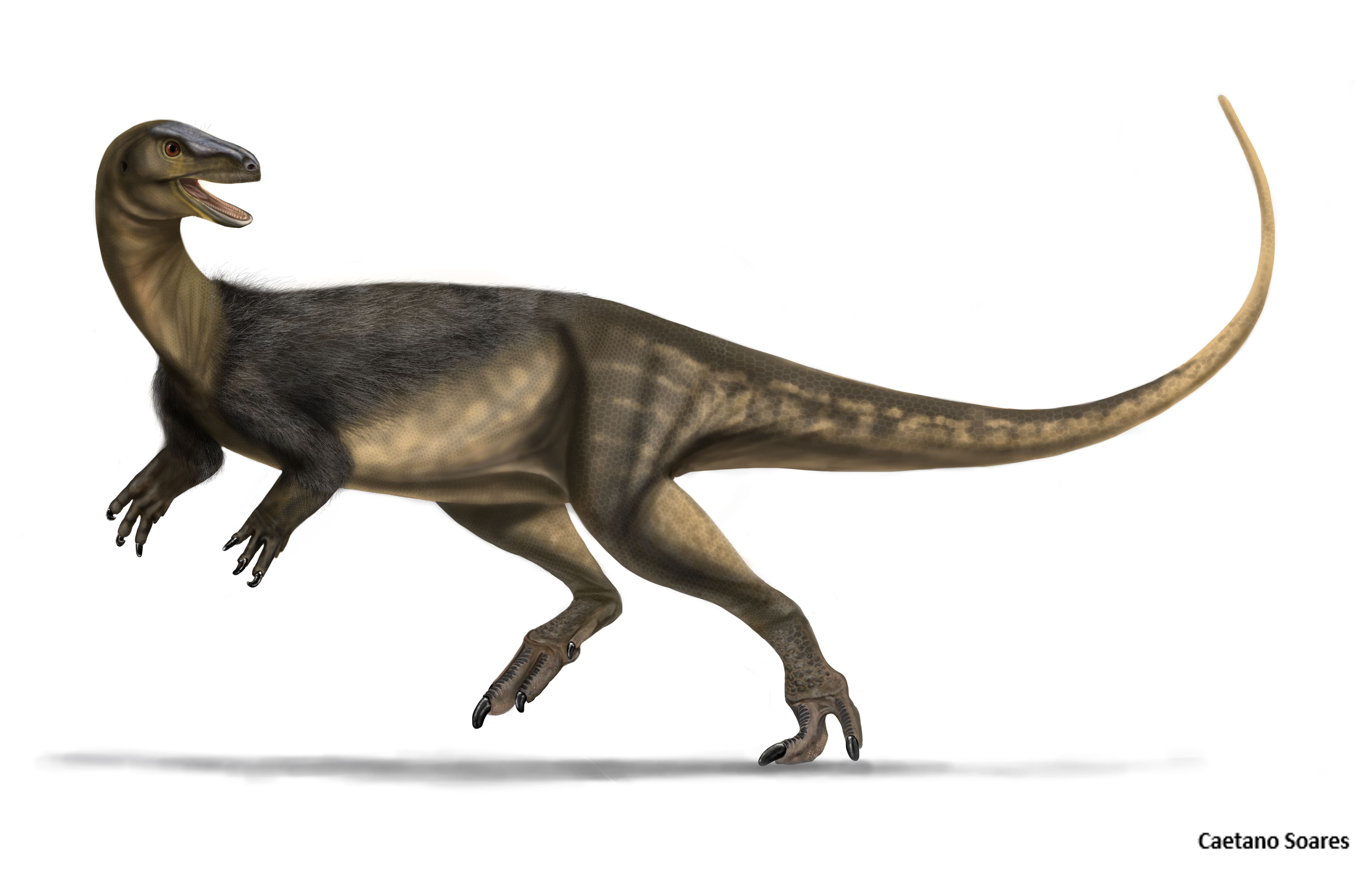





Life reconstruction of Unaysaurus tolentinoi by FunkMonk, a basal sauropodomorph from the Late Triassic of Rio Grande do Sul, Brazil, feeding on a cycad.
FunkMonk, Wikimedia Commons, CC BY-SA 3.0
Ecology and behavior
Habitat
Fluvio-lacustrine plains of the Late Triassic (early Norian) southwest of Gondwana. The Caturrita Formation preserves perennial braided river systems alternating with flood plains, in sandy and silty red beds deposited under an increasingly humid climate compared with the underlying Santa Maria Formation.
Feeding
Herbivore. The teeth and jaw of Unaysaurus indicate feeding on low and medium vegetation, mainly conifers, cycads, ferns and gnetophytes, without the ability to process tough plant matter. The moderately elongated neck already enabled foraging slightly higher than Saturnalia.
Behavior and senses
Facultative bipedal posture with possible forelimb use for support and manipulation. The discovery of an immature individual associated with the holotype (Muller et al. 2023) suggests sustained occupation of the site and possible coexistence of different ontogenetic stages, without direct evidence of the gregarious behaviour documented for Macrocollum.
Physiology and growth
Size measurements (about 70 kg, 2.5 m) indicate active metabolism compatible with bipedal posture and physiology intermediate between the small Carnian carnivorous sauropodomorphs (Buriolestes, Saturnalia) and the large long-necked Norian herbivores (Macrocollum). Later histological studies suggest relatively fast juvenile growth consistent with the plateosaurid pattern.
Paleogeography
Continental configuration

Scotese & Vérard · CC BY 4.0 · Triassic, ~225 Ma
During the Noriano inicial (~228–225 Ma), Unaysaurus tolentinoi inhabited Pangea, the single supercontinent joining all modern continents. Climate was dry and hot across much of the continental interior.
Bone Inventory
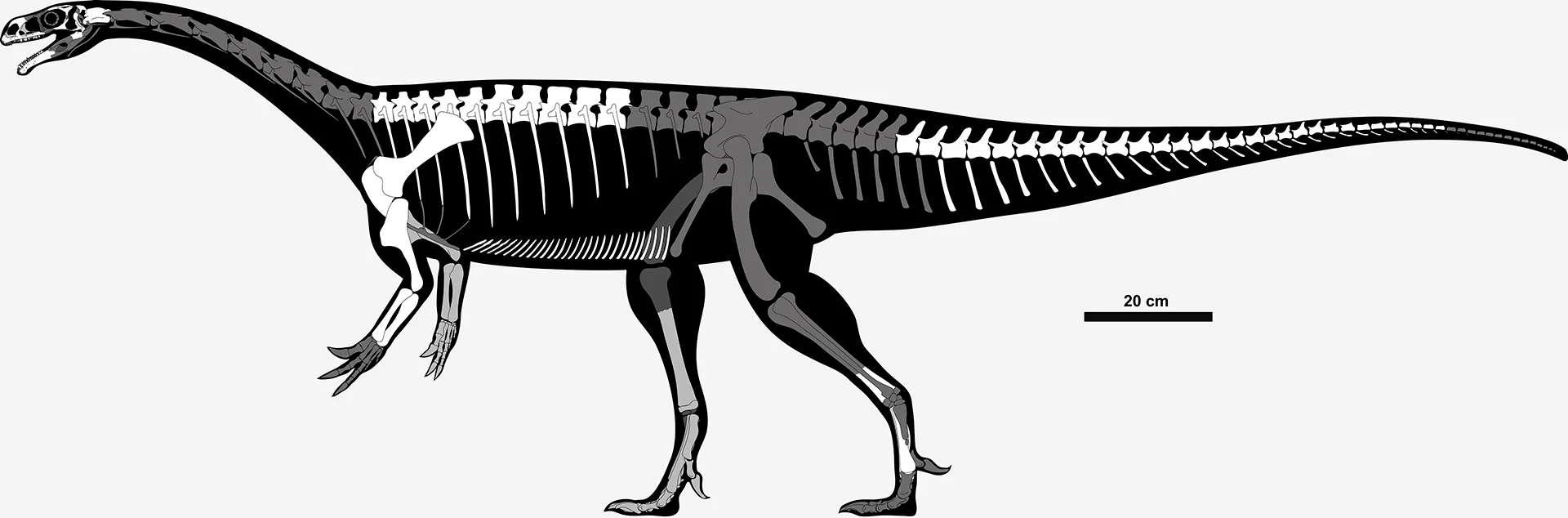
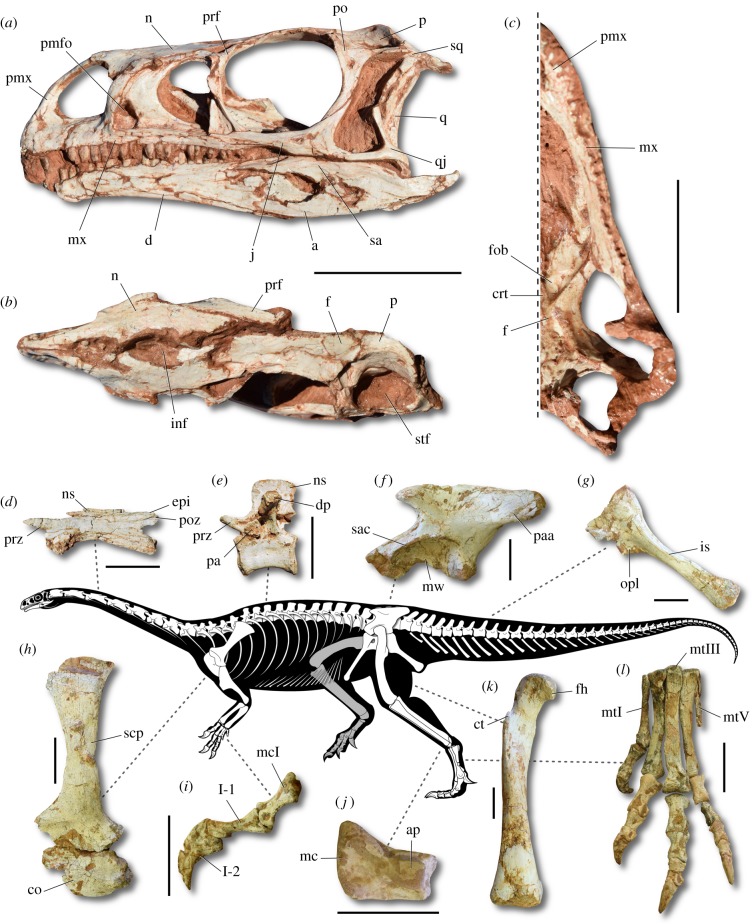
Holotype UFSM 11069 is one of the most complete Triassic skeletons ever found in Brazil, with a nearly intact skull with mandible and a partially articulated postcranium. The cranial preservation is especially valuable: in a country known for fragmentary dinosaurs, Unaysaurus allows detailed anatomical reconstruction of the head, almost 100% complete.

Found elements
Inferred elements
Scientific Literature
15 papers in chronological order — from the original description to recent research.
A new early dinosaur (Sauropodomorpha) from the Caturrita Formation (Late Triassic), Paraná Basin, Brazil
Leal, L.A., Azevedo, S.A.K., Kellner, A.W.A. e Da-Rosa, A.A.S. · Zootaxa 690, 1-24
Formal description of the genus and species Unaysaurus tolentinoi based on holotype UFSM 11069, collected in 1998 at the Agua Negra site (Agudo, Rio Grande do Sul). The material preserves an almost complete skull with mandible and part of the postcranium, one of the most complete Brazilian dinosaur assemblages. The preliminary phylogenetic analysis placed the taxon within Plateosauridae, close to European Plateosaurus, suggesting Late Triassic faunal links between southern Gondwana and Laurasia.
Basal Saurischia
Langer, M.C. · The Dinosauria, 2nd edition (University of California Press), pp. 25-46
A key chapter on basal saurischians in The Dinosauria. It discusses Staurikosaurus and Saturnalia as Brazilian Late Triassic examples, contextualising the newly named Unaysaurus (published the same year) within the debate on the base of Sauropodomorpha and Saurischia. An obligatory reference for Triassic dinosaur phylogeny.
The continental tetrapod-bearing Triassic of South Brazil
Langer, M.C., Ribeiro, A.M., Schultz, C.L. e Ferigolo, J. · Bulletin of the New Mexico Museum of Natural History and Science 41, 201-218
A reference review of continental Triassic biotas of southern Brazil, including the Santa Maria and Caturrita formations. It systematises the assemblage zones (Hyperodapedon, Jachaleria) and contextualises Unaysaurus among the dinosaurs, cynodonts, rhynchosaurs and archosauriforms recovered from the units.
The evolution of feeding mechanisms in early sauropodomorph dinosaurs
Barrett, P.M. e Upchurch, P. · Special Papers in Palaeontology 77, 91-112 (The Palaeontological Association)
Functional analysis of feeding in early sauropodomorphs, including jaw, dentition and dietary inferences. Unaysaurus, with its nearly complete skull, appears as one of the few basal taxa with oral anatomy sufficient for direct testing of hypotheses on the transition from opportunistic (omnivorous) diet to specialised herbivory.
The first complete skull of the Triassic dinosaur Melanorosaurus Haughton (Sauropodomorpha: Anchisauria)
Yates, A.M. · Special Papers in Palaeontology 77, 9-55
Description of the first complete skull of Melanorosaurus and a phylogenetic reanalysis of Plateosauridae. Treats Unaysaurus as part of an expanded Plateosauridae that also includes Plateosaurus. The analysis anticipates several debates that would culminate in the 2018 proposal of Unaysauridae.
A new early dinosaur (Saurischia: Sauropodomorpha) from the Late Triassic of Argentina: a reassessment of dinosaur origin and phylogeny
Ezcurra, M.D. · Journal of Systematic Palaeontology 8(3), 371-425
Description of Chromogisaurus novasi from the Ischigualasto Formation and a broad phylogenetic reanalysis of basal dinosaurs. Ezcurra's matrix included Unaysaurus in anatomical comparisons and helped calibrate the taxon's position among basal sauropodomorphs. A key work for the design of later analyses (including Müller 2018).

The origin and early evolution of dinosaurs
Langer, M.C., Ezcurra, M.D., Bittencourt, J.S. e Novas, F.E. · Biological Reviews 85(1), 55-110
A benchmark global review of dinosaur origin and early evolution, with a detailed section on the earliest sauropodomorphs. It discusses Unaysaurus among plateosaurids and presents consensus trees for the initial radiation of the group.
Mesozoic dinosaurs from Brazil and their biogeographic implications
Bittencourt, J.S. e Langer, M.C. · Anais da Academia Brasileira de Ciências 83(1), 23-60
A systematic review of all Brazilian Mesozoic dinosaurs with biogeographic analysis. It catalogues the 21 species named by then, including Unaysaurus tolentinoi, and discusses faunal connections between the southern Brazilian and Argentinian Triassic, flagging Unaysaurus as evidence of plateosaurid dispersal within Gondwana.
Postcranial anatomy and phylogenetic relationships of Mussaurus patagonicus (Dinosauria, Sauropodomorpha)
Otero, A. e Pol, D. · Journal of Vertebrate Paleontology 33(5), 1138-1168
Complete redescription of Mussaurus patagonicus, with a new phylogenetic analysis of Sauropodomorpha. Unaysaurus appears among the taxa compared to calibrate Mussaurus's position within Plateosauridae/Massospondylidae, contributing to the debate on Plateosauridae integrity.
The complete anatomy and phylogenetic relationships of Antetonitrus ingenipes (Sauropodiformes, Dinosauria): implications for the origins of Sauropoda
McPhee, B.W., Yates, A.M., Choiniere, J.N. e Abdala, F. · Zoological Journal of the Linnean Society 171(1), 151-205
Complete redescription of Antetonitrus ingenipes and a major analysis of the transition from basal sauropodomorphs to early sauropods. Unaysaurus features in the matrix as a basal-tree taxon, helping fix the base of Plateosauria.
A unique Late Triassic dinosauromorph assemblage reveals dinosaur ancestral anatomy and diet
Cabreira, S.F., Kellner, A.W.A., Dias-da-Silva, S., Silva, L.R., Bronzati, M., Marsola, J.C.A., Müller, R.T., Bittencourt, J.S., Batista, B.J.A., Raugust, T., Carrilho, R., Brodt, A. e Langer, M.C. · Current Biology 26(22), 3090-3095
Description of Buriolestes schultzi and Ixalerpeton polesinensis from the Sao Joao do Polesine site (Santa Maria Formation, Carnian). Shows that the earliest sauropodomorphs were small and carnivorous, an essential light on the transition to Unaysaurus, a specialised herbivore only about 8 million years later.
An exceptionally preserved association of complete dinosaur skeletons reveals the oldest long-necked sauropodomorphs
Müller, R.T., Langer, M.C. e Dias-da-Silva, S. · Biology Letters 14(11), 20180633
Description of Macrocollum itaquii from three articulated skeletons, the oldest known long-necked sauropodomorphs. The authors erect the family Unaysauridae to accommodate Unaysaurus tolentinoi, Macrocollum itaquii, and Indian Jaklapallisaurus asymmetricus, defining the group by cranial expansion of the medial condyle of the astragalus. Unaysaurus emerges as the type species of a Gondwanan lineage.
A new dinosaur (Saurischia: Sauropodomorpha) from the Late Triassic of Brazil provides insights on the evolution of sauropodomorph body plan
Pretto, F.A., Langer, M.C. e Schultz, C.L. · Zoological Journal of the Linnean Society 185(2), 388-416
Description of Bagualosaurus agudoensis, a sauropodomorph from the Santa Maria Formation collected at Agudo, the same municipality as Unaysaurus. The phylogenetic matrix reanalyses Unaysaurus's position within Plateosauridae and discusses the sauropodomorph body plan, linking Unaysaurus to the size increase documented by the new taxon.
Review of the fossil record of early dinosaurs from South America, and its phylogenetic implications
Novas, F.E., Agnolin, F.L., Ezcurra, M.D., Müller, R.T., Martinelli, A.G. e Langer, M.C. · Journal of South American Earth Sciences 110, 103341
Broad review of South American Triassic dinosaurs with phylogenetic reassessment. Discusses Unaysaurus among plateosaurids and maps the initial diversity of the group in Gondwana. It revalidates the relevance of the Brazilian holotype in consensus trees.
On a skeletally immature individual of Unaysaurus tolentinoi (Dinosauria: Sauropodomorpha) from the upper Triassic of southern Brazil
Müller, R.T., Ezcurra, M.D., Cabreira, S.F., Da-Rosa, A.A.S., Silva, L.R. e Dias-da-Silva, S. · The Anatomical Record 307(4), 1064-1080
Describes a second, smaller and skeletally immature Unaysaurus tolentinoi individual found at the same Agua Negra site as the holotype. The material includes isolated vertebrae and posterior-autopodium elements with a metatarsal I of about 41.7 mm, against 75.9 mm in the holotype. The discovery confirms a population at the site and adds ontogenetic data.
Famous museum specimens
UFSM 11069 (holótipo)
Laboratório de Estratigrafia e Paleobiologia, Universidade Federal de Santa Maria (UFSM), Santa Maria, Rio Grande do Sul, Brasil
Holotype UFSM 11069 is one of the most complete Triassic skeletons ever found in Brazil. It was collected in 1998 by Tolentino Marafiga, a local farmer who noticed bones outcropping at the roadside in Linha Varzinha (Agudo/Sao Martinho da Serra, Rio Grande do Sul). The UFSM collection preserves the material under the curatorship of the Laboratorio de Estratigrafia e Paleobiologia, now linked to the Centro de Apoio a Pesquisa Paleontologica da Quarta Colonia (CAPPA/UFSM) in Sao Joao do Polesine. It serves as the reference specimen for all of Unaysauridae and was the basis of the ontogenetic redescription by Muller et al. (2023).
Indivíduo imaturo associado (material referido)
UFSM / CAPPA, São João do Polesine, Rio Grande do Sul, Brasil
Material referred to Unaysaurus tolentinoi and formally described by Muller et al. (2023), the first known skeletally immature individual of the species. Open neurocentral sutures and bone texture confirmed its juvenile status. The find extends our knowledge of early Gondwanan sauropodomorph ontogeny.
Classification
Discovery
Fun fact
The name Unaysaurus begins with 'Unay', a Tupi-Guarani word meaning 'dark water', referring to the Agua Negra site where the fossil was found. It is one of very few dinosaur scientific names in the world that uses Tupi-Guarani as a source language, alongside Santanaraptor, Gondwanatitan and few others. The fossil is so complete that it allows reconstruction of 100% of the skull: in a country famous for fragmentary dinosaurs, Unaysaurus was the first Brazilian species with an almost intact skull.
Last reviewed: April 24, 2026