
Tapuiasaurus
Tapuiasaurus macedoi
"Tapuia lizard (Macedo)"
About this species
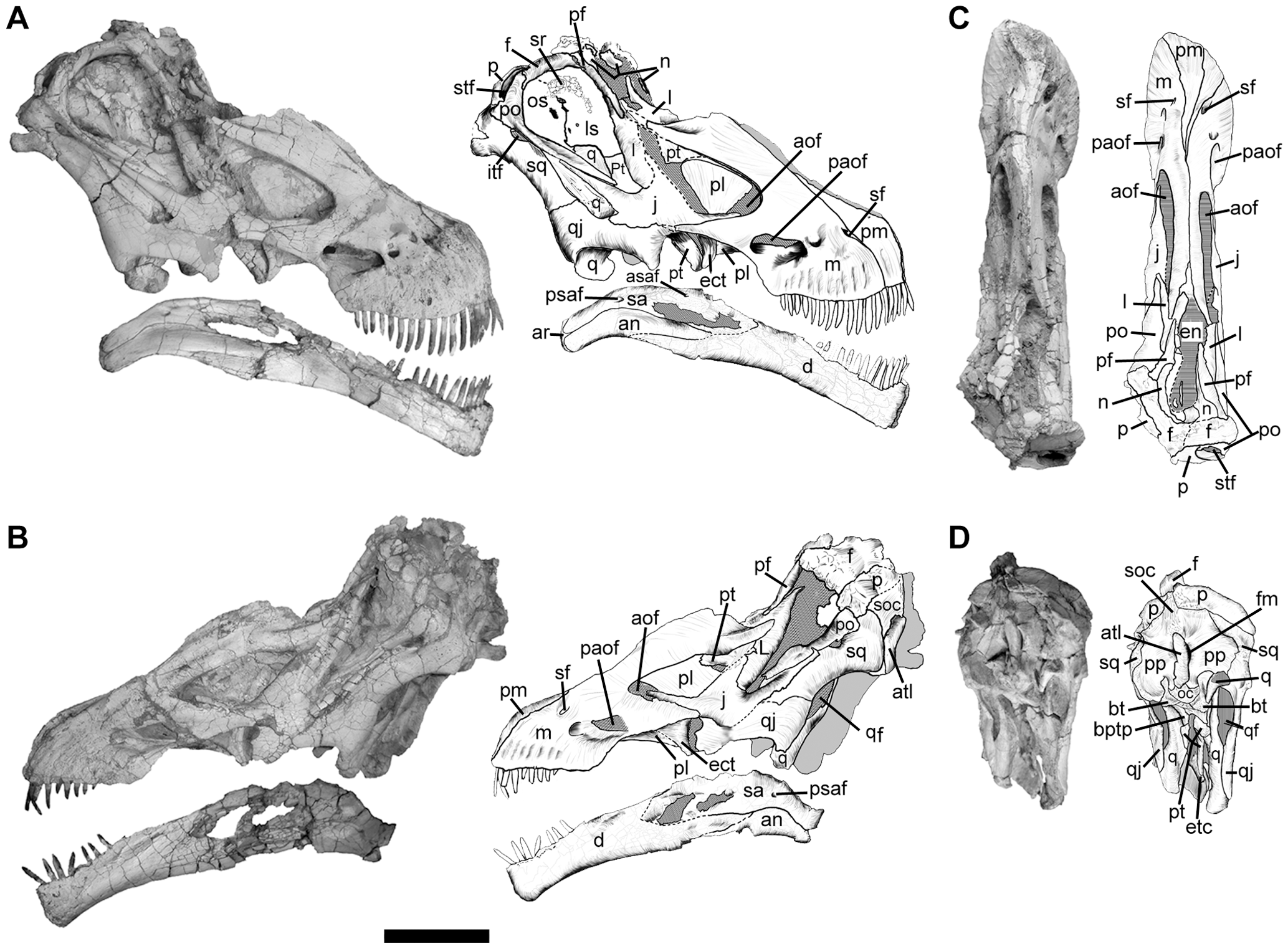
Tapuiasaurus macedoi is a mid-sized titanosaur (~13 m, ~10 tonnes) from the Early Cretaceous (Aptian, ~120 Ma) Quiricó Formation, Areado Group, Sanfranciscana Basin, in northern Minas Gerais, Brazil. The holotype MZSP-PV 807, curated at the Museu de Zoologia da USP, is renowned for preserving the only nearly complete Early Cretaceous titanosaur skull known worldwide, combined with an articulated partial postcranial skeleton. Its 'diplodocoid-like' cranial anatomy, with elongated rostrum, pencil-shaped cylindrical teeth and retroposed nares, pushed back by up to 30 million years the radiation of advanced titanosaurs that literature had assumed was restricted to the Late Cretaceous. Described in 2011 by Hussam Zaher and colleagues in PLOS ONE and cranially redescribed by Wilson, Pol, Carvalho and Zaher in 2016, the taxon is now a key piece for understanding the early evolution of Titanosauria in Gondwana.
Geological formation & environment
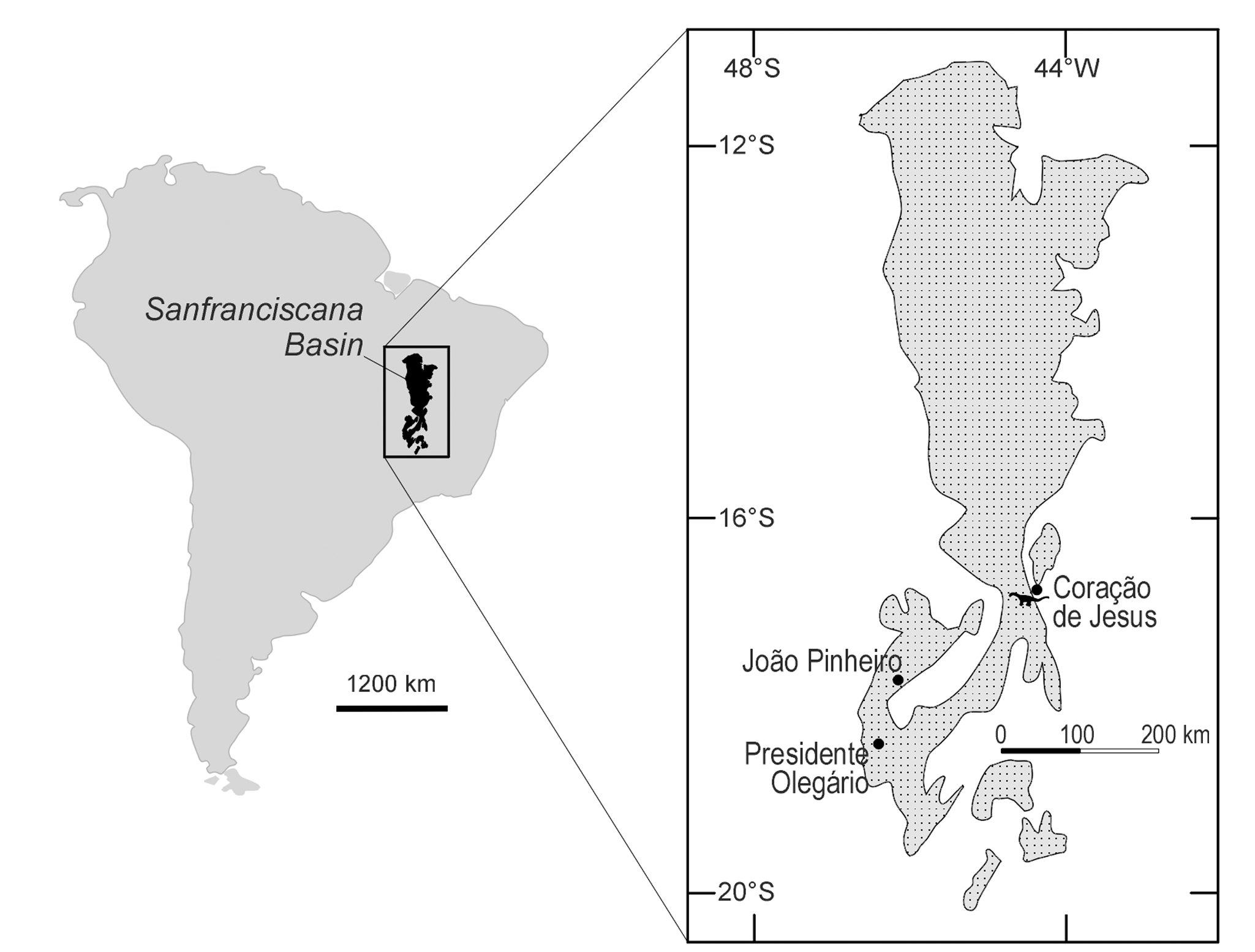
Quiricó Formation, part of the Areado Group in the Sanfranciscana Basin (north-central Minas Gerais and southern Bahia). Barremian to Aptian age (~125 to 113 Ma), with the Tapuiasaurus horizon in the Aptian interval. Lithology dominated by mudstones, siltstones and muddy sandstones, interpreted as lacustrine deposits transitioning to fluvial with increasing aeolian input upwards. Tropical to arid palaeoclimate with shallow lakes fed by ephemeral drainages. The fauna includes the titanosaur Tapuiasaurus macedoi, rebbachisaurids (undetermined remains), teeth from abelisaurid and carcharodontosaurid theropods, the abelisauroid Spectrovenator ragei, chelonians, crocodyliforms, actinopterygian fish, elasmobranchs, coelacanths, ostracods, spinicaudatans, insects and palynomorphs. The faunas show affinities with the Kem Kem Basin (Morocco), reinforcing Gondwanan palaeobiogeographic connections before the definitive break-up.
Image gallery
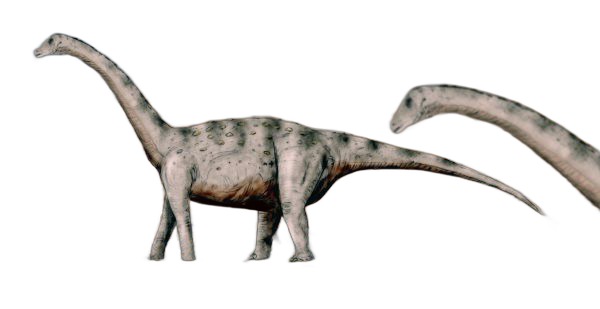



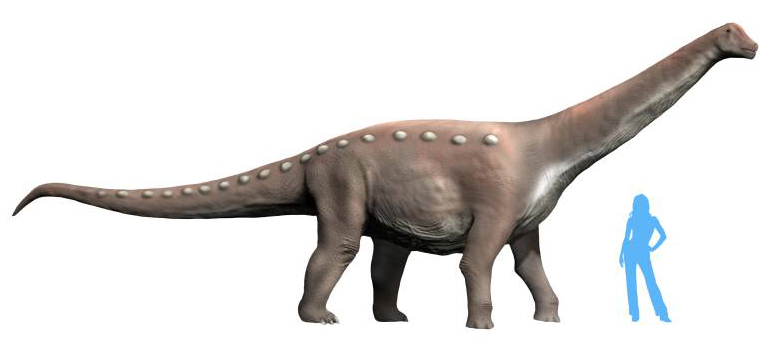


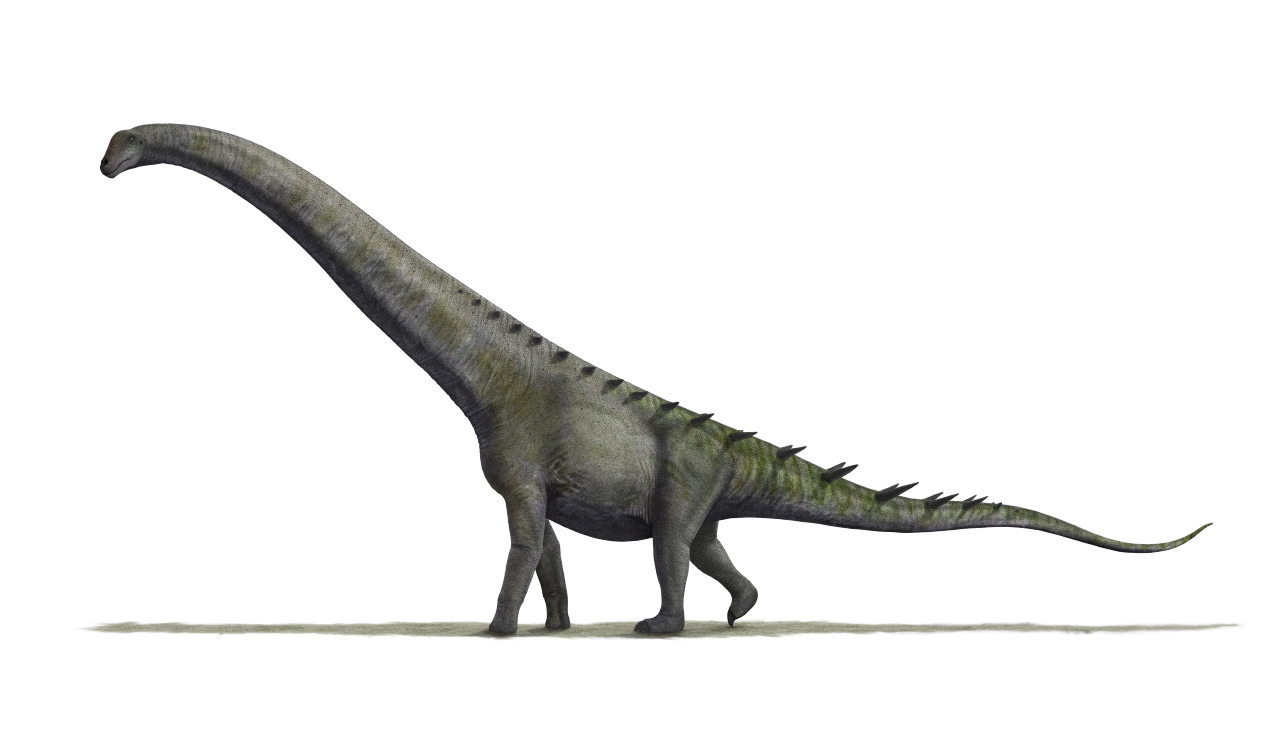
Life reconstruction of Tapuiasaurus macedoi by Nobu Tamura, a nemegtosaurid titanosaur from the Early Cretaceous of Brazil (Quiricó Formation, Minas Gerais).
Nobu Tamura, Wikimedia Commons, CC BY-SA 3.0
Ecology and behavior
Habitat
Interior of western Gondwana during the Aptian (~120 Ma), in a lacustrine to fluvial setting under a tropical to arid climate. The Quiricó Formation was deposited in a system of shallow lakes with increasing aeolian contribution upwards, suggesting progressive intensification of aridity. The plains around the lakes supported xerophytic vegetation of conifers, cycads and gnetophytes, with primitive angiosperms starting to appear.
Feeding
A high and low-canopy herbivore, by analogy with other titanosaurs. Tapuiasaurus's narrow, cylindrical teeth resemble those of diplodocoids and suggest a 'combing' strategy for foliage from canopies and shrubs, followed by swallowing without chewing; fermentative digestion in stomach chambers and a long intestine.
Behavior and senses
No direct evidence of behaviour, but modern analogues and titanosaur trackway records on other continents suggest movement in small groups, with seasonal migration between water bodies. The abundance of sauropod footprints in the Sanfranciscana Basin (Três Barras Formation, overlying the Quiricó) reinforces sustained occupation of the region by these animals.
Physiology and growth
A mid-sized sauropod for the group (~13 m, ~10 t), with an elongate neck, long tail, four columnar limbs and a relatively large and well-preserved head. The skull is diagnostic for combining primitive features (well-defined temporal fenestrae) with derived ones (elongated rostrum, retroposed nares, cylindrical teeth), the hallmark of the advanced titanosaurian cranial evolution that arose surprisingly early in the Aptian.
Paleogeography
Continental configuration

Scotese & Vérard · CC BY 4.0 · Cretaceous, ~105 Ma
During the Aptiano (~125–113 Ma), Tapuiasaurus macedoi inhabited Laramidia, the western half of present-day North America, separated from the east by the Western Interior Seaway, a shallow sea dividing the continent. The continents were in very different positions: India was drifting toward Asia, Antarctica was still connected to Australia, and South America was an isolated island.
Bone Inventory
Holotype MZSP-PV 807 preserves roughly 25 to 30 percent of the skeleton but with a rare combination: a nearly complete skull and jaws, articulated anterior axial elements and partially represented limbs. It is the most complete Early Cretaceous titanosaur in the world, above all because of the skull.
Found elements
Inferred elements
Scientific Literature
15 papers in chronological order — from the original description to recent research.
Revision of South American Titanosaurid dinosaurs: palaeobiological, palaeobiogeographical and phylogenetic aspects
Powell, J.E. · Records of the Queen Victoria Museum, Launceston
Jaime Powell's foundational monograph revising every South American titanosaur known up to the early 2000s. It established the taxonomic, osteological and biogeographic framework that Zaher et al. 2011 used as a starting point for evaluating Tapuiasaurus.
Titanosauria: a phylogenetic overview
Curry Rogers, K. · The Sauropods: Evolution and Paleobiology (University of California Press)
Synthesis chapter that reviewed Titanosauria before Tapuiasaurus was discovered. It consolidated the clade's definition and included the first comprehensive cladistic analysis with cranial characters, which Zaher et al. 2011 would later expand by incorporating Tapuiasaurus's previously unknown skull.

A new Cretaceous terrestrial ecosystem from Gondwana with the description of a new sauropod dinosaur
Calvo, J.O., Porfiri, J.D., González Riga, B.J. e Kellner, A.W.A. · Anais da Academia Brasileira de Ciências
Description of the Argentine titanosaur Futalognkosaurus dukei, one of the giant Neuquén lognkosaurines. Contextualises Tapuiasaurus within the South American Titanosauria radiation, with which it shares phylogenetic affinities in some analyses.
Amazonsaurus maranhensis gen. et sp. nov. (Sauropoda, Diplodocoidea) from the Lower Cretaceous (Aptian-Albian) of Brazil
Carvalho, I.S., Santos Avilla, L. e Salgado, L. · Cretaceous Research
Description of Amazonsaurus maranhensis, an Aptian-Albian diplodocoid from the Itapecuru Formation (Maranhão). It is the main Brazilian sauropod roughly contemporary with Tapuiasaurus and evidence that Early Cretaceous sauropod diversity in Brazil included both diplodocoids and titanosaurs.

The Age of Dinosaurs in South America
Novas, F.E. · Indiana University Press
Comprehensive treatise on South American dinosaurs with chapters dedicated to Cretaceous sauropods. It provides the biogeographic backdrop against which Tapuiasaurus would be published two years later as the first record of an advanced Aptian titanosaur.
A Complete Skull of an Early Cretaceous Sauropod and the Evolution of Advanced Titanosaurians
Zaher, H., Pol, D., Carvalho, A.B., Nascimento, P.M., Riccomini, C., Larson, P., Juarez-Valieri, R., Pires-Domingues, R., da Silva, N.J. Jr. e Campos, D.A. · PLoS ONE
Original, formal description of Tapuiasaurus macedoi based on holotype MZSP-PV 807 with skull and partial skeleton from the Quiricó Formation (Aptian, Minas Gerais). The discovery is a landmark because it shows the diplodocoid-like cranial anatomy of advanced titanosaurs already existed around 120 Ma, pushing back by up to 30 Myr the supposed diversification of nemegtosaurids in the Late Cretaceous.
Mesozoic dinosaurs from Brazil and their biogeographic implications
Bittencourt, J.S. e Langer, M.C. · Anais da Academia Brasileira de Ciências
Comprehensive review of Brazilian Mesozoic dinosaurs published the same year Tapuiasaurus was described. Lists 21 valid Brazilian species and discusses their biogeography, providing the immediate context for Tapuiasaurus's role in the Aptian fauna of the South American interior.
A new sauropod (Macronaria, Titanosauria) from the Adamantina Formation, Bauru Group, Upper Cretaceous of Brazil and the phylogenetic relationships of Aeolosaurini
Santucci, R.M. e Arruda-Campos, A.C. · Zootaxa
Description of Aeolosaurus maximus, a titanosaur from the Adamantina Formation (Brazilian Late Cretaceous), published in the same year as Tapuiasaurus. It contributes phylogenetic characters and broadens the picture of Brazilian titanosaur diversity, complementing Tapuiasaurus's basal position.

Osteology of the Late Jurassic Portuguese sauropod dinosaur Lusotitan atalaiensis (Macronaria) and the evolutionary history of basal titanosauriforms
Mannion, P.D., Upchurch, P., Barnes, R.N. e Mateus, O. · Zoological Journal of the Linnean Society
Extensive osteological revision of the Portuguese Lusotitan and a phylogenetic analysis of 63 taxa and 279 characters. Proposes that titanosauriform diversity increased in the Barremian and Aptian-Albian via radiation of somphospondylans and lithostrotians, the very interval that Tapuiasaurus inhabits.
A New Giant Titanosauria (Dinosauria: Sauropoda) from the Late Cretaceous Bauru Group, Brazil
Bandeira, K.L.N., Medeiros Simbras, F., Batista Machado, E., de Almeida Campos, D., Oliveira, G.R. e Kellner, A.W.A. · PLoS ONE
Description of Austroposeidon magnificus, Brazil's largest titanosaur (~25 m), from the Presidente Prudente Formation (Bauru). It also reviews national titanosaur diversity, listing nine valid taxa and placing Tapuiasaurus as the only Brazilian Early Cretaceous representative.
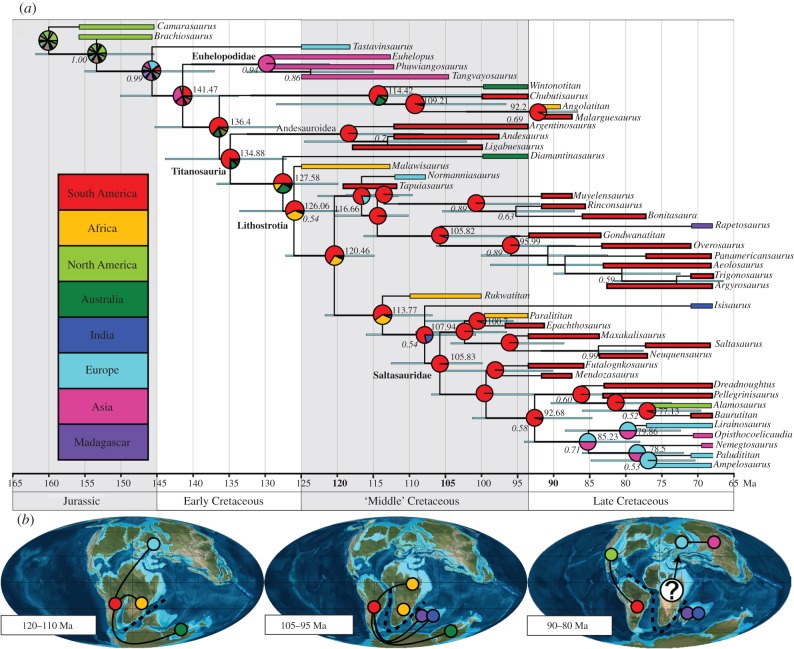
Time-calibrated models support congruency between Cretaceous continental rifting and titanosaurian evolutionary history
Gorscak, E. e O'Connor, P.M. · Biology Letters
Time-calibrated phylogenetic models testing congruency between Cretaceous continental rifting and titanosaur evolution. Shows that the clade's key diversification coincides with Gondwana's break-up, the very period Tapuiasaurus inhabited.
The skull of the titanosaur Tapuiasaurus macedoi (Dinosauria: Sauropoda), a basal titanosaur from the Lower Cretaceous of Brazil
Wilson, J.A., Pol, D., Carvalho, A.B. e Zaher, H. · Zoological Journal of the Linnean Society
Detailed redescription of the Tapuiasaurus skull five years after the original description, with further preparation and computed tomography. Identifies six new diagnostic features, revises the phylogenetic framework and recovers the taxon, preferentially, in a basal position adjacent to Malawisaurus and Tangvayosaurus, more basal than proposed by Zaher et al. (2011).
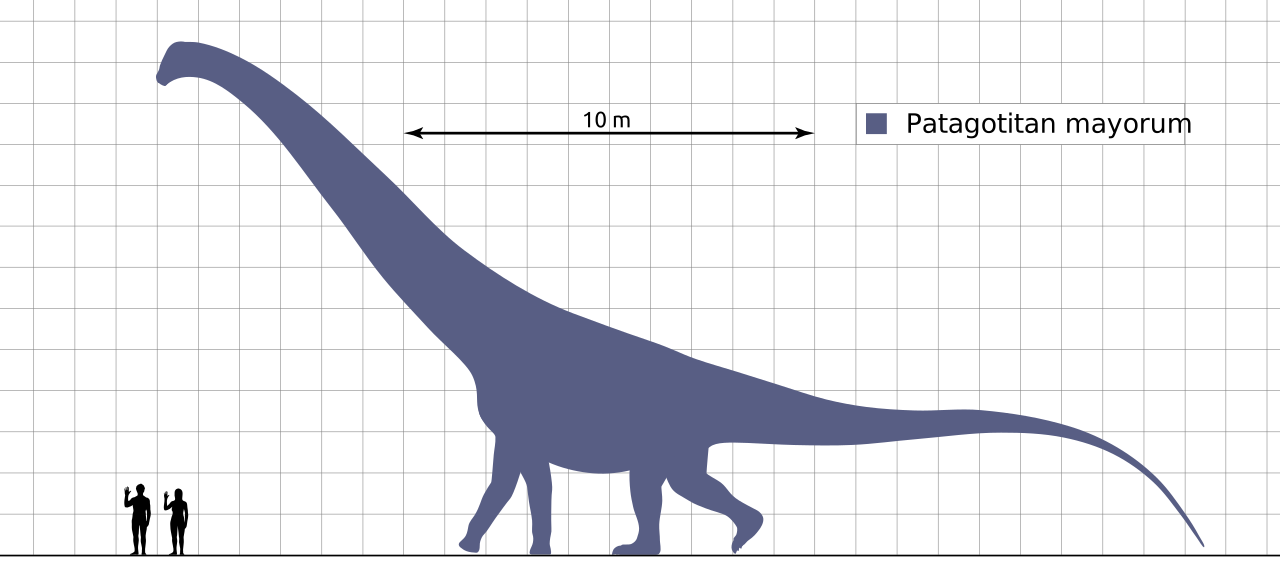
A new giant titanosaur sheds light on body mass evolution among sauropod dinosaurs
Carballido, J.L., Pol, D., Otero, A., Cerda, I.A., Salgado, L., Garrido, A.C., Ramezani, J., Cúneo, N.R. e Krause, J.M. · Proceedings of the Royal Society B: Biological Sciences
Description of Patagotitan mayorum, one of the largest titanosaurs ever described, and an analysis of body-mass evolution in Sauropoda. Illuminates the 'mid-Cretaceous' lognkosaurian radiation that postdates Tapuiasaurus and provides the basic contrast between the basal Aptian Brazilian taxon and Patagonian Albian-Turonian gigantothermy.
A new basal titanosaur (Dinosauria, Sauropoda) from the Lower Cretaceous of Brazil
Carvalho, I.S., Salgado, L., Lindoso, R.M., Araújo-Júnior, H.I., Nogueira, F.C.C. e Soares, J.A. · Journal of South American Earth Sciences
Description of Triunfosaurus leonardii, a basal titanosaur from the Rio Piranhas Formation (Berriasian-Hauterivian), among the oldest titanosaurs documented in Gondwana. Complements the Aptian Tapuiasaurus record by showing that the Brazilian titanosaur lineage began at least 15 Myr earlier.
New Egyptian sauropod reveals Late Cretaceous dinosaur dispersal between Europe and Africa
Sallam, H.M., Gorscak, E., O'Connor, P.M., El-Dawoudi, I.A., El-Sayed, S., Saber, S., Kora, M.A., Sertich, J.J.W., Seiffert, E.R. e Lamanna, M.C. · Nature Ecology and Evolution
Description of Mansourasaurus shahinae, an Egyptian Late Cretaceous titanosaur, plus a biogeographic analysis showing a connection between African and European faunas at the end of the Cretaceous. It serves as the temporal and geographic counterpoint to Tapuiasaurus, which represents an Aptian Brazilian titanosaur predating the full isolation of Africa and South America.
Famous museum specimens
MZSP-PV 807 (holótipo)
Museu de Zoologia da Universidade de São Paulo (MZSP/USP), São Paulo, Brasil
Only nearly complete Early Cretaceous titanosaur skull in the world. The material is curated at MZSP/USP (Ipiranga district, São Paulo) and is regularly studied through international collaborations (Wilson, Pol, Carvalho).
Réplica em exposição no MZSP/USP
Museu de Zoologia da Universidade de São Paulo, São Paulo, Brasil
The museographic mount of the Tapuiasaurus skull is one of the most publicly visible pieces in the USP vertebrate-fossil collection.
Classification
Discovery
Fun fact
The skull of Tapuiasaurus macedoi is the only nearly complete Early Cretaceous titanosaur skull in the world. Before its discovery, the 'diplodocoid-like' cranial anatomy (elongate rostrum, pencil-shaped cylindrical teeth, retroposed nares) was only known from Late Cretaceous titanosaurs such as Rapetosaurus and Nemegtosaurus. Tapuiasaurus showed that this anatomy already existed around 120 million years ago, pushing the radiation scientists thought had happened in the late Mesozoic back by up to 30 million years.
Last reviewed: April 24, 2026