Styracosaurus
Styracosaurus albertensis
"Spiked lizard of Alberta"
About this species
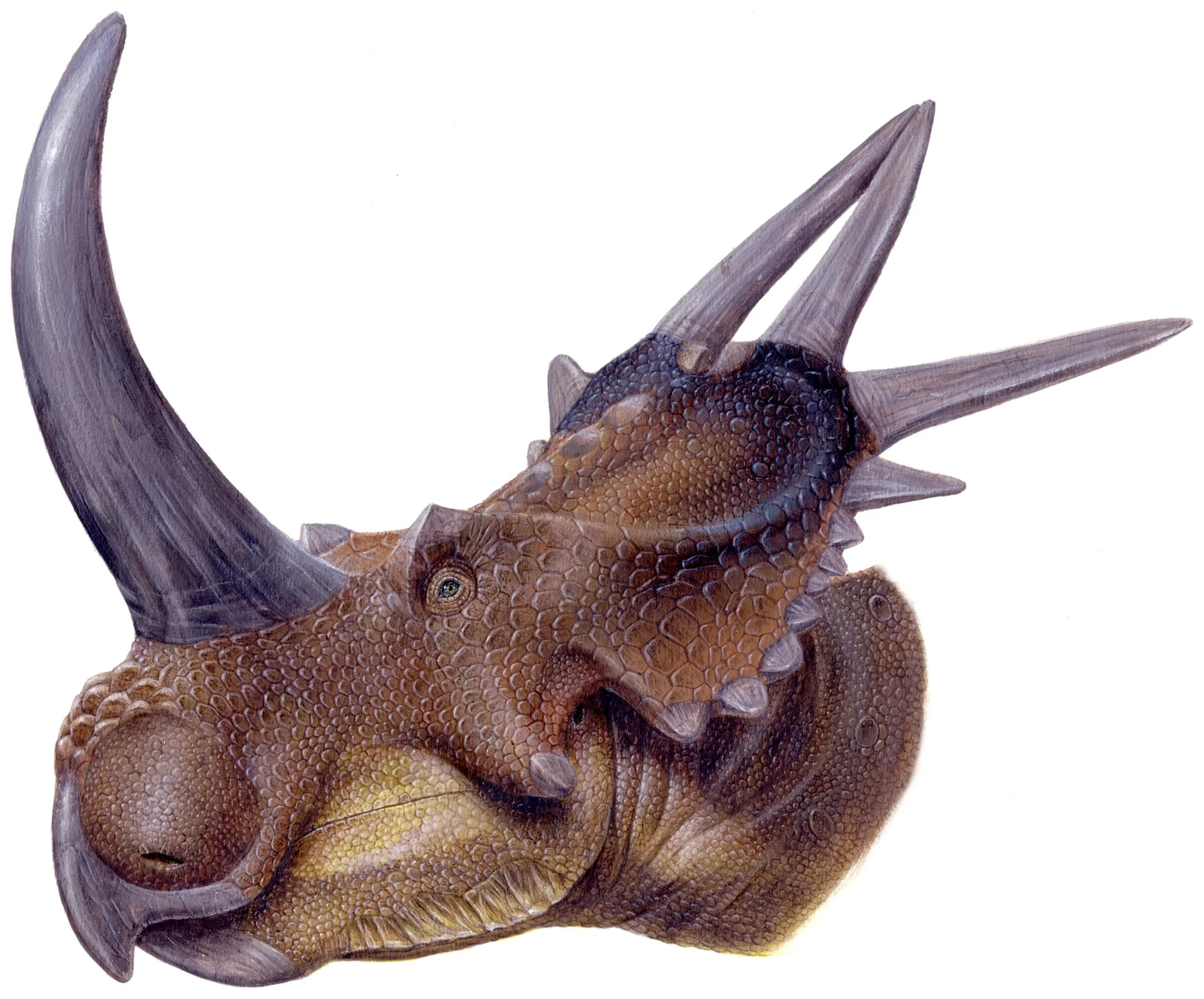
Styracosaurus albertensis was a centrosaurine ceratopsid that lived during the Late Campanian stage of the Cretaceous, approximately 75 million years ago, in what is now the province of Alberta, Canada. Measuring roughly 5.5 meters in length and weighing about 2.7 metric tons, it was distinguished by an elaborately ornamented skull featuring a nasal horn up to 60 centimeters long and a parietal frill bearing up to six long posterior spikes. These structures likely functioned in intraspecific recognition and mate attraction. Large fossil accumulations suggest the animals lived in herds and may have migrated seasonally across Campanian coastal environments.
Geological formation & environment
The Dinosaur Park Formation, of Campanian age (~76.5–74.4 Ma), outcrops primarily in Dinosaur Provincial Park in Alberta, Canada, where it is a UNESCO World Heritage Site. The formation consists of fluvial and deltaic sediments deposited on the western margin of the Western Interior Seaway. Climate was subtropical humid, without polar ice caps, with dense angiosperm vegetation. Styracosaurus albertensis occurs exclusively in the upper zone (MAZ-2, ~75–74.5 Ma), replacing Centrosaurus apertus as the dominant ceratopsid. The formation is one of the most prolific in dinosaur diversity in the world.
Image gallery

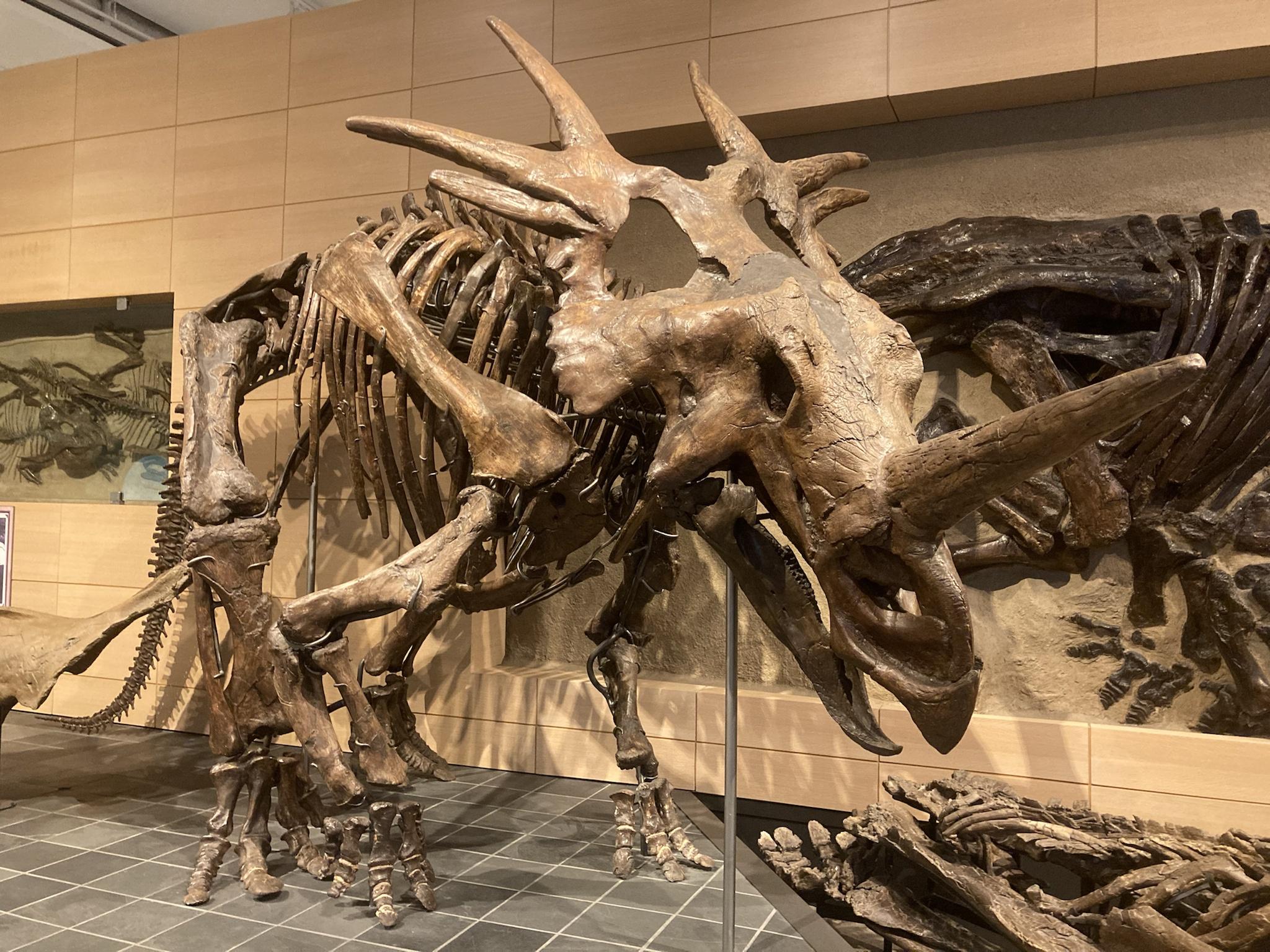

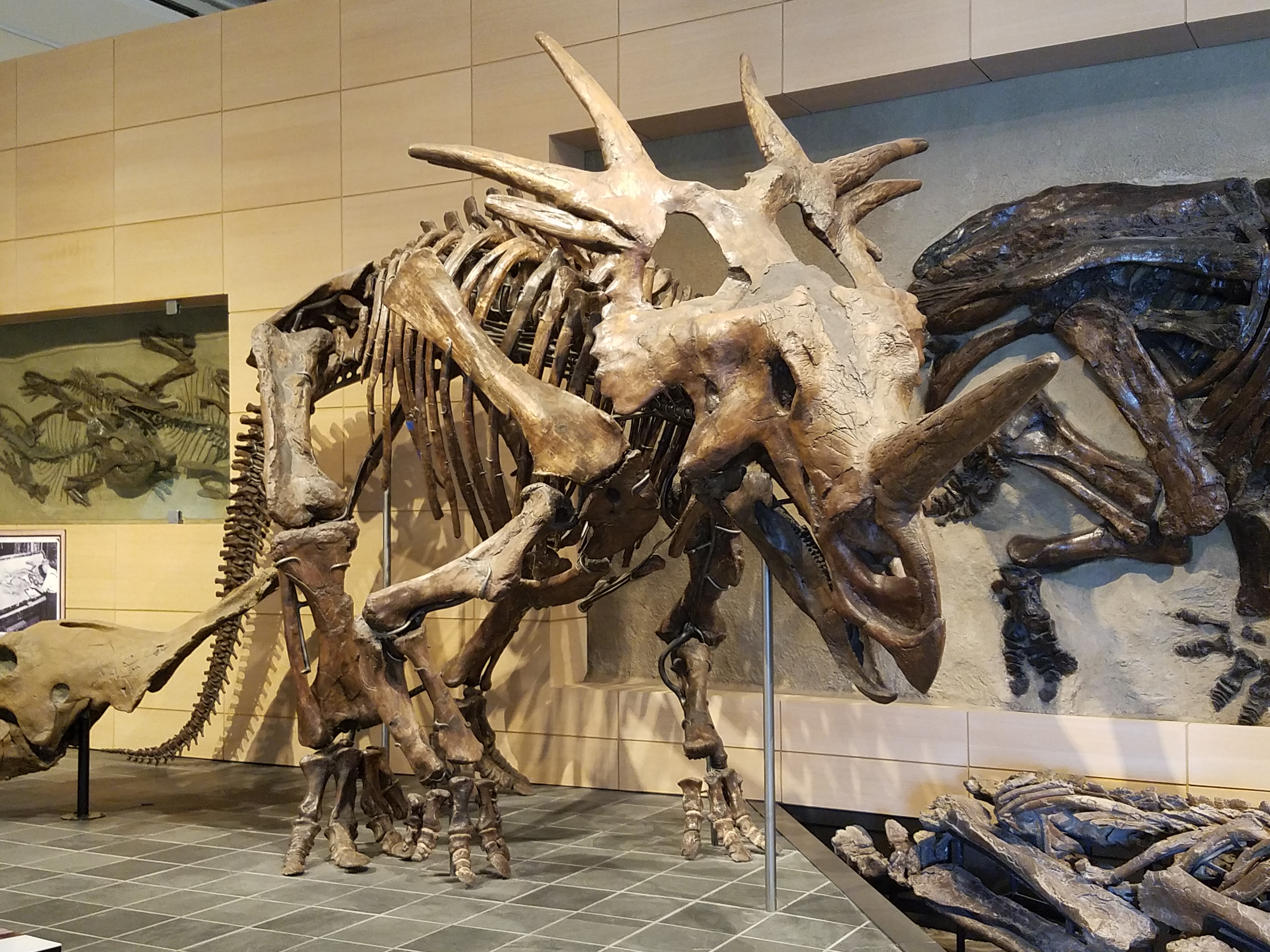


Modern scientific reconstruction of Styracosaurus albertensis in lateral view, showing the prominent nasal horn and parietal frill with six posterior spines. Based on anatomy updated by Holmes et al. (2020).
Connor Ashbridge (Ddinodan), CC BY 4.0
Ecology and behavior
Habitat
Styracosaurus albertensis lived in the coastal and alluvial plain environments of the upper Campanian (~75–74.5 Ma) on the western margin of the Western Interior Seaway, the epicontinental sea that divided North America. The Dinosaur Park Formation preserves dense forests, swamps, and floodplains in a warm, humid climate without polar ice caps. The ecosystem included predators such as Gorgosaurus libratus and Daspletosaurus, and other herbivores like Centrosaurus (in the lower zone), Corythosaurus, and Prosaurolophus.
Feeding
Styracosaurus was a herbivore specialized in low-to-mid height vegetation. Its deep horny beak was adapted for cutting stems and tough foliage, and the laterally compressed dental battery allowed efficient processing of fibrous plant material. Ecomorphological analysis by Mallon and Anderson (2013) placed the animal in a mid-height browsing niche, differentiated from Centrosaurus (lower). The robust jaw musculature, evidenced by skull bone processes, supported a powerful bite for resistant vegetation.
Behavior and senses
Large fossil accumulations (bone beds) of Styracosaurus in Dinosaur Provincial Park suggest gregarious herd behavior, possibly similar to large modern ungulates like buffalo or wildebeest. Seasonal migration was proposed to explain the formation of these bone beds through flood events. The spiny frill likely functioned in intraspecific dominance signaling and mate attraction, as supported by Knapp et al. (2018). Agonistic interactions between males may have involved frontal frill display.
Physiology and growth
As a large warm-blooded herbivore (endothermic metabolism is inferred for ceratopsids from bone histology with LAGs and fibrolamellar tissue), Styracosaurus likely grew rapidly during juvenility. The craniofacial asymmetry documented by Holmes et al. (2020) in specimen UALVP 55900 suggests developmental plasticity was greater than previously supposed, and that the ornamented frill tolerates some degree of asymmetry without compromising signaling function. Tegument was likely scaly, as in other ceratopsids, with no evidence of feathers.
Paleogeography
Continental configuration

Scotese & Vérard · CC BY 4.0 · Cretaceous, ~105 Ma
Fossil sites

Brown & Schlaikjer, 1937 — Domínio Público
During the Campaniano (~75.5–74.5 Ma), Styracosaurus albertensis inhabited Laramidia, the western half of present-day North America, separated from the east by the Western Interior Seaway, a shallow sea dividing the continent. The continents were in very different positions: India was drifting toward Asia, Antarctica was still connected to Australia, and South America was an isolated island.
Bone Inventory
Based on multiple specimens. The holotype (CMN 344) preserves a nearly complete skull and most of the postcranial skeleton. Specimen UALVP 55900, discovered in 2015, revealed morphological variation and asymmetry in the parietal shield never before observed in the species.

Found elements
Inferred elements
Scientific Literature
15 papers in chronological order — from the original description to recent research.
A new genus and species from the Belly River Formation of Alberta
Lambe, L.M. · Ottawa Naturalist
The founding paper formally describing Styracosaurus albertensis based on holotype CMN 344, collected from the Red Deer River bank in Alberta. Lawrence Lambe, paleontologist at the Canadian Museum of Nature, defines the species' diagnostic characters: the large nasal horn, reduced supraorbital horns, and most notably the parietal frill with its long posterior spines — a structure without parallel among then-known ceratopsians. The generic name Styracosaurus derives from Greek for 'spiked lizard.' Lambe places the animal in Family Ceratopsidae and discusses its relationship with Centrosaurus and Monoclonius. The paper is the primary taxonomic reference for the species and is cited in all subsequent studies on the genus.

The skeleton of Styracosaurus with the description of a new species
Brown, B. & Schlaikjer, E.M. · American Museum Novitates
Brown and Schlaikjer describe the nearly complete postcranial skeleton of Styracosaurus collected by Barnum Brown in 1915 at Dinosaur Provincial Park. The paper provides the first comprehensive analysis of the species' skeleton, documenting in detail the vertebrae, limbs, and pectoral and pelvic girdles. The authors describe and name a new species, Styracosaurus parksi, based on differences in frill shape, jugal bone, and dentary. Later revisions reclassified S. parksi as a probable intraspecific or ontogenetic variant of S. albertensis. The paper provided the postcranial anatomical foundation for all 20th-century reconstructions of the animal.
A revision of the late Campanian centrosaurine ceratopsid genus Styracosaurus from the Western Interior of North America
Ryan, M.J., Holmes, R. & Russell, A.P. · Journal of Vertebrate Paleontology
Comprehensive taxonomic revision of the genus Styracosaurus examining all specimens known at the time and reassessing the validity of the two proposed species. Ryan, Holmes, and Russell catalog morphological differences among specimens and discuss the validity of S. parksi relative to S. albertensis. The paper analyzes intraspecific variation in the parietal shield and epiossified processes and situates the genus within centrosaurine phylogeny. The revision represents the most complete taxonomic reference for the genus before the era of geometric morphometrics and CT scanning. It establishes diagnostic criteria used in subsequent revisions and is widely cited in all 21st-century ceratopsid literature.

A Subadult Specimen of Rubeosaurus ovatus (Dinosauria: Ceratopsidae), with Observations on Other Ceratopsids from the Two Medicine Formation
McDonald, A.T. · PLOS ONE
McDonald describes a subadult specimen of Rubeosaurus ovatus (formerly Styracosaurus ovatus) from the Two Medicine Formation of Montana. The phylogenetic analysis presented is central to understanding the taxonomic boundaries of Styracosaurus albertensis: by placing Rubeosaurus in a separate clade with Einiosaurus, Achelousaurus, and Pachyrhinosaurus, the study reinforces the validity of S. albertensis as a distinct taxon. The paper discusses diagnostic characters differentiating the two genera and their implications for upper Campanian centrosaurine biogeography. This analysis was later revised by Holmes et al. (2020), who found that variation in S. albertensis rendered Rubeosaurus superfluous as a separate genus.

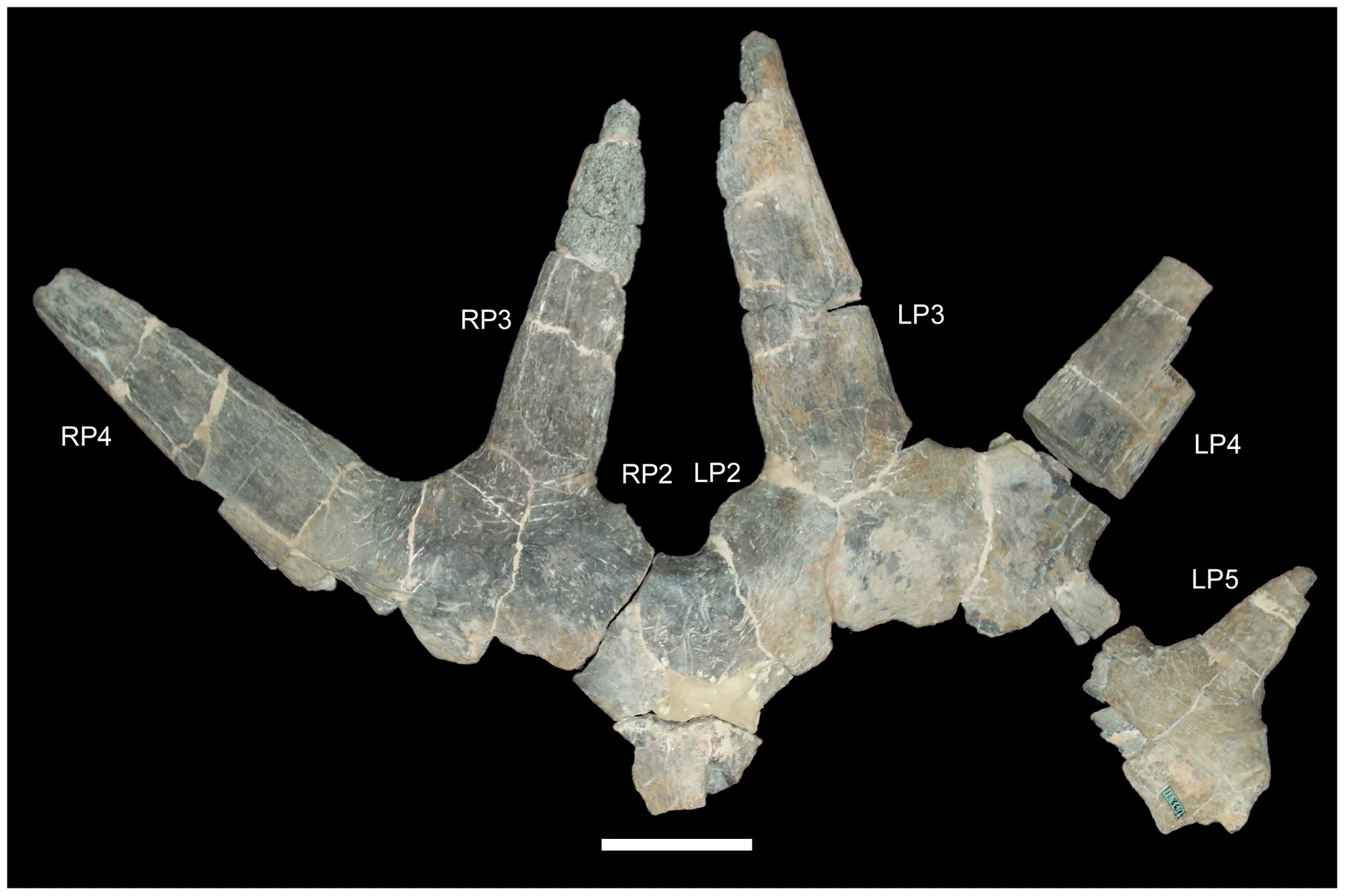
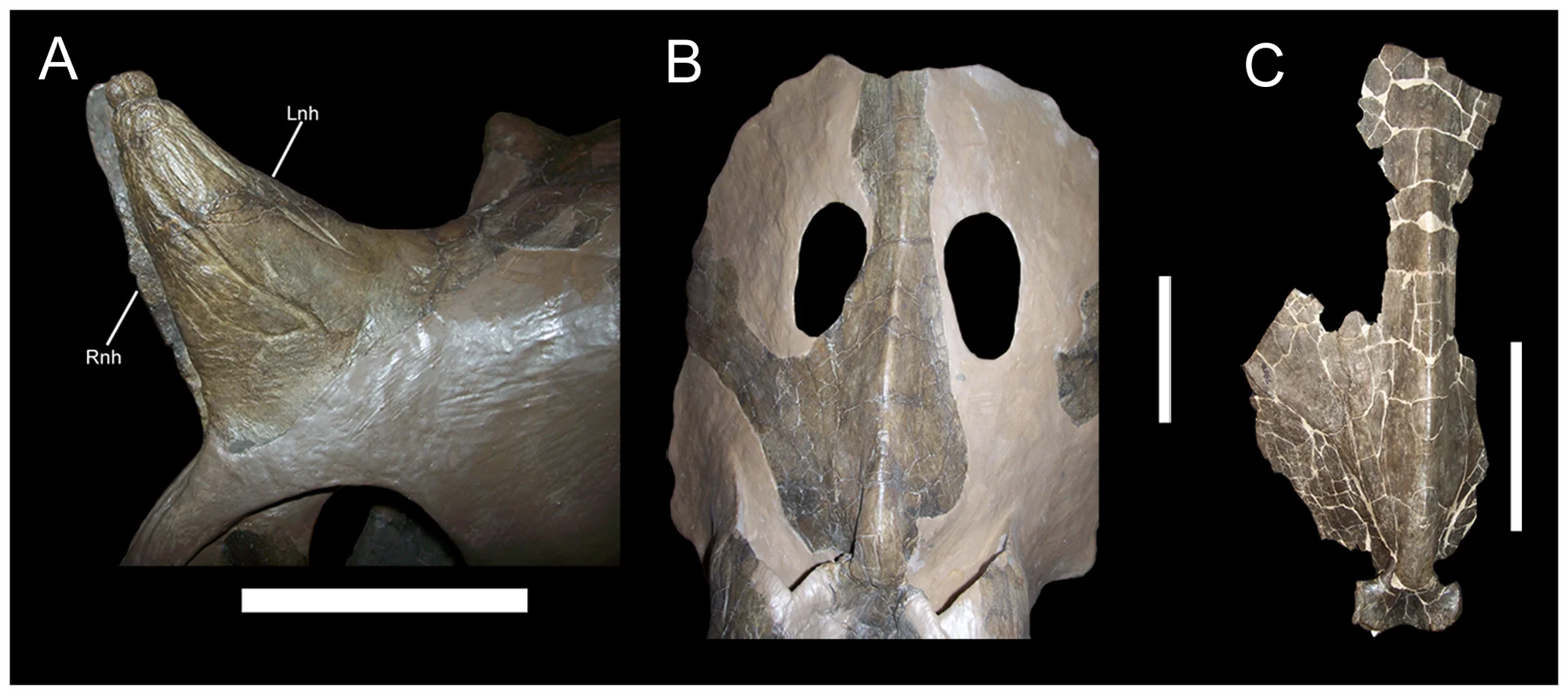
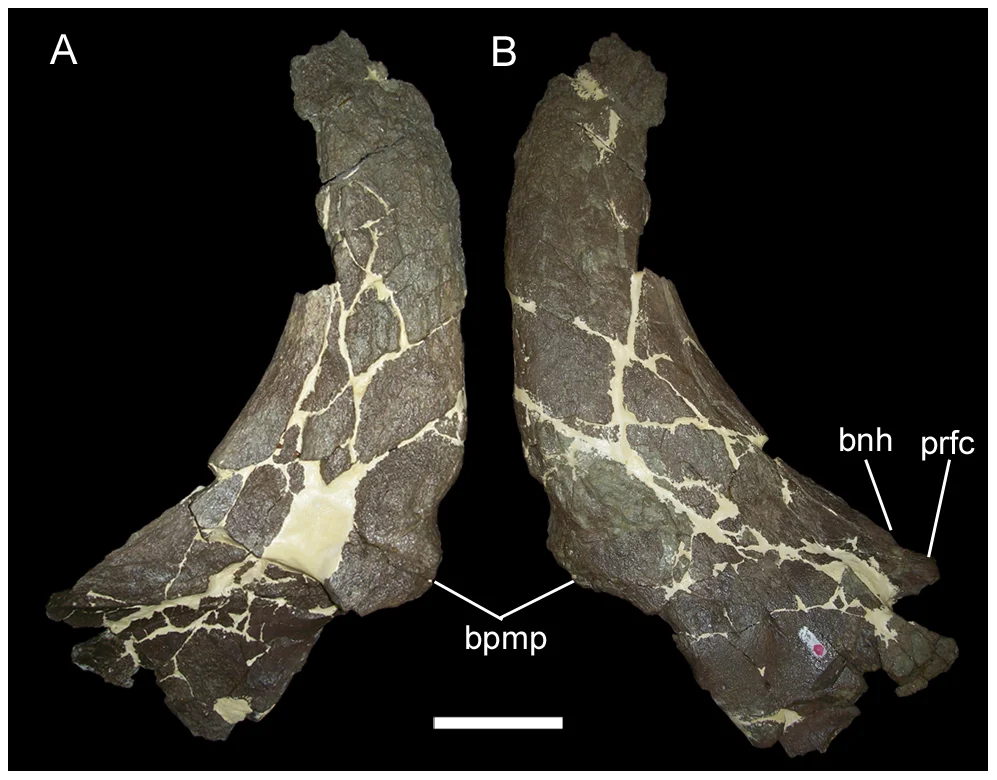
The postcranial skeleton of Styracosaurus albertensis
Holmes, R. & Ryan, M.J. · Kirtlandia
Osteological monograph dedicated to the postcranial skeleton of Styracosaurus albertensis, based on holotype CMN 344 and additional isolated specimens from Alberta. Holmes and Ryan systematically document the pectoral girdle, vertebral column, limbs, and pelvic girdle, providing descriptions that complement the photographic atlas previously published by the same author. The paper is the most complete postcranial anatomical reference for the species, describing ossification patterns, articulations, and comparisons with other centrosaurines. Published in Kirtlandia, the journal of the Cleveland Museum of Natural History, the paper is widely cited in subsequent ceratopsid biomechanics and phylogeny studies.

Skull Ecomorphology of Megaherbivorous Dinosaurs from the Dinosaur Park Formation (Upper Campanian) of Alberta, Canada
Mallon, J.C. & Anderson, J.S. · PLOS ONE
Mallon and Anderson apply geometric morphometrics and discriminant analysis to skull shape in all large herbivores of the Dinosaur Park Formation, including Styracosaurus albertensis, to test whether the species occupied distinct dietary niches. Results confirm the niche partitioning hypothesis: ceratopsids, hadrosaurs, and ankylosaurs exhibit significantly different cranial morphologies consistent with distinct feeding heights. Styracosaurus, with its deep beak and robust jaw musculature, is placed in a mid-height browsing niche, differentiated from Centrosaurus (lower) and hadrosaurs (higher). The paper links cranial anatomy to paleoecology and is a central reference for understanding faunal structure in the Dinosaur Park Formation.
Megaherbivorous dinosaur turnover in the Dinosaur Park Formation (upper Campanian) of Alberta, Canada
Mallon, J.C., Evans, D.C., Ryan, M.J. & Anderson, J.S. · Palaeogeography, Palaeoclimatology, Palaeoecology
Mallon, Evans, Ryan, and Anderson document the temporal replacement of large herbivore faunas through the stratigraphic column of the Dinosaur Park Formation, identifying two faunal assemblage zones (MAZ-1 and MAZ-2). Styracosaurus albertensis characterizes the upper zone (MAZ-2, ~75–74.5 Ma), replacing Centrosaurus apertus as the dominant ceratopsid. The analysis uses precise stratigraphic coordinates from hundreds of specimens and clustering and ordination methods to demonstrate that this faunal transition was not gradual but relatively abrupt, possibly linked to changes in vegetation and sea level. The paper situates Styracosaurus in a precise paleoecological and temporal context within the upper Campanian of Canada.

Variation in the shape and mechanical performance of the lower jaws in ceratopsid dinosaurs (Ornithischia, Ceratopsia)
Maiorino, L., Farke, A.A., Kotsakis, T., Teresi, L. & Piras, P. · Journal of Anatomy
Maiorino and colleagues combine geometric morphometrics and finite element analysis (FEA) to examine lower jaw shape and biomechanical performance in ceratopsid dinosaurs, including Styracosaurus albertensis (specimen CMN 334). Results reveal centrosaurines and chasmosaurines exhibit distinct mandibular mechanical profiles: Styracosaurus shows jaw morphology similar to other centrosaurines, consistent with feeding on dense, resistant vegetation. FEA quantifies stresses during biting and identifies areas of greatest stress concentration. The paper provides the first quantitative biomechanical analysis of the Styracosaurus jaw and situates the species in a broad comparative context of functional diversity among ceratopsids.
Patterns of divergence in the morphology of ceratopsian dinosaurs: sympatry is not a driver of ornament evolution
Knapp, A., Knell, R.J., Farke, A.A., Loewen, M.A. & Hone, D.W.E. · Proceedings of the Royal Society B: Biological Sciences
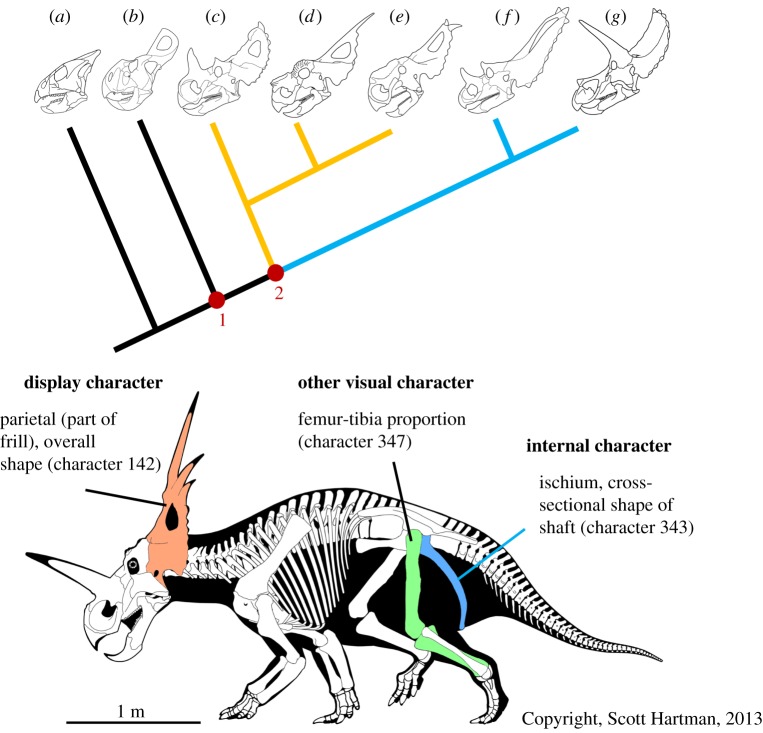
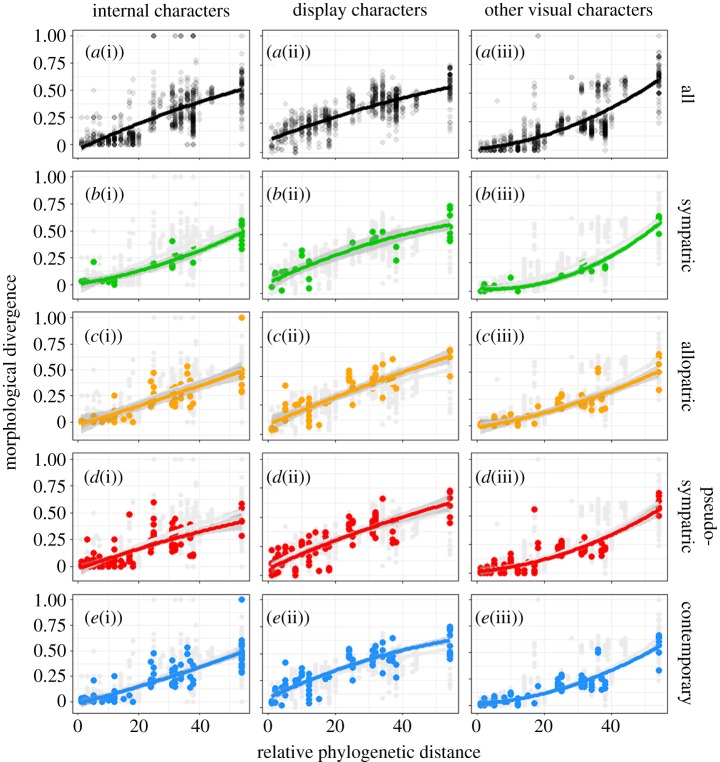
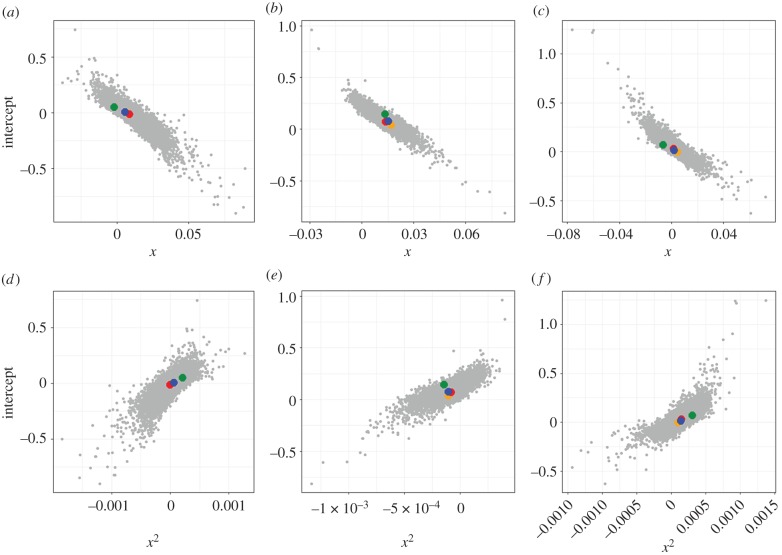
Knapp and colleagues examine 46 ceratopsian species, including Styracosaurus albertensis, to test whether sympatry (geographic coexistence with related species) drove divergence in frill ornamentation. Results reject the species recognition hypothesis as the primary selective force: sympatric species are no more divergent in their ornaments than allopatric ones. Instead, the data support sexual or social selection as the primary driver of the elaborate horns and frills of ceratopsians. The paper highlights Styracosaurus albertensis as one of the most prominent examples of exaggerated ornamentation in the fossil record, with its long parietal spines being consistent with intraspecific signaling.

Morphological variation and asymmetrical development in the skull of Styracosaurus albertensis
Holmes, R.B., Persons, W.S., Rupal, B.S., Qureshi, A.J. & Currie, P.J. · Cretaceous Research
Holmes and colleagues describe specimen UALVP 55900, a large and well-preserved skull of Styracosaurus albertensis discovered in the Matzhiwin Creek basin in 2015. The animal bears seven epiossifications on the right parietal bar and eight on the left, demonstrating for the first time marked asymmetry in the parietal shield of this species. 3D laser scanning enabled detailed analysis of morphological variations. Crucially, the expanded morphological variation detected in S. albertensis encompasses the characters previously used to define Rubeosaurus ovatus as a separate genus, leading the authors to synonymize it with S. albertensis. The paper represents the most modern and comprehensive study of the Styracosaurus skull to date.

A new, transitional centrosaurine ceratopsid from the Upper Cretaceous Two Medicine Formation of Montana and the evolution of the 'Styracosaurus-line' dinosaurs
Wilson, J.P., Ryan, M.J. & Evans, D.C. · Royal Society Open Science
Wilson, Ryan, and Evans describe Stellasaurus ancellae, a new centrosaurine ceratopsid from the Two Medicine Formation of Montana representing an evolutionary intermediate between Styracosaurus albertensis and Einiosaurus procurvicornis. Phylogenetic analysis recovers an anagenetic series: S. albertensis (oldest) evolves into Stellasaurus, which evolves into Einiosaurus, Achelousaurus, and Pachyrhinosaurus. This model implies that Styracosaurus albertensis is the direct ancestor of this entire evolutionary lineage. The paper redefines the position of Styracosaurus in centrosaurine macroevolution, transforming it from a mere taxonomic data point into the temporal anchor of one of the best-documented ceratopsid lineages.


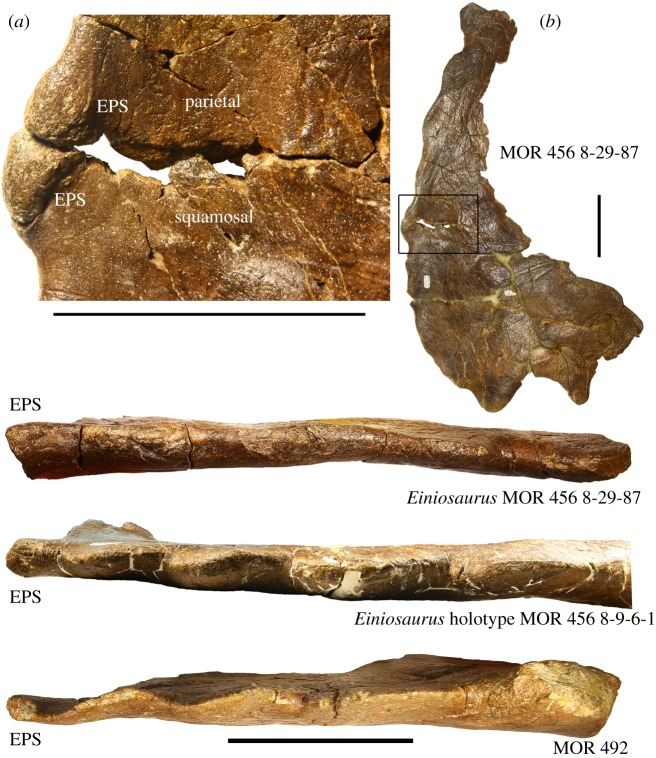
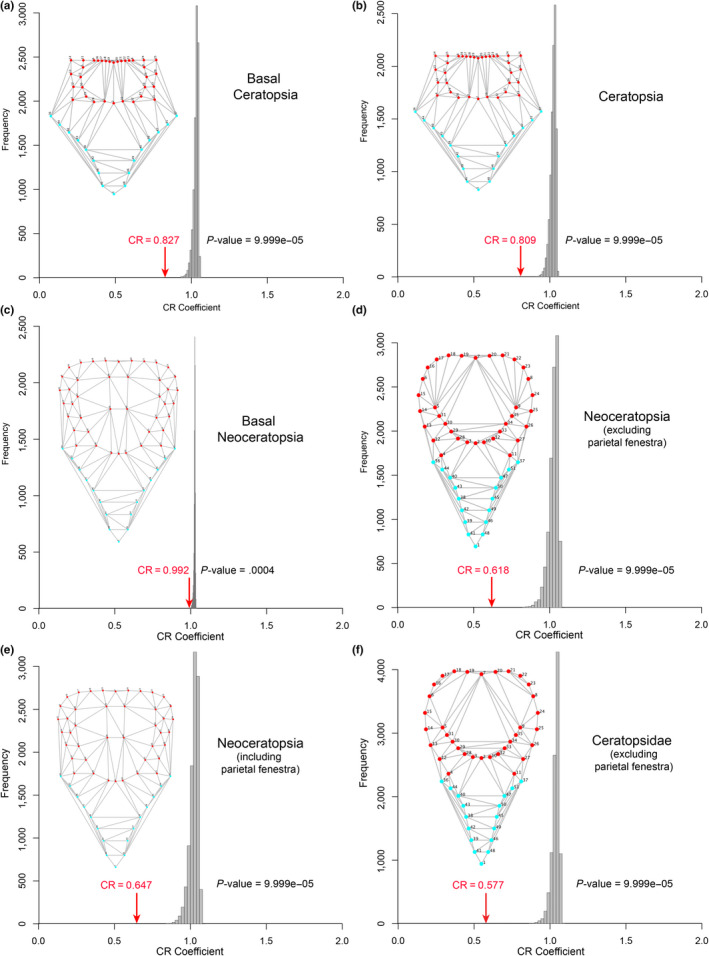
![Homology of parietal processes as indicated by imbrication. EPS is greyed out in the McDonald [ 14 ] homology as it was not identified as such in that study. EPS, epiparietosquamosal; (I), imbricated. Scale bar 10 cm.](/images/species/styracosaurus-albertensis/papers/d2a165841c-11.jpg)
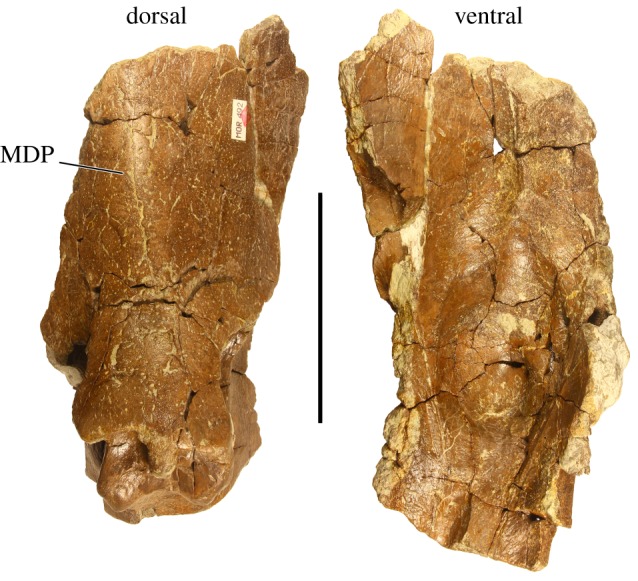
![Left lateral parietal bar of Stellasaurus ancellae holotype MOR 492 in dorsal and ventral views. EPS, epiparietosquamosal; PSC, parietosquamosal contact. Scale bar 10 cm. Parietal line drawing modified from Evans & Ryan [ 22 ], Public Library of Science (PLoS), used under Creative Commons Attribution 4.0.](/images/species/styracosaurus-albertensis/papers/d2a165841c-12.jpg)
A subadult individual of Styracosaurus albertensis (Ornithischia: Ceratopsidae) with comments on ontogeny and intraspecific variation in Styracosaurus and Centrosaurus
Brown, C.M., Holmes, R. & Currie, P.J. · Vertebrate Anatomy Morphology Palaeontology
Brown, Holmes, and Currie describe a subadult specimen of Styracosaurus albertensis representing approximately 80% of maximum adult size, with a complete skull and fragmentary skeleton. Ontogenetic analysis documents the development of the nasal horncore, supraorbital horncores, and parietal processes through growth, comparing with patterns in Centrosaurus apertus. The study reveals that Styracosaurus retains a recurved nasal horncore throughout ontogeny — unlike Centrosaurus, which develops procurved morphology in adults. Postorbital horns are lower and more rounded in Styracosaurus throughout ontogeny. The paper is the most complete ontogenetic analysis available for the species.


Modularity and heterochrony in the evolution of the ceratopsian dinosaur frill
Prieto-Marquez, A., Garcia-Porta, J., Joshi, S.H., Norell, M.A. & Makovicky, P.J. · Ecology and Evolution
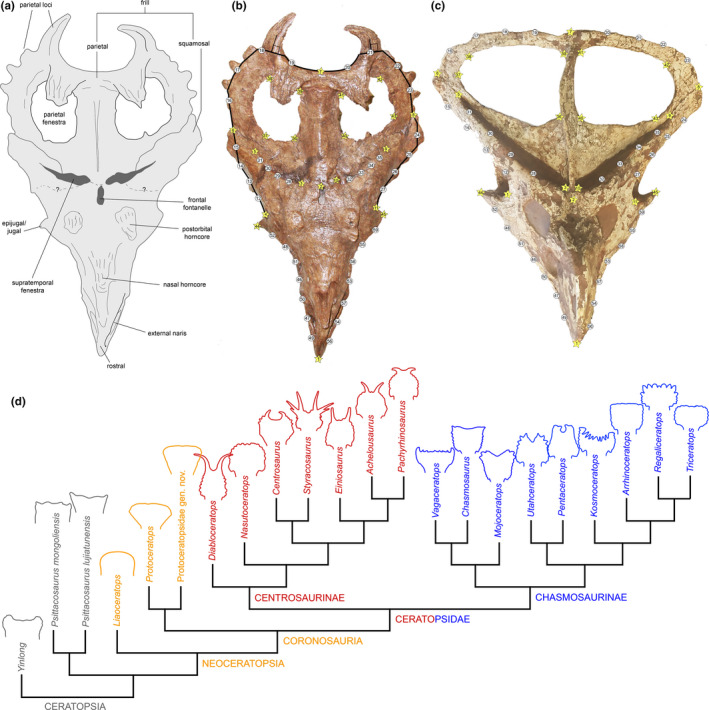
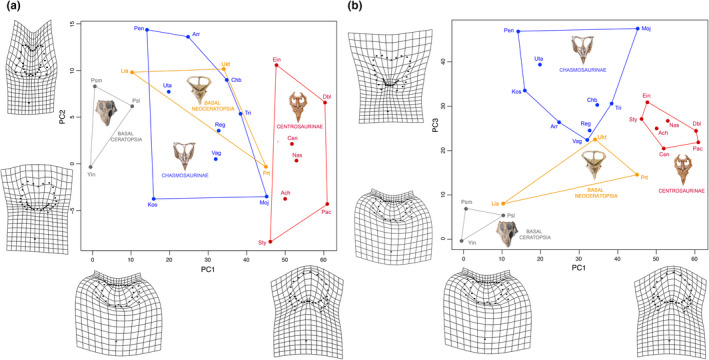
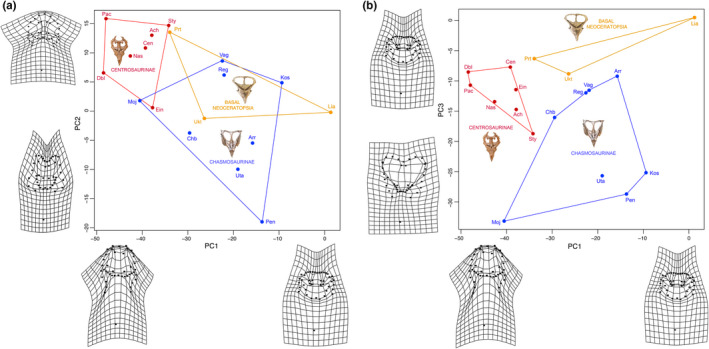
Prieto-Marquez and colleagues apply geometric morphometrics to frill shape variation in 25 ceratopsian species, including Styracosaurus albertensis, to test whether the frill functions as an independent evolutionary module. Results indicate peramorphosis played an important role early in neoceratopsian evolution, followed by progenesis in more derived ceratopsians. Evolutionary decoupling of the frill from jaw musculature is identified as the key event permitting rapid diversification of ornamentations. The paper frames Styracosaurus's spiny frill as a product of peramorphosis — extension of growth beyond the ancestral pattern — within the evolutionary trajectory of centrosaurines.
.png)
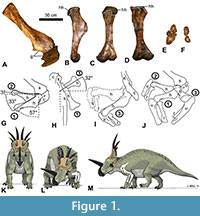
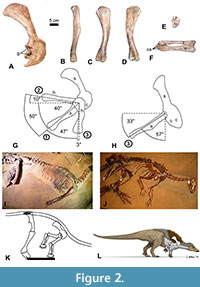
Forelimb motion and orientation in the ornithischian dinosaurs Styracosaurus and Thescelosaurus, and its implications for locomotion and other behavior
Senter, P.J. & Mackey, J.J. · Palaeontologia Electronica
Senter and Mackey manually manipulate forelimb bones of the Styracosaurus albertensis holotype to determine shoulder range of motion and functional orientation of the humerus, radius, and ulna. Results show locomotion in S. albertensis occurred with elbows tucked in at the sides and radius anterior to the ulna, without pronation — a pattern similar to that found in chasmosaurine ceratopsids. The paper provides direct biomechanical data for Styracosaurus postural and locomotor reconstruction and its behavioral implications: the documented range of motion suggests the animal could lower its head close to the ground for grazing, but had limited lateral mobility of the forelimb.

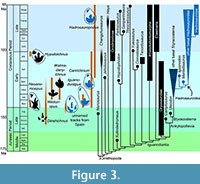
Competition structured a Late Cretaceous megaherbivorous dinosaur assemblage
Mallon, J.C., Ott, C.J., Larson, P.L., Iuliano, E.M. & Evans, D.C. · Scientific Reports
Mallon and colleagues conduct a meta-analysis of 21 ecomorphological variables measured across 14 contemporaneous megaherbivore genera from the Dinosaur Park Formation, including Styracosaurus albertensis. Results demonstrate that contemporaneous taxa are consistently well-separated in ecomorphological space at the family and subfamily level, and that this pattern persists across approximately 1.5 million years of species turnover, despite the replacement of Centrosaurus by Styracosaurus in the upper zone. The central conclusion is that long-term ecological competition structured the megaherbivore assemblage of the formation, with S. albertensis occupying a distinct ecological niche from contemporaneous hadrosaurs and ankylosaurs.


Famous museum specimens
CMN 344 (Holótipo)
Canadian Museum of Nature, Ottawa, Canadá
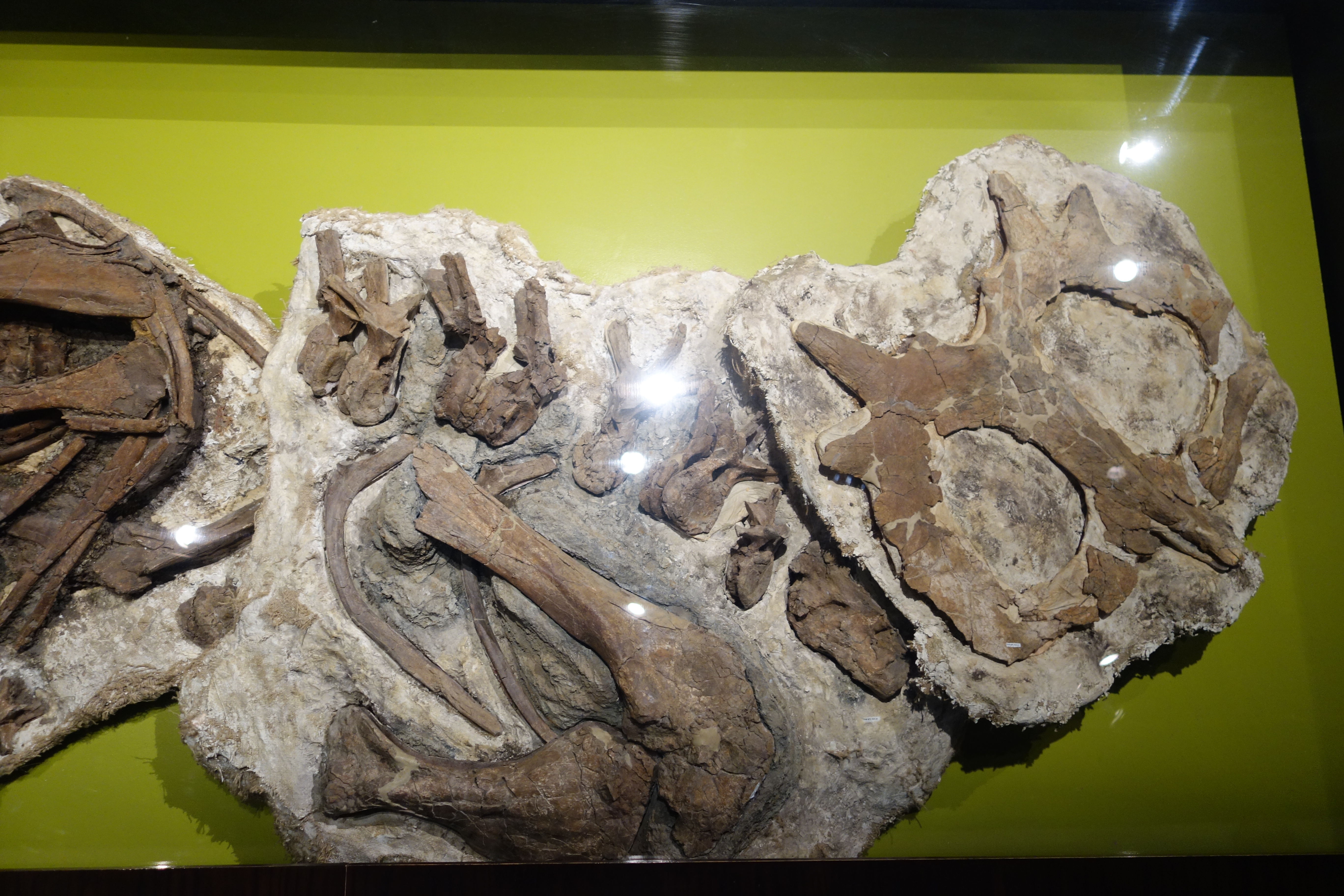
Holotype of Styracosaurus albertensis, collected from the Red Deer River bank in Alberta in 1913. Preserves a nearly complete skull and most of the postcranial skeleton. It was the basis for all taxonomic studies of the species for over a century.
AMNH 5372
American Museum of Natural History, Nova York, EUA
Specimen collected by Barnum Brown in 1915 at Dinosaur Provincial Park. Preserves a nearly complete postcranial skeleton but only a partial skull. Brown and Schlaikjer (1937) described it as a new species, S. parksi, a name now considered invalid.
UALVP 55900
University of Alberta Laboratory for Vertebrate Paleontology, Edmonton, Canadá
Large, well-preserved skull discovered in the Matzhiwin Creek basin in 2015. Revealed unprecedented asymmetry in the parietal shield, with seven epiossifications on one side and eight on the other. Holmes et al. (2020) used 3D laser scanning to describe the specimen in detail.
In cinema and popular culture
Styracosaurus albertensis never achieved the cultural ubiquity of Triceratops or T. rex, but built a solid presence in pop culture over decades. Its most prominent mainstream film appearance was as Eema in Disney's animated film Dinosaur (2000), where the character was originally conceived as the protagonist before being replaced by an Iguanodon. The species also occupies a prominent position in the DINOSAUR attraction at Disney's Animal Kingdom, where it serves as mascot of the fictional Dino Institute and is the first dinosaur encountered by visitors. In gaming, Styracosaurus features in all three generations of the Jurassic World Evolution franchise and appears in Prehistoric Kingdom. Scientific representation has progressively improved: more recent models incorporate correct horizontal posture, vascularized frill, and herd behavior based on bone bed evidence. The species' unique visual aspect, with its single long nasal horn and multiple parietal spines, makes it a frequent choice for artists and game designers seeking ceratopsians visually distinct from Triceratops.
Classification


Discovery
Fun fact
Specimen UALVP 55900, discovered in 2015, revealed that Styracosaurus had an asymmetric frill: seven spines on one side and eight on the other. This suggests perfect symmetry was not required for signaling function — much like humans have slightly asymmetric faces without impairing communication.
Last reviewed: April 24, 2026