
Squalicorax
Squalicorax falcatus
"Falcate crow shark (from the curved, sickle-like teeth)"
About this species
Squalicorax falcatus was a medium-sized lamniform shark that inhabited the shallow seas of the Late Cretaceous, including the extensive Western Interior Seaway of North America. About 2.5 meters in length, it had a fusiform body similar to the modern reef shark, but its strongly serrated teeth resembled those of today's tiger shark. The genus Squalicorax, commonly called the crow shark, was a generalist predator and opportunistic scavenger. Fossil evidence includes teeth embedded in bones of terrestrial hadrosaurs, mosasaurs, and sea turtles, revealing that it fed on carcasses washed into the sea. The species S. falcatus is known from nearly complete skeletons found in Kansas, making it one of the best-documented Mesozoic sharks.
Geological formation & environment
The Niobrara Formation (Coniacian-Campanian, ~87-82 Ma) is a carbonatic sedimentary rock unit deposited on the floor of the Western Interior Seaway. Composed mainly of limestone and chalk, it is famous for preserving fish, sharks, mosasaurs, plesiosaurs, and birds of the Late Cretaceous with exceptional quality. Outcropping mainly in Kansas, South Dakota, and Nebraska, it is one of the most productive formations for North American Cretaceous marine fossils.
Image gallery

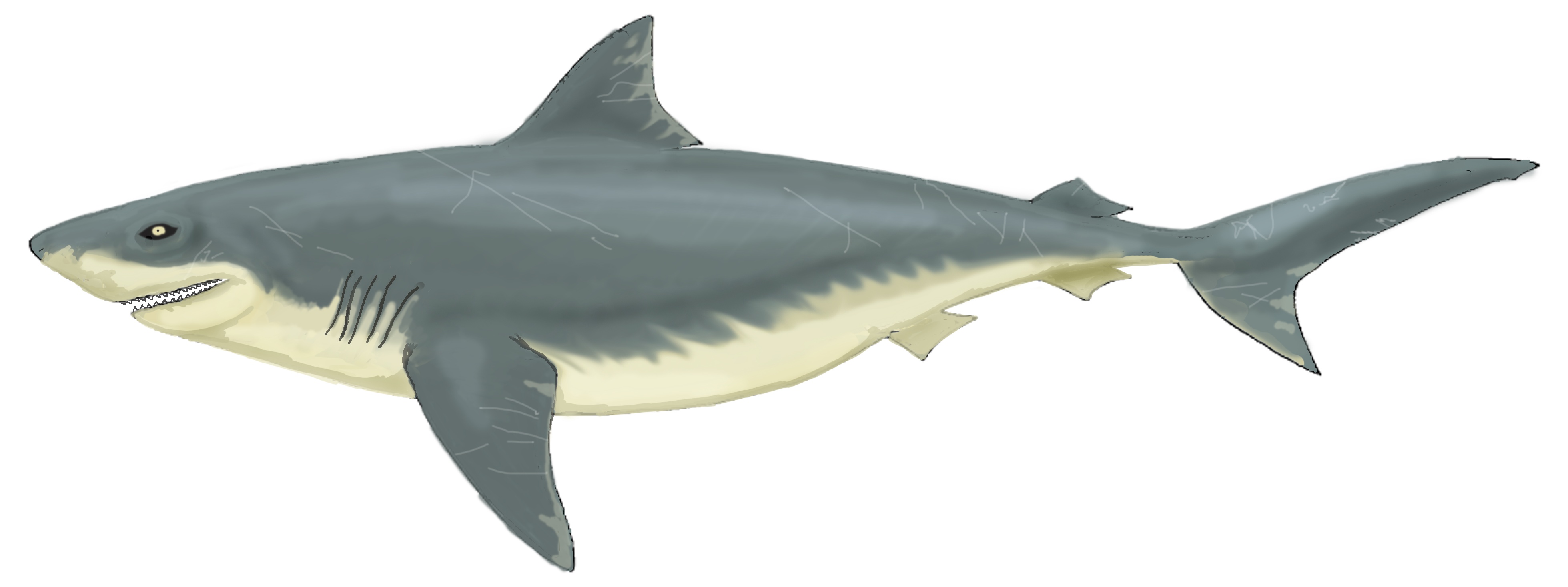


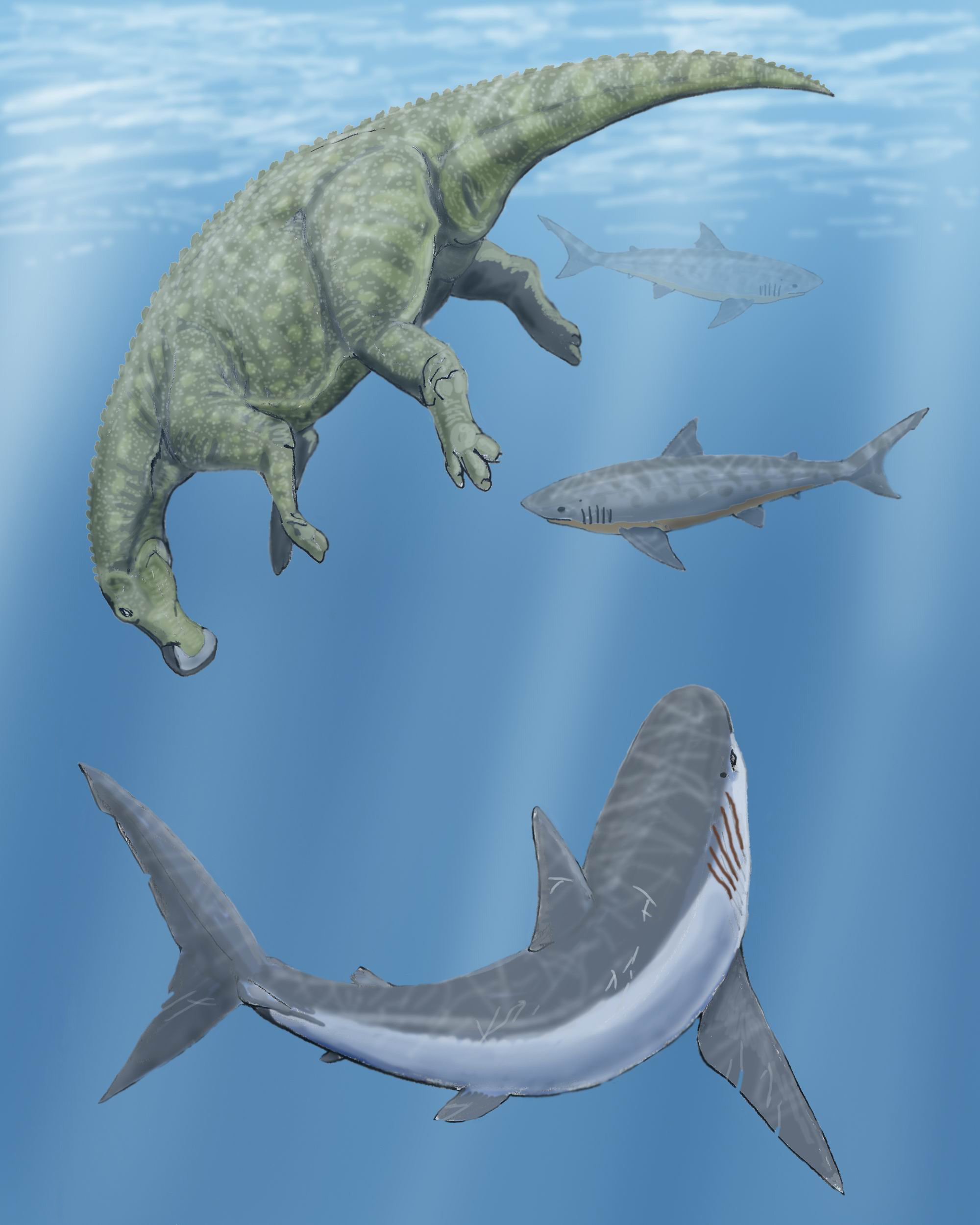
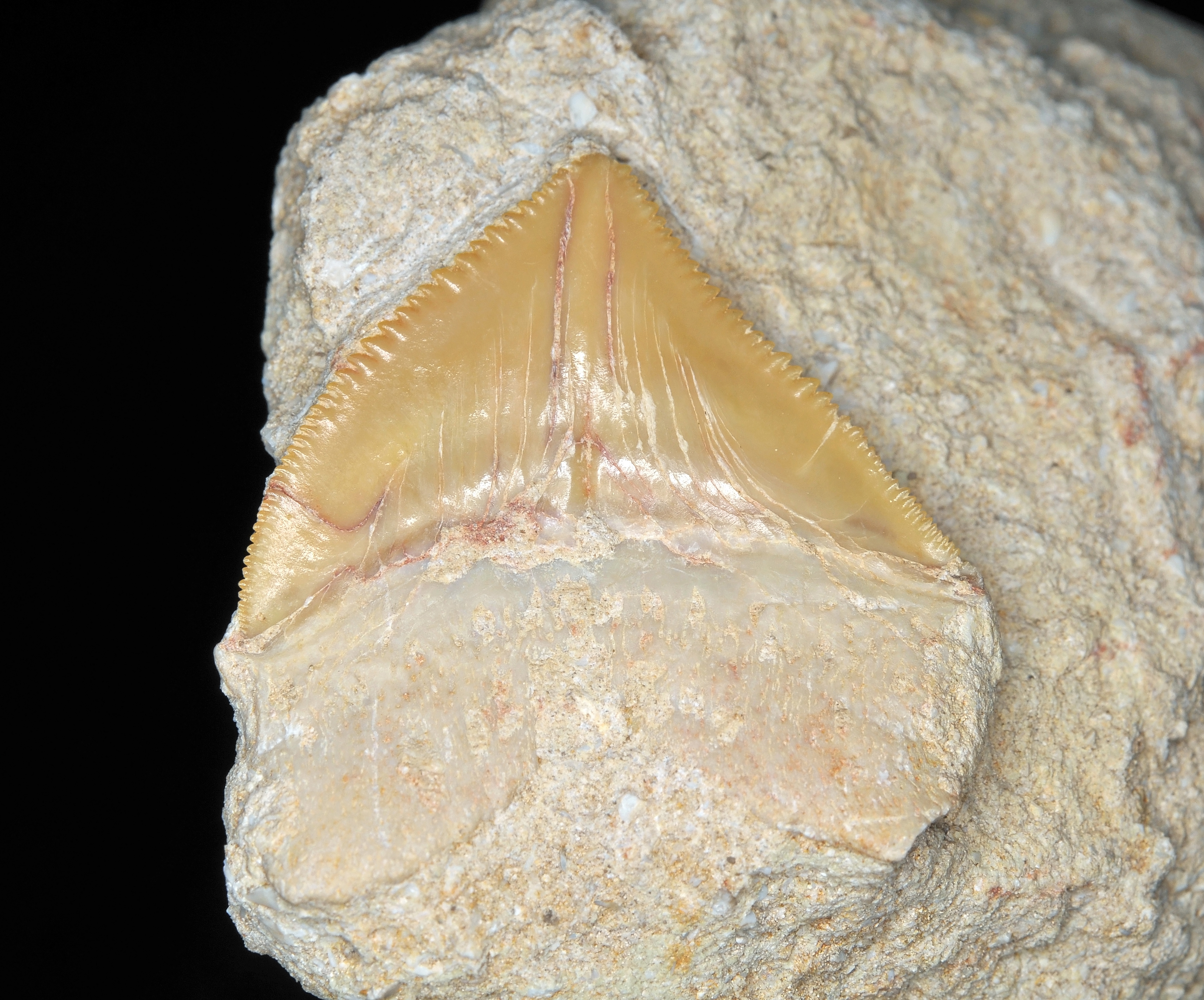




Reconstruction of Squalicorax falcatus showing the fusiform body typical of a coastal lamniform shark. The general shape is similar to the modern reef shark, but the serrated dentition is characteristic of the tiger shark.
Wikimedia Commons — CC BY-SA 3.0
Ecology and behavior
Habitat
Squalicorax falcatus inhabited the shallow epicontinental seas of the Late Cretaceous, especially the Western Interior Seaway of North America, which split the continent into two landmasses with maximum depths of about 900 meters. The climate was warm with no polar ice caps; waters were warmer than modern oceans. The species was also documented in the European-African Tethys Sea and other global Cretaceous basins, indicating tolerance to different oceanic conditions.
Feeding
The feeding behavior of Squalicorax was predominantly scavenging, as attested by teeth embedded in mosasaur, terrestrial hadrosaur, and sea turtle bones. The dental morphology, with strongly serrated triangular teeth, is adapted for cutting soft flesh and occasionally bones of already-dead prey. There is no definitive evidence of active predation on large vertebrates, but the tooth size suggests that medium-sized prey (fish, young turtles) were actively caught when available.
Behavior and senses
Squalicorax was probably a solitary or semi-gregarious animal, like most modern medium-sized sharks. Scavenging behavior was its most documented trait: upon detecting a carcass (whether of a marine reptile, dinosaur, or turtle), it used its dentition to rip it apart. There is no evidence of territorial behavior or nesting. As a cartilaginous shark, it was probably ovoviviparous, with young born from internally incubated eggs, similar to modern tiger sharks.
Physiology and growth
As a lamniform shark, Squalicorax had a cartilaginous skeleton, which explains the rarity of complete fossils. The presence of placoid scales (dermal denticles) confirmed in preserved specimens indicates capacity for fast, silent swimming. The sensory system included the lateral line and ampullae of Lorenzini for detecting prey electric fields. Thermoregulation was probably similar to modern reef sharks: ectothermic with some capacity to retain muscular heat during active swimming.
Paleogeography
Continental configuration

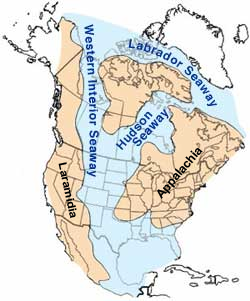
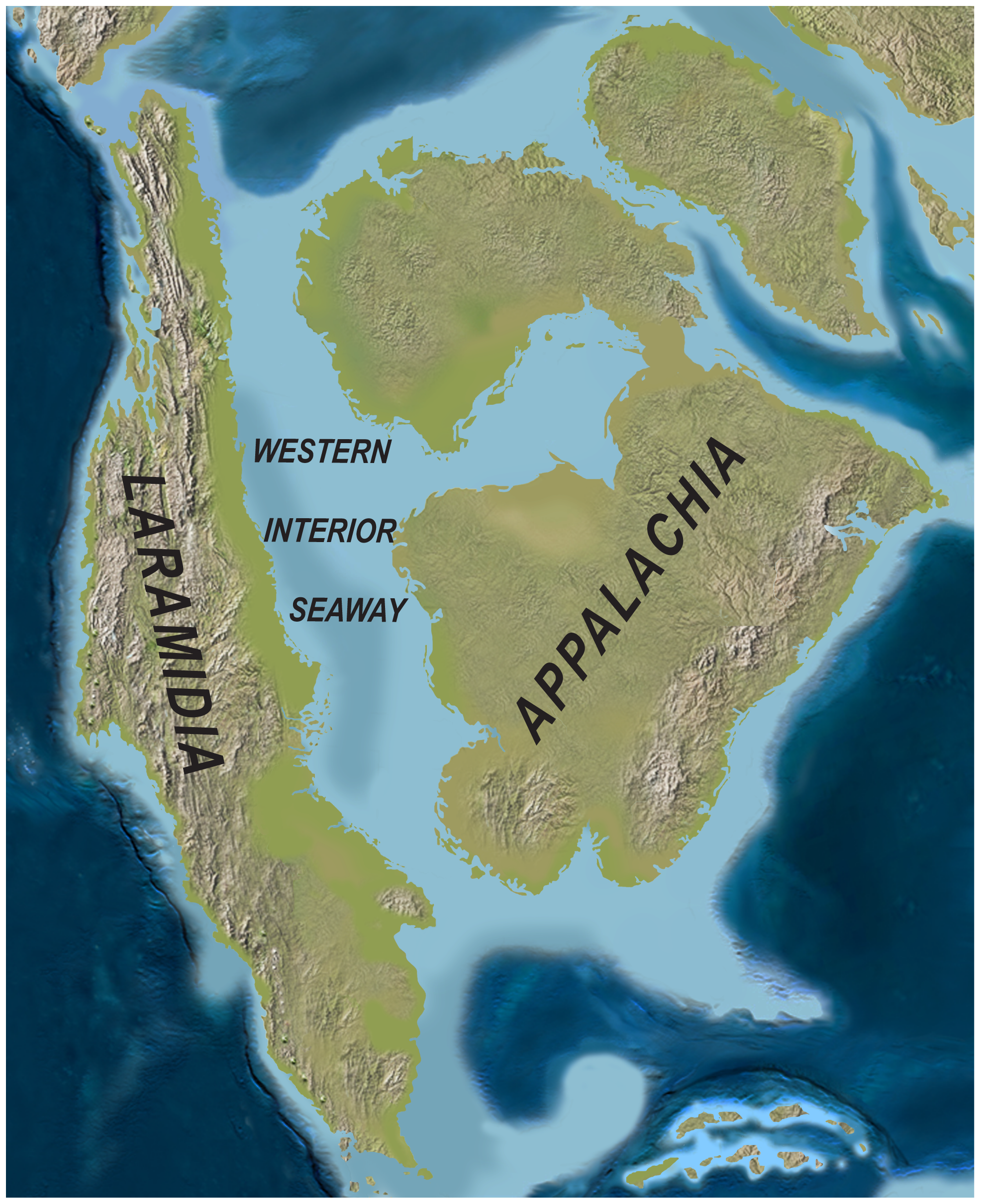
Scotese & Vérard · CC BY 4.0 · Cretaceous, ~105 Ma
During the Cenomaniano-Campaniano (~100–72 Ma), Squalicorax falcatus inhabited Laramidia, the western half of present-day North America, separated from the east by the Western Interior Seaway, a shallow sea dividing the continent. The continents were in very different positions: India was drifting toward Asia, Antarctica was still connected to Australia, and South America was an isolated island.
Bone Inventory
Specimen USNM 425665, deposited at the National Museum of Natural History (Smithsonian), is the most complete S. falcatus specimen: it includes the skull, vertebral column, ribs, and pectoral fins. As sharks have a cartilaginous skeleton, such preservation is unusual. The estimated 45% completeness reflects that cartilage rarely fossilizes; most records are based on isolated teeth. Other specimens from Kansas and South Dakota complement the anatomical picture, but none preserve soft tissue or complete caudal fins.
Found elements
Inferred elements
Scientific Literature
15 papers in chronological order — from the original description to recent research.
Recherches sur les poissons fossiles, vol. 3
Agassiz, L. · Jent et Gassmann / H. Nicolet, Neuchâtel
Louis Agassiz originally described the species as Corax falcatus in his monumental work on fossil fishes, based on isolated teeth collected from the Cretaceous of Europe and North Africa. The original diagnosis emphasized the curvature of the tooth crown and serrations, characteristics distinguishing the species from other contemporary forms. This foundational work laid the groundwork for decades of research on Cretaceous lamniform sharks, and the epithet 'falcatus' directly refers to the sickle-shaped teeth.
Selachians from the Carlile Shale (Turonian) of South Dakota
Cappetta, H. · Journal of Paleontology
Henri Cappetta catalogued and described the selachians (sharks and rays) from the Carlile Shale Formation (Turonian) of South Dakota, including important Squalicorax material. This work was fundamental in establishing clear taxonomic criteria for distinguishing species within the genus based on precise dental characters. Cappetta would go on to become the leading world expert on fossil elasmobranchs over the following decades, and his 1973 work initiated a series of systematic revisions of the group.
Skeletal anatomy of the Late Cretaceous shark, Squalicorax (Neoselachii: Anacoracidae)
Shimada, K. & Cicimurri, D.J. · Paläontologische Zeitschrift
Shimada and Cicimurri carried out the first systematic and comprehensive description of Squalicorax skeletal anatomy, using partial and near-complete specimens of three species including S. falcatus from the Niobrara Formation of Kansas. The work described vertebral morphology, fin cartilages, and cranial structure, confirming the anacoracid affinities of the genus and definitively separating it from modern lamniforms. This remains the standard anatomical reference for the genus, and the description of the S. falcatus skeleton revealed adaptations for active swimming in relatively shallow coastal waters.
Scavenging by Sharks of the Genus Squalicorax in the Late Cretaceous of North America
Schwimmer, D.R., Stewart, J.D. & Williams, G.D. · PALAIOS
Schwimmer and colleagues documented direct evidence of scavenging behavior in Squalicorax: a mosasaur vertebral centrum with an embedded Squalicorax tooth and a hadrosaur metatarsal with an encrusted tooth, indicating post-mortem feeding. The authors argued that Santonian-Campanian Squalicorax species were the dominant scavengers of North American epicontinental seas. The work definitively established the foraging ecology of the group and provided analogies with modern tiger sharks, which are also generalist scavengers.
Anacoracid shark teeth (Chondrichthyes, Vertebrata) from the early Cretaceous Albian sediments of Leighton Buzzard, south-central England
Smart, P.J. · Proceedings of the Geologists' Association
Smart documented the first record of anacoracid sharks from the Albian (Lower Cretaceous) of England, at Leighton Buzzard, significantly extending the temporal range of the family and revealing that the group appeared earlier than previously thought. The work analyzes isolated teeth and compares them with material from other European Albian formations, providing a biogeographic perspective on the origin and dispersal of anacoracids in the Proto-North Atlantic. This early record is relevant to understanding the evolution of the genus Squalicorax and its arrival in the Western Interior Seaway of North America.
Handbook of Paleoichthyology, Vol. 3E: Chondrichthyes (Mesozoic and Cenozoic Elasmobranchii: Teeth)
Cappetta, H. · Verlag Dr. Friedrich Pfeil
Cappetta's handbook represents the definitive taxonomic reference for Mesozoic and Cenozoic fossil elasmobranch teeth. For Squalicorax, the volume consolidates decades of the author's work, confirming species validity, synonymizing invalid names, and standardizing diagnostic characters. The work is essential reading for any paleontologist working with Cretaceous sharks: it establishes the identification criteria for S. falcatus, S. kaupi, S. pristodontus, and other species based on cusp geometry, degree of serration, and root morphology.
An elasmosaur with stomach contents and gastroliths from the Pierre Shale (Late Cretaceous) of Kansas
Cicimurri, D.J. & Everhart, M.J. · Transactions of the Kansas Academy of Science
Cicimurri and Everhart described an elasmosaurid plesiosaur specimen with preserved stomach contents and gastroliths from the Pierre Shale Formation of Kansas. The study documents trophic interactions in the Late Cretaceous ecosystem, including evidence of Squalicorax predation or scavenging on the plesiosaur. This work is essential for reconstructing food webs in Cretaceous seas and contextualizing the ecological role of S. falcatus as a top predator and opportunistic scavenger in a system dominated by giant marine reptiles.

Oceans of Kansas: A Natural History of the Western Interior Sea
Everhart, M.J. · Indiana University Press
Everhart produced the most accessible and comprehensive reference on the paleoecology of the Cretaceous Western Interior Seaway, with special attention to sharks, including Squalicorax falcatus. The work contextualizes the species within an ecosystem rich in mosasaurs, plesiosaurs, Cretoxyrhina, and seabirds, discussing direct evidence of feeding behavior and interactions between major predators. The book is widely cited in the scientific literature and served as the basis for paleoecological reconstructions of the Niobrara fauna.

Squalicorax Chips a Tooth: A Consequence of Feeding-Related Behavior from the Lowermost Navesink Formation (Late Cretaceous: Campanian-Maastrichtian) of Monmouth County, New Jersey, USA
Hamm, S.A. & Everhart, M.J. · Geosciences
Hamm and Everhart documented a chipped-tipped Squalicorax tooth from the Navesink Formation (Campanian-Maastrichtian) of New Jersey, interpreting the damage as evidence of feeding on hard-bodied prey, likely a sea turtle. The paper analyzes the implications of tooth breakage for the feeding biomechanics of the species and discusses how the varied diet, including prey with hard shells, occasionally damaged the dental apparatus. This type of direct evidence is rare and valuable for reconstructing the feeding behavior of extinct sharks.

Selachians from the Greenhorn Cyclothem ('Middle' Cretaceous: Cenomanian-Turonian), Black Mesa, Arizona, and the paleogeographic distribution of Late Cretaceous selachians
Williamson, T.E., Kirkland, J.I. & Lucas, S.G. · Journal of Paleontology
Williamson and colleagues documented the selachian fauna of the Greenhorn Cyclothem (Cenomanian-Turonian) at Black Mesa, Arizona, including records of Squalicorax. The work analyzes paleogeographic distribution patterns of Late Cretaceous sharks across the Western Interior Seaway, offering data on the colonization of this environment and temporal variation in shark community composition. Arizona data expands the mapping of S. falcatus in the interior of North America during the Cenomanian.

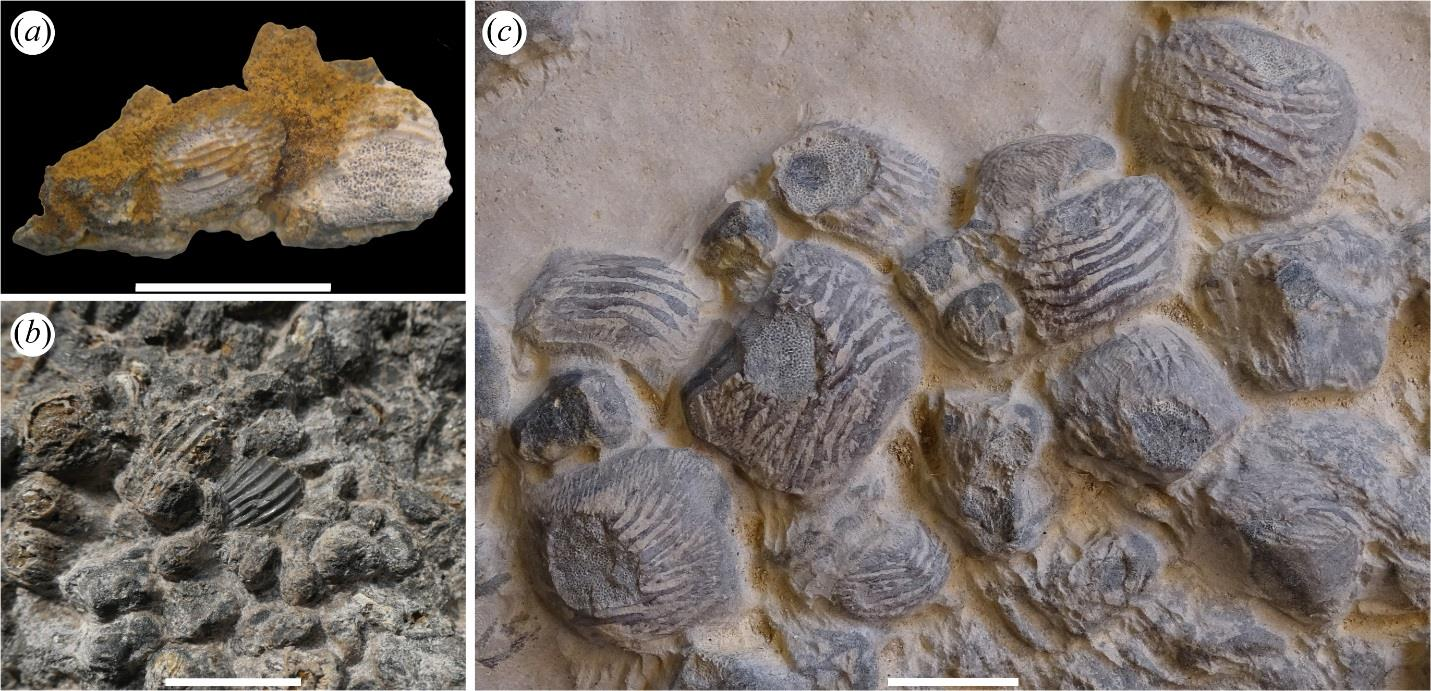
Giant fossil coelacanths of the Late Cretaceous in the eastern United States
Schwimmer, D.R., Stewart, J.D. & Williams, G.D. · Geology
Schwimmer and colleagues documented giant coelacanthan fish from the Late Cretaceous of the eastern United States, providing crucial context for the aquatic ecosystem in which Squalicorax falcatus operated as a scavenger. The study describes the diversity of large bony and cartilaginous fish that coexisted in North American Cretaceous seas, including discussion of Squalicorax interactions with other species. Documentation of large-bodied coelacanths in these seas reveals the complexity of food webs in which S. falcatus was embedded.


Analysis of an Associated Cretoxyrhina mantelli Dentition from the Late Cretaceous (Smoky Hill Member, Niobrara Formation) of Kansas
Bourdon, J. & Everhart, M.J. · Transactions of the Kansas Academy of Science
Bourdon and Everhart analyzed an associated Cretoxyrhina mantelli dentition from the Niobrara Formation, providing critical context for the competitive dynamics between the two largest Cretaceous sharks of the region: Cretoxyrhina and Squalicorax. The study reveals that Squalicorax frequently benefited from carcasses left by Cretoxyrhina, functioning as a secondary scavenger. This ecological relationship is analogous to what occurs between modern white sharks and bull sharks, and provides insights into the predator guild structure of the Late Cretaceous marine environment.

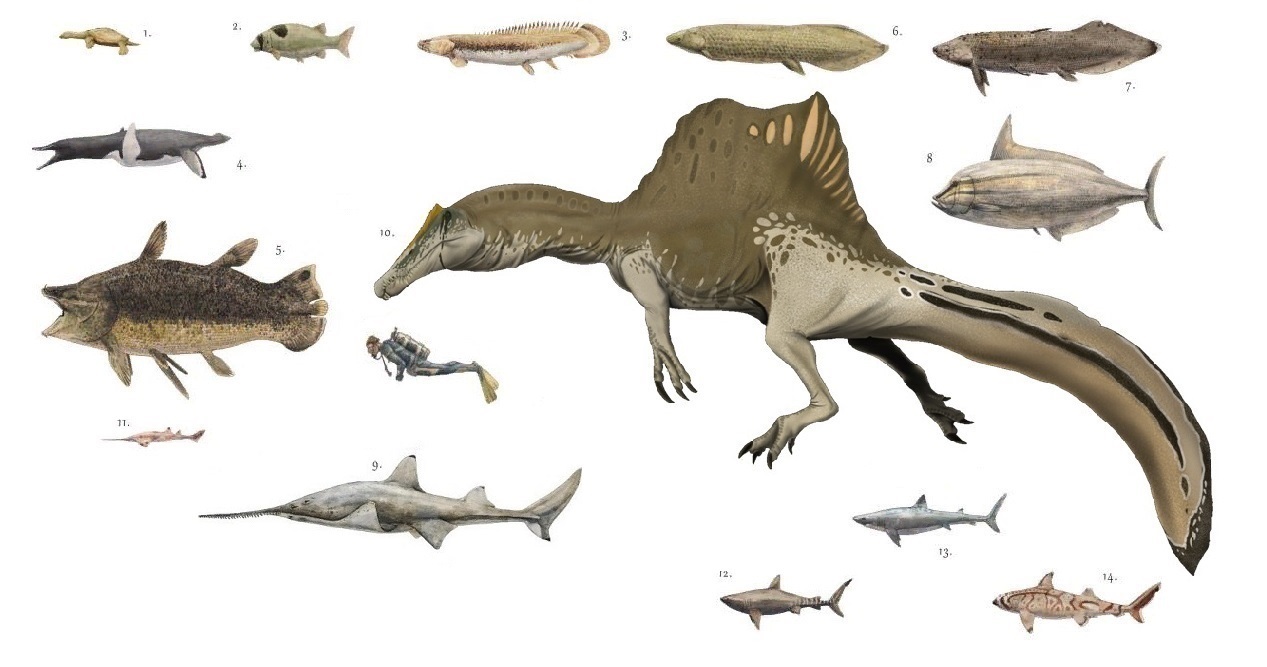
An overview of the pachycormid fish Leedsichthys in the context of Squalicorax-related feeding on the Jurassic Sea Wyvern
Liston, J.J. · Mesozoic Fishes 3 - Systematics, Paleoenvironments and Biodiversity, Verlag Dr. Friedrich Pfeil
Liston reviewed the ecological context of large Mesozoic fish, including comparative data on scavenging behavior in Squalicorax and related genera. The work provides an evolutionary perspective on how scavenging behavior arose and diversified among Mesozoic lamniform sharks, with Squalicorax as a central case study. The analysis compares foraging strategies with those of modern analogously adapted groups, contributing to a broader view of the evolution of ecological niches in elasmobranchs.


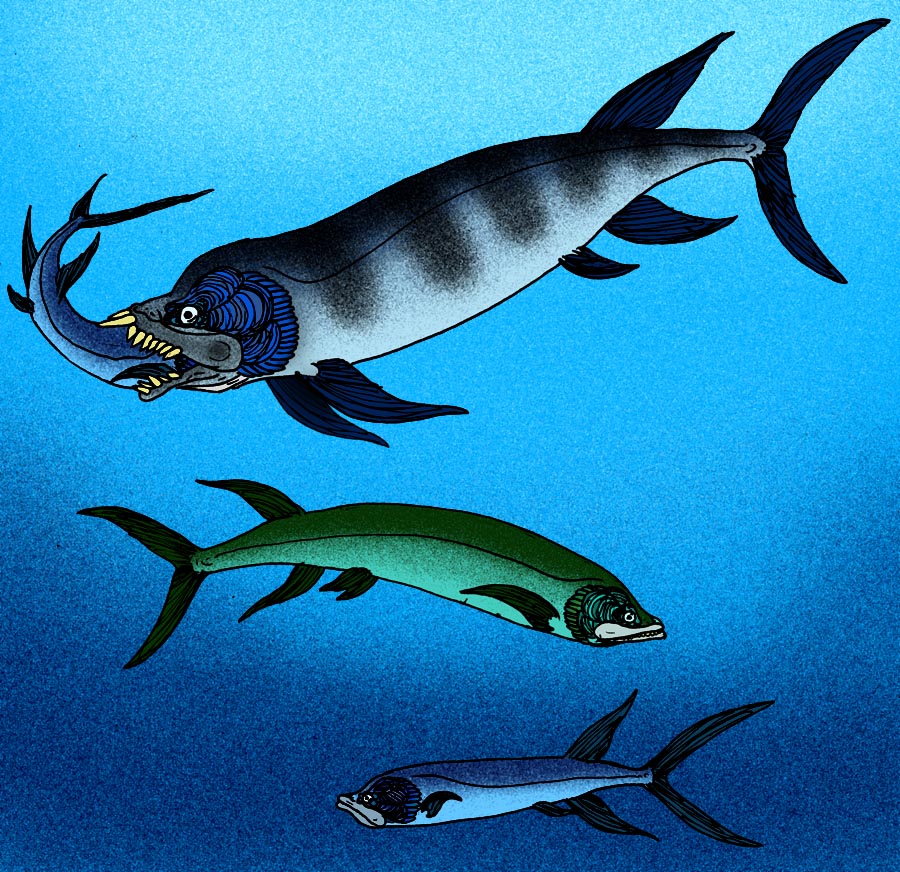
First direct evidence of a vertebrate three-level trophic chain in the fossil record
Kriwet, J., Witzmann, F., Klug, S. & Heidtke, U.H.J. · Proceedings of the Royal Society B
Kriwet and colleagues presented the first direct fossil evidence of a three-level trophic chain involving sharks, including members of Anacoracidae, fish, and smaller fish. The study provides unique insights into the structure of the Cretaceous marine food web and the role of lamniform sharks as top predators. Direct documentation of trophic chains in fossil records is extremely rare, making this work an important methodological contribution to shark paleobiology.


Diversification of the Neoselachii (Chondrichthyes) during the Jurassic and Cretaceous
Underwood, C.J. · Paleobiology
Underwood analyzed diversification patterns in neoselachians (modern sharks and their extinct lineages, including Anacoracidae) during the Jurassic and Cretaceous, documenting the evolutionary radiation that produced Squalicorax and related genera. The work identifies major diversification and extinction events throughout the Mesozoic and offers a macroevolutionary context for understanding why S. falcatus and other genus species were so abundant in the Late Cretaceous. The analysis reveals that the anacoracid radiation coincided with the opening and expansion of epicontinental seas.

Famous museum specimens
USNM 425665
Museu Nacional de História Natural (Smithsonian), Washington D.C.
Near-complete skeleton including skull, vertebral column, and pectoral fins from the Niobrara Formation of Kansas. It is one of the most complete Squalicorax falcatus specimens known and served as the basis for the formal anatomical description by Shimada and Cicimurri (2005).
USNM 11934
Museu Nacional de História Natural (Smithsonian), Washington D.C.
Dental and cranial material collected by Charles H. Sternberg in Cretaceous Kansas. Includes well-preserved tooth series that allowed establishing the diagnostic dental morphology of S. falcatus. Sternberg was one of the greatest fossil collectors of the 19th century in Kansas.
In cinema and popular culture
Squalicorax falcatus was never the protagonist of a major blockbuster, but gained relevant presence in paleontological pop culture through prestigious documentaries. In the BBC documentary Sea Monsters (2003), a Walking with Dinosaurs spin-off, the crow shark appears in the episode set in the Cretaceous Western Interior Seaway, portrayed as an opportunistic scavenger competing with Cretoxyrhina for access to carcasses. In the IMAX film Sea Monsters: A Prehistoric Adventure (2007) by the National Geographic Museum, Squalicorax is again an antagonist in the marine sequences. The scientific representation in these documentaries is reasonably faithful: the size and scavenging behavior are consistent with fossil evidence. What media tends to exaggerate is aggressiveness as an active predator, while science suggests Squalicorax was primarily a scavenger. The genus also appears in illustrated paleontology books and natural history museums around the world.
Classification
Discovery
Fun fact
A Squalicorax falcatus tooth was found embedded in a hadrosaur foot bone: a terrestrial dinosaur that would have died on land before being washed into the sea, where the crow shark found it already dead. This is one of the rare cases in which a Cretaceous marine predator left physical evidence of having 'crossed' the terrestrial and marine biomes in a single meal.
Last reviewed: April 24, 2026