
Smilosuchus
Smilosuchus gregorii
"Gregory's knife-crocodile (honoring geologist Herbert E. Gregory)"
About this species
Smilosuchus gregorii was one of the largest semiaquatic predators of the Late Triassic of North America. Up to 6 meters long, it occupied the same ecological niche as modern crocodiles: ambush predation along the margins of rivers and lakes in the Chinle Formation of what is now Arizona. Its key distinction from true crocodilians lies in nostril position: instead of opening at the tip of the snout, phytosaur nostrils open in a bony mound between the eyes. The skull of S. gregorii can exceed 1.5 meters in length, with heterodontic dentition, large anterior tusks for impaling prey and more blade-like posterior teeth for slicing flesh. The species was originally described by Camp (1930) and transferred to the genus Smilosuchus by Long and Murry (1995).
Geological formation & environment
The Chinle Formation is an Upper Triassic geological unit extending across the Colorado Plateau in Arizona, Utah, New Mexico, and Colorado. Deposited between 235 and 200 Ma, it represents fluvial and lacustrine environments on low-altitude alluvial plains near the equator during Pangaea. The Blue Mesa Member and Sonsela Member, from which most Smilosuchus gregorii specimens derive, preserve an exceptionally diverse fauna including phytosaurs, aetosaurs, rauisuchians, early dinosaurs, metoposaurids, and cynodonts.
Image gallery


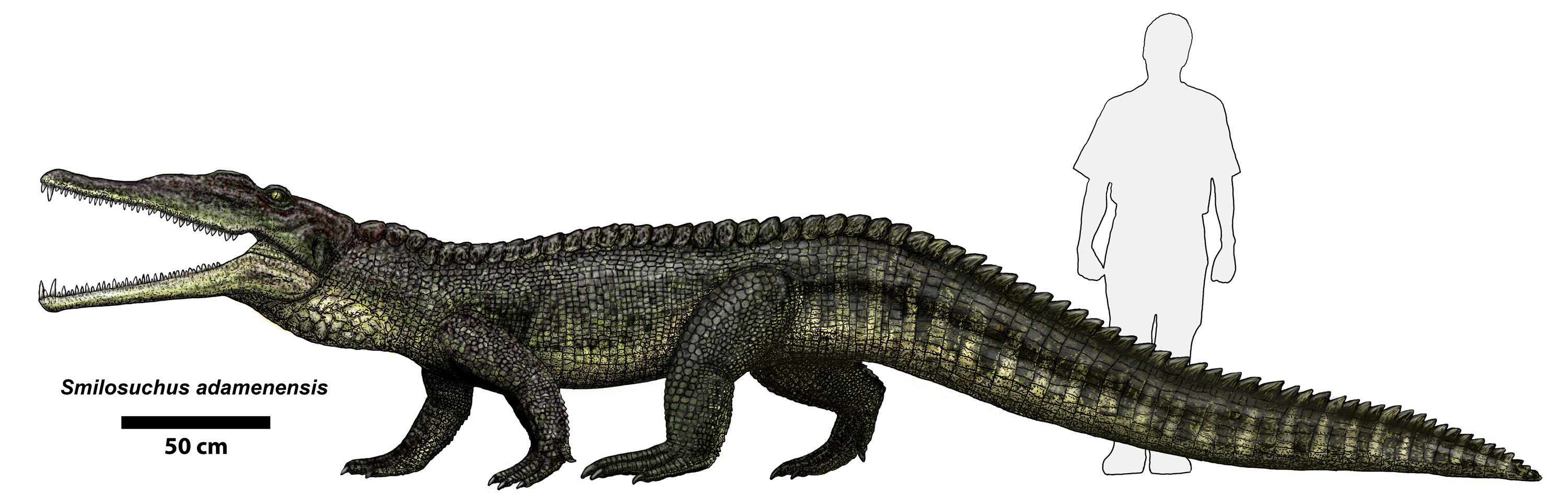




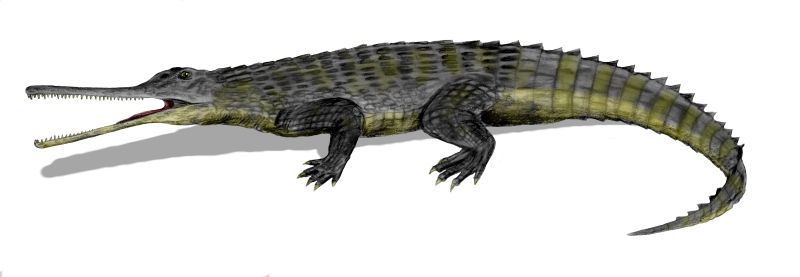
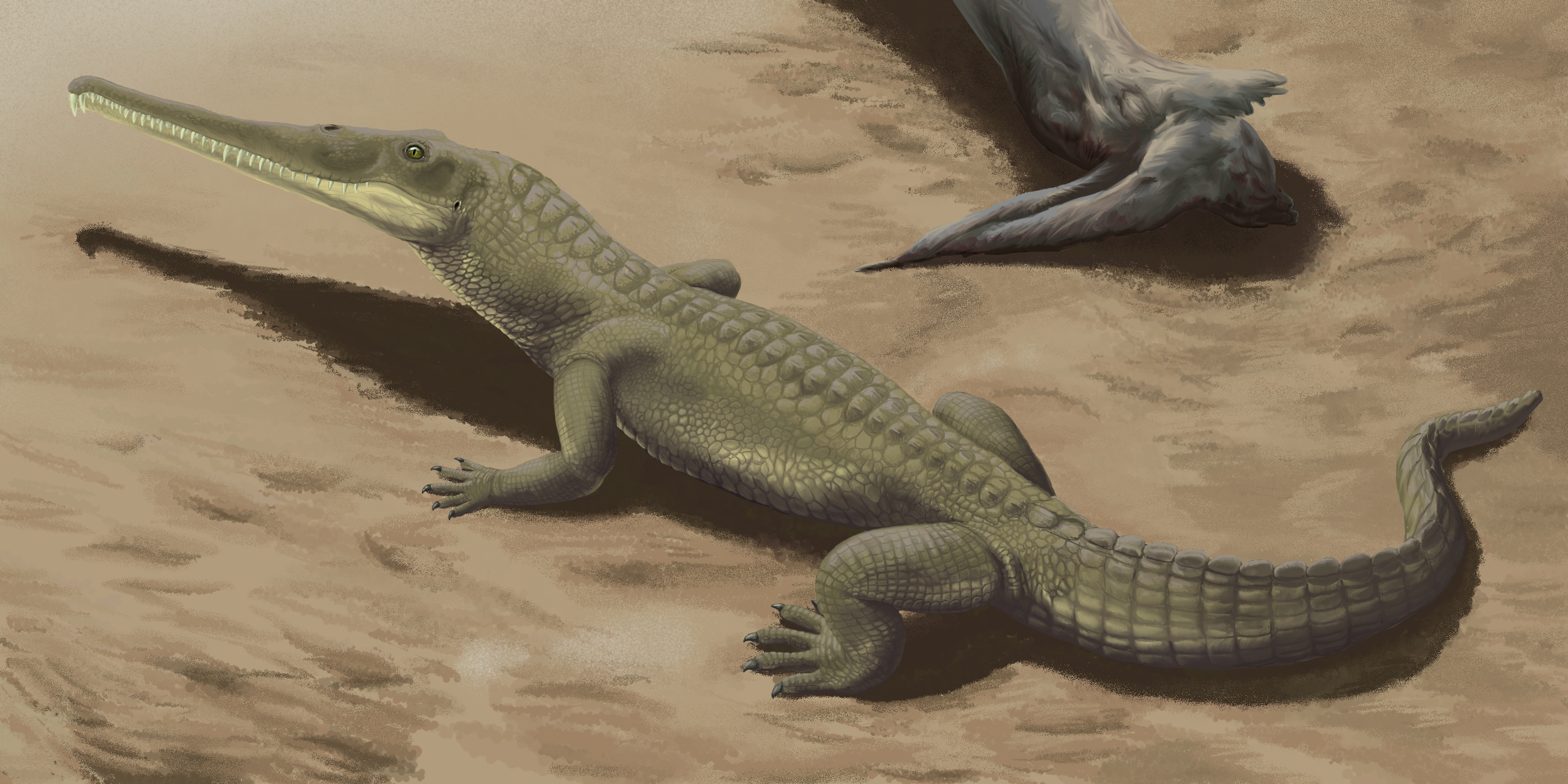
Artistic reconstruction of Smilosuchus gregorii by Nobu Tamura. Note the nasal bony mound between the eyes, the main distinction of phytosaurs from true crocodilians.
Nobu Tamura · CC BY 3.0
Ecology and behavior
Habitat
Smilosuchus gregorii inhabited the tropical fluvial and lacustrine plains of the Chinle Formation in southwestern North America during the Norian. The environment was a mosaic of riparian forests dominated by araucarias and cycads, multi-channel rivers with muddy margins, and shallow lakes. The climate was hot and seasonally humid, with a marked dry season. It coexisted with large metoposaurids, aetosaurs, rauisuchians, and the first dinosaurs.
Feeding
Generalist ambush predator, similar in strategy to modern crocodilians. The heterodontic dentition of S. gregorii, with large anterior tusks and cutting posterior teeth, indicates capacity to capture diverse prey: fish, metoposaurids, small reptiles, and potentially large herbivores like Placerias. The short and broad snout suggests capacity to generate high bite force, favorable for capturing resistant prey. The elevated nostrils between the eyes allowed breathing with the body submerged.
Behavior and senses
Based on the extensive bone pathologies described by Lessner and Stocker (2021), S. gregorii was an active predator subject to frequent injuries, possibly resulting from intraspecific combat or fights with large prey. Variation in nasal crest size among specimens suggests possible sexual dimorphism, with males having larger crests. There is no evidence of colonial behavior, but modern large semiaquatic predators tend to be territorial along water bodies.
Physiology and growth
As a basal archosauriform, Smilosuchus likely had ectothermic or mixed metabolism, dependent on ambient temperature for thermoregulation. The dermal osteoderms covering the back and belly served protective functions and possibly solar thermoregulation. The extremely robust skull, with short and broad proportions, indicates well-developed temporal and pterygoid muscles, generating considerable bite force for an animal of its size.
Paleogeography
Continental configuration

Scotese & Vérard · CC BY 4.0 · Triassic, ~225 Ma
Fossil sites
Eikeskog1225/SMB99thx · CC BY-SA 4.0
During the Noriano (~221–205 Ma), Smilosuchus gregorii inhabited Pangea, the single supercontinent joining all modern continents. Climate was dry and hot across much of the continental interior.
Bone Inventory
The holotype UCMP 27200 includes a complete skull with mandible, eight vertebrae, one femur, and osteoderms. Additional specimens from Petrified Forest National Park complement postcranial knowledge, but distal limb elements remain rare. The skull is the most complete and well-preserved element, allowing detailed analysis of cranial anatomy.
Found elements
Inferred elements
Scientific Literature
15 papers in chronological order — from the original description to recent research.
A study of the phytosaurs with description of new material from western North America
Camp, C.L. · Memoirs of the University of California
Camp's foundational monograph on North American phytosaurs, containing the original description of the specimen that would become Smilosuchus gregorii. The work details cranial morphology, heterodontic dentition with large anterior tusks and posterior cutting teeth, and available postcranial elements. Camp places the material in the genus Machaeroprosopus, naming the species after geologist Herbert E. Gregory. The holotype UCMP 27200 comprises a complete skull with mandible, vertebrae, and osteoderms from the Blue Mesa Member of the Chinle Formation in Arizona. This work establishes the morphological foundation that would guide all subsequent revisions of the taxon for decades.
Late Triassic (Carnian and Norian) tetrapods from the southwestern United States
Long, R.A. & Murry, P.A. · New Mexico Museum of Natural History and Science Bulletin
Comprehensive systematic revision of Late Triassic tetrapods from the southwestern United States. Long and Murry erect the new genus Smilosuchus for Leptosuchus gregorii Camp 1930, diagnosing it by eight cranial characters including the large rostral crest that elevates the nostrils. This work is the starting point of modern nomenclature for the species. The authors demonstrate that S. gregorii is distinguished from other Leptosuchus species by the combination of a particularly developed nasal crest with the short and broad snout shape and skull proportions. The monograph also provides valuable stratigraphic data situating the species mainly in the Blue Mesa Member and lower portions of the Sonsela Member of the Chinle Formation.
A new taxon of phytosaur (Archosauria: Pseudosuchia) from the Late Triassic (Norian) Sonsela Member (Chinle Formation) in Arizona, and a critical reevaluation of Leptosuchus Case, 1922
Stocker, M.R. · Palaeontology
Stocker describes Pravusuchus hortus, a new phytosaur from the Sonsela Member of the Chinle Formation, and conducts the first rigorous phylogenetic analysis focused on the interrelationships of leptosuchomorphs. The work critically reassesses the validity of Leptosuchus and its relationship to Smilosuchus, with direct implications for the phylogeny of S. gregorii. The analysis demonstrates that Smilosuchus is a valid taxon with robust diagnosis, positioning it as sister group to Pravusuchus within Leptosuchomorpha. The study also provides important biostratigraphic data, showing that different leptosuchomorph species diversified before the Adamanian-Revueltian turnover.

Sacral anatomy of the phytosaur Smilosuchus adamanensis, with implications for pelvic girdle evolution among Archosauriformes
Griffin, C.T., Stefanic, C.M., Parker, W.G., Hungerbühler, A. & Stocker, M.R. · Journal of Anatomy
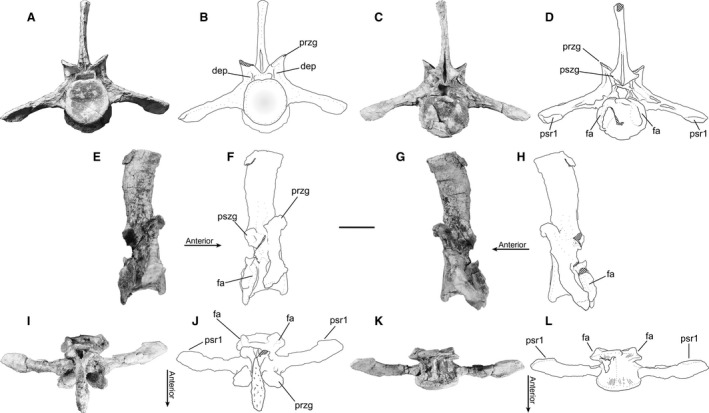
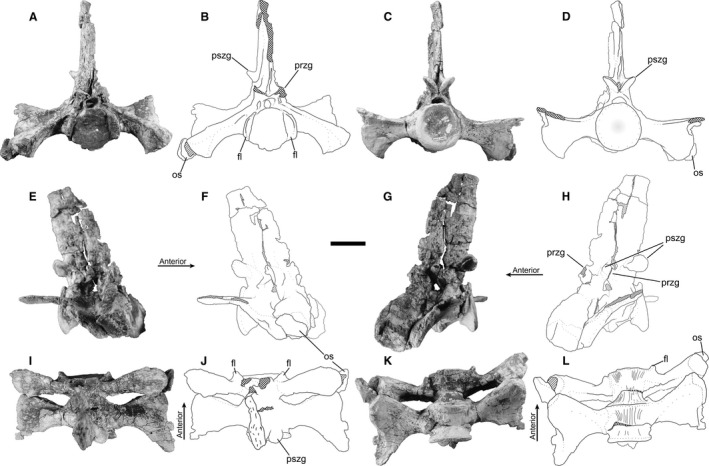
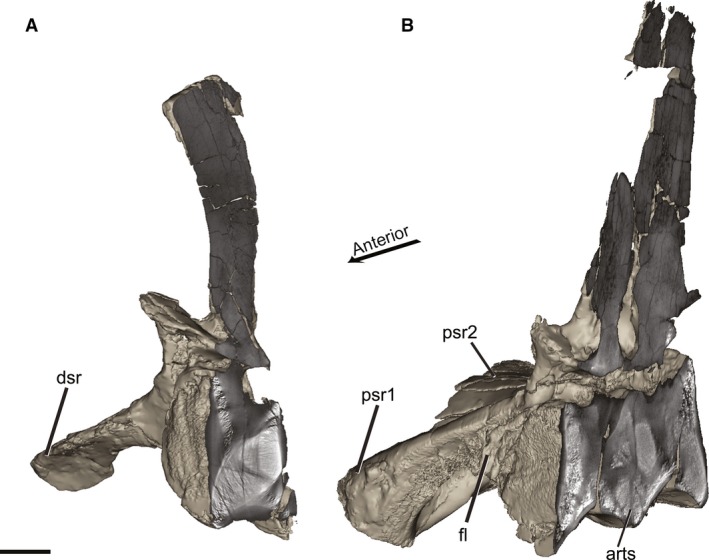
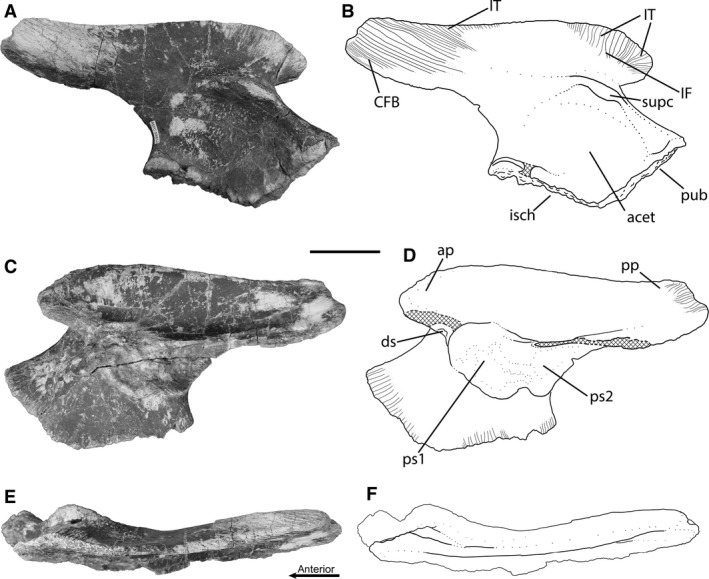
CT-based study of a sacrum from Smilosuchus adamanensis (PEFO 34852) revealing three sacral vertebrae, a dorsosacral plus two primordials. This is the first documentation of a phytosaur with more than two sacral vertebrae. The authors demonstrate that dorsosacral incorporation evolved at least eight times independently among Triassic archosauriforms, suggesting convergent evolution driven by developmental mechanisms involving Hox genes. Although the specimen is S. adamanensis, the implications are direct for S. gregorii, a sister species with comparable postcranial morphology. CT imaging confirmed the primordial sacral vertebrae are not co-ossified.
Phytosauria
Stocker, M.R. & Butler, R.J. · Geological Society, London, Special Publications
Comprehensive review of Phytosauria covering taxonomy, phylogeny, distribution, and paleoecology. The chapter synthesizes decades of research on phytosaur diversity, addressing the placement of Smilosuchus within a broader phylogenetic context. The authors review evidence on the aquatic ecology of phytosaurs, including skull adaptations for ambush and large prey capture. The review confirms that Smilosuchus gregorii was one of the largest semiaquatic predators of the Triassic of North America, with the specialized 155 cm skull being among the largest known for phytosaurs. The geographic and stratigraphic distribution of the taxon is mapped in detail.
The Late Triassic phytosaur Mystriosuchus westphali, with a revision of the genus
Hungerbühler, A. · Palaeontology
Revision of Mystriosuchus westphali with a broad assessment of phytosaur generic and specific limits. The work provides comparative anatomical data relevant to diagnosing Smilosuchus and other leptosuchomorphs, clarifying morphological characters used to distinguish genera within the family. Hungerbühler's analysis specifically addresses the skull characteristics that separate large long-snouted phytosaurs from short-snouted morphs like Smilosuchus, providing context for interpreting cranial shape evolution within Phytosauria. The study contributes to understanding the diversity of foraging strategies among Triassic phytosaurs.

Relationships of the Indian phytosaur Parasuchus hislopi Lydekker, 1885
Kammerer, C.F., Butler, R.J., Bandyopadhyay, S. & Stocker, M.R. · Papers in Palaeontology
Phylogenetic analysis placing the Indian phytosaur Parasuchus hislopi within the broader phytosaur tree and testing its relationships with leptosuchomorphs including Smilosuchus. The analysis identifies key synapomorphies supporting the monophyly of Parasuchidae and clarifies biogeographic patterns of phytosaur dispersal across Pangaea. The results indicate that North American leptosuchomorphs, including Smilosuchus, form a distinct clade from European and Asian phytosaurs, suggesting regional diversification during the Late Triassic. The work contributes to understanding how phytosaurs colonized different regions of Pangaea from a common ancestor.

Variation in the Late Triassic Canjilon quarry (Upper Chinle Group, New Mexico) phytosaur skulls: a case for sexual dimorphism
Zeigler, K.E., Heckert, A.B. & Lucas, S.G. · Paläontologische Zeitschrift
Analysis of cranial variation in a phytosaur assemblage from the Canjilon quarry in New Mexico, testing the hypothesis of sexual dimorphism. The study examines differences in crest size, snout proportions, and overall skull shape, with implications for understanding intraspecific variation in leptosuchomorphs including Smilosuchus. The authors identify two morphotypes: one with a more developed rostral crest and more robust skull (interpreted as male) and another with a smaller crest and more gracile skull (interpreted as female). This work has direct relevance for S. gregorii, where the large rostral crest was used as a diagnostic character by Long and Murry (1995).

The phylogenetic relationships of basal archosauriforms: a revision of the problem
Ezcurra, M.D. · PeerJ
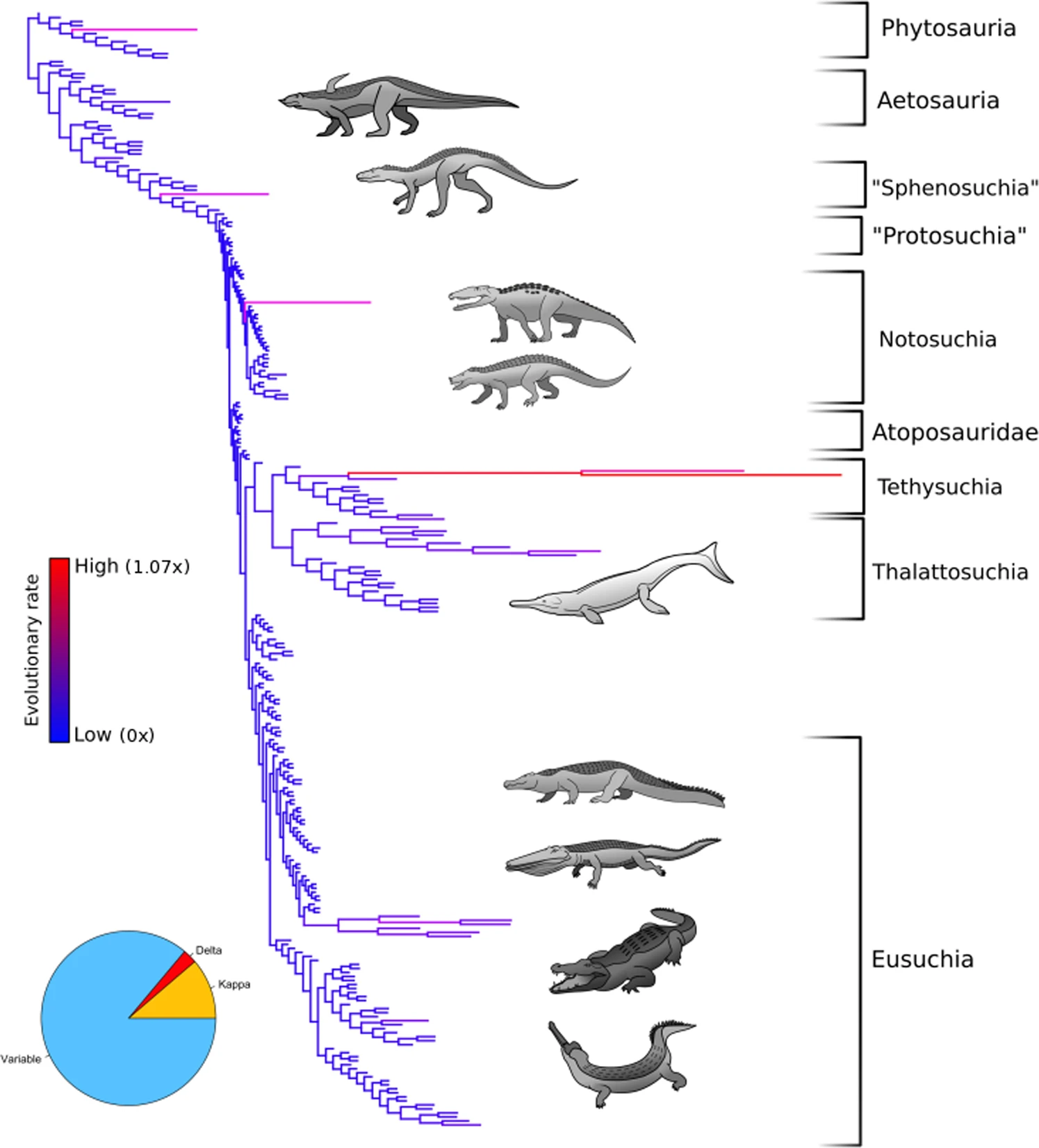
Comprehensive phylogenetic analysis of basal Archosauriformes, including a revised matrix with extensive new data. Phytosauria including Smilosuchus is placed as a basal archosauriform outside crown Archosauria, providing a robust phylogenetic framework for interpreting the evolutionary history of the group. Ezcurra's work is the largest analytical effort to resolve the relationships of primitive archosauriforms, with important implications for understanding why phytosaurs convergently developed so many characteristics of modern crocodilians despite being only distant relatives. The analysis recovers phytosaurs as either outgroup to all other archosauriforms or as basal pseudosuchians, depending on character weighting.

A large, pathological skeleton of Smilosuchus gregorii (Archosauriformes: Phytosauria) from the Upper Triassic of Arizona, with discussion of paleobiological implications of paleopathology in fossil archosauromorphs
Lessner, E.J. & Stocker, M.R. · PeerJ
Description of a large, pathological skeleton of Smilosuchus gregorii from the Chinle Formation, including extensive periosteal reactions and healed bone fractures. The study analyzes paleobiological implications of paleopathology in fossil archosauromorphs, providing data on injury patterns, survival, and life history. The specimens exhibit extensive periosteal reactions in multiple skeletal elements, indicating bone infections (osteomyelitis) that the animal survived. The analysis suggests high-risk behaviors, possibly resulting from intraspecific combat or fights with large prey. This is one of the most detailed paleopathological studies ever conducted for any phytosaur, demonstrating that S. gregorii was an active predator capable of surviving serious injuries.


New description of the postcranial skeleton of the Late Triassic phytosaur Machaeroprosopus mccauleyi (Archosauria: Phytosauria)
Parker, W.G. · Neues Jahrbuch für Geologie und Paläontologie - Abhandlungen
Detailed osteological description of the postcranial skeleton of the phytosaur Machaeroprosopus mccauleyi from the Chinle Formation of Petrified Forest National Park. Provides comparative data relevant to understanding postcranial anatomy across leptosuchomorphs, including Smilosuchus. The description includes the shoulder girdle, forelimbs, pelvic girdle, hindlimbs, and osteoderms. Parker demonstrates that the postcranial skeleton of large leptosuchomorph phytosaurs is surprisingly similar to modern crocodilians, indicating functional convergence for the semiaquatic lifestyle. The work complements knowledge of S. gregorii, whose postcranium is partially known.


Early ornithischian dinosaurs: the Triassic record
Irmis, R.B., Parker, W.G., Nesbitt, S.J. & Liu, J. · Historical Biology
Review of the Triassic record of early ornithischian dinosaurs and other archosaurs, including phytosaurs, in the context of Late Triassic faunal diversity. Provides data on the co-occurrence of Smilosuchus with other archosaurs in the Chinle Formation biotas. The study documents that phytosaurs like Smilosuchus were the dominant aquatic predators in communities where the first dinosaurs were just beginning to diversify. The faunal review shows that Smilosuchus coexisted with aetosaurs, rauisuchians, metoposaurid amphibians, cynodonts, and the first dinosaur representatives in the Chinle Formation of Arizona during the Norian.


Progress and future directions in archosaur phylogenetics
Brochu, C.A. · Journal of Paleontology
Review of progress and future directions in archosaur phylogenetics, addressing the unresolved placement of Phytosauria relative to other archosauriforms. The paper discusses convergent evolution between phytosaurs and crocodilians and implications for functional morphology. Brochu highlights that convergence between Smilosuchus and modern crocodilians is one of the most extraordinary cases of convergent evolution in vertebrates, with the nostrils being the only immediately visible morphological distinction for non-specialist observers. The review also addresses how the uncertain phylogenetic position of phytosaurs complicates common ancestor reconstructions and interpretations of shared characters.


The early evolution of archosaurs: relationships and the origin of major clades
Nesbitt, S.J. · Bulletin of the American Museum of Natural History
Comprehensive analysis of archosaur phylogenetics using 443 characters and 80 taxa, including thorough treatment of Phytosauria. Places Smilosuchus and other phytosaurs as archosauriforms outside the crown archosaur node, providing the most complete phylogenetic framework for the group. Nesbitt's monograph is the broadest analysis ever conducted on archosaur relationships, representing a fundamental reference point for all Triassic reptile paleontology. For Smilosuchus specifically, the work confirms that phytosaurs are basal archosauriforms, definitively clarifying the long-standing controversy about their phylogenetic placement.

A new aetosaur genus (Archosauria: Pseudosuchia) from the early Late Triassic of southern Brazil: first record of aetosaurs from the Carnian of South America
Desojo, J.B., Ezcurra, M.D. & Kischlat, E.E. · Zootaxa
Description of a new aetosaur from the Late Triassic of Brazil, providing biogeographic context for Pseudosuchia diversification in Pangaea. The paper documents faunal exchange between North and South American Triassic ecosystems, relevant for understanding the biogeography of phytosaurs like Smilosuchus. The biogeographic analysis indicates that while aetosaurs reached South America during the Carnian, leptosuchomorphs like Smilosuchus remained predominantly in North America. The work contributes to understanding why Smilosuchus and its relatives did not disperse to other regions of Pangaea, unlike other pseudosuchians.


Famous museum specimens
UCMP 27200 (holótipo)
University of California Museum of Paleontology, Berkeley, EUA
Holotype of Smilosuchus gregorii, including complete skull with mandible (155 cm length), eight vertebrae, femur, and osteoderms. Collected by Camp from the Chinle Formation of Arizona. The skull is one of the largest known among phytosaurs.
PEFO 31221
Petrified Forest National Park, Holbrook, Arizona, EUA
Referred specimen of Smilosuchus gregorii from Petrified Forest National Park, including cranial and postcranial elements. Excavated during park research activities and used in comparative studies of phytosaur postcranial anatomy.
In cinema and popular culture
Smilosuchus gregorii has never received individual named cinematic representation. Phytosaurs as a group appear in natural history documentaries dedicated to the Triassic, such as the BBC's Walking with Dinosaurs (1999) and Planet Dinosaur (2011). In these documentaries, phytosaurs are invariably presented as ecological predecessors of crocodilians, occupying the aquatic ambush niche before going extinct at the Triassic-Jurassic boundary. Scientific accuracy in these documentaries is reasonable regarding general morphology, but behavioral representations are speculative. The group has no significant presence in science fiction or games, being less known to the general public than modern crocodilians, despite having been the largest semiaquatic predators of the Late Triassic.
Classification
Discovery
Fun fact
Smilosuchus nostrils were positioned between the eyes, not at the snout tip like in crocodilians. This allowed the animal to breathe with its body almost fully submerged, with only the eyes and nostrils above the water surface, the same strategy used by modern hippos.
Last reviewed: April 24, 2026