
Sauroposeidon
Sauroposeidon proteles
"Poseidon lizard, before-complete"
About this species
Sauroposeidon proteles was a giant titanosauriform sauropod that lived in the Early Cretaceous of North America, between approximately 115 and 108 million years ago, during the Aptian and Albian stages. The name, chosen by Mathew Wedel in 2000, combines the Greek sauros (lizard) with Poseidon, the Greek god of the seas and also known as the Earth-shaker, in reference to the seismic impact that an animal of this mass would produce while walking. The specific epithet proteles means complete before the end and was chosen because Sauroposeidon is the last large brachiosaur-grade sauropod known from North America before the sauropod hiatus that marks most of the mid-Early Cretaceous on the continent. Length estimates range between 27 and 34 meters, with typical values near 30 meters, while body mass is estimated between 40,000 and 60,000 kg, with 45,000 kg being the most frequently cited figure. All these estimates are extrapolated from a partial cervical series, as no complete skeleton of the taxon exists. The holotype OMNH 53062 consists of four articulated cervical vertebrae (C5 to C8), each approximately 1.25 to 1.4 meters long, the longest sauropod cervical vertebrae ever measured at the time of the original description. The vertebrae show extreme pneumaticity, with more than 89% of internal volume occupied by air chambers, an adaptation that drastically reduced neck mass and made an animal with cervical bones of this dimension biomechanically viable. Matthew Wedel, a graduate student at the University of Oklahoma when he recognized the material in 1999, used Sauroposeidon's pneumaticity as the basis for two decades of research on air sacs and respiratory physiology of sauropods, with implications for understanding the origin of bird airways. The taxon's phylogenetic position has been significantly revised since its original description. Wedel, Cifelli and Sanders initially classified Sauroposeidon as a derived brachiosaurid, the youngest of the group in North America. Later cladistic analyses by D'Emic (2012) and D'Emic and Foreman (2012), confirmed by Mannion et al. (2013), repositioned the genus within basal Somphospondyli, outside Brachiosauridae, as a taxon close to the base of Titanosauria. D'Emic and Foreman (2012) also synonymized Paluxysaurus jonesi Rose (2007), from the Twin Mountains Formation in Texas, with Sauroposeidon, substantially expanding the known material of the taxon. The Fort Worth Museum of Science and History mount, originally displayed as Paluxysaurus, is today the only substantially complete mounted skeleton attributed to Sauroposeidon. Sauroposeidon's paleoecology is associated with the Antlers Formation, in Oklahoma, and contemporary formations such as Twin Mountains (Texas) and Cloverly (Wyoming). The environment was one of humid subtropical coastal plains, with conifer and cycad forests near a shallow epicontinental sea. Contemporaries included the giant theropod Acrocanthosaurus atokensis, the main predator of the ecosystem, the dromaeosaurid Deinonychus antirrhopus and the ornithopod Tenontosaurus tilletti, its preferred prey. Another titanosauriform sauropod, Astrodon, occurred in nearby Early Cretaceous formations. Sauroposeidon's maximum foraging height, estimated at 17 to 18 meters with the neck raised, would position it among the tallest dinosaurs ever documented, possibly the tallest known.
Geological formation & environment
The Antlers Formation is an Early Cretaceous (Aptian-Albian, ~120-110 Ma) stratigraphic unit that crops out in southern Oklahoma and northern Texas, United States. The formation is composed of sandstones, siltstones and mudstones deposited in fluvial and coastal environments, near the western margin of the Western Interior Seaway, which at the time covered much of the North American interior. The vertebrate fauna includes the giant sauropod Sauroposeidon proteles, the theropod Acrocanthosaurus atokensis (main apex predator), the dromaeosaurid Deinonychus antirrhopus, the ornithopod Tenontosaurus tilletti (preferred prey of Deinonychus), in addition to crocodilians, turtles and fish. The Antlers Formation is contemporary and faunally similar to the Twin Mountains Formation of Texas, the Cloverly Formation of Wyoming and Montana, and the Trinity Group in general, composing a transcontinental ecosystem of the North American Early Cretaceous. The Sauroposeidon holotype was collected in 1994 on Weyerhaeuser property in Atoka County, Oklahoma, in blocks that were initially mistaken for petrified wood. The Antlers Formation is historically important for North American paleontology because it preserves the last large sauropod community on the continent before the sauropod hiatus that extends from the late Albian (~100 Ma) to the late Campanian (~75 Ma), an interval in which large sauropods are essentially absent from the North American fossil record. Sauroposeidon therefore represents not only one of the largest terrestrial animals of all time, but also the last large sauropod to inhabit the region before a 25 million-year interval of fossil absence.
Image gallery
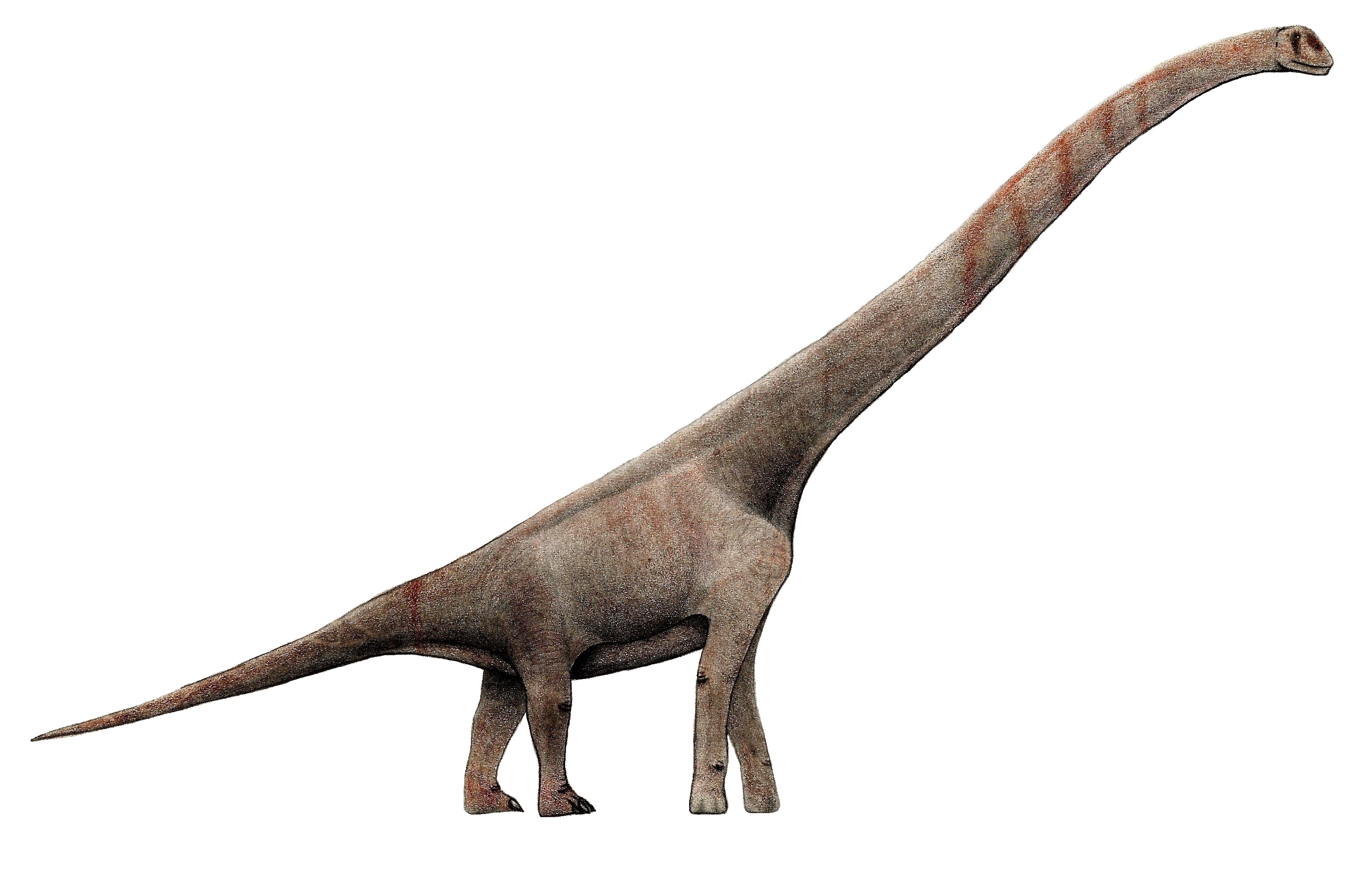




Life reconstruction of Sauroposeidon proteles used in the Wikipedia article infobox, with neck raised in characteristic brachiosaur-grade posture.
Wikimedia Commons / CC BY-SA
Ecology and behavior
Habitat
Sauroposeidon proteles inhabited humid subtropical coastal plains in the territory that today corresponds to the south-central United States, during the Aptian and Albian of the Early Cretaceous. The Antlers Formation, in Oklahoma, preserves fluvial and lacustrine deposits interbedded with marginal marine sediments, indicating a low-elevation environment near the coast of the Western Interior epicontinental sea. The vegetation was dominated by tall conifers (Araucariaceae, Cheirolepidiaceae), cycads, tree ferns and herbaceous ferns, with incipient angiosperm flowering at water body margins. The climate was warm and humid, with well-marked rainy seasons, favorable to dense high-canopy forests that constituted the main food resource of the giant sauropod.
Feeding
Sauroposeidon was a herbivore specialized in high-canopy foraging, using the extraordinarily long neck to reach vegetation at heights of 17 to 18 meters from the ground. Cervical vertebrae up to 1.4 meters long, combined with the brachiosaur-grade posture with forelimbs longer than hindlimbs, allowed the animal to graze in niches above the reach of any other Antlers Formation herbivore. The spatulate teeth, absent in the holotype but inferred from Paluxysaurus referred material, allowed stripping foliage without chewing, with subsequent food processing by gastrointestinal fermentation in a voluminous digestive tract. Daily consumption estimates based on metabolic models for 40 to 60 tonne sauropods suggest ingestion between 300 and 500 kg of plant material per day, implying almost continuous foraging during daylight hours.
Behavior and senses
Sauroposeidon's behavior is inferred from analogy with other giant sauropods whose fossil material is more complete. Evidence of fossil trackways in correlated formations suggests that Early Cretaceous titanosauriforms moved in small to medium groups, perhaps with size sexual dimorphism. Reproduction was oviparous, with nesting in shallow nests, and growth was extremely fast: histological studies on Paluxysaurus (now Sauroposeidon) bones show growth lines consistent with growth rates close to those of the largest known sauropods, possibly reaching adult size in 25 to 35 years. Defense against predators like Acrocanthosaurus depended mainly on absolute size and herd behavior.
Physiology and growth
Sauroposeidon's physiology is deduced from the extreme vertebral pneumaticity documented in the holotype, which occupies more than 89% of the internal volume of cervical vertebrae. This architecture indicates an avian respiratory system with invasive pulmonary air sacs, providing unidirectional air circulation and high respiratory efficiency. Metabolism was probably intermediate between ectothermic reptiles and endothermic birds, higher than in modern crocodilians, but with gigantothermy (corporal thermal inertia) compensating for the need for precise thermoregulation. The blood pressure required to pump blood to the brain at 17 meters of height, when the neck was fully raised, would require an extraordinarily powerful heart, estimated at 50 to 100 kg in mass and with systolic pressure far superior to that of any living vertebrate.
Paleogeography
Continental configuration

Scotese & Vérard · CC BY 4.0 · Cretaceous, ~105 Ma
During the Aptiano-Albiano (~115–108 Ma), Sauroposeidon proteles inhabited Laramidia, the western half of present-day North America, separated from the east by the Western Interior Seaway, a shallow sea dividing the continent. The continents were in very different positions: India was drifting toward Asia, Antarctica was still connected to Australia, and South America was an isolated island.
Bone Inventory
The holotype OMNH 53062 consists only of four articulated cervical vertebrae (C5 to C8) and some associated cervical ribs, which represents less than 20% of the skeleton. All length, height and mass estimates of Sauroposeidon are extrapolations from comparing the cervical vertebrae to more complete skeletons of Giraffatitan brancai. After the synonymization of Paluxysaurus jonesi (Rose 2007) with Sauroposeidon by D'Emic and Foreman (2012), substantial postcranial material from the Jones Ranch Quarry (Texas), representing at least four individuals, was incorporated into the taxon, including dorsal vertebrae, pectoral girdle, long limb bones and pelvic girdle elements. The mounted skeleton at the Fort Worth Museum of Science and History incorporates this reference material. Even so, no complete skull of the genus is known.

Found elements
Inferred elements
Scientific Literature
15 papers in chronological order — from the original description to recent research.
Sauroposeidon proteles, a new sauropod from the Early Cretaceous of Oklahoma
Wedel, M.J., Cifelli, R.L., Sanders, R.K. · Journal of Vertebrate Paleontology
Short naming paper that formally establishes Sauroposeidon proteles as a new genus and species of Early Cretaceous sauropod from Oklahoma. Wedel, Cifelli and Sanders describe the holotype OMNH 53062, four articulated cervical vertebrae collected in 1994 by Bobby Cross on Weyerhaeuser property in Atoka County, Oklahoma, and initially mistaken for petrified wood. The authors highlight that the vertebrae, up to 1.4 meters long, are the largest sauropod cervical vertebrae ever described, exceeding in length those of Giraffatitan brancai. The proposed classification is derived brachiosaurid, the youngest known in North America, living approximately 110 million years ago in the Aptian-Albian of the Antlers Formation. The preliminary mass estimate is 50 to 60 tonnes, with raised neck height exceeding 17 meters, which would make Sauroposeidon the tallest dinosaur ever documented. The paper was widely covered by the scientific and popular press and marks the starting point for subsequent research on the taxon.
Osteology, paleobiology, and relationships of the sauropod dinosaur Sauroposeidon
Wedel, M.J., Cifelli, R.L., Sanders, R.K. · Acta Palaeontologica Polonica
Full osteological description monograph of Sauroposeidon proteles, published in the same year as the short naming paper in Journal of Vertebrate Paleontology. Wedel, Cifelli and Sanders detail the anatomy of the four cervical vertebrae of the holotype OMNH 53062, including tomographic images that reveal extreme internal pneumaticity, with more than 89% of vertebral volume occupied by air chambers. The authors propose that Sauroposeidon's air sac system was analogous to that of modern birds, with direct implications for models of body mass and thermoregulation in giant sauropods. Paleobiology is discussed in depth: the brachiosaur-grade posture with raised neck would allow foraging at 17 meters or more in height, above the reach of any other terrestrial herbivore of the Early Cretaceous of North America. The paper also phylogenetically positions Sauroposeidon as a derived brachiosaurid, a position that would later be revised by D'Emic (2012) to basal Somphospondyli.
Vertebral pneumaticity, air sacs, and the physiology of sauropod dinosaurs
Wedel, M.J. · Paleobiology
Wedel expands the research initiated with Sauroposeidon on vertebral pneumaticity in sauropods to propose a general model of air sacs and respiratory physiology. The paper argues that the highly pneumatized internal architecture of Sauroposeidon, Brachiosaurus and other neosauropod vertebrae is evidence of a complete avian respiratory system, with thoracic and abdominal air sacs that extended into the vertebral bones. The direct consequence is that sauropod metabolic models based on analogy with modern reptiles significantly underestimate oxygen consumption rates and metabolic activity of the group. Wedel calculates that body mass of giant sauropods, including Sauroposeidon, must be reduced by 10 to 20% compared to estimates assuming solid vertebrae, which helps explain how animals of apparently prohibitive dimensions could biomechanically sustain themselves. The paper is one of the fundamental references for reconstructing the paleobiology of giant sauropods.
The evolution of vertebral pneumaticity in sauropod dinosaurs
Wedel, M.J. · Journal of Vertebrate Paleontology
Wedel traces the evolution of vertebral pneumaticity along the Sauropoda phylogeny, using Sauroposeidon as the most derived example of the phenomenon in brachiosaurids. The paper documents that vertebral pneumaticity appears incipiently in basal sauropodomorphs, progressively intensifies in Eusauropoda and reaches its maximum expression in Neosauropoda, especially in Somphospondyli, a group that includes Sauroposeidon after the revision by D'Emic (2012). Wedel uses transverse sections of the cervical vertebrae of holotype OMNH 53062 to show that the volume occupied by air (absent bone tissue) reaches 89% of total vertebral element volume, one of the highest values ever measured in any vertebrate. The paper establishes a standardized terminological vocabulary (camerate, camellate, polycamerate) that is today universally adopted in sauropod osteological descriptions.
First occurrence of Brachiosaurus (Dinosauria: Sauropoda) from the Upper Jurassic Morrison Formation of Oklahoma
Bonnan, M.F., Wedel, M.J. · PaleoBios
Bonnan and Wedel describe a humerus attributed to Brachiosaurus from the Morrison Formation in Oklahoma, establishing the regional Late Jurassic context that precedes Sauroposeidon's environment in the same region. The paper uses the newly described humerus as an anatomical comparison baseline with Early Cretaceous brachiosaurids, including Sauroposeidon, and argues that the persistence of the brachiosaurid lineage in Oklahoma from the Late Jurassic to the Early Cretaceous suggests regional phylogenetic continuity. The authors also discuss how Brachiosaurus long bone proportions provide a model for estimating Sauroposeidon body dimensions, whose postcranial material was unknown at the time (before synonymization with Paluxysaurus). The paper is important for reconstructions of body dimensions and brachiosaur-grade posture of Sauroposeidon.


Postcranial skeletal pneumaticity in sauropods and its implications for mass estimates
Wedel, M.J. · The Sauropods: Evolution and Paleobiology (Wilson & Curry-Rogers eds.), Univ. California Press
Chapter in the reference book The Sauropods, edited by Jeffrey Wilson and Kristina Curry-Rogers. Wedel synthesizes a decade of research on postcranial skeletal pneumaticity, arguing that body mass estimates of giant sauropods like Sauroposeidon and Argentinosaurus need to be revised downward when considering the substantial volume occupied by air sacs within bones. The author proposes a methodology to quantify mass reduction attributable to pneumaticity, applying it to Sauroposeidon and obtaining a refined estimate of 40 to 50 tonnes, a lower figure than the original estimates of 50 to 60 tonnes in Wedel et al. (2000). The chapter is one of the most cited texts in subsequent work on sauropod biomechanics and biology and remains the standard reference for those estimating body mass in giant dinosaurs.

A new titanosauriform sauropod (Dinosauria: Saurischia) from the Early Cretaceous of central Texas and its phylogenetic relationships
Rose, P.J. · Palaeontologia Electronica
Peter J. Rose describes Paluxysaurus jonesi, new genus and species of titanosauriform sauropod from the Jones Ranch Quarry, Twin Mountains Formation, Texas, Early Cretaceous (Aptian-Albian). The holotype FWMSH 93B-10-19 consists of partial cranial material, vertebrae and postcranial elements representing at least four individuals. Rose positions the taxon as a basal titanosauriform, a close relative of Sauroposeidon but distinct enough to warrant generic separation. The work is important for the richness of the material, which is substantially more complete than the Sauroposeidon holotype. Five years later, D'Emic and Foreman (2012) review the material and conclude that Paluxysaurus is a junior synonym of Sauroposeidon, incorporating this rich material into the genus hypodigm. Rose's paper is today read mainly as a description of material referred to Sauroposeidon.
A re-evaluation of Brachiosaurus altithorax Riggs 1903 and its generic separation from Giraffatitan brancai
Taylor, M.P. · Journal of Vertebrate Paleontology
Michael Taylor formally validates the generic separation between Brachiosaurus altithorax (North America) and Giraffatitan brancai (Tanzania), identifying 26 diagnostic characters distinguishing the two taxa. The paper is fundamental for understanding the comparative anatomy of brachiosaurids and provides a direct anatomical reference for Sauroposeidon proteles, whose original classification by Wedel et al. (2000) was as a derived brachiosaurid close to Brachiosaurus/Giraffatitan. Taylor briefly discusses Sauroposeidon in the context of the taxonomic revision, noting that the cervical proportions of the American Early Cretaceous genus are consistent with positioning close to Brachiosauridae, a position that would be revised three years later by D'Emic (2012) to basal Somphospondyli. The paper is the standard reference for any subsequent cladistic analysis involving basal titanosauriforms.


The early evolution of titanosauriform sauropod dinosaurs
D'Emic, M.D. · Zoological Journal of the Linnean Society
Michael D'Emic performs a comprehensive cladistic analysis of basal titanosauriforms, revising the phylogeny of all relevant taxa from the Late Jurassic to mid-Cretaceous. The most impactful result for Sauroposeidon is repositioning of the genus outside Brachiosauridae, where it had been placed by Wedel et al. (2000), to basal Somphospondyli, a group that also includes Euhelopodidae and Titanosauria. The analysis uses an expanded character matrix with 119 characters and positions Sauroposeidon as a closer relative of Titanosauria than of Brachiosauridae. The taxonomic consequence is significant: Sauroposeidon ceases to be the last North American brachiosaurid and becomes a basal somphospondyl lineage that persisted in the Americas during the Early Cretaceous. The paper is today the standard reference for basal titanosauriform phylogeny and is cited in all subsequent work on the group.


The beginning of the sauropod dinosaur hiatus in North America: insights from the Lower Cretaceous Cloverly Formation of Wyoming
D'Emic, M.D., Foreman, B.Z. · Journal of Vertebrate Paleontology
D'Emic and Foreman review the Early Cretaceous sauropod material from the Cloverly Formation, Wyoming, and conclude that Paluxysaurus jonesi (Rose 2007) is a junior synonym of Sauroposeidon proteles. The synonymization is based on detailed comparative analysis of cervical vertebrae, long bone proportions and partial skull morphology. The authors also reinterpret Cloverly Formation material historically referred to Pleurocoelus as belonging to Sauroposeidon, expanding the geographic distribution of the taxon to Wyoming. The most important consequence is that Sauroposeidon goes from a taxon known by four cervical vertebrae to a taxon with substantial postcranial material, including partial skull, extensive vertebral column and girdle and limb elements. The paper also discusses the beginning of the North American sauropod hiatus, which extends from the late Albian (~100 Ma) to the late Campanian (~75 Ma), with Sauroposeidon representing the last large sauropod before this interval.

Osteology of the Late Jurassic Portuguese sauropod dinosaur Lusotitan atalaiensis and the evolutionary history of basal titanosauriforms
Mannion, P.D., Upchurch, P., Barnes, R.N., Mateus, O. · Zoological Journal of the Linnean Society
Mannion and collaborators redescribe Lusotitan atalaiensis from the Late Jurassic of Portugal and present a broad cladistic analysis of basal titanosauriforms. The phylogenetic result confirms the positioning of Sauroposeidon proteles in basal Somphospondyli, previously proposed by D'Emic (2012), reinforcing that the American Early Cretaceous genus does not belong to Brachiosauridae. The authors discuss biogeographic implications: the radiation of somphospondyls in the Early Cretaceous covers North America (Sauroposeidon), Asia (Euhelopodidae) and South America (basal Titanosauria), suggesting late Pangean dispersal. The paper also provides the most extensive character matrix available at the time for titanosauriforms, which would become the standard base for subsequent cladistic analyses, including work on Sauroposeidon.

Anatomy, systematics, paleoenvironment, growth, and age of the sauropod dinosaur Sonorasaurus thompsoni
D'Emic, M.D., Foreman, B.Z., Jud, N.A. · Journal of Paleontology
D'Emic, Foreman and Jud describe in detail the titanosauriform Sonorasaurus thompsoni from the Early Cretaceous of Arizona, providing regional faunal context for Sauroposeidon proteles. The authors include Sonorasaurus in an updated cladistic analysis of basal somphospondyls and confirm once more the position of Sauroposeidon in non-titanosaur Somphospondyli. The paleoenvironmental discussion is important: the authors reconstruct arid to semi-arid paleoenvironments for Sonorasaurus, contrasting with the humid coastal environments of the Antlers Formation where Sauroposeidon lived, suggesting considerable ecological diversity among contemporary titanosauriforms in North America. Sonorasaurus bone histology reveals rapid growth rates comparable to other giant sauropods, supporting the general accelerated growth model already applied to Sauroposeidon.

A new giant titanosaur sheds light on body mass evolution among sauropod dinosaurs
Carballido, J.L., Pol, D., Otero, A., Cerda, I.A., Salgado, L., Garrido, A.C., Ramezani, J., Cúneo, N.R., Krause, J.M. · Proceedings of the Royal Society B
Carballido and collaborators describe Patagotitan mayorum, giant titanosaur from the Early Cretaceous of Argentine Patagonia, and present a body mass evolution model in Sauropoda. Sauroposeidon proteles is included in mass and length analyses as a North American reference for basal titanosauriform in the Early Cretaceous. The paper proposes that body mass in Titanosauriformes evolved gradually from the Late Jurassic to the mid-Cretaceous, with mass peaks in multiple large somphospondyl lineages, including the lineage leading to Sauroposeidon. The methodology combines volumetric modeling from articulated skeletons with allometric equations based on long bone circumference, producing mass estimates for Patagotitan between 55 and 70 tonnes and comparative references for Sauroposeidon maintained in the 40 to 60 tonne range.


Reassessment of the non-titanosaurian somphospondylan Wintonotitan wattsi and Diamantinasaurus matildae
Poropat, S.F., Upchurch, P., Mannion, P.D., Hocknull, S.A., Kear, B.P., Sloan, T., Sinapius, G.H.K., Elliott, D.A. · Gondwana Research
Poropat and collaborators reassess the Australian non-titanosaurian somphospondyls Wintonotitan wattsi and Diamantinasaurus matildae, providing global phylogenetic context for the position of Sauroposeidon proteles in basal Somphospondyli. The paper includes a cladistic analysis confirming Sauroposeidon as a basal somphospondyl close to the base of Titanosauria, corroborating the results of D'Emic (2012) and Mannion et al. (2013). The biogeographic discussion is relevant: Wintonotitan and Diamantinasaurus occupied Australia in the same time interval that Sauroposeidon inhabited North America, suggesting a broad Pangean distribution for basal somphospondyls. The authors also discuss diagnostic characters that differentiate the Asian clades (Euhelopodidae) from the American clades (including Sauroposeidon) and the Australian ones, reinforcing a pattern of regional radiation within Somphospondyli.

First occurrence of Deinonychus antirrhopus (Dinosauria: Theropoda) from the Antlers Formation (Lower Cretaceous: Aptian-Albian) of Oklahoma
Brinkman, D.L., Cifelli, R.L., Czaplewski, N.J. · Oklahoma Geological Survey Bulletin
Brinkman, Cifelli and Czaplewski record the first occurrence of Deinonychus antirrhopus in the Early Cretaceous (Aptian-Albian) Antlers Formation of Oklahoma, the same stratigraphic context as the holotype of Sauroposeidon proteles. The paper establishes the Antlers ecosystem as a contemporary community, including Deinonychus as a medium-sized predator, Tenontosaurus as the dominant small to medium ornithopod and Acrocanthosaurus as the large apex theropod. The authors use the Deinonychus material as additional evidence of faunal correlation between the Antlers Formation and the Cloverly Formation of Wyoming/Montana, reinforcing that Sauroposeidon probably occupied a transcontinental ecosystem in the Early Cretaceous. The work is the standard reference for paleoecological reconstruction of Sauroposeidon's environment and was published two years before the formal description of the taxon, setting the scene in which the giant sauropod would be recognized.
Famous museum specimens
OMNH 53062
Sam Noble Oklahoma Museum of Natural History, Norman
The Sauroposeidon proteles holotype was found in 1994 by Bobby Cross, a field worker on Weyerhaeuser property in Atoka County, Oklahoma. Cross initially mistook the bones for petrified wood, and the blocks remained stored at the museum without definitive identification for five years. In 1999 graduate student Matthew Wedel recognized that they were cervical vertebrae of a giant sauropod and, in 2000, Wedel, Cifelli and Sanders formally described the taxon in two simultaneous publications in the Journal of Vertebrate Paleontology and Acta Palaeontologica Polonica. Each vertebra is about 1.25 to 1.4 meters long, exceeding in size all sauropod cervical vertebrae known until then, including those of Giraffatitan brancai. The vertebrae show extreme internal pneumaticity documented by CT scan imaging.
In cinema and popular culture
Sauroposeidon proteles is one of the most represented dinosaurs in popular culture, appearing in films, animations and documentaries for over a century.
Classification

Discovery
Fun fact
Sauroposeidon proteles is a candidate for the title of tallest dinosaur ever documented, with head-top height estimates between 17 and 18 meters when the neck is fully extended vertically. For comparison, this is approximately the height of a six-story residential building. Another little-known fact: the genus Paluxysaurus jonesi, described in 2007 by Peter Rose from rich material at the Jones Ranch Quarry in Texas, was synonymized with Sauroposeidon in 2012 by D'Emic and Foreman, transforming a taxon known by only four cervical vertebrae into a taxon with substantial postcranial skeleton. The mounted skeleton at the Fort Worth Museum of Science and History, originally labeled as Paluxysaurus, is today the only substantially complete mount attributed to Sauroposeidon in the world. Finally, when Bobby Cross found the holotype bones in 1994, he mistook them for petrified logs: it took five years until Matthew Wedel, then a graduate student, identified the material as cervical vertebrae of a giant sauropod.
Last reviewed: April 24, 2026