
Saturnalia
Saturnalia tupiniquim
"Saturnalia, tupiniquim (Brazilian)"
About this species
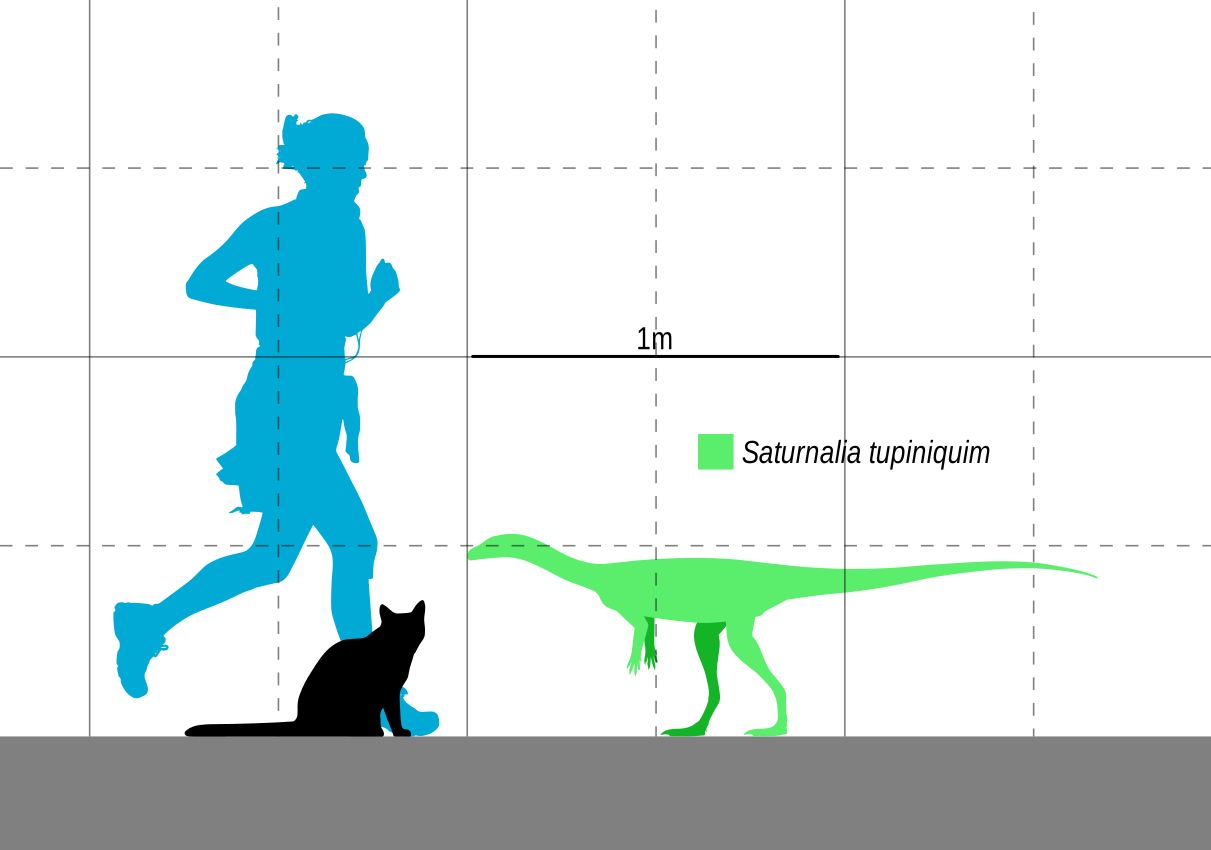
Saturnalia tupiniquim is one of the oldest known dinosaurs in the world, living approximately 233 million years ago in what is now Rio Grande do Sul, Brazil. At roughly 1.5 meters in length and an estimated weight between 4 and 11 kilograms, it was a small bipedal animal. Described in 1999 by Max Cardoso Langer, Fernando Abdala, Martha Richter, and Michael Benton, it is classified as one of the most basal sauropodomorphs on the evolutionary tree, representing a critical transition between primitive carnivorous dinosaurs and the future giant herbivores like sauropods. Its diet likely included insects and small vertebrates, indicating that the earliest sauropodomorphs were not yet exclusive herbivores. The name honors the Roman Saturnalia festival, celebrated at the time of discovery.
Geological formation & environment
The Santa Maria Formation, specifically the Alemoa Member, is a Late Triassic (Carnian, ca. 233 Ma) geological unit outcropping in Rio Grande do Sul, Brazil. Deposited in a fluvial and lacustrine environment under arid to semi-arid climate with pronounced seasonal variations, it preserved one of the richest Triassic vertebrate faunas in the world. The assemblage includes rauisuchians (the dominant large predators), rhynchosaurs, dicynodonts, cynodonts, and some of the most primitive known dinosaurs: Saturnalia tupiniquim, Staurikosaurus pricei, Gnathovorax cabreirai, Bagualosaurus agudoensis, Buriolestes schultzi. U-Pb dating (Langer et al. 2018) confirmed that the assemblage dates from ~233 Ma, contemporaneous with the Argentine Ischigualasto Formation. In the Triassic, Rio Grande do Sul was located near the south pole of the supercontinent Gondwana.
Image gallery
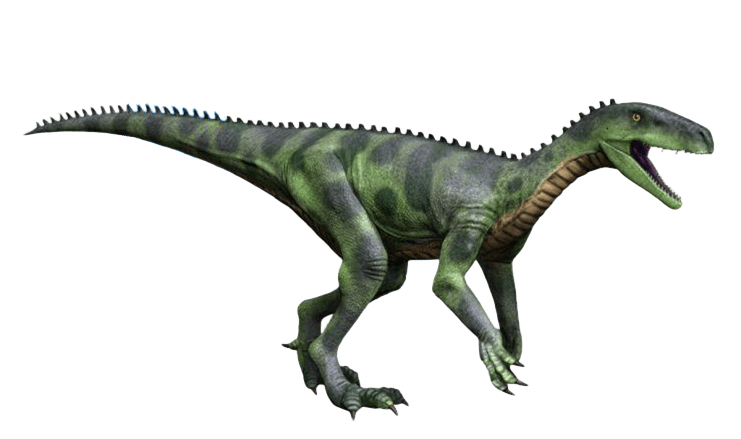
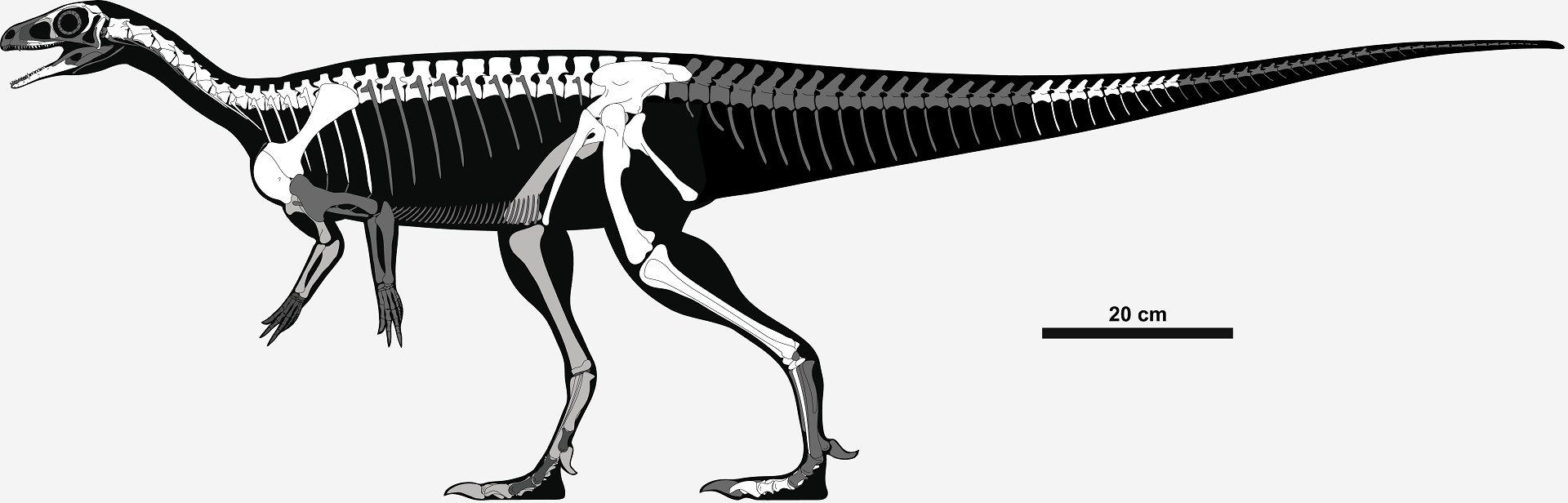


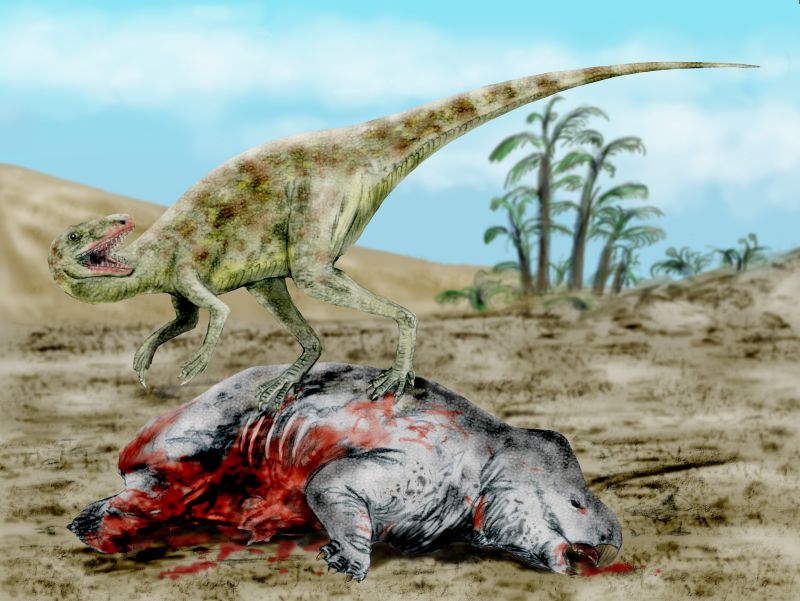


Artistic reconstruction of Herrerasaurus ischigualastensis by Nobu Tamura. Although this illustration depicts Herrerasaurus rather than Saturnalia, both shared the same ecosystem in the Upper Triassic of South America approximately 233 million years ago, and Saturnalia had comparable size and bipedal body proportions.
Nobu Tamura / Wikimedia Commons, CC BY-SA 4.0
Ecology and behavior
Habitat
Saturnalia inhabited the alluvial plains of the Santa Maria Formation (Alemoa Member) in present-day Rio Grande do Sul, Brazil, approximately 233 million years ago. The Carnian environment was arid to semi-arid, with pronounced dry seasons, vegetation of ferns, seed ferns, cycads, and primitive conifers. Seasonal streams and rivers crossed the landscape. Associated fauna included rauisuchians (dominant large predators), abundant herbivorous rhynchosaurs, dicynodonts, cynodonts, lagerpetids, and the first dinosaurs: Staurikosaurus, Gnathovorax, Bagualosaurus, and Buriolestes. Rio Grande do Sul was located near the south pole of Gondwana during this period.
Feeding
Saturnalia was likely omnivorous, with a diet including insects and small vertebrates, and occasionally plant material. The skull description by Bronzati et al. (2019) revealed fine, pointed teeth compatible with this mixed diet, rather than exclusive herbivory like that of later sauropods. This finding was reinforced by Cabreira et al. (2016) in the description of Buriolestes schultzi, a contemporary sauropodomorph with clearly carnivorous teeth. The modern understanding is that the first sauropodomorphs like Saturnalia were opportunistic omnivores, and obligate herbivory evolved later within the group.
Behavior and senses
Saturnalia was likely a solitary animal or in small groups, with an active lifestyle and opportunistic foraging. The long hindlimbs and tail with multiple vertebrae indicate the capacity for fast running, likely used both to chase prey and to escape larger predators such as rauisuchians. Bronzati et al.'s (2017) neuroanatomical study revealed that the Saturnalia cerebellum already exhibited well-developed flocculus lobes, associated with balance and fine motor coordination, suggesting an agile and sensorially sophisticated animal for its time. The obligate bipedal posture facilitated both locomotion and the use of forelimbs to manipulate food.
Physiology and growth
Saturnalia, as one of the most primitive known dinosaurs, offers valuable clues about the group's ancestral physiology. Its small size (10 kg) suggests a relatively high metabolism, perhaps intermediate between reptilian ectothermy and derived dinosaur endothermy. The brain endocast study (Bronzati et al. 2017) revealed advanced neuroanatomical features, suggesting continuous activity and complex behavior. The obligate bipedal posture, confirmed by detailed limb descriptions (Langer 2003, 2007), indicates that postural muscles were already efficient, and the tail with >20 caudal vertebrae served as a counterbalance during running. Ontogenetic growth has not yet been studied via bone histology in the species.
Paleogeography
Continental configuration

Scotese & Vérard · CC BY 4.0 · Triassic, ~225 Ma
Fossil sites
Martinelli et al. 2016, CC BY 4.0
During the Carniano (~233–229 Ma), Saturnalia tupiniquim inhabited Pangea, the single supercontinent joining all modern continents. Climate was dry and hot across much of the continental interior.
Bone Inventory
Three well-preserved partial skeletons are known (holotype MCP 3844-PV, paratypes MCP 3845-PV and MCP 3846-PV), plus disarticulated material from at least three other individuals. The holotype includes most presacral vertebrae, the sacrum, pectoral and pelvic girdles, the right humerus, part of the right ulna, the left femur, and the right hindlimb. Cranial fragments were only fully described from CT scans in 2019. The hand and furcula remain inferred by comparison with close relatives.
Found elements
Inferred elements
Scientific Literature
15 papers in chronological order — from the original description to recent research.
A sauropodomorph dinosaur from the Upper Triassic (Carnian) of southern Brazil
Langer, M.C., Abdala, F., Richter, M. & Benton, M.J. · Comptes Rendus de l'Académie des Sciences - Série IIA
The founding paper establishing the genus and species Saturnalia tupiniquim. Max Langer and colleagues describe three partial skeletons collected in the Alemoa Member of the Santa Maria Formation, near Santa Maria in Rio Grande do Sul. The animal is characterized as a small bipedal dinosaur (~1.5 m) with a peculiar mix of sauropodomorph and theropod features, assigned to the base of Sauropodomorpha. The name Saturnalia refers to the Roman Saturnalia festival, celebrated during excavation, and tupiniquim is a Brazilian indigenous term meaning 'native from here'. The description establishes one of the oldest known dinosaurs in the world and opens an unprecedented window into the initial radiation of sauropodomorphs.
The pelvic and hind limb anatomy of the stem-sauropodomorph Saturnalia tupiniquim (Late Triassic, Brazil)
Langer, M.C. · PaleoBios
Max Langer provides a detailed osteological description of the pelvic girdle and hindlimbs of Saturnalia tupiniquim, four years after the original description. The work meticulously documents each bone element, identifies primitive characters shared with theropods and derived characters shared with later sauropodomorphs like Plateosaurus. This detailed anatomical description has become a mandatory reference in subsequent phylogenetic analyses of basal dinosaurs. The study confirms Saturnalia's position at the base of Sauropodomorpha and provides essential information about the group's primitive bipedal locomotion before the transition to the giant quadrupedal body plan of sauropods.
Early dinosaurs: a phylogenetic study
Langer, M.C. & Benton, M.J. · Journal of Systematic Palaeontology
Max Langer and Michael Benton present one of the most comprehensive phylogenetic analyses of early dinosaurs, using a matrix of 400 characters and 51 taxa. Saturnalia tupiniquim is firmly recovered as a basal sauropodomorph, confirming Langer et al.'s (1999) original classification. The paper also positions Herrerasauridae as basal saurischians outside Theropoda. The analysis becomes a reference in the literature for a decade and strongly influences subsequent understanding of relationships among the first dinosaurs. The inclusion of Saturnalia is central to testing hypotheses about the origin of sauropodomorphs and the initial split between the main dinosaurian lineages.

The pectoral girdle and forelimb anatomy of the stem-sauropodomorph Saturnalia tupiniquim (Upper Triassic, Brazil)
Langer, M.C., França, M.A.G. & Gabriel, S. · Special Papers in Palaeontology
Complementing the 2003 study of the pelvis and hindlimbs, Langer and colleagues provide a detailed description of the pectoral girdle and forelimbs of Saturnalia tupiniquim. The work documents the scapula, coracoid, humerus, radius, and ulna of the holotype, establishing proportions intermediate between basal theropods and typical sauropodomorphs like Plateosaurus. The forelimbs shorter than the hindlimbs confirm the animal's obligate bipedal posture. This paper completes the systematic osteological description of Saturnalia, making it one of the most anatomically well-described Triassic dinosaurs in the world and providing valuable data for subsequent phylogenetic studies.

The origin and early evolution of dinosaurs
Langer, M.C., Ezcurra, M.D., Bittencourt, J.S. & Novas, F.E. · Biological Reviews
Encyclopedic review of the origin and initial diversification of dinosaurs, led by Max Langer, reviewing 55 pages of literature on the group. Saturnalia tupiniquim is discussed in depth as one of the most primitive known sauropodomorphs, with detailed analysis of its phylogenetic position, temporal distribution, paleoenvironment of the Santa Maria Formation, and associated records. The paper compares the Brazilian fauna with the Argentine Ischigualasto Formation, demonstrating that the southwestern part of the supercontinent Pangea (present-day South America) was the epicenter of the initial dinosaur radiation approximately 230 million years ago. A mandatory reference for any researcher studying the group's evolutionary origin.
A unique Late Triassic dinosauromorph assemblage reveals dinosaur ancestral anatomy and diet
Cabreira, S.F., Kellner, A.W.A., Dias-da-Silva, S. et al. · Current Biology
Sérgio Cabreira and colleagues describe two new dinosauromorphs from the Santa Maria Formation: Buriolestes schultzi, a carnivorous sauropodomorph, and Ixalerpeton polesinensis, a lagerpetid (near-dinosaur). The work reveals a unique Carnian assemblage that clarifies the anatomy and diet of the first sauropodomorphs. Particularly relevant for Saturnalia: Buriolestes has sharp teeth clearly adapted for carnivory, suggesting that Saturnalia and other basal sauropodomorphs were also likely carnivorous or omnivorous. The paper revolutionizes understanding of dietary origins in sauropodomorphs, showing that herbivory came after the group's origin, contradicting previous hypotheses that sauropodomorphs were herbivores from the start.


Endocast of the Late Triassic (Carnian) dinosaur Saturnalia tupiniquim: implications for the evolution of brain tissue in Sauropodomorpha
Bronzati, M., Rauhut, O.W.M., Bittencourt, J.S. & Langer, M.C. · Scientific Reports
Mario Bronzati and collaborators reconstruct the first braincase endocast of a Carnian dinosaur (the oldest in the world) using CT scans of Saturnalia tupiniquim. The study reveals that the floccular and parafloccular lobe of the cerebellum, structures associated with balance and coordination, already showed the typical conformation of more derived sauropodomorphs. This indicates that neuroanatomical adaptations associated with sophisticated motor control evolved early in the group, even before the transition to gigantism and quadrupedalism. The paper inaugurates a new era of paleoneurological research in basal dinosaurs and demonstrates the scientific value of Brazilian fossils for understanding brain evolution.

U-Pb age constraints on dinosaur rise from south Brazil
Langer, M.C., Ramezani, J. & Da Rosa, Á.A.S. · Gondwana Research
Langer, Ramezani, and Da Rosa use U-Pb radiometric dating of zircons from the Santa Maria Formation, refining for the first time the absolute age of the faunal assemblage that includes Saturnalia tupiniquim. The results place the origin of unequivocal dinosaurs at approximately 233 million years ago (Carnian), consistent with ages from the Argentine Ischigualasto Formation. This precise chronological calibration is critical for establishing that Saturnalia and other basal South American dinosaurs are among the oldest in the world. The paper resolves a decades-old question about the exact age of initial dinosaur diversification and consolidates the importance of Rio Grande do Sul as the cradle of the group.


Gnathovorax cabreirai: a new early dinosaur and the origin and initial radiation of predatory dinosaurs
Pacheco, C., Müller, R.T., Langer, M.C. et al. · PeerJ
Pacheco and colleagues describe Gnathovorax cabreirai, a new herrerasaurid from the Santa Maria Formation based on a virtually complete and articulated skeleton. The discovery significantly expands knowledge of the Carnian fauna that includes Saturnalia tupiniquim, showing that medium-sized predators (Gnathovorax, ~3 m) coexisted with small basal sauropodomorphs (Saturnalia, 1.5 m) and non-dinosaurian lagerpetids. The phylogenetic analysis incorporates Saturnalia in its local context. The paper also includes morphological disparity analysis and geochronological distribution, contextualizing Saturnalia in the complete Triassic ecosystem of Rio Grande do Sul 233 million years ago. Published in open access, it strengthens international recognition of Brazilian paleontology.
Skull remains of the dinosaur Saturnalia tupiniquim (Late Triassic, Brazil): with comments on the early evolution of sauropodomorph feeding behaviour
Bronzati, M., Müller, R.T. & Langer, M.C. · PLOS ONE
Bronzati, Müller, and Langer provide the first detailed description of the Saturnalia tupiniquim skull, using CT-scan analysis of paratype MCP 3845-PV. The skull of just 10 cm in length is significantly smaller relative to the body than in later sauropodomorphs. The dental morphology and jaw structure are consistent with an omnivorous diet, including insects and small vertebrates. The study provides fundamental insights into the early evolution of feeding behavior in Sauropodomorpha, showing that obligate herbivory came later. Published in PLOS ONE (open access), this is one of the most important papers on Saturnalia since the original description.
An exceptionally preserved association of complete dinosaur skeletons reveals the oldest long-necked sauropodomorphs
Müller, R.T., Langer, M.C. & Dias-da-Silva, S. · Biology Letters
Rodrigo Müller and colleagues describe Macrocollum itaquii, a Late Triassic sauropodomorph from Rio Grande do Sul, based on three exceptionally preserved articulated skeletons. Macrocollum represents the oldest known long-necked sauropodomorph, dating from the Norian (~225 Ma), just after the time of Saturnalia. The discovery illustrates the rapid diversification of sauropodomorphs following basal forms like Saturnalia: in just a few million years, body size, neck length, and herbivory began to evolve in derived lineages. The paper contextualizes Saturnalia as a morphological ancestor of this group that eventually produced the giant titanosaurs of the Cretaceous, connecting Brazilian Triassic fauna to the origin of the largest dinosaurs in history.

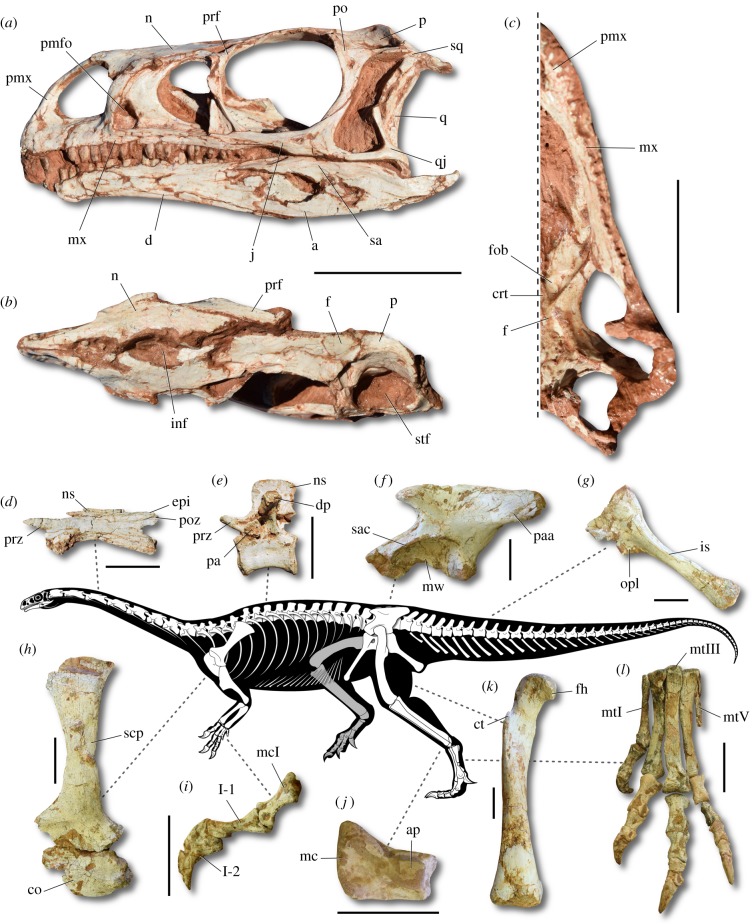
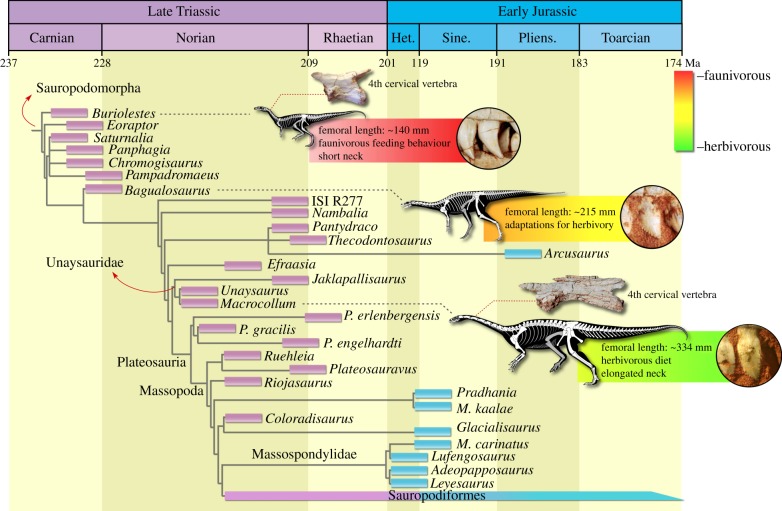
A new early-branching sauropodomorph from the Late Triassic of China with a well-preserved skull
Peyre de Fabrègues, C., Bi, S., Li, H. et al. · Royal Society Open Science
Peyre de Fabrègues and team describe a new basal sauropodomorph from the Late Triassic of China, including Saturnalia tupiniquim in a comprehensive phylogenetic analysis. The resulting cladogram positions Saturnalia near the base of Sauropodomorpha, confirming its importance as a key taxon for understanding the group's initial radiation. The analysis also demonstrates that basal sauropodomorphs had a global distribution in the Triassic, with representatives in South America (Saturnalia), Europe (Plateosaurus), South Africa (Eucnemesaurus), and Asia (Lingwulong, Mussaurus). Saturnalia emerges as one of the most primitive taxa of this Pangean radiation, reinforcing the role of the Santa Maria Formation as the epicenter of sauropodomorph origin.
The early radiation of sauropodomorphs in the Carnian (Late Triassic) of South America
Langer, M.C., Novas, F.E., Bittencourt, J.S. et al. · South American Sauropodomorph Dinosaurs (Springer)
Langer, Novas, Bittencourt, and collaborators present a comprehensive book chapter on the initial radiation of sauropodomorphs in the Carnian of South America. Saturnalia tupiniquim is treated in depth as one of the group's main taxa, with synthesis of phylogeny, biogeography, paleoecology, and ontogeny. The work integrates 23 years of discoveries since the original 1999 description and contextualizes Saturnalia within the broader Carnian fauna of Brazil and Argentina. This is the most recent compendium on the taxon as of 2022, serving as a starting point for any future research. The chapter is published by Springer and integrates a volume dedicated to South American sauropodomorphs.

New specimens of Saturnalia tupiniquim (Dinosauria: Sauropodomorpha): insights into intraspecific variation, rostral anatomy, and skull size
Damke, L.V.S., Müller, R.T. & Langer, M.C. · Zoological Journal of the Linnean Society
Damke, Müller, and Langer describe new Saturnalia tupiniquim specimens (UFSM 11660), expanding the species' fossil record 25 years after its original description. The new materials provide data on intraspecific variation, rostral anatomy, and skull size, revealing that Saturnalia had more morphological variation than previously thought. This is the most recent and relevant work on the species, published in 2024, and demonstrates that Brazilian paleontological research on Carnian dinosaurs remains active and productive. The paper consolidates Saturnalia as one of the best-documented basal dinosaurs in the world, rivaling the best Argentine records.
Early evolution of sauropodomorphs: anatomy and phylogenetic relationships of a remarkably well-preserved dinosaur from the Upper Triassic of southern Brazil
Müller, R.T., Langer, M.C., Bronzati, M. et al. · Zoological Journal of the Linnean Society
Müller and colleagues describe Bagualosaurus agudoensis, a new basal sauropodomorph from the Santa Maria Formation preserved in articulation. The phylogenetic analysis places Bagualosaurus close to Saturnalia tupiniquim, demonstrating that the initial sauropodomorph radiation in Rio Grande do Sul was more diverse than previously thought. The work expands knowledge of Brazilian Carnian sauropodomorphs beyond Saturnalia, revealing that multiple basal lineages coexisted in the Late Triassic alluvial plains. This discovery is relevant to the study of Saturnalia because it provides rich comparative material and confirms the region as a hotspot of sauropodomorph origin, alongside the contemporaneous Argentine Ischigualasto Formation.

Famous museum specimens
MCP 3844-PV (holótipo)
Museu de Ciências e Tecnologia da PUCRS, Porto Alegre
Holotype of Saturnalia tupiniquim, including most of the presacral vertebrae, the sacrum, pectoral and pelvic girdles, right humerus, part of the right ulna, left femur, and most of the right hindlimb. Primary anatomical basis of the species.
MCP 3845-PV (paratipo)
Museu de Ciências e Tecnologia da PUCRS, Porto Alegre
Paratype with partial skeleton including partial skull, dorsal vertebrae, pectoral girdle, right side of pelvic girdle, right humerus, and most of the right hindlimb. Central material for the cranial description via CT scan (Bronzati et al. 2019).
MCP 3846-PV (paratipo)
Museu de Ciências e Tecnologia da PUCRS, Porto Alegre
Paratype with partial skeleton including dorsal vertebrae, tibia, and part of the foot. Completes the set of three original individuals that served as the basis for Langer et al.'s (1999) description.
UFSM 11660 (material referido)
Universidade Federal de Santa Maria, RS
Material referred to Saturnalia tupiniquim described by Damke et al. (2024), expanding the species' fossil record beyond the three original specimens. Provides data on intraspecific variation and rostral anatomy.
In cinema and popular culture
Saturnalia tupiniquim occupies a peculiar position in popular culture: scientifically it is one of the most important dinosaurs in the world (among the oldest known, and key to understanding the origin of sauropods), but it has never been directly represented in mainstream films or series. This absence reflects a persistent pattern in paleontological media: the almost exclusive focus on large Cretaceous predators (T-Rex, Velociraptor) and North American giants, to the detriment of small, Triassic, and South American dinosaurs, regardless of their scientific importance. Specialized documentaries such as Prehistoric Planet (Apple TV+, 2022) and When Dinosaurs Roamed America (2001) show basal sauropodomorphs generically, but without naming Saturnalia. The opening of museums such as the PUCRS Museum of Science and Technology and the Museu Nacional (where an outdated model of Saturnalia in quadrupedal posture is displayed) is the main form of public exposure for the animal. The absence of representation in popular media is a significant gap and reflects the bias of the film industry, not the scientific importance of Saturnalia, which is immense: it represents the oldest link between the first small dinosaurs and the giant sauropods that would eventually dominate the planet.
Classification
Discovery
Fun fact
The name Saturnalia was chosen because the fossil was discovered during the period when Romans celebrated the Saturnalia, a festival in honor of the god Saturn, held in December. The epithet tupiniquim is a Brazilian term of indigenous origin meaning 'native from here', referring to the original inhabitants of Brazil. The combination plays with the idea of a 'Brazilian festival' of paleontological discovery: Saturnalia is one of the oldest dinosaurs in the world and, ironically, weighs only 10 kilograms, being an evolutionary ancestor of the largest terrestrial animals that ever existed: the giant sauropods of up to 100 tons that would emerge 60 million years later.
Last reviewed: April 24, 2026