
Santanaraptor
Santanaraptor placidus
"Santana raider, placid"
About this species
Santanaraptor placidus is a small coelurosaurian theropod from the Early Cretaceous (Aptian-Albian, ~110 Ma) Romualdo Formation (formerly the 'Romualdo Member' of the Santana Formation) of the Araripe Basin in southern Ceará, Brazil. The holotype MN 4802-V is famous for preserving fossilized soft tissue — muscle fibres, epidermis and possible blood vessels — which prompted one of the first dinosaur soft-tissue reports, published by Alexander Kellner in Nature in 1996. Formally described in 1999 as a basal coelurosaur, it was later reinterpreted as a tyrannosauroid (Holtz 2004; Delcourt and Grillo 2018) and, most recently, redescribed as a basal maniraptoromorph by Delcourt and colleagues in 2025. The juvenile holotype survived the September 2018 Museu Nacional fire and remains a reference specimen for studies of exceptional preservation and small-theropod diversity in Brazil.
Geological formation & environment
Romualdo Formation (formerly the 'Romualdo Member' of the Santana Formation), part of the Santana Group, Araripe Basin. Late Aptian to early Albian age (~113 to 108 Ma). Lithology dominated by mudstones and shales with characteristic calcareous concretions in which three-dimensional soft-tissue preservation is exceptional. It is considered a world-class Konservat-Lagerstätte. The fauna includes theropods (Santanaraptor, Mirischia, Irritator, Angaturama, Aratasaurus), pterosaurs (Anhanguera, Tropeognathus, Tapejara, Thalassodromeus, Tupuxuara) and around 25 species of fish, in addition to turtles and crocodyliforms.
Image gallery
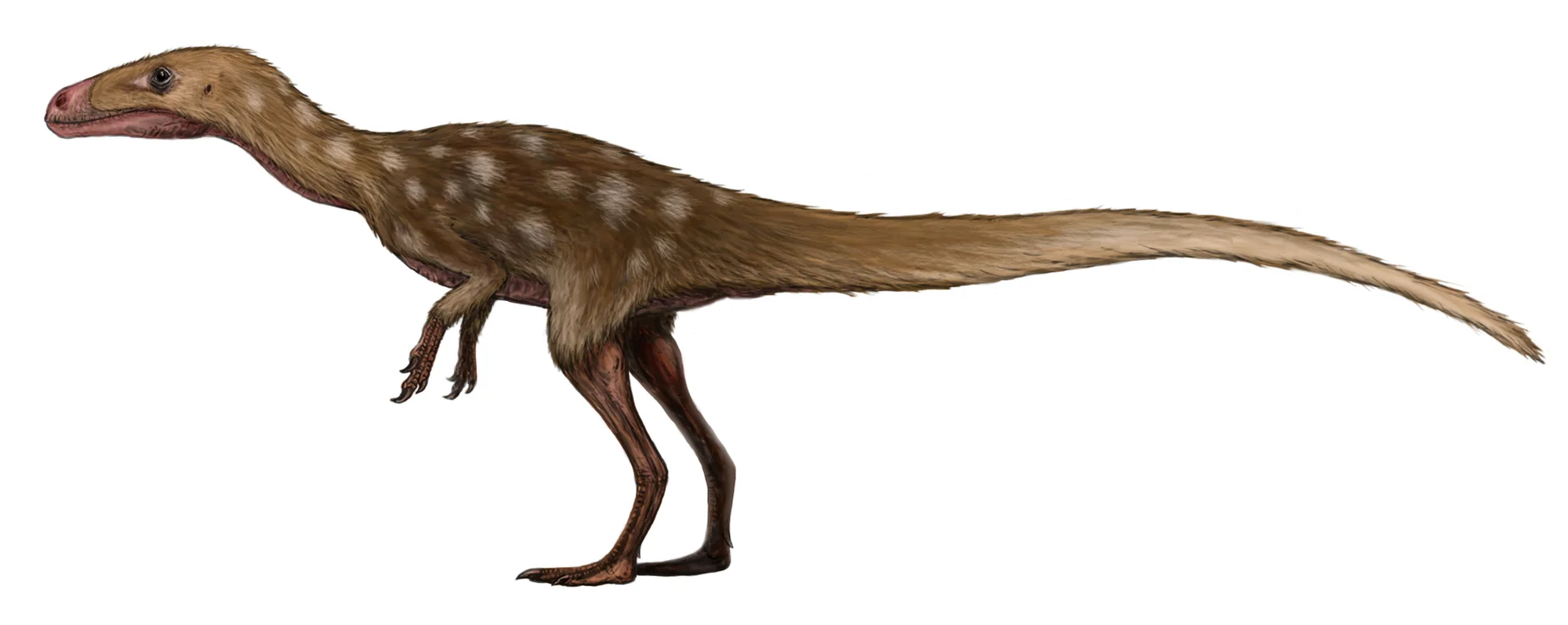

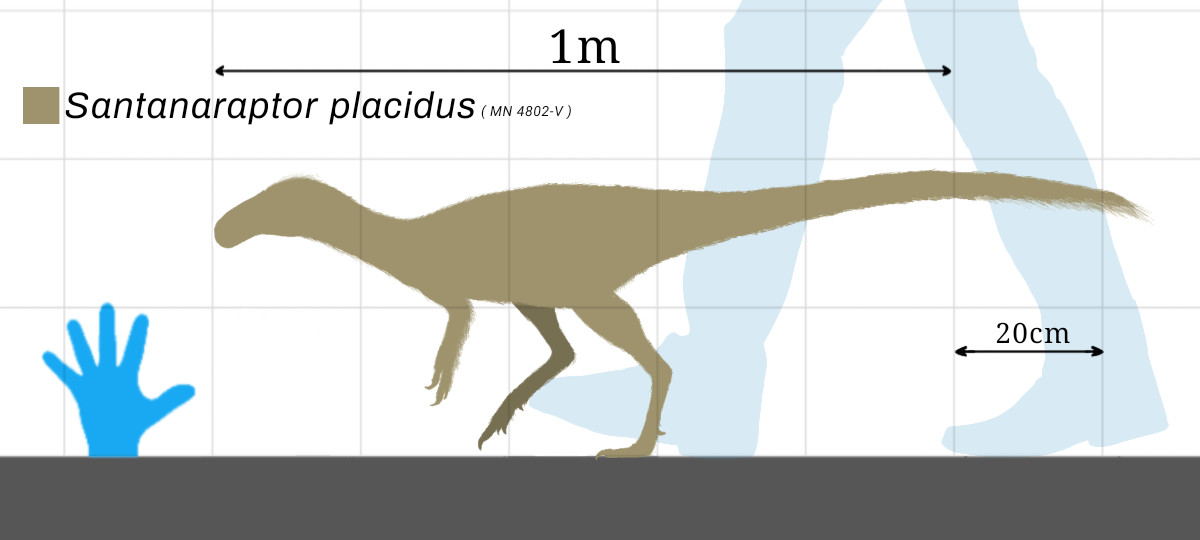


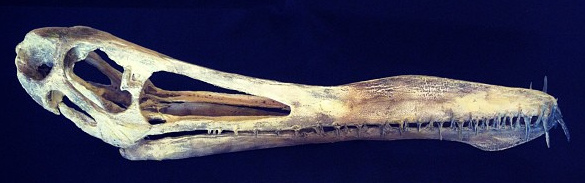


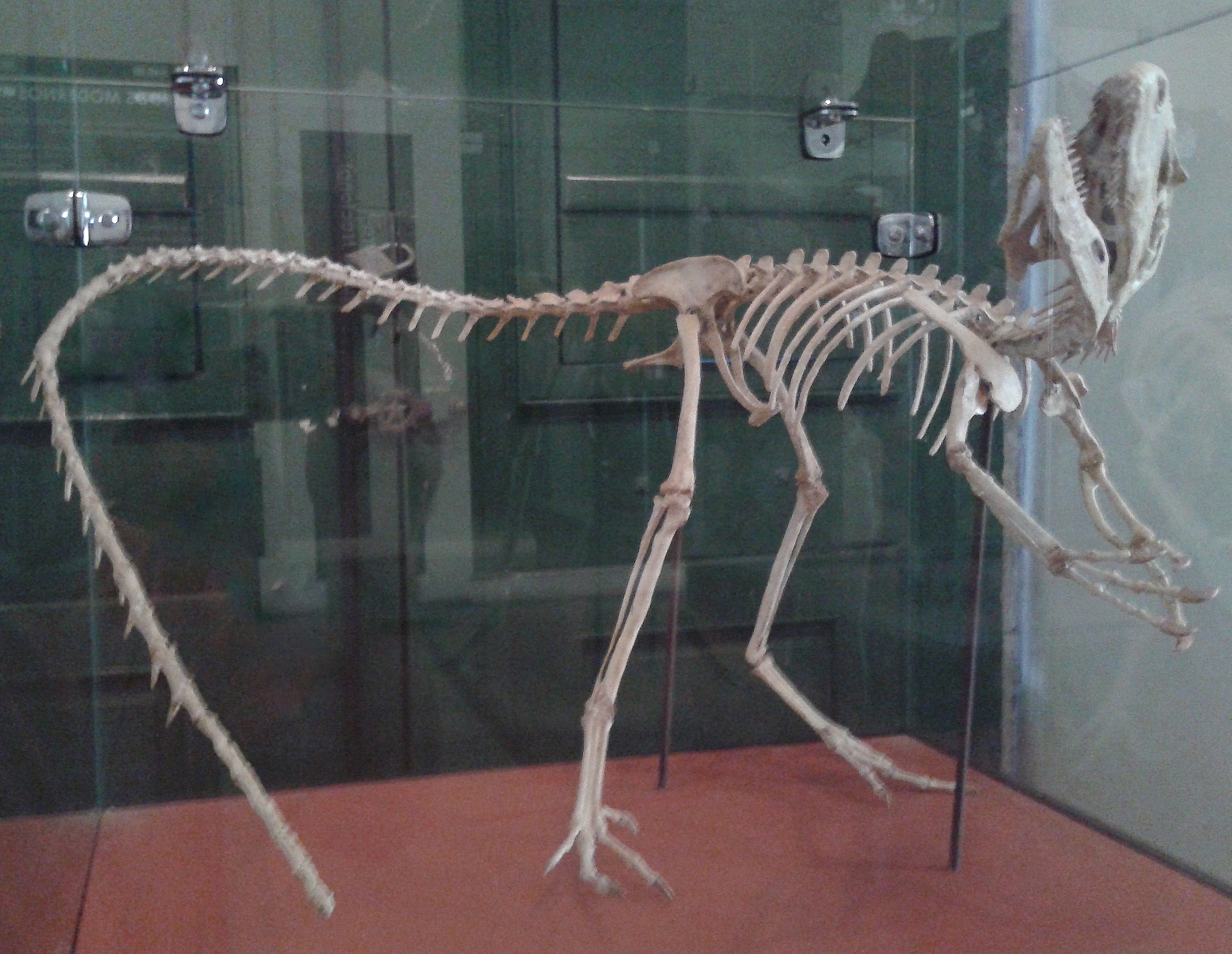


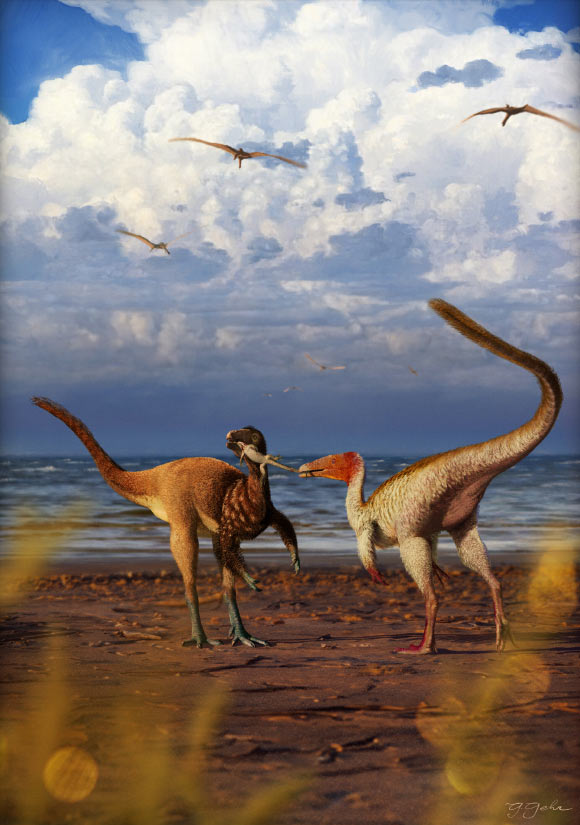
Life reconstruction of Santanaraptor placidus, a small coelurosaurian theropod from the Araripe Basin. The juvenile holotype preserves soft tissue, including muscle fibres and epidermis.
Wikimedia Commons
Ecology and behavior
Habitat
Rift-lacustrine sedimentary basin with shallow marine incursions, surrounded by xerophytic vegetation of conifers, cycads and gnetophytes. The carbonate deposits that preserved the holotype formed in a hypersaline lagoon with limited circulation, which favoured exceptional soft-tissue preservation.
Feeding
A small opportunistic carnivore that likely fed on small vertebrates (lizards, mammaliaforms, stranded fish) and invertebrates. Because of its small size, it was probably prey for the large spinosaurids (Irritator, Angaturama) of the same ecosystem.
Behavior and senses
There is no direct evidence of behaviour, but most known small coelurosaurs are interpreted as solitary or small-group hunters, agile on semi-open terrain. Carbonised filaments associated with the tibia suggest a protofeather-like integument, consistent with active thermoregulation.
Physiology and growth
The holotype is notable for its preservation of fossilized muscle fibres, thin epidermis and possible blood vessels, among the first worldwide records of this type of preservation in dinosaurs. This preservation supports inferences about soft-tissue physiology (muscle density, dermal structure) that are inaccessible from bones alone.
Paleogeography
Continental configuration

Scotese & Vérard · CC BY 4.0 · Cretaceous, ~105 Ma
During the Aptiano-Albiano (~113–110 Ma), Santanaraptor placidus inhabited Laramidia, the western half of present-day North America, separated from the east by the Western Interior Seaway, a shallow sea dividing the continent. The continents were in very different positions: India was drifting toward Asia, Antarctica was still connected to Australia, and South America was an isolated island.
Bone Inventory
The holotype mainly preserves the posterior half (pelvis, hindlimbs and caudals), without a skull or forelimbs. The exceptional preservation of associated soft tissue is nevertheless one of the rarest records in dinosaur palaeontology worldwide and justifies the sustained interest in the species.
Found elements
Inferred elements
Scientific Literature
15 papers in chronological order — from the original description to recent research.
Fossilized theropod soft tissue
Kellner, A.W.A. · Nature
Brief note in Nature reporting for the first time the exceptional preservation of soft tissues (epidermis, muscle fibres) in the specimen later formally described as Santanaraptor placidus.
Short note on a new dinosaur (Theropoda, Coelurosauria) from the Santana Formation (Romualdo Member, Albian), northeastern Brazil
Kellner, A.W.A. · Boletim do Museu Nacional, Nova Série, Geologia
Formal description of the genus and species Santanaraptor placidus based on holotype MN 4802-V. Kellner interpreted it as a basal coelurosaur, establishing the first named theropod from the Araripe Basin.
Brief review of dinosaur studies and perspectives in Brazil
Kellner, A.W.A. e Campos, D.A. · Anais da Academia Brasileira de Ciências
Review of Brazilian dinosaur research up to 2000, discussing Santanaraptor as a small Albian coelurosaur from northeastern Brazil and presenting the state of the art of Brazilian palaeontology at that time.


Skeletal remains of a small theropod dinosaur with associated soft structures from the Lower Cretaceous Santana Formation of northeastern Brazil
Martill, D.M., Frey, E., Sues, H.-D. e Cruickshank, A.R.I. · Canadian Journal of Earth Sciences
Independent description, contemporary with Kellner's work, of a small theropod from the Santana Formation with preserved soft tissues. The material is now considered directly comparable to Santanaraptor or part of the same corpus.

Tyrannosauroidea
Holtz, T.R. · The Dinosauria, 2nd edition (University of California Press)
Classic chapter on Tyrannosauroidea in which Holtz formally proposes Santanaraptor as the first Gondwanan tyrannosauroid, opening a debate on the group's global distribution that persists today.
Ecology, systematics and biogeographical relationships of dinosaurs, including a new theropod, from the Santana Formation (?Albian, Early Cretaceous) of Brazil
Naish, D., Martill, D.M. e Frey, E. · Historical Biology
Formal naming of Mirischia asymmetrica (SMNK 2349 PAL) and biogeographic synthesis of Santana Formation dinosaurs, establishing Santanaraptor and Mirischia as the two main small theropods of the Araripe Basin.

Irritator challengeri, a spinosaurid (Dinosauria: Theropoda) from the Lower Cretaceous of Brazil
Sues, H.-D. · Journal of Vertebrate Paleontology
Definitive description of the spinosaurid Irritator challengeri, a large theropod of the Romualdo ecosystem coeval with Santanaraptor. Both shared the same Aptian-Albian hypersaline lacustrine environment.


First Early Cretaceous theropod dinosaur from Brazil with comments on Spinosauridae
Kellner, A.W.A. e Campos, D.A. · Neues Jahrbuch für Geologie und Paläontologie Abhandlungen
Original description of Angaturama limai, a spinosaurid from the Romualdo Formation. Establishes the faunal context of small and large theropods in the Araripe Basin environment where Santanaraptor would be formally described in 1999.


The first theropod dinosaur (Coelurosauria, Theropoda) from the base of the Romualdo Formation (Albian), Araripe Basin, Northeast Brazil
Sayão, J.M. et al. · Scientific Reports
Description of Aratasaurus museunacionali, a juvenile coelurosaur (~3.12 m) from the Romualdo Formation. The name honours the Museu Nacional destroyed by the 2018 fire, the same institution that houses the Santanaraptor holotype.


Tyrannosauroids from the Southern Hemisphere: implications for biogeography, evolution, and taxonomy
Delcourt, R. e Grillo, O.N. · Palaeogeography, Palaeoclimatology, Palaeoecology
Reanalysis of Santanaraptor, Timimus and Australian pubes, confirming a tyrannosauroid position across three phylogenetic analyses. Proposes the new clades Pantyrannosauria and Eutyrannosauria and suggests a pan-Pangaean origin for the group.
The coelurosaur theropods of the Romualdo Formation, early Cretaceous (Aptian) of Brazil: Santanaraptor placidus meets Mirischia asymmetrica
Delcourt, R., Grillo, O.N., Hendrickx, C., Kellermann, M. e Langer, M.C. · The Anatomical Record
Complete and comprehensive redescription of Santanaraptor and Mirischia. The preferred phylogenetic position is that of early-branching maniraptoromorphs in a clade with Juratyrant and Tanycolagreus. Alternative position: megaraptorans within Tyrannosauroidea.
Middle Cretaceous dinosaur assemblages from northern Brazil and northern Africa and their implications for northern Gondwanan composition
Candeiro, C.R.A. · Journal of South American Earth Sciences
Review of Middle Cretaceous dinosaur faunas from northern Gondwana, contextualising Santanaraptor among Brazilian small theropods and discussing parallels with coeval North African fauna.

On a theropod dinosaur (Abelisauria) from the continental Cretaceous of Brazil
Kellner, A.W.A. e Campos, D.A. · Arquivos do Museu Nacional
Contextualisation of Santanaraptor within the broader landscape of Brazilian Cretaceous theropods, presented alongside the description of Pycnonemosaurus nevesi, a Late Cretaceous abelisaurid from Mato Grosso.


Masiakasaurus-like theropod teeth from the Alcântara Formation, São Luís Basin (Cenomanian), northeastern Brazil
Lindoso, R.M. et al. · Cretaceous Research
Description of teeth referred to Masiakasaurus-like abelisauroids, broadening the context of Brazilian Cretaceous theropod diversity, in which Santanaraptor is one of very few named coelurosaurs.

The anatomy and phylogenetic position of the Triassic dinosaur Staurikosaurus pricei Colbert, 1970
Bittencourt, J.S. e Kellner, A.W.A. · Zootaxa
Osteological review of Staurikosaurus pricei, a Brazilian Triassic dinosaur also curated at the Museu Nacional. Provides institutional and historical context for the palaeontological collection that houses the Santanaraptor holotype.

Famous museum specimens
MN 4802-V (holótipo)
Museu Nacional / UFRJ, Rio de Janeiro, Brasil
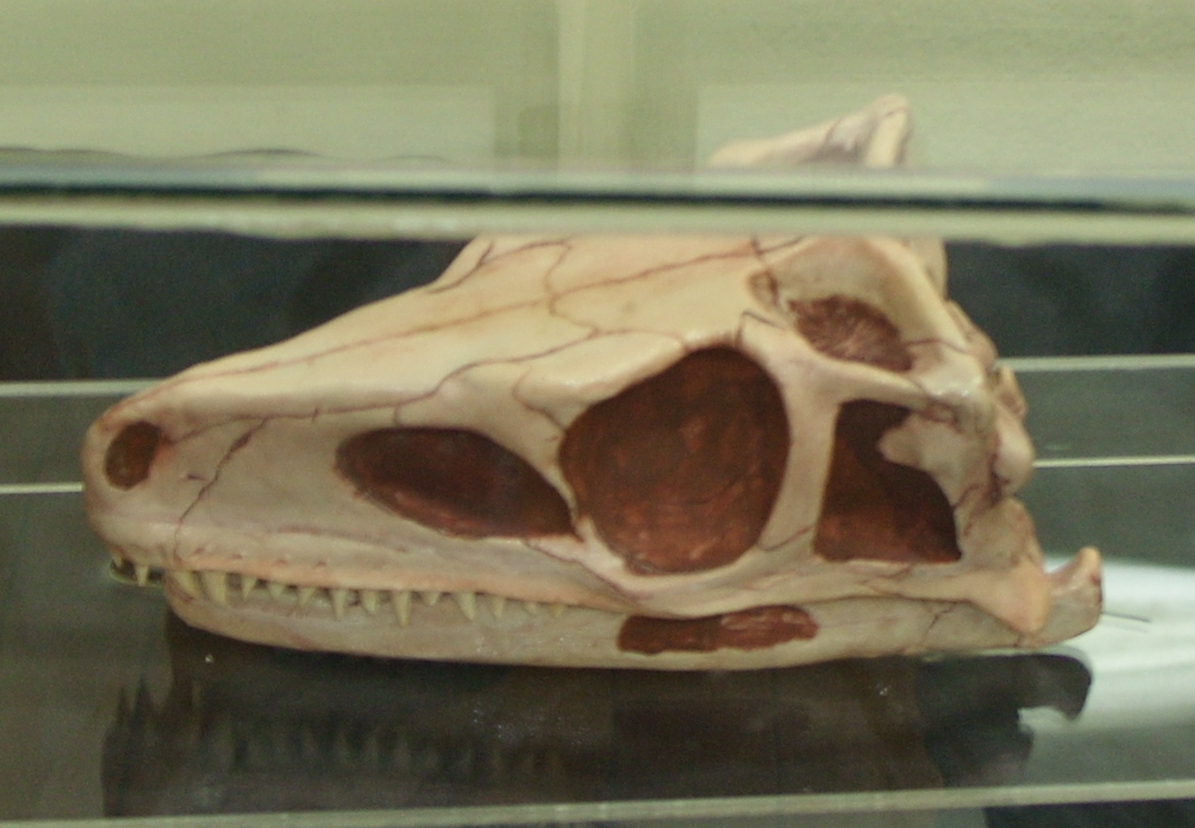
Holotype MN 4802-V is one of few Brazilian dinosaurs with preserved soft tissue, including fossilized muscle fibres, epidermis and carbonised filaments on the tibia. It was initially feared lost in the September 2018 Museu Nacional fire but later found in an undamaged room; Delcourt et al. (2025) used the material for a complete redescription, confirming its post-fire preservation.
MCT 1502-R (molde)
Departamento Nacional da Produção Mineral / Museu de Ciências da Terra, Rio de Janeiro, Brasil
Official cast of the holotype kept in the DNPM/MCT collection as a safety backup, a common practice for exceptional Brazilian specimens. Ensures continued study even in case of damage to the original material.
Classification
Discovery
Fun fact
Santanaraptor was one of the first dinosaurs in the world with soft tissue reported in a high-impact journal (Kellner, Nature, 1996), before the holotype was formally named in 1999. Although the Museu Nacional was devastated by the fire of 2 September 2018, holotype MN 4802-V survived in an undamaged room and became the basis for the species's complete redescription by Delcourt and colleagues in 2025, which now interprets it as a basal maniraptoromorph rather than a tyrannosauroid.
Last reviewed: April 24, 2026