
Rapetosaurus
Rapetosaurus krausei
"Rapeto's lizard (Krause)"
About this species
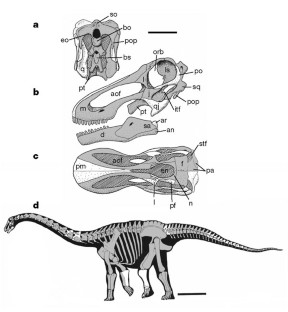
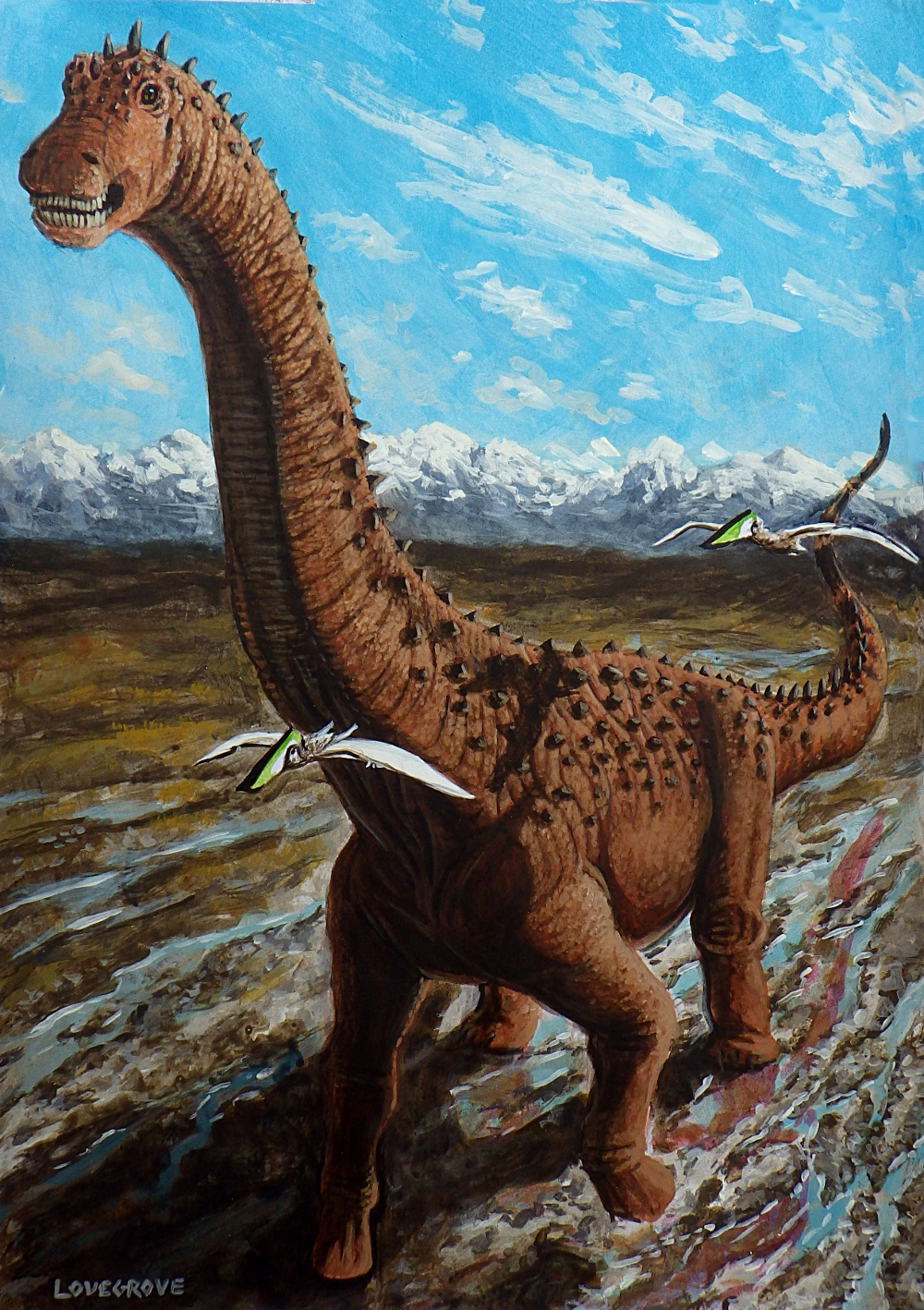
Rapetosaurus krausei is a medium-sized titanosaur from the Maastrichtian (about 70 to 66 million years ago) of the Maevarano Formation in northwestern Madagascar. Described by Kristina Curry Rogers and Catherine Forster in 2001 from holotype UA 8698 (partial adult skull) and the referred juvenile skeleton FMNH PR 2209, reaching about 8 metres in the immature individual and estimated 15 to 16.5 metres and roughly 10 tonnes for adults, it is the most complete titanosaur ever found and the first with a skull articulated to the skeleton. The skull combines diplodocoid features (elongated, with retracted external nares) with macronarian ones (pencil-like teeth restricted to the anterior portion), while the postcranial skeleton is clearly titanosaurian, with procoelous caudal vertebrae, a saddle-shaped pelvis, crescent-shaped sterna and pneumatic dorsal ribs. Curry Rogers et al. (2016, Science) described a post-hatchling (MAD 07-17) of only around 40 kg and 35 cm at the hip, and inferred precocial habits with limb isometry and rapid cortical remodelling. Curry Rogers and Kulik (2018) detailed the genus's osteohistology in 25 growth-series elements, confirming highly vascularised fibrolamellar tissue and rapid growth. The genus represents the final record of sauropod dinosaurs in Madagascar, alongside Vahiny depereti (Curry Rogers and Wilson 2014).
Geological formation & environment
Maevarano Formation, Anembalemba Member (main fossil-bearing unit) and Lac Kinkony Member (coastal tidal), Upper Cretaceous (Maastrichtian, about 70 to 66 Ma). It crops out in the Mahajanga Basin, northwestern Madagascar, near the village of Berivotra (approximately 15 degrees 54' S and 46 degrees 36' E), with palaeolatitude around 30 degrees south. The unit records seasonal semi-arid alluvial plains with recurrent fine-grained debris flow events responsible for the exceptional preservation of articulated skeletons (Rogers 2005). The fauna includes the titanosaurs Rapetosaurus krausei and Vahiny depereti, the abelisaurid Majungasaurus crenatissimus, the noasaurid Masiakasaurus knopfleri, the basal avialan Rahonavis ostromi, the paravian Vorona berivotrensis, the giant frog Beelzebufo ampinga, the crocodyliforms Mahajangasuchus, Simosuchus, Araripesuchus and Miadanasuchus, turtles (Sahonachelys), snakes (Madtsoia, Menarana) and Gondwanatherian mammals (Adalatherium, Vintana).
Image gallery


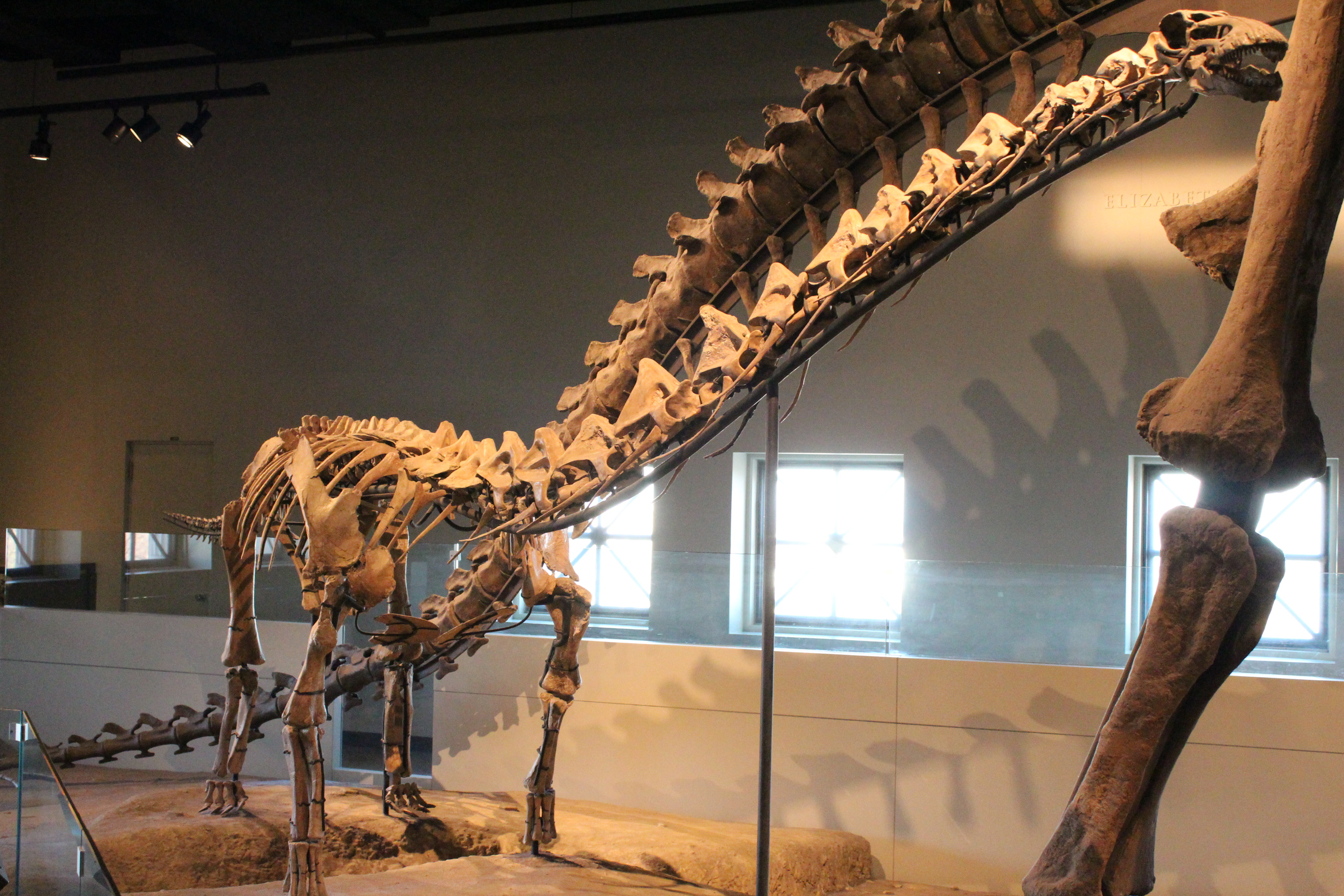


Juvenile skeleton FMNH PR 2209 of Rapetosaurus krausei mounted at the Field Museum of Natural History (Chicago), the most complete titanosaur ever found and the only one with skull articulated to postcranium.
Wikimedia Commons
Ecology and behavior
Habitat
Seasonal semi-arid alluvial plains of the Madagascan Maastrichtian, drained by meandering rivers with highly variable discharge and recurrent fine-grained debris flow events. Vegetation dominated by conifers, cycads, tree ferns and early angiosperms; grasses not yet diversified. Towards the coast, tidal-flat deposits (Lac Kinkony Member) indicate periodic influx of estuarine environments.
Feeding
Generalist herbivore. The elongated skull with pencil-like anterior teeth allowed stripping of leaves and twigs, with little or no chewing. The long neck was compatible with both high browsing on conifers and mid-level browsing on cycads and ferns. The absence of posterior teeth and the palate morphology suggest that food processing occurred in a muscular crop and in the gut.
Behavior and senses
Prehistoric Planet (Apple TV+, 2023) depicts Rapetosaurus in small herds, consistent with group inferences based on tracks and bonebeds of other titanosaurs. Curry Rogers et al. (2016) demonstrated precocial habits: hatchlings emerged proportionally similar to adults, with roughly 3.4 kg at hatching, and likely fed on their own early on, without prolonged parental care. Majungasaurus tooth marks on Rapetosaurus bones (Rogers et al. 2003) confirm the predator-prey relationship.
Physiology and growth
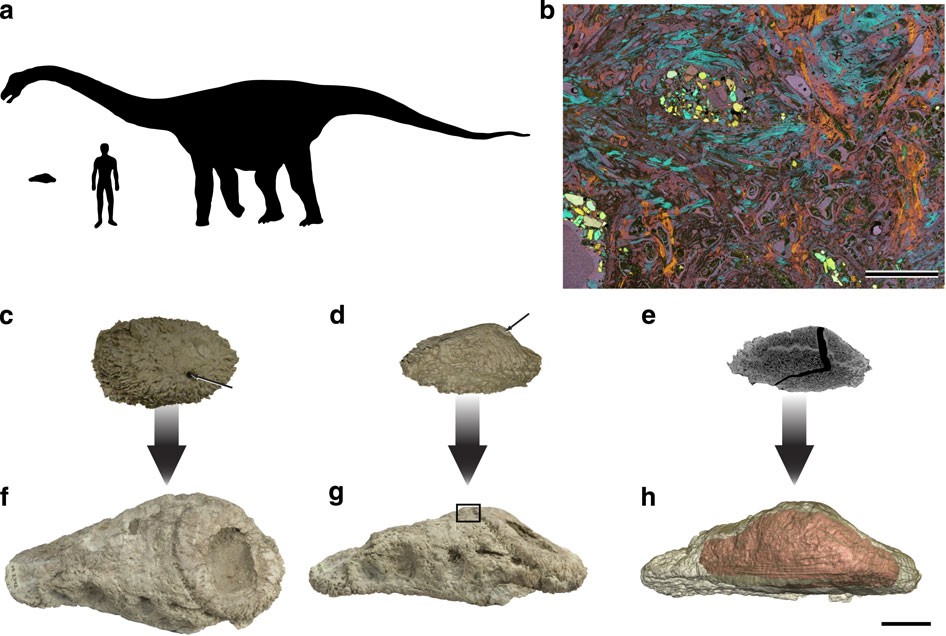
Medium-sized titanosaur (15 to 16.5 m, about 10 tonnes as adult), with highly vascularised fibrolamellar primary tissue indicating rapid and continuous growth. Curry Rogers and Kulik (2018) analysed 25 elements from a growth series and documented progressive Haversian remodelling without well-defined growth lines. The giant osteoderm described by Curry Rogers et al. (2011), with an internal cavity of more than 50 per cent of its volume, suggests a role as a mineral reserve in a stressful seasonal environment.
Paleogeography
Continental configuration

Scotese & Vérard · CC BY 4.0 · Cretaceous, ~105 Ma
During the Maastrichtiano (~70–66 Ma), Rapetosaurus krausei inhabited Laramidia, the western half of present-day North America, separated from the east by the Western Interior Seaway, a shallow sea dividing the continent. The continents were in very different positions: India was drifting toward Asia, Antarctica was still connected to Australia, and South America was an isolated island.
Bone Inventory
Juvenile skeleton FMNH PR 2209 is the most complete titanosaur ever found and the only one known with a skull articulated to the postcranium. An estimated 90 per cent of the skeleton is present, missing mainly the distal tail. The formal holotype is the adult skull UA 8698 (rostrum, mandible, palate and basicranium); other juvenile and subadult specimens (FMNH PR 2184 to 2197) and the post-hatchling MAD 07-17 (Curry Rogers et al. 2016) complete a rare titanosaurian ontogenetic series, enabling histological analysis (Curry Rogers and Kulik 2018) and precociality studies.
Found elements
Inferred elements
Scientific Literature
15 papers in chronological order — from the original description to recent research.
Late Cretaceous vertebrates from Madagascar: implications for biotic change in deep time
Krause, D.W., Hartman, J.H. e Wells, N.A. · Natural Change and Human Impact in Madagascar (ed. Goodman e Patterson), Smithsonian Institution Press, pp. 3 a 43
First comprehensive synthesis of the Maastrichtian fauna of the Mahajanga Basin, setting the stage for the formal description of Rapetosaurus. It mentions indeterminate sauropod material later referred to Rapetosaurus krausei and establishes the Mahajanga Basin Project as a source of exceptionally preserved Gondwanan Late Cretaceous tetrapods.
Stratigraphic analysis of Upper Cretaceous rocks in the Mahajanga Basin, northwestern Madagascar: implications for ancient and modern faunas
Rogers, R.R., Hartman, J.H. e Krause, D.W. · The Journal of Geology 108(3): 275 a 301
Formalises the Maevarano Formation and its three originally recognised members (Masorobe, Anembalemba, Miadana), overlain by the marine Berivotra Formation. The unit is securely dated to the Maastrichtian, correcting earlier Campanian age interpretations. This stratigraphic framework underpins all descriptions of Rapetosaurus and Majungasaurus.
The last of the dinosaur titans: a new sauropod from Madagascar
Curry Rogers, K. e Forster, C.A. · Nature 412: 530 a 534
Original description of the genus and species based on adult skull UA 8698 (holotype) and juvenile skeleton FMNH PR 2209, the most complete titanosaur ever recovered and the first with a skull articulated to the postcranium. The authors identify a mosaic of diplodocoid features (elongated skull, retracted nares) with unequivocal titanosaurian postcranial features (saddle-shaped pelvis, procoelous caudals) and place Rapetosaurus within Nemegtosauridae alongside Nemegtosaurus and Quaesitosaurus.
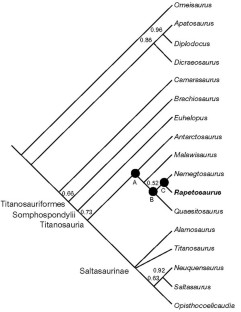
Sauropod dinosaur phylogeny: critique and cladistic analysis
Wilson, J.A. · Zoological Journal of the Linnean Society 136: 215 a 275
Comprehensive phylogenetic revision of sauropods with 234 characters and 27 taxa. Wilson recovers Rapetosaurus within Nemegtosauridae in Titanosauria, supporting the Curry Rogers and Forster (2001) hypothesis. The study consolidates the transfer of Nemegtosaurus and Opisthocoelicaudia from Diplodocoidea to Titanosauria suggested earlier by Upchurch in 1995 and 1999.

The skull of Rapetosaurus krausei (Sauropoda: Titanosauria) from the Late Cretaceous of Madagascar
Curry Rogers, K. e Forster, C.A. · Journal of Vertebrate Paleontology 24(1): 121 a 144
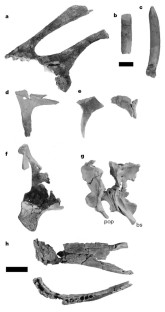
Detailed monograph on the adult skull (UA 8698) and juvenile skull (FMNH PR 2192). The study provides complete osteological descriptions of the basicranium, rostrum, mandible, palate, vault and juvenile braincase, establishing the reference anatomical standard for titanosaurian skull analysis to date. It reinforces the placement of Rapetosaurus within Titanosauria.

Titanosauria: a phylogenetic overview
Curry Rogers, K.A. · In The Sauropods: Evolution and Paleobiology (ed. Curry Rogers e Wilson), University of California Press, pp. 50 a 103
Phylogenetic analysis with 364 characters and 29 putatively titanosaurian taxa, the largest to date at that time. Rapetosaurus appears deeply nested within Titanosauria, now outside Nemegtosauridae in most recovered trees. The chapter argues that Gondwanan endemism among titanosaurs is less pronounced than previously thought, with cladograms suggesting multiple trans-oceanic dispersals into the Maastrichtian.

Fine-grained debris flows and extraordinary vertebrate burials in the Late Cretaceous of Madagascar
Rogers, R.R. · Geology 33(4): 297 a 300
Taphonomic investigation of the Anembalemba Member bonebeds: the exceptional preservation of articulated skeletons of Rapetosaurus and Majungasaurus is attributed to fine-grained debris flows dominated by montmorillonite (17 to 46 per cent silt-clay fraction), triggered by extreme rainfall events in a seasonal semi-arid environment. The juvenile skeleton FMNH PR 2209 is presented as a paradigmatic example.
Redescription of the Mongolian sauropod Nemegtosaurus mongoliensis Nowinski (Dinosauria: Saurischia) and comments on Late Cretaceous sauropod diversity
Wilson, J.A. · Journal of Systematic Palaeontology 3(3): 283 a 318
Redescription of the Mongolian Nemegtosaurus skull and discussion of its relationship with Rapetosaurus. Wilson reaffirms both in Titanosauria but questions the monophyly of Nemegtosauridae: Rapetosaurus and Nemegtosaurus appear to represent independent branches within Lithostrotia with convergent cranial characters. The study paves the way for analyses that abandon the family.

The postcranial osteology of Rapetosaurus krausei (Sauropoda: Titanosauria) from the Late Cretaceous of Madagascar
Curry Rogers, K. · Journal of Vertebrate Paleontology 29(4): 1046 a 1086
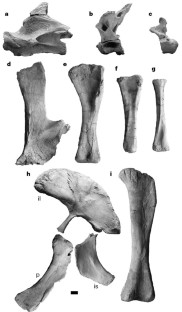
Postcranial monograph of Rapetosaurus krausei, the anatomical complement to the 2004 cranial monograph. Curry Rogers describes in detail the vertebral column, scapular and pelvic girdles, fore- and hind limbs. She identifies autapomorphies such as the deep lateral fossa in the anterior caudals and the peculiar morphology of the tibia. The work is a reference for any later titanosaur description.


Sauropod dinosaur osteoderms from the Late Cretaceous of Madagascar
Curry Rogers, K., D'Emic, M., Rogers, R., Vickaryous, M. e Cagan, A. · Nature Communications 2: 564
Describes two titanosaur osteoderms recovered in association with partial skeletons of Rapetosaurus krausei. The adult, 67 cm long and with an estimated volume of 9.63 litres, is the largest integumentary element ever discovered in any tetrapod. The bone has an internal cavity exceeding 50 per cent of its total volume, leading the authors to propose a mineral reserve function in a stressful seasonal environment, alongside signalling or defence.

A new, richly fossiliferous member comprised of tidal deposits in the Upper Cretaceous Maevarano Formation, northwestern Madagascar
Rogers, R.R., Curry Rogers, K., Bagley, B.C., Goldin, J.J., Hartman, J.H., Thole, J.T. e Zinsmeister, W.J. · Cretaceous Research 44: 12 a 29
Formalises the Lac Kinkony Member, the fourth unit of the Maevarano Formation, composed of siliciclastic and carbonate tidal-flat deposits dissected by tidally influenced rivers. Several taxa, including Rapetosaurus krausei and Majungasaurus crenatissimus, are known from both the Anembalemba and Lac Kinkony members, indicating faunal continuity up to the transgressive Berivotra marine level.


Vahiny depereti, gen. et sp. nov., a new titanosaur (Dinosauria, Sauropoda) from the Upper Cretaceous Maevarano Formation, Madagascar
Curry Rogers, K. e Wilson, J.A. · Journal of Vertebrate Paleontology 34(3): 606 a 617
Describes a second titanosaur from the Maevarano Formation, Vahiny depereti, based on a partial braincase distinct from Rapetosaurus by features of the basal tubera, parasphenoid and cranial-nerve foramina. Vahiny is most similar to Indian Jainosaurus and shows that titanosaur diversity in Madagascar was greater than it appeared, although Rapetosaurus remains the commonest in the unit.

Precocity in a tiny titanosaur from the Cretaceous of Madagascar
Curry Rogers, K., Whitney, M., D'Emic, M. e Bagley, B. · Science 352(6284): 450 a 453
Ontogenetic analysis of post-hatchling MAD 07-17 (only 35 cm at the hip and about 40 kg, with estimated 3.4 kg at hatching). Bone histology reveals a hatching line, intense cortical remodelling, limb isometry and thin calcified hypertrophic metaphyseal cartilages, a pattern consistent with precocial habits: hatchlings were proportionally like the adults and fed on their own, without prolonged parental care.

A new giant titanosaur sheds light on body mass evolution amongst sauropod dinosaurs
Carballido, J.L., Pol, D., Otero, A., Cerda, I.A., Salgado, L., Garrido, A.C., Ramezani, J., Cuneo, N.R. e Krause, J.M. · Proceedings of the Royal Society B 284: 20171219
Description of the Patagonian giant Patagotitan mayorum with the largest phylogenetic matrix published at the time (405 characters, 87 taxa, 28 titanosaurs). Rapetosaurus is recovered within Lithostrotia close to Tapuiasaurus, Isisaurus and the lognkosaurs, supporting the view that Nemegtosauridae is not monophyletic and that the elongated skull is a convergent feature among advanced titanosaurs.


Osteohistology of Rapetosaurus krausei (Sauropoda: Titanosauria) from the Upper Cretaceous of Madagascar
Curry Rogers, K. e Kulik, Z. · Journal of Vertebrate Paleontology 38(4): e1493689
Osteohistological analysis of the largest growth series ever examined in a titanosaur: 25 appendicular and girdle elements from post-hatchling to an adult with 143 cm femur. It documents highly vascularised fibrolamellar primary tissue, progressive Haversian remodelling, absence of well-defined growth lines (consistent with the basal sauropodomorph pattern) and confirms rapid continuous growth until late maturity.

Famous museum specimens
UA 8698 (holótipo)
Université d'Antananarivo (UA), Antananarivo, Madagascar
Formal holotype of Rapetosaurus krausei, catalogued at the University of Antananarivo under the agreement between the Mahajanga Basin Project partners. Basis of the 2001 Nature description and the 2004 cranial monograph.
FMNH PR 2209 (juvenil referido)
Field Museum of Natural History (FMNH), Chicago, Illinois, EUA
The most complete titanosaur ever found and the only one known with a skull articulated to the postcranium. Mounted in the Field Museum's permanent 'Evolving Planet' exhibit since 2006, alongside the Majungasaurus skull.
MAD 07-17 (recém-eclodido)
Denver Museum of Nature and Science (DMNS), Denver, Colorado, EUA (após 2016)
Key specimen of the precociality study by Curry Rogers et al. (2016, Science). Bone histology indicates precocial habits, with hatchlings proportionally like the adults and weighing around 3.4 kg at hatching.
FMNH PR 2342 (adulto histológico)
Field Museum of Natural History (FMNH), Chicago, Illinois, EUA
Adult material sampled in the osteohistological analysis by Curry Rogers and Kulik (2018), which included 25 appendicular and girdle elements in an ontogenetic series spanning post-hatchling to adult.
Réplica do crânio no Royal Ontario Museum
Royal Ontario Museum (ROM), Toronto, Canadá
Cast displayed at the ROM since the mid-2000s, used in public outreach and in direct morphological comparisons with the Mongolian Nemegtosaurus skull in the same collection.
In cinema and popular culture
Rapetosaurus had its biggest media exposure in Prehistoric Planet (Apple TV+ and BBC Studios Natural History Unit), with confirmed presence in the second season (2023), episode 3 'Swamps', in a scene where a herd of six individuals interrupts the courtship display of a male Beelzebufo ampinga by entering a mud pool. The series depicts the animal as a medium titanosaur (15 to 16.5 m, about 10.3 tonnes), consistent with the estimates by Curry Rogers and colleagues. It also appears in Field Museum educational material and in coverage by Science (2016) and National Geographic about the precocial hatchlings. It is absent from the Jurassic Park and Jurassic World franchises as of April 2026.
Classification
Discovery
Fun fact
The juvenile skeleton FMNH PR 2209 of Rapetosaurus krausei, about 8 metres long and nearly 90 per cent complete, is the most complete titanosaur ever found and the only one with skull articulated to postcranium. Even better: the post-hatchling MAD 07-17, described by Curry Rogers et al. (2016) in Science, weighed around 40 kg and was just 35 cm at the hip; at hatching it is estimated to have weighed 3.4 kg, growing from there to the roughly 10 adult tonnes. The largest land-dwelling dinosaur group therefore began life at roughly the weight of a house cat.
Last reviewed: April 24, 2026