
Prognathodon
Prognathodon saturator
"Jaw-toothed satiator (from Latin saturator, the one who satisfies)"
About this species
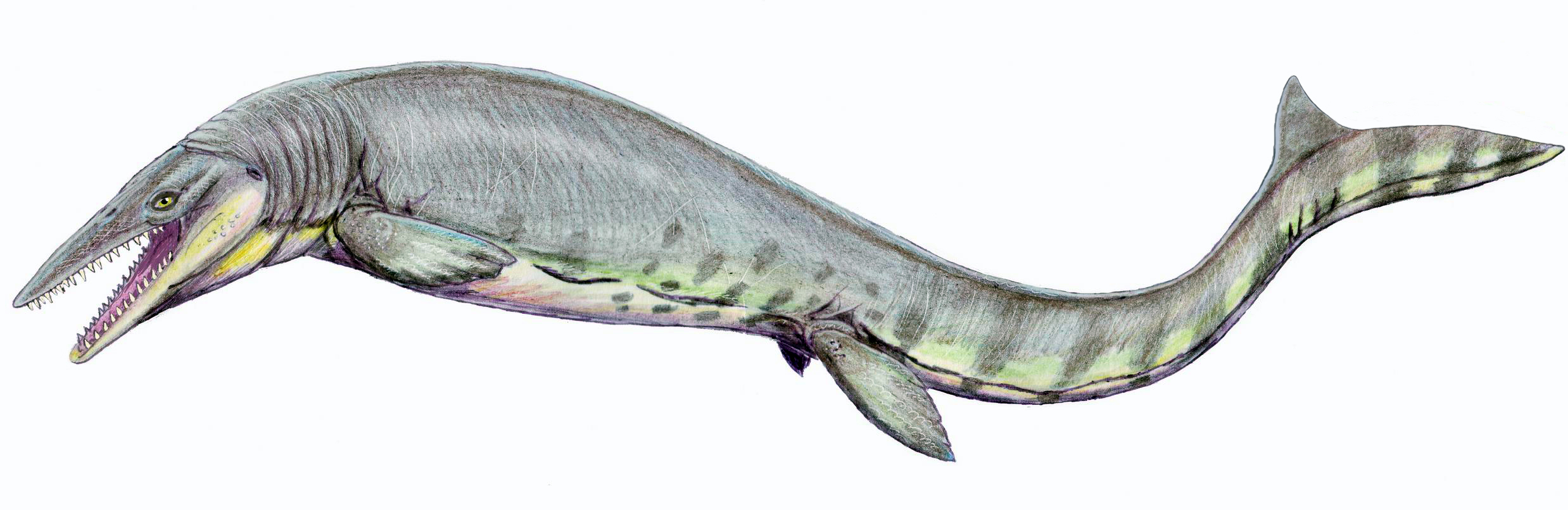
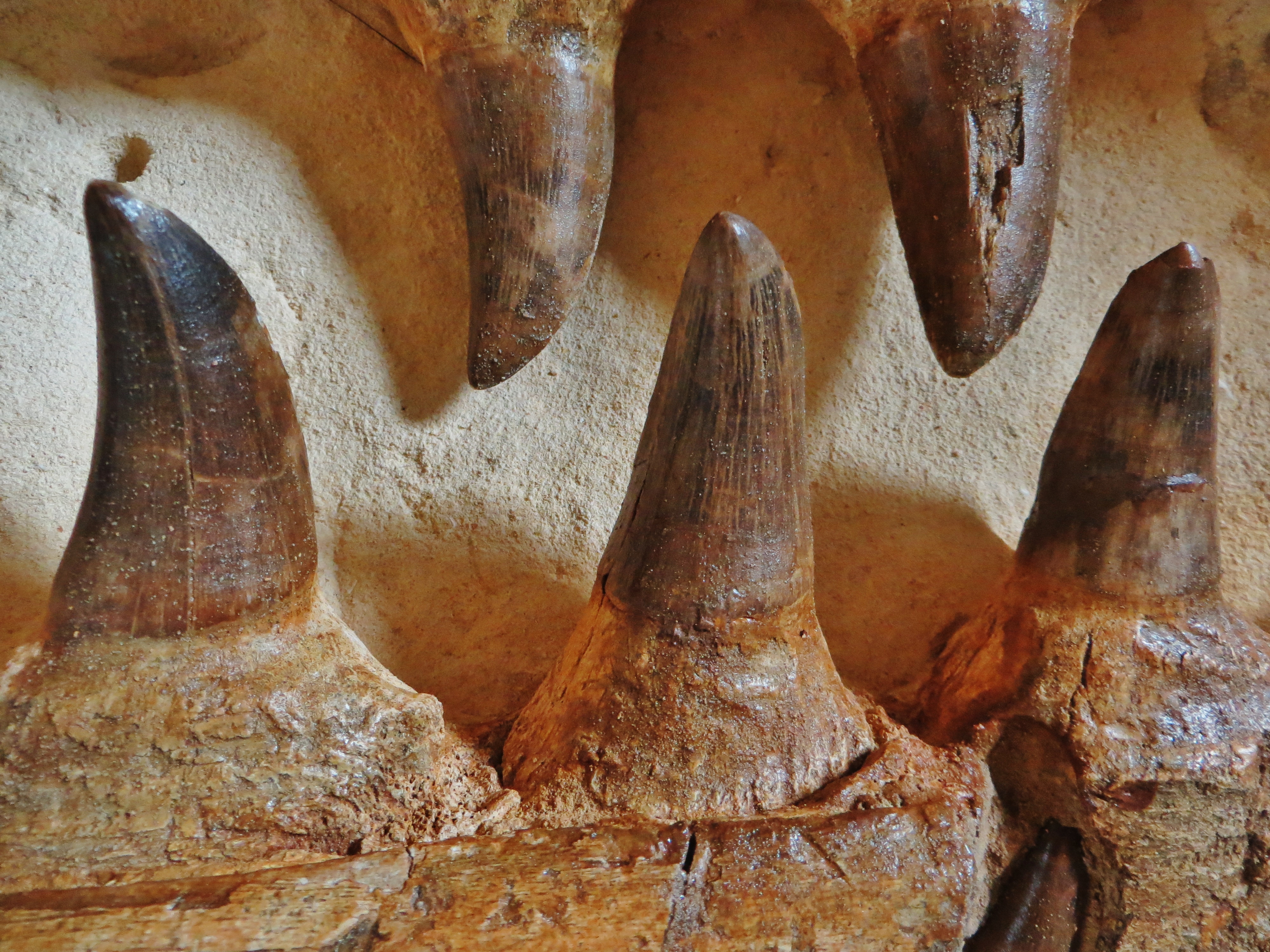
Prognathodon saturator was one of the largest and most powerfully built mosasaurs that ever existed. It lived at the end of the Cretaceous, between ~70 and 66 million years ago, in the shallow seas that covered what is now the Maastricht region of the Netherlands and Belgium. At up to 12 meters long and estimated at 5 to 7 tonnes, it shared the same waters as the famous Mosasaurus hoffmannii. Unlike M. hoffmannii, a generalist hunter, P. saturator had a massive skull and extremely robust jaws, considered the strongest of any known mosasaur. Its short, conical, blunt-tipped teeth were adapted to crush hard prey: sea turtles, thick-shelled ammonites, large fish and possibly other mosasaurs. It was not a dinosaur but a squamate reptile (Squamata), a distant relative of modern monitor lizards and snakes. The holotype, specimen NHMM 1998141, was discovered in 1998 at the ENCI quarry, received the affectionate nickname Bèr, and today rests inside a special glass structure in the courtyard of the Natuurhistorisch Museum Maastricht.
Geological formation & environment
The Gulpen Formation (Lanaye Member), where the Bèr holotype was found, is a chalk unit of the upper Maastrichtian of southeast Netherlands and northeast Belgium. Together with the overlying Maastricht Formation, it forms the type area of the Maastrichtian Stage, which lends its name to the last stage of the Cretaceous. The depositional environment was a shallow, warm, epicontinental sea with a light carbonate seafloor and an extraordinarily rich biota of ammonites (Hoploscaphites, Baculites), belemnites (Belemnitella junior), bony fish, lamniform sharks (Squalicorax), sea turtles (Allopleuron), and at least three coexisting large mosasaurs (P. saturator, Mosasaurus hoffmannii, and Plioplatecarpus marshi). It is one of the most complete records of the end-Cretaceous in the world.
Image gallery
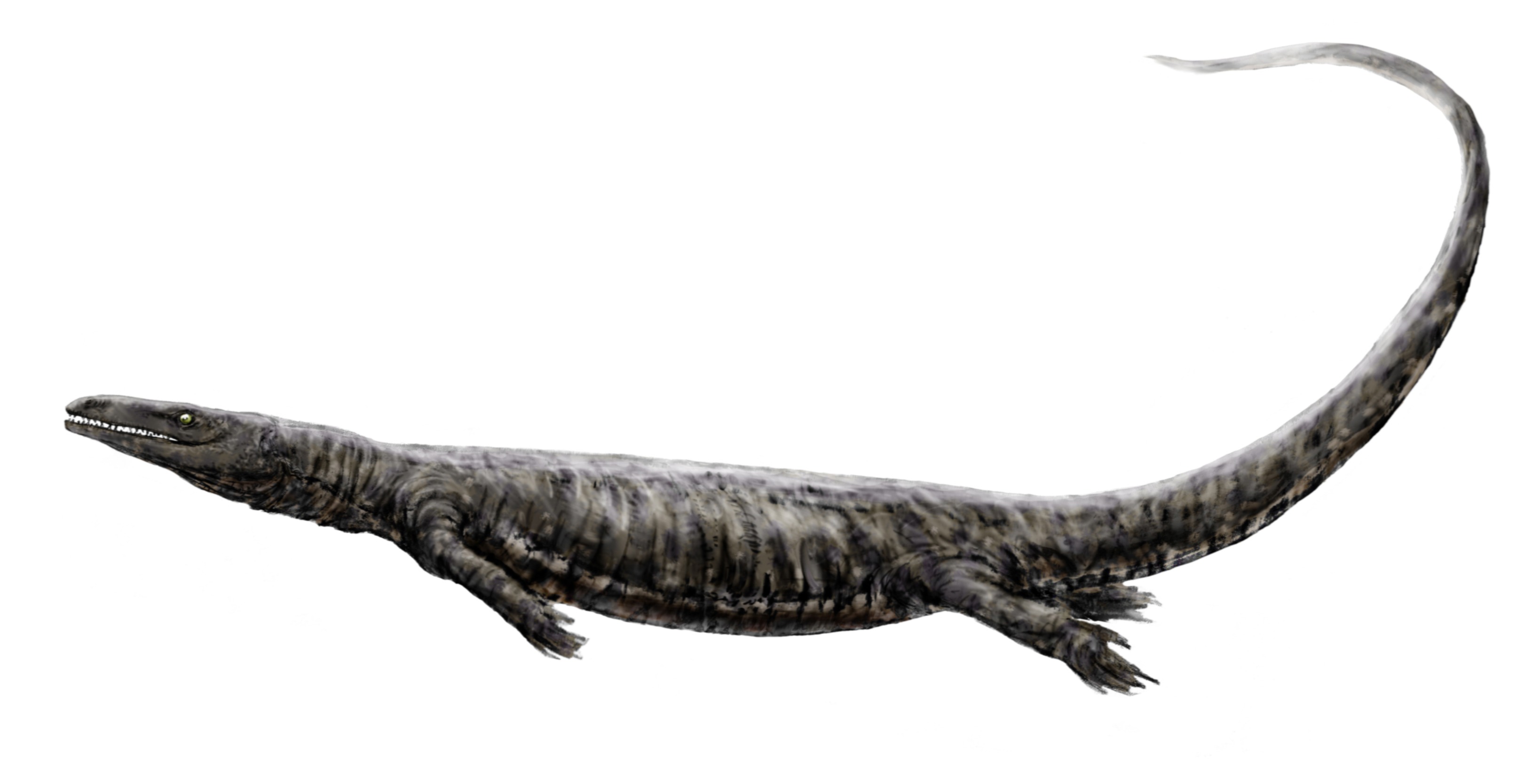


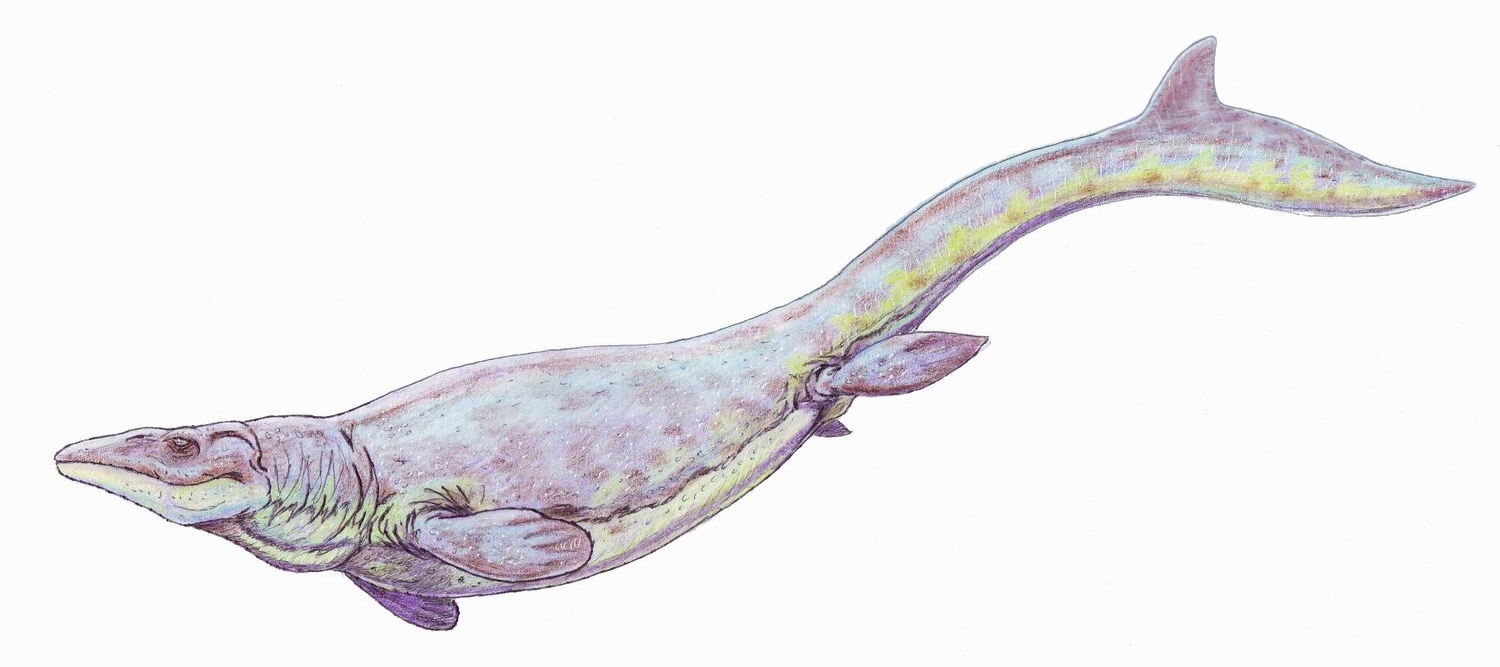
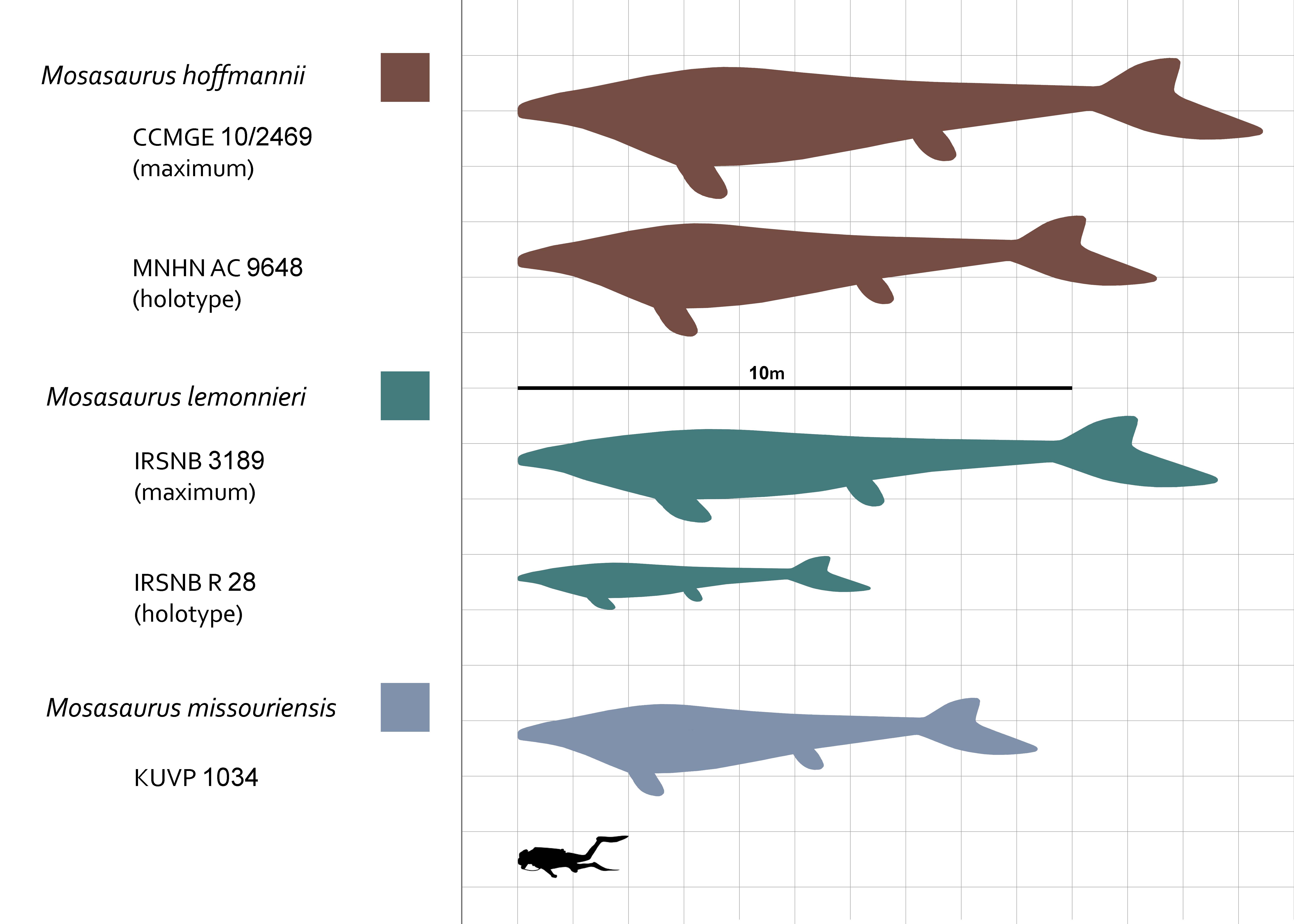


Aigialosaurus, a basal mosasaur relative. The lineage that gave rise to P. saturator emerged from small semi-aquatic lizards like Aigialosaurus in the mid-Cretaceous.
Wikimedia Commons
Ecology and behavior
Habitat
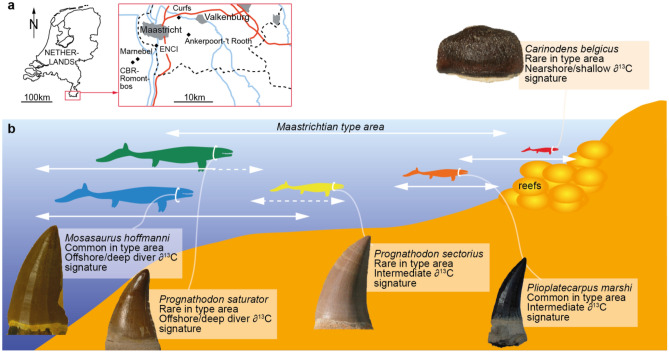
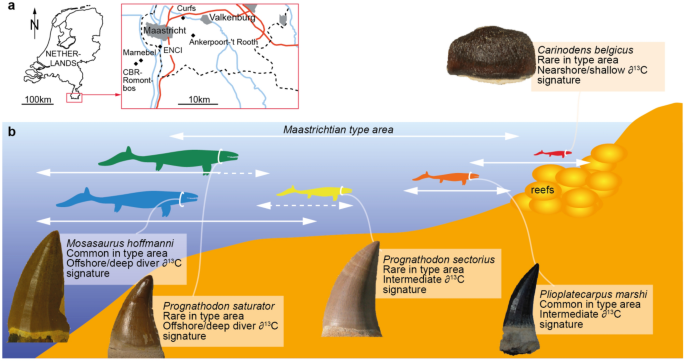
P. saturator inhabited the shallow epicontinental sea that covered much of western Europe at the end of the Cretaceous. The type region, today Maastricht (Netherlands) and northeast Belgium, was a warm shelf sea with estimated depths from tens to a few hundred meters, a light chalk seafloor, and a rich biota of ammonites, belemnites, bony fish, sharks, and sea turtles. Isotopic analysis indicates P. saturator preferred intermediate depths, unlike the more pelagic M. hoffmannii.
Feeding
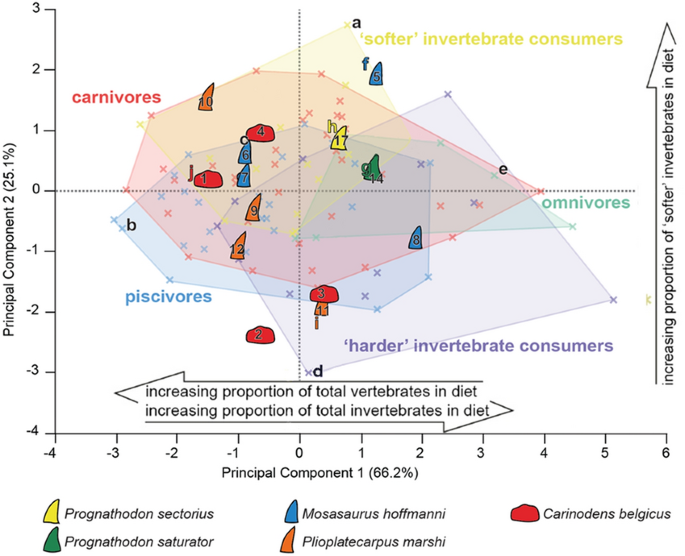
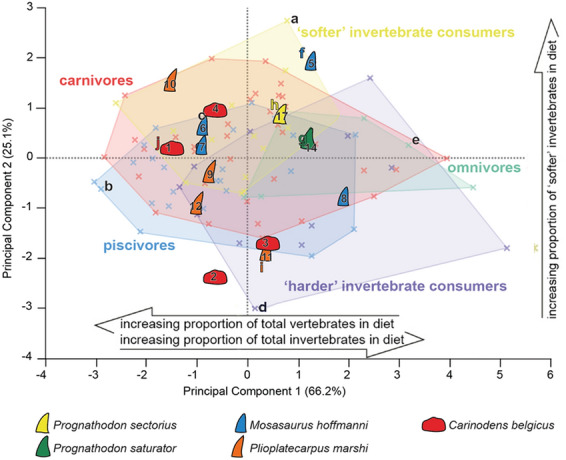
Opportunistic apex predator with jaws considered the most powerful among mosasaurs. Conical teeth with blunt tips, reinforced by a massive quadrate, enabled it to crush sea turtles (Allopleuron hofmanni), thick-shelled ammonites (Hoploscaphites, Baculites), and large fish. Three-dimensional dental microwear analysis (Holwerda et al. 2023) suggests, however, a more diverse diet than a strict durophagous specialist, including softer prey such as invertebrates and smaller fish. It likely ambushed prey at intermediate depths.
Behavior and senses
Little is inferred directly about behavior, but the presence of a healed fracture on one of Bèr's ribs (Schulp et al. 2018) indicates the animal suffered significant trauma and survived, possibly from intraspecific fighting or an attack on large prey. Coexistence with Mosasaurus hoffmannii and Plioplatecarpus marshi in the same sea was maintained by ecological resource partitioning (depth, prey type), confirmed by isotopic analysis. It was probably solitary, like adult mosasaurs in general, and used vision to locate prey in relatively clear water.
Physiology and growth
Like other derived mosasaurs, P. saturator was probably endothermic (warm-blooded) or mesothermic, according to isotopic analyses of mosasaur teeth indicating body temperatures higher than seawater. It reproduced by viviparity, as proven in mosasaurs with preserved embryos. Swimming mechanics were sub-carangiform, powered by a tail with a long lower caudal lobe, while the flippers served mainly for steering. The jaw had a flexible intramandibular joint, allowing it to swallow large prey whole.
Paleogeography
Continental configuration

Ron Blakey · CC BY 3.0 · Cretáceous, ~90 Ma
During the Maastrichtiano (~70–66 Ma), Prognathodon saturator inhabited Laramidia, the western half of present-day North America, separated from the east by the Western Interior Seaway, a shallow sea dividing the continent. The continents were in very different positions: India was drifting toward Asia, Antarctica was still connected to Australia, and South America was an isolated island.
Bone Inventory
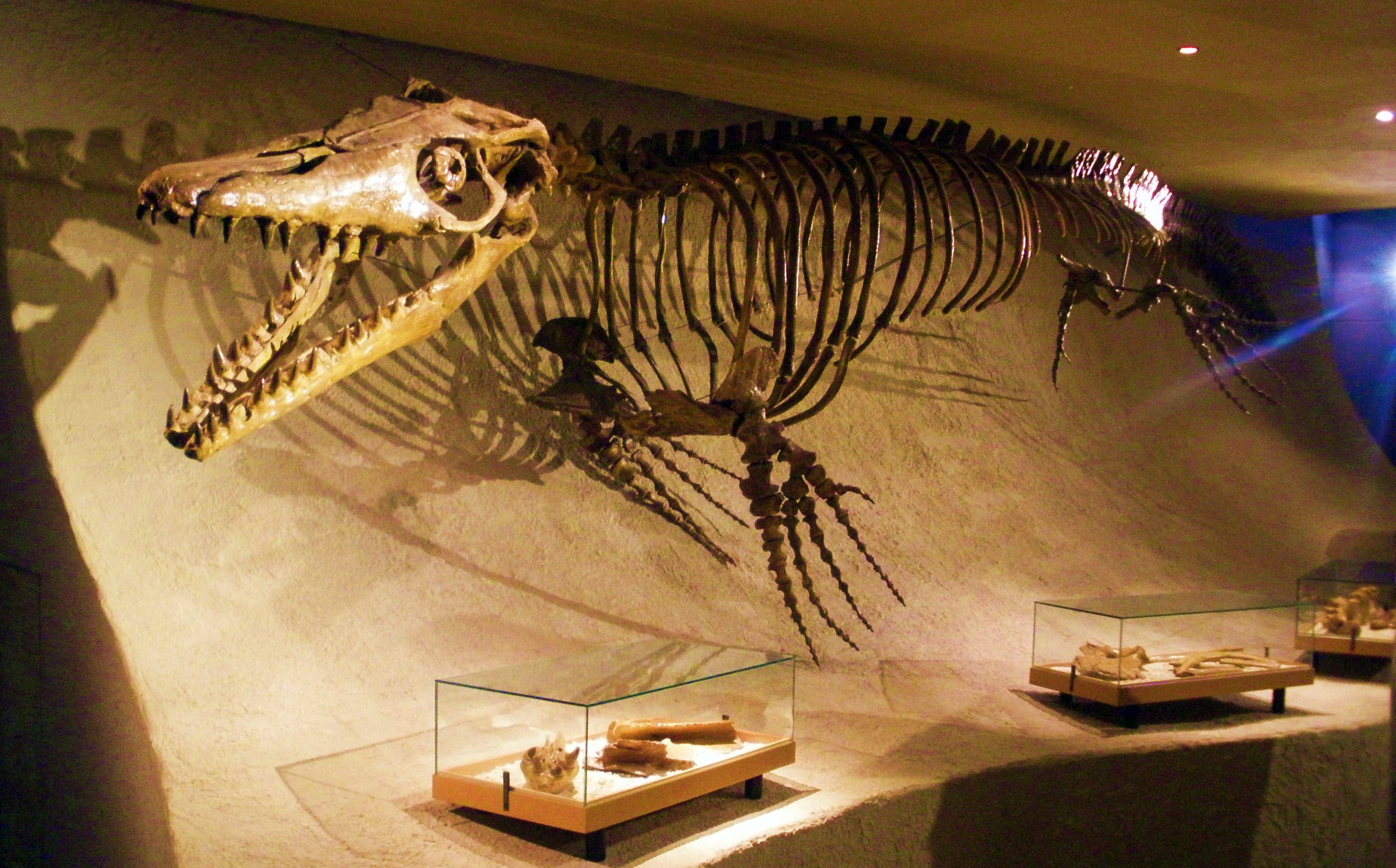
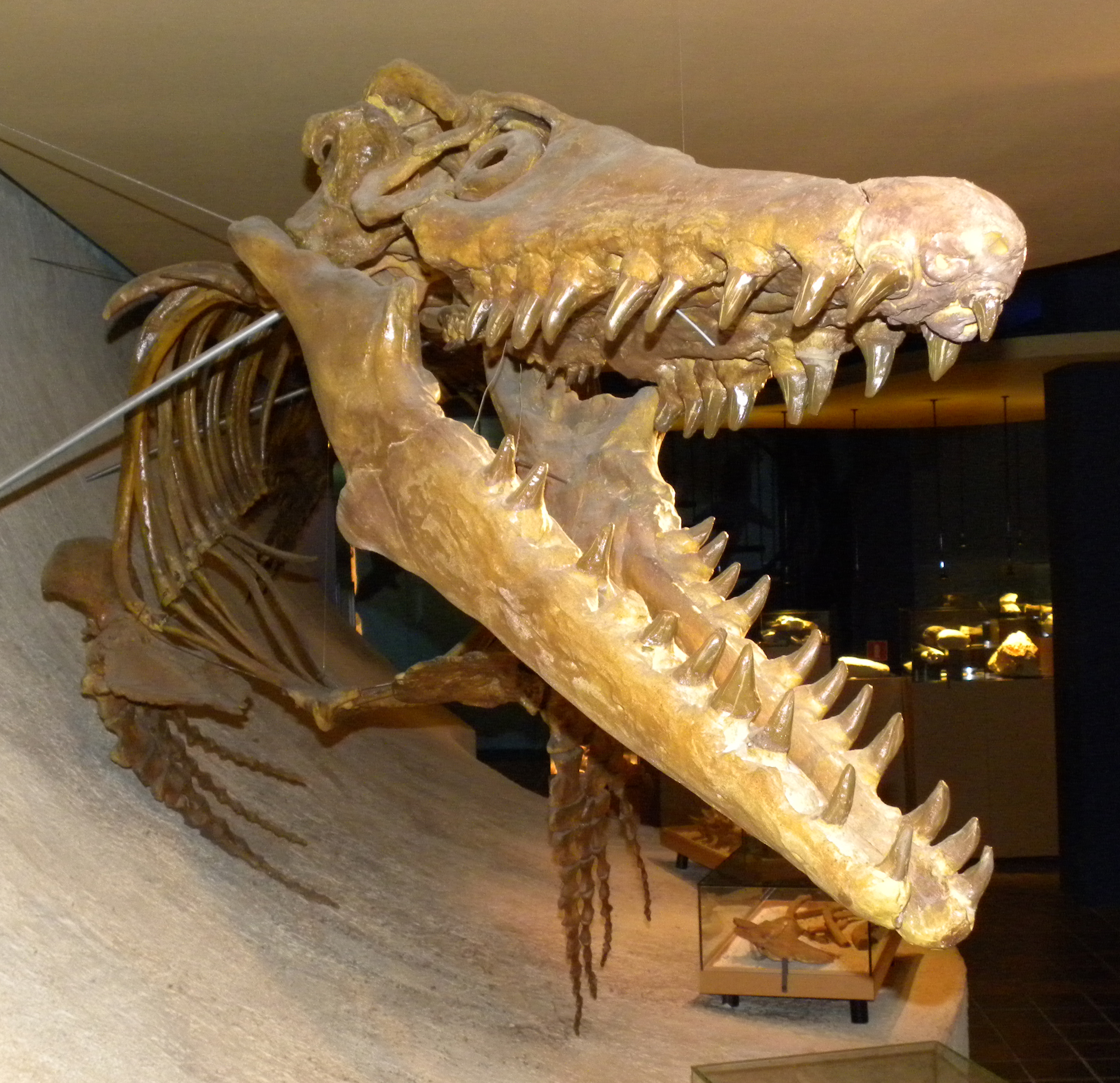
The holotype NHMM 1998141 preserves a near-complete skull (lacking only the anterior portion of the premaxilla and dentaries), articulated cervical and anterior dorsal vertebrae with ribs, isolated pygal and caudal vertebrae, scapula-coracoid, and scattered elements of the appendicular skeleton. It was the first reasonably complete mosasaur specimen recovered from the Maastricht area since 1957. Additional material assigned to P. cf. saturator was described by Schulp and colleagues in later works. The main block weighs roughly 6,000 kg and is housed in a dedicated glass house (Mosaleum) in the courtyard of the Natuurhistorisch Museum Maastricht.
Found elements
Inferred elements
Scientific Literature
15 papers in chronological order — from the original description to recent research.
A large new mosasaur from the Upper Cretaceous of The Netherlands
Dortangs, R.W., Schulp, A.S., Mulder, E.W.A., Jagt, J.W.M., Peeters, H.H.G. & de Graaf, D.T. · Netherlands Journal of Geosciences / Geologie en Mijnbouw
Original description of the species. Dortangs and colleagues describe specimen NHMM 1998141, collected in August 1998 by amateur paleontologist Rudi Dortangs at the ENCI quarry in Maastricht, and erect the new species Prognathodon saturator. The holotype is the first reasonably complete mosasaur recovered from the type area of the Maastrichtian since 1957. The authors highlight three diagnostic features: gigantic size (estimated at 12 meters), a robust skull with an extraordinarily massive quadrate, and jaws more powerfully built than in any other known mosasaur. The epithet saturator is Latin for the one who satisfies, referring to the animal's size and apparent voracity. This paper is the mandatory starting point for research on the species and confirms the presence of giant Prognathodon at the end of the European Cretaceous.


Comparative osteology, palaeoecology and systematics of the Late Cretaceous turtle Allopleuron hofmanni (Gray, 1831) from the Maastrichtian type area
Mulder, E.W.A. · DEINSEA
Monograph on Allopleuron hofmanni, a large marine turtle contemporaneous with Prognathodon saturator at Maastricht. Mulder analyzes bite marks on Allopleuron carapaces and discusses predation pressure exerted by robust mosasaurs on the turtle fauna of the Maastrichtian sea. The study provides essential paleoecological context for understanding P. saturator's diet, whose massive jaws were adapted to crush hard prey such as turtle shells. Allopleuron emerges as a key trophic link in the type area of the Maastrichtian, alongside ammonites, belemnites, bony fish, sharks, and various mosasaurs.
On Maastricht Mosasaurs (including a comparative description of Prognathodon saturator)
Schulp, A.S. · Publicaties van het Natuurhistorisch Genootschap in Limburg
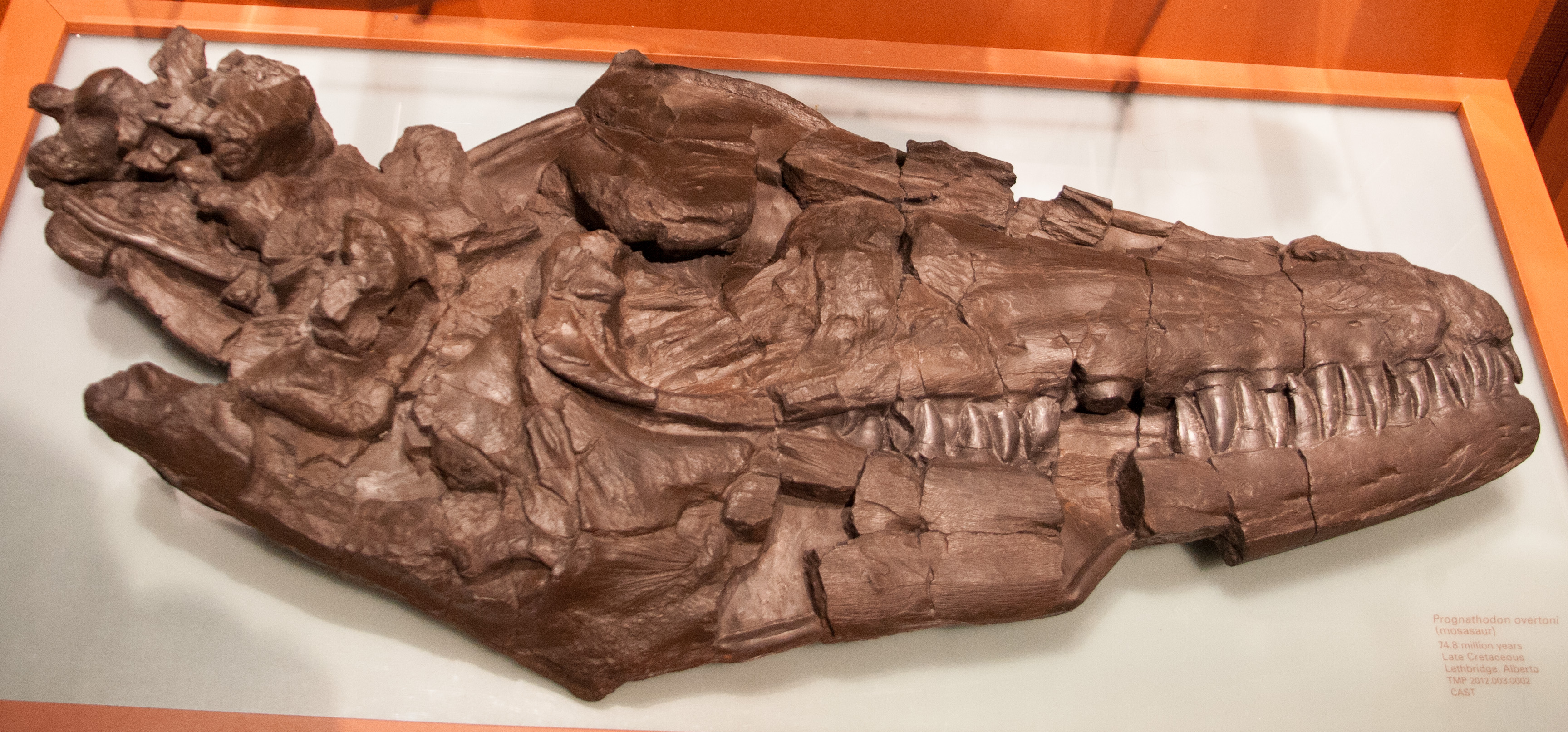
Anne Schulp's doctoral thesis reworked as a monograph. It is the most complete anatomical and systematic treatment of P. saturator, covering a detailed comparative description of each cranial element preserved in the holotype, bite mechanics analysis, phylogeny within Mosasaurinae, and paleobiology. Schulp documents that the ratio of supratemporal fenestra length to total skull length reaches 0.22 in P. saturator (versus 0.19 in Mosasaurus hoffmannii), suggesting a substantially stronger bite. The work also describes additional material of P. cf. saturator from other quarries in southeast Netherlands and northeast Belgium. It remains the standard reference for any anatomical or behavioral study of the species.


New mosasaur material from the Maastrichtian of Angola, with notes on the phylogeny, distribution and palaeoecology of the genus Prognathodon
Schulp, A.S., Polcyn, M.J., Mateus, O., Jacobs, L.L., Morais, M.L. & da Silva Tavares, T. · Publicaties van het Natuurhistorisch Genootschap in Limburg
Schulp and colleagues describe new Prognathodon material from the Maastrichtian of Angola (Bentiaba, Namibe Province) and present the first phylogenetic analysis dedicated exclusively to the genus. P. saturator appears as one of the reference species in the analysis, serving as an anatomical model for comparison with the Angolan material. The work consolidates Prognathodon as a globally distributed genus at the end of the Cretaceous, with representatives in Europe (P. saturator, P. solvayi), North America (P. overtoni, P. rapax), the Middle East (P. currii, P. hashimi), and Africa (P. kianda, described in a subsequent paper by the same authors). The paper also discusses the paleoecology of the genus as a robust apex predator of shallow Cretaceous seas.
Body size estimation and evolution in mosasaurs (Squamata, Mosasauroidea): implications for the Late Cretaceous marine food web
Schulp, A.S., Mulder, E.W.A. & Schwenk, K. · Netherlands Journal of Geosciences / Geologie en Mijnbouw
Schulp, Mulder, and Schwenk review body size estimates across mosasaur species and discuss allometric methods for inferring length and mass from incomplete skulls. P. saturator serves as a case study for robust skull allometry, illustrating how an animal can be enormous in mass without being the longest. The authors also analyze ecological implications: large mosasaurs such as P. saturator sat at the top of the Maastrichtian marine food web, competing or partially overlapping with Mosasaurus hoffmannii and Tylosaurus. The work is a methodological reference for subsequent body size studies in Cretaceous marine reptiles.


New exceptional specimens of Prognathodon overtoni (Squamata, Mosasauridae) from the upper Campanian of Alberta, Canada, and the systematics and ecology of the genus
Konishi, T., Brinkman, D., Massare, J.A. & Caldwell, M.W. · Journal of Vertebrate Paleontology
Konishi and colleagues describe the first fully articulated Prognathodon skeletons, from the upper Campanian Bearpaw Formation of Alberta, Canada. Specimen TMP 2007.034.0001 preserves direct stomach contents: a 1.6-meter fish, a smaller fish, a sea turtle, and possibly a cephalopod. It is the first direct evidence of Prognathodon diet, revealing an opportunistic apex predator attacking very different prey. The inference is transferable to P. saturator, which shared similar cranial morphology (robust jaws, blunt teeth). The work also refines the systematics of the genus and establishes Prognathodon as a versatile predator, not the strict durophagous specialist previously assumed.


On diving and diet: resource partitioning in type-Maastrichtian mosasaurs
Schulp, A.S., Vonhof, H.B., van der Lubbe, J.H.J.L., Janssen, R. & van Baal, R.R. · Netherlands Journal of Geosciences
Key study for understanding how P. saturator, Mosasaurus hoffmannii, and Plioplatecarpus marshi could coexist in the same shallow Maastrichtian sea without direct competition. Schulp and colleagues analyze stable carbon and oxygen isotopes in tooth enamel and find distinct isotopic signatures for each species, indicating separate ecological niches: different diving depths, different prey, and possibly different habitats within the same epicontinental sea. P. saturator shows an isotopic signal consistent with shallower-water prey and a diet enriched in turtles and thick-shelled ammonites, different from the more pelagic profile of M. hoffmannii. This is a classic example of resource partitioning inferred through geochemistry.
Stable isotope record of type-Maastrichtian mosasaurs (Squamata, Mosasauridae): implications for diet and diving ecology
Schulp, A.S., Janssen, R., van Baal, R.R., Jagt, J.W.M., Mulder, E.W.A. & Vonhof, H.B. · Netherlands Journal of Geosciences
Extension of the 2013 work with an expanded isotopic dataset. The authors confirm and refine the differences between P. saturator, Mosasaurus hoffmannii, and Plioplatecarpus marshi, incorporating more specimens and applying more precise geochemical techniques. Oxygen signatures suggest P. saturator dove and hunted at intermediate depths, with possible excursions into colder water. Carbon signatures indicate a diet rich in benthic or shallow neritic prey. The work reinforces that the three large Maastricht mosasaurs formed a predator guild segregated by diving behavior and prey choice, sustaining the high diversity of the region at the end of the Cretaceous.
Mosasauroid phylogeny under multiple phylogenetic methods provides new insights on the evolution of aquatic adaptations in the group
Simões, T.R., Vernygora, O., Paparella, I., Jimenez-Huidobro, P. & Caldwell, M.W. · PLOS ONE
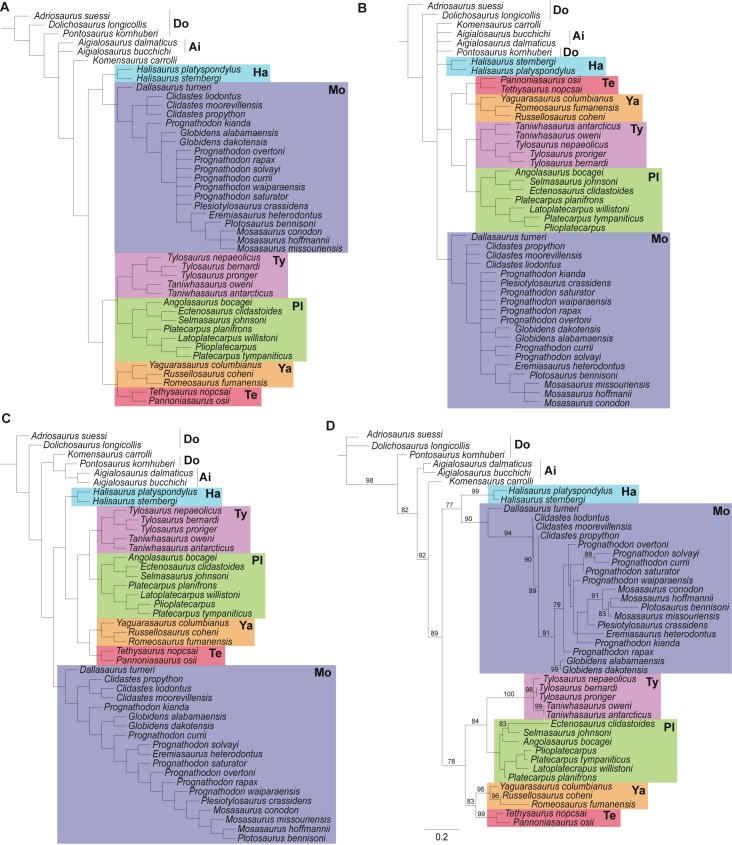
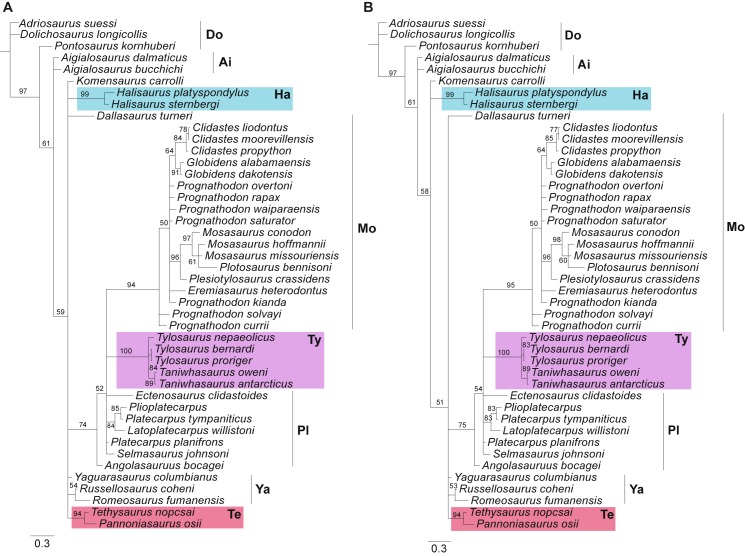
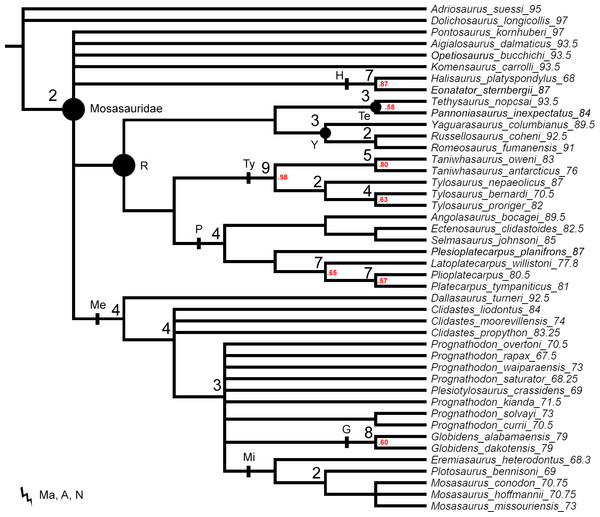
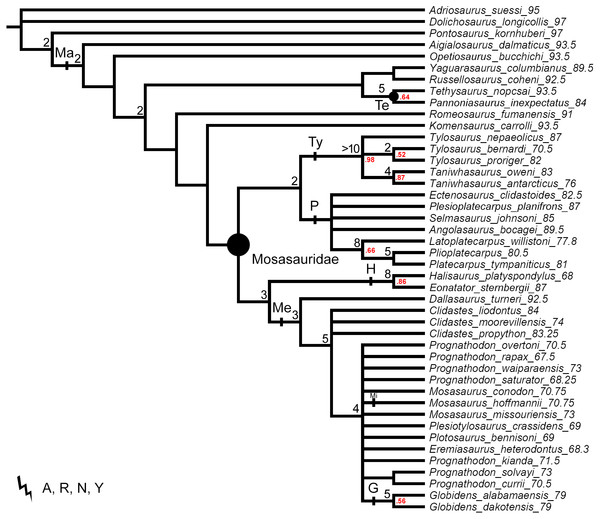
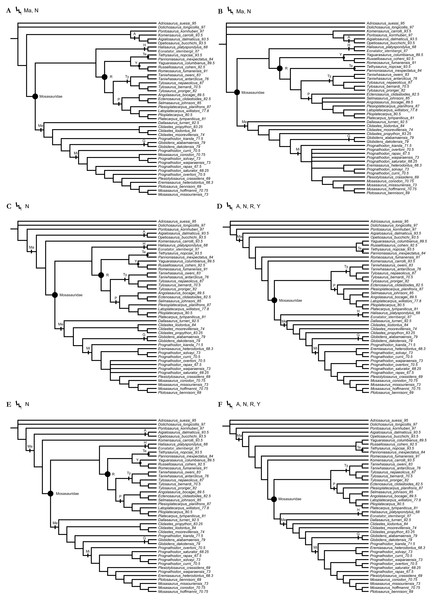
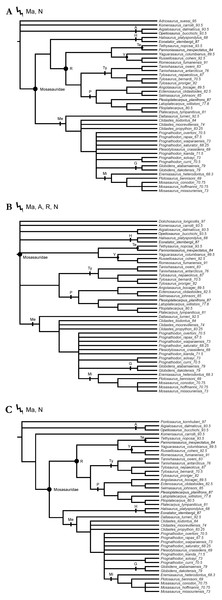
First comprehensive phylogenetic analysis of mosasaurs under three different methods: maximum likelihood, Bayesian inference, and implied weighting maximum parsimony. The study recovers Mosasaurinae as a monophyletic clade but shows that the genus Prognathodon is paraphyletic, meaning its species do not form a single cohesive group. P. saturator appears close to the more derived Prognathodon species and near Mosasaurus hoffmannii in the topology. The result has important taxonomic implications: in the future, species currently assigned to Prognathodon may be transferred to other genera. The paper is the most-cited open-access cladistic reference for mosasaurs and provides the standard cladogram used in phylogenetic illustrations of the species.
Inferring 'weak spots' in phylogenetic trees: application to mosasauroid nomenclature
Madzia, D. & Cau, A. · PeerJ
Madzia and Cau apply a bootstrap methodology to identify poorly supported nodes in mosasaur phylogenies and propose a revised nomenclature, including formal definitions of Mosasaurinae, the subfamily to which P. saturator belongs. The work consolidates modern phylogenetic nomenclature for mosasaurs and provides the clade-based definitions used today by all specialists of the group. P. saturator appears among the derived Mosasaurini. The paper also highlights areas where the phylogeny of the group is still uncertain, including the internal relationships of Prognathodon, which remains paraphyletic in virtually all modern analyses.

Rib fracture in Prognathodon saturator (Mosasauridae, Late Cretaceous)
Schulp, A.S., Mulder, E.W.A. & de Graaf, D.T. · Netherlands Journal of Geosciences
Schulp and colleagues describe two unusual bumps on the internal surface of a rib of the holotype Bèr (NHMM 1998141). After morphological and comparative analysis, they interpret these as a healed fracture. The finding is an important paleopathological record because it proves the animal survived the trauma long enough for the bone to regenerate, showing that even the largest predator of the Maastricht sea experienced significant injuries, possibly from intraspecific fighting, attack on large prey, or foraging accidents. The study is a rare example of mosasaur paleopathology with positive species identification and precise stratigraphic context.

Cranial palaeopathologies in a Late Cretaceous mosasaur from the Netherlands
Lingham-Soliar, T., Foffa, D. & Young, M.T. · Cretaceous Research
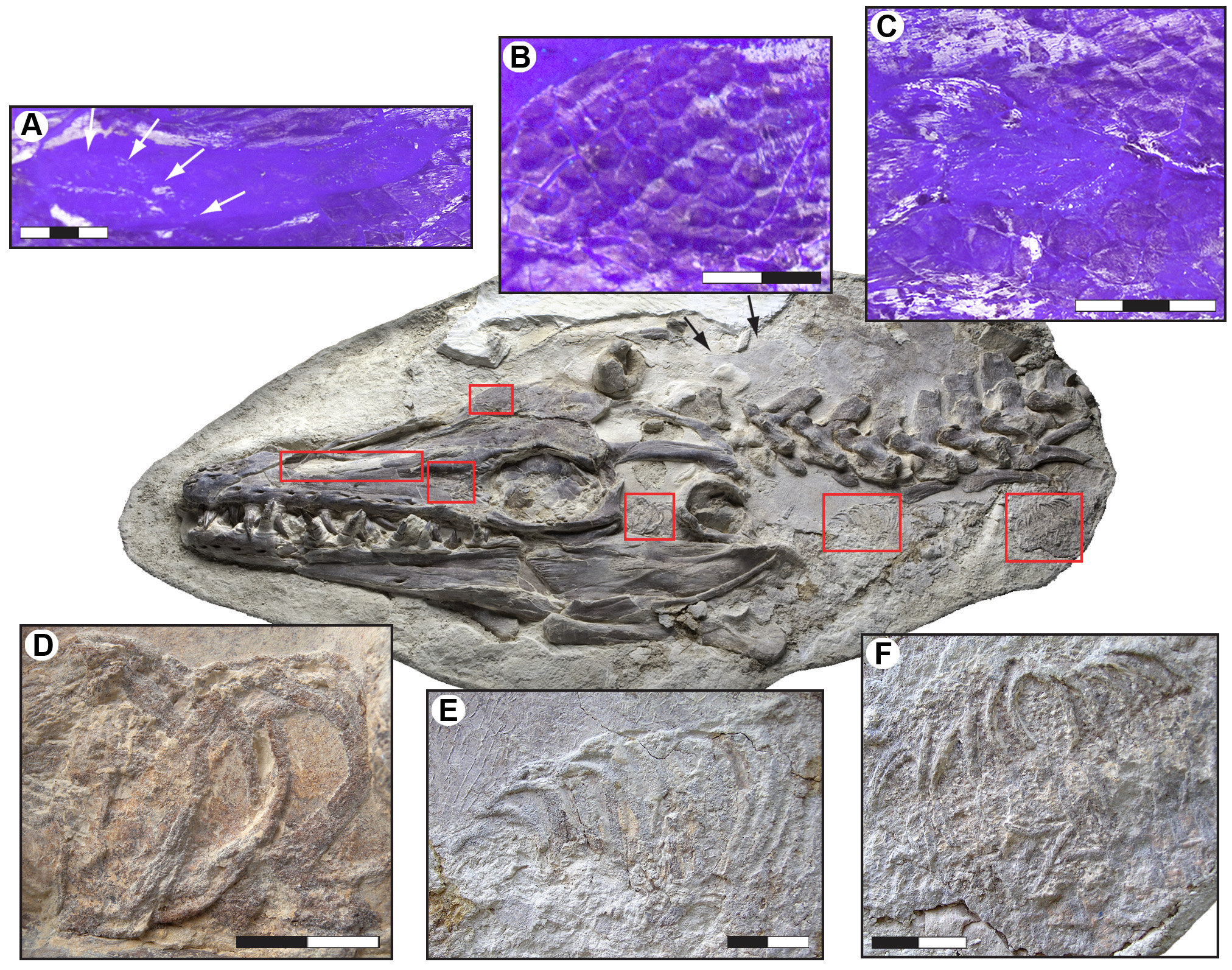
Description of cranial pathologies on a Late Cretaceous mosasaur from the Maastricht region, interpreted as bite wounds possibly inflicted by another mosasaur. While the specific specimen is not P. saturator, the study is directly relevant to understanding the agonistic behavior of the mosasaur guild that included this species. The preserved bite marks are consistent with robust conical teeth (compatible with Prognathodon) or sharper teeth (compatible with Mosasaurus). The paper supports the hypothesis of violent interactions, including possible intraspecific predation among the large mosasaurs of the Late Cretaceous of Europe.


A new species of longirostrine plioplatecarpine mosasaur (Squamata: Mosasauridae) from the Late Cretaceous of Morocco, with a re-evaluation of the problematic taxon 'Platecarpus' ptychodon
Strong, C.R.C., Caldwell, M.W., Konishi, T. & Palci, A. · Journal of Systematic Palaeontology
Strong and colleagues describe a new longirostrine mosasaur species from Morocco and, along the way, re-evaluate taxa that were problematic in recent phylogenetic analyses, including several Prognathodon species. The paper updates the cladistic matrix used since Bell (1997) and provides updated phylogenetic trees for Mosasaurinae. P. saturator maintains a stable position within the Mosasaurini/Prognathodontini clade, consistently close to Mosasaurus hoffmannii and Globidens. The work reinforces Prognathodon paraphyly even with the addition of new characters and taxa, suggesting that a formal taxonomic revision of the genus is needed in the near future.

Three-dimensional dental microwear in type-Maastrichtian mosasaur teeth (Reptilia, Squamata)
Holwerda, F.M., Bestwick, J., Purnell, M.A., Jagt, J.W.M. & Schulp, A.S. · Scientific Reports
Pioneering application of three-dimensional dental microwear texture analysis (DMTA) to mosasaur teeth, including Prognathodon saturator. Holwerda and colleagues compare wear textures with living reptiles of known diets and find an unexpected result: P. saturator overlaps with reptiles that consume higher proportions of softer invertebrates, not only hard prey. The finding challenges the traditional view of P. saturator as a strict durophagous specialist, reinforcing Konishi et al.'s (2011) interpretation of Prognathodon as an opportunistic generalist predator capable of crushing hard prey when needed. The paper is published in open-access Scientific Reports.
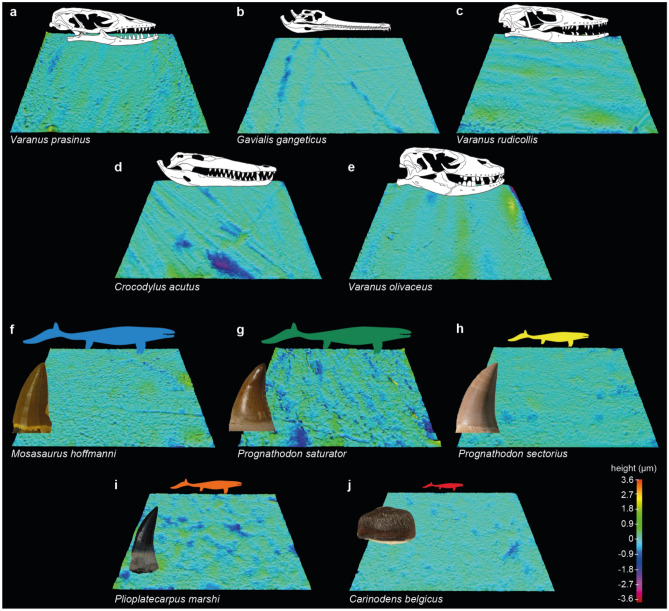
Dental morphology and feeding ecology of mosasaurid reptiles from the type-Maastrichtian (Upper Cretaceous)
Bestwick, J., Jagt, J.W.M., Ornée, J.H., Schulp, A.S. & Purnell, M.A. · Palaeontology
Most recent and integrative study on the feeding ecology of type-Maastrichtian mosasaurs. Bestwick and colleagues combine dental morphometrics, wear analysis, and biomechanical modeling to compare the feeding guilds of P. saturator, Mosasaurus hoffmannii, and Plioplatecarpus marshi. They confirm that the three species occupied distinct trophic niches even while sharing the same sea. P. saturator emerges as a facultative durophage capable of crushing turtle shells and robust ammonites, but with a dietary gradient including softer prey. The work provides the most complete ecological picture available for P. saturator and settles (for now) the debate started by Dortangs et al. (2002) about the degree of dietary specialization in the species.
Famous museum specimens

Bèr (NHMM 1998141, holotipo)
Natuurhistorisch Museum Maastricht, Maastricht, Países Baixos
Holotype of the species, described by Dortangs et al. (2002). Preserves near-complete skull, articulated cervical and anterior dorsal vertebrae, scapula-coracoid, and appendicular elements. The main block weighs 6,000 kg and sits in a dedicated glass house (Mosaleum) in the museum courtyard. Since 2024, the museum has displayed an 11-meter reconstructed skeleton assembled from 400 3D-printed bones.

Material de P. cf. saturator
Natuurhistorisch Museum Maastricht e coleções belgas (IRSNB, Bruxelas)
Additional material (isolated teeth, quadrate fragments, partial jaws) assigned to P. cf. saturator has been recovered from other quarries in southeast Netherlands and northeast Belgium. These specimens expand the stratigraphic and geographic distribution of the species beyond the holotype.
In cinema and popular culture
Prognathodon saturator has a minimal presence in popular cinema, far smaller than its contemporary and distant cousin Mosasaurus hoffmannii, catapulted to global fame by Jurassic World (2015). The species appears (by name or as a representative of the genus) in two main documentary titles. Sea Monsters (BBC, 2003) portrayed the Maastrichtian sea but focused only on Mosasaurus, without mentioning P. saturator. Prehistoric Planet (Apple TV, 2022-2023) partially corrected this gap: in season 2, the Islands episode features a large Prognathodon hunting on Hateg Island, confirmed by scientific advisor Darren Naish as the genus to which P. saturator belongs. The depiction follows modern paleobiology: a robust opportunistic predator capable of attacking varied prey, including small dinosaurs that venture into the sea. The relative absence of P. saturator in pop culture reflects the effect of Jurassic World and the name Mosasaurus (more melodic and familiar) on the public, eclipsing other scientifically important mosasaurs from specific localities like Maastricht.
Classification
Discovery
Fun fact
The name saturator is Latin for the one who satisfies, referring to the enormous size and devastating bite of the species. The holotype was affectionately nicknamed Bèr (a local nickname) in 2002. The block containing the fossil weighed so much (6,000 kg) that it did not fit inside the museum: a special glass house, the Mosaleum, was built in the courtyard of the Natuurhistorisch Museum Maastricht to display it. In 2024, the museum opened the Mosasaurus Experience exhibit with an 11-meter reconstructed skeleton of Bèr, assembled from roughly 400 3D-printed bones, the first digitally reconstructed complete mosasaur skeleton in the world.
Last reviewed: April 24, 2026