← Back to catalog
Postosuchus kirkpatricki
Triassic Carnivore

Postosuchus

Postosuchus kirkpatricki

"Crocodile from Post (Post, Texas)"

Period
Triassic · Noriano
Lived
228–201 Ma
Length
up to 5 m
Estimated weight
400 kg
Country of origin
United States
Described in
1985 by Sankar Chatterjee

Postosuchus kirkpatricki was one of the largest terrestrial predators of the Late Triassic in North America. A crurotarsal archosaur belonging to the family Rauisuchidae, it was not a dinosaur but rather a distant relative of modern crocodilians. Estimated at 4 to 6 meters in length, it had an erect posture, laterally compressed serrated teeth, and a robust skull. Locomotion was predominantly bipedal in adults, with the forelimbs progressively reduced with growth. It lived in the tropical humid and semiarid environments of the Late Triassic, coexisting with the first dinosaurs and the rhynchosaurs it would eventually replace.

The Tecovas Formation (part of the Dockum Group) in western Texas is the origin site of the Postosuchus holotype, deposited in the Norian of the Late Triassic, between 225 and 210 million years ago. Composed of reddish mudstones, siltstones, and fine sandstones, it represents deposits of meandering rivers and floodplains in a semiarid to tropical environment. The Chinle Formation in Arizona and New Mexico is contemporaneous and equally rich in Postosuchus fossils. Both formations preserve one of the most complete Triassic faunas in the world.

🌿

Habitat

Postosuchus inhabited the Late Triassic environments of the southwestern and eastern United States, corresponding to today's Texas, Arizona, New Mexico, and North Carolina. The climate was seasonal, alternating between wet periods and prolonged droughts, with vegetation dominated by ferns, cycads, and primitive gymnosperms. The meandering rivers and floodplains of the Tecovas/Dockum Formation and the Chinle Formation were the main setting, with wooded savannas interspersed with open areas.

🦷

Feeding

Postosuchus was the main apex predator of the North American Late Triassic, capable of taking down large prey such as Placerias (dicynodonts of up to 2 tons) and large aetosaurs. The laterally compressed serrated teeth indicate adaptations for cutting meat, similar to those of theropods. Bite marks on Desmatosuchus bones suggest that Postosuchus attacked these armored herbivores. The partial stereoscopic vision indicated by the position of the orbits suggested capability to estimate distances.

🧠

Behavior and senses

Fossil evidence from the Post Quarry, where multiple specimens were found together, raised the hypothesis of gregarious behavior, though this is debated. Walking with Dinosaurs (1999) popularized the idea of territorial marking with secretions, but there is no direct fossil evidence of this. Juveniles, with proportionally larger forelimbs, were likely more quadrupedal and may have occupied different ecological niches from bipedal adults, reducing intraspecific competition.

Physiology and growth

Postosuchus was likely ectothermic, like modern crocodilians, but with a higher metabolism than squamate reptiles, necessary to sustain erect posture and possibly more constant activity. The dense bone structure indicates relatively slow growth compared to contemporary dinosaurs. Locomotor biomechanics studies suggest capability for rapid movements, but not sustained running, based on ankle morphology and hindlimb proportions.

Continental configuration

Mapa paleogeográfico do Triassic (~90 Ma)

Ron Blakey · CC BY 3.0 · Triassic, ~90 Ma

During the Noriano (~228–201 Ma), Postosuchus kirkpatricki inhabited Pangea, the single supercontinent joining all modern continents. Climate was dry and hot across much of the continental interior.

Estimated completeness 75%

The holotype (TTU-P 9000) preserves a complete skull and partial postcranial skeleton. The paratype (TTU-P 9002) includes a nearly complete skull and skeleton. Together, these specimens represent approximately 75% of the skeleton, making Postosuchus one of the most completely known rauisuchids.

Found (11)
Inferred (2)
Esqueleto de dinossauro — other
D2Hills, CC BY-SA 4.0 CC BY-SA 4.0

Found elements

skulllower_jawvertebraeribshumerusfemurtibiafibulafootpelvisscapula

Inferred elements

furculasternum

15 papers in chronological order — from the original description to recent research.

1985

Postosuchus, a new thecodontian reptile from the Triassic of Texas and the origin of tyrannosaurs

Chatterjee, S. · Philosophical Transactions of the Royal Society B

Foundational paper formally describing Postosuchus kirkpatricki from the holotype collected at the Post Quarry, Texas. Chatterjee interpreted the animal as an erect bipedal 'thecodont', with cranial morphology he considered related to the tyrannosaur lineage. Although this phylogenetic hypothesis was later refuted, the work established the diagnostic characteristics of the species and remains the primary taxonomic reference. The paper describes the robust skull, serrated teeth, and erect posture as notable features.

Official reconstruction of Postosuchus kirkpatricki by the National Park Service, showing erect posture and reduced forelimbs.

Official reconstruction of Postosuchus kirkpatricki by the National Park Service, showing erect posture and reduced forelimbs.

Map of the US indicating Postosuchus fossil discovery sites in Texas, Arizona, New Mexico, and North Carolina.

Map of the US indicating Postosuchus fossil discovery sites in Texas, Arizona, New Mexico, and North Carolina.

1995

Late Triassic (Carnian and Norian) tetrapods from the southwestern United States

Long, R.A.; Murry, P.A. · New Mexico Museum of Natural History and Science Bulletin

Important taxonomic revision that separated Postosuchus from the family Poposauridae and reallocated it to Rauisuchidae, based on detailed analysis of osteological characters. Long and Murry catalogued the Late Triassic tetrapods of the American Southwest, contextualizing Postosuchus within the Chinle Formation fauna and related groups. The work clarified relationships among North American rauisuchids and established the basis for subsequent phylogenetic analyses, serving as a fundamental reference for the Triassic fauna of the region.

Mirrored lateral view of Postosuchus kirkpatricki highlighting body proportions with tall skull, muscular neck, and robust limbs.

Mirrored lateral view of Postosuchus kirkpatricki highlighting body proportions with tall skull, muscular neck, and robust limbs.

Historical reconstruction of Postosuchus by Nobu Tamura (2007), prior to Weinbaum's redescriptions, with longer forelimbs than current studies indicate.

Historical reconstruction of Postosuchus by Nobu Tamura (2007), prior to Weinbaum's redescriptions, with longer forelimbs than current studies indicate.

2011

The skull of Postosuchus kirkpatricki (Archosauria: Paracrocodyliformes) from the Upper Triassic of the United States

Weinbaum, J.C. · PaleoBios

Weinbaum's exhaustive redescription of the Postosuchus skull revealed that the animal shares several synapomorphies with crocodylomorphs, including fossae and foramina in the dermatocranium absent in other basal pseudosuchians. The paper corrected important errors in Chatterjee's (1985) original description, especially the reassignment of what was previously considered the prefrontal to the palpebral bone. The arrangement of cranial sutures differs considerably from previous descriptions, redefining the phylogenetic position of the genus within Paracrocodyliformes.

Artistic reconstruction of Postosuchus kirkpatricki by Leví Bernardo Martínez (2014), showing the predator in an active posture.

Artistic reconstruction of Postosuchus kirkpatricki by Leví Bernardo Martínez (2014), showing the predator in an active posture.

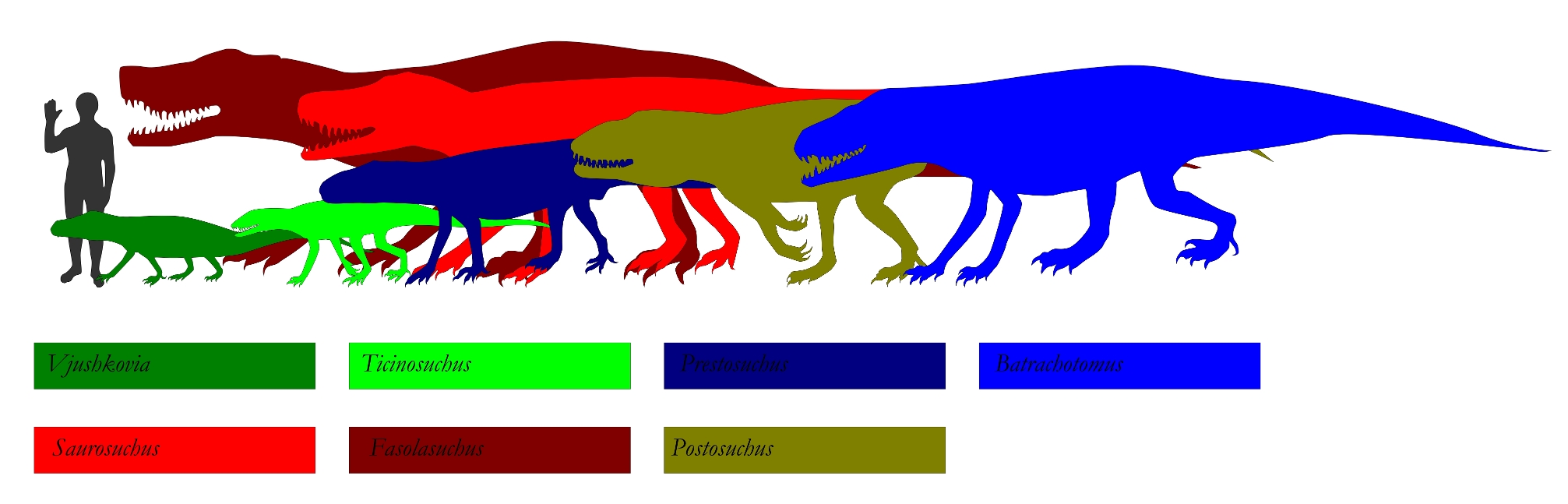
Size comparison of the main Triassic rauisuchids alongside a human silhouette, including Postosuchus, Saurosuchus, and Fasolasuchus.

Size comparison of the main Triassic rauisuchids alongside a human silhouette, including Postosuchus, Saurosuchus, and Fasolasuchus.

2013

Postcranial skeleton of Postosuchus kirkpatricki (Archosauria: Paracrocodylomorpha), from the Upper Triassic of the United States

Weinbaum, J.C. · Geological Society, London, Special Publications

Weinbaum's systematic description of the Postosuchus postcranial skeleton established that the holotype measured approximately 5 to 6 meters, while the paratype was between 3.5 and 4 meters. The study documented the detailed anatomy of the limbs, pelvis, and vertebrae, confirming erect posture with a vertical femur. The short forelimbs relative to hindlimbs suggest bipedal capability, with quadrupedal locomotion being more common in juveniles. This work is the definitive anatomical reference for the postcranial skeleton of the species.

Updated 2024 reconstruction of Postosuchus kirkpatricki by D2Hills, with greatly reduced forelimbs per modern postcranial data.

Updated 2024 reconstruction of Postosuchus kirkpatricki by D2Hills, with greatly reduced forelimbs per modern postcranial data.

Reconstruction of the Triassic Chinle Formation fauna with Postosuchus, Coelophysis, and Placerias, illustrating coexistence in the Late Triassic ecosystem.

Reconstruction of the Triassic Chinle Formation fauna with Postosuchus, Coelophysis, and Placerias, illustrating coexistence in the Late Triassic ecosystem.

2008

A new suchian archosaur from the Upper Triassic of North Carolina

Peyer, K.; Carter, J.G.; Sues, H.-D.; Novak, S.E.; Olsen, P.E. · Journal of Vertebrate Paleontology

Peyer and colleagues described Postosuchus alisonae from material at the Triangle Brick Company Quarry, Durham County, North Carolina. The new species differs from P. kirkpatricki in cranial and dental characters, expanding the geographic distribution of the genus to the eastern US seaboard. The paper discusses variability within the genus Postosuchus and contributes to understanding rauisuchid biogeography in the Late Triassic of North America, suggesting a wider distribution than the previous fossil record indicated.
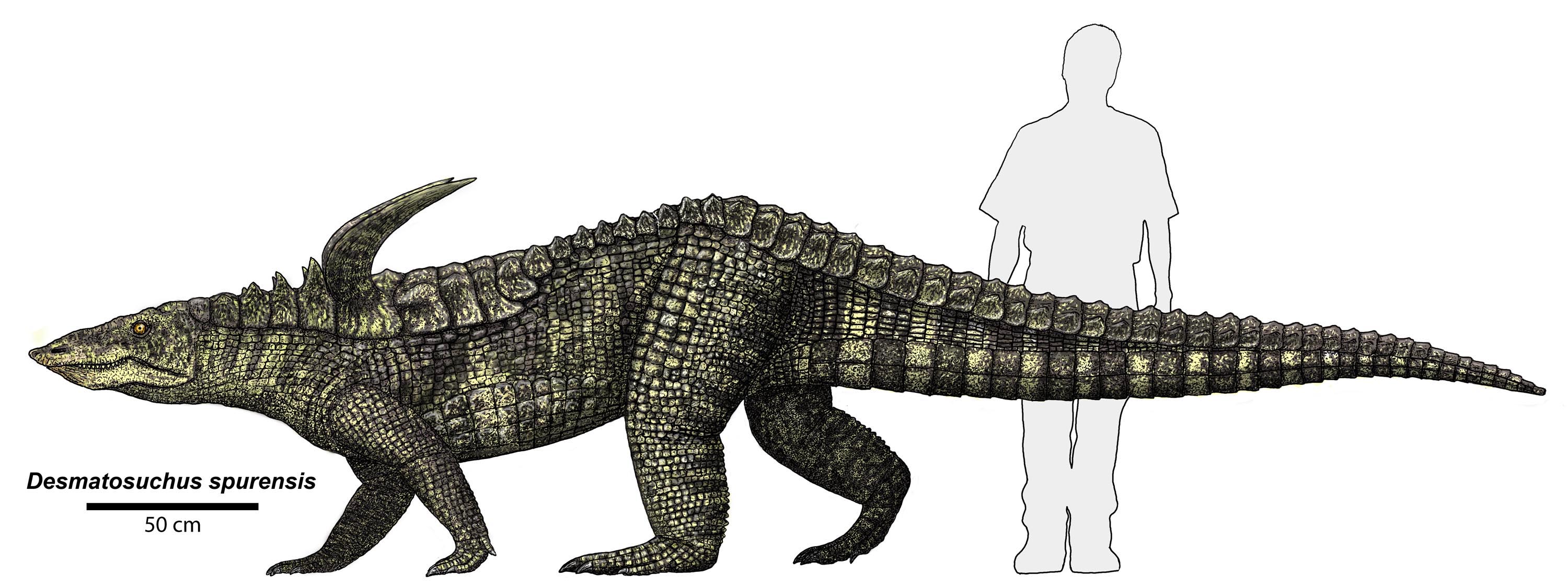
Reconstruction of Desmatosuchus spurensis, an armored aetosaur contemporary of Postosuchus in the Texas Tecovas/Dockum Formation, a possible prey of the predator.

Reconstruction of Desmatosuchus spurensis, an armored aetosaur contemporary of Postosuchus in the Texas Tecovas/Dockum Formation, a possible prey of the predator.

Skeletal reconstruction of Rauisuchus tiradens, a South American rauisuchid closely related to Postosuchus, showing the typical morphology of the group.

Skeletal reconstruction of Rauisuchus tiradens, a South American rauisuchid closely related to Postosuchus, showing the typical morphology of the group.

2011

The early evolution of archosaurs: relationships and the origin of major clades

Nesbitt, S.J. · Bulletin of the American Museum of Natural History

Nesbitt conducted the most comprehensive phylogenetic analysis of basal archosaurs published to that date, including 80 taxa and 412 characters. The study firmly positioned Postosuchus within Paracrocodylomorpha, clarifying its relationships with other Triassic pseudosuchians such as Fasolasuchus, Saurosuchus, and Rauisuchus. The paper refuted old hypotheses about Postosuchus relationships with dinosaurs and established the modern phylogenetic framework used to interpret crocodylomorph evolution and the decline of rauisuchids at the end of the Triassic.

Reconstruction of Typothorax coccinarum, a Chinle Formation aetosaur contemporary of Postosuchus, illustrating the diversity of Triassic pseudosuchians.

Reconstruction of Typothorax coccinarum, a Chinle Formation aetosaur contemporary of Postosuchus, illustrating the diversity of Triassic pseudosuchians.

Reconstruction of Aetosauroides scagliai, an armored Triassic pseudosuchian, representing the aetosaur group that shared the environment with Postosuchus.

Reconstruction of Aetosauroides scagliai, an armored Triassic pseudosuchian, representing the aetosaur group that shared the environment with Postosuchus.

2010

The origin and early radiation of dinosaurs

Brusatte, S.L.; Nesbitt, S.J.; Irmis, R.B.; Butler, R.J.; Benton, M.J.; Novas, F. · Earth-Science Reviews

Brusatte and colleagues reviewed the ecological context of dinosaur origins in the Late Triassic, highlighting that rauisuchids such as Postosuchus occupied apex predator niches before the rise of dinosaurs. The paper discusses how the decline of pseudosuchians at the end of the Triassic opened ecological space for theropods. Postosuchus is used as a paradigmatic example of a crurotarsal predator that shared the environment with the first dinosaurs before being replaced by them in the Triassic-Jurassic extinction crisis.
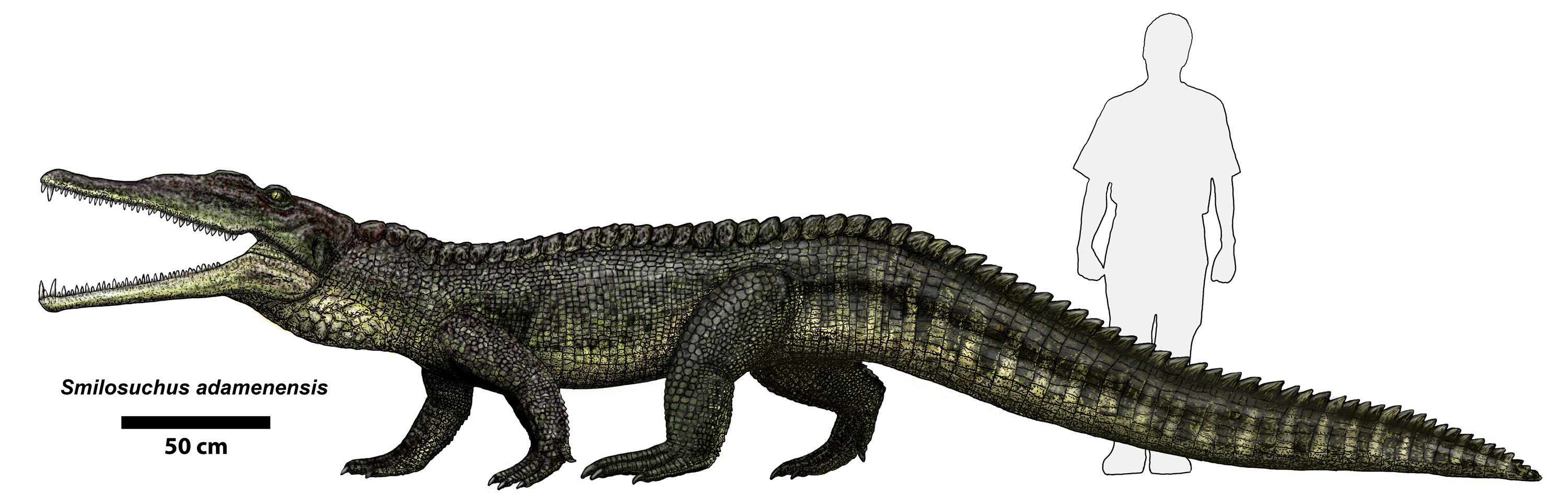
Reconstruction of Smilosuchus adamanensis, a Chinle Formation phytosaur contemporary of Postosuchus, illustrating the associated Late Triassic fauna.

Reconstruction of Smilosuchus adamanensis, a Chinle Formation phytosaur contemporary of Postosuchus, illustrating the associated Late Triassic fauna.

Speculative reconstruction of Garjainia, a primitive Triassic erythrosuchid relative of archosaurs, illustrating the ancestors of rauisuchids like Postosuchus.

Speculative reconstruction of Garjainia, a primitive Triassic erythrosuchid relative of archosaurs, illustrating the ancestors of rauisuchids like Postosuchus.

1983

Dinosaur success in the Triassic: a noncompetitive ecological model

Benton, M.J. · The Quarterly Review of Biology

Benton proposed the influential opportunistic replacement model to explain the rise of dinosaurs. Challenging the direct competition hypothesis, the study argues that dinosaurs did not replace rauisuchids such as Postosuchus through competitive superiority, but by opportunistically exploiting vacant niches after mass extinctions. The work had a lasting impact on how we interpret the ecological relationship between Postosuchus and the first dinosaurs, suggesting coexistence rather than gradual competitive replacement.
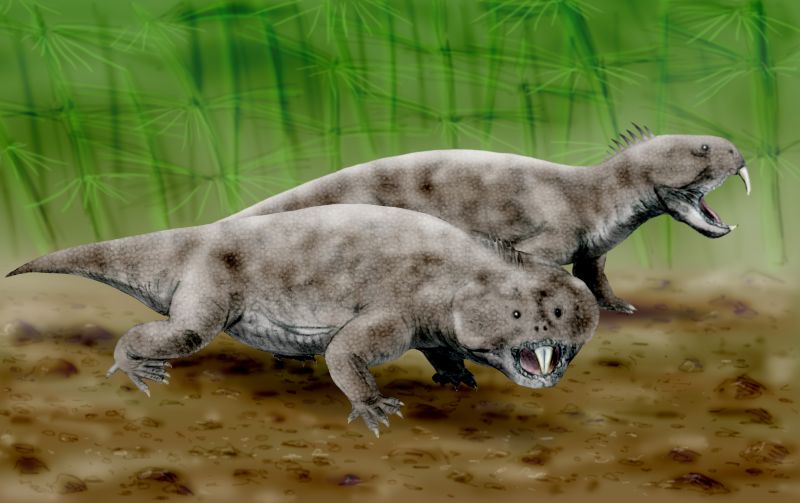
Reconstruction of Hyperodapedon huxleyi, a Late Triassic rhynchosaur from India and South America, a herbivore contemporary of Postosuchus and a possible prey item.

Reconstruction of Hyperodapedon huxleyi, a Late Triassic rhynchosaur from India and South America, a herbivore contemporary of Postosuchus and a possible prey item.

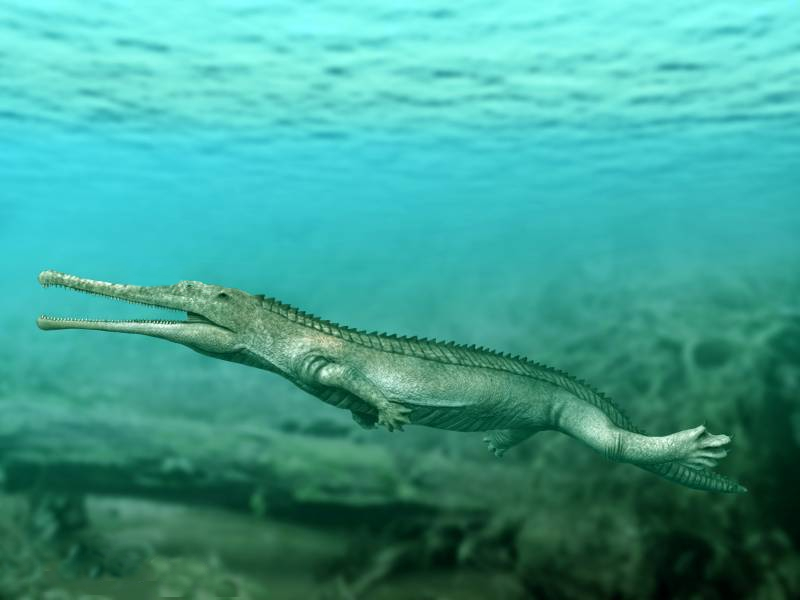
Reconstruction of Mystriosuchus planirostris, a European Late Triassic aquatic phytosaur, representing the aquatic reptiles that coexisted with Postosuchus.

Reconstruction of Mystriosuchus planirostris, a European Late Triassic aquatic phytosaur, representing the aquatic reptiles that coexisted with Postosuchus.

2002

Sphenodontia from the Upper Triassic Dockum Group of West Texas

Heckert, A.B.; Lucas, S.G. · New Mexico Museum of Natural History and Science Bulletin

Heckert and Lucas described the fauna associated with the Dockum Group of western Texas, the same sedimentary basin that preserved Postosuchus kirkpatricki. The study documents the diversity of reptiles in the Tecovas Formation, including sphenodontians, aetosaurs, metoposaurs, and the first dinosaurs. This faunal context is essential for understanding the ecological niche of Postosuchus as an apex predator in an ecosystem with high tetrapod diversity, many of which would have been potential prey of the large rauisuchid.

Fossil of Coelophysis bauri, one of the first dinosaurs to share the environment with Postosuchus in the Chinle Formation, showing the size contrast between the groups.

Fossil of Coelophysis bauri, one of the first dinosaurs to share the environment with Postosuchus in the Chinle Formation, showing the size contrast between the groups.

Fossil skeleton of Placerias, dicynodonts of up to 2 tons contemporary of Postosuchus in the Arizona Petrified Forest, potential prey of the Triassic predator.

Fossil skeleton of Placerias, dicynodonts of up to 2 tons contemporary of Postosuchus in the Arizona Petrified Forest, potential prey of the Triassic predator.

2007

Early ornithischian dinosaurs: the Triassic record

Irmis, R.B.; Parker, W.G.; Nesbitt, S.J.; Liu, J. · Historical Biology

Irmis and colleagues reviewed the Triassic record of ornithischian dinosaurs, focusing on the formations where Postosuchus was found. The work clarifies which animals coexisted with Postosuchus in the Chinle and Dockum formations, contributing to the paleoecological reconstruction of the Late Triassic environment. The study shows that the first dinosaurs were relatively rare and small-bodied at the time of Postosuchus, corroborating its status as the dominant predator in the ecosystem.

3D model of Aetosaurus ferratus, a European Late Triassic aetosaur, relative of Postosuchus contemporaries and representative of the armored group.

3D model of Aetosaurus ferratus, a European Late Triassic aetosaur, relative of Postosuchus contemporaries and representative of the armored group.

Reconstruction of Silesaurus opolensis, a Late Triassic Polish herbivorous dinosauriform, representing dinosaur relatives that coexisted with Postosuchus.

Reconstruction of Silesaurus opolensis, a Late Triassic Polish herbivorous dinosauriform, representing dinosaur relatives that coexisted with Postosuchus.

1993

Phylogeny of the Crocodylotarsi, with reference to archosaurian and crurotarsal monophyly

Parrish, J.M. · Journal of Vertebrate Paleontology

Parrish conducted a phylogenetic analysis that firmly placed Postosuchus within Crocodylotarsi (now Pseudosuchia), definitively separating the genus from dinosaurs. The study proposed the monophyly of Crurotarsi based on ankle characters and other postcranial synapomorphies. This work was fundamental in abandoning Chatterjee's hypotheses about Postosuchus relationships with tyrannosaurs and establishing the modern understanding that the animal belonged to the crocodilian lineage, not the dinosaurian one.
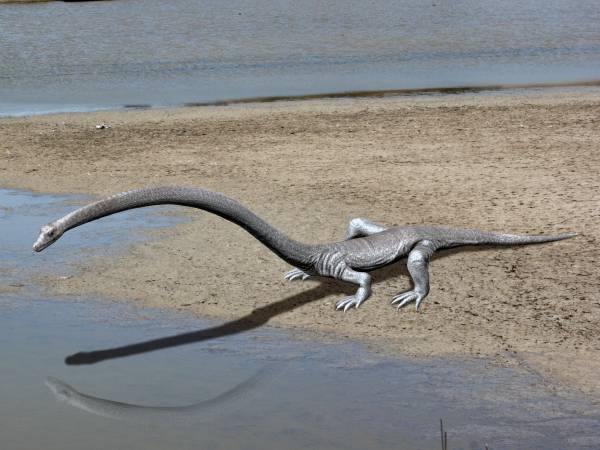
Reconstruction of Tanystropheus longobardicus, a long-necked Middle Triassic archosauriform reptile, a more primitive relative of the group that led to archosaurs.

Reconstruction of Tanystropheus longobardicus, a long-necked Middle Triassic archosauriform reptile, a more primitive relative of the group that led to archosaurs.

Skeletal reconstruction of Ticinosuchus ferox, a Middle Triassic Swiss rauisuchid, representing a more primitive relative of Postosuchus within the Rauisuchidae lineage.

Skeletal reconstruction of Ticinosuchus ferox, a Middle Triassic Swiss rauisuchid, representing a more primitive relative of Postosuchus within the Rauisuchidae lineage.

2011

An unusual new archosauriform from the Middle-Late Triassic of southern Brazil and the monophyly of Doswelliidae

Desojo, J.B.; Ezcurra, M.D.; Schultz, C.L. · Zoological Journal of the Linnean Society

Desojo and colleagues described Doswellia kaltenbachi from new Brazilian materials, conducting a phylogenetic analysis that includes Postosuchus as a North American representative of paracrocodylomorphs. The work clarifies biogeographical relationships between South and North American rauisuchids in the Triassic, suggesting faunal interchanges between the two continental masses before the complete separation of Pangea. Postosuchus serves as a North American phylogenetic anchor in this analysis, with a direct impact on understanding its evolutionary position.

Mounted fossil skeleton of Prestosuchus chiniquensis at AMNH, a South American Late Triassic rauisuchid, one of the closest relatives of Postosuchus.

Mounted fossil skeleton of Prestosuchus chiniquensis at AMNH, a South American Late Triassic rauisuchid, one of the closest relatives of Postosuchus.

Skull reconstruction of Fasolasuchus tenax, the largest known rauisuchid from Argentina, illustrating the size diversity within Rauisuchidae.

Skull reconstruction of Fasolasuchus tenax, the largest known rauisuchid from Argentina, illustrating the size diversity within Rauisuchidae.

2016

The phylogenetic relationships of basal archosauriforms, with an emphasis on the systematics of proterochampsid reptiles

Ezcurra, M.D. · PeerJ

Ezcurra published the most extensive phylogenetic analysis of basal archosauriforms of the time, with 96 taxa and 614 characters. The study confirmed Postosuchus as a member of Paracrocodylomorpha and systematically tested the relationships between rauisuchids, poposaurs, and other Triassic pseudosuchians. The work reinforced the modern view of archosaur phylogeny and provided a widely-used reference matrix in subsequent phylogenetic analyses involving Postosuchus and its relatives.
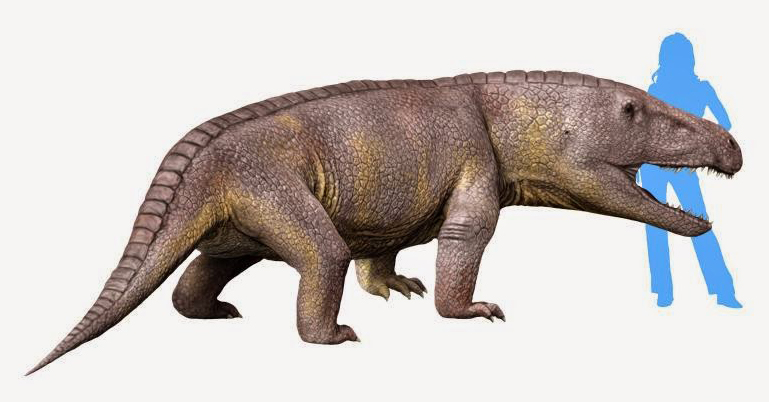
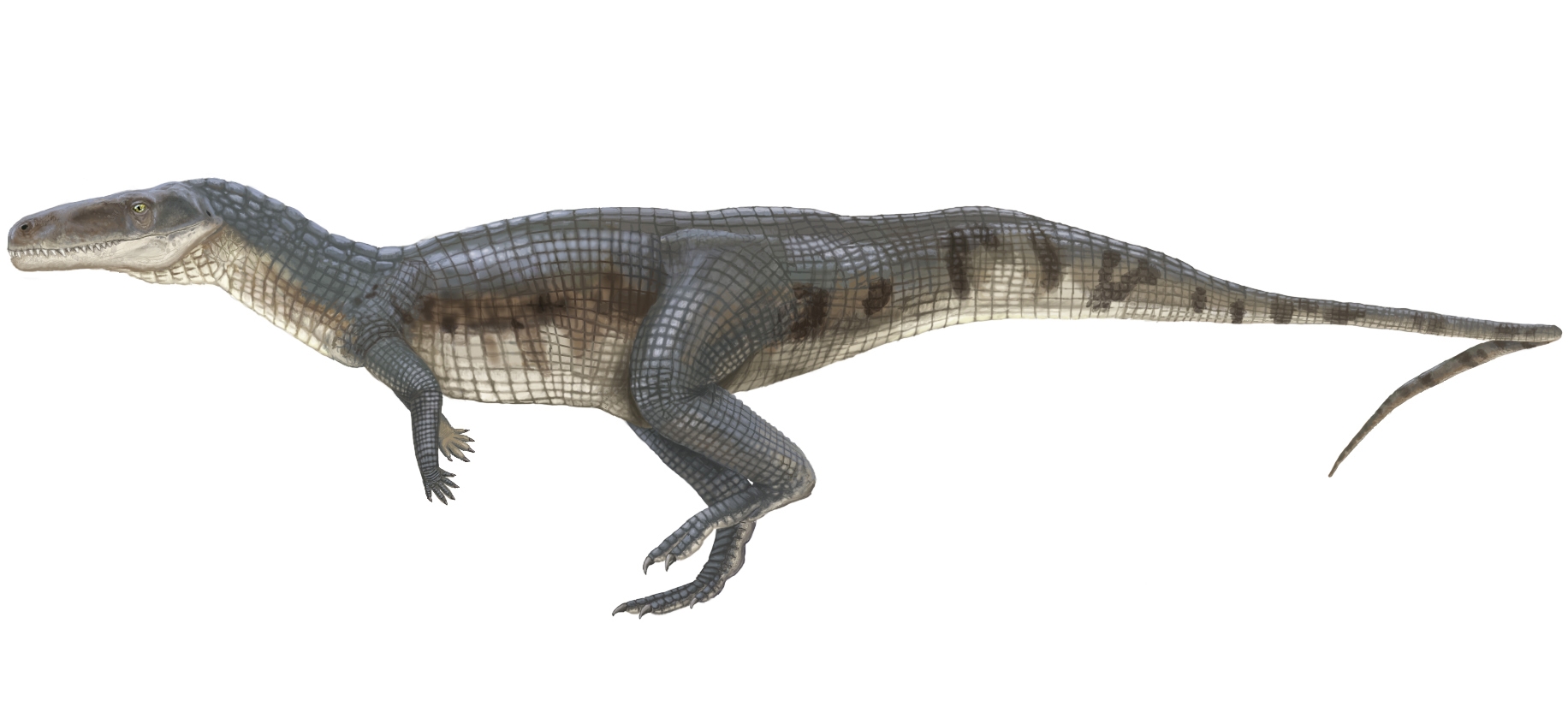
Reconstruction of Erythrosuchus africanus, an African Middle Triassic archosauriform, representing the predators that preceded rauisuchids like Postosuchus.

Reconstruction of Erythrosuchus africanus, an African Middle Triassic archosauriform, representing the predators that preceded rauisuchids like Postosuchus.

Reconstruction of Poposaurus gracilis, a bipedal poposaurid from the Chinle Formation, a close relative of Postosuchus within Pseudosuchia, illustrating convergent bipedalism.

Reconstruction of Poposaurus gracilis, a bipedal poposaurid from the Chinle Formation, a close relative of Postosuchus within Pseudosuchia, illustrating convergent bipedalism.

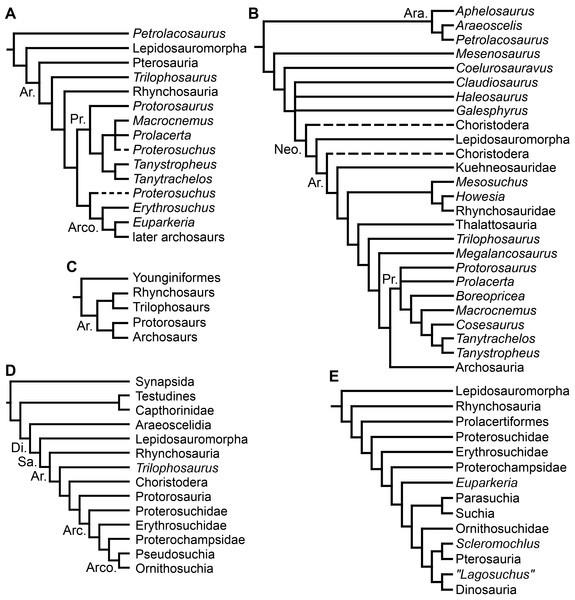
Figure 1: Phylogenetic trees depicting selected previous hypotheses for the higher-level relationships of early archosauromorphs in the period 1985–1996. (A) Benton (1985) ; (B) Evans (1988) ; (C) Chatterjee (1986) ; (D) Gauthier, Kluge & Rowe (1988) ; and (E) Bennett (1996) . Abbreviations: Ar., Archosauromorpha; Ara, Araeoscelidia; Arc., Archosauriformes; Arco., Archosauria; Di., Diapsida; Neo., Neodiapsida; Pr., Prolacertiformes; Sa., Sauria. Download full-size image DOI: 10.7717/peerj.1778/f

Figure 1: Phylogenetic trees depicting selected previous hypotheses for the higher-level relationships of early archosauromorphs in the period 1985–1996. (A) Benton (1985) ; (B) Evans (1988) ; (C) Chatterjee (1986) ; (D) Gauthier, Kluge & Rowe (1988) ; and (E) Bennett (1996) . Abbreviations: Ar., Archosauromorpha; Ara, Araeoscelidia; Arc., Archosauriformes; Arco., Archosauria; Di., Diapsida; Neo., Neodiapsida; Pr., Prolacertiformes; Sa., Sauria. Download full-size image DOI: 10.7717/peerj.1778/f

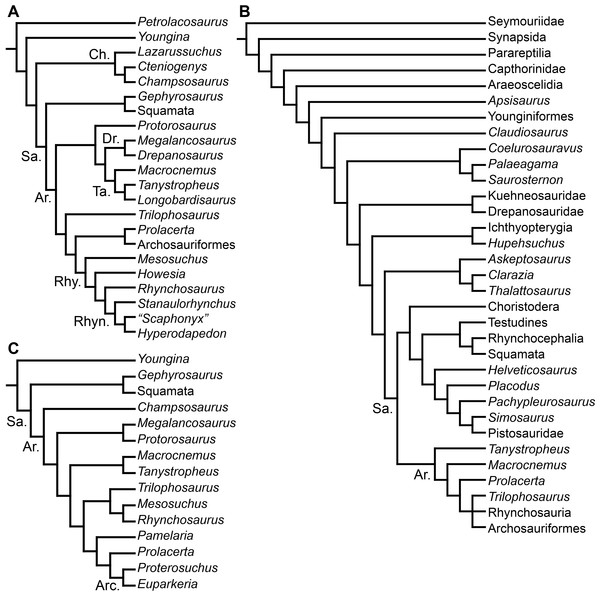
Figure 2: Phylogenetic trees depicting selected previous hypotheses for the higher-level relationships of early archosauromorphs in the period 1998–2009. (A) Dilkes (1998) ; (B) Müller (2004) ; and (C) Gottmann-Quesada & Sander (2009) . Abbreviations: Ar., Archosauromorpha; Arc., Archosauriformes; Ch., Choristodera; Dr., Drepanosauridae; Rhy., Rhynchosauria; Rhyn., Rhynchosauridae; Sa., Sauria; Ta., Tanystropheidae. Download full-size image DOI: 10.7717/peerj.1778/fig-2

Figure 2: Phylogenetic trees depicting selected previous hypotheses for the higher-level relationships of early archosauromorphs in the period 1998–2009. (A) Dilkes (1998) ; (B) Müller (2004) ; and (C) Gottmann-Quesada & Sander (2009) . Abbreviations: Ar., Archosauromorpha; Arc., Archosauriformes; Ch., Choristodera; Dr., Drepanosauridae; Rhy., Rhynchosauria; Rhyn., Rhynchosauridae; Sa., Sauria; Ta., Tanystropheidae. Download full-size image DOI: 10.7717/peerj.1778/fig-2

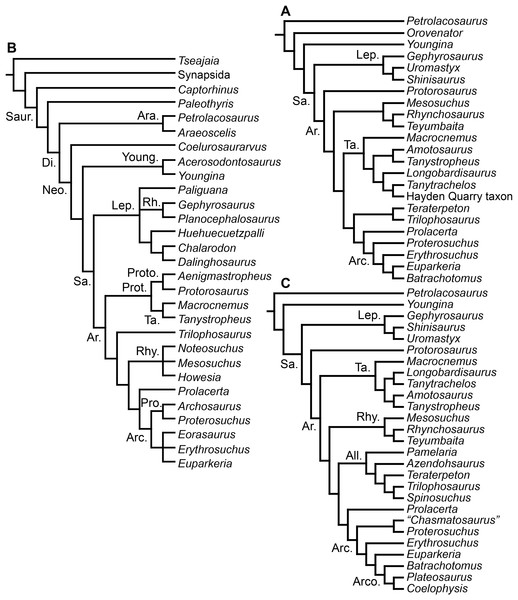
Figure 3: Phylogenetic trees depicting selected previous hypotheses for the higher-level relationships of early archosauromorphs in the period 2014–2015. (A) Pritchard et al. (2015) ; (B) Ezcurra, Scheyer & Butler (2014) ; and (C) Nesbitt et al. (2015) . Abbreviations: All., Allokotosauria; Ar., Archosauromorpha; Ara, Araeoscelidia; Arc., Archosauriformes; Arco., Archosauria; Di., Diapsida; Lep., Lepidosauromorpha; Neo., Neodiapsida; Pro., Proterosuchidae; Prot., Protorosauria; Proto., Protorosa

Figure 3: Phylogenetic trees depicting selected previous hypotheses for the higher-level relationships of early archosauromorphs in the period 2014–2015. (A) Pritchard et al. (2015) ; (B) Ezcurra, Scheyer & Butler (2014) ; and (C) Nesbitt et al. (2015) . Abbreviations: All., Allokotosauria; Ar., Archosauromorpha; Ara, Araeoscelidia; Arc., Archosauriformes; Arco., Archosauria; Di., Diapsida; Lep., Lepidosauromorpha; Neo., Neodiapsida; Pro., Proterosuchidae; Prot., Protorosauria; Proto., Protorosa

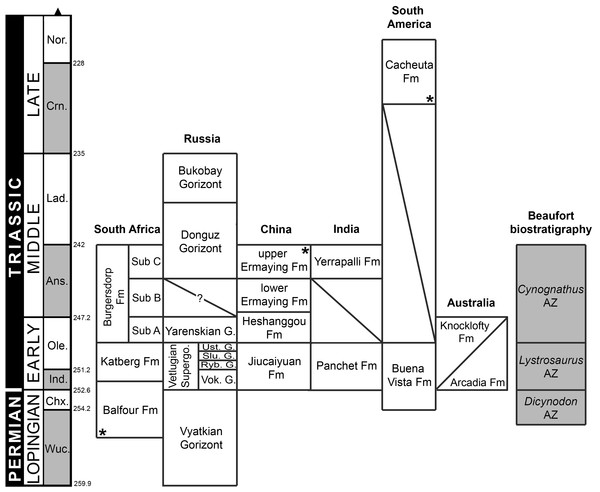
Figure 4: Chronostratigraphic diagram of proterosuchian-bearing units (sensu Ezcurra, Butler & Gower, 2013 ; Ezcurra et al., 2015 ). Ages of South African units based on Rubidge (2005) and Rubidge et al. (2013) ; Russian units based on Newell et al. (2010) and Newell et al. (2012) ; Chinese and Indian units based on Lucas (2010) and Liu, Li & Li (2013) ; South American units based on Piñeiro et al. (2003) and Spalletti, Fanning & Rapela (2008) ; and Australian units based on Ezcurra (2014) and W

Figure 4: Chronostratigraphic diagram of proterosuchian-bearing units (sensu Ezcurra, Butler & Gower, 2013 ; Ezcurra et al., 2015 ). Ages of South African units based on Rubidge (2005) and Rubidge et al. (2013) ; Russian units based on Newell et al. (2010) and Newell et al. (2012) ; Chinese and Indian units based on Lucas (2010) and Liu, Li & Li (2013) ; South American units based on Piñeiro et al. (2003) and Spalletti, Fanning & Rapela (2008) ; and Australian units based on Ezcurra (2014) and W

2019

Non-dinosaurian dinosauriformes from the Chinle Formation (Upper Triassic) of the Zuni Mountains, New Mexico, USA

Martz, J.W.; Small, B.J. · PeerJ

Martz and Small described dinosauriform and other archosaur material from the Chinle Formation in the Zuni Mountains, New Mexico, one of the formations where Postosuchus fossils also occur. The work documents the faunal diversity of the Late Triassic ecosystem of the American Southwest, contextualizing the relationships between the first dinosaurs and dominant rauisuchids. The data provide an updated picture of faunal composition contemporary with Postosuchus, with implications for understanding its ecology and interactions with other groups.
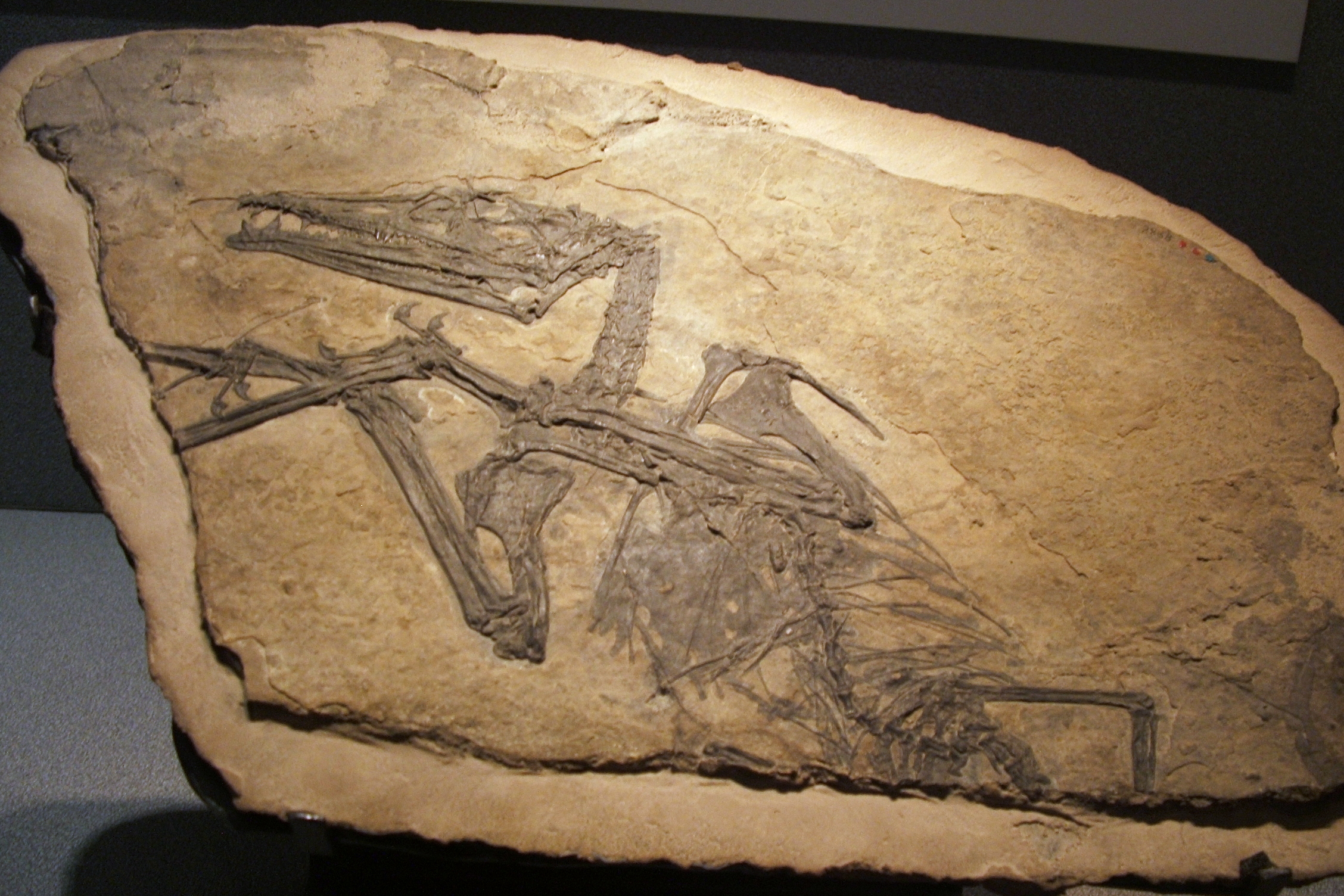
Fossil of Eudimorphodon ranzii, one of the most primitive pterosaurs from the European Late Triassic, representing the flying reptiles that shared the ecosystem with Postosuchus.

Fossil of Eudimorphodon ranzii, one of the most primitive pterosaurs from the European Late Triassic, representing the flying reptiles that shared the ecosystem with Postosuchus.

Mounted fossil skeleton of Staurikosaurus pricei, a South American basal Late Triassic dinosaur, representing the first dinosaurs that coexisted with rauisuchids.

Mounted fossil skeleton of Staurikosaurus pricei, a South American basal Late Triassic dinosaur, representing the first dinosaurs that coexisted with rauisuchids.

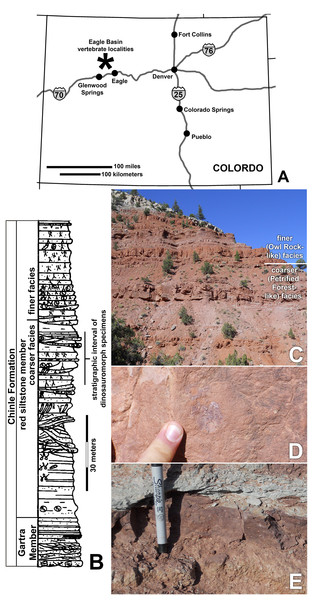
Figure 1: Chinle Formation exposures in the Eagle Basin of northern Colorado. (A) Map of Colorado showing approximate location of localities. (B) Stratigraphic section of the Chinle Formation showing approximate stratigraphic interval of dinosauromorph localities (modified from Derby Junction section of Dubiel, 1992 : fig. 4). (C) Exposures of the red siltstone member along the Colorado River north of I-70 at 13S 033415 4412881 NAD 27 showing the approximate division between the coarser facies s

Figure 1: Chinle Formation exposures in the Eagle Basin of northern Colorado. (A) Map of Colorado showing approximate location of localities. (B) Stratigraphic section of the Chinle Formation showing approximate stratigraphic interval of dinosauromorph localities (modified from Derby Junction section of Dubiel, 1992 : fig. 4). (C) Exposures of the red siltstone member along the Colorado River north of I-70 at 13S 033415 4412881 NAD 27 showing the approximate division between the coarser facies s

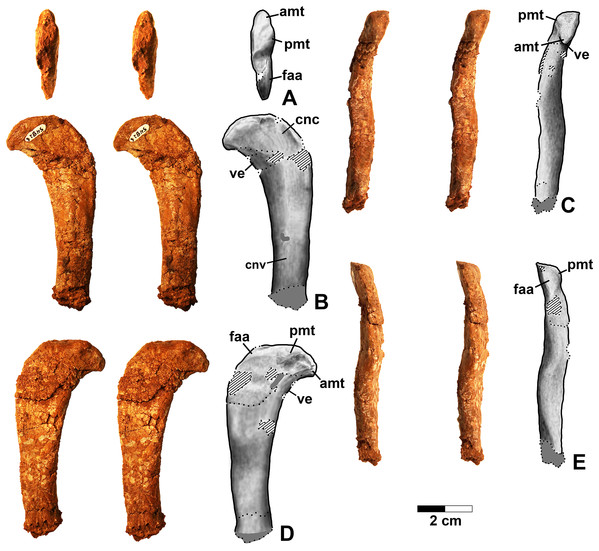
Figure 2: Dromomeron romeri voucher specimen (DMNH EPV.54826), proximal left femur, stereopairs, and interpretive drawings. (A) Proximal view, (B) anterolateral view, (C) anteromedial view, (D) posteromedial view, (E) posterolateral view. See text for abbreviations. Scale bar = 2 cm. Download full-size image DOI: 10.7717/peerj.7551/fig-2

Figure 2: Dromomeron romeri voucher specimen (DMNH EPV.54826), proximal left femur, stereopairs, and interpretive drawings. (A) Proximal view, (B) anterolateral view, (C) anteromedial view, (D) posteromedial view, (E) posterolateral view. See text for abbreviations. Scale bar = 2 cm. Download full-size image DOI: 10.7717/peerj.7551/fig-2

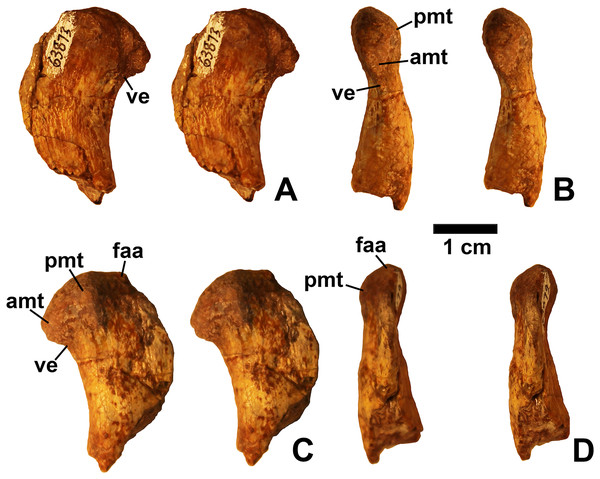
Figure 3: Dromomeron romeri (DMNH EPV.63873), proximal right femur, labeled steropairs. (A) Anterolateral view, (B) anteromedial view, (C) posteromedial view, (D) posterolateral view. See text for abbreviations. Scale bar = 1 cm. Download full-size image DOI: 10.7717/peerj.7551/fig-3

Figure 3: Dromomeron romeri (DMNH EPV.63873), proximal right femur, labeled steropairs. (A) Anterolateral view, (B) anteromedial view, (C) posteromedial view, (D) posterolateral view. See text for abbreviations. Scale bar = 1 cm. Download full-size image DOI: 10.7717/peerj.7551/fig-3

Figure 4: Dromomeron romeri (DMNH EPV.29956), right humerus, labeled stereopairs. (A) Proximal view, (B) anterior view, (C) medial view, (D) posterior view, (E) lateral view, (F) proximal view showing angle of torsion between long axes of proximal and distal ends, gray lines represent the long axes of the proximal and distal ends. See text for abbreviations. Scale bar = 2 cm. Download full-size image DOI: 10.7717/peerj.7551/fig-4

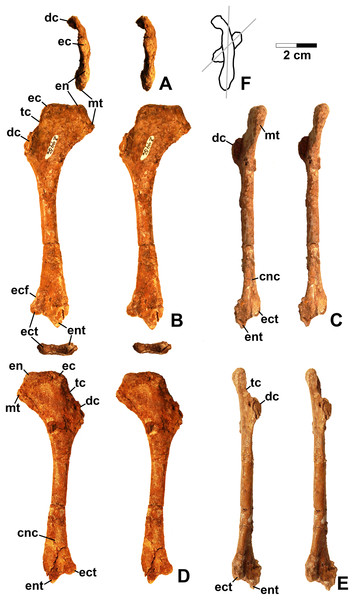
Figure 4: Dromomeron romeri (DMNH EPV.29956), right humerus, labeled stereopairs. (A) Proximal view, (B) anterior view, (C) medial view, (D) posterior view, (E) lateral view, (F) proximal view showing angle of torsion between long axes of proximal and distal ends, gray lines represent the long axes of the proximal and distal ends. See text for abbreviations. Scale bar = 2 cm. Download full-size image DOI: 10.7717/peerj.7551/fig-4

2020

The second record of a nearly complete early dinosaur, with details of facultative bipedality in Triassic archosaurs

Griffin, C.T.; Nesbitt, S.J. · Journal of Paleontology

Griffin and Nesbitt examined facultative bipedal locomotion in Triassic archosaurs, with direct discussion of implications for Postosuchus. The work analyzes limb proportions and pelvis morphology to infer locomotor capacity, concluding that adult Postosuchus was predominantly bipedal while juveniles were likely more quadrupedal. This result connects to Weinbaum's (2013) observations on forelimb reduction during ontogeny, providing a functional framework for understanding the locomotion of this Triassic predator.

Reconstruction of Terrestrisuchus gracilis, a small European Late Triassic crocodylomorph, representing the crocodilian lineage that would survive the extinction that eliminated Postosuchus.

Reconstruction of Terrestrisuchus gracilis, a small European Late Triassic crocodylomorph, representing the crocodilian lineage that would survive the extinction that eliminated Postosuchus.

Fossil of Eoraptor lunensis outcropping from the soil in the Ischigualasto Formation, Argentina. One of the most primitive dinosaurs, contemporary with the first rauisuchids like Postosuchus.

Fossil of Eoraptor lunensis outcropping from the soil in the Ischigualasto Formation, Argentina. One of the most primitive dinosaurs, contemporary with the first rauisuchids like Postosuchus.

TTU-P 9000 (Holótipo) — Museum of Texas Tech University, Lubbock, Texas

Dr. Jeff Martz / NPS, Domínio Público

TTU-P 9000 (Holótipo)

Museum of Texas Tech University, Lubbock, Texas

Completeness: ~60%
Found in: 1980
By: Sankar Chatterjee

Holotype of Postosuchus kirkpatricki collected at the Post Quarry, Garza County, Texas. Preserves a complete skull and partial postcranial skeleton, estimated at 5 to 6 meters in length. Primary reference specimen for the entire species.

TTU-P 9002 (Parátipo) — Museum of Texas Tech University, Lubbock, Texas

Dr. Jeff Martz / NPS, Domínio Público

TTU-P 9002 (Parátipo)

Museum of Texas Tech University, Lubbock, Texas

Completeness: ~75%
Found in: 1980
By: Sankar Chatterjee

Paratype of Postosuchus kirkpatricki collected at the same Post Quarry as the holotype. With nearly complete skull and skeleton, this specimen measured between 3.5 and 4 meters in length. It was fundamental for Weinbaum's (2011, 2013) redescriptions and for understanding the ontogenetic variation of the species.

UNC 15575 (Holótipo P. alisonae) — North Carolina Museum of Natural Sciences, Raleigh, Carolina do Norte

Liopleurodon93, CC BY-SA 3.0

UNC 15575 (Holótipo P. alisonae)

North Carolina Museum of Natural Sciences, Raleigh, Carolina do Norte

Completeness: ~40%
Found in: 1992
By: Jeff Efird

Holotype of Postosuchus alisonae, new species described by Peyer et al. (2008), collected at the Triangle Brick Company Quarry, Durham County, North Carolina. Represents the first confirmed occurrence of the genus on the US East Coast, significantly expanding its known geographic distribution.

Postosuchus has gained significant space in popular culture primarily through high-production scientific documentaries. Its television debut in the 'New Blood' episode of Walking with Dinosaurs (BBC, 1999) was landmark: the narrative centered on a female that hunts, dominates territory, and eventually dies introduced the Triassic predator to millions of viewers worldwide. Although the reconstruction had anatomical inaccuracies, such as overly long forelimbs, the territorial behavior and rivalry with the first dinosaurs were captured in an emotionally effective way. The IMAX documentary Dinosaurs Alive! (2007) and the series Prehistoric Park (2006) reinforced its media presence. Lower-budget science fiction productions like Triassic World (2018) exploited the animal's name without commitment to scientific accuracy. In the current landscape, with growing interest in Triassic fauna driven by programs like Prehistoric Planet, Postosuchus has gained renewed recognition as the Triassic equivalent of T-rex: dominant yet doomed to extinction even before the rise of the great dinosaurs.

Animatrônico do T-rex da franquia Jurassic Park com o Jeep característico da série

Full-size T-rex animatronic from the Jurassic Park franchise, with the iconic red Jeep — Amaury Laporte · CC BY 2.0

1999 📹 Walking with Dinosaurs — Tim Haines Wikipedia →
2006 📹 Prehistoric Park — Matthew Thompson Wikipedia →
2007 📹 Dinosaurs Alive! — David Clark Wikipedia →
2012 🎨 Andy's Prehistoric Adventures — BBC Children's Wikipedia →
2018 🎥 Triassic World — Dylan Vox Wikipedia →
Archosauria
Pseudosuchia
Paracrocodylomorpha
Rauisuchidae
First fossil
1980
Discoverer
Sankar Chatterjee
Formal description
1985
Described by
Sankar Chatterjee
Formation
Tecovas Formation (Cooper Canyon Formation, Dockum Group)
Region
Texas
Country
United States
📄 Original description paper

Fun fact

Postosuchus was not a dinosaur, but a distant relative of modern crocodilians that independently evolved erect posture and bipedalism completely separately from dinosaurs. In the Late Triassic, this 'false dinosaur' dominated the same ecosystems as the first true dinosaurs, such as Coelophysis, which were much smaller and less imposing.