
Pinacosaurus
Pinacosaurus grangeri
"Plank lizard of Granger"
About this species
Pinacosaurus grangeri is a medium-sized ankylosaurid from the Late Cretaceous (Campanian, about 80 to 75 million years ago) of the Djadokhta Formation of Mongolia and the Bayan Mandahu Formation of Inner Mongolia, China, with older records from the Alagteeg Formation. It was described by Charles W. Gilmore in 1933 based on holotype AMNH 6523, collected in 1923 at Shabarakh Usu (today Bayn Dzak, 'Flaming Cliffs') by palaeontologist Walter Granger during the Central Asiatic Expeditions led by Roy Chapman Andrews. It reached about 5 metres in length and 1.9 tonnes in body mass. The skull was low and broad, with a toothless beak, weakly developed squamosal horns, four pyramidal occipital horns and a series of accessory narial openings perforating the premaxilla, a diagnostic feature of the genus. The body was covered with keeled polygonal osteoderms, with two cervical half rings protecting the neck and a tail ending in a bony club. The genus contains two valid species: P. grangeri (Mongolia and China) and P. mephistocephalus (Godefroit et al., 1999), distinguished by 'devil-like' squamosal horns projecting far beyond the skull roof. Pinacosaurus is best known for the extraordinary juvenile bonebeds of Alag Teeg (Mongolia) and Bayan Mandahu (China), with about 100 partially articulated immature skeletons preserved together, direct evidence of gregarious behaviour in young ankylosaurs. In 2023, Yoshida, Kobayashi and Norell described in Communications Biology the first preserved laryngeal apparatus in a non-avian dinosaur, also in Pinacosaurus, suggesting bird-like vocalisation.
Geological formation & environment
Djadokhta Formation, Campanian (about 80 to 75 Ma), Ulan Nuur Basin, southern Mongolia. The unit crops out as iconic reddish-orange sandstones at the 'Flaming Cliffs' of Bayn Dzak (Bayanzag), at Tugrikin Shireh, Ukhaa Tolgod, Udyn Sayr and Zamyn Khondt. It was first documented by the AMNH's Central Asiatic Expeditions (1922-1925) led by Roy Chapman Andrews, with Walter Granger as chief palaeontologist. The depositional environment was an aeolian dune field with interfingering ephemeral fluvial and shallow lake sediments under a semi-arid climate. Associated fauna includes Protoceratops andrewsi (abundant), Velociraptor mongoliensis, Citipati osmolskae, Oviraptor philoceratops, Khaan mckennai and the multituberculate mammal Kryptobaatar. The Alagteeg Formation (slightly older) crops out at Alag Teeg with fluvial-lacustrine lithofacies. The Bayan Mandahu Formation is the Chinese equivalent of the Djadokhta, in Inner Mongolia. All three formations contain Pinacosaurus grangeri.
Image gallery
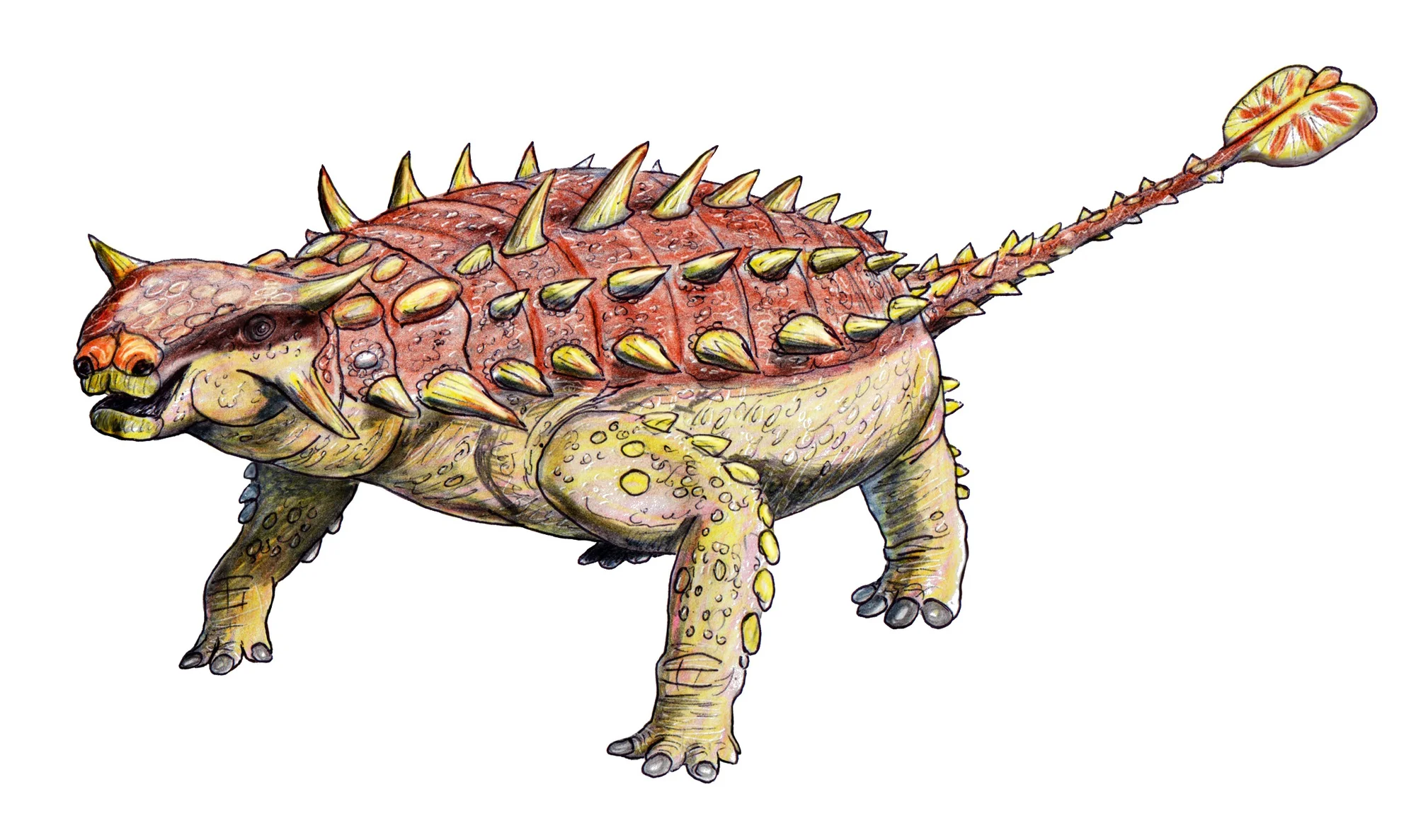


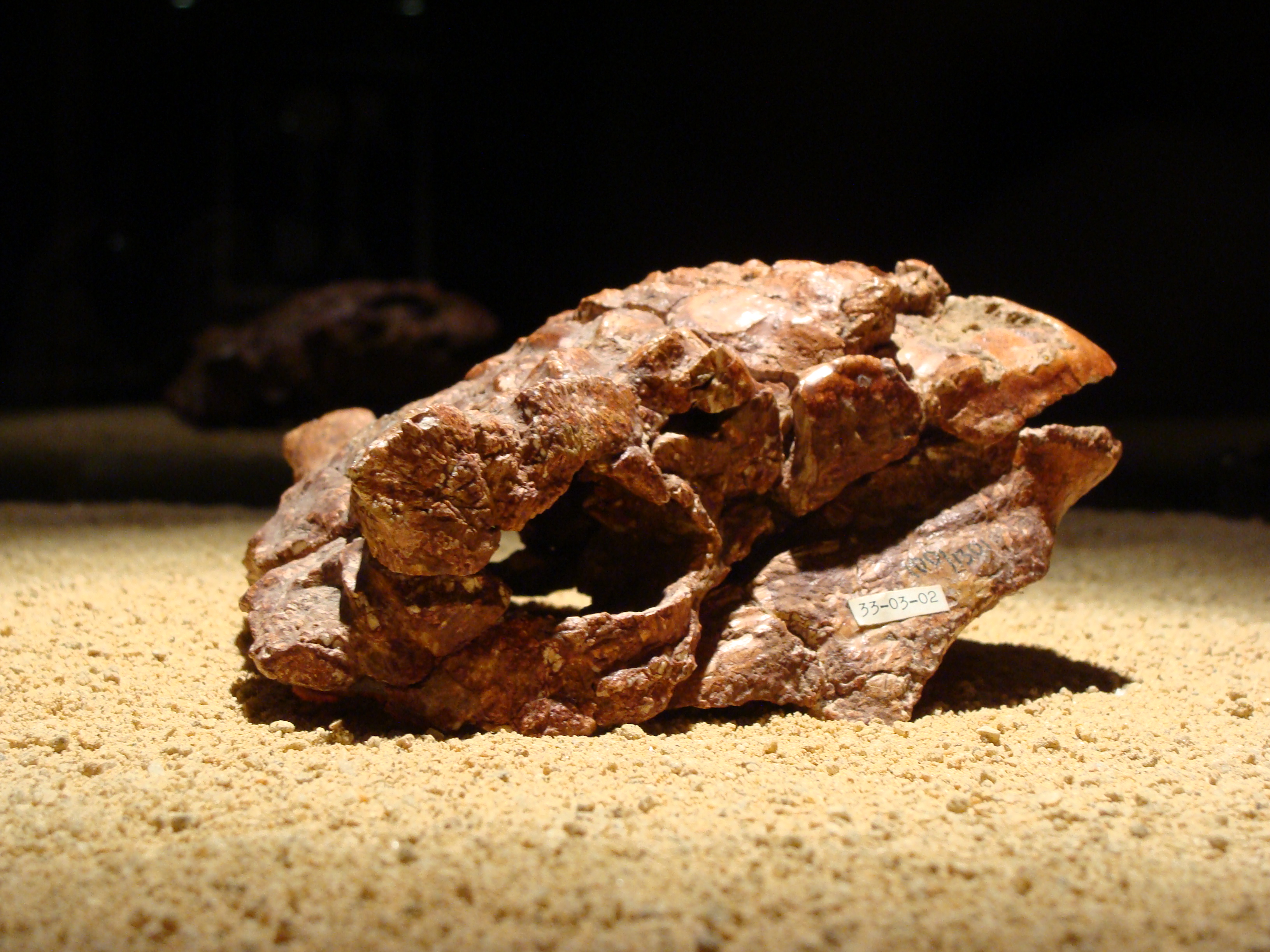


Life reconstruction of Pinacosaurus grangeri by Dmitry Bogdanov, an ankylosaurid from the Late Cretaceous of Mongolia and China, showing dorsal osteoderms and tail club.
Dmitry Bogdanov (DiBgd), Wikimedia Commons, CC BY-SA 4.0
Ecology and behavior
Habitat
Desert and semi-arid environments of the Late Cretaceous of Central Asia. The Djadokhta Formation preserves aeolian dune fields with interbedded ephemeral fluvial and shallow seasonal lake deposits. The Alagteeg Formation, slightly older, represents a braided river system with floodplains and ephemeral ponds under a subhumid climate. Vegetation was dominated by conifers (Frenelopsis), cycads and small early angiosperms. The famous 'Flaming Cliffs' expose reddish-orange sandstones that record recurring sandstorms, responsible for the living burial of juvenile groups of Pinacosaurus and Protoceratops.
Feeding
Strict low-browsing herbivore with the head close to the ground. The broad toothless beak and small leaf-shaped teeth in the posterior dentary suggest selective grazing of low-growing vegetation. Analogies with other ankylosaurids indicate a diet of ferns, young conifers and low-stature foliage. The broad palate and complex nasal cavity, with multiple accessory openings, may have functioned as air-conditioning chambers for inspired air, useful in dry environments.
Behavior and senses
Gregarious behaviour confirmed in juveniles: the Alag Teeg bonebeds (about 100 individuals) and Bayan Mandahu (at least 12) preserve whole partially articulated groups, many in similar orientation, consistent with troops buried by sandstorms or rapid floods (Currie et al. 2011; Hone et al. 2014). Predation on fully armoured adults with tail clubs would have been difficult even for large Gobi theropods like Tarbosaurus; the tail club constituted active defence. In 2023, Yoshida et al. provided the first direct evidence of vocalisation through the preserved laryngeal apparatus, with structures analogous to bird vocal modifiers.
Physiology and growth
Medium-sized ankylosaurid (about 5 m length, 1.9 tonnes). Bone histology of juveniles reveals rapid growth in the immature phase, consistent with an accelerated maturation strategy. The large number of preserved juveniles, one of the highest in the fossil record, suggests high mortality at early stages, probably related to recurring catastrophic events in the Gobi desert environment. The larynx of IGM 100/3186 shows vocalisation capacity comparable to modern archosaurs (Yoshida et al. 2023).
Paleogeography
Continental configuration

Scotese & Vérard · CC BY 4.0 · Cretaceous, ~105 Ma
During the Campaniano (Cretáceo Superior) (~80–75 Ma), Pinacosaurus grangeri inhabited Laramidia, the western half of present-day North America, separated from the east by the Western Interior Seaway, a shallow sea dividing the continent. The continents were in very different positions: India was drifting toward Asia, Antarctica was still connected to Australia, and South America was an isolated island.
Bone Inventory
Pinacosaurus is one of the best-known ankylosaurids worldwide. The holotype AMNH 6523 consists of a near-complete skull, mandible, atlas, axis and osteoderms. The real wealth, however, comes from the juvenile bonebeds: Alag Teeg (Mongolia) yielded about 30 skeletons collected by the Soviet-Mongolian expeditions (1969-1971) and an additional 70 by the Canada-China, Mongolian-Japanese and Polish expeditions between 1993 and 2006, totalling approximately 100 immature skeletons; Bayan Mandahu (Inner Mongolia) yielded at least 12 juvenile skeletons and multiple adults from the Canada-China Dinosaur Project between 1987 and 1990. In 2003, Hill, Witmer and Norell described a new juvenile skull (IGM 100/1014) from Ukhaa Tolgod. In 2023, a preserved laryngeal apparatus in IGM 100/3186 provided the first direct evidence of vocalisation in a non-avian dinosaur.
Found elements
Inferred elements
Scientific Literature
15 papers in chronological order — from the original description to recent research.
Two new dinosaurian reptiles from Mongolia with notes on some fragmentary specimens
Gilmore, C.W. · American Museum Novitates, 679: 1-20
Original description of the genus and species Pinacosaurus grangeri based on holotype AMNH 6523 (dorsoventrally crushed skull, mandible, atlas, axis and osteoderms) collected by Walter Granger in 1923 in the Djadokhta Formation at Shabarakh Usu (Flaming Cliffs), Mongolia. Gilmore identified the diagnostic combination of pyramidal squamosal horns, large premaxillary sinus, a quadrate not co-ossified with the paroccipital process and multiple accessory narial openings.
New data on the skull of Pinacosaurus grangeri (Ankylosauria)
Maryanska, T. · Palaeontologia Polonica, 25: 45-53
First post-Gilmore redescription of the skull of Pinacosaurus grangeri, based on material collected by the Polish-Mongolian expeditions led by Zofia Kielan-Jaworowska between 1963 and 1971. Maryanska clarifies the structure of the skull roof, the squamosal and occipital horns and the narial region, providing the first detailed view of an uncrushed adult skull.
Ankylosauridae (Dinosauria) from Mongolia
Maryanska, T. · Palaeontologia Polonica, 37: 85-151
Landmark monograph on the family Ankylosauridae based on Mongolian material collected by the Polish-Mongolian expeditions. Maryanska systematically describes Pinacosaurus grangeri (including adult material ZPAL MgD-I/113 and subadults), establishes Saichania chulsanensis and Tarchia gigantea, and proposes the internal taxonomic arrangement of the family that dominated for decades.

A new species of the ankylosaurid dinosaur Pinacosaurus from the Late Cretaceous of Inner Mongolia (P.R. China)
Godefroit, P., Pereda-Suberbiola, X., Li, H. e Dong, Z. · Bulletin de l'Institut Royal des Sciences Naturelles de Belgique, Sciences de la Terre, 69-suppl. B: 17-36
Description of Pinacosaurus mephistocephalus from holotype IMM 96BM3/1, a nearly complete articulated skeleton from the Bayan Mandahu Formation, Inner Mongolia. The species name combines 'Mephistopheles' and Greek kephalé ('head'), in reference to the devil-like squamosal horns projecting far beyond the back of the skull roof. The authors separate the species from P. grangeri by details of the narial region, lacrimal and deltopectoral crest.
The cranial ornamentation of ankylosaurs (Ornithischia: Thyreophora): reappraisal of developmental hypotheses
Vickaryous, M.K., Russell, A.P. e Currie, P.J. · In: K. Carpenter (ed.), The Armored Dinosaurs, Indiana University Press, pp. 318-340
Reappraisal of developmental hypotheses for cranial ornamentation in ankylosaurs, with Pinacosaurus and Euoplocephalus as key models. The authors identify two main modes of morphogenesis: fusion of additional osteoderms to the skull and elaboration of cranial elements themselves. They show that the extent of osteoderm-skull contact is species-specific and ontogenetically variable, establishing the conceptual framework that still governs the literature.

A new specimen of Pinacosaurus grangeri (Dinosauria: Ornithischia) from the Late Cretaceous of Mongolia: ontogeny and phylogeny of ankylosaurs
Hill, R.V., Witmer, L.M. e Norell, M.A. · American Museum Novitates, 3395: 1-29
Description of a juvenile skull of Pinacosaurus grangeri (IGM 100/1014) from the Ukhaa Tolgod locality, Omnogov, Mongolia, famous for exquisitely preserved theropods, mammals and squamates but until then lacking diagnostic ankylosaur material. The authors confirm attribution to P. grangeri through the combination of a large premaxillary sinus, a quadrate not co-ossified with the paroccipital process and multiple accessory narial openings.
Juvenile specimens of Pinacosaurus grangeri Gilmore, 1933 (Ornithischia: Ankylosauria) from the Late Cretaceous of China, with comments on the specific taxonomy of Pinacosaurus
Burns, M.E., Currie, P.J., Sissons, R.L. e Arbour, V.M. · Cretaceous Research, 32(2): 174-186
Description of multiple juvenile specimens of Pinacosaurus grangeri from the Bayan Mandahu Formation (Inner Mongolia, China), preserving skulls, mandibles, postcrania and osteoderms. The authors synonymise P. ninghsiensis (Young, 1935) with P. grangeri, reassess the validity of P. mephistocephalus and provide the best anatomical basis for the genus from subadults, whose cranial anatomy (still-visible sutures) cannot be studied in adults.

Hands, feet and behaviour in Pinacosaurus (Dinosauria: Ankylosauridae)
Currie, P.J., Badamgarav, D., Koppelhus, E.B., Sissons, R. e Vickaryous, M.K. · Acta Palaeontologica Polonica, 56(3): 489-504
Description of the hand and foot anatomy of juvenile Pinacosaurus from the Alagteeg Formation at Alag Teeg (Mongolia), confirming the manus phalangeal formula of 2-3-3-3-2 and a tridactyl pes with X-3-3/4-3/4-X (the number of phalanges in digits III and IV varies between three and four, even within a single individual). The authors interpret the bonebeds as evidence of gregarious behaviour in juveniles, possibly related to recurring sandstorms that buried whole groups alive.

A new mass mortality of juvenile Protoceratops and size-segregated aggregation behaviour in juvenile non-avian dinosaurs
Hone, D.W.E., Farke, A.A., Watabe, M., Shigeru, S. e Tsogtbaatar, K. · PLOS ONE, 9(11): e113306
Description of an aggregation of four juvenile Protoceratops from the Djadokhta Formation, with explicit comparative discussion of the Pinacosaurus juvenile bonebeds from Alag Teeg and Bayan Mandahu. The authors establish a consistent pattern of size-segregated aggregation in juvenile non-avian dinosaurs of the Gobi, interpreting the large Pinacosaurus accumulations as troops of gregarious juveniles buried by storms.
Postcrania of juvenile Pinacosaurus grangeri (Ornithischia: Ankylosauria) from the Upper Cretaceous Alagteeg Formation, Alag Teeg, Mongolia: implications for ontogenetic allometry in ankylosaurs
Burns, M.E., Tumanova, T.A. e Currie, P.J. · Journal of Paleontology, 89(1): 168-182
Detailed description of juvenile-to-subadult postcrania of Pinacosaurus grangeri collected by the Soviet-Mongolian Palaeontological Expedition from the Alagteeg Formation (Alag Teeg, Mongolia). The authors document ontogenetic allometry patterns in ankylosaurs, including changes in limb proportions and osteoderm ornamentation through growth.

Ankylosaurid dinosaur tail clubs evolved through stepwise acquisition of key features
Arbour, V.M. e Currie, P.J. · Journal of Anatomy, 227(4): 514-523
Phylogenetic and anatomical analysis of tail club evolution in Ankylosauridae. The authors show that the club evolved stepwise: first the 'handle' of interlocking caudal vertebrae, then the expansion and co-ossification of distal osteoderms into a bony knob. Pinacosaurus is a key taxon in the analysis, with a well-developed club and typical ankylosaurine handle.


Systematics, phylogeny and palaeobiogeography of the ankylosaurid dinosaurs
Arbour, V.M. e Currie, P.J. · Journal of Systematic Palaeontology, 14(5): 385-444
Comprehensive systematic and phylogenetic review of Ankylosauridae based on all known species and ankylosaurs of uncertain affinity. The analysis yields a monophyletic Ankylosauridae and establishes the tribe Ankylosaurini within Ankylosaurinae. Pinacosaurus grangeri and P. mephistocephalus are recovered as derived sister taxa in the Asian clade. Palaeobiogeography indicates an Asian origin of the family and multiple migrations to North America.


The most basal ankylosaurine dinosaur from the Albian-Cenomanian of China, with implications for the evolution of the tail club
Zheng, W., Jin, X., Azuma, Y., Wang, Q., Miyata, K. e Xu, X. · Scientific Reports, 8: 3711
Description of Jinyunpelta sinensis, the most basal ankylosaurine with a well-developed tail club. Phylogenetic analysis places Pinacosaurus grangeri within Ankylosaurinae, in an Asian clade with Saichania, Tarchia, Tsagantegia and Talarurus. The paper pushes the origin of the club back to about 100 Ma, 20 Ma earlier than previously thought, and reinforces the Asian origin of the clade.
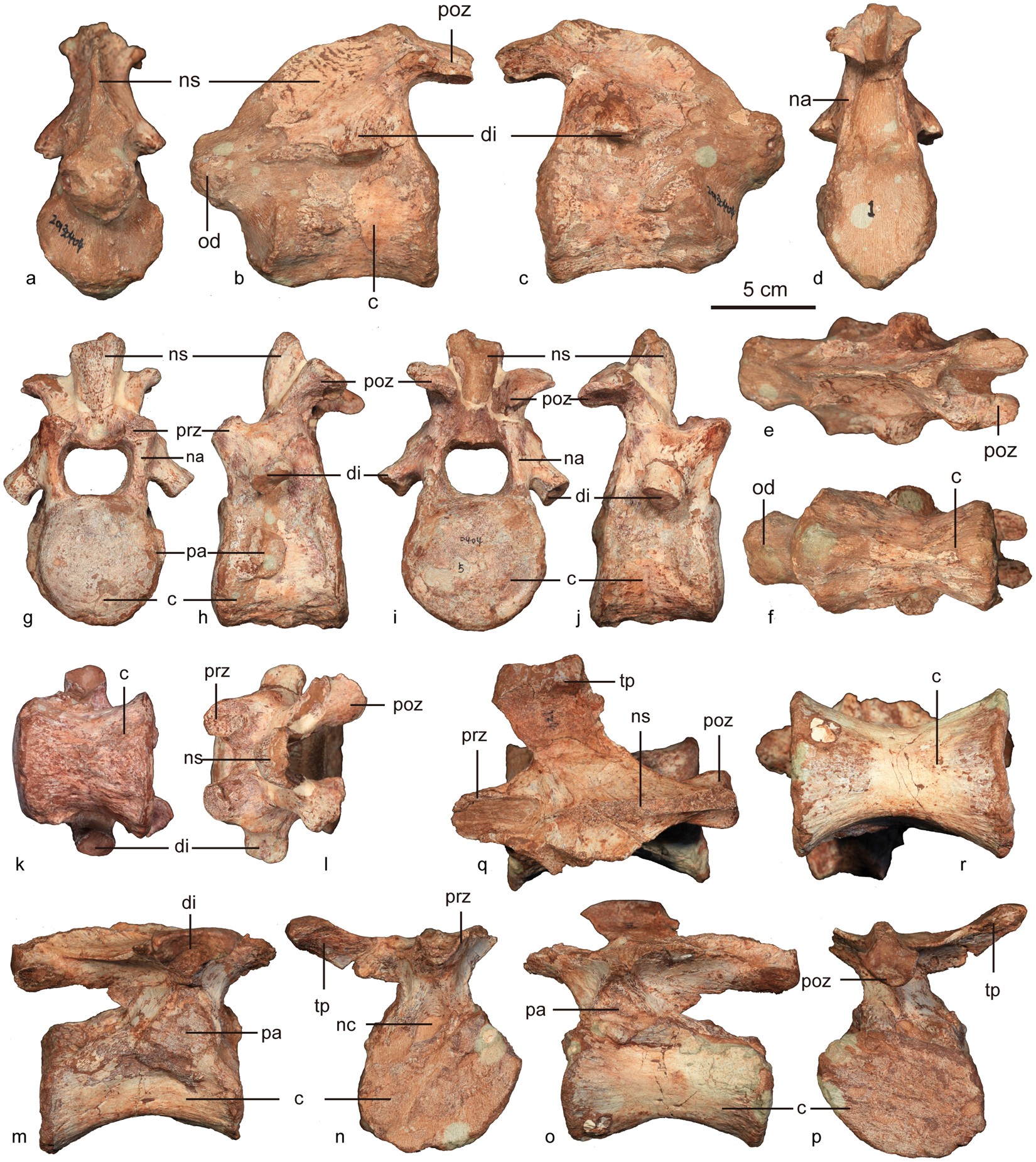
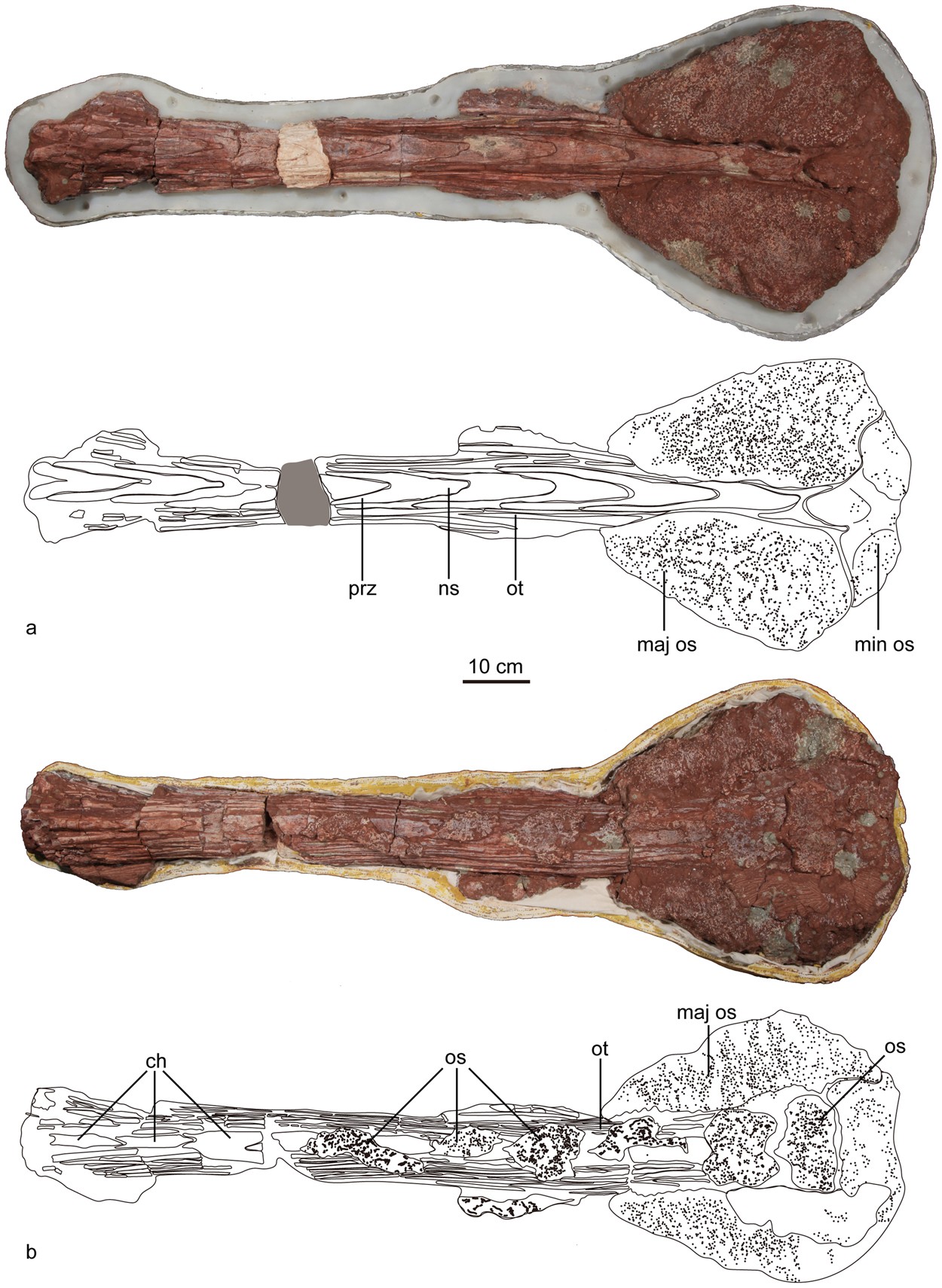
A new ankylosaurid skeleton from the Upper Cretaceous Baruungoyot Formation of Mongolia: its implications for ankylosaurid postcranial evolution
Park, J.-Y., Lee, Y.-N., Currie, P.J., Ryan, M.J., Bell, P., Sissons, R., Koppelhus, E.B., Barsbold, R., Lee, S. e Kim, S.-H. · Scientific Reports, 11: 4101
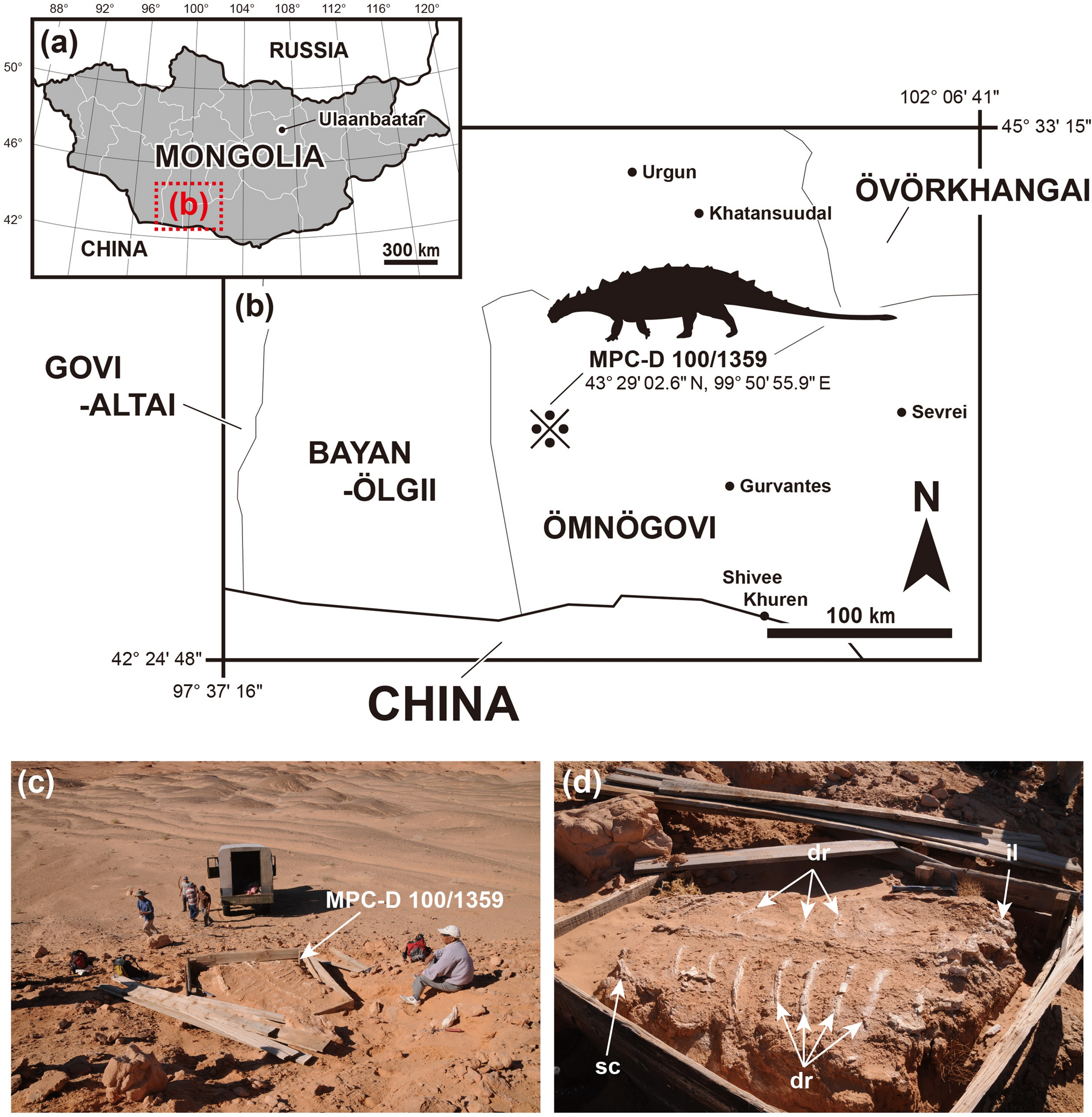
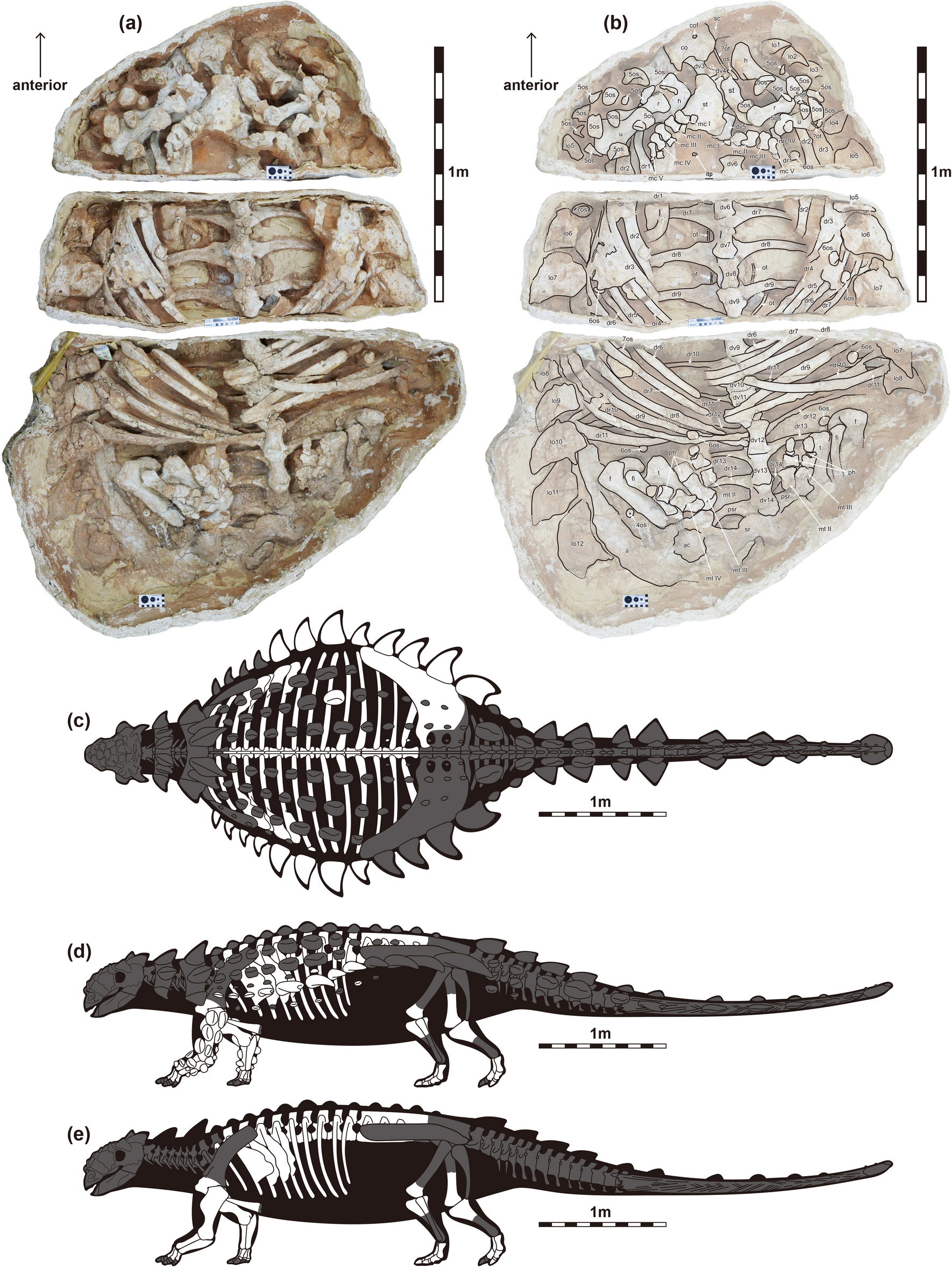
Description of an articulated postcranial skeleton (MPC-D 100/1359) from the Baruungoyot Formation (middle-upper Campanian, Hermiin Tsav, southern Gobi) including twelve dorsal vertebrae, ribs, pectoral and pelvic girdles, limbs and free osteoderms. The analysis shows that Asian ankylosaurids such as Pinacosaurus evolved rigid bodies with a reduced pedal phalanx count, and that at least two flank armour forms existed within the family.
An ankylosaur larynx provides insights for bird-like vocalization in non-avian dinosaurs
Yoshida, J., Kobayashi, Y. e Norell, M.A. · Communications Biology, 6: 152
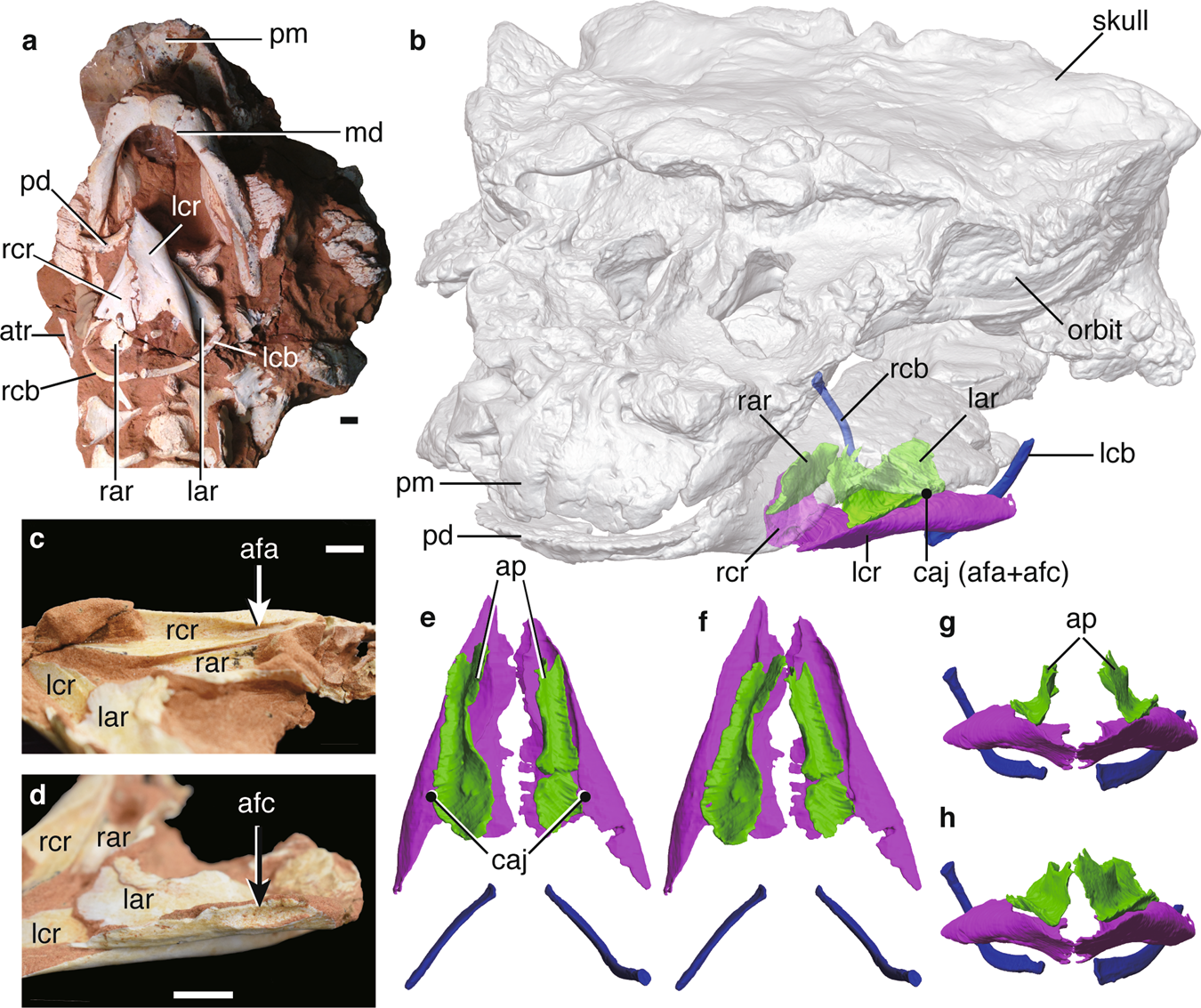
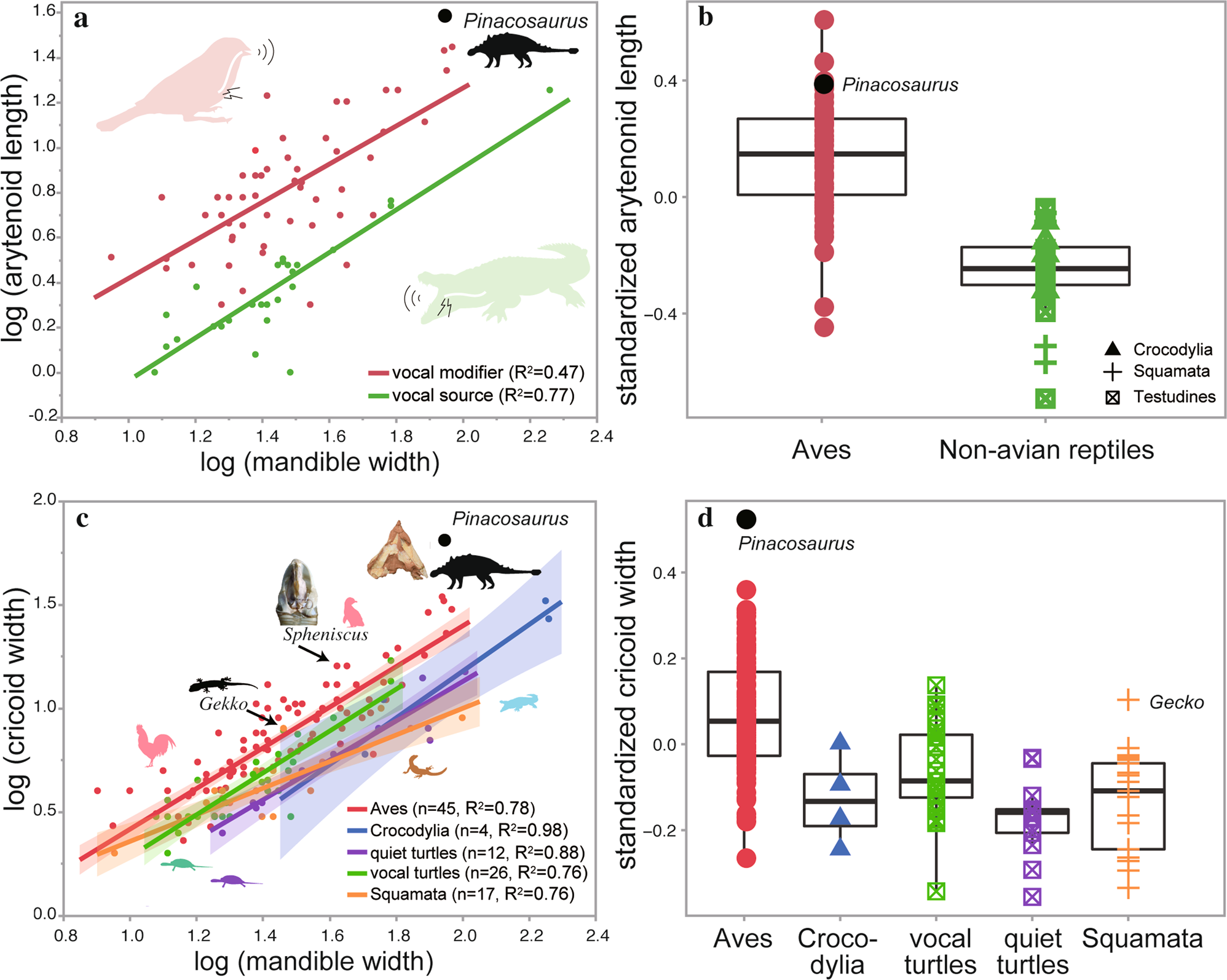
Description of the first known fossil laryngeal apparatus in a non-avian dinosaur, preserved in near-life articulation in a juvenile Pinacosaurus grangeri (IGM 100/3186) from the Gobi. The authors identify cricoid and arytenoid analogous to those of non-avian reptiles, but with a firm kinetic crico-arytenoid joint, prominent arytenoid process, long arytenoid and enlarged cricoid, suggesting a vocal-modifier function comparable to birds. The study provides the first direct evidence of vocalisation in an ankylosaur.
Famous museum specimens
AMNH 6523 (holótipo)
American Museum of Natural History (AMNH), Nova York, Estados Unidos
Holotype collected in 1923 at Shabarakh Usu (today Bayn Dzak, 'Flaming Cliffs'), Djadokhta Formation, Campanian, Mongolia. Described by Charles W. Gilmore in 1933 in American Museum Novitates 679. It remains the largest known skull of Pinacosaurus grangeri and the reference for the genus diagnosis.
ZPAL MgD-I/113 e material polonês associado
Institute of Paleobiology, Polish Academy of Sciences (ZPAL), Varsóvia, Polônia
Foundational Polish collection of Pinacosaurus material, basis of Maryanska's monographs (1971, 1977). Includes the uncrushed adult skull that allowed the first accurate reconstruction of the skull roof, horns and narial region of the genus.
IGM 100/1014 (juvenil de Ukhaa Tolgod)
Institute of Geology, Mongolian Academy of Sciences (IGM), Ulaanbaatar, Mongólia
Juvenile skull from Ukhaa Tolgod (Ömnögovi, Mongolia), described by Hill, Witmer and Norell (2003) in American Museum Novitates 3395. First diagnostic attribution of ankylosaur material to the famous Ukhaa Tolgod locality, known for spectacularly preserved theropods, mammals and squamates.
IGM 100/3186 (juvenil com aparelho laríngeo)
Institute of Geology, Mongolian Academy of Sciences (IGM), Ulaanbaatar, Mongólia
Juvenile specimen preserving the first known fossil laryngeal apparatus in any non-avian dinosaur. Described by Yoshida, Kobayashi and Norell in 2023 in Communications Biology, it documents a cricoid and arytenoid with a firm kinetic joint, interpreted as vocal modifiers comparable to those of birds.
IVPP V16853, V16283, V16854, V16346, V16855 (juvenis de Bayan Mandahu)
Institute of Vertebrate Paleontology and Paleoanthropology (IVPP), Pequim, China
Set of specimens collected by the Canada-China Dinosaur Project at Bayan Mandahu (Inner Mongolia), including one of the rare articulated juvenile ankylosaur bonebeds. Basis of the Burns et al. (2011) Cretaceous Research description. Some juveniles were oriented in the same direction, interpreted as a herd buried alive by a sandstorm.
IMM 96BM3/1 (holótipo de P. mephistocephalus)
Inner Mongolia Museum (IMM), Hohhot, China
Holotype of Pinacosaurus mephistocephalus, described by Godefroit, Pereda-Suberbiola, Li and Dong in 1999. The species epithet refers to the 'devil-like' squamosal horns that project far beyond the skull roof. The validity of the species as distinct from P. grangeri is debated (Burns et al. 2011 maintain separation, others synonymise).
MPC (juvenis de Alag Teeg)
Mongolian Paleontological Center (MPC, antigo IGM), Ulaanbaatar, Mongólia
Largest known accumulation of juvenile ankylosaurs in the world, from the Alagteeg Formation at Alag Teeg (Mongolia). Initially interpreted as drought-pond mortality, but reinterpreted as burial by flood deposit. Basis of the postcranial descriptions by Burns, Tumanova and Currie (2015).
Classification
Discovery
Fun fact
Pinacosaurus grangeri is the ankylosaurid with the largest known juvenile sample in the world: about 100 immature individuals accumulated at the Alag Teeg site alone (Mongolia), plus dozens at Bayan Mandahu (China). This abundance revolutionised knowledge of the group's growth and behaviour, because juvenile skulls preserve sutures before the full fusion of osteoderms to the skull, allowing each individual element to be identified. In 2023, Yoshida, Kobayashi and Norell described in Communications Biology the first fossil laryngeal apparatus of a non-avian dinosaur, preserved in a juvenile Pinacosaurus: the study suggests that the animal was capable of bird-like vocalisations, far earlier than previously imagined.
Last reviewed: April 24, 2026