Paralititan
Paralititan stromeri
"Stromer's tidal titan"
About this species
Paralititan stromeri is a giant titanosaur from the Cenomanian (about 95 to 94 million years ago) of the Bahariya Formation in the Bahariya Oasis of Egypt's Western Desert. It was described in 2001 by Joshua B. Smith, Matthew C. Lamanna, Kenneth J. Lacovara, Peter Dodson and colleagues in Science, based on holotype CGM 81119, a fragmentary but significant skeleton including two humeri (the right complete, at 1.69 metres long among the largest ever recovered in a Cretaceous sauropod at the time of description), two sacral vertebrae likely the fifth and sixth, an anterior caudal vertebra, dorsal and sacral ribs, incomplete scapulae and the distal end of a metacarpal. With only around 5 per cent of the skeleton preserved, Paralititan's dimensions are estimated by comparison with more complete relatives. Carpenter (2006) calculated about 26 metres in length using Saltasaurus as guide, while mass estimates vary widely depending on method, between 20 tonnes (Paul 2010), roughly 30 tonnes (Wikipedia, April 2026 revision), 50 tonnes (Gonzalez Riga et al. 2016, via humerus and femur circumference), 30 to 55 tonnes (Paul 2019) and 59 tonnes (2011 estimate). All these values are approximate and reflect the uncertainty intrinsic to fragmentary preservation. The animal lived in a coastal mangrove ecosystem, the first dinosaur scientifically demonstrated to inhabit this type of environment. The deposit preserving the holotype is a tidal flat dominated by the seed fern Weichselia reticulata, and a Carcharodontosaurus tooth associated with the skeleton suggests immediate scavenging of the carcass by a giant predator. Villa et al. (2022), in the description of Abditosaurus kuehnei, recovered Paralititan in an Afro-European clade within Saltasaurinae with Abditosaurus, sister to the South American Saltasaurini clade including Neuquensaurus and Saltasaurus; earlier analyses, such as Curry Rogers (2005) and Mannion and Upchurch (2011), had interpreted the genus as a more basal titanosaur. The Bahariya Oasis is the same site where Austro-Hungarian collector Richard Markgraf gathered fossils between 1912 and 1914, later described by Ernst Stromer in Munich; the rediscovery of the site by Joshua Smith's team in 2000 marked the return of palaeontology to North Africa after nearly 70 years of silence.
Geological formation & environment
Bahariya Formation, Lower Cenomanian (approximately 101 to 94 Ma; commonly cited 95 Ma). Crops out in the Bahariya Oasis in Egypt's Western Desert, about 300 km southwest of Cairo. Palaeoenvironmental record of coastal and tidal plains along the Tethys Sea margin, with fluvial channels, mangrove zones and vegetation dominated by the seed fern Weichselia reticulata. The vertebrate fauna includes the sauropods Paralititan stromeri and Aegyptosaurus baharijensis, the theropods Spinosaurus aegyptiacus, Carcharodontosaurus saharicus, Bahariasaurus ingens, Tameryraptor markgrafi and an unnamed abelisaurid, the coelacanthiform fish Mawsonia, crocodyliforms such as Stomatosuchus and pleurodire turtles.
Image gallery
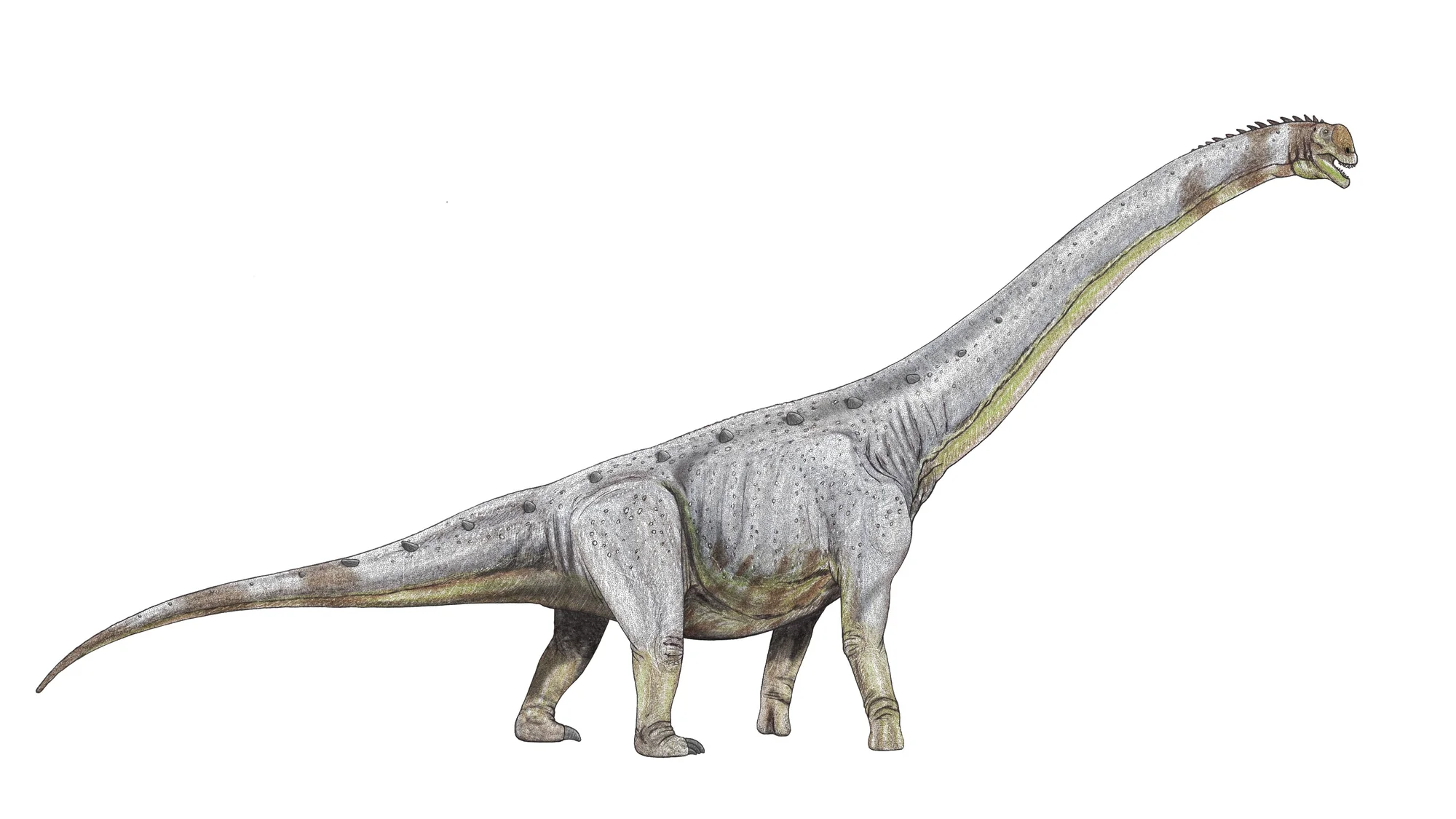



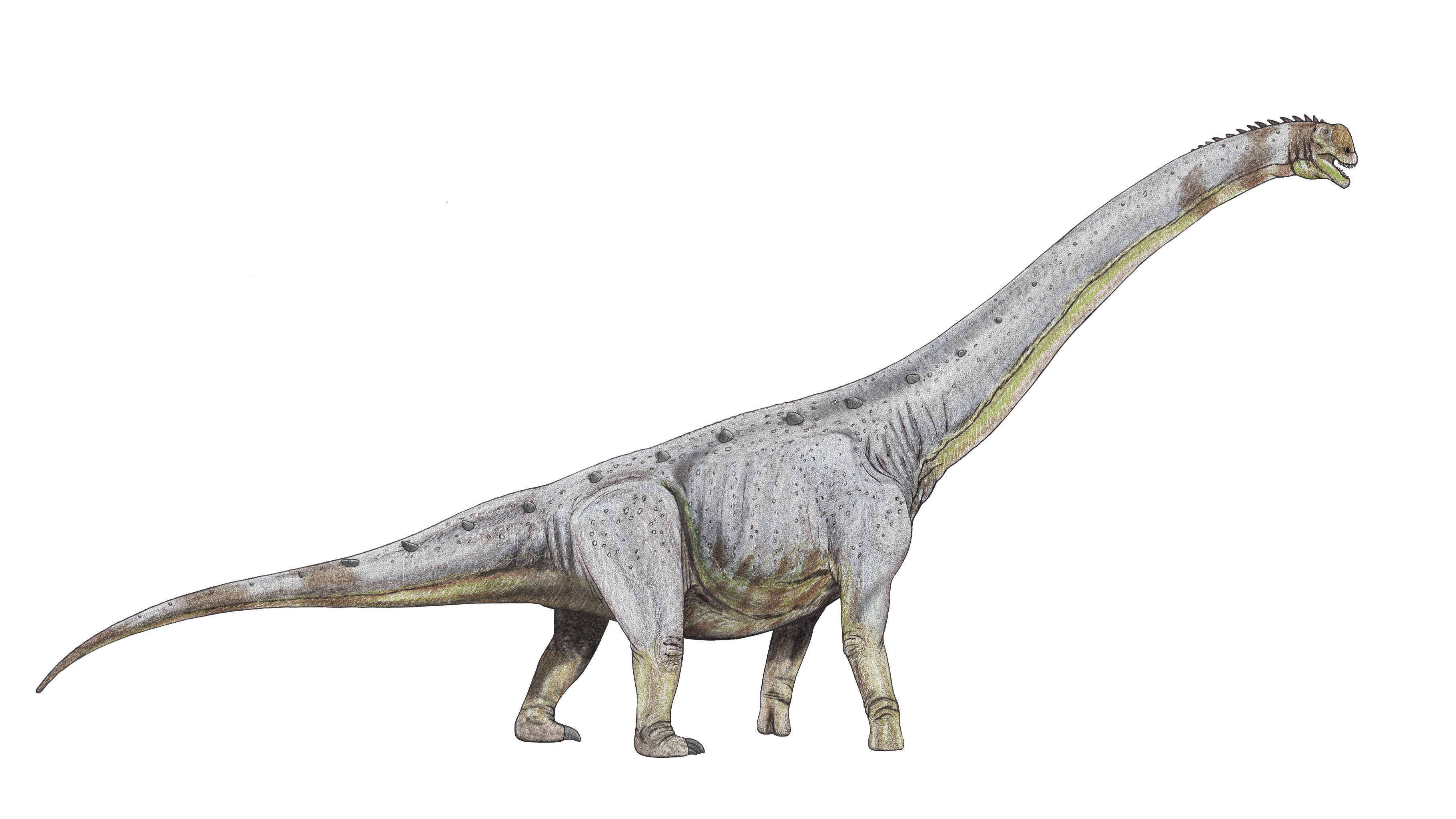


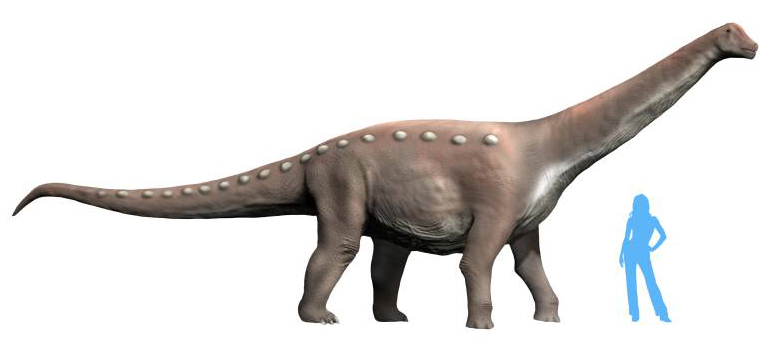


Life reconstruction of Paralititan stromeri by Dmitry Bogdanov, a giant titanosaur from the mid-Cretaceous of Egypt (Bahariya Formation).
Dmitry Bogdanov (DiBgd), Wikimedia Commons, CC BY 3.0
Ecology and behavior
Habitat
Coastal mangrove palaeoenvironment along the Tethys Sea margin in what is now northern Egypt. The deposit that preserved the Paralititan holotype is a tidal flat with vegetation dominated by the seed fern Weichselia reticulata and root traces in the sediment. The stratigraphic level of the skeleton indicates shallow-water, seasonally flooded conditions. It is the first dinosaur scientifically demonstrated to inhabit a mangrove ecosystem, according to Smith et al. (2001).
Feeding
Large-bodied generalist herbivore. The skull was not recovered, but by analogy with other advanced titanosaurs, Paralititan probably had pencil-like teeth restricted to the front of the mouth, allowing stripping of leaves and twigs from the mangrove's seed ferns and conifers, with little or no chewing. The long neck enabled both high browsing on conifers and mid-level foraging on tidal-flat vegetation.
Behavior and senses
Gregarious behaviour common to titanosaurs is inferred, although no tracks or bonebeds of Paralititan specifically are known. Planet Dinosaur (2011) depicts the animal in small herds crossing coastal rivers, a scenario consistent with other titanosaurs but speculative for the genus. The predator relationship is direct: a Carcharodontosaurus tooth was found associated with the holotype skeleton, suggesting scavenging of the carcass shortly after death. Sarcosuchus and other giant crocodyliforms also shared the habitat.
Physiology and growth
Giant-bodied titanosaurian sauropod. Mass estimates are highly uncertain due to fragmentary preservation (about 5 per cent of the skeleton) and range between 20 tonnes (Paul 2010), roughly 30 tonnes (most recent estimate), 50 tonnes (Gonzalez Riga et al. 2016), 30 to 55 tonnes (Paul 2019) and 59 tonnes (2011). Estimated length is about 26 metres (Carpenter 2006). The complete right humerus, 1.69 metres long, was the largest humerus known in any Cretaceous sauropod at the time of description in 2001.
Paleogeography
Continental configuration

Scotese & Vérard · CC BY 4.0 · Cretaceous, ~105 Ma
During the Cenomaniano (~95–94 Ma), Paralititan stromeri inhabited Laramidia, the western half of present-day North America, separated from the east by the Western Interior Seaway, a shallow sea dividing the continent. The continents were in very different positions: India was drifting toward Asia, Antarctica was still connected to Australia, and South America was an isolated island.
Bone Inventory
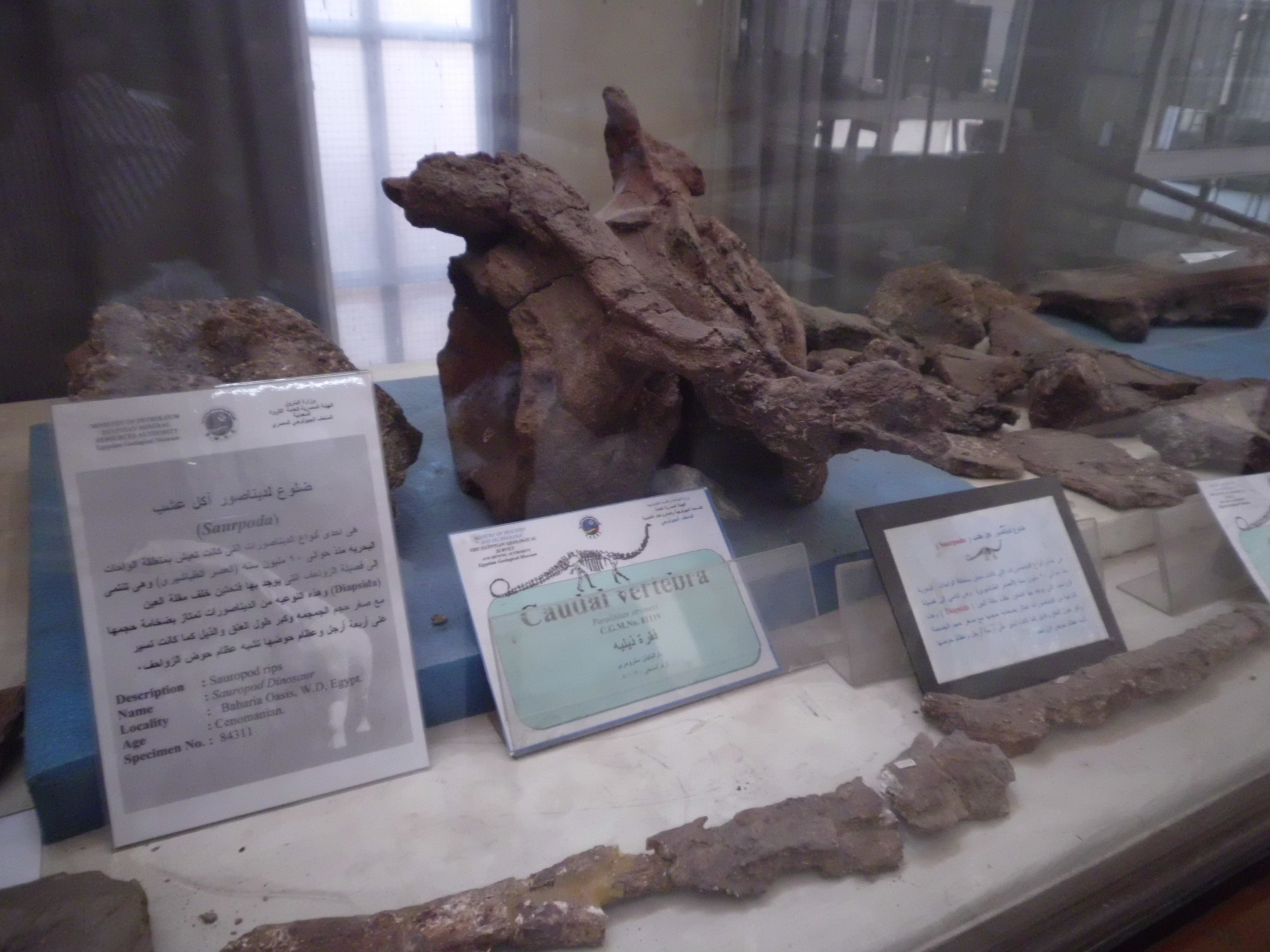
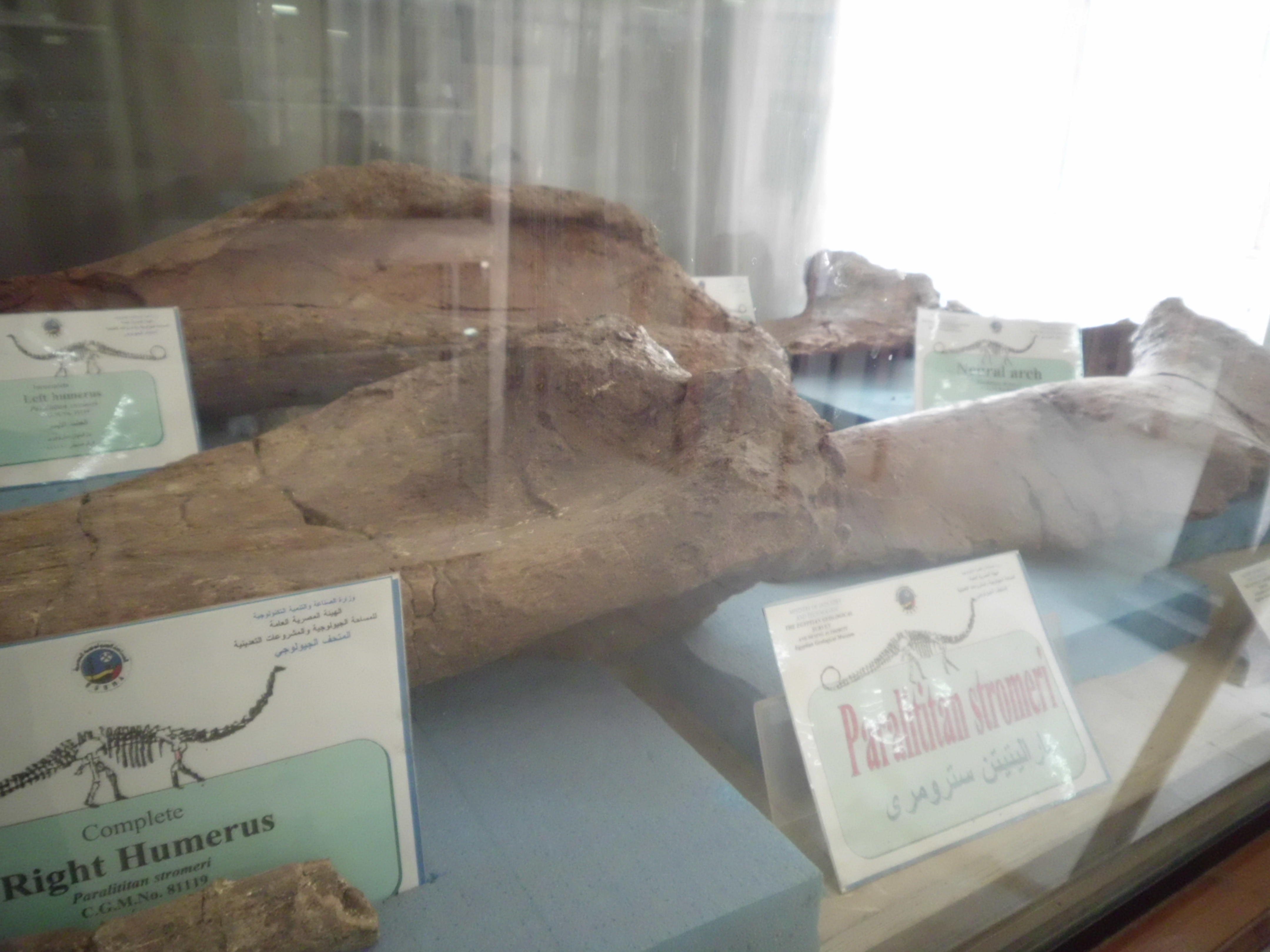
Only about 5 per cent of Paralititan's skeleton has been recovered. The holotype CGM 81119, housed at the Egyptian Geological Museum in Cairo, includes both humeri (right complete at 1.69 m), sacral and caudal vertebrae, ribs, incomplete scapulae and a distal metacarpal. Additional material SNSB-BSPG 1912V11164 is an anterior dorsal vertebra collected by Richard Markgraf at Bahariya between 1912 and 1914, described by Stromer in 1932 as 'Giant Sauropod indet.' and destroyed on the night of 24 to 25 April 1944 in an Allied air raid on the Paläontologisches Museum München. Preservation is modest, but the 1.69 m humerus was, at the time of description in 2001, the largest humerus known in any Cretaceous sauropod; it was surpassed in 2016 by Notocolossus (1.76 m).

Found elements
Inferred elements
Scientific Literature
15 papers in chronological order — from the original description to recent research.
A giant sauropod dinosaur from an Upper Cretaceous mangrove deposit in Egypt
Smith, J.B., Lamanna, M.C., Lacovara, K.J., Dodson, P., Smith, J.R., Poole, J.C., Giegengack, R. e Attia, Y. · Science 292(5522): 1704 a 1706
Original description of Paralititan stromeri based on holotype CGM 81119, recovered in 2000 by the Bahariya Dinosaur Project team in the Bahariya Oasis. The authors document the complete right humerus of 1.69 m, at the time the largest humerus known in any Cretaceous sauropod, and record the preservation of the animal in coastal mangrove deposits, the first dinosaur scientifically demonstrated to inhabit that type of environment. An associated Carcharodontosaurus tooth suggests scavenging of the carcass.
Ergebnisse der Forschungsreisen Prof. E. Stromers in den Wüsten Ägyptens. II. Wirbeltier-Reste der Baharije-Stufe (unterstes Cenoman). 11. Sauropoda
Stromer, E. · Abhandlungen der Bayerischen Akademie der Wissenschaften, Mathematisch-naturwissenschaftliche Abteilung, Neue Folge 10: 1 a 21
Stromer describes a large anterior dorsal vertebra (SNSB-BSPG 1912V11164), collected by Richard Markgraf at Bahariya between 1912 and 1914, as 'Giant Sauropod indet.'. The specimen was housed at the Paläontologisches Museum München and destroyed in the Allied bombing of Munich in April 1944. Decades later, Smith et al. (2001) referred this vertebra to Paralititan, establishing continuity between Stromer's pioneering work and the fauna described in 2001.

From dinosaurs to dyrosaurids (Crocodyliformes): removal of the post-Cenomanian (Late Cretaceous) record of Spinosauridae from Africa
Lamanna, M.C., Smith, J.B., Attia, Y.S. e Dodson, P. · Journal of Vertebrate Paleontology 24(3): 764 a 768
Subsequent study by the Bahariya Dinosaur Project team reinterpreting teeth previously assigned to spinosaurids from the post-Cenomanian Upper Cretaceous of Africa as belonging to dyrosaurids (Crocodyliformes). The result confines the Spinosauridae record to the Cenomanian of the Bahariya Formation, where the group coexisted with Paralititan, Aegyptosaurus, Carcharodontosaurus and Bahariasaurus.


An abelisaurid from the Late Cretaceous of Egypt: implications for theropod biogeography
Smith, J.B. e Lamanna, M.C. · Naturwissenschaften 93(5): 242 a 245
Description of an unnamed abelisaurid from the Cenomanian of the Bahariya Formation, increasing the known theropod diversity in the fauna that includes Paralititan. The authors discuss biogeographic implications for African Abelisauridae, suggesting dispersal between Gondwanan continents still connected during the Early Cretaceous.

Biggest of the big: a critical re-evaluation of the mega-sauropod Amphicoelias fragillimus
Carpenter, K. · Paleontology and Geology of the Upper Jurassic Morrison Formation, New Mexico Museum of Natural History and Science Bulletin 36: 131 a 137
Critical re-evaluation of the largest known sauropods. In the comparative discussion, Carpenter estimates Paralititan stromeri at approximately 26 metres in length by scaling from the 1.69 m humerus using Saltasaurus as a body-plan model. The value became the most cited length reference for the genus, albeit with high uncertainty given the fragmentary preservation.
Titanosauria: a phylogenetic overview
Curry Rogers, K. · The Sauropods: Evolution and Paleobiology (ed. Curry Rogers e Wilson), University of California Press, pp. 50 a 103
Extensive phylogenetic analysis of Titanosauria with 364 characters and 29 taxa. Paralititan is recovered as a basal titanosaur, outside Lithostrotia in this matrix. The work is a reference for understanding the historical position of the genus prior to the more recent analyses of Villa et al. (2022), which place it in Saltasaurinae.

A quantitative analysis of environmental associations in sauropod dinosaurs
Mannion, P.D. e Upchurch, P. · Paleobiology 37(4): 692 a 707
Quantitative analysis of environmental associations in Mesozoic sauropods. Paralititan is included in the dataset as a basal titanosaur in coastal settings, reinforcing Smith et al.'s (2001) observation that certain titanosaurian lineages show correlation with nearshore depositional environments. The later study by Mannion et al. (2013) revises the full phylogeny of Titanosauriformes.
The early evolution of titanosauriform sauropod dinosaurs
D'Emic, M.D. · Zoological Journal of the Linnean Society 166(3): 624 a 671
Revised systematics of Titanosauriformes, with expanded matrix and revised characters. D'Emic discusses the position of Paralititan among derived titanosaurs, and the study provides the terminological and cladistic framework used by subsequent descriptions of African titanosaurs such as Mansourasaurus and Rukwatitan.


A gigantic new dinosaur from Argentina and the evolution of the sauropod hind foot
Gonzalez Riga, B.J., Lamanna, M.C., Ortiz David, L.D., Calvo, J.O. e Coria, J.P. · Scientific Reports 6: 19165
Description of the Patagonian giant Notocolossus gonzalezparejasi, whose 1.76 m humerus surpassed Paralititan's 1.69 m humerus as the largest known in any titanosaur. The authors apply scaling equations based on humerus and femur circumference in quadrupeds and estimate Paralititan's mass at approximately 50 tonnes, one of the most widely cited calculations for the genus.
A new giant titanosaur sheds light on body mass evolution among sauropod dinosaurs
Carballido, J.L., Pol, D., Otero, A., Cerda, I.A., Salgado, L., Garrido, A.C., Ramezani, J., Cuneo, N.R. e Krause, J.M. · Proceedings of the Royal Society B 284(1860): 20171219
Description of the Patagonian titanosaur Patagotitan mayorum, with the largest phylogenetic matrix published at the time (405 characters, 87 taxa). Paralititan appears among the giant titanosaurs considered in the body-mass evolution discussion, though gaps in the record prevent robust positioning in the final topology.

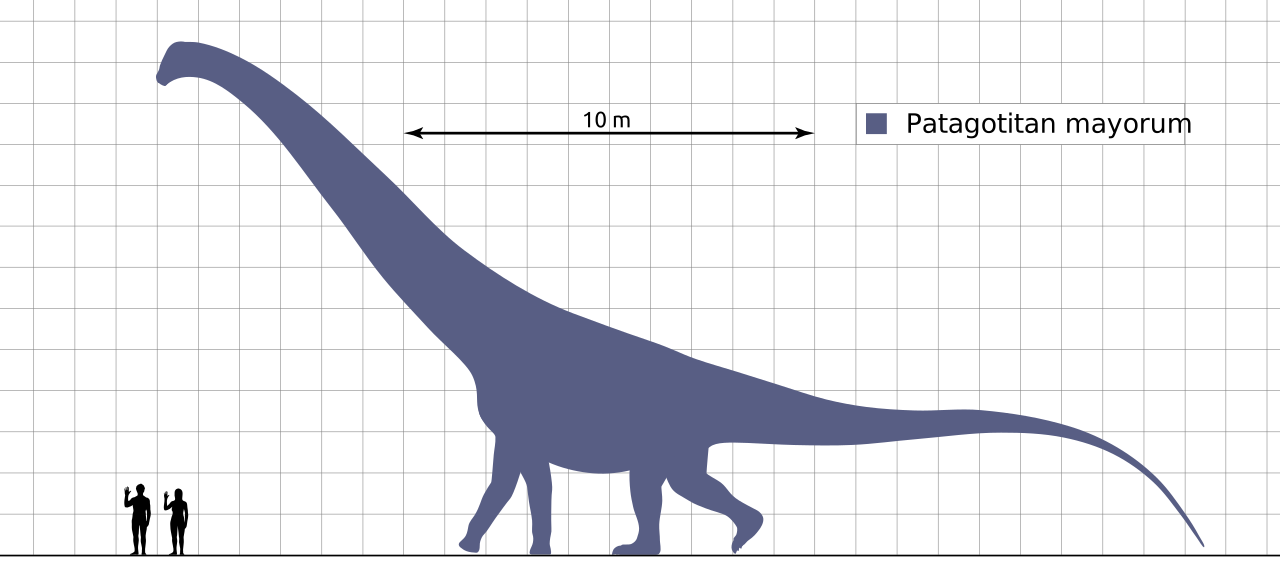
A gigantic, exceptionally complete titanosaurian sauropod dinosaur from southern Patagonia, Argentina
Lacovara, K.J., Lamanna, M.C., Ibiricu, L.M., Poole, J.C., Schroeter, E.R., Ullmann, P.V., Voegele, K.K., Boles, Z.M., Carter, A.M., Fowler, E.K., Egerton, V.M., Moyer, A.E., Coughenour, C.L., Schein, J.P., Harris, J.D., Martinez, R.D. e Novas, F.E. · Scientific Reports 4: 6196
Description of Dreadnoughtus schrani, a Patagonian titanosaur with exceptional preservation (about 45 per cent of the skeleton) that serves as a reference for reconstructing more fragmentary giant titanosaurs such as Paralititan. Kenneth Lacovara, co-author of the original Paralititan description, leads the study; the contrast between Paralititan (5 per cent) and Dreadnoughtus (45 per cent) highlights the rarity of complete preservation in the group.

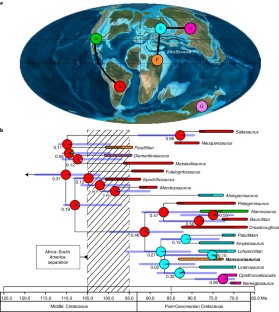
New Egyptian sauropod reveals Late Cretaceous dinosaur dispersal between Europe and Africa
Sallam, H.M., Gorscak, E., O'Connor, P.M., El-Dawoudi, I.A., El-Sayed, S., Saber, S., Kora, M.A., Sertich, J.J.W., Seiffert, E.R. e Lamanna, M.C. · Nature Ecology & Evolution 2: 445 a 451
Description of Mansourasaurus shahinae, a Campanian titanosaur from Egypt's Sahara, and biogeographic analysis recovering Eurasian affinities for late African titanosaurs. Paralititan, from the Cenomanian, is included in the discussion as the other formally named Egyptian titanosaur, though the two species are separated by about 20 million years and by substantial changes in Gondwanan palaeogeography.

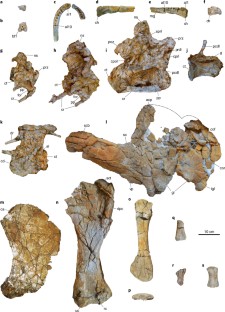
The basal titanosaurian Rukwatitan bisepultus (Dinosauria, Sauropoda) from the middle Cretaceous Galula Formation, Rukwa Rift Basin, southwestern Tanzania
Gorscak, E., O'Connor, P.M., Stevens, N.J. e Roberts, E.M. · Journal of Vertebrate Paleontology 34(5): 1133 a 1154
Description of Rukwatitan bisepultus, a basal titanosaur from the Middle Cretaceous of Tanzania, reinforcing the presence of titanosaurs in coastal and continental settings of sub-Saharan Africa during the Cenomanian and Turonian. Rukwatitan is a direct African comparison for Paralititan in biogeographic context.

Sauropod dinosaurs from the Early Cretaceous of Malawi, Africa
Gomani, E.M. · Palaeontologia Electronica 8(1): 27A
Review of the Early Cretaceous sauropods of Malawi, focused on Malawisaurus dixeyi. The work is part of the comparative framework for African titanosaurs, including Paralititan, and supports the hypothesis that African titanosaurian lineages included both gigantic forms (Paralititan) and medium-sized taxa (Malawisaurus) throughout the Cretaceous.
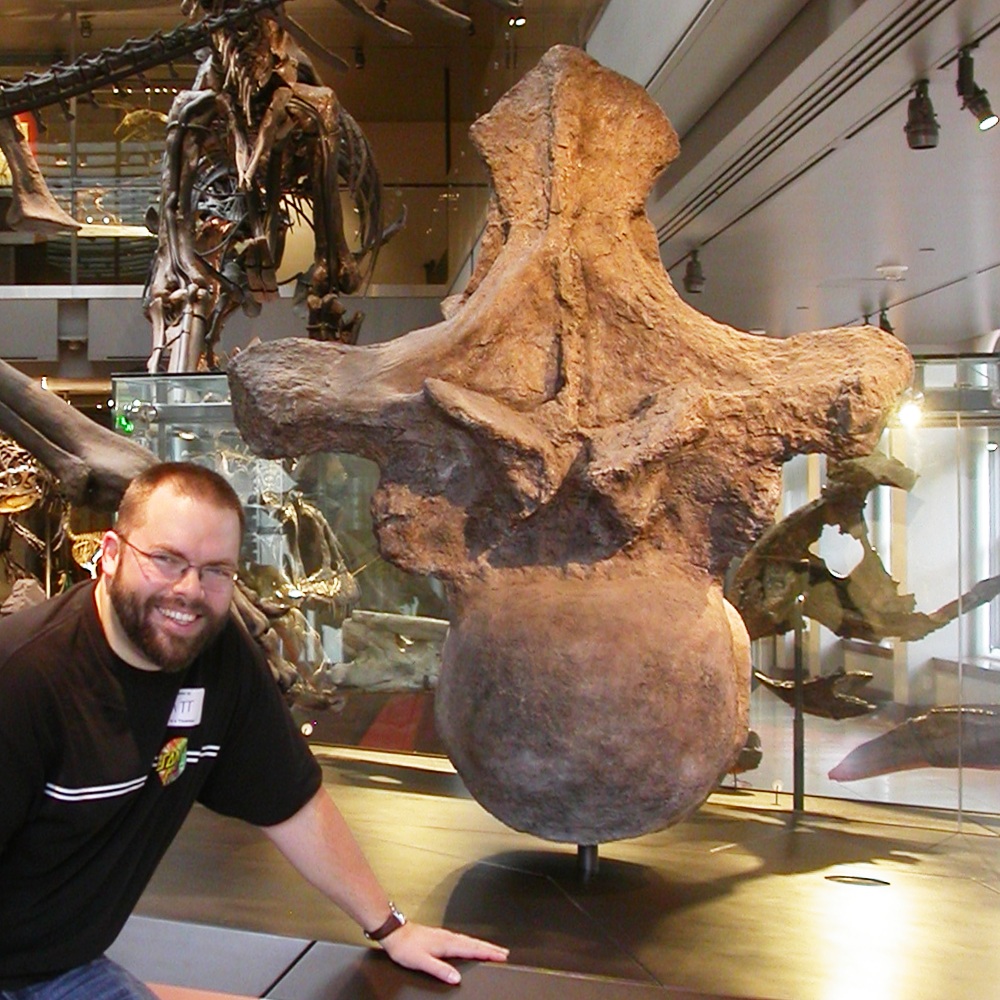

A titanosaurian sauropod with an Asian affinity in the latest Cretaceous of Europe
Villa, B., Selles, A.G., Moreno-Azanza, M., Razzolini, N.L., Gil-Delgado, A., Canudo, J.I. e Galobart, A. · Scientific Reports 12: 4321
Description of Abditosaurus kuehnei, a Maastrichtian Iberian titanosaur, with a cladogram that places Paralititan in an Afro-European clade within Saltasaurinae alongside Abditosaurus, sister to Saltasaurini (Neuquensaurus and Saltasaurus). This is the most recent and currently cited phylogenetic position for the genus, replacing earlier interpretations as a basal titanosaur by Curry Rogers (2005) and Mannion and Upchurch (2011).

Famous museum specimens
CGM 81119 (holótipo)
Egyptian Geological Museum, Cairo
Formal holotype of Paralititan stromeri, recovered on 22 January 2000 by the Bahariya Dinosaur Project team at Gebel Fagga in the Bahariya Oasis. The 1.69 m right humerus was, at the time of description in 2001, the largest humerus known in any Cretaceous sauropod; it was surpassed in 2016 by the 1.76 m humerus of Notocolossus. The specimen is catalogued at the Egyptian Geological Museum in Cairo and is the basis of the Smith et al. (2001) Science description and the phylogenetic placement by Villa et al. (2022).
In cinema and popular culture
Paralititan's best-known screen appearance is in the BBC series Planet Dinosaur (2011), episode 5 'New Giants', in a scene where a herd visits a North African Cenomanian river and a juvenile survives a combined attack by Sarcosuchus and Carcharodontosaurus. The animal is portrayed as a giant titanosaur consistent with the estimates of Smith et al. (2001) and Carpenter (2006). In National Geographic promotional material, Paralititan also appears on posters associated with the series Bizarre Dinosaurs (2009), though its presence in reconstructed scenes within the episode itself has not been unequivocally confirmed. The genus is absent from the Jurassic Park and Jurassic World franchises as of April 2026.
Classification
Discovery
Fun fact
Between 1911 and 1914, Ernst Stromer received a collection of giant fossils from the Bahariya Oasis gathered by Richard Markgraf. From this material Stromer named Spinosaurus aegyptiacus, Carcharodontosaurus saharicus, Bahariasaurus ingens and Aegyptosaurus baharijensis, plus an enigmatic 'Giant Sauropod indet.' vertebra. On the night of 24 to 25 April 1944, an Allied air raid hit the Paläontologisches Museum München and almost all of Stromer's Egyptian collection was destroyed. On 22 January 2000, 56 years later, Josh Smith's team returned to Gebel Fagga, the same site as Markgraf, and rediscovered the skeleton that would be named Paralititan stromeri. The epithet honours the German palaeontologist whose work was literally erased by the Second World War. It is also the first dinosaur documented in a mangrove habitat in the fossil record.
Last reviewed: April 24, 2026