
Nasutoceratops
Nasutoceratops titusi
"Big-nosed horned face, honoring Alan Titus"
About this species
Nasutoceratops titusi is a centrosaurine ceratopsid dinosaur that lived approximately 76 to 75 million years ago, during the late Campanian of the Cretaceous, in what is now southern Utah in the United States. The animal is immediately recognizable by two extraordinary diagnostic features: supraorbital horns that are extremely long, oriented laterally and curved upward and forward over the eye sockets in a pattern that researchers frequently compare to Texas Longhorn cattle, and a hypertrophied nasal cavity that gives the skull a bulbous, short-snouted appearance. No other known ceratopsid combines these two traits so strikingly, and it was precisely this anatomy without parallel that led the describers to erect not only a new genus and species but a new tribe within Centrosaurinae, the tribe Nasutoceratopsini. The genus name comes from the Latin nasutus, meaning big-nosed, combined with the Greek keratops, horned face. The specific epithet titusi honors Alan L. Titus, the paleontologist at Grand Staircase-Escalante National Monument who supported the field expeditions that led to the discovery. The holotype, catalogued as UMNH VP 16800, was excavated in 2006 by then graduate student Eric K. Lund in the Kaiparowits Formation, within the national monument in Kane County, Utah. The specimen includes a sub-complete skull with mandible, with both supraorbital horns and the nasal region preserved, plus fused cervical vertebrae (syncervical) and associated post-cranial elements. The formal description was published on 10 July 2013 in Proceedings of the Royal Society B by Scott D. Sampson, Eric K. Lund, Mark A. Loewen, Andrew A. Farke, and Katherine E. Clayton. The evolutionary significance of Nasutoceratops extends far beyond its unusual appearance. The species occupies a basal position within Centrosaurinae, retaining the long supraorbital horns characteristic of the common ancestor of Ceratopsidae, while derived centrosaurines such as Centrosaurus, Styracosaurus, and Pachyrhinosaurus dramatically reduced those horns above the eyes and developed, in their place, prominent nasal horns or bosses. This reverses the traditional intuition that long eye horns would be exclusive to chasmosaurines like Triceratops and Kosmoceratops. The tribe Nasutoceratopsini, formalized by Ryan, Holmes, Mallon, and colleagues in 2017, groups Nasutoceratops titusi, Avaceratops lammersi, and Xenoceratops foremostensis, all sharing this combination of short centrosaurine frill with long supraorbital horns and reduced nasal horn. Nasutoceratops titusi is also a central piece in the debate over the intracontinental endemism of Laramidia, the island continent formed in the western portion of North America during the Late Cretaceous, when the Western Interior Seaway divided the continent into two landmasses. The fauna of the Kaiparowits Formation, in southern Utah, contains multiple endemic species that do not appear in contemporary northern formations in Alberta and Montana, and Nasutoceratops is, together with Kosmoceratops richardsoni and Utahceratops gettyi, one of the clearest markers of this pattern. The holotype and the mounted skeleton are on permanent display in the Past Worlds gallery of the Natural History Museum of Utah in Salt Lake City.
Geological formation & environment
The Kaiparowits Formation is a Late Campanian (roughly 76.6 to 74.5 million years ago) geological unit located in southern Utah, outcropping mainly within Grand Staircase-Escalante National Monument. It represents a subtropical alluvial plain environment with dense angiosperm forests, meandering rivers, and lakes, with a warm and humid climate. It is considered one of the most diverse formations of the Late Cretaceous in North America, preserving hundreds of specimens of dozens of species of dinosaurs, crocodilians, turtles, lizards, mammals, and amphibians. The 40Ar/39Ar radiometric dating by Roberts and colleagues (2005) constrains the fauna chronologically. In the debate over intracontinental Laramidia endemism, the Kaiparowits is a key piece: it hosts Nasutoceratops titusi, Utahceratops gettyi, and Kosmoceratops richardsoni, all southern endemics, while contemporaneous formations in Alberta and Montana contain completely distinct genera. This faunal difference has been interpreted as evidence of a habitat barrier dividing the continental island into at least two biogeographic provinces during the late Campanian.
Image gallery


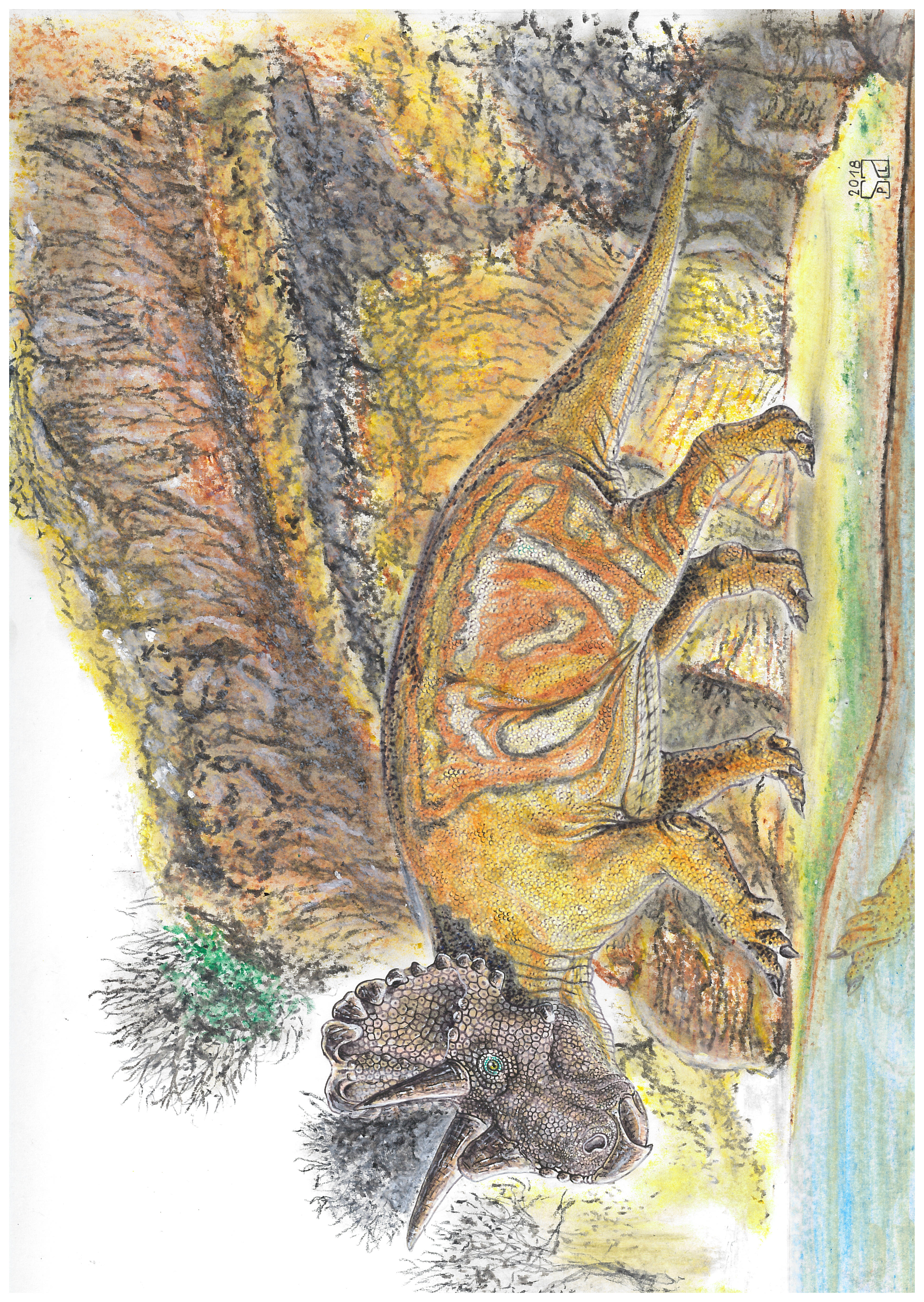
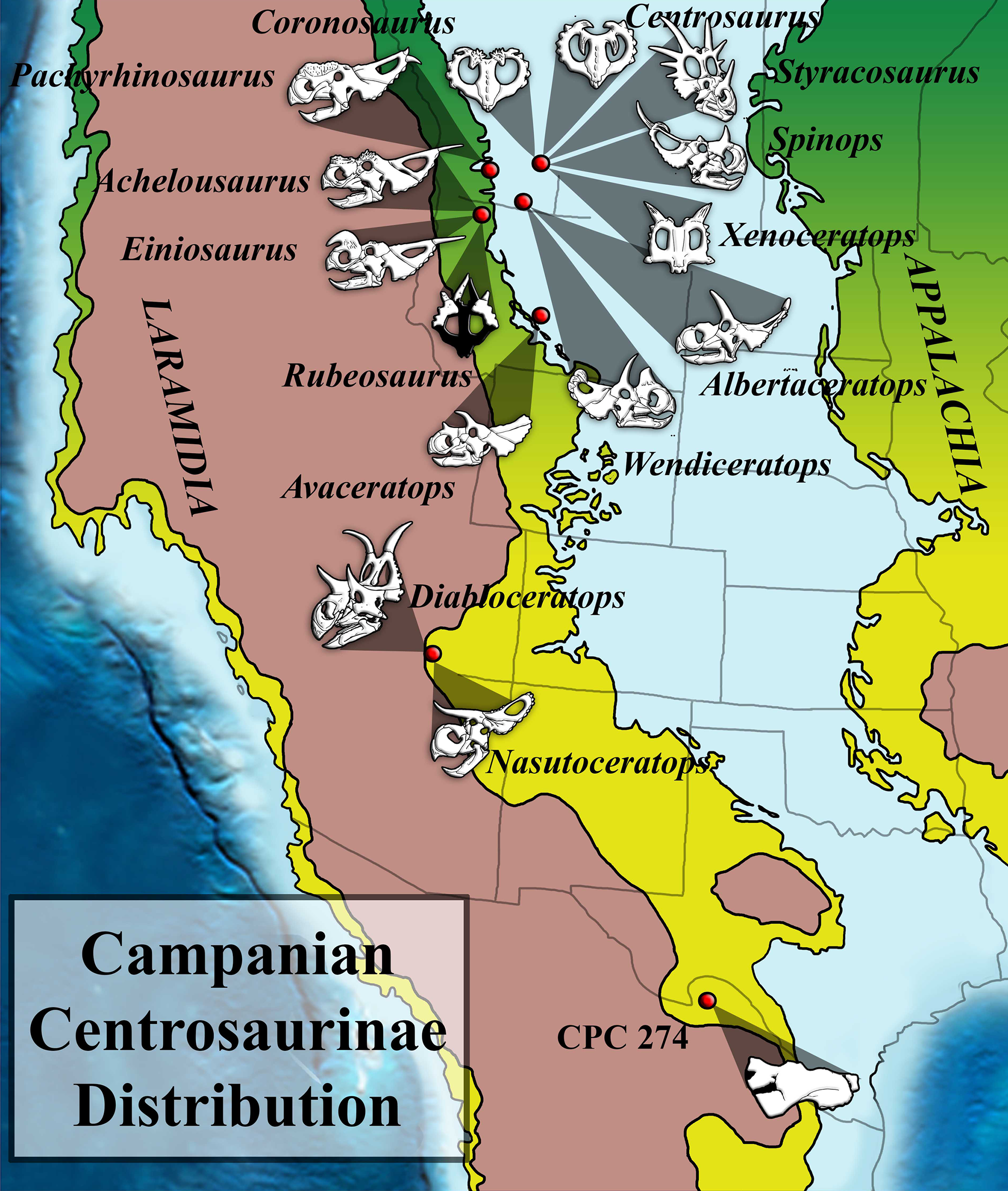
Life reconstruction of Nasutoceratops titusi by Tom Parker, showing the long Texas Longhorn-style supraorbital horns curved upward and forward and the short snout with hypertrophied nasal cavity.
Tom Parker, Wikimedia Commons, CC BY-SA
Ecology and behavior
Habitat
Nasutoceratops titusi lived in the southern portion of the Laramidia island continent, in what is today southern Utah, during the late Campanian (76 to 75 million years ago). The environment of the Kaiparowits Formation was a warm and humid subtropical alluvial plain, with dense angiosperm, palm, fern, and conifer forests, meandering rivers, lakes, and swamps. The estimated mean annual temperature was roughly 19 to 22 degrees Celsius, without pronounced cold seasons. Associated fauna included Utahceratops gettyi and Kosmoceratops richardsoni (other ceratopsids), the tyrannosaurid Teratophoneus curriei, the ankylosaurid Akainacephalus johnsoni, hadrosaurids, crocodilians, turtles, multituberculate mammals, and lizards. It was one of the most diverse Late Cretaceous ecosystems in North America.
Feeding
Like all ceratopsids, Nasutoceratops was herbivorous with a powerful chewing apparatus based on tooth batteries with shearing surfaces. The wide horny beak was used to cut low-to-medium vegetation, likely foliage, angiosperms, flowering plants, cycads, and conifers. The hypertrophied nasal cavity, a diagnostic feature of the genus, may have had an amplified olfactory or thermoregulatory function, but its exact role is still debated in the literature. Feeding niche partitioning with Utahceratops and Kosmoceratops in the same environment is inferred, possibly by feeding height or plant preference.
Behavior and senses
The geometry of the long supraorbital horns of Nasutoceratops, oriented laterally and curving upward and forward, is consistent with ritualized intraspecific combat and display, analogous to that seen in modern bovids like the Texas Longhorn cattle that lend the comparison its name. The horns may have been used for lateral interlocking between males during competition for mates or territory, without significant defensive function against large predators like Teratophoneus. Gregarious behavior is inferred by comparison with other ceratopsids that appear in multi-individual deposits, although for Nasutoceratops no bonebed has been reported so far.
Physiology and growth
Like all Late Cretaceous ornithischians, Nasutoceratops was likely mesothermic to endothermic, with a metabolism higher than that of modern ectothermic reptiles. Centrosaurine bone histology shows fibrolamellar tissue with rapid growth rates in juveniles, slowing at maturity. The hypertrophied nasal cavity may have housed elaborate nasal turbinates or highly vascularized soft tissues, possibly associated with thermoregulation, vocal resonance, or olfaction. The obligate quadrupedal posture with an anterior center of mass implies stable but relatively slow locomotion.
Paleogeography
Continental configuration

Scotese & Vérard · CC BY 4.0 · Cretaceous, ~105 Ma
During the Campaniano (~76–75 Ma), Nasutoceratops titusi inhabited Laramidia, the western half of present-day North America, separated from the east by the Western Interior Seaway, a shallow sea dividing the continent. The continents were in very different positions: India was drifting toward Asia, Antarctica was still connected to Australia, and South America was an isolated island.
Bone Inventory
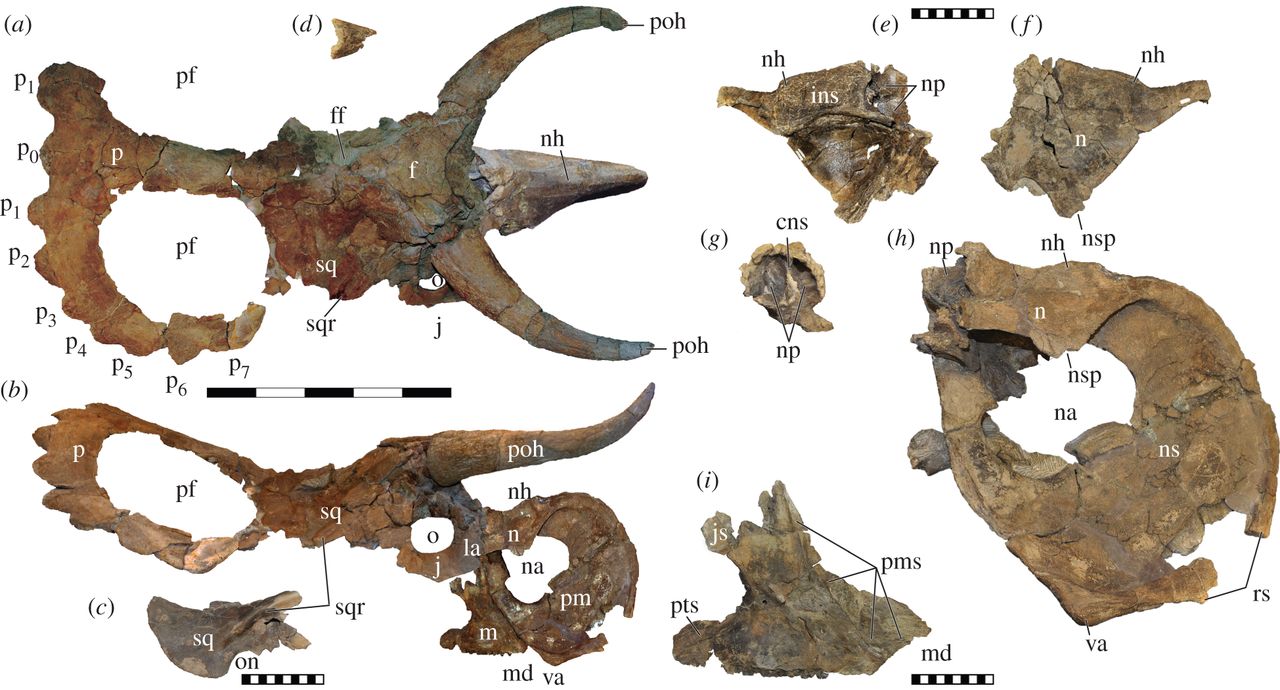
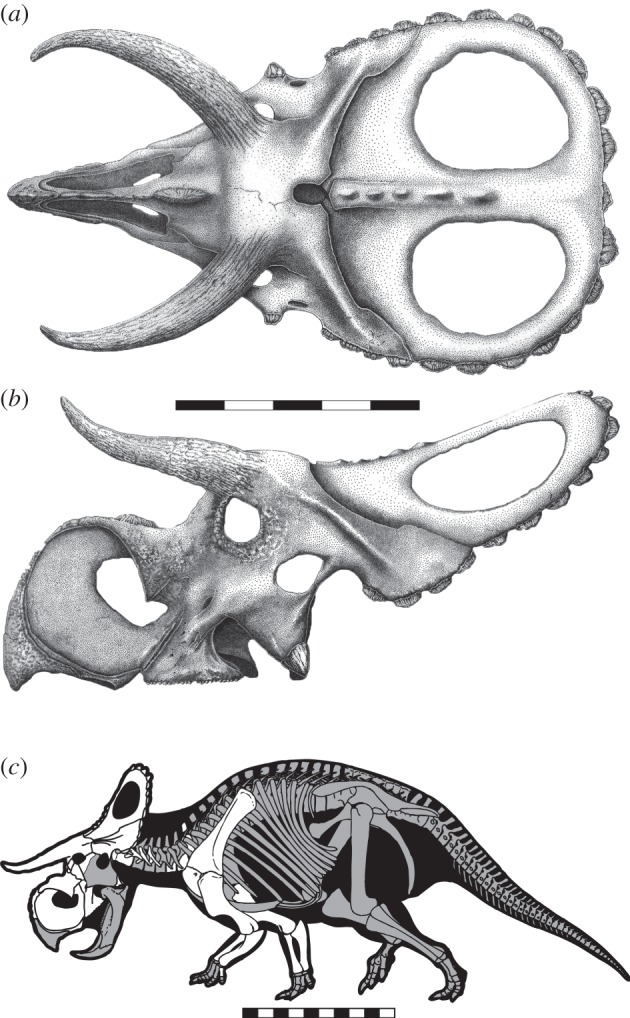
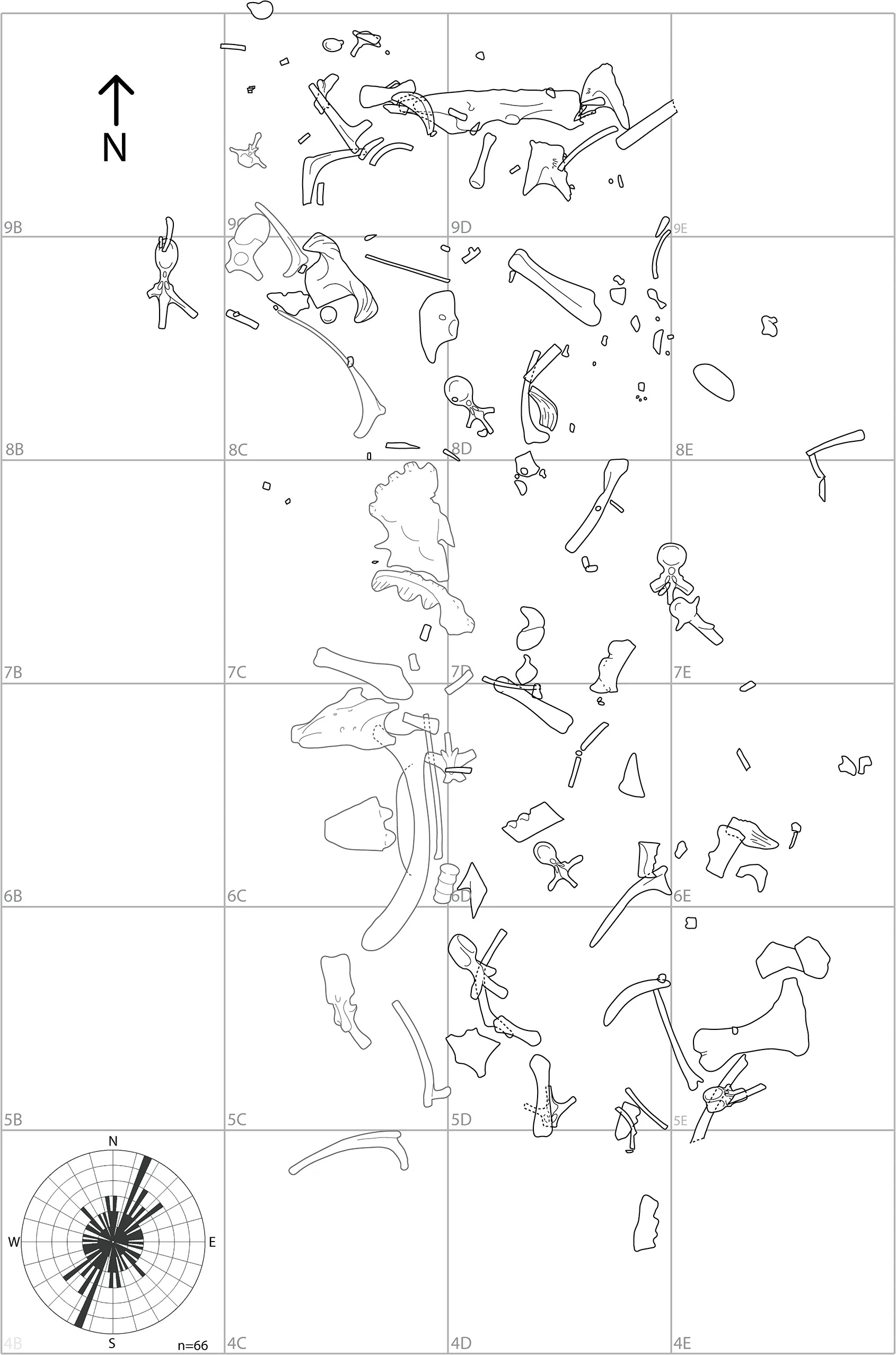
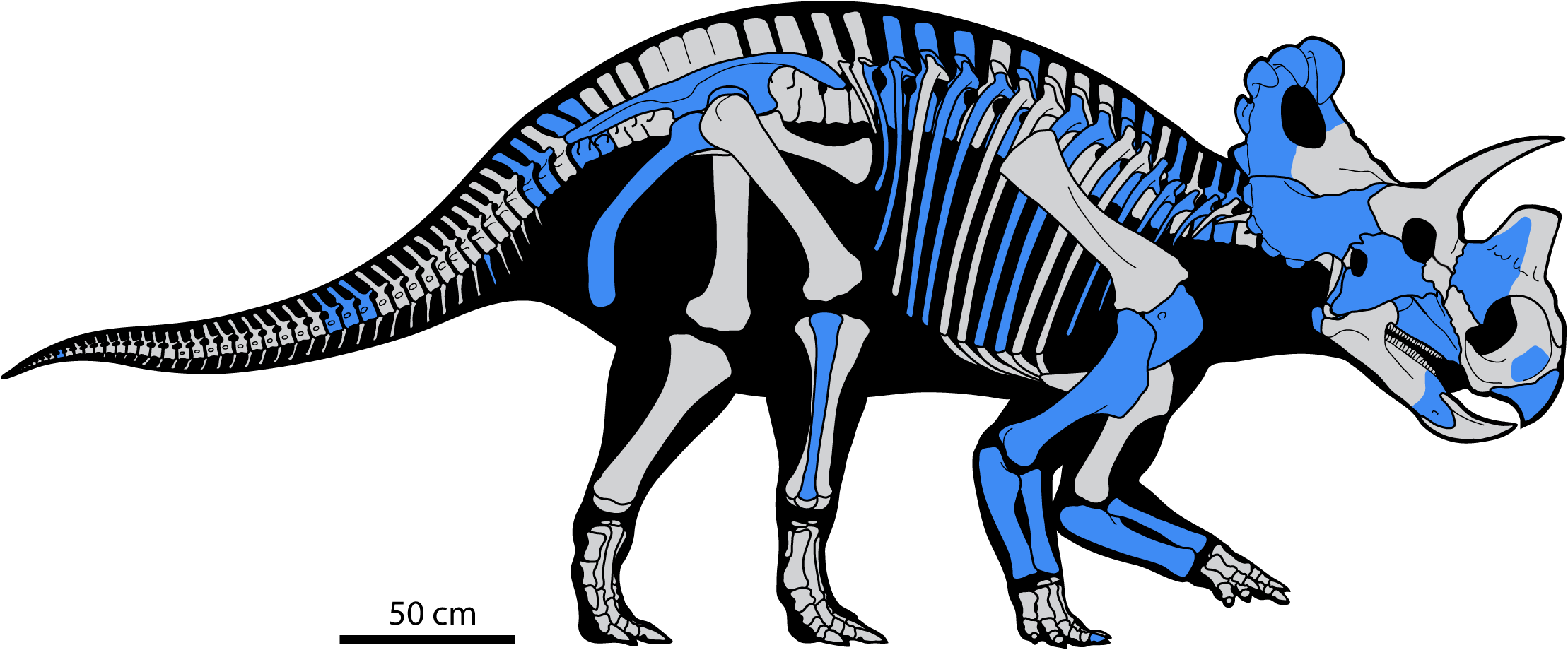
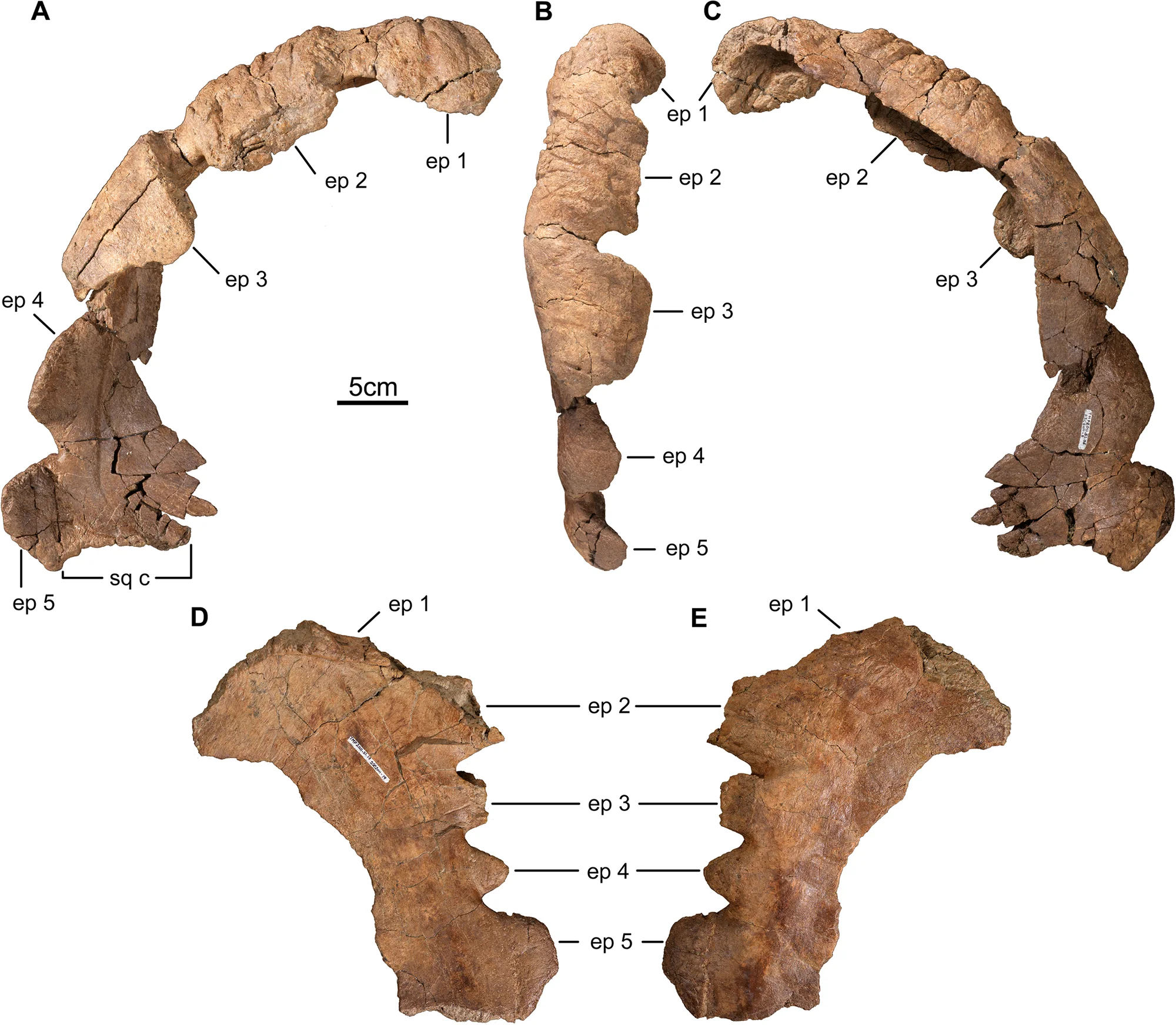
Based on holotype UMNH VP 16800 (sub-complete skull with mandible, nasal region and both supraorbital horns preserved, fused cervical vertebrae, and part of the post-cranial skeleton) and on two referred specimens at the NHMU, UMNH VP 19466 (partial skull with right squamosal) and UMNH VP 19469 (post-cranial elements). The skull is exceptionally informative, allowing detailed characterization of the autapomorphies; the complete tail and distal limb elements are inferred by comparison with other centrosaurines.

Found elements
Inferred elements
Scientific Literature
15 papers in chronological order — from the original description to recent research.
A remarkable short-snouted horned dinosaur from the Late Cretaceous (late Campanian) of southern Laramidia
Sampson, S.D., Lund, E.K., Loewen, M.A., Farke, A.A. & Clayton, K.E. · Proceedings of the Royal Society B
Original description of the taxon and of the clade Nasutoceratopsini. Sampson and colleagues document Nasutoceratops titusi as a basal centrosaurine ceratopsid with an unprecedented combination of long Texas Longhorn-style supraorbital horns, reduced nasal horn, and hypertrophied nasal cavity. The phylogenetic analysis in the paper places the animal at the base of Centrosaurinae, reversing the intuition that long supraorbital horns would be exclusive to chasmosaurines. The work formalizes the southern Laramidia endemism hypothesis by adding another endemic species to the Kaiparowits Formation fauna.

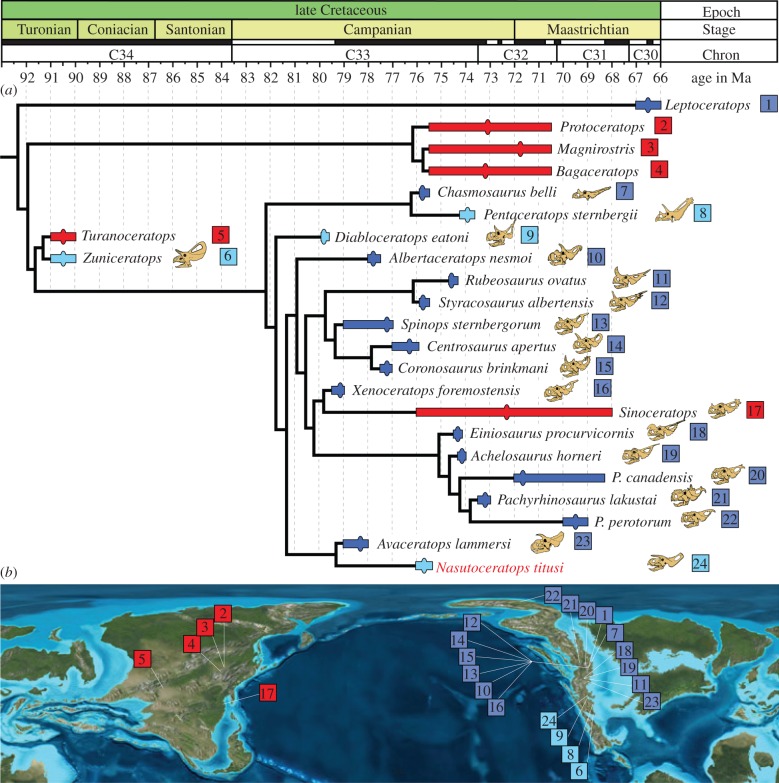
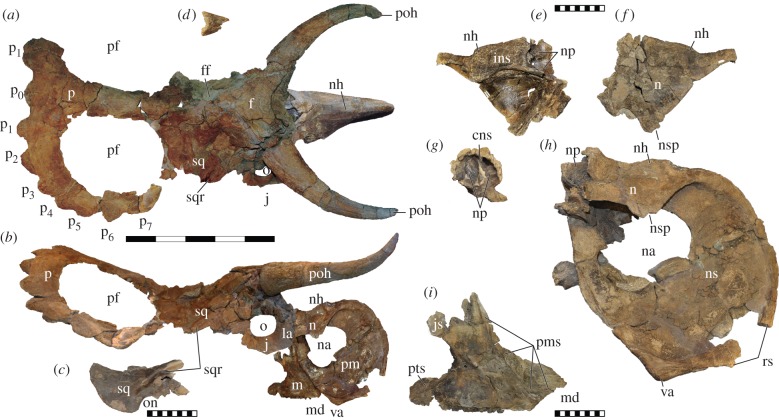
A new centrosaurine ceratopsid, Machairoceratops cronusi gen et sp. nov., from the Upper Sand Member of the Wahweap Formation (Middle Campanian), southern Utah
Lund, E.K., O'Connor, P.M., Loewen, M.A. & Jinnah, Z.A. · PLOS ONE
Lund and colleagues describe Machairoceratops cronusi, a centrosaurine from the Wahweap Formation of southern Utah, geologically older than Nasutoceratops. Phylogenetic analysis recovers both taxa as basal centrosaurines from southern Laramidia, suggesting an early radiation of the group in that region. The paper is relevant because it shows that the Kaiparowits was not the only source of basal centrosaurines in Utah and reinforces the southern Laramidia endemism hypothesis.


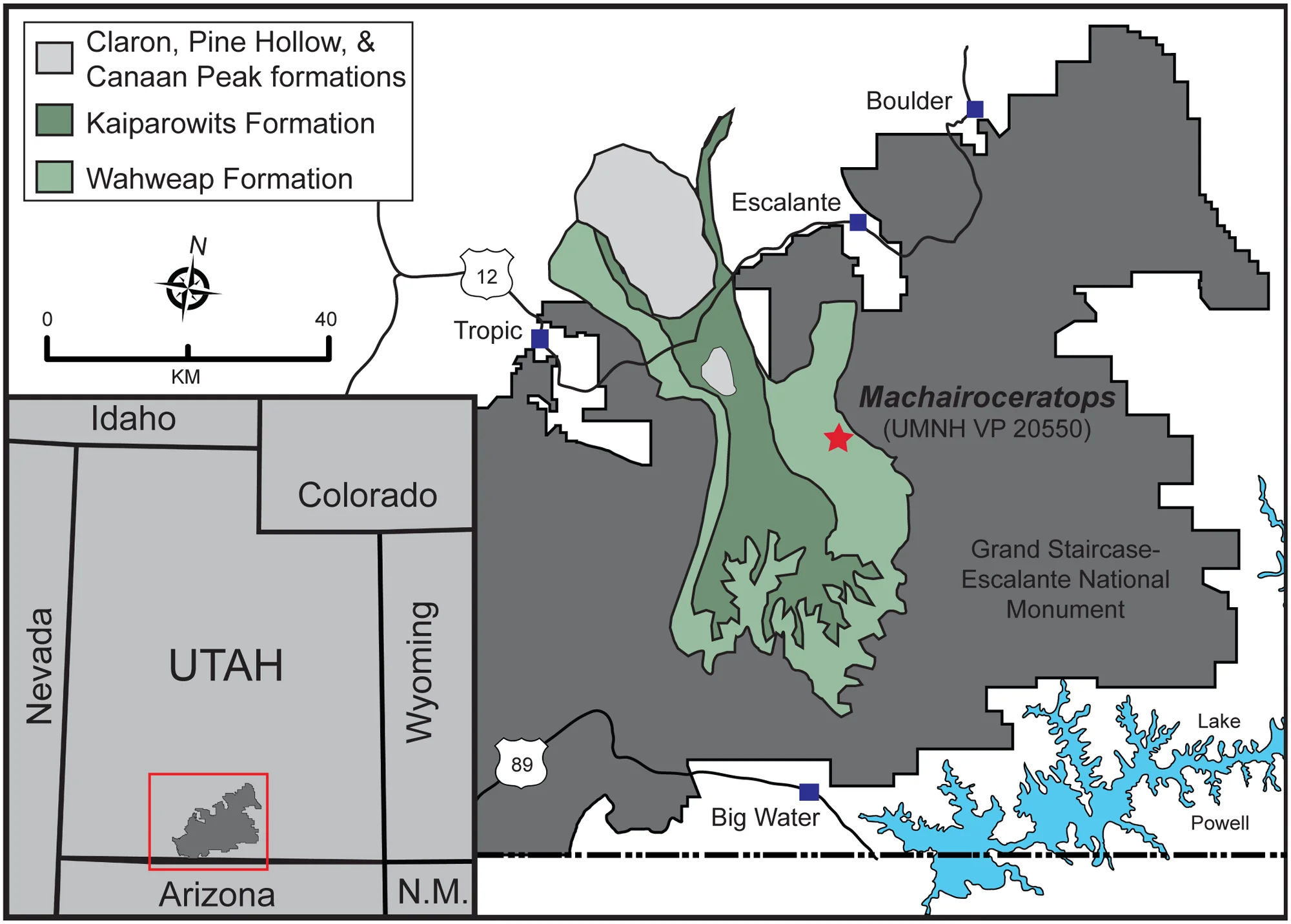
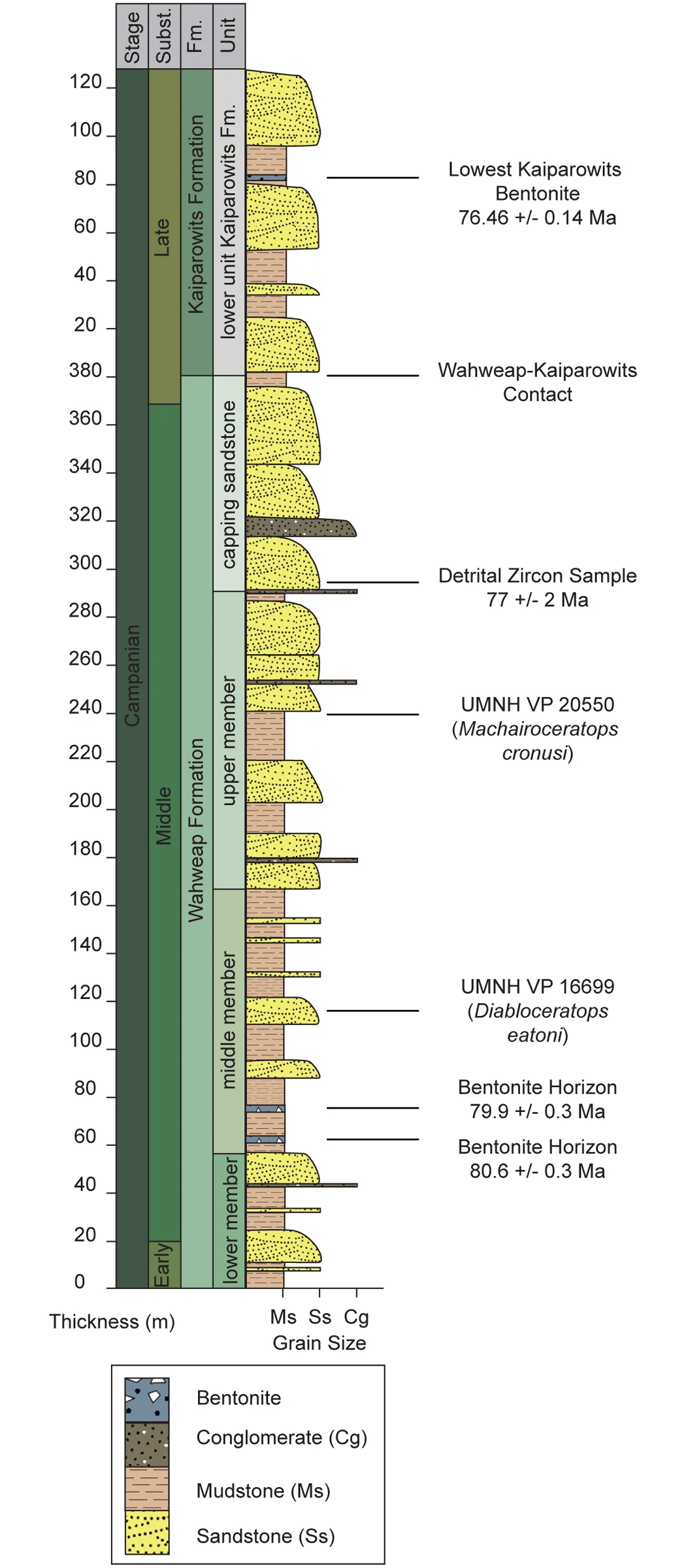
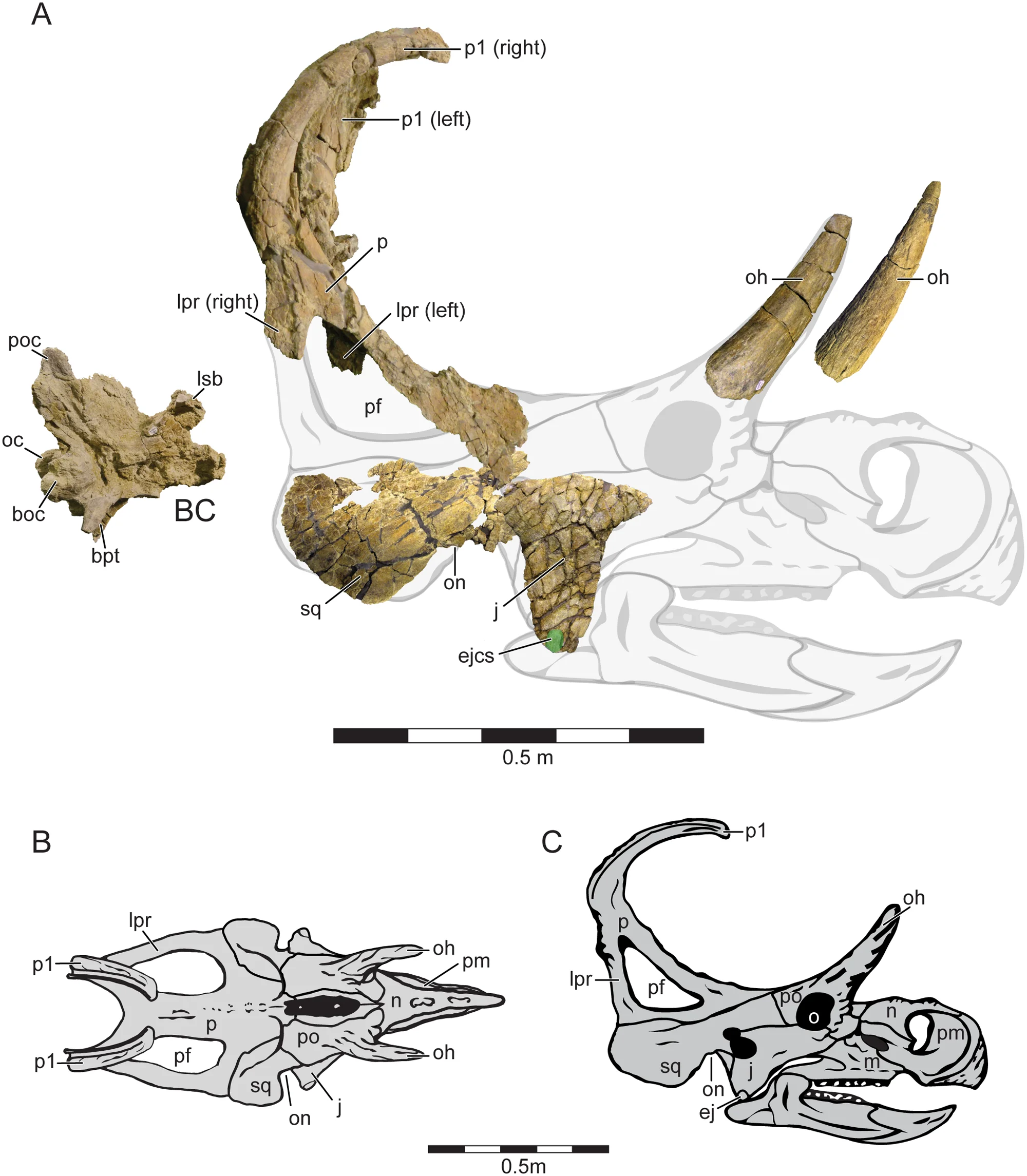
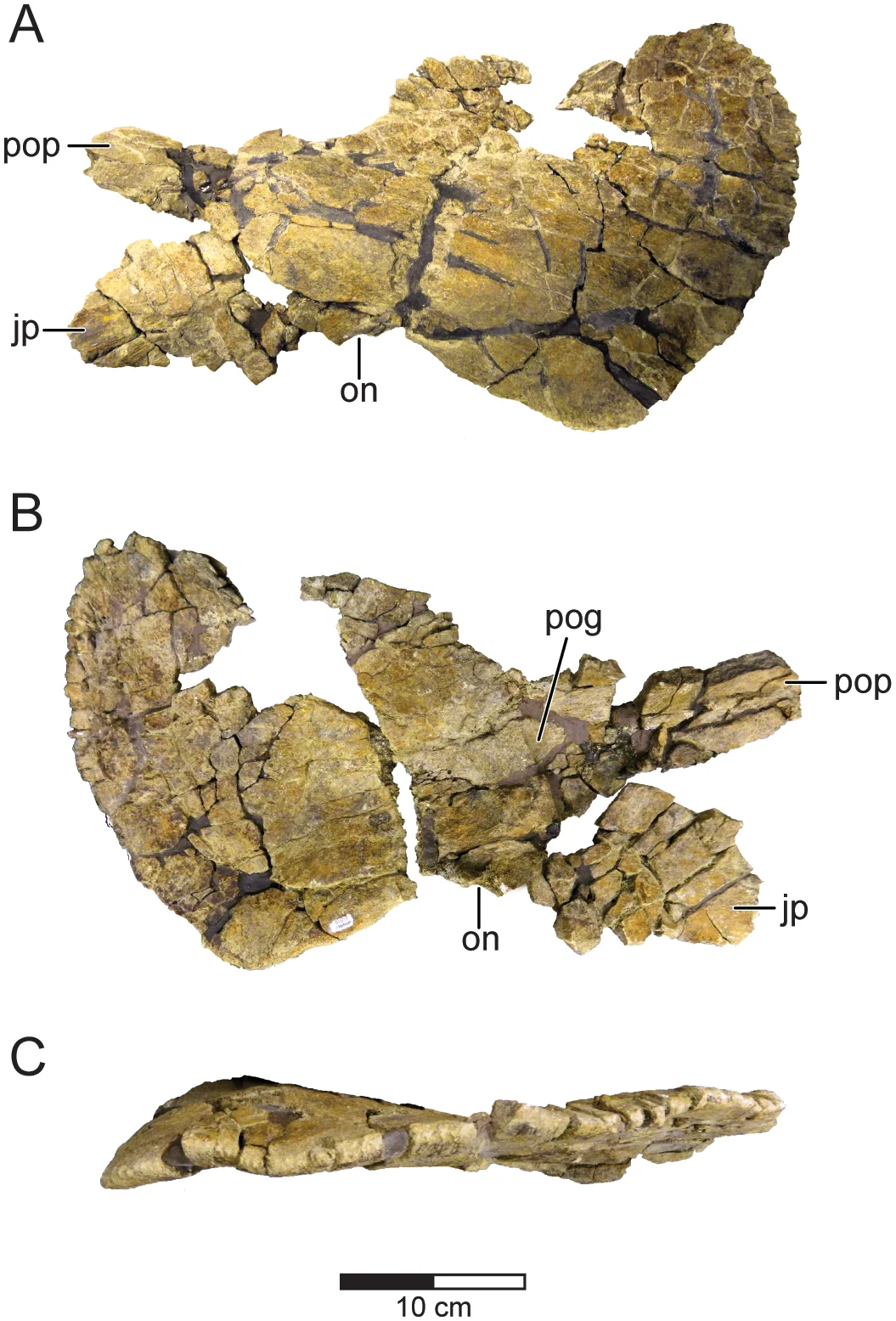
A basal ceratopsid (Centrosaurinae: Nasutoceratopsini) from the Oldman Formation (Campanian) of Alberta, Canada
Ryan, M.J., Holmes, R., Mallon, J., Loewen, M. & Evans, D.C. · Canadian Journal of Earth Sciences
Ryan and colleagues formalize the tribe Nasutoceratopsini, grouping Nasutoceratops titusi, Avaceratops lammersi, and Xenoceratops foremostensis as a plesiomorphic centrosaurine lineage that retained long supraorbital horns. The paper provides the first rigorous phylogenetic definition of the tribe and sets Nasutoceratops as its type species. Important evidence that Laramidia hosted multiple centrosaurine lineages in parallel during the Campanian.

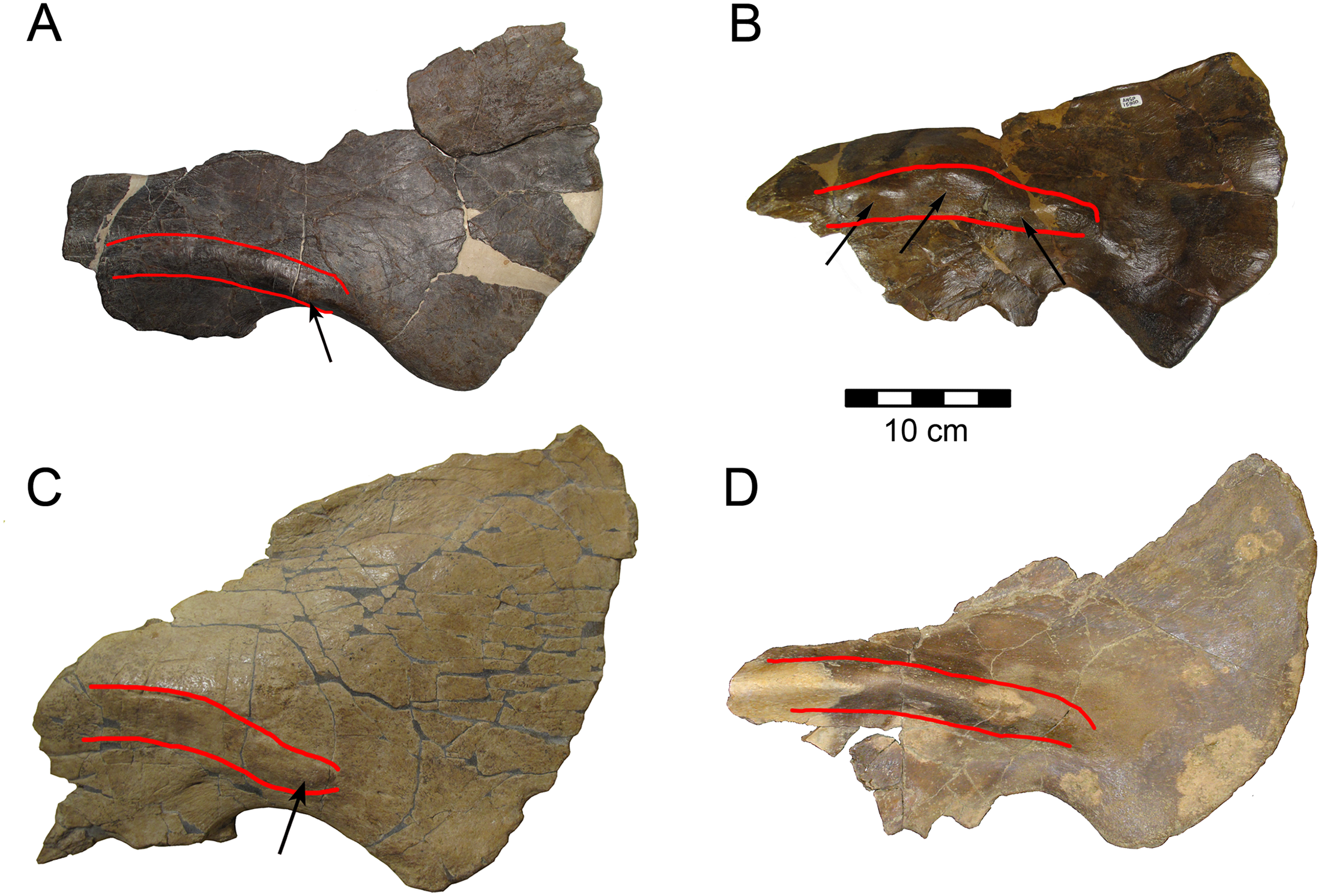
New material and systematic re-evaluation of Medusaceratops lokii (Ceratopsidae, Centrosaurinae) from the Judith River Formation (Campanian, Montana)
Chiba, K., Ryan, M.J., Fanti, F., Loewen, M.A. & Evans, D.C. · Journal of Paleontology
Chiba and colleagues re-evaluate Medusaceratops lokii based on new material and conduct a comprehensive phylogenetic analysis of Centrosaurinae. Nasutoceratops titusi is recovered at the base of the subfamily, and the monophyly of Nasutoceratopsini is supported. The paper refines the topology used in subsequent evolutionary reconstructions, including the time-calibrated cladogram used in science communication.


Wendiceratops pinhornensis gen. et sp. nov., a centrosaurine ceratopsid (Dinosauria: Ornithischia) from the Oldman Formation (Campanian), Alberta, Canada, and the evolution of ceratopsid nasal ornamentation
Evans, D.C. & Ryan, M.J. · PLOS ONE
Evans and Ryan describe Wendiceratops pinhornensis, another basal centrosaurine close to Nasutoceratopsini. Analysis of nasal ornamentation evolution in Ceratopsidae shows that prominent nasal horns evolved independently in multiple lineages, while Nasutoceratops retained the plesiomorphic reduced nasal horn state. Fundamental evolutionary context for understanding the unique facial anatomy of the genus.

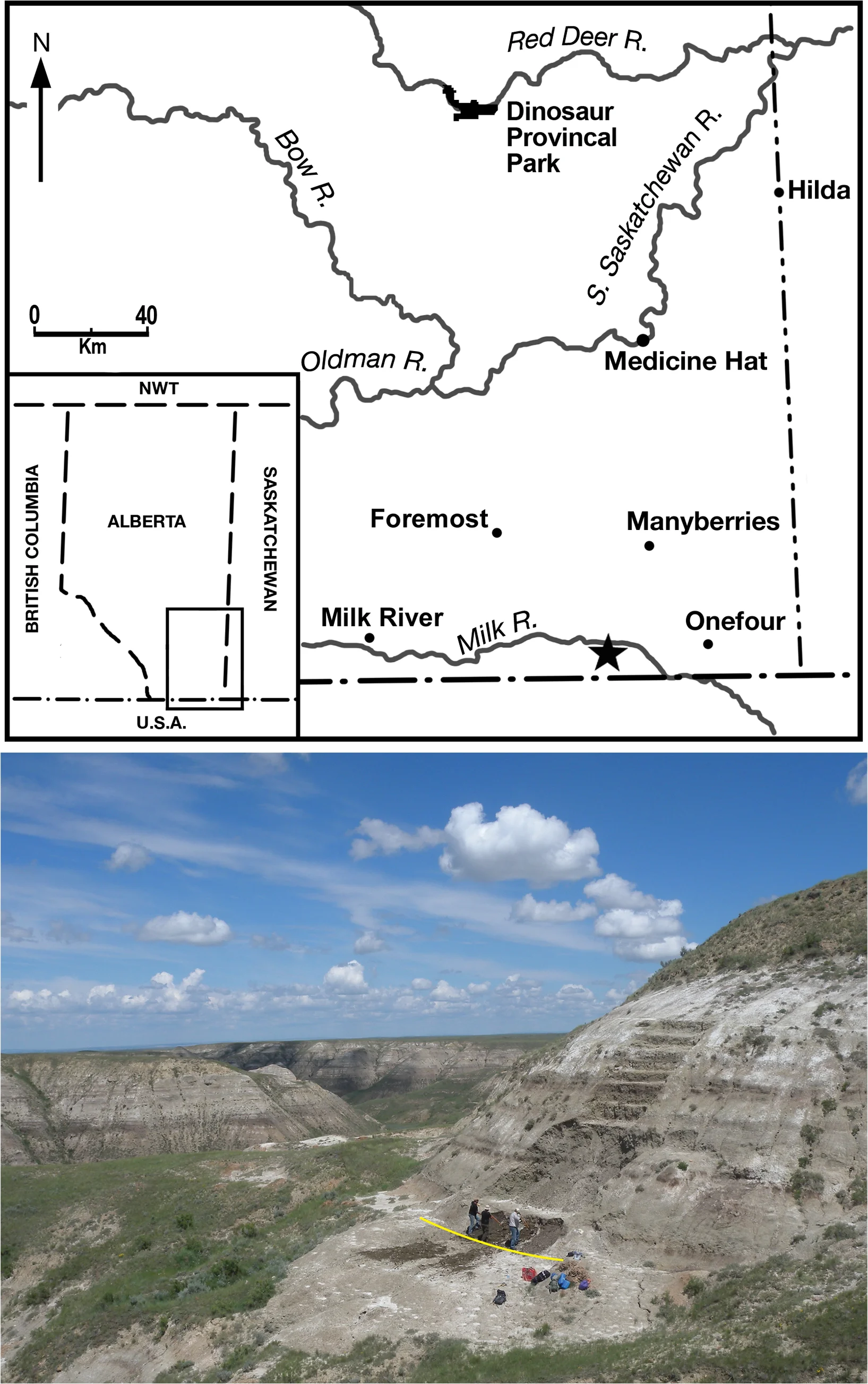
New horned dinosaurs from Utah provide evidence for intracontinental dinosaur endemism
Sampson, S.D., Loewen, M.A., Farke, A.A., Roberts, E.M., Forster, C.A., Smith, J.A. & Titus, A.L. · PLOS ONE
Sampson and colleagues describe Utahceratops gettyi and Kosmoceratops richardsoni from the Kaiparowits Formation, the two ceratopsids that share an environment with Nasutoceratops titusi. The paper presents the Laramidia endemism model, arguing that southern and northern portions of the continental island harbored distinct faunas, a model later reinforced by the description of Nasutoceratops in 2013. Provides the paleobiogeographic context where Nasutoceratops lived.
Tyrant dinosaur evolution tracks the rise and fall of Late Cretaceous oceans
Loewen, M.A., Irmis, R.B., Sertich, J.J.W., Currie, P.J. & Sampson, S.D. · PLOS ONE
Loewen and colleagues map the evolution of tyrannosaurids along Western Interior Seaway variations in the Late Cretaceous. Teratophoneus curriei, the tyrannosaurid from the Kaiparowits Formation, is identified as a contemporary predator of Nasutoceratops titusi. The paper provides the paleoenvironmental and trophic context in which Nasutoceratops lived, with marine dynamics shaping the biogeography of both herbivores and apex predators.

Evaluating combat in ornithischian dinosaurs
Farke, A.A. · Journal of Zoology
Farke biomechanically evaluates combat in ornithischians, citing Nasutoceratops titusi as an example of horn morphology consistent with ritualized intraspecific combat and display, rather than defense against predators. The long lateral supraorbital horns of Nasutoceratops are suitable for lateral interlocking, analogous to modern bovids, supporting the social function hypothesis.

A new centrosaurine from the Late Cretaceous of Alberta, Canada, and the evolution of parietal ornamentation in horned dinosaurs
Farke, A.A., Ryan, M.J., Barrett, P.M., Tanke, D.H., Braman, D.R., Loewen, M.A. & Graham, M.R. · Acta Palaeontologica Polonica
Farke and colleagues describe Spinops sternbergorum from Alberta and analyze the evolution of parietal ornamentation in centrosaurines. The paper contextualizes Nasutoceratops titusi as a basal centrosaurine with simple parietal ornamentation compared to derived taxa, reinforcing the plesiomorphic position of the genus.


A new southern Laramidian ankylosaurid, Akainacephalus johnsoni, from the upper Campanian Kaiparowits Formation of southern Utah, USA
Wiersma, J.P. & Irmis, R.B. · PeerJ
Wiersma and Irmis describe Akainacephalus johnsoni, an ankylosaurid from the same Kaiparowits Formation that yielded Nasutoceratops. The paper strengthens the picture of a distinctive southern Laramidian fauna in the late Campanian, with multiple endemic lineages of armored dinosaurs and ceratopsids coexisting in the same ecosystem.

A new centrosaurine ceratopsid from the Oldman Formation of Alberta and its implications for centrosaurine taxonomy and systematics
Ryan, M.J. & Russell, A.P. · Canadian Journal of Earth Sciences
Ryan and Russell describe Albertaceratops nesmoi and revise centrosaurine taxonomy, establishing the systematic framework later used by Sampson et al. (2013) to position Nasutoceratops titusi. The paper is an obligatory reference for understanding the topology at the base of Centrosaurinae where Nasutoceratops sits.

Ceratopsidae
Dodson, P., Forster, C.A. & Sampson, S.D. · The Dinosauria, 2nd Edition (Weishampel, Dodson & Osmólska, eds.), University of California Press
Dodson, Forster, and Sampson provide the comprehensive review of Ceratopsidae in The Dinosauria. The chapter defines the diagnostic characters and comparative framework that Sampson et al. (2013) use to characterize Nasutoceratops titusi as a distinct taxon. Fundamental reference for the anatomical interpretation of the genus.

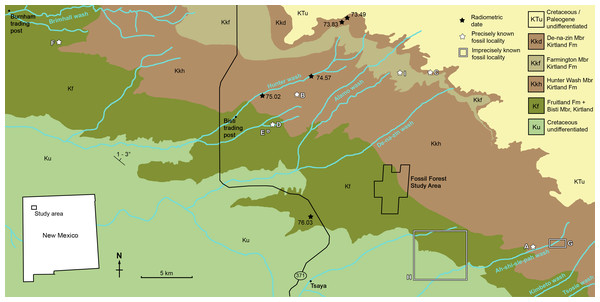
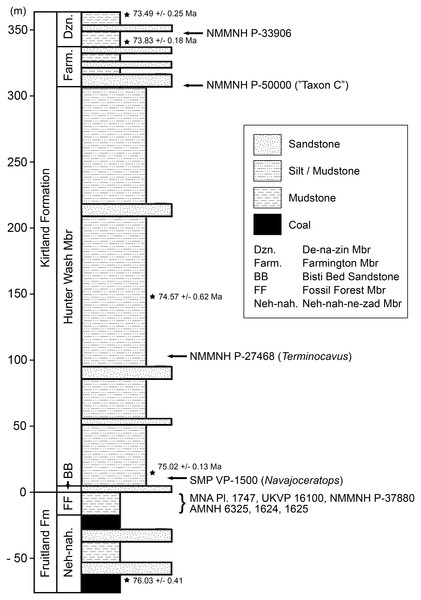
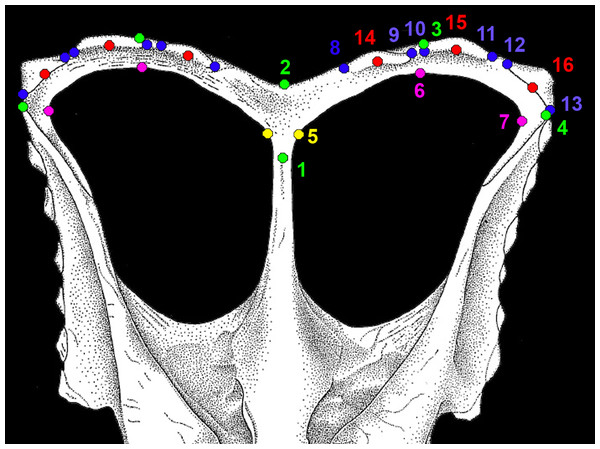
Transitional evolutionary forms in chasmosaurine ceratopsid dinosaurs: evidence from the Campanian of New Mexico
Fowler, D.W. & Freedman Fowler, E.A. · PeerJ
Fowler and Freedman Fowler document transitional chasmosaurine forms in the Campanian of New Mexico, discussing the north-south biogeography of Laramidia. Although focused on chasmosaurines, the work provides essential context for understanding the southern Laramidia endemism where Nasutoceratops titusi fits as a centrosaurine endemic.
A geologic and taxonomic overview of Early and Middle Cretaceous dinosaurs from Utah
Kirkland, J.I., Loewen, M.A., Sertich, J.J.W. & Getty, M.A. · Geology and Vertebrate Paleontology of Western and Central North America, Utah Geological Association
Kirkland and colleagues provide a geologic and taxonomic overview of Early and Middle Cretaceous dinosaurs from Utah, essential to stratigraphically and faunally contextualize the Late Cretaceous Kaiparowits, where Nasutoceratops titusi was found. The paper establishes the evolutionary continuity of the Utah dinosaur record.


A small, exquisitely preserved specimen of Mosasaurus missouriensis with comments on Late Cretaceous mosasaur paleobiogeography
Konishi, T., Newbrey, M.G. & Caldwell, M.W. · Journal of Vertebrate Paleontology
Konishi and colleagues describe an exquisitely preserved Mosasaurus missouriensis and discuss mosasaur paleobiogeography along the Western Interior Seaway. Relevant to Nasutoceratops because it documents the dynamics of the same marine body that isolated Laramidia and produced the endemism patterns in southern Laramidian terrestrial dinosaurs.

Famous museum specimens
UMNH VP 16800
Natural History Museum of Utah, Salt Lake City, Estados Unidos
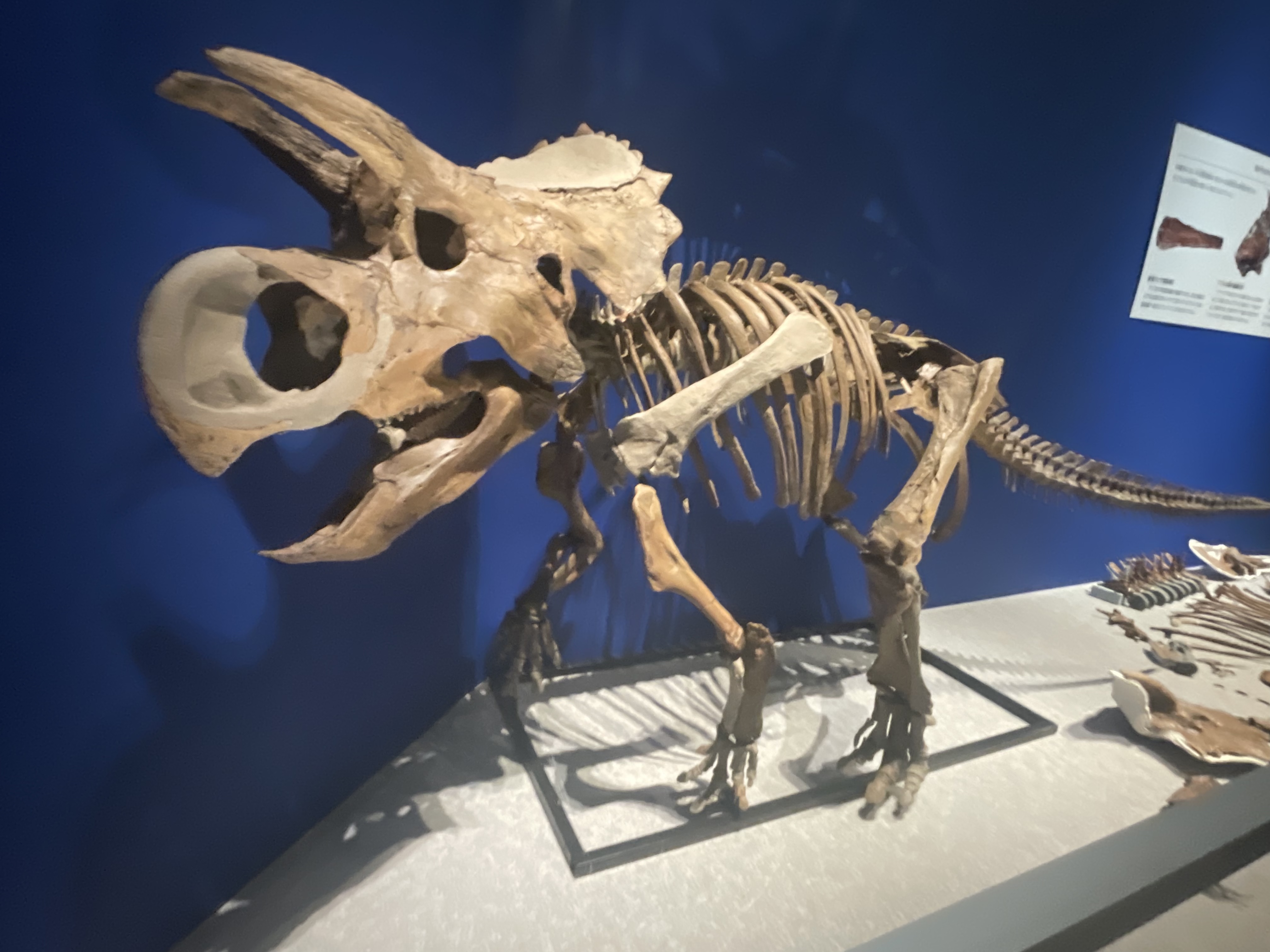
Holotype of Nasutoceratops titusi. Excavated in 2006 by Eric K. Lund, then a graduate student under Scott D. Sampson, in the Kaiparowits Formation within Grand Staircase-Escalante National Monument, Kane County, Utah. On permanent display in the Past Worlds gallery of the NHMU, alongside the holotypes of Kosmoceratops richardsoni and Utahceratops gettyi. A cast or digital scan of this skull appeared as a set prop in Jurassic World Dominion (2022).
In cinema and popular culture
Nasutoceratops titusi had a late but remarkable entry into pop culture. Formally described in 2013, it was chosen only six years later to star in the short film Jurassic World: Battle at Big Rock (2019), directed by Colin Trevorrow and released on the franchise's official YouTube channel as a bridge between Fallen Kingdom and Dominion. In the short, a family of Nasutoceratops consisting of male, female, and calf is attacked by an Allosaurus, and the conflict is the dramatic focus of the first half of the film. The choice of this animal, instead of a more popular ceratopsid like Triceratops, was deliberate and had educational impact: the reconstruction closely follows the scientific profile, with the characteristic long supraorbital horns clearly visible and the short snout preserved. Its presence in the short made Nasutoceratops the lesser-known dinosaur with the greatest screen exposure in a short period. The cast or scan of the UMNH VP 16800 holotype skull, housed at the Natural History Museum of Utah, appeared in a scene of Jurassic World Dominion (2022), as documented in an institutional video from the museum with curator Randall B. Irmis. This indirect presence of the holotype in a high-budget film is unusual and reinforces the franchise's connection to real paleontology. Outside the Jurassic World franchise, Nasutoceratops does not yet have confirmed appearances in major documentaries such as Prehistoric Planet, although the growth in popularity of the genus after 2019 may lead to future appearances.
Classification

Discovery
Fun fact
Nasutoceratops titusi is often nicknamed by paleontologists as the Texas Longhorn dinosaur. Its long supraorbital horns, oriented laterally and curving upward and forward over the eye sockets, replicate in form and general orientation the horns of modern Texas Longhorn cattle in a way that no other known dinosaur does. And, as if that were not enough, the extremely enlarged nasal cavity, the trait that gives the genus its name, has no clearly established function: it may have served olfaction, thermoregulation, or vocal resonance, but the most provocative hypothesis is that it amplified horn-like vocalizations during mating displays.
Last reviewed: April 24, 2026