
Kulindadromeus
Kulindadromeus zabaikalicus
"Kulinda runner from Transbaikalia"
About this species
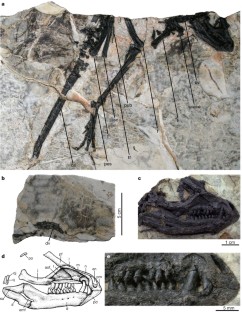
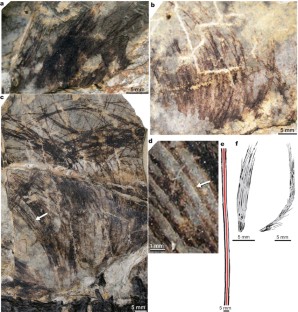
Kulindadromeus zabaikalicus is a basal neornithischian from the Middle Jurassic (Bathonian, about 168 to 166 million years ago according to Cincotta et al. 2019) Ukureyskaya Formation, also spelled Ukurey, at the Kulinda locality in the Olov Depression, Chernyshevsky District, Zabaikalsky Krai, southeastern Siberia, Russia. A small bipedal herbivore about 1.5 m long with an estimated mass of 2 kg, it became famous as the first ornithischian with clearly documented complex integumentary cover, a find that unsettled the consensus that feathers were an exclusive trait of coelurosaurian theropods. Godefroit and colleagues, in 2014 in Science, described three types of feather-like filaments at Kulinda: monofilament fuzz covering head and trunk, with simple fibres of constant width comparable to the earliest generation of feather-like structures in Sinosauropteryx; compound tufts of 6 to 7 filaments arising from hexagonal base plates on arms and legs, a previously unknown morphology without exact parallel in theropods; and ribbon-like structures on thigh and tibia, broad, flattened and lacking a defined rachis. Added to these filaments are three scale types: imbricated hexagonal scales on the shins, small rounded scales on hands and feet, and arched rectangular scales on the tail. The simultaneous presence of filaments and scales in the same individual shows that the integumentary morphology of basal dinosaurs was mosaic and suggests that feather-like integument may be plesiomorphic for Dinosauria as a whole rather than restricted to Coelurosauria, radically changing the classical reading that confined feathers to carnivorous theropods. The find overturned the precedent that only Tianyulong and Psittacosaurus bore filamentous structures in Ornithischia, extending the condition to a much older basal ornithischian and geographically anchoring the record in Siberia, outside the Chinese Jehol stage that had dominated feathered fossils. U-Pb dating on detrital zircons and monazites combined with palynology by Cincotta et al. (2019) refined the original age of Godefroit et al. (2014), which pointed to a Bajocian to Tithonian interval (169 to 144 Ma), to Bathonian (168.3 ± 1.3 to 166.1 ± 1.2 Ma), making Kulindadromeus the oldest known dinosaur with unequivocal 'feather-like' structures. The same study synonymised Kulindapteryx ukureica, Daurosaurus olovus and Lepidocheirosaurus natalis, taxa erected by Alifanov and Saveliev in 2014 and 2015 on material from the same bone beds, as nomina dubia likely junior synonyms of Kulindadromeus, simplifying the site's systematics to a single dominant ornithischian taxon. The holotype INREC K3/109, a partial skull with mandibles, is housed at the Institute of Natural Resources, Ecology and Cryology SB RAS in Chita, with referred material distributed across INREC, the Institute of Earth's Crust SB RAS in Irkutsk and the Royal Belgian Institute of Natural Sciences in Brussels, where Paul Spagna prepared the blocks bearing integument. Together, the type skull and the hundreds of disarticulated elements from three bone beds allowed Godefroit and colleagues to reconstruct the animal's nearly complete anatomy and to document the richest record of body cover in a basal ornithischian of the Mesozoic.
Geological formation & environment
Ukureyskaya Formation (or Ukurey), lower part, Olov Depression, Chernyshevsky District, Zabaikalsky Krai, about 220 km east of Chita city, southeastern Siberia, Russia. It is a volcanosedimentary succession with sandstones, siltstones, shales and tuffites deposited in shallow lakes under a recurrent volcanic regime. The original dating in Godefroit et al. (2014) suggested a Bajocian to Tithonian age (169 to 144 Ma). The U-Pb dating on detrital zircons and monazites combined with palynological analysis in Cincotta et al. (2019) refined the age to Bathonian (Middle Jurassic, 168.3 ± 1.3 to 166.1 ± 1.2 Ma), making Kulindadromeus zabaikalicus the oldest known dinosaur with structures clearly interpretable as 'feather-like'. The bone beds are distributed across three fossil horizons rich in ornithischian material, excavated between 2010 and 2013.
Image gallery
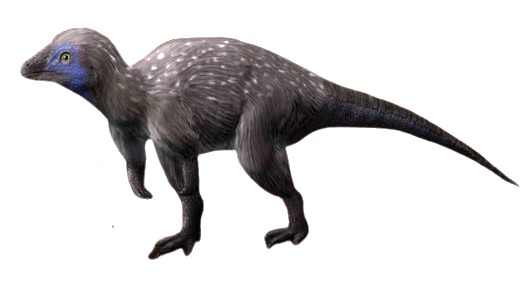

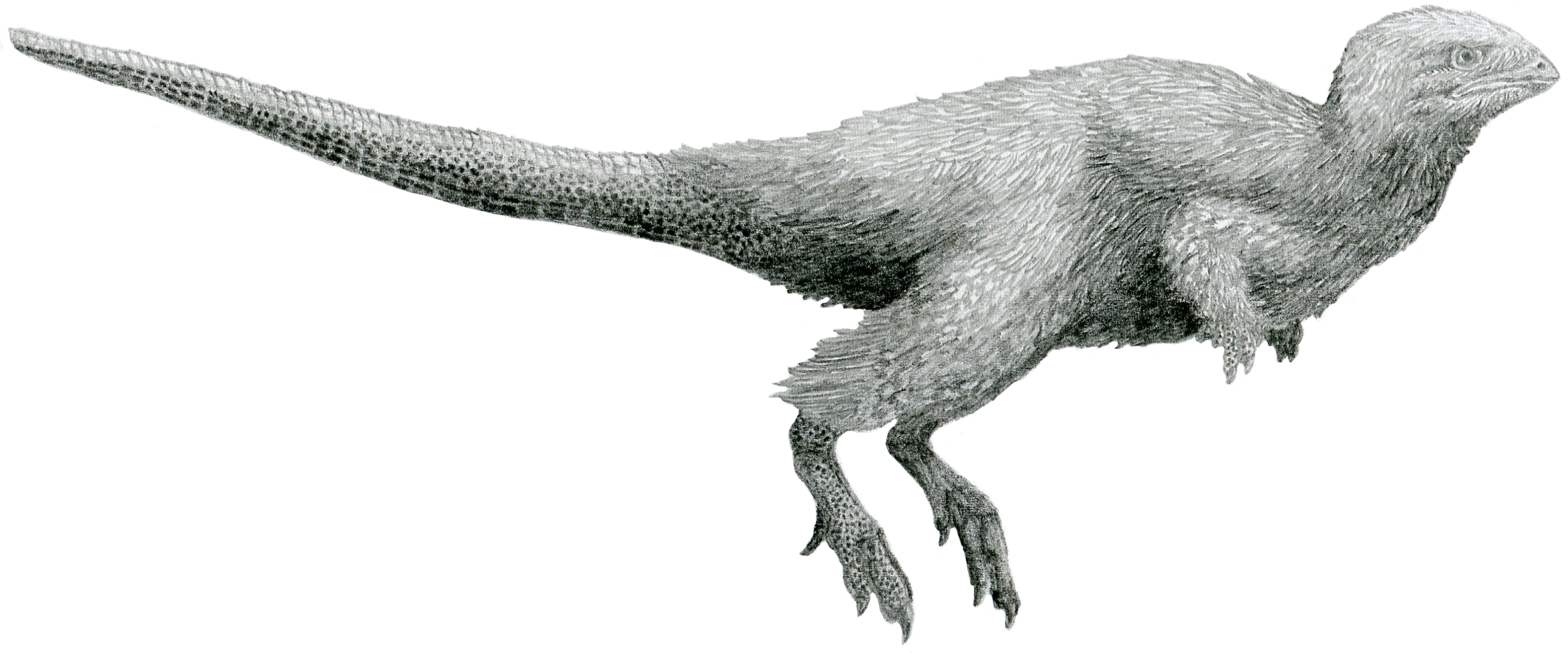


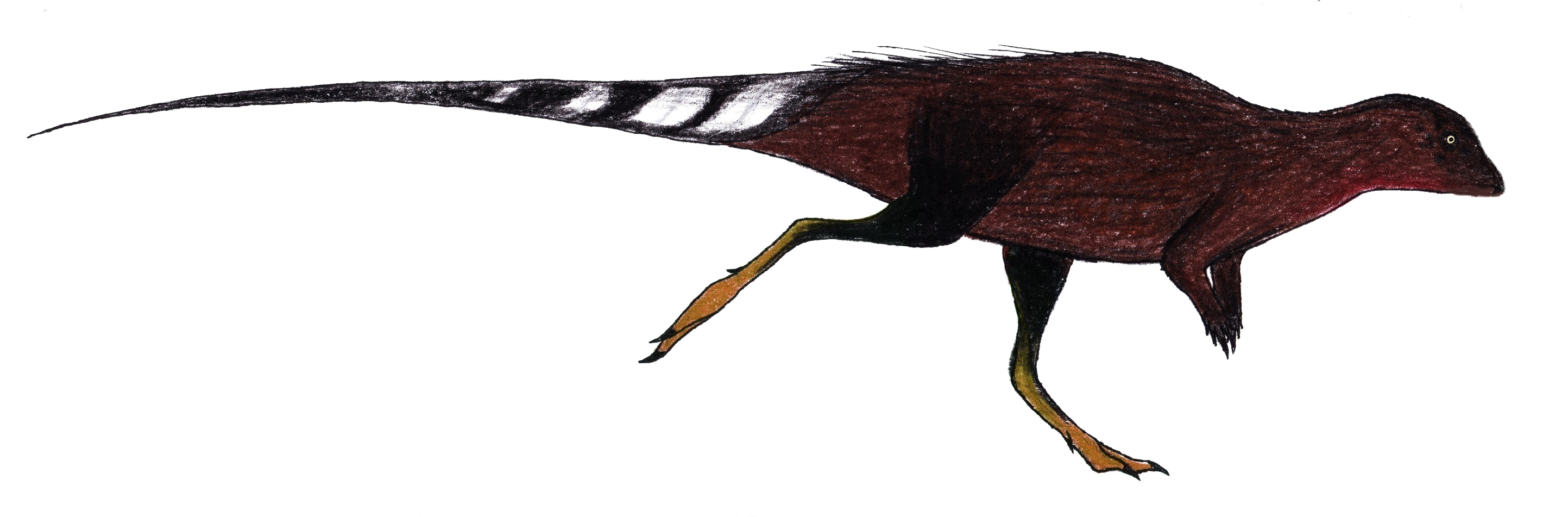


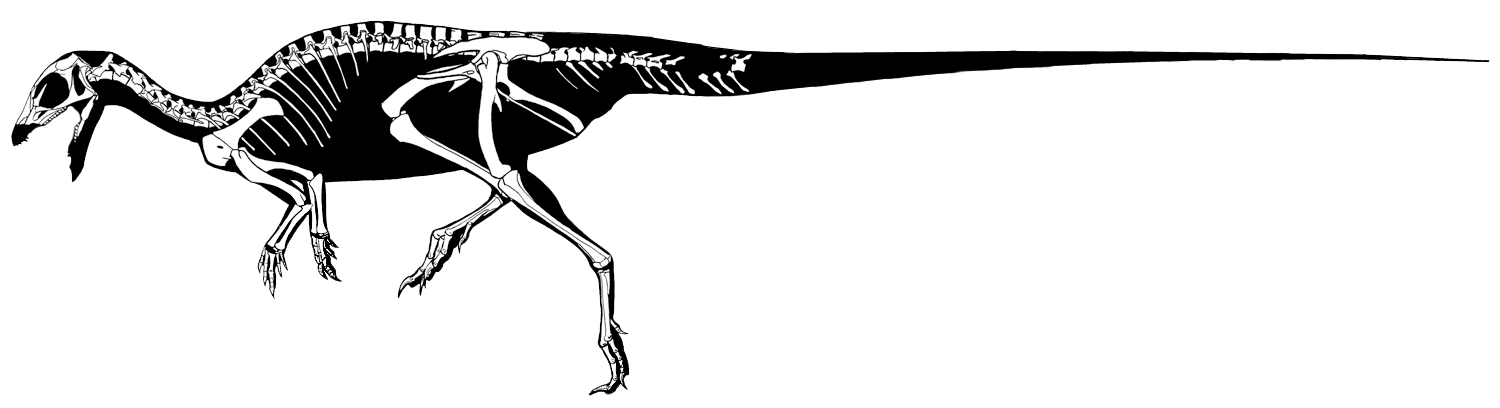
Life reconstruction of Kulindadromeus zabaikalicus by Nobu Tamura, a small feathered ornithischian from Jurassic Siberia.
Nobu Tamura, Wikimedia Commons, CC BY-SA 4.0
Ecology and behavior
Habitat
Volcanosedimentary lacustrine system on the inner plains of the Siberian continent during the Middle Jurassic. The Ukureyskaya Formation preserves tuffaceous shales, sandstones and siltstones deposited in shallow lakes periodically buried by volcanic ash, under a humid temperate climate. Flora included conifers, ginkgoaleans, ferns and horsetails; associated fauna included insects, crustaceans, fish and other indeterminate small dinosaurs. Recurrent volcanic ash produced Konservat-Lagerstätten responsible for the exceptional preservation of soft tissues.
Feeding
Small herbivore. The small skull with simple leaf-shaped teeth, short snout with aligned premaxillae, maxillae and dentaries indicates a diet of soft vegetation, leaves, shoots and possibly ginkgoalean and fern fruits. The absence of complex dental batteries places Kulindadromeus among basal neornithischians in terms of feeding specialisation.
Behavior and senses
Small agile biped, with long hindlimbs adapted for fast running and tail used as a counterweight. The heterogeneous filamentous integument, including compound tufts and ribbon-like structures, supports roles in visual display and intraspecific signalling, plus a possible thermal function in an environment with recurrent ash falls.
Physiology and growth
The extensive filamentous cover on head, neck and trunk suggests at least facultative endothermy. The coexistence with scales (hexagonal on shins, rounded on hands and feet, rectangular on the tail) shows that integumentary morphology was mosaic, consistent with what is observed in living neornithine birds and with the ancestral integument in Dinosauria as a whole.
Paleogeography
Continental configuration

Scotese & Vérard · CC BY 4.0 · Jurassic, ~155 Ma
During the Batoniano (~168–166 Ma), Kulindadromeus zabaikalicus inhabited the fragmenting Pangea. North America and Europe were still close, and the North Atlantic was just beginning to open. Climate was warm and humid globally, with no polar ice caps.
Bone Inventory
The genus is known from holotype INREC K3/109 (partial skull with mandibles) and hundreds of disarticulated elements from three main bone beds at Kulinda, including blocks with preserved soft tissues (filament and scale impressions). Taken together, the material allows near-complete skeletal reconstruction from skull to feet and unprecedented documentation of integument in basal ornithischians. Material distributed across INREC SB RAS (Chita), Institute of Earth's Crust SB RAS (Irkutsk) and RBINS (Brussels).

Found elements
Inferred elements
Scientific Literature
15 papers in chronological order — from the original description to recent research.
Bristle-like integumentary structures at the tail of the horned dinosaur Psittacosaurus
Mayr, G., Peters, D.S., Plodowski, G. e Vogel, O. · Naturwissenschaften 89(8), 361-365
First report of bristle-like integumentary structures in an ornithischian, preserved on the tail of Psittacosaurus specimen SMF R 4970 (Early Cretaceous of China). It set the anatomical precedent for filamentous structures outside Theropoda and became the comparative reference for Kulindadromeus more than a decade later.

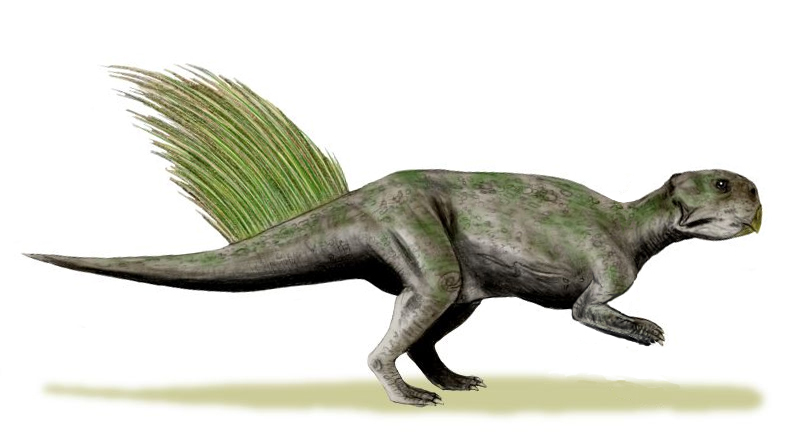
An Early Cretaceous heterodontosaurid dinosaur with filamentous integumentary structures
Zheng, X.-T., You, H.-L., Xu, X. e Dong, Z.-M. · Nature 458(7236), 333-336
Description of Tianyulong confuciusi, a heterodontosaurid from the Tiaojishan Formation (Late Jurassic of China, about 159 Ma), bearing long single filaments along back, neck and tail. It provided the first unequivocal evidence of filamentous structures in Ornithischia and anticipated the reading of Kulindadromeus as ancestral dinosaur integument.


A gigantic feathered dinosaur from the Lower Cretaceous of China
Xu, X., Wang, K., Zhang, K., Ma, Q., Xing, L., Sullivan, C., Hu, D., Cheng, S. e Wang, S. · Nature 484(7392), 92-95
Description of Yutyrannus huali, a 9 m tyrannosauroid from the Yixian Formation, with 15 to 20 cm filaments covering much of the body. It expanded the size envelope in which filamentous cover occurs in theropods and established the broad comparative context in which Kulindadromeus was interpreted two years later.


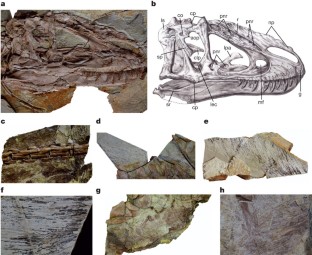
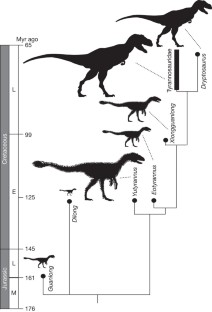
Exceptionally preserved juvenile megalosauroid theropod dinosaur with filamentous integument from the Late Jurassic of Germany
Rauhut, O.W.M., Foth, C., Tischlinger, H. e Norell, M.A. · Proceedings of the National Academy of Sciences (PNAS) 109(29), 11746-11751
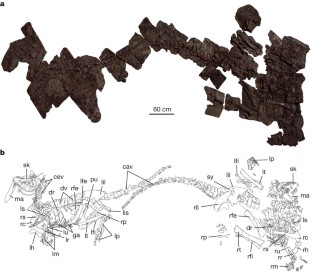
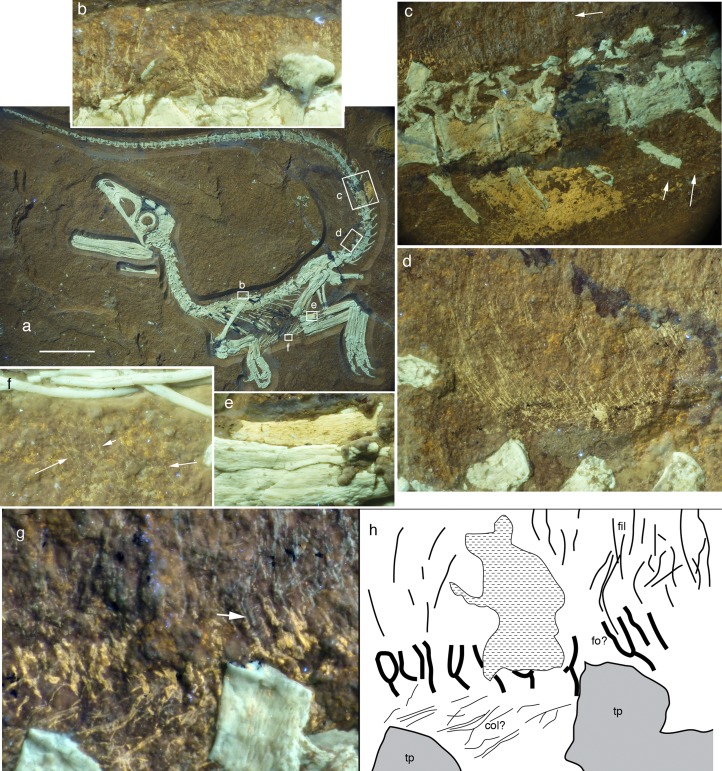
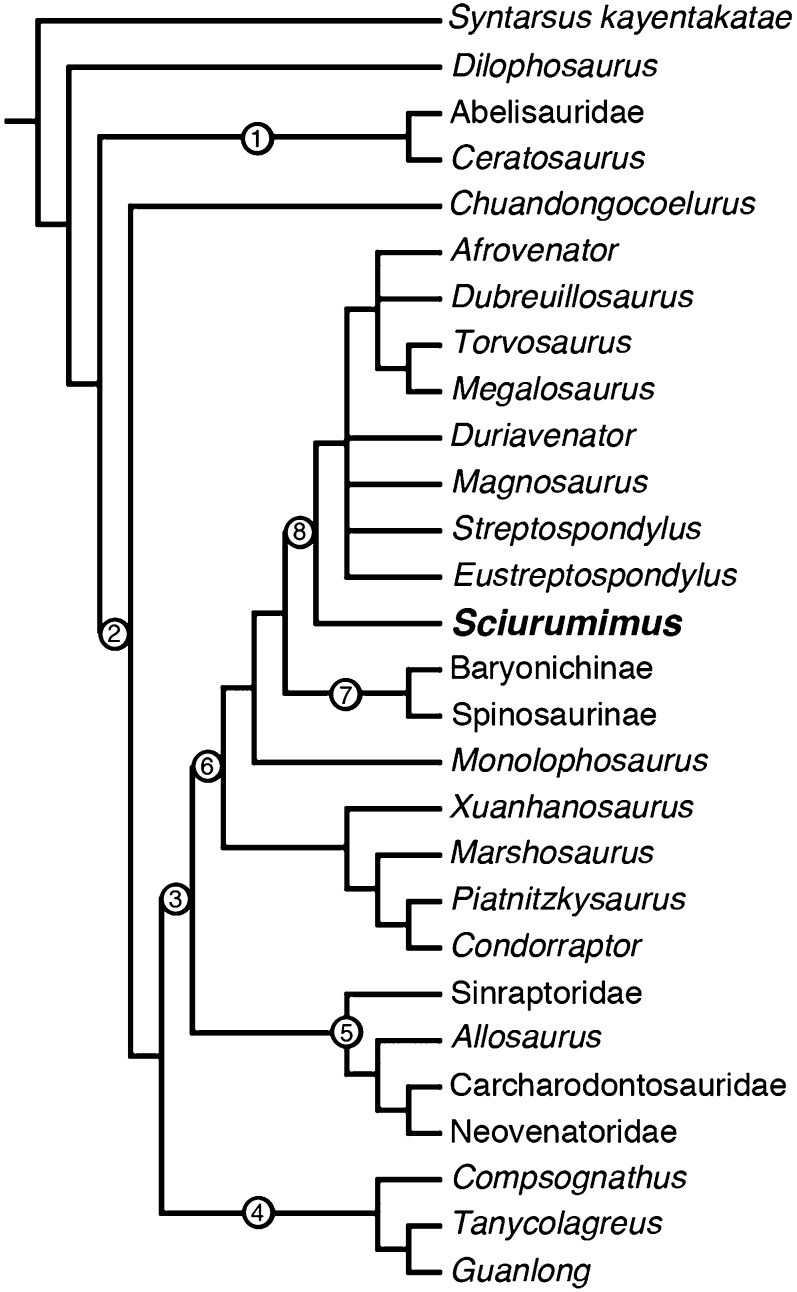
Description of the juvenile Sciurumimus albersdoerferi, a Late Jurassic megalosauroid from Solnhofen (Germany) with preserved integumentary filaments. It pushed the record of feather-like integument outside Coelurosauria, a condition later consolidated by the discovery of Kulindadromeus in Ornithischia.


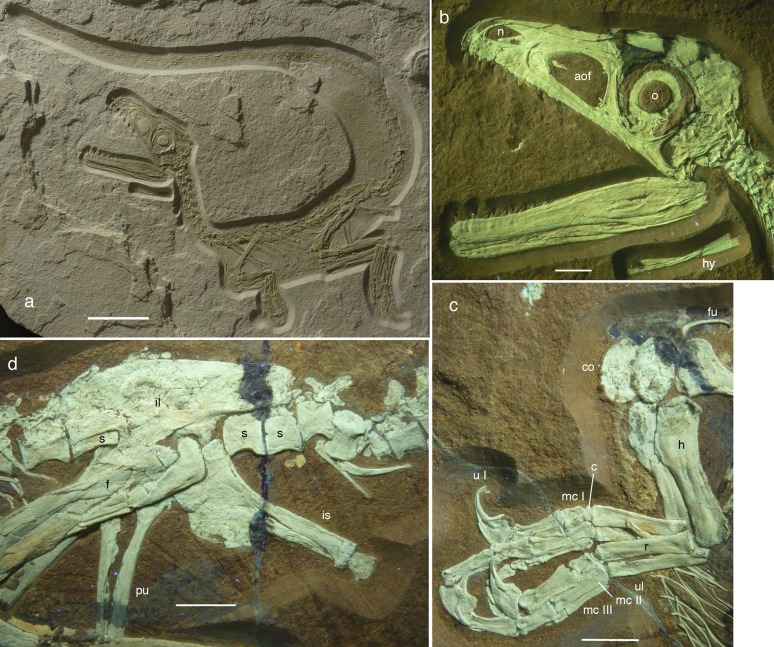
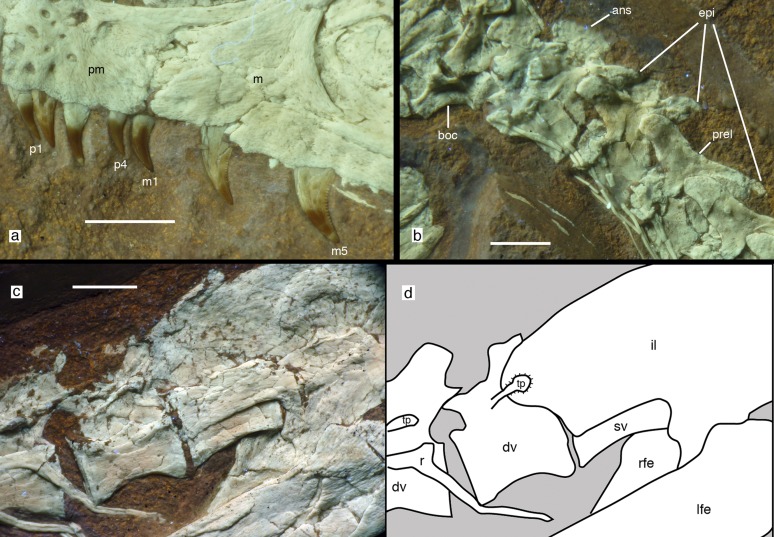
A Jurassic ornithischian dinosaur from Siberia with both feathers and scales
Godefroit, P., Sinitsa, S.M., Dhouailly, D., Bolotsky, Y.L., Sizov, A.V., McNamara, M.E., Benton, M.J. e Spagna, P. · Science 345(6195), 451-455
Original description of Kulindadromeus zabaikalicus based on holotype INREC K3/109 and on hundreds of disarticulated elements from Kulinda (Ukureyskaya Formation). Documents three filament types (monofilament fuzz, compound tufts, ribbon-like structures) and three scale types, suggesting that feather-like integument may be plesiomorphic for Dinosauria.


Comment on "A Jurassic ornithischian dinosaur from Siberia with both feathers and scales"
Lingham-Soliar, T. · Science 346(6208), 434
Critical comment questioning the interpretation of Kulindadromeus filaments as protofeathers, proposing instead that the compound structures around humerus and femur are support fibres of degraded scales. It framed the main debate on the homology of feather-like integument in ornithischians.

Response to Comment on "A Jurassic ornithischian dinosaur from Siberia with both feathers and scales"
Godefroit, P., McNamara, M.E., Dhouailly, D. e Benton, M.J. · Science 346(6208), 434
Formal response of the original authors to Lingham-Soliar's critique. They reaffirm, based on electron microscopy and experimental decay, that Kulindadromeus filaments have constant width, keratinous behaviour and are incompatible with collagen fibres, supporting homology with basal feathers.
Two new ornithischian dinosaurs (Hypsilophodontia, Ornithopoda) from the Late Jurassic of Russia
Alifanov, V.R. e Saveliev, S.V. · Paleontological Journal 48(4), 414-425
Description of Kulindapteryx ukureica and Daurosaurus olovus based on material collected at Kulinda, interpreted as distinct ornithopods. Subsequent studies (Cincotta et al. 2019) concluded they are likely junior synonyms of Kulindadromeus and should be treated as nomina dubia.


The systematic relationships and biogeographic history of ornithischian dinosaurs
Boyd, C.A. · PeerJ 3, e1523
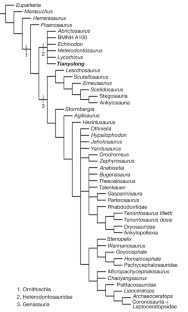
Phylogenetic analysis with 255 characters and 65 terminal taxa, the largest at the time for basal ornithischians. It provides the framework in which Kulindadromeus fits as a non-cerapodan neornithischian, and confirms that old 'Hypsilophodontidae' are paraphyletic.


New specimen of Archaeopteryx provides insights into the evolution of pennaceous feathers
Foth, C., Tischlinger, H. e Rauhut, O.W.M. · Nature 511(7507), 79-82
Description of the 11th Archaeopteryx specimen, with pennaceous feather pattern on limbs and tail. It provides the avian context contemporary to Kulindadromeus within a broader feather evolution scenario, clearly distinguishing pennaceous from filamentous morphotypes.


A new psittacosaurid dinosaur (Psittacosauridae, Ornithischia) from the Late Jurassic of Transbaikalia
Alifanov, V.R. e Saveliev, S.V. · Paleontological Journal 49(5), 517-526
Description of Lepidocheirosaurus natalis, a putative Jurassic psittacosaurid from Kulinda. The detailed analysis of Cincotta et al. (2019) considers the material indistinguishable from Kulindadromeus and treats the taxon as a junior synonym and nomen dubium.


3D camouflage in an ornithischian dinosaur
Vinther, J., Nicholls, R., Lautenschlager, S., Pittman, M., Kaye, T.G., Rayfield, E., Mayr, G. e Cuthill, I.C. · Current Biology 26(18), 2456-2462
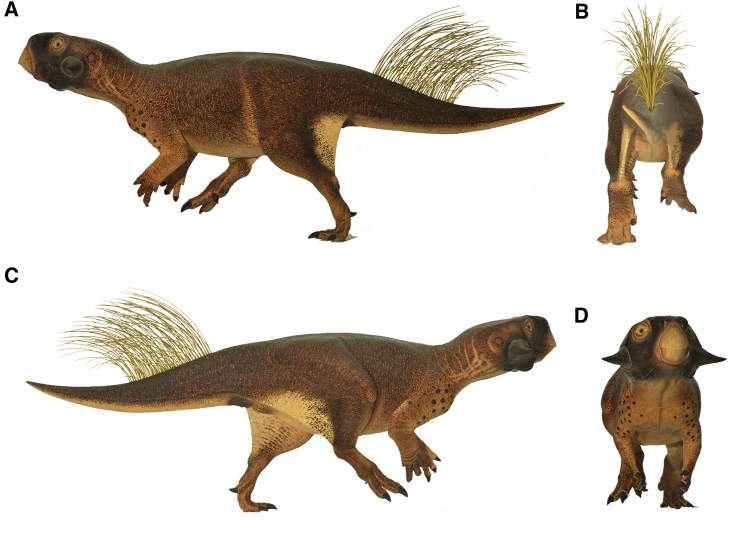
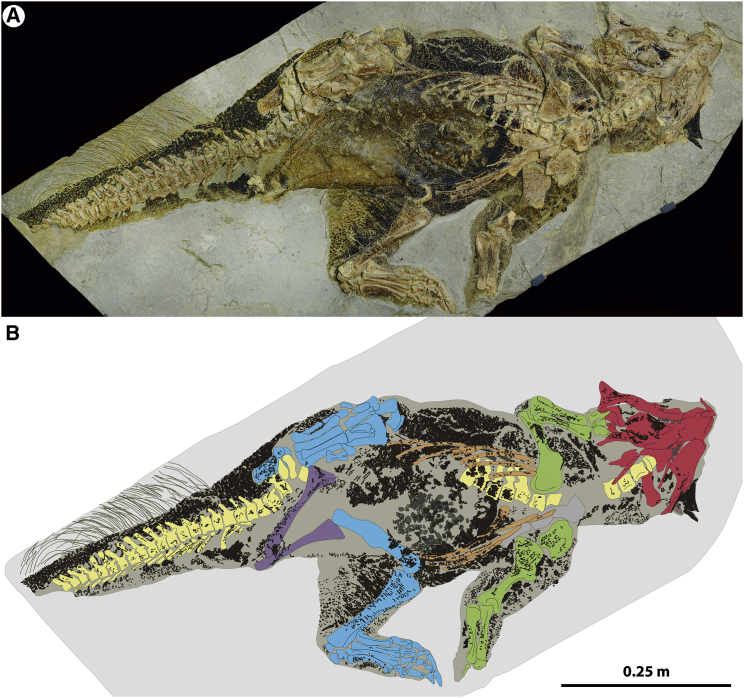
3D reconstruction of Psittacosaurus SMF R 4970 pigmentation based on preserved melanosomes, revealing pronounced countershading. The work demonstrates how much integumentary information can be recovered from Cretaceous ornithischians, and acts as a counterpoint to Kulindadromeus, the older and more basal feathered ornithischian.
The rise of feathered dinosaurs: Kulindadromeus zabaikalicus, the oldest dinosaur with "feather-like" structures
Cincotta, A., Pestchevitskaya, E.B., Sinitsa, S.M., Markevich, V.S., Debaille, V., Reshetova, S.A., Mashchuk, I.M., Frolov, A.O., Gerdes, A., Yans, J. e Godefroit, P. · PeerJ 7, e6239
Comprehensive redescription of Kulindadromeus integument and U-Pb dating of detrital zircons and monazites, combined with palynological analysis. It concludes a Bathonian age (168.3 ± 1.3 to 166.1 ± 1.2 Ma) and synonymises Kulindapteryx, Daurosaurus and Lepidocheirosaurus with Kulindadromeus. It makes the taxon the oldest dinosaur with unequivocal 'feather-like' structures.


The exquisitely preserved integument of Psittacosaurus and the scaly skin of ceratopsian dinosaurs
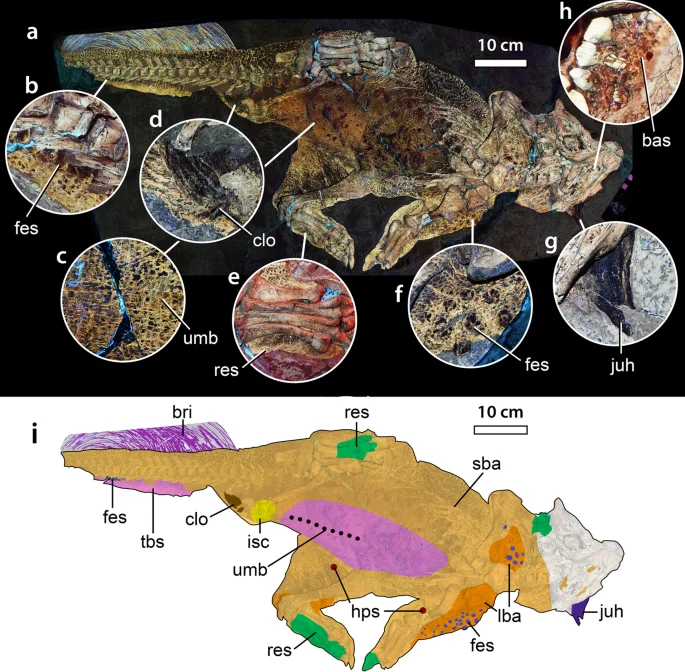
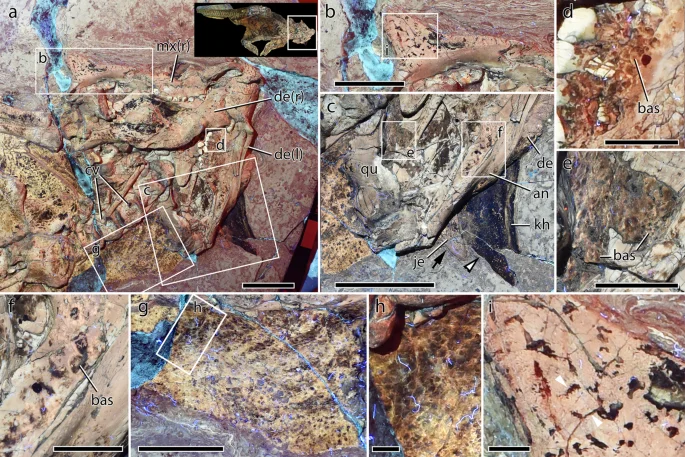
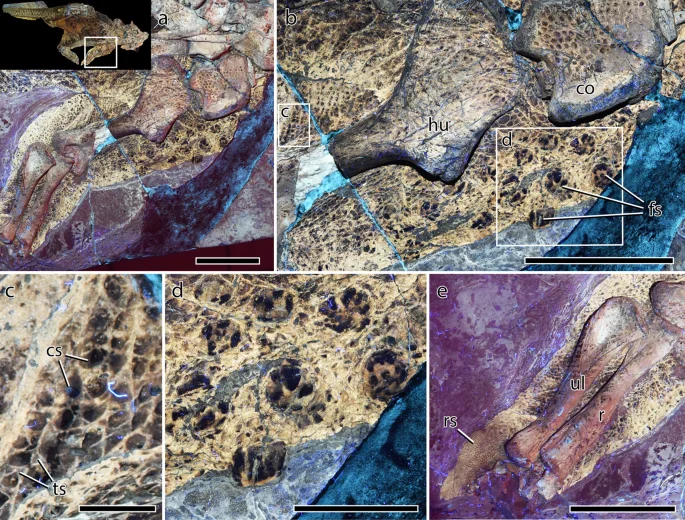
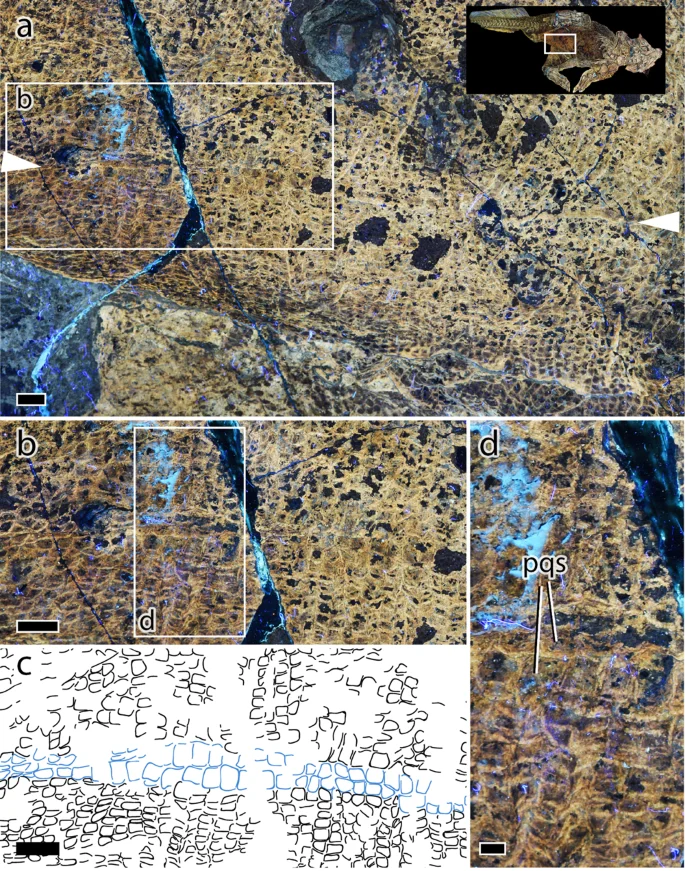
Bell, P.R., Hendrickx, C., Pittman, M., Kaye, T.G. e Mayr, G. · Communications Biology 5, 809
Laser-stimulated fluorescence (LSF) reanalysis of Psittacosaurus specimen SMF R 4970. It maps heterogeneous scalation by body region, cloaca, umbilicus and a keratinous sheath. It complements the repertoire of known ornithischian integument and offers a Cretaceous counterpart to the Jurassic Kulindadromeus.


The phylogenetic nomenclature of ornithischian dinosaurs
Madzia, D., Arbour, V.M., Boyd, C.A., Farke, A.A., Cruzado-Caballero, P. e Evans, D.C. · PeerJ 9, e12362
Comprehensive review of phylogenetic definitions of Ornithischia clades, including Neornithischia, Cerapoda and Ornithopoda, in the spirit of the PhyloCode. It provides the formal framework in which Kulindadromeus is labelled as a basal non-cerapodan neornithischian.

Famous museum specimens
INREC K3/109
Institute of Natural Resources, Ecology and Cryology SB RAS, Chita
Holotype designated by Godefroit et al. (2014, Science 345:451). Partial skull with mandibles from the lower Kulinda bone bed in the Ukureyskaya Formation, basis of the diagnosis of Kulindadromeus zabaikalicus. The associated referred material, comprising hundreds of postcranial elements and blocks with integument, is distributed across INREC (Chita), the Institute of Earth's Crust SB RAS (Irkutsk) and RBINS (Brussels), where Paul Spagna prepared the fragments bearing filaments and scales.
Classification
Discovery
Fun fact
Before Kulindadromeus, some people hoped that feathers would remain a theropod-only affair, confined to the 'carnivorous' side of the dinosaur tree. In 2014, Pascal Godefroit and colleagues published in Science a small Siberian bipedal herbivore about 1.5 m long with not one but three variants of filamentous integument, from simple fuzz to compound tufts and the strange ribbon-like structures on the legs, all in a basal ornithischian older than Archaeopteryx. In 2019, U-Pb zircon dating fixed the age as Bathonian, around 167 Ma, crowning Kulindadromeus as the oldest feathered dinosaur known to date and reinforcing the hypothesis that feather-like integument is an ancestral trait of all Dinosauria, rather than a late invention of coelurosaurs.
Last reviewed: April 24, 2026