
Huayangosaurus
Huayangosaurus taibaii
"Huayang lizard (poet Li Bai)"
About this species
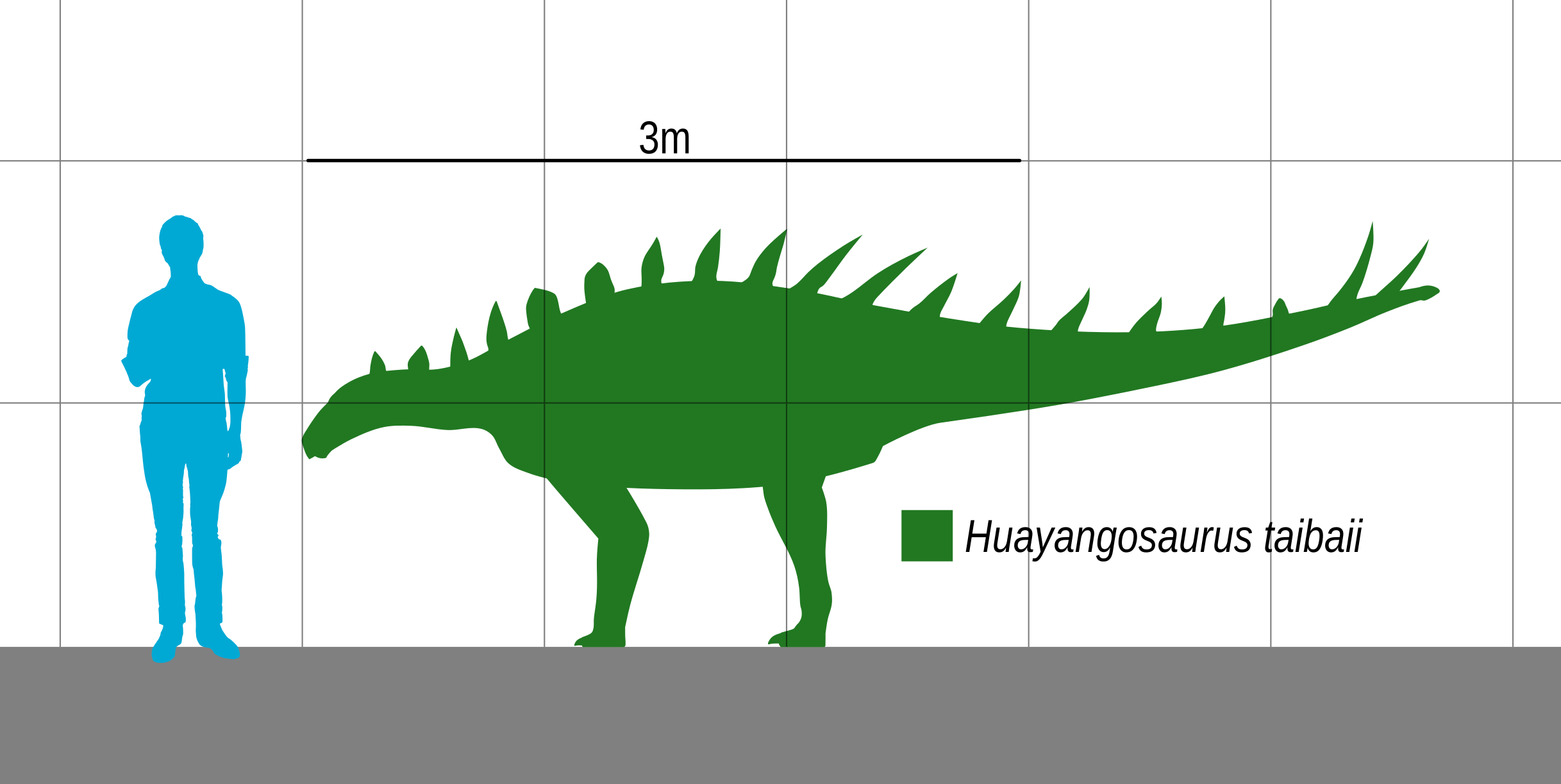
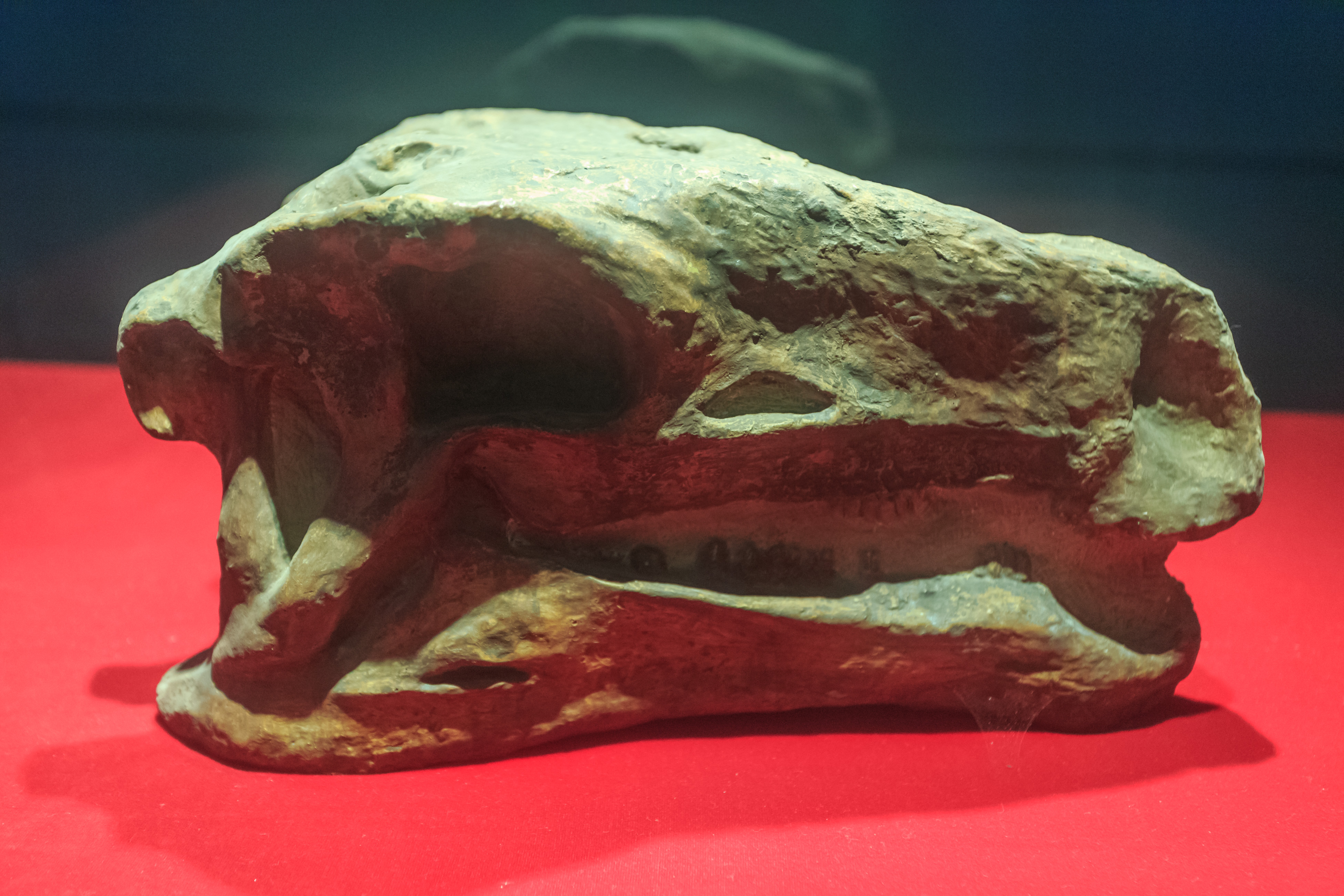
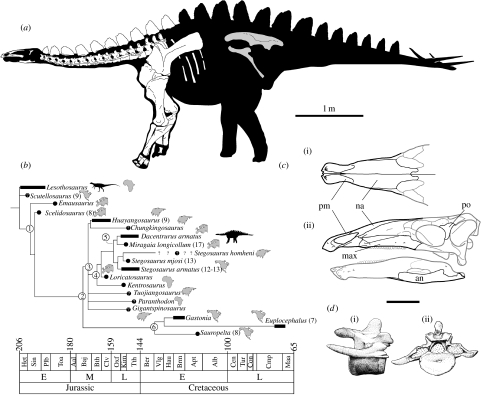
Huayangosaurus taibaii was a small Middle Jurassic stegosaur from southern China, collected at the Dashanpu Quarry near Zigong, Sichuan Province. At roughly 4.5 meters long and about 300 kg, it was much smaller than the famous North American Stegosaurus, yet it carries enormous scientific weight: it is the oldest well-known stegosaur recovered from abundant remains, serving as a key reference for understanding the origin and early diversification of the group. The genus name refers to Huayang, an ancient place name for Sichuan Province, while the specific epithet honors the Tang dynasty poet Li Taibai, also known as Li Bai. Described in 1982 by Dong Zhiming, Tang Zilu, and Zhou Shiwu, the holotype IVPP V6728 includes a relatively complete skull, vertebrae, ribs, caudals, and osteoderms, belonging to one of twelve individuals recovered from the site. This material made Huayangosaurus the best-documented Middle Jurassic stegosaur and the anatomical baseline for comparisons with derived forms such as Stegosaurus and Kentrosaurus. Several traits preserved in Huayangosaurus are regarded as primitive for Stegosauria: it still has teeth in the premaxilla (lost in later stegosaurs), retains open antorbital and mandibular fenestrae (both closed in derived forms), and has a shorter, broader skull. Its dorsal armor consisted of 17 pairs of plates and spikes arranged in two rows, intermediate in shape between the flat plates of Stegosaurus and the long spines of Kentrosaurus, plus a thagomizer with two terminal spike pairs and a distinctive parascapular spine on each shoulder. The forelimbs were proportionally longer relative to the hindlimbs than in Stegosaurus, giving it a less extreme body profile. The animal lived on the warm, humid floodplains of the Lower Shaximiao Formation alongside the sauropods Shunosaurus and Omeisaurus, the small ornithopod Xiaosaurus, and the carnivorous theropod Gasosaurus. Its herbivorous diet, based on ferns, cycads, and low conifers, was consistent with leaf-shaped teeth and a robust lower jaw. As a key early stegosaur on the phylogenetic tree, Huayangosaurus is a genuine link between basal thyreophorans and the Late Jurassic radiation of stegosaurids.
Geological formation & environment
The Lower Shaximiao Formation (Xiashaximiao) is a Bathonian to Callovian unit (~169 to 160 million years old) cropping out in the Sichuan Basin of southern China. It is composed of reddish sandstones and siltstones deposited on meandering river floodplains, with minor lacustrine intercalations. The Dashanpu Quarry, about 7 km northeast of Zigong, preserves one of the richest Middle Jurassic dinosaur communities in the world, including the sauropods Shunosaurus and Omeisaurus, the ornithopod Xiaosaurus, the theropod Gasosaurus, and Huayangosaurus itself. The collection is the heart of the Zigong Dinosaur Museum, built directly over the site.
Image gallery
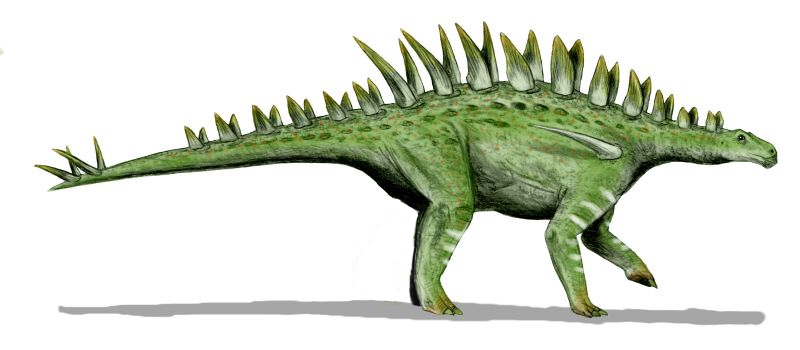




Life reconstruction of Huayangosaurus taibaii by Nobu Tamura, showing the compact body, parascapular shoulder spines, and double row of plates and spikes along the back and tail.
Nobu Tamura / Wikimedia Commons — CC BY 3.0
Ecology and behavior
Habitat
Huayangosaurus inhabited the warm, humid alluvial plains of the Lower Shaximiao Formation in the Middle Jurassic of Sichuan, roughly 169 to 164 million years ago. The environment was dominated by meandering rivers, shallow lakes, and riparian forests of conifers, cycads, and ferns, forming mosaics with low-vegetation clearings where the animal found food. The climate was subtropical, with pronounced wet seasons and frequent rainfall that favored the preservation of remains accumulated on floodplains. Paleocoordinates reconstruct the region at about 35 degrees north, in southern continental Laurasia.
Feeding
An exclusive herbivore, Huayangosaurus grazed on low vegetation, reaching ferns, cycads, and low conifer branches. The robust skull, leaf-shaped teeth, and jaws with retained mandibular fenestra suggest a more generalist diet than that of derived stegosaurs, possibly including tougher plant material. The retention of premaxillary teeth reinforces this idea, indicating the animal could still pluck foliage with the front of the snout before processing it with the posterior tooth batteries.
Behavior and senses
Huayangosaurus shared the alluvial plain with the sauropods Shunosaurus and Omeisaurus, the small ornithopod Xiaosaurus, and the predatory theropod Gasosaurus. Defense against carnivores likely relied on an active thagomizer at the tail tip combined with the pair of outward-pointing parascapular spines that protected the front flanks. The moderate size and diverse armor suggest a defensive strategy more dependent on body weapons than on body mass, unlike its larger relatives.
Physiology and growth
Stegosaur bone histology suggests relatively rapid growth in huayangosaurids, although specific studies on Huayangosaurus are scarcer than on taxa such as Kentrosaurus. The dermal plates and spikes were vascularized and may have contributed to heat dissipation, though their main role was defensive and likely also related to display. The retention of cranial fenestrae and the premaxillary tooth indicate a less specialized cranial structure, with physiological implications for jaw mechanics and bite force.
Paleogeography
Continental configuration

Scotese & Vérard · CC BY 4.0 · Jurassic, ~155 Ma
During the Batoniano-Caloviano (~169–164 Ma), Huayangosaurus taibaii inhabited the fragmenting Pangea. North America and Europe were still close, and the North Atlantic was just beginning to open. Climate was warm and humid globally, with no polar ice caps.
Bone Inventory
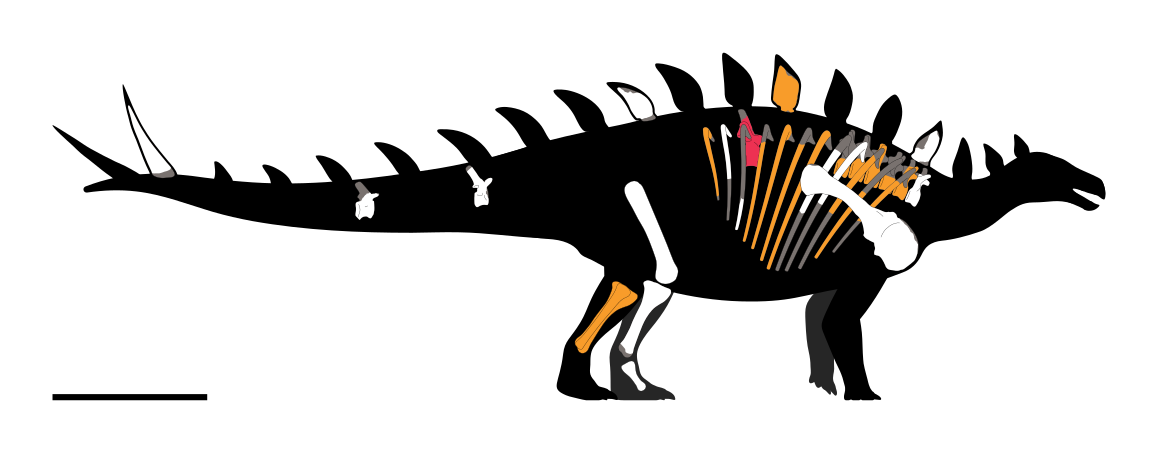
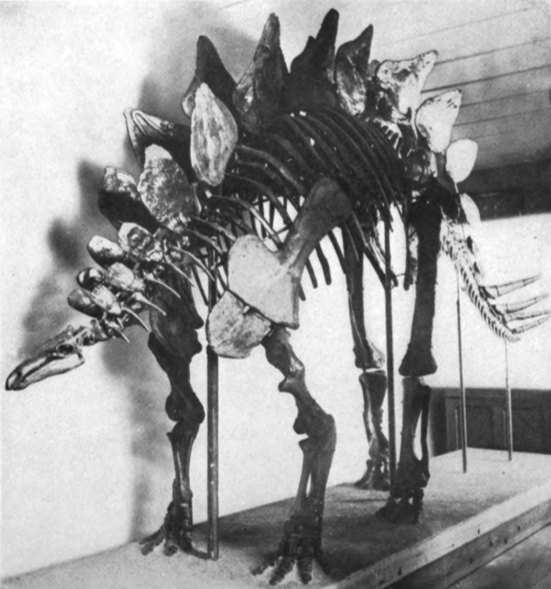
Twelve individuals were collected at the Dashanpu Quarry between 1979 and 1980, making Huayangosaurus one of the best-represented stegosaurs in the world. The holotype IVPP V6728, housed at the Institute of Vertebrate Paleontology and Paleoanthropology in Beijing, preserves a relatively complete skull, vertebral series, ribs, caudals, and osteoderms. The Zigong Dinosaur Museum holds additional referred specimens (ZDM T7001 and others), including near-complete skeletons that enabled detailed mounts in permanent displays. The abundance of material is exceptional for a Middle Jurassic thyreophoran and surpasses in quality the record of many more famous stegosaurs.
Found elements
Inferred elements
Scientific Literature
15 papers in chronological order — from the original description to recent research.
Note on the new Mid-Jurassic stegosaur from Sichuan Basin, China
Dong, Z., Tang, Z.-L. & Zhou, S.-W. · Vertebrata PalAsiatica
Founding paper for Huayangosaurus research. Dong Zhiming, Tang Zilu, and Zhou Shiwu formally describe Huayangosaurus taibaii based on material collected at the Dashanpu Quarry, Zigong, in the Lower Shaximiao Formation. The holotype IVPP V6728 is a partial skeleton with a relatively complete skull, vertebrae, tail, and osteoderms. The authors highlight features considered primitive for Stegosauria: premaxillary teeth, open antorbital fenestra, and mandibular fenestra. The taxon is positioned as the most primitive stegosaur then known. The paper is written in Chinese with an English abstract and is mandatory citation for any research on the species.
The Middle Jurassic dinosaurian fauna from Dashanpu, Zigong, Sichuan. Vol. 2: Stegosaurs
Zhou, S. · Sichuan Scientific and Technological Publishing House
Detailed osteological monograph on the stegosaurs from the Dashanpu Quarry, with emphasis on Huayangosaurus taibaii. The volume offers element-by-element descriptions, figured plates of the skull, postcranium, and dermal armor, and establishes morphological standards used in subsequent comparative studies. The monograph is a mandatory reference for work on Asian stegosaurs and for the anatomical reconstruction of Huayangosaurus, and it underlies the skeletal mounts on display at the Zigong Dinosaur Museum.
The skull of the basal stegosaur Huayangosaurus taibaii and a cladistic diagnosis of Stegosauria
Sereno, P.C. & Dong, Z. · Journal of Vertebrate Paleontology
Detailed redescription of the skull of Huayangosaurus taibaii and first cladistic diagnosis of Stegosauria. Sereno and Dong identify synapomorphies of the clade and position Huayangosaurus as the most basal known stegosaur, sister to all other members of the group (Stegosauridae). The work consolidates features such as premaxillary teeth and open facial fenestrae as retained plesiomorphies. This is the definitive cranial reference for Huayangosaurus and a key piece in the entire modern phylogeny of Stegosauria.
Stegosaurs of Asia
Dong, Z. · Dinosaur Systematics: Approaches and Perspectives (Cambridge University Press)
Overview of Asian stegosaurs with systematic and biogeographic discussion. Dong reviews Huayangosaurus, Tuojiangosaurus, Chialingosaurus, Chungkingosaurus, and Gigantspinosaurus, emphasizing the richness of the Sichuan Middle to Late Jurassic record and the importance of Huayangosaurus for understanding early stegosaur evolution. The review offers the first comparative synthesis of the Asian radiation of the group and includes discussion of dispersal between Asia and the rest of Laurasia.


Stegosauria
Galton, P.M. & Upchurch, P. · The Dinosauria, 2nd ed. (University of California Press)
Comprehensive chapter on Stegosauria in the second edition of The Dinosauria. Galton and Upchurch review all valid genera, with detailed entries for Huayangosaurus as the basal-most member of the clade, discussing osteology, phylogeny, and stratigraphy of each taxon. The work consolidates knowledge of stegosaurs available up to 2004 and serves as the standard reference for any comparative research involving Huayangosaurus.

Systematics and phylogeny of Stegosauria (Dinosauria: Ornithischia)
Maidment, S.C.R., Norman, D.B., Barrett, P.M. & Upchurch, P. · Journal of Systematic Palaeontology
Comprehensive cladistic analysis of Stegosauria based on direct observation of specimens. The study recovers Huayangosaurus as the sister taxon to all other stegosaurs, supporting the family Huayangosauridae, and reduces the diversity of valid stegosaurid genera. Maidment and colleagues establish the reference morphological matrix used by virtually all subsequent phylogenetic analyses of the group, consolidating the role of Huayangosaurus as basal calibration point of the tree.

Stegosauria: a historical review of the body fossil record and phylogenetic relationships
Maidment, S.C.R. · Swiss Journal of Geosciences
Historical review of the Stegosauria fossil record and phylogenetic relationships, updating the 2008 analysis. Huayangosaurus is confirmed as the sister taxon of Stegosauridae, with Huayangosauridae recognized as a valid family of basal stegosaurs. The review integrates continuous data and new osteological characters, reinforcing the calibrating role of Huayangosaurus as basal starting point of the tree and contextualizing its record in the Middle Jurassic of Asia. Published in an open-access special volume on Stegosauria in the Swiss Journal of Geosciences.

A new specimen of the ornithischian dinosaur Hesperosaurus mjosi from the Upper Jurassic Morrison Formation of Montana, U.S.A., and implications for growth and size in Morrison stegosaurs
Maidment, S.C.R., Woodruff, D.C. & Horner, J.R. · Journal of Vertebrate Paleontology
Description of a new specimen of Hesperosaurus mjosi from the Morrison Formation, with implications for growth, size, and ontogenetic variation in stegosaurs. The authors include Huayangosaurus as an outgroup comparison to contextualize growth trajectories within Stegosauria. The study provides quantitative data on plate and spine allometry, with the Chinese material serving as a basal reference for the analysis of the derived Morrison stegosaurids.

A review of the Late Jurassic stegosaurs (Dinosauria, Stegosauria) from the People's Republic of China
Maidment, S.C.R. & Wei, G. · Geological Magazine
Review of Chinese Late Jurassic stegosaurs with partial redescription of Huayangosaurus material and comparisons with Tuojiangosaurus, Chialingosaurus, Chungkingosaurus, and Gigantspinosaurus. The study evaluates the validity of each Chinese stegosaur genus and refines their stratigraphic placement. Maidment and Wei provide comparative data essential for understanding the diversity of Sichuan stegosaurs and consolidate the morphological basis for phylogenetic analyses of the group.


A new phylogeny of Stegosauria (Dinosauria, Ornithischia)
Raven, T.J. & Maidment, S.C.R. · Palaeontology
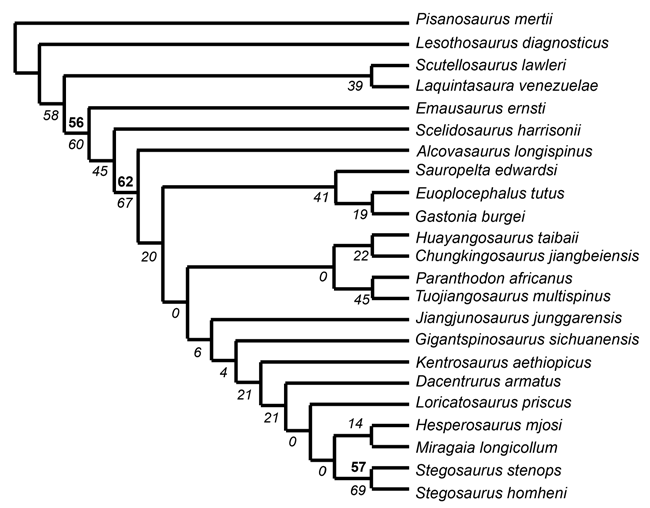
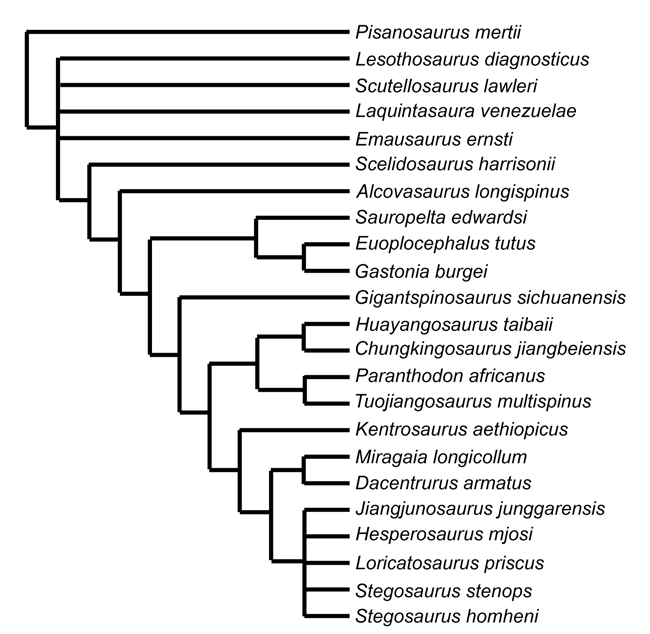
New phylogenetic analysis of Stegosauria incorporating new specimens and continuous data. Huayangosaurus is recovered as the earliest-diverging stegosaur, with Huayangosauridae comprising a small clade of basal forms from the Middle Jurassic. The analysis supports re-erection of Miragaia and Hesperosaurus. Raven and Maidment produce the best-resolved tree yet obtained for the group, consolidating Huayangosaurus as an indispensable starting point of the stegosaurian phylogeny.


New evidence of shared dinosaur across Upper Jurassic Proto-North Atlantic: Stegosaurus from Portugal
Escaso, F., Ortega, F., Dantas, P., Malafaia, E., Pimentel, N.L., Pereda-Suberbiola, X., Sanz, J.L., Kullberg, J.C., Kullberg, M.C. & Barriga, F. · Naturwissenschaften
Report of Stegosaurus material from the Upper Jurassic of Portugal, with biogeographic discussion of stegosaur dispersal across the proto-North Atlantic. The study cites Huayangosaurus as a basal calibration taxon when evaluating the ages of stegosaur radiations. The analysis places the Portuguese record within a broader phylogeographic network in which Asian huayangosaurids represent the starting tip of the tree.

A new long-necked 'sauropod-mimic' stegosaur and the evolution of the plated dinosaurs
Mateus, O., Maidment, S.C.R. & Christiansen, N.A. · Proceedings of the Royal Society B
Description of Miragaia longicollum from Portugal and discussion of neck elongation and body plan evolution in stegosaurs. Huayangosaurus is included in the phylogenetic analysis as the sister taxon of all other stegosaurs. The study reinforces the role of Huayangosaurus as a basal reference in any attempt to reconstruct the evolution of body proportions in the group, including the radical neck elongation seen in Miragaia.

New stegosaurs from the Middle Jurassic Lower Member of the Shaximiao Formation of Chongqing, China
Dai, H., Li, N., Maidment, S.C.R., Wei, G., Zhou, Y., Hu, X., Ma, Q., Wang, X., Hu, H. & Peng, G. · Journal of Vertebrate Paleontology
Description of Bashanosaurus primitivus from the Lower Shaximiao Formation of Chongqing, recovered as a basal stegosaur closely related to Huayangosaurus. The analysis strengthens Huayangosauridae as a basal clade of Middle Jurassic stegosaurs and refines the timeline of stegosaur origin. Dai and colleagues offer a new phylogenetic tree in which Huayangosaurus and Bashanosaurus share primitive features, supporting an early Asian radiation of the clade.

The dinosaurian remains from Sichuan Basin, China
Dong, Z., Zhou, S. & Zhang, Y. · Palaeontologia Sinica, New Series C
Monographic treatment of dinosaurs from the Sichuan Basin, including descriptions and discussion of Tuojiangosaurus, Chungkingosaurus, and Chialingosaurus, with contextual information on Huayangosaurus and the broader Middle to Late Jurassic fauna of China. The work gathers most of the Chinese stegosaur material known at the time and sets the stratigraphic context in which Huayangosaurus is the most basal stegosaur recovered. Published in Chinese with an English abstract.

A nearly complete skeleton of a stegosaur from the Middle Jurassic of Dashanpu, Zigong, Sichuan
Zhou, S. · Journal of the Chengdu College of Geology, Supplement 1
Preliminary description of a nearly complete skeleton of Huayangosaurus from the Dashanpu Quarry. The paper precedes the 1984 monograph and highlights the exceptional preservation of cranial, vertebral, and dermal armor elements. Zhou anticipates data on the arrangement of 17 pairs of plates and spikes and on postcranial morphology that would be detailed in the following year's monograph, laying the groundwork for the first skeletal mounts placed on public display.
Famous museum specimens
IVPP V6728 (Holótipo)
Instituto de Paleontologia e Paleoantropologia Vertebrada, Pequim, China
Official holotype of Huayangosaurus taibaii designated by Dong, Tang, and Zhou in 1982. The specimen includes a relatively complete skull, vertebral series, ribs, caudals, and osteoderms. It was collected at the Dashanpu Quarry between 1979 and 1980 as part of the broader IVPP excavation program in the Middle Jurassic of Sichuan. The material is the basic reference for all comparative descriptions of the genus and for cladistic diagnoses of Stegosauria.
ZDM T7001 (espécime referido)
Zigong Dinosaur Museum, Sichuan, China
Nearly complete skeleton referred to Huayangosaurus taibaii, housed at the Zigong Dinosaur Museum. It served as the basis for Zhou's (1983) preliminary description and the Zhou (1984) osteological monograph, which established the postcranial morphological standard for the genus. It is one of the most complete Middle Jurassic stegosaur skeletons in the world.
CV 00720 / CV 00721 (espécimes referidos)
Chongqing Natural History Museum, Chongqing, China
Referred specimens of Huayangosaurus taibaii with partial cranial and postcranial material, collected at Dashanpu and housed at the Chongqing museum. They complement the record of the taxon and have been used in comparative studies with other Sichuanese stegosaurs, such as Tuojiangosaurus and Chungkingosaurus.
Classification

Discovery
Fun fact
Huayangosaurus is the oldest well-known stegosaur in the fossil record, and it still carried primitive traits that all later relatives had lost: it had teeth at the front of the snout (premaxilla), open fenestrae in the skull and jaws, and seventeen alternating pairs of plates and spikes along the back and tail, quite different from the broad plates of Stegosaurus. It is literally the stegosaur closest to the evolutionary starting point of the group.
Last reviewed: April 24, 2026