
Gnathovorax
Gnathovorax cabreirai
"Voracious jaws (of Cabreira)"
About this species
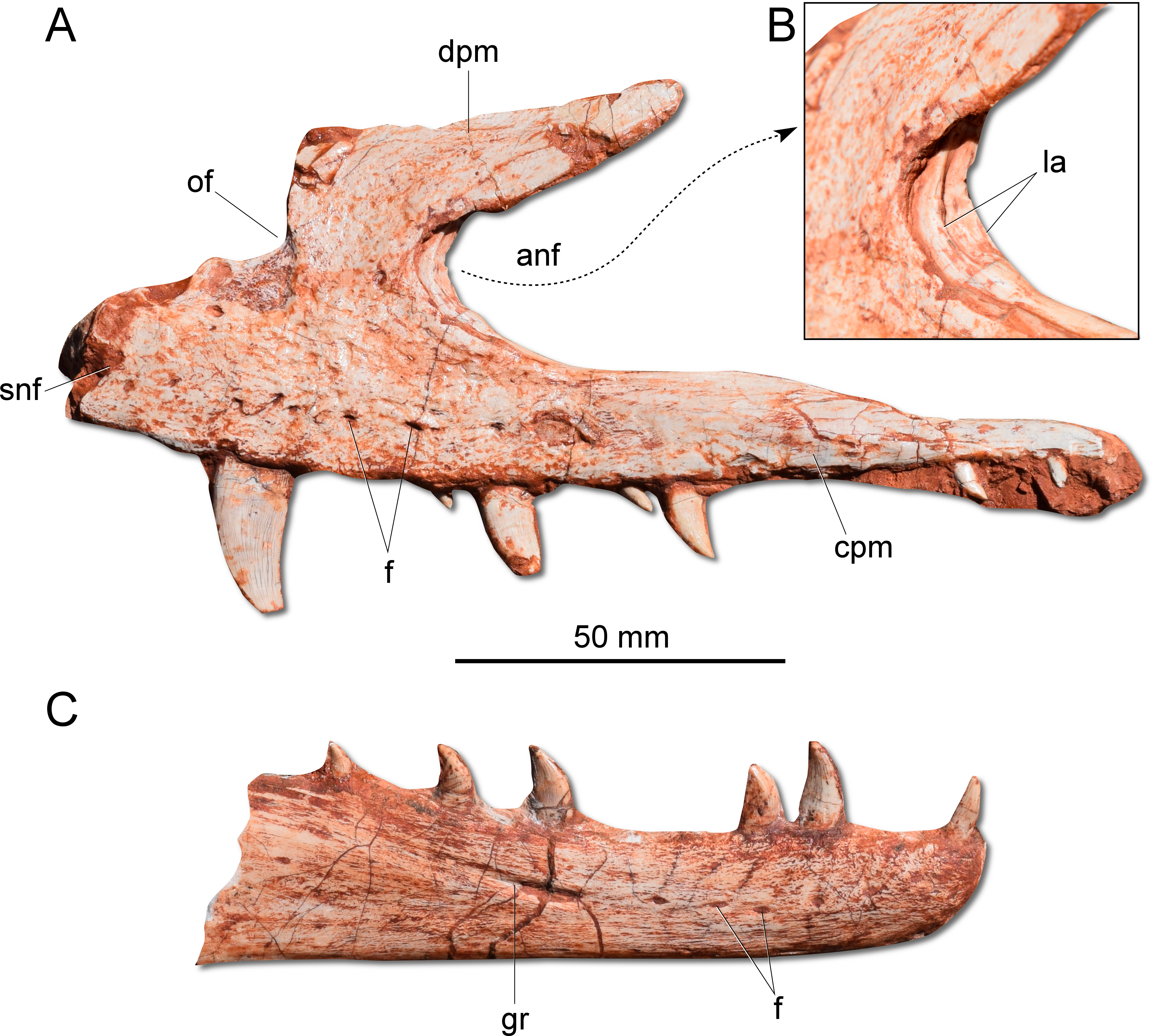
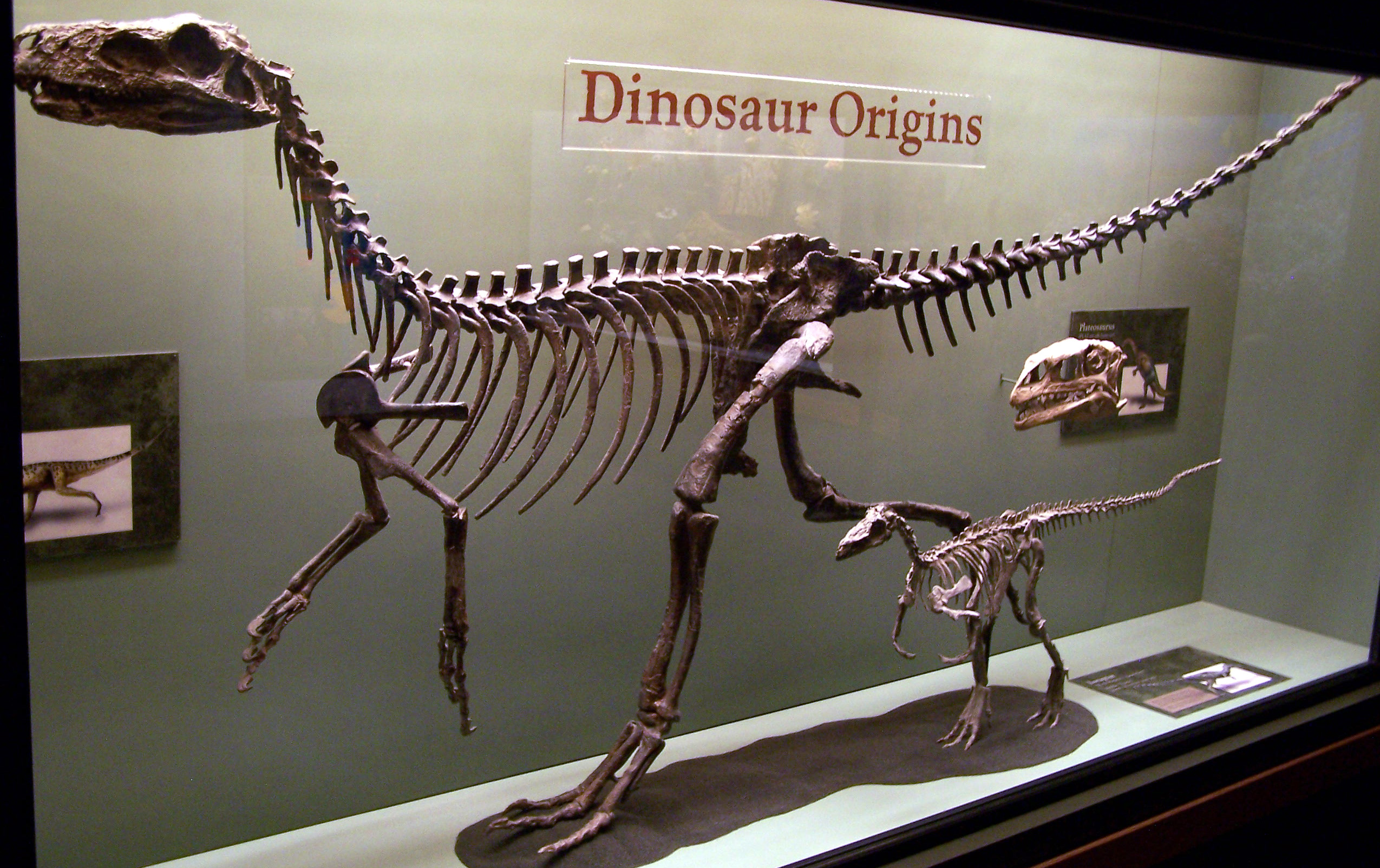
Gnathovorax cabreirai is one of the earliest bipedal predators in the fossil record, living around 233 million years ago in what is now central Rio Grande do Sul. Roughly 3 metres long, it was a medium-sized herrerasaurid that dominated its ecosystem alongside rhynchosaurs, cynodonts and the first sauropodomorphs. Holotype CAPPA/UFSM 0009, discovered in 2014 by Sérgio Cabreira at the Marchezan site in São João do Polêsine, preserves an articulated skeleton with a near-complete skull and is among the best-preserved Herrerasauridae specimens ever found. The name literally means 'voracious jaws', a direct reference to its robust skull and serrated teeth adapted for active predation. Given the completeness of the material, Gnathovorax has been decisive in reassessing the phylogenetic position of herrerasaurids at the start of the dinosaur radiation.
Geological formation & environment
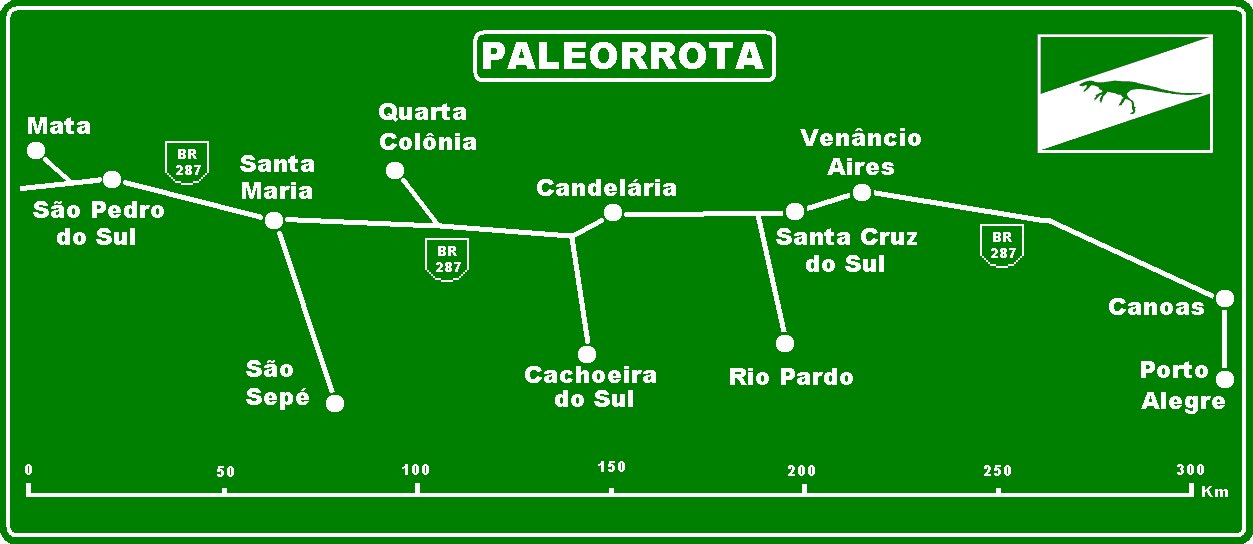
Santa Maria Formation (Candelária Sequence, Hyperodapedon Assemblage Zone), Paraná Basin, Rio Grande do Sul, Brazil, dated to ~233 Ma (Carnian, Late Triassic). Environment of seasonally dry floodplains with meandering rivers and a semi-arid climate. The fauna includes the dinosaurs Gnathovorax cabreirai, Buriolestes schultzi, Saturnalia tupiniquim, Pampadromaeus barberenai, Bagualosaurus agudoensis and Staurikosaurus pricei; the lagerpetid Ixalerpeton polesinensis; Hyperodapedon rhynchosaurs (dominant); cynodonts (Exaeretodon, Trucidocynodon); and pseudosuchians (Prestosuchus, Rauisuchus, Decuriasuchus, Aetosauroides). The region falls within the Paleorrota Geopark, recognised by UNESCO for its density of exceptional Triassic sites.
Image gallery
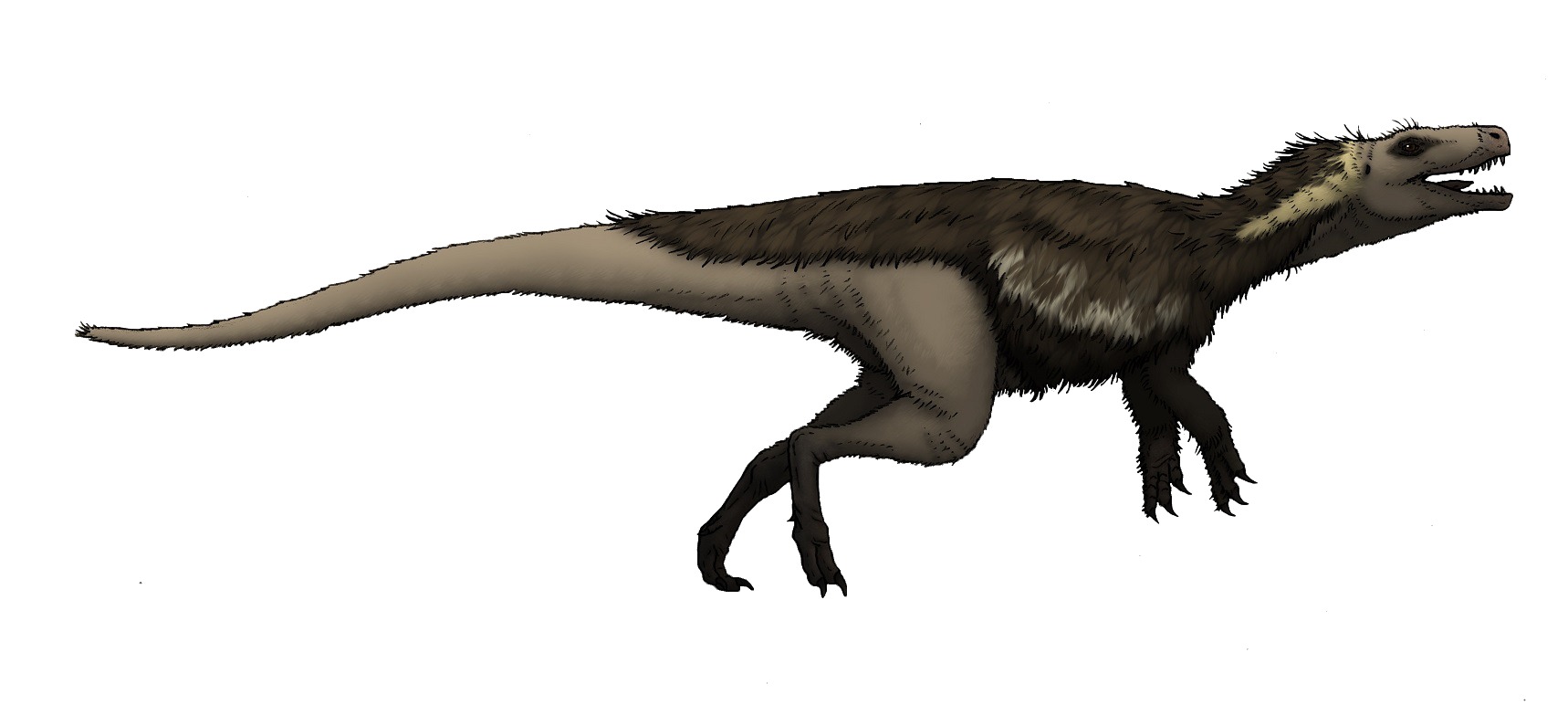




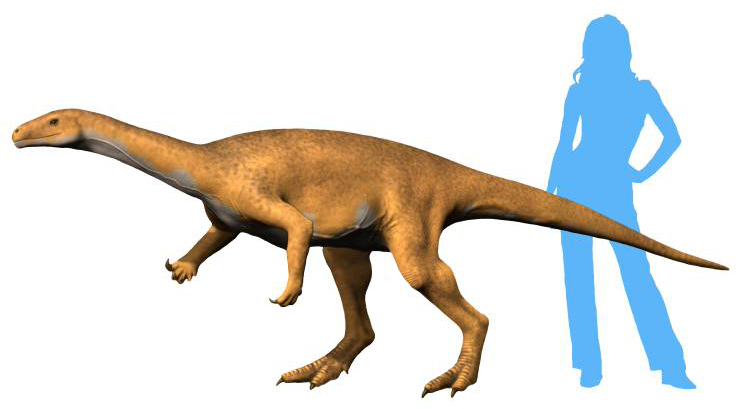
Lateral life reconstruction of Gnathovorax cabreirai attributed to Juan, based on Scott Hartman's skeletal diagrams. Shows the robust skull and serrated teeth that inspired the name: 'voracious jaws'.
Juan (Wikimedia Commons)
Ecology and behavior
Habitat
Seasonally semi-arid Carnian alluvial floodplains with meandering rivers and shallow lagoons, under the influence of the Carnian Pluvial Episode (~234–232 Ma). Vegetation dominated by conifers, cycads, ferns and lycopods. Palaeolatitude around 40°S in the interior of southwestern Gondwana, with climate alternating between humid pulses and drier periods.
Feeding
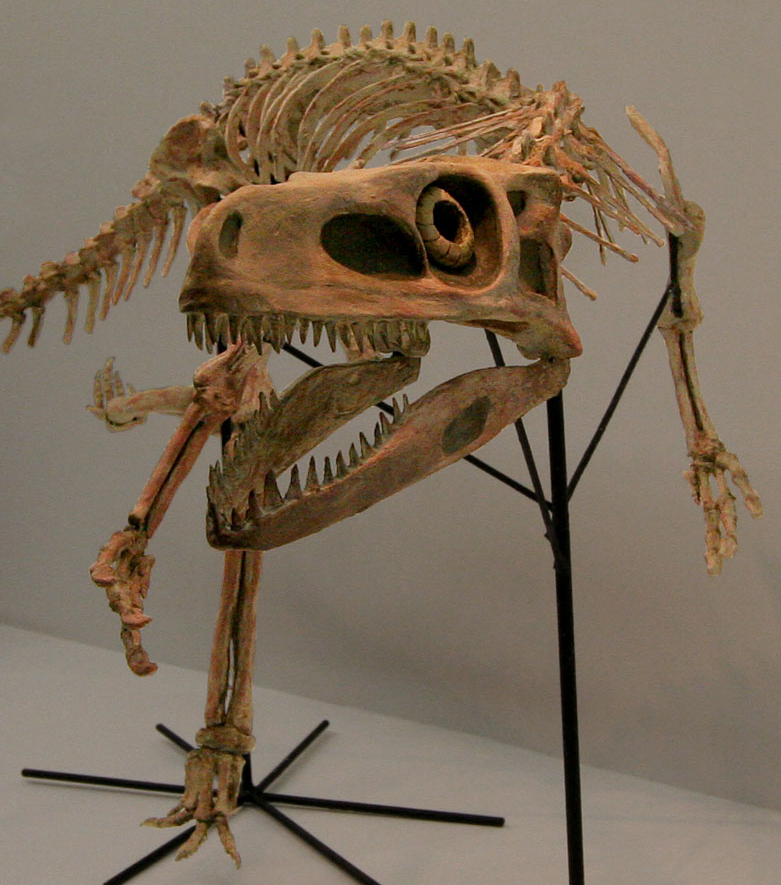
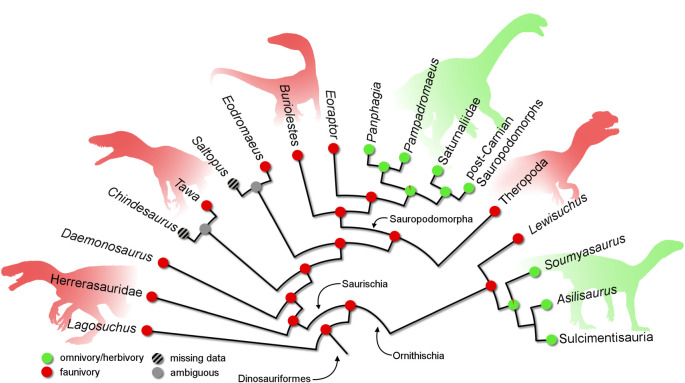
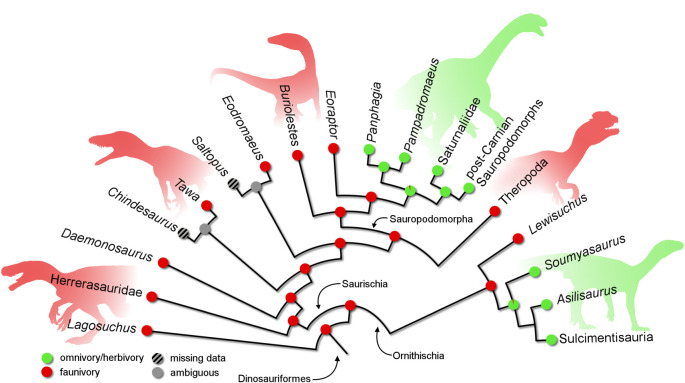
Active medium-sized predator with a robust skull, long jaws and recurved, serrated teeth. It likely fed on rhynchosaurs (the most abundant prey in the assemblage), cynodonts, other small dinosaurs and dinosauromorphs. Short forelimbs with recurved claws indicate a specialisation in grasping small-to-medium-sized prey.
Behavior and senses
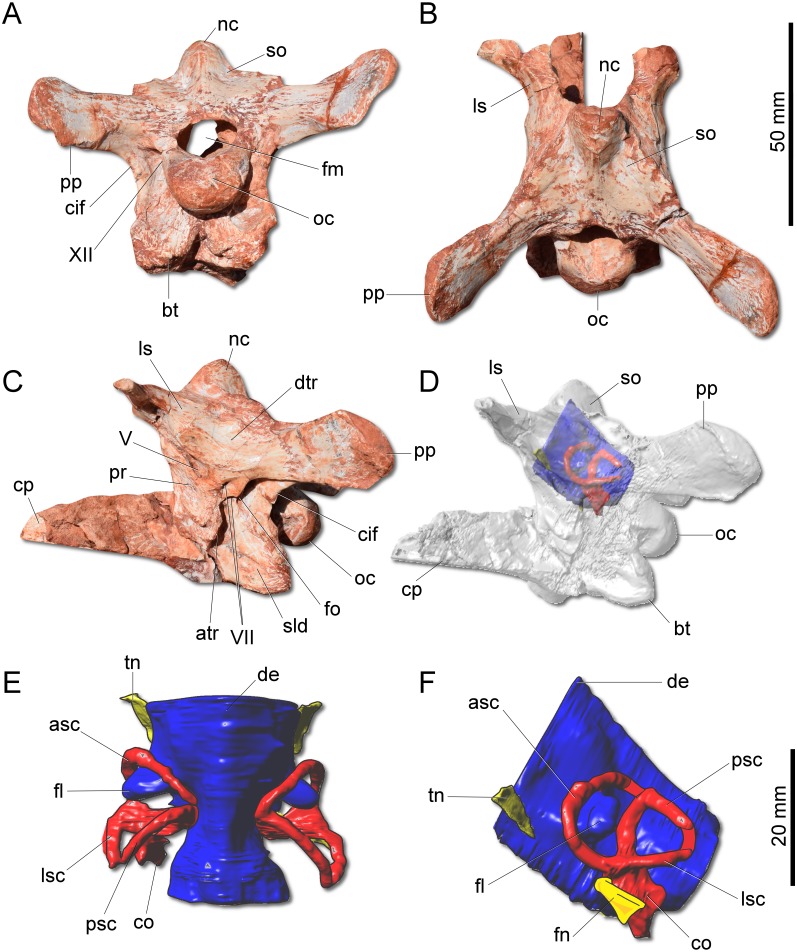
Craniofacial lesions described by Garcia et al. (2025) suggest agonistic interactions (intraspecific combat or predator attack), direct evidence of combative behaviour. Inner-ear and brain anatomy indicate good locomotor agility and balance, consistent with a fast bipedal predator on semi-open terrain. There is no evidence of gregariousness or parental care.
Physiology and growth
Gnathovorax bones are not pneumatised (no invasive air sacs), a pattern shared with other early dinosaurs and described by Aureliano et al. (2022). This contrasts strongly with derived theropods, whose vertebrae are highly pneumatised, and suggests the air-sac system evolved multiple times independently within Dinosauria.
Paleogeography
Continental configuration

Scotese & Vérard · CC BY 4.0 · Triassic, ~225 Ma
During the Carniano (~233–233 Ma), Gnathovorax cabreirai inhabited Pangea, the single supercontinent joining all modern continents. Climate was dry and hot across much of the continental interior.
Bone Inventory
Holotype CAPPA/UFSM 0009 is considered one of the most complete and best-preserved herrerasaurid skeletons ever collected, missing only parts of the left shoulder girdle and left forelimb. The skull was CT-scanned, enabling reconstruction of the brain and inner ear.
Found elements
Inferred elements
Scientific Literature
15 papers in chronological order — from the original description to recent research.
Gnathovorax cabreirai: a new early dinosaur and the origin and initial radiation of predatory dinosaurs
Pacheco, C., Müller, R.T., Langer, M., Pretto, F.A., Kerber, L. e Dias-da-Silva, S. · PeerJ
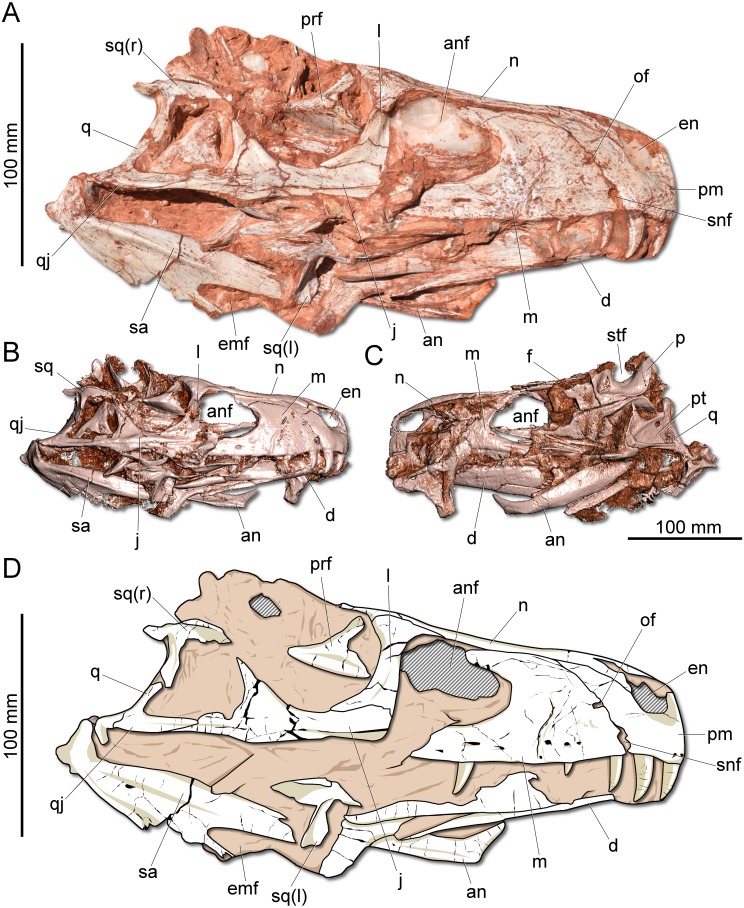
Original description of the genus and species Gnathovorax cabreirai based on holotype CAPPA/UFSM 0009, a near-complete skeleton from the Marchezan site, São João do Polêsine, Rio Grande do Sul. The paper describes cranial, postcranial and endocranial anatomy in detail (via CT scanning), places the taxon within Herrerasauridae closer to Herrerasaurus and Sanjuansaurus than to Staurikosaurus, and recovers the family as external to the Theropoda/Sauropodomorpha dichotomy. Age of 233.23 ± 0.73 Ma from correlated beds.
The absence of an invasive air sac system in the earliest dinosaurs suggests multiple origins of vertebral pneumaticity
Aureliano, T., Ghilardi, A.M., Müller, R.T., Kerber, L., Fernandes, M.A., Ricardi-Branco, F. e Wedel, M.J. · Scientific Reports
Micro-CT analysis of the internal vertebral structure of three Carnian Brazilian dinosaurs, including Gnathovorax cabreirai, Buriolestes schultzi and Pampadromaeus barberenai. The authors find dense, chaotic bone tissue with no evidence of invasive pneumaticity, suggesting that the air-sac system evolved multiple times independently within Dinosauria and was not present in the common ancestor.


The Complete Skull and Skeleton of an Early Dinosaur
Sereno, P.C. e Novas, F.E. · Science
Reports the first complete skull and skeleton of Herrerasaurus ischigualastensis from the Ischigualasto Formation, Argentina. The fossil revealed Herrerasaurus as an agile bipedal predator with short grasping forelimbs. The paper established the herrerasaurid as a key piece for understanding dinosaur origins and became a direct reference for later comparisons with Gnathovorax.

New information on the systematics and postcranial skeleton of Herrerasaurus ischigualastensis (Theropoda: Herrerasauridae) from the Ischigualasto Formation (Upper Triassic) of Argentina
Novas, F.E. · Journal of Vertebrate Paleontology
Redescribes the postcranial skeleton of Herrerasaurus ischigualastensis, listing 11 synapomorphies shared with theropods. Positions Herrerasauridae as saurischian dinosaurs with theropod affinities, the essential comparative baseline for the description of Gnathovorax and for the phylogenetic debate about the family.
The anatomy and phylogenetic position of the Triassic dinosaur Staurikosaurus pricei Colbert, 1970
Bittencourt, J.S. e Kellner, A.W.A. · Zootaxa
Reanalyses in detail the holotype MCZ 1669 of Staurikosaurus pricei, correcting vertebral counts and testing its phylogenetic position. Recovers Staurikosaurus within Herrerasauridae and provides the main Brazilian comparative benchmark for Gnathovorax a decade later.

The origin and early evolution of dinosaurs
Langer, M.C., Ezcurra, M.D., Bittencourt, J.S. e Novas, F.E. · Biological Reviews
Comprehensive review of dinosaur origins, their basal relatives and the earliest lineages, synthesising the Late Triassic record of Gondwana (Argentina, Brazil). Discusses the phylogenetic position of herrerasaurids and provides the stratigraphic framework directly applied to the dating and paleoenvironmental context of Gnathovorax.

A new early dinosaur (Saurischia: Sauropodomorpha) from the Late Triassic of Argentina: a reassessment of dinosaur origin and phylogeny
Ezcurra, M.D. · Journal of Systematic Palaeontology
Describes Chromogisaurus novasi and reassesses early dinosaur phylogeny with an expanded morphological matrix. Recovers Herrerasauridae as a basal lineage of Saurischia outside Eusaurischia (Theropoda + Sauropodomorpha), a hypothesis later supported by Pacheco et al. (2019)'s analysis for Gnathovorax.

A Unique Late Triassic Dinosauromorph Assemblage Reveals Dinosaur Ancestral Anatomy and Diet
Cabreira, S.F., Kellner, A.W.A., Dias-da-Silva, S., Roberto-da-Silva, L., Bronzati, M., Marsola, J.C.A., Müller, R.T., Bittencourt, J.S., Batista, B.J.A., Raugust, T., Carrilho, R., Brodt, A. e Langer, M.C. · Current Biology
Describes Buriolestes schultzi and Ixalerpeton polesinensis from a unique association at the Buriol site, in Carnian beds of the Santa Maria Formation. Provides anatomical information on the most basal known sauropodomorph and an immediate dinosaur relative, part of the same paleobiogeographic context as Gnathovorax.


A new hypothesis of dinosaur relationships and early dinosaur evolution
Baron, M.G., Norman, D.B. e Barrett, P.M. · Nature
Proposes the Ornithoscelida hypothesis (Ornithischia + Theropoda) and redefines Saurischia as Sauropodomorpha + Herrerasauridae. The proposal challenges the classical structure of the dinosaur family tree and is especially relevant for herrerasaurids like Gnathovorax, whose position becomes even more central to the debate.
Untangling the dinosaur family tree
Langer, M.C., Ezcurra, M.D., Rauhut, O.W.M., Benton, M.J., Knoll, F., McPhee, B.W., Novas, F.E., Pol, D. e Brusatte, S.L. · Nature
Direct response to Baron et al. (2017). Reanalyses the character matrix with recodings in ~10% of the data and recovers the classical Saurischia/Ornithischia dichotomy with a Gondwanan origin for dinosaurs. Reinforces the traditional placement of Herrerasauridae within Saurischia adopted by Pacheco et al. (2019) for Gnathovorax.
Review of the fossil record of early dinosaurs from South America, and its phylogenetic implications
Novas, F.E., Agnolin, F.L., Ezcurra, M.D., Müller, R.T., Martinelli, A.G. e Langer, M.C. · Journal of South American Earth Sciences
Systematic review of the South American early dinosaur fossil record, focused on Carnian faunas of Argentina and Brazil. Includes Gnathovorax in the discussion of herrerasaurids and evaluates phylogenetic, biogeographic and biostratigraphic implications of the most recent finds.
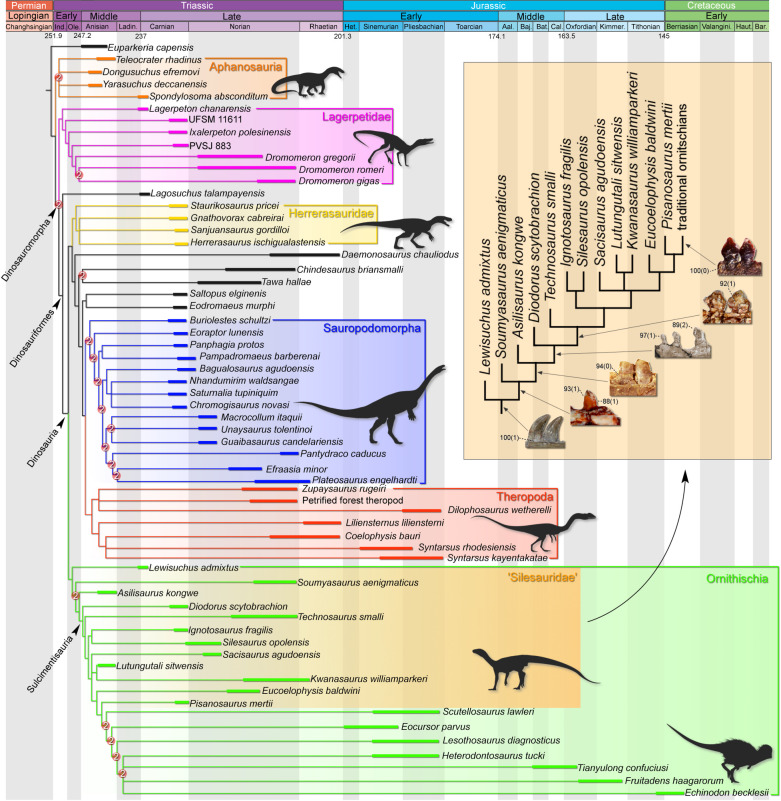
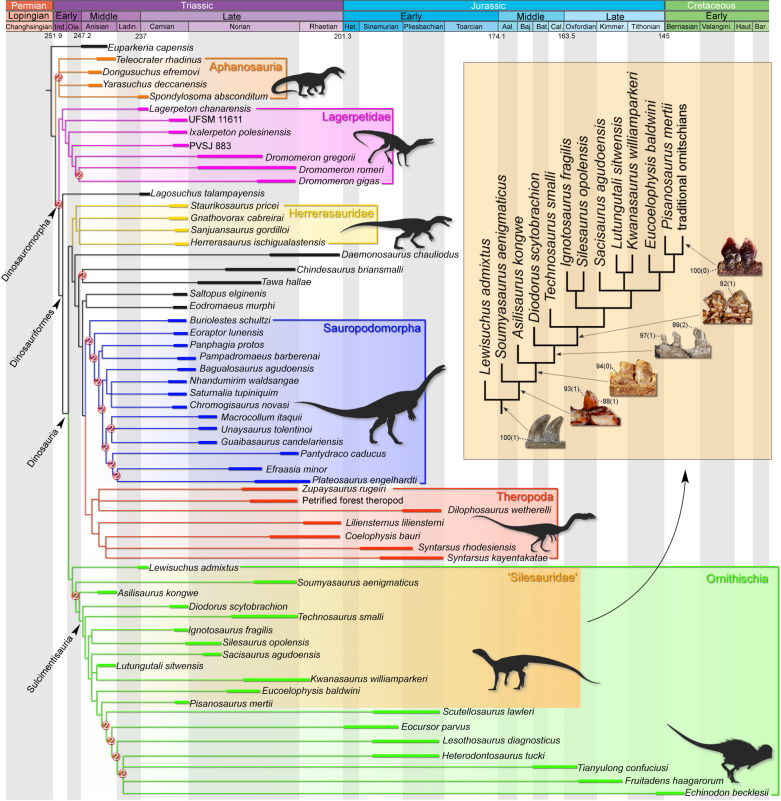
A paraphyletic 'Silesauridae' as an alternative hypothesis for the initial radiation of ornithischian dinosaurs
Müller, R.T. e Garcia, M.S. · Biology Letters
Reanalyses early dinosaur and dinosauromorph phylogeny, arguing that Silesauridae is paraphyletic and part of the ornithischian stem. Although focused on Ornithischia, the reorganisation of the basal tree of Dinosauria provides context for the phylogenetic position of herrerasaurids like Gnathovorax.
A new dinosaur (Saurischia: Sauropodomorpha) from the Late Triassic of Brazil provides insights on the evolution of sauropodomorph body plan
Pretto, F.A., Langer, M.C. e Schultz, C.L. · Zoological Journal of the Linnean Society
Describes Bagualosaurus agudoensis, a basal sauropodomorph from Agudo (RS) in the same stratigraphic unit as Gnathovorax (Hyperodapedon Zone). Discusses the evolution of the sauropodomorph body plan and the Carnian paleoenvironment of southern Brazil, providing faunal and stratigraphic context for Gnathovorax.

The oldest known co-occurrence of dinosaurs and their closest relatives: A new lagerpetid from a Carnian (Upper Triassic) bed of Brazil
Garcia, M.S., Müller, R.T., Da-Rosa, Á.A.S. e Dias-da-Silva, S. · Journal of South American Earth Sciences
Describes a new lagerpetid co-occurring with dinosaurs in the Carnian of southern Brazil, establishing the oldest known co-occurrence between dinosaurs and their immediate relatives. Refines Hyperodapedon Zone biostratigraphy and informs the evolutionary context of contemporaneous taxa like Gnathovorax.

A herrerasaurid dinosaur (Saurischia) with craniofacial lesions from the Late Triassic of Brazil
Garcia, M.S., Pretto, F.A. e Müller, R.T. · The Science of Nature (Naturwissenschaften)
Paleopathological study of the skull of Gnathovorax cabreirai, identifying craniofacial lesions on holotype CAPPA/UFSM 0009. The lesions suggest agonistic interactions (intraspecific combat or predator attack) and provide direct evidence of the active predatory behaviour of herrerasaurids.
Famous museum specimens
CAPPA/UFSM 0009 (holótipo)
Centro de Apoio à Pesquisa Paleontológica da Quarta Colônia, Universidade Federal de Santa Maria (CAPPA/UFSM), São João do Polêsine, Rio Grande do Sul, Brasil
Considered one of the most complete and best-preserved herrerasaurids ever collected. The skull was CT-scanned, enabling reconstruction of the braincase, endocranial cast and inner ear, presented alongside the description in Pacheco et al. (2019).
Classification
Discovery
Fun fact
Gnathovorax is so complete that researchers could digitally reconstruct the shape of the animal's brain and inner ear, extremely rare for a Triassic dinosaur. Garcia et al. (2025) also detected craniofacial lesions on the holotype, possibly caused by intraspecific combat, providing one of the oldest direct pieces of evidence for fighting between dinosaurs. The name 'voracious jaws' was chosen literally to describe the robust skull and serrated dentition, and is especially fitting for what was probably the largest predator in the ecosystem it inhabited.
Last reviewed: April 24, 2026