
Gargoyleosaurus
Gargoyleosaurus parkpinorum
"gargoyle lizard of the Parkpins (fossil-donating family)"
About this species
Gargoyleosaurus parkpinorum was one of the oldest and most primitive ankylosaurs ever described by science. It lived near the end of the Late Jurassic, approximately 152 to 148 million years ago, in interior Laurasia, in a region that today corresponds to the state of Wyoming, United States. Its partial skeleton, including an almost complete skull, was found in 1995 at Bone Cabin Quarry West, in Albany County, within rocks of the Morrison Formation. The fossil was prepared by the Western Paleontological Laboratories team and formally described in 1998 by Kenneth Carpenter, Clifford Miles and Karen Cloward, in the volume The Armored Dinosaurs, published by Indiana University Press. Under the plural rule of the International Code of Zoological Nomenclature (ICZN), the original specific epithet, parkpini, was emended to parkpinorum, honoring siblings Tyler and Jolene Parkpin, whose family donated the specimen to the Denver Museum of Nature and Science. About 3.5 meters long and roughly 600 kilograms in weight, it was a quadrupedal herbivore with a low-slung body, a back covered by conical osteoderms, and elongated lateral spines. It preserved ancestral traits that set it apart from later ankylosaurs, including an open antorbital fenestra, simple dentition with seven conical teeth per premaxilla, and dermal armor less elaborate than that of Cretaceous forms such as Ankylosaurus or Euoplocephalus. The rough skull shows pronounced deltoid bosses and moderate dermal ornamentation, and the broad premaxilla appears without the full fusion of cranial plates, an ancestral state that would only be abandoned in the Late Cretaceous. The shoulder region bore the insertion of two pairs of long conical spines, whose arrangement has inspired several paleoartistic reconstructions of the genus. Its phylogenetic position is debated: different analyses recover it either as a basal ankylosaur close to Mymoorapelta, or as a member of Nodosauridae, always outside the crown group, and the Wiersma and Irmis (2018) cladogram has become the modern reference for this discussion. It shared its world with gigantic sauropods such as Apatosaurus, Diplodocus, Camarasaurus and Brachiosaurus, with stegosaurs like Stegosaurus, with ornithopods like Camptosaurus and Dryosaurus, and with predatory theropods such as Allosaurus and Ceratosaurus, composing one of the best-documented dinosaur faunas on the planet. In that setting, Gargoyleosaurus occupied the niche of a low, well-protected herbivore, grazing on ferns, horsetails and ground-level foliage while relying on its armor to deter attacks. The name Gargoyleosaurus, gargoyle lizard, refers to the rough and angular appearance of the skull, which resembles the stone carvings on medieval European cathedrals.
Geological formation & environment
The Morrison Formation is a Late Jurassic (Kimmeridgian-Tithonian, approximately 155 to 148 Ma) geological unit exposed in Wyoming, Colorado, Utah, Montana, New Mexico and other western states of the United States. Deposited on alluvial plains, river channels, seasonal lakes and swamps, under a semiarid climate with wet and dry seasons, the formation preserves one of the richest and best-documented dinosaur faunas on the planet. It includes sauropods such as Apatosaurus, Diplodocus, Camarasaurus, Brachiosaurus and Haplocanthosaurus, stegosaurs like Stegosaurus, ornithopods such as Camptosaurus and Dryosaurus, theropods like Allosaurus, Ceratosaurus and Torvosaurus, and basal ankylosaurs such as Mymoorapelta and Gargoyleosaurus. The unit has been studied since the late 19th century, with historic localities like Como Bluff, Bone Cabin Quarry, Dinosaur National Monument, Cleveland-Lloyd and Mygatt-Moore.
Image gallery





Life reconstruction of Gargoyleosaurus parkpinorum by Jonas Hakkens, showing the animal in a quadrupedal posture with detailed skin over conical osteoderms and lateral spines, beside Morrison Formation turtles. Transparent background, widely used as a reference image for the taxon.
Jonas Hakkens (Jonagold2000), CC BY-SA 4.0
Ecology and behavior
Habitat
Gargoyleosaurus lived on the semiarid plains of the Morrison Formation, in the Late Jurassic of the United States, in an environment marked by alternating wet and dry seasons. The landscape included meandering rivers, shallow seasonal lakes, riparian conifer forests and vast open areas covered with ferns, horsetails and ginkgoales. The territory was shared with giant sauropods such as Apatosaurus, Diplodocus, Camarasaurus and Brachiosaurus, with stegosaurs like Stegosaurus, with ornithopods such as Camptosaurus and Dryosaurus, and with predatory theropods such as Allosaurus and Ceratosaurus. This scenario represents one of the best-documented dinosaur ecosystems on the planet, with hundreds of fossil localities studied since the 19th century.
Feeding
Gargoyleosaurus was a small herbivore that fed close to the ground. Its simple dentition, composed of small leaf-shaped teeth and seven conical teeth on each premaxilla, was adapted to cut and tear soft low vegetation, such as ferns, horsetails, low conifer foliage and possible young ginkgoales. The low position of the head and the broad snout favor the interpretation of shallow grazing, without the ability to reach tall vegetation. The absence of a complex dental battery and elaborate oral processing suggests that fermentative digestion in the intestinal tract played the central role in food breakdown.
Behavior and senses
The behavior of Gargoyleosaurus is inferred from skeletal morphology and by comparison with Cretaceous ankylosaurs. The dorsal armor of conical osteoderms and the long lateral spines indicate a passive defense strategy, in which the animal relied on its low stature and bony shield to withstand attacks by predators such as Allosaurus and Ceratosaurus. The absence of a tail club, present only in more derived ankylosaurids, reinforces the passive character of the defense. There is no direct evidence of gregarious behavior, and Gargoyleosaurus was probably a predominantly solitary animal, encountering conspecifics only in reproductive contexts or in seasonal concentrations of resources.
Physiology and growth
Gargoyleosaurus is considered one of the most primitive ankylosaurs known. It retains ancestral characters such as still-open antorbital fenestrae, simple dentition and dermal armor less elaborate than that of derived Cretaceous forms like Ankylosaurus or Euoplocephalus. The skull shows deltoid bosses and moderate ornamentation, without the complete fusion of cranial plates observed in Late Cretaceous ankylosaurids. The histological pattern of the osteoderms indicates moderate growth, consistent with an intermediate metabolism and long lifespan. The modest body size, between 3 and 3.5 meters in length, suggests that Gargoyleosaurus occupied an ecological niche different from that of large ankylosaurids, probably exploring microhabitats with low vegetation.
Paleogeography
Continental configuration

Scotese & Vérard · CC BY 4.0 · Jurassic, ~155 Ma
During the Kimmeridgiano-Titoniano (~152–148 Ma), Gargoyleosaurus parkpinorum inhabited the fragmenting Pangea. North America and Europe were still close, and the North Atlantic was just beginning to open. Climate was warm and humid globally, with no polar ice caps.
Bone Inventory
The holotype DMNH 27726 preserves an almost complete skull articulated with a partial postcranial skeleton, including cervical, dorsal and caudal vertebrae, ribs, shoulder girdle, part of the forelimb, pelvic girdle, part of the hindlimb, and numerous osteoderms. The caudal tip and most of the distal limb elements were not recovered, but the material is sufficient for a detailed reconstruction of cranial morphology, dentition and dorsal armor pattern.
Found elements
Inferred elements
Scientific Literature
15 papers in chronological order — from the original description to recent research.
Skull of a Jurassic ankylosaur (Dinosauria)
Carpenter, K., Miles, C. & Cloward, K. · The Armored Dinosaurs (Indiana University Press)
Original description of Gargoyleosaurus parkpini based on holotype DMNH 27726, found in 1995 at Bone Cabin Quarry West, Wyoming. Carpenter, Miles and Cloward present an almost complete skull with seven conical teeth per premaxilla, a deep palate, an open antorbital fenestra and a series of dermal osteoderms preserved in situ. The authors interpret the taxon as one of the oldest known ankylosaurs at the time, positioning it as a basal Ankylosauridae (an interpretation later revised). The paper establishes the diagnostic characters of the species, including the deltoid cranial bosses and elongated lateral spines, and sets a new benchmark for discussing the origin of ankylosaurs in the Late Jurassic of North America.


Gargoyleosaurus parkpinorum revisited
Carpenter, K., Miles, C. & Cloward, K. · New Mexico Museum of Natural History and Science Bulletin
Detailed revision of Gargoyleosaurus carried out ten years after the original description. The work incorporates additional preparation of holotype DMNH 27726 and referred material DMNH 33431, expanding the description of the skull, cervical vertebrae and armor pattern. The authors also formalize the emendation of the specific epithet from parkpini to parkpinorum, in compliance with the plural rule of the International Code of Zoological Nomenclature, acknowledging that the name honors more than one member of the Parkpin family.


Redescription of Gargoyleosaurus parkpinorum, a polacanthid ankylosaur from the Upper Jurassic of Albany County, Wyoming
Kilbourne, B. & Carpenter, K. · Neues Jahrbuch für Geologie und Paläontologie
Formal redescription of Gargoyleosaurus parkpinorum focused on the postcranial skeleton. Kilbourne and Carpenter detail vertebrae, shoulder girdle, limbs and osteoderms, and interpret the taxon as Polacanthidae, a group then considered valid within Ankylosauria. Phylogenetic analysis places Gargoyleosaurus close to Mymoorapelta and Hylaeosaurus, in a clade of forms with long lateral spines and prominent cervical plates. The study consolidates the role of Gargoyleosaurus as a window into ankylosaur anatomy at its early evolutionary stage.


Phylogeny of the ankylosaurian dinosaurs (Ornithischia: Thyreophora)
Thompson, R.S., Parish, J.C., Maidment, S.C.R. & Barrett, P.M. · Journal of Systematic Palaeontology
The most comprehensive phylogenetic analysis of ankylosaurs conducted up to 2012. Thompson and colleagues build a broad matrix integrating Jurassic and Cretaceous taxa and obtain a topology in which Gargoyleosaurus appears as a basal ankylosaur, often within Nodosauridae rather than Ankylosauridae, a position that contradicts the original interpretation of Carpenter, Miles and Cloward (1998). The study also recovers Polacanthidae as a non-monophyletic group, reinterpreting forms like Gargoyleosaurus, Mymoorapelta and Hylaeosaurus as nodosaurids or basal ankylosaurs. The phylogenetic approach proposed became the basis for subsequent studies on the early radiation of ankylosaurs.


Systematics, phylogeny and palaeobiogeography of the ankylosaurid dinosaurs
Arbour, V.M. & Currie, P.J. · Journal of Systematic Palaeontology
Systematic and biogeographic revision of Ankylosauridae that reassesses dozens of species and redefines the internal structure of the family. Arbour and Currie recover Gargoyleosaurus as a basal ankylosaur outside Ankylosauridae, favoring a position close to Mymoorapelta and separate from the clade that includes Ankylosaurus and Euoplocephalus. The work also proposes a biogeographic scenario in which more derived ankylosaurs migrated from Asia to North America during the Cretaceous, in contrast with the still broad Laurasian distribution of the Late Jurassic, the period in which Gargoyleosaurus lived.


Paleoecological analysis of the vertebrate fauna of the Morrison Formation (Upper Jurassic), Rocky Mountain region, USA
Foster, J.R. · New Mexico Museum of Natural History and Science Bulletin
Comprehensive paleoecological analysis of the Morrison Formation vertebrate fauna. John Foster compiles data from hundreds of localities and quantifies the relative abundance of dinosaurs, crocodylomorphs, mammals, fishes and other vertebrates. The work contextualizes Gargoyleosaurus as a rare ankylosaur in the ecosystem, numerically dominated by sauropods such as Apatosaurus, Diplodocus and Camarasaurus, by stegosaurs like Stegosaurus and by theropods such as Allosaurus and Ceratosaurus. The environmental reconstruction indicates semiarid plains with a seasonal climate, wet and dry seasons, riparian forests and vast open areas covered by ferns and horsetails.


Armored dinosaurs (Ornithischia: Ankylosauria) from the Middle and Upper Jurassic of Europe
Galton, P.M. · Palaeontographica A
Pioneering study on European Jurassic ankylosaurs, in particular Dracopelta and fragments attributed to the family Nodosauridae. Peter Galton gathers material from Portugal, France and England, describing osteoderms, vertebrae and cranial fragments that indicate the presence of basal ankylosaurs as early as the Middle and Late Jurassic of Europe. The work provides a historical basis for discussing the Laurasian distribution of the group, a context in which Gargoyleosaurus appears as the North American counterpart of contemporary European ankylosaurs.


Ankylosauria
Vickaryous, M.K., Maryanska, T. & Weishampel, D.B. · The Dinosauria, 2nd edition (University of California Press)
Reference encyclopedic chapter on Ankylosauria in the second edition of The Dinosauria. Vickaryous, Maryanska and Weishampel consolidate the knowledge on ankylosaurs up to 2004, including Gargoyleosaurus as a basal representative of the clade. The chapter discusses cranial morphology, osteoderms, stratigraphic distribution, phylogeny and paleobiology, and recognizes Gargoyleosaurus as one of the main taxa filling the gap between Scelidosaurus and the derived Cretaceous ankylosaurs. The synthesis became the main didactic reference for the group in the following decade.


A polacanthine ankylosaur (Ornithischia: Dinosauria) from the Early Cretaceous (Barremian) of Eastern Utah
Kirkland, J.I. · The Armored Dinosaurs (Indiana University Press)
Description of Gastonia, a polacanthine ankylosaur from the Early Cretaceous of Utah, with comparative discussion of Mymoorapelta, a Jurassic ankylosaur from the Morrison Formation, and of the lineage that includes Gargoyleosaurus. Kirkland organizes a phylogenetic framework in which Gargoyleosaurus, Mymoorapelta and Gastonia would form an evolutionary succession of basal North American ankylosaurs, with dermal armor of lateral spines and well-developed sacral shields. The paper consolidates the concept of Polacanthinae as an informal grouping of archaic ankylosaurs.


Skeletal structures and armor of ankylosaurs
Carpenter, K. · The Armored Dinosaurs (Indiana University Press)
Chapter on the skeletal structure and armor of ankylosaurs, based on material from several species including Gargoyleosaurus. Carpenter describes the pattern of dorsal osteoderms, cervical plates with sagittal osteoderm, elongated conical lateral spines and small dermal scleral covering of the skull. The work presents skeletal reconstructions and discusses the biomechanical function of the armor, inferring passive defense against large predators, which in Gargoyleosaurus would correspond to Morrison Formation theropods such as Allosaurus and Ceratosaurus.


The real Jurassic Park: dinosaurs and habitats at Como Bluff, Wyoming
Bakker, R.T. · Continental Jurassic Symposium Volume
Geological and paleontological essay by Robert Bakker on Como Bluff, a classic Morrison Formation locality in Wyoming, close to the site where Gargoyleosaurus would be discovered two decades later. Bakker reconstructs Late Jurassic environments of the Laurasian interior, detailing sedimentology, paleosols and plant communities, and describes the fauna dominated by sauropods, stegosaurs, basal ankylosaurs and large theropods. The work helps to contextualize the setting in which Gargoyleosaurus lived, on semiarid plains subject to seasonal droughts and episodic floods.


A new southern Laramidian ankylosaurid, Akainacephalus johnsoni gen. et sp. nov., from the upper Campanian Kaiparowits Formation of southern Utah, USA
Wiersma, J.P. & Irmis, R.B. · PeerJ
Description of Akainacephalus johnsoni, a Late Cretaceous ankylosaurid from Utah, accompanied by a broad phylogenetic analysis that includes Gargoyleosaurus at the base of the Ankylosauria tree. Wiersma and Irmis employ an updated character matrix and recover Gargoyleosaurus in a basal position, distinct from the derived Asian and North American lineages of the Late Cretaceous. The cladogram published in the article became the standard reference for phylogenetic discussions involving Gargoyleosaurus and other Jurassic ankylosaurs.


Ankylosaurian dinosaur palaeoenvironmental associations were influenced by extirpation, sea-level fluctuation, and geodispersal
Arbour, V.M., Zanno, L.E. & Gates, T. · Palaeogeography, Palaeoclimatology, Palaeoecology
Macroecological analysis of ankylosaur distribution throughout the Jurassic and Cretaceous. Arbour, Zanno and Gates show that nodosaurids dominated coastal environments while ankylosaurids were more common in inland continental environments, a pattern that traces back to basal forms such as Gargoyleosaurus, associated with continental plains in the interior of Laurasia. The study also connects local extinctions to sea-level fluctuations and geodispersal events in the Cretaceous, reinforcing that the Jurassic origin of the group was continental, consistent with the Gargoyleosaurus record in the Morrison Formation.


Taxonomic utility of ankylosaur (Dinosauria, Ornithischia) osteoderms: Glyptodontopelta mimus Ford, 2000: a test case
Burns, M.E. · Journal of Vertebrate Paleontology
Methodological work by Michael Burns on the taxonomic utility of ankylosaur osteoderms, focused on Glyptodontopelta but with direct application to the entire group. The paper demonstrates that osteoderm microstructure and morphology preserve reliable phylogenetic signals and can be used to identify genera based on dermal armor alone. The method also applies to Gargoyleosaurus, whose conical osteoderms and mosaic cervical plates provide diagnostic characters useful in comparisons with Mymoorapelta, Polacanthus and other basal ankylosaurs.
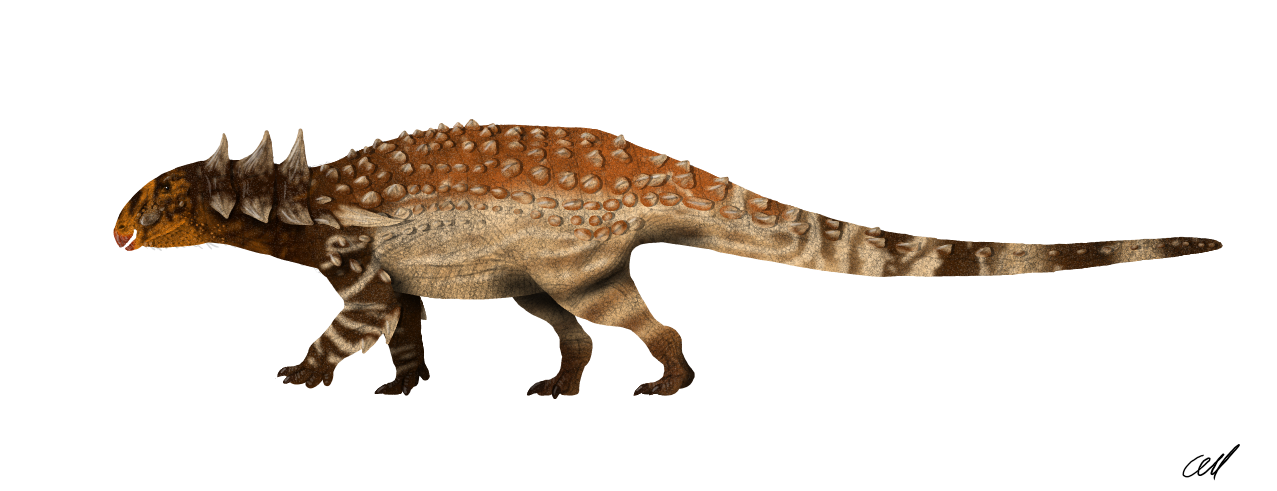
Scolosaurus cutleri (Ornithischia: Ankylosauria) from the Upper Cretaceous Dinosaur Park Formation of Alberta, Canada
Penkalski, P. & Blows, W.T. · Canadian Journal of Earth Sciences
Revision of Scolosaurus cutleri, a Cretaceous ankylosaur from Alberta, with extensive comparative discussion of diagnostic characters of basal ankylosaurs, including Hylaeosaurus and Gargoyleosaurus. Penkalski and Blows review the cranial anatomy and armor of Scolosaurus and present comparative tables in which Gargoyleosaurus appears as a reference for the primitive state of several characters, such as the open antorbital fenestra and the less-fused conical osteoderm pattern. The article reinforces the role of Gargoyleosaurus as a comparative point for the evolution of armor in Ankylosauria.


Famous museum specimens
DMNH 27726
Denver Museum of Nature & Science, Denver, EUA
Holotype of Gargoyleosaurus parkpinorum, found in 1995 at Bone Cabin Quarry West, Albany County, Wyoming, in rocks of the Morrison Formation. It preserves a nearly complete skull with mandible and a partial postcranial skeleton with vertebrae, ribs, shoulder and pelvic girdles, parts of the limbs and numerous osteoderms. The material was prepared by Western Paleontological Laboratories and formally described in 1998 by Carpenter, Miles and Cloward. The mounted skeleton, with reconstructed parts in model, has been on display at the Denver Museum of Nature and Science since approximately 2002.
Classification

Discovery
Fun fact
It is one of the oldest and most primitive known ankylosaurs in the world. The name 'gargoyle' comes from the rough appearance of the skull, reminiscent of the stone carvings on medieval cathedrals.
Last reviewed: April 24, 2026