
Elasmosaurus
Elasmosaurus platyurus
"Thin-plate flat-tailed reptile"
About this species
Elasmosaurus platyurus was one of the largest and most distinctive plesiosaurs of the Late Cretaceous, famous for its extraordinarily long neck that accounted for more than half of its total length of approximately 14 meters. With 71 cervical vertebrae, it holds the record for the greatest number of neck vertebrae of any known vertebrate. It was not a dinosaur but a marine reptile of the group Sauropterygia. It lived in the Western Interior Seaway that covered central North America, feeding on fish and cephalopods with sharp teeth. It became famous for a historic error: when Edward Drinker Cope described it in 1868, he assembled the skeleton with the skull at the wrong end, placing it at the tip of the tail. The mistake was corrected in 1870 following the intervention of Joseph Leidy.
Geological formation & environment
The Elasmosaurus platyurus holotype was collected from the Sharon Springs Member of the Pierre Shale Formation, in the lower Campanian (~80 Ma) of Logan County, Kansas. The Pierre Shale Formation is a sequence of marine shales deposited at the bottom of the Western Interior Seaway, rich in marine reptile fossils (mosasaurs, plesiosaurs), fish, ammonites, and invertebrates. The Smoky Hill Chalk, an equivalent formation to the west, preserved similar fauna including Styxosaurus, Tylosaurus, Platecarpus, and Pteranodon.
Image gallery




Scientific reconstruction of Elasmosaurus platyurus by Dmitry Bogdanov, showing the animal with the neck in horizontal position, a posture accepted by modern biomechanics.
Dmitry Bogdanov (DiBgd), CC BY-SA 4.0
Ecology and behavior
Habitat
Elasmosaurus platyurus inhabited the Western Interior Seaway, a shallow epicontinental sea (50-150 m) that crossed North America during the Campanian. The waters were warm and productive, with high diversity of fish, cephalopods, and other marine reptiles. The environment was similar to a modern tropical sea, with normal salinity and surface temperatures above 25°C. The Pierre Shale formation, where the holotype was found, represents open-sea deposits far from the coast.
Feeding
Elasmosaurus was piscivorous, feeding predominantly on teleost fish, squid, and other cephalopods available in the Western Interior Seaway. The sharp, pointed teeth were ideal for capturing slippery prey. The long neck was not used to strike like a snake, but probably to stealthily approach schools of fish from below or to sweep the water searching for prey. Gastroliths found in close relatives indicate the species swallowed polished stones, possibly as ballast or for grinding.
Behavior and senses
Behavioral evidence for Elasmosaurus is scarce, but data from close relatives and biomechanical analyses provide some inferences. The neck rigidity suggests flipper-based swimming, not body undulation. Gastroliths indicate intentional rock-swallowing behavior. There is no evidence of gregarious behavior or parental care. Body shape suggests an efficient open-sea swimmer, probably covering large distances in search of fish schools.
Physiology and growth
Elasmosaurus was a warm-blooded (endothermic or mesothermic) reptile, as suggested by oxygen isotope analyses in plesiosaurs from the same group and by the need to sustain large muscle masses in four flippers. Growth was determinate, with animals reaching sexual maturity possibly between 10 and 15 years and final lengths of up to 14 meters. Bone histology from close relatives indicates rapid growth rates in the juvenile phase, slowing at maturity.
Paleogeography
Continental configuration

Scotese & Vérard · CC BY 4.0 · Cretaceous, ~105 Ma
Fossil sites
Sampson et al. (2010), CC BY 4.0
During the Campaniano (~80.5–77 Ma), Elasmosaurus platyurus inhabited Laramidia, the western half of present-day North America, separated from the east by the Western Interior Seaway, a shallow sea dividing the continent. The continents were in very different positions: India was drifting toward Asia, Antarctica was still connected to Australia, and South America was an isolated island.
Bone Inventory
The holotype ANSP 10081, collected in 1867 by Theophilus H. Turner in Kansas, is the only specimen definitively attributed to E. platyurus. It preserves a nearly complete vertebral column with 72 cervical vertebrae, dorsal, sacral, and caudal vertebrae, as well as cranial fragments, ribs, and elements of the pectoral and pelvic girdles. The flippers and most of the skull are missing. The 55% completeness reflects the excellent state of the vertebral column but the absence of complete appendicular elements.
Found elements
Inferred elements
Scientific Literature
15 papers in chronological order — from the original description to recent research.
Remarks on a new enaliosaurian, Elasmosaurus platyurus
Cope, E.D. · Proceedings of the Academy of Natural Sciences of Philadelphia
Original description of Elasmosaurus platyurus by Edward Drinker Cope, based on the holotype collected in Kansas in 1867 by Theophilus H. Turner. Cope presented the animal as a new enaliosaurian from the Upper Cretaceous, attributing it a short neck and long tail because he reversed the orientation of the skeleton. The error would be pointed out two years later by Joseph Leidy, becoming one of the most famous episodes in American paleontology history and fueling the rivalry between Cope and Marsh in the Bone Wars.
North American plesiosaurs: Elasmosaurus, Cimoliasaurus, and Polycotylus
Williston, S.W. · American Journal of Science
Comprehensive review by Samuel Wendell Williston on North American plesiosaurs, including Elasmosaurus, Cimoliasaurus, and Polycotylus. Williston reassesses the known material, clarifies taxonomic relationships between genera, and consolidates the basic anatomy of Elasmosaurus from the holotype. The work establishes Elasmosauridae as a distinct family and describes the diagnostic features separating elasmosaurids from other plesiosaur groups from the Cretaceous of North America.

Revision of North American elasmosaurids (Reptilia, Plesiosauria) from the Cretaceous of the Western Interior
Carpenter, K. · Paludicola
Systematic revision by Ken Carpenter on North American elasmosaurids from the Cretaceous of the Western Interior. Carpenter concluded that only Elasmosaurus platyurus is a valid species within the genus, invalidating all other previously assigned species or transferring them to other genera. The work redefined the limits of the genus Elasmosaurus and established clear criteria for identifying the taxon, essential for all subsequent revisions of North American elasmosaurids.
Terminonatator ponteixensis, a new elasmosaurid (Reptilia; Plesiosauria) from the Upper Cretaceous of Saskatchewan
Sato, T. · Journal of Vertebrate Paleontology
Sato describes Terminonatator ponteixensis, a new elasmosaurid from the Upper Cretaceous of Saskatchewan, Canada. The accompanying phylogenetic analysis places Terminonatator as sister taxon to Elasmosaurus within the subfamily Styxosaurinae. This work was fundamental in defining the phylogenetic relationships of Elasmosaurus within Elasmosauridae, demonstrating that extremely long-necked elasmosaurids form a coherent clade within the family.
Redescription of Elasmosaurus platyurus Cope, 1868 (Plesiosauria: Elasmosauridae) from the Upper Cretaceous (Lower Campanian) of Kansas, U.S.A.
Sachs, S. · Paludicola
First comprehensive modern redescription of the holotype ANSP 10081 by Sven Sachs. The work defines E. platyurus by two unambiguous autapomorphies: presence of six premaxillary teeth and the high number of 71 cervical vertebrae. Sachs systematically documents all preserved material, corrects previous interpretations of vertebral morphology, and establishes the diagnostic characters distinguishing E. platyurus from all other elasmosaurids, becoming the standard anatomical reference for the species.
Revised vertebral count in the 'longest-necked vertebrate' Elasmosaurus platyurus Cope 1868, and clarification of the cervical-dorsal transition in Plesiosauria
Sachs, S., Kear, B.P. & Everhart, M.J. · PLOS ONE
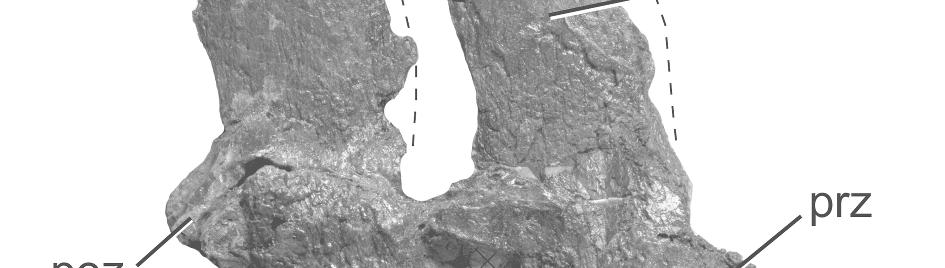
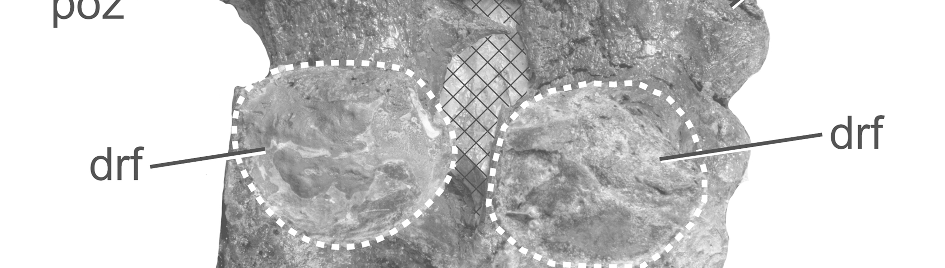
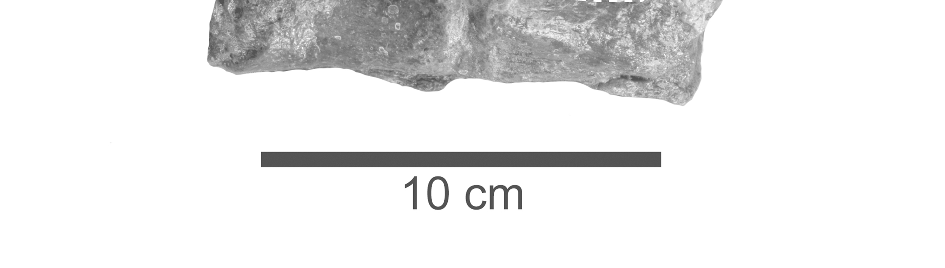
Sachs, Kear, and Everhart revisit the vertebral count of Elasmosaurus platyurus, correcting it to 72 cervical vertebrae rather than the previously accepted 71. The study clarifies the criteria for distinguishing cervical from dorsal vertebrae in plesiosaurs, based on morphological features of the ribs and zygapophyseal facets. Published as an open-access article in PLOS ONE, the work became the primary reference for elasmosaurid vertebral anatomy and confirmed E. platyurus as the vertebrate with the most known cervical vertebrae.
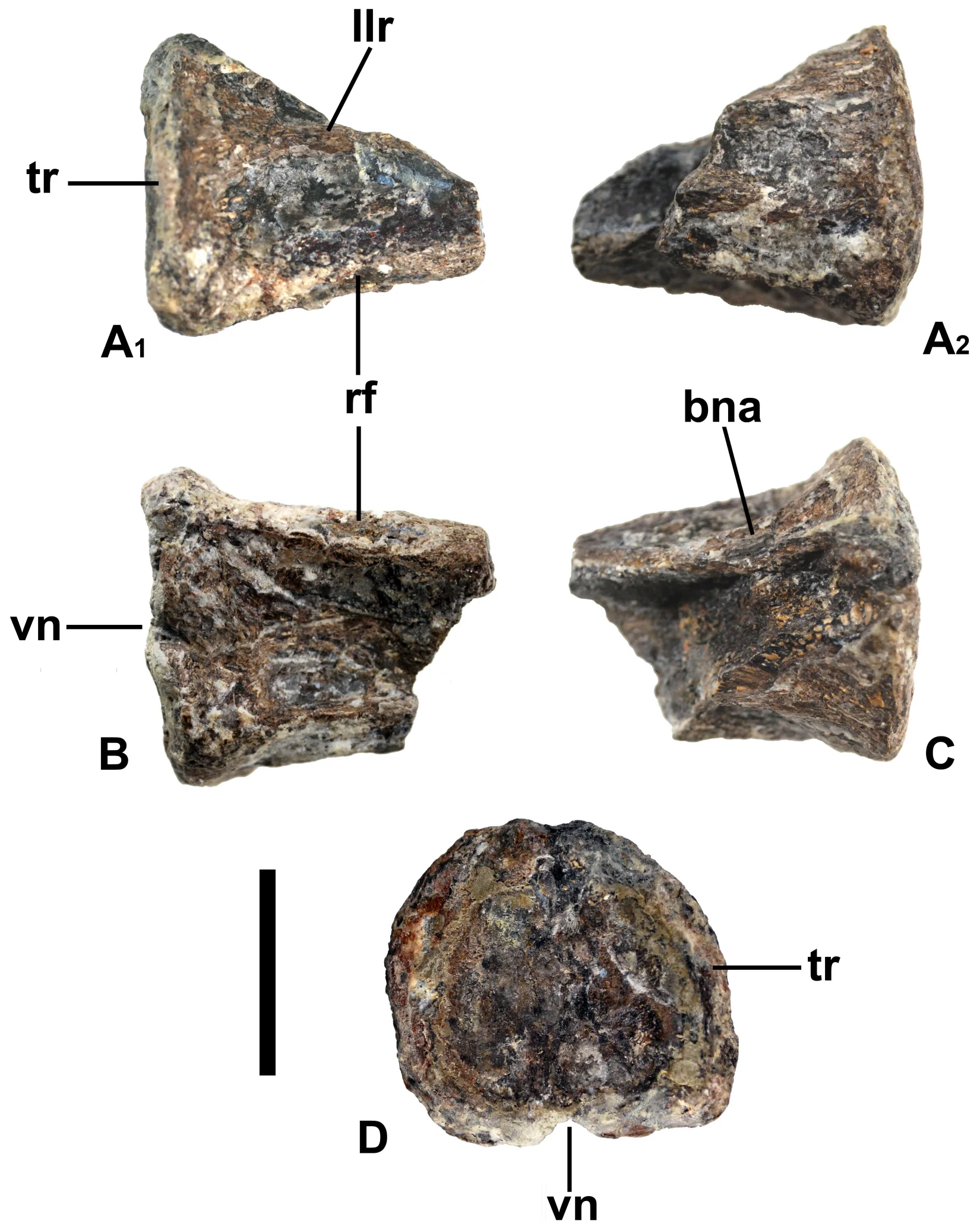
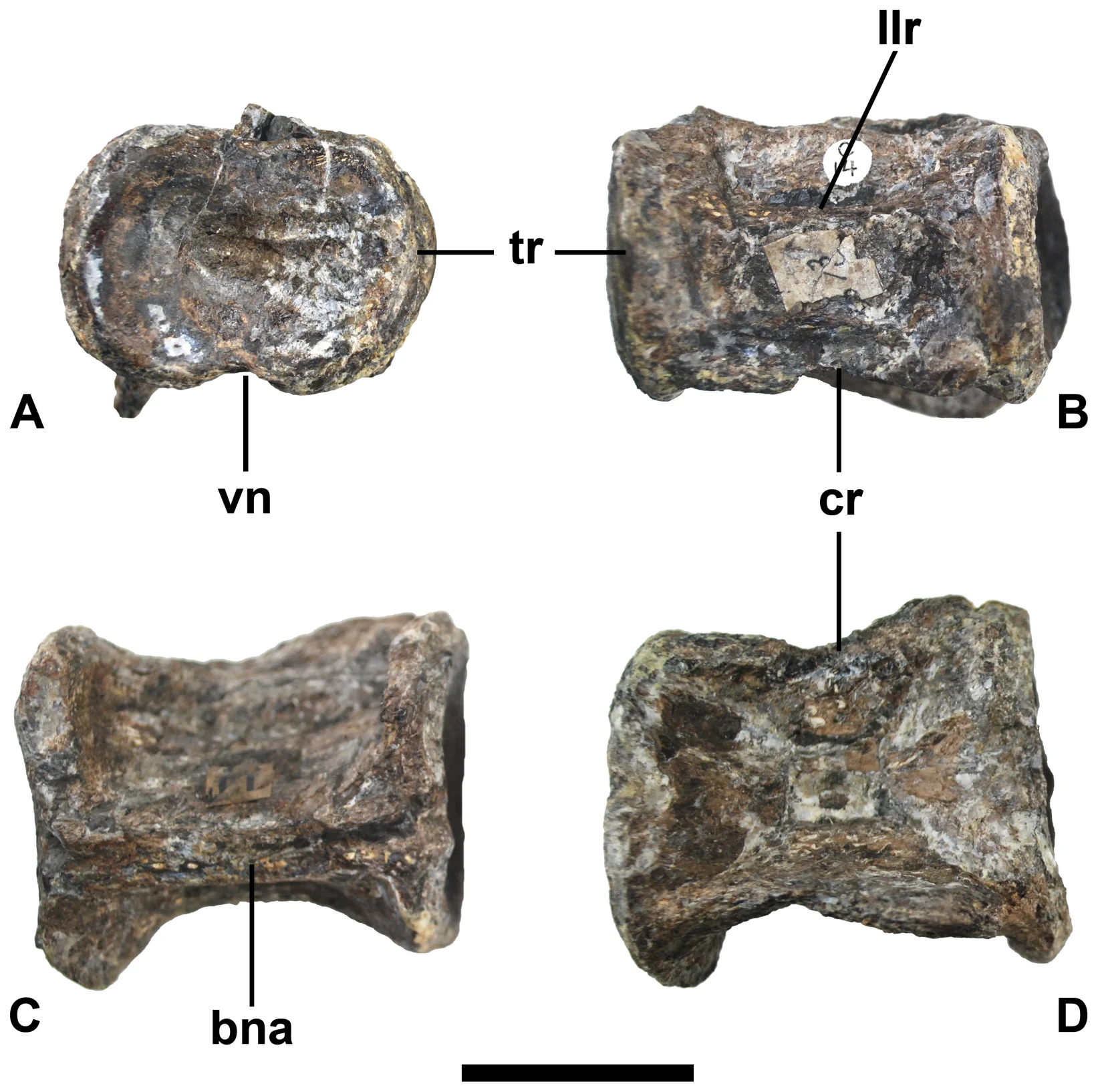
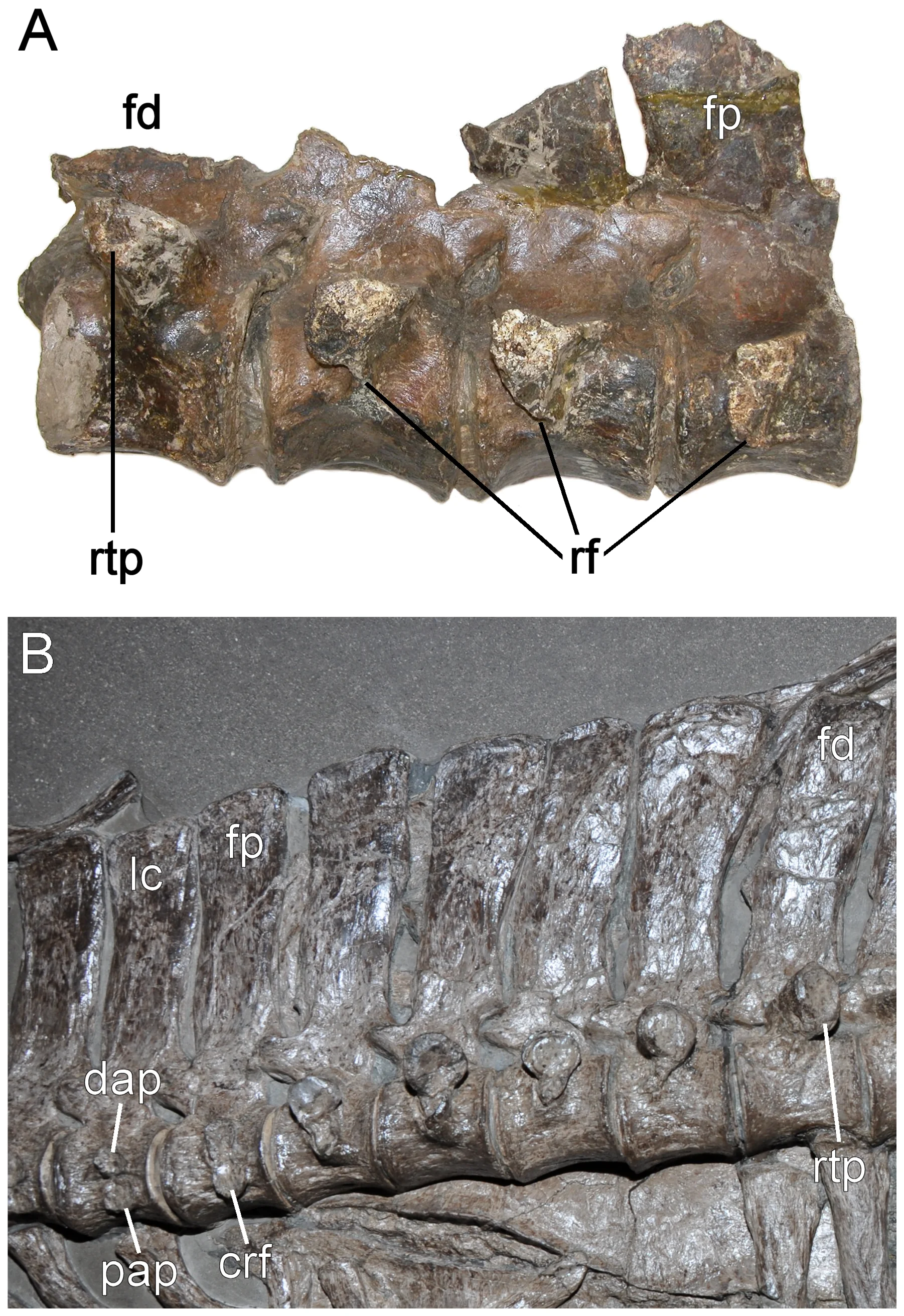
Taxonomic reassessment of Hydralmosaurus as Styxosaurus: new insights on the elasmosaurid neck evolution throughout the Cretaceous
Otero, R.A. · PeerJ
Rodrigo Otero performs a taxonomic reassessment of Hydralmosaurus as Styxosaurus, with a detailed phylogenetic analysis placing Elasmosaurus as the closest relative of Albertonectes within Styxosaurinae. The work provides new data on neck evolution in elasmosaurids throughout the Cretaceous, demonstrating a trend of progressive increase in the number of cervical vertebrae. Otero's analysis became a reference point for Elasmosauridae phylogeny.

A new elasmosaurid (Sauropterygia, Plesiosauria) from the Bearpaw Shale (Late Cretaceous, Maastrichtian) of Montana with information on the phylogenetics and ecology of latest Cretaceous elasmosaurids
Serratos, D.J., Druckenmiller, P.S. & Bhullar, B.A.S. · Journal of Vertebrate Paleontology
Serratos and colleagues describe a new elasmosaurid from the Maastrichtian of Montana, with a comprehensive phylogenetic analysis including Elasmosaurus platyurus. The study also incorporates stable isotope analysis to infer the ecology and feeding habits of latest Cretaceous elasmosaurids. The work provides valuable data on the ecological diversity and biogeography of North American elasmosaurids at the end of the Cretaceous.


Gastroliths and diet in plesiosaurs
Wahl, W.R. · Tate Museum Publications
Wahl examines gastroliths (stomach stones) associated with plesiosaurs from the Sundance and Morrison formations, discussing their physiological and dietary function. The study is relevant for Elasmosaurus because members of the family were found with similar accumulations of polished stones, suggesting that these marine reptiles intentionally swallowed rocks as ballast for buoyancy control or as an aid in crushing hard-to-digest food.

Gastroliths associated with plesiosaur remains in the Smoky Hill Chalk (Upper Cretaceous) of western Kansas
Everhart, M.J. · Transactions of the Kansas Academy of Science
Everhart documents gastroliths found in association with elasmosaurid plesiosaur remains in the Smoky Hill Chalk of Kansas. The study records the precise location, quantity, and type of rocks found, inferring ballast functions for buoyancy control or a role in digestion. The work is especially relevant for Elasmosaurus because the Smoky Hill Chalk is the lateral contemporaneous environment to the Pierre Shale where the E. platyurus holotype was found.


A cladistic analysis and taxonomic revision of the Plesiosauria (Reptilia: Sauropterygia)
O'Keefe, F.R. · Acta Zoologica Fennica
Comprehensive cladistic analysis by Frank Robin O'Keefe establishing the major clades of plesiosaurs and revising their taxonomy. The work placed Elasmosaurus within Elasmosauridae and established the fundamental phylogenetic relationships of the order Plesiosauria. O'Keefe's analysis provided the taxonomic framework that would be refined by subsequent work by Sato, Otero, and others, becoming a mandatory reference in plesiosaur literature.


Revision of Nectosaurus and Megacephalosaurus, polycotylid-grade (Reptilia, Plesiosauria) taxa from the Cretaceous of North America
Zverkov, N.G. & Jacobs, M.L. · Journal of Paleontology
Zverkov and Jacobs revise the polycotylids Nectosaurus and Megacephalosaurus from the Cretaceous of North America, with a new phylogenetic analysis including Elasmosauridae. The work brings comparative data on plesiosaur diversity in the Western Interior Seaway and reinforces understanding of the relationships between different plesiosaroid families that coexisted with Elasmosaurus in the same environment during the Campanian.


A stratigraphic and taxonomic review of plesiosaurs from the old 'Fort Benton Group' of central Kansas: a new assessment of old records
Schumacher, B.A. & Everhart, M.J. · Paludicola
Schumacher and Everhart stratigraphically and taxonomically review the plesiosaur records from the old Fort Benton Group of central Kansas, including material relevant to Elasmosaurus. The work updates the identifications of historical specimens collected in the 19th and early 20th centuries, contextualizing them within modern stratigraphic units. The revision is essential for understanding the temporal and geographic distribution of E. platyurus and its relatives in the Western Interior Seaway.


Faunal turnover of marine tetrapods during the Jurassic-Cretaceous transition
Benson, R.B.J. & Druckenmiller, P.S. · Biological Reviews
Benson and Druckenmiller present a comprehensive phylogenetic analysis of marine tetrapods including a revised topology for Elasmosauridae. The study analyzes faunal turnover during the Jurassic-Cretaceous transition, demonstrating that Elasmosauridae emerged and diversified during this period. The work establishes the position of Elasmosaurus within a global plesiosaur phylogeny and contextualizes the group's evolution within the broader framework of Mesozoic marine reptile radiations.


How elongated? The pattern of elongation of cervical centra of Elasmosaurus platyurus with comments on cervical elongation patterns among plesiosauromorphs
O'Gorman, J.P. · Diversity
O'Gorman performs a detailed quantitative analysis of the cervical vertebrae elongation pattern in Elasmosaurus platyurus, comparing it with other plesiosauromorphs. The study demonstrates a unique distribution pattern of elongation along the neck, with more elongated central vertebrae and a gradual decrease toward the skull and trunk. This is the most recent and comprehensive work on the vertebral anatomy of E. platyurus, providing precise morphometric data on the holotype ANSP 10081.

Famous museum specimens
Holótipo ANSP 10081
Academy of Natural Sciences of Drexel University, Filadélfia, Estados Unidos
The only specimen definitively attributed to E. platyurus. Collected near Fort Wallace, Logan County, Kansas, from Pierre Shale rocks (lower Campanian). Preserves 72 cervical vertebrae, part of the skull, ribs, and elements of the pectoral and pelvic girdles. It was the specimen used by Cope in his erroneous and later famous 1868 scheme.
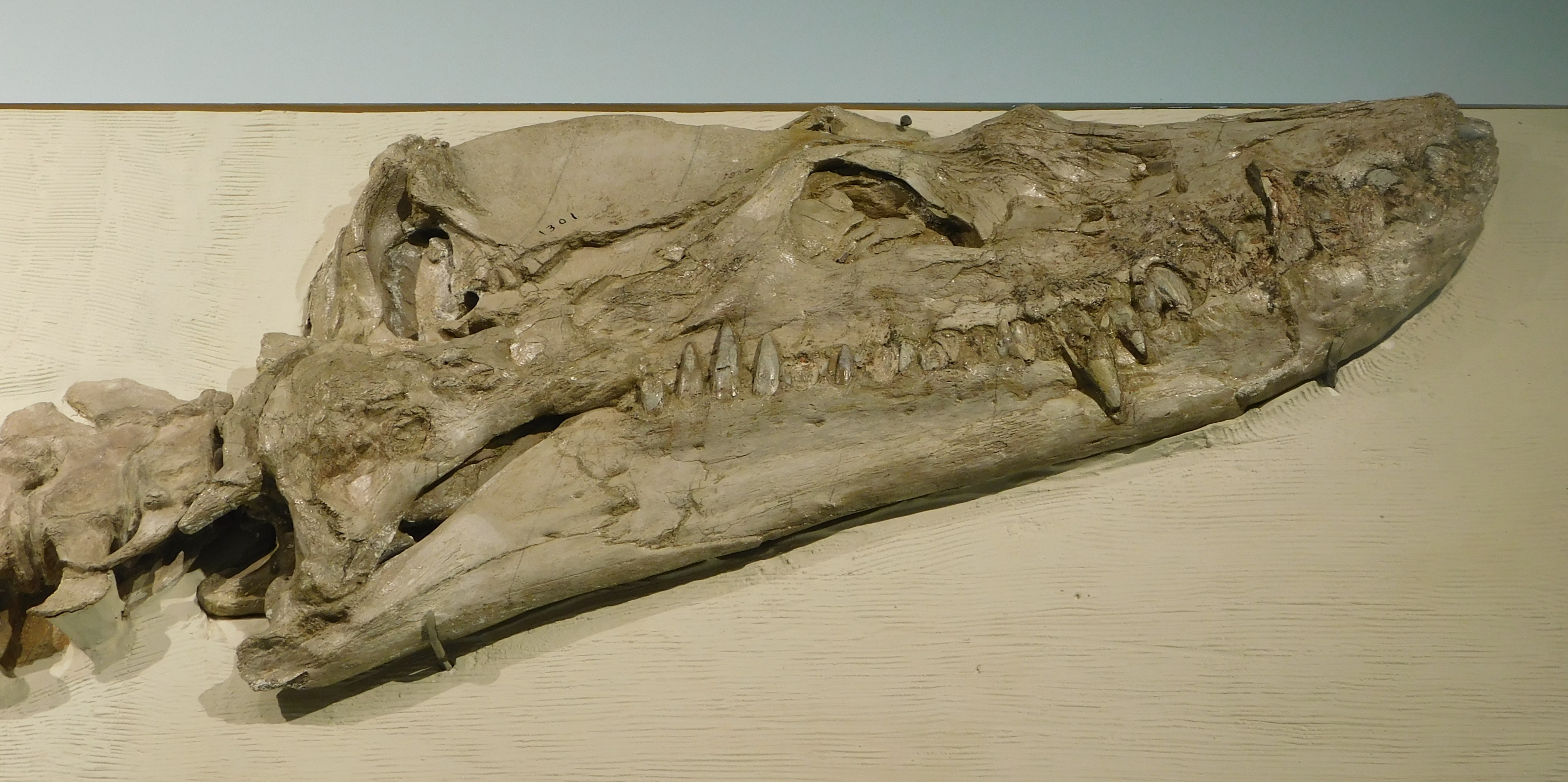
KUVP 1301 (Styxosaurus snowii, parente próximo)
University of Kansas Natural History Museum, Lawrence, Estados Unidos
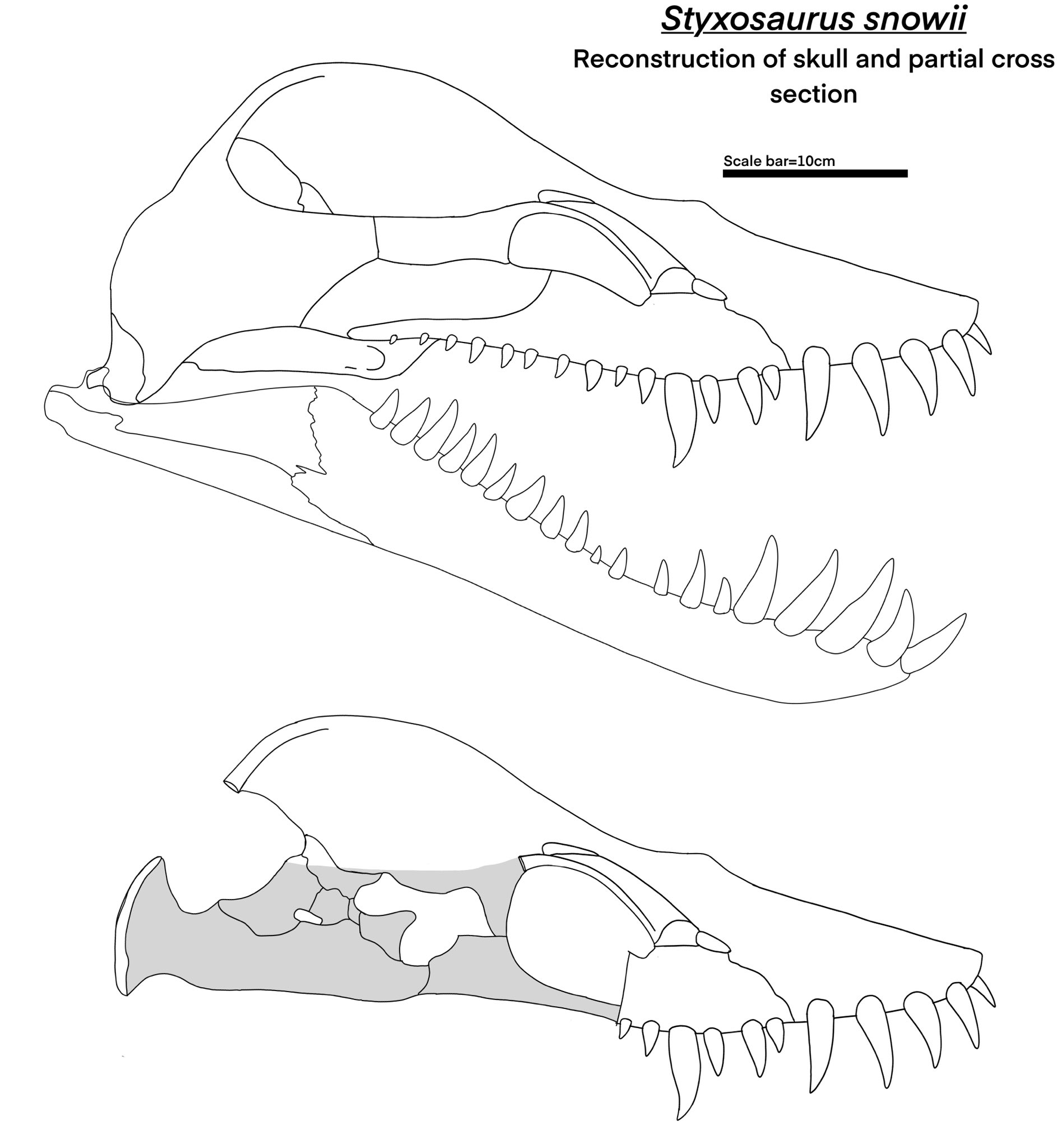
Although it is Styxosaurus snowii (not E. platyurus), this specimen is the most complete of an elasmosaurid from Elasmosaurus's sister genus, collected from the Smoky Hill Chalk of Kansas. It preserves the skull, nearly complete neck, and part of the body. Fundamental for understanding E. platyurus anatomy by comparison, since the Elasmosaurus holotype lacks a complete skull.
In cinema and popular culture
Elasmosaurus held a special place in cultural imagination long before modern cinema. Its long, sinuous neck became the visual basis for the Loch Ness monster and other aquatic monsters of 20th-century folklore. In film, it appeared as early as King Kong (1933) as a terrifying lake creature. The most notable production was Chased by Sea Monsters (BBC, 2003), a documentary narrated by Nigel Marven that dedicated an entire episode to the Campanian Western Interior Seaway, depicting Elasmosaurus with relative scientific accuracy for the time. Sea Monsters: A Prehistoric Adventure (2007) brought the species to IMAX in 3D, making it accessible to new audiences. In animation, Elsie in The Land Before Time V (1997) popularized elasmosaurids with young audiences. The long, sinuous neck of Elasmosaurus remains one of the most recognizable silhouettes in paleontology, frequently mistaken for a dinosaur by the general public, despite the animal belonging to a completely different group of marine reptiles.
Classification

Discovery
Fun fact
Edward Drinker Cope's 1868 mistake, placing Elasmosaurus's skull at the tip of the tail instead of the head, was so embarrassing that the paleontologist reportedly tried to buy and destroy all copies of the original paper to erase the record of the blunder.
Last reviewed: April 24, 2026