
Edmontonia
Edmontonia rugosidens
"Edmonton lizard with wrinkled teeth"
About this species
Edmontonia rugosidens was a large-bodied nodosaurid that lived in the Late Cretaceous, during the Campanian, approximately 76 to 73 million years ago, across the coastal plains of western North America that formed the island continent of Laramidia. About 6.5 meters long and with an estimated mass of three metric tons, it was a massive quadrupedal herbivore covered by impressive dermal armor composed of rows of osteoderms along the back, flanks, and base of the tail. The taxonomic history of the species begins in 1930, when Charles W. Gilmore described material recovered by George Fryer Sternberg in 1928 from the Two Medicine Formation of Montana. Gilmore coined the epithet rugosidens in reference to the wrinkled surface of the small leaf-shaped teeth of the animal, assigning the species to the genus Palaeoscincus, then used as a dumping ground for isolated ankylosaur teeth. A decade later, in 1940, Loris S. Russell reexamined the material and erected the new genus Edmontonia, named after the Edmonton Formation, a stratigraphic unit that also preserved related specimens in southern Alberta. Edmontonia belongs to the family Nodosauridae, the sister group of Ankylosauridae within Ankylosauria. The most striking anatomical difference between the two families lies in the tail. Ankylosaurids such as Ankylosaurus and Euoplocephalus evolved the famous tail club formed by fused osteoderms at the tip of the tail, used as an impact weapon. Edmontonia and other nodosaurids never evolved this structure. Instead, both passive and active defense were concentrated in its body armor and, above all, in a set of enormous spikes projecting laterally from the shoulders, a structure particularly developed in Edmontonia and interpreted as a possible weapon in intraspecific contests between males, in addition to defense against predators such as the tyrannosaurids Gorgosaurus and Daspletosaurus. The ecological context of Edmontonia rugosidens is the Dinosaur Park Formation ecosystem of Alberta, one of the richest dinosaur-bearing sedimentary units of the Cretaceous. The environment consisted of moist coastal plains under the influence of the Western Interior Seaway, with meandering rivers, wetlands, and dense vegetation of conifers, cycads, and early flowering plants. The contemporary fauna included ceratopsids such as Centrosaurus and Styracosaurus, hadrosaurids such as Corythosaurus and Lambeosaurus, and the predators Gorgosaurus and Daspletosaurus. The fossil record of the species is remarkably rich compared with that of other ankylosaurs. Several specimens preserve the dermal armor near its original position, allowing detailed reconstructions of the arrangement of cervical, dorsal, and lateral osteoderms. The holotype USNM 11868, the AMNH 5381 skull and partial skeleton, and the complete AMNH 5665 material are the central anatomical references. The historical documentation by William Diller Matthew in 1922 at the American Museum of Natural History produced some of the first systematic reconstructions of the armor of a nodosaurid, an iconography that shaped how Edmontonia was depicted in museums and popular literature for decades.
Geological formation & environment
The Dinosaur Park Formation is a Late Cretaceous sedimentary unit (Campanian, approximately 76.5 to 74.5 Ma) located in southern Alberta, Canada, within Dinosaur Provincial Park, a UNESCO World Heritage Site. The formation consists of sandstones, siltstones, and claystones deposited in a coastal plain environment dominated by meandering rivers, wetlands, and ponds, under the influence of the Western Interior Seaway. The preserved fauna is exceptionally diverse and includes ceratopsids, hadrosaurids, tyrannosaurids, ankylosaurs, smaller theropods, turtles, crocodilians, and primitive mammals, making it one of the most important fossil-bearing units in the world.
Image gallery


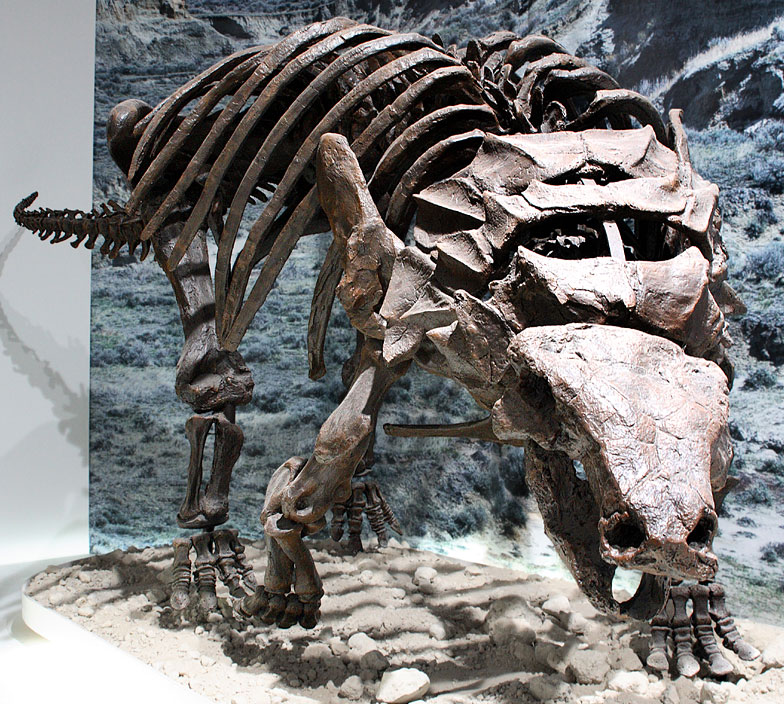

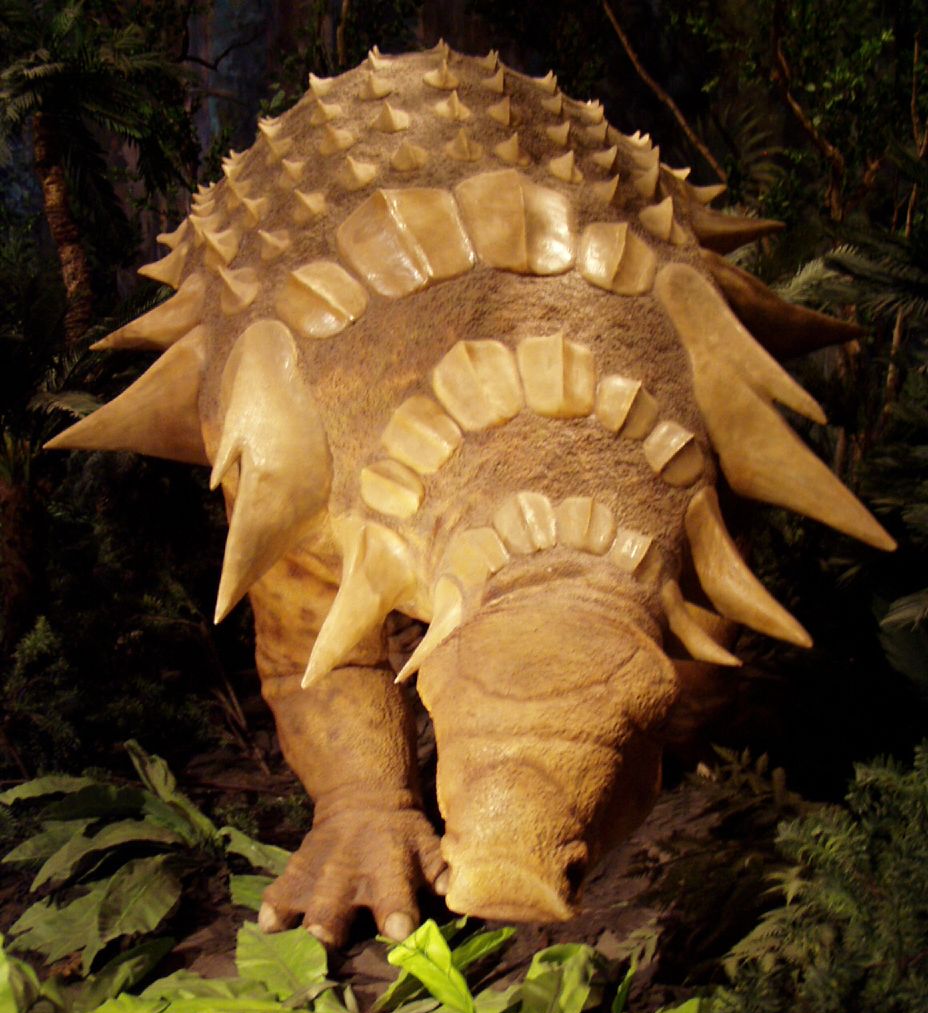

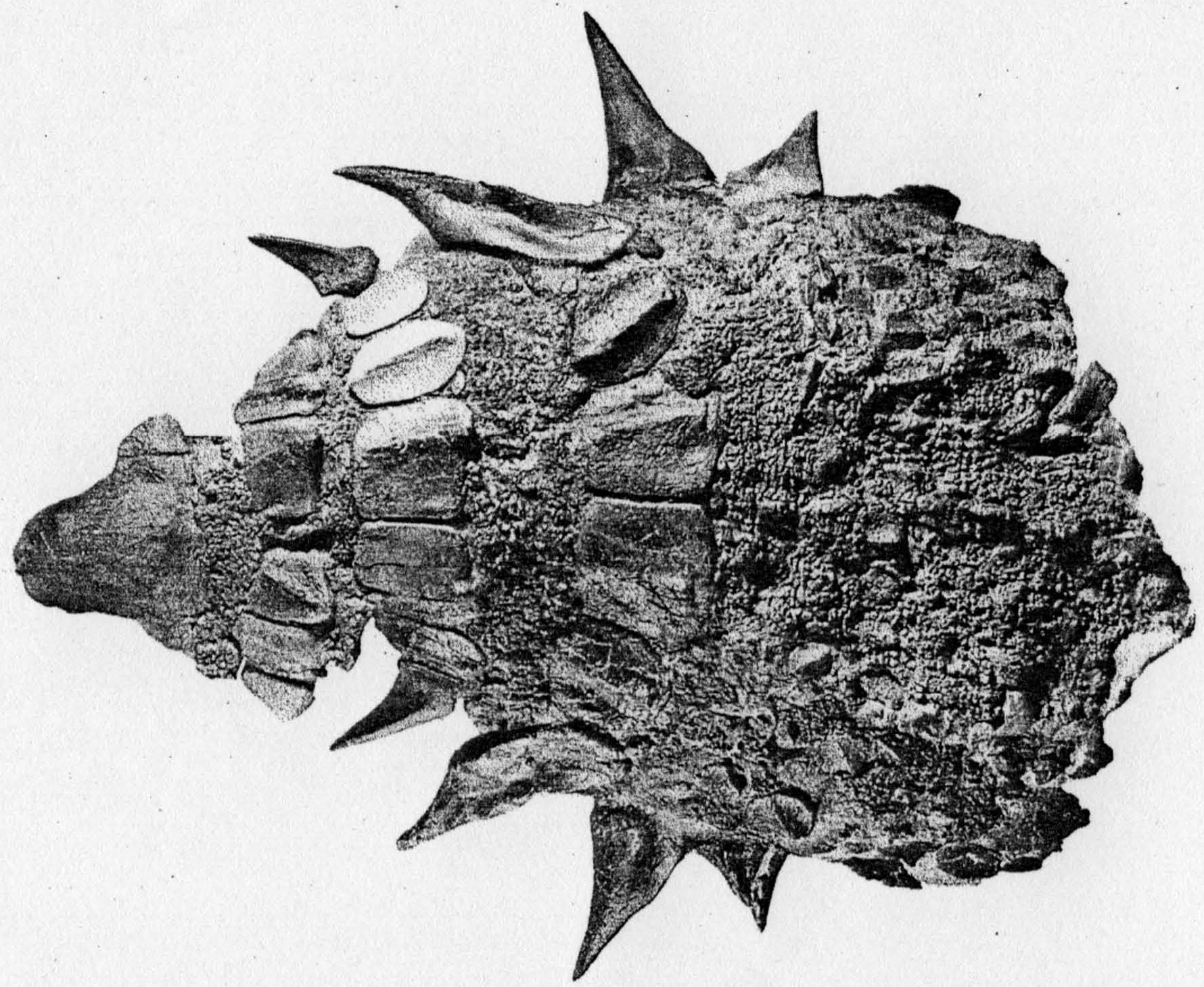


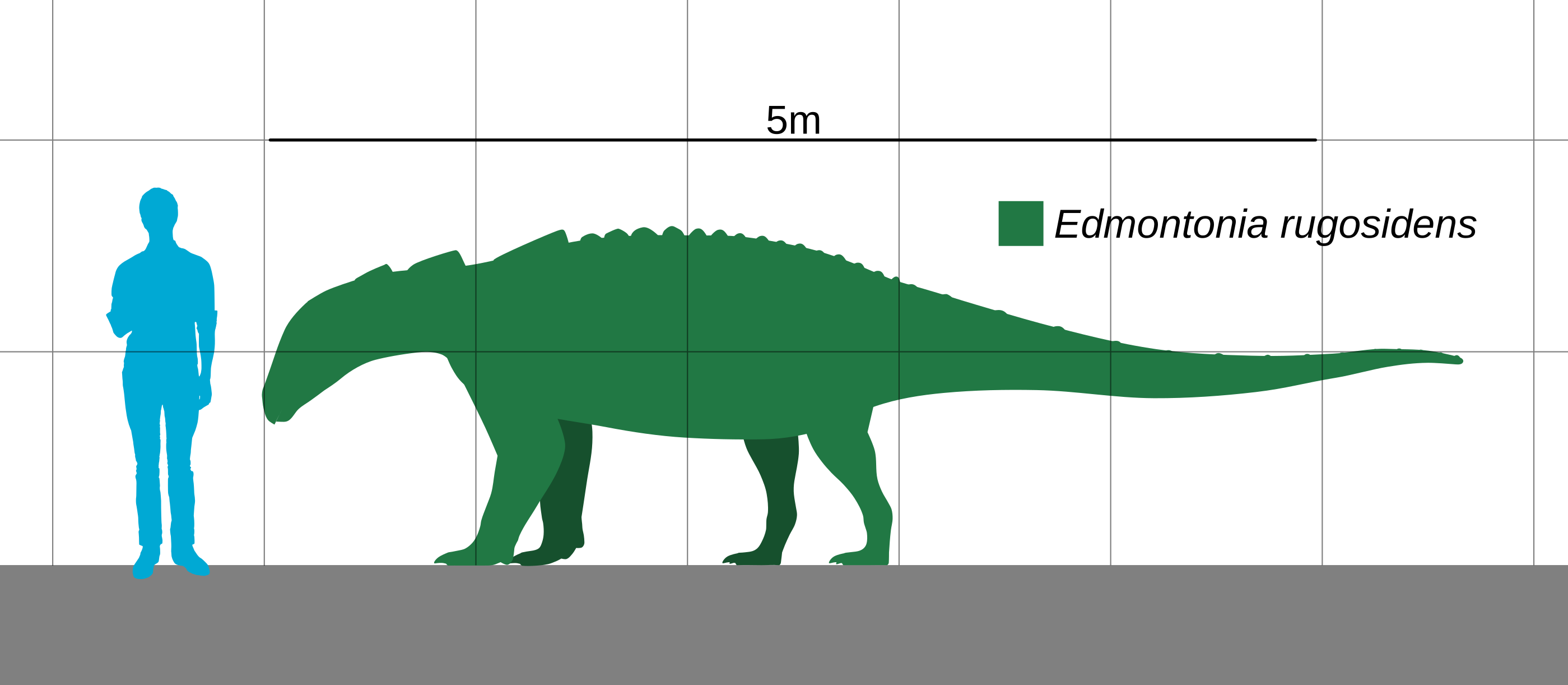


Life reconstruction of Edmontonia rugosidens by Mariana Ruiz (LadyofHats), public domain, with transparent background. Hero image of the species on the site.
Mariana Ruiz (LadyofHats), domínio público
Ecology and behavior
Habitat
Edmontonia rugosidens inhabited the moist coastal plains of Alberta during the late Campanian, in an environment influenced by the Western Interior Seaway. The landscape included meandering rivers, wetlands, ponds, and dense vegetation of conifers, cycads, and early flowering plants. The contemporary fauna of the Dinosaur Park Formation includes the ceratopsids Centrosaurus and Styracosaurus, the hadrosaurid Corythosaurus, and the tyrannosaurid Gorgosaurus, forming one of the most diverse and well-documented dinosaur ecosystems of the Cretaceous.
Feeding
Low-browsing herbivore, with small leaf-shaped teeth and beak-like jaws. The dental and cranial morphology suggests selective feeding on low foliage, tender branches, and ground-level plants, likely young conifers, ferns, and basal angiosperms. The moderate height of the skull relative to the ground and the absence of adaptations for high browsing indicate ground-level foraging similar to that of modern medium-sized ungulates.
Behavior and senses
Likely solitary or small-group animal, with passive defense based on dorsal armor and active defense via lateral spikes projecting from the shoulders. There is no clear evidence of gregarious behavior, unlike that observed in some contemporary ceratopsids and hadrosaurids. The shoulder spikes are large enough to suggest use in intraspecific combat between males, in addition to an antipredator function against tyrannosaurids.
Physiology and growth
Heavy armor composed of rows of dorsal, ventral, and lateral osteoderms, complemented by enormous spikes projecting outward from the shoulders. Unlike the Ankylosauridae, Edmontonia lacks a tail club: tail defense is based on smaller lateral osteoderms without terminal fusion. The heavy bone structure and low posture indicate a slow-moving animal adapted to prolonged foraging and stationary defense. Bone histology suggests continuous growth in early stages, with deceleration at adulthood typical of large-bodied vertebrates.
Paleogeography
Continental configuration

Scotese & Vérard · CC BY 4.0 · Cretaceous, ~105 Ma
During the Campaniano (~76–73 Ma), Edmontonia rugosidens inhabited Laramidia, the western half of present-day North America, separated from the east by the Western Interior Seaway, a shallow sea dividing the continent. The continents were in very different positions: India was drifting toward Asia, Antarctica was still connected to Australia, and South America was an isolated island.
Bone Inventory
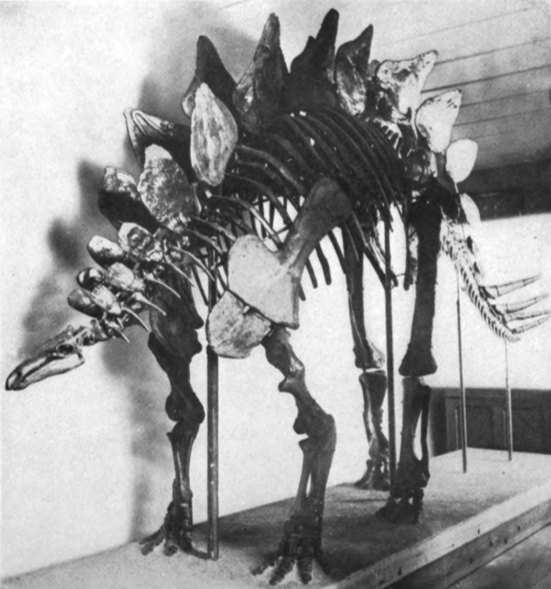
Edmontonia rugosidens is one of the most completely known nodosaurids. The holotype USNM 11868, the basis of Gilmore's original 1930 description, includes skull and partial postcranial skeleton. Specimen AMNH 5381, recovered in 1915 by George Sternberg, preserves dermal armor near its original position. Material AMNH 5665, on display at the American Museum of Natural History, is one of the most complete mounted skeletons of any nodosaurid, with armor in situ.
Found elements
Inferred elements
Scientific Literature
15 papers in chronological order — from the original description to recent research.
On dinosaurian reptiles from the Two Medicine Formation of Montana
Gilmore, C.W. · Proceedings of the United States National Museum
Original description of the species as Palaeoscincus rugosidens based on holotype USNM 11868, a skull and partial postcranial skeleton collected by George Fryer Sternberg in 1928 from the Two Medicine Formation of Montana. Gilmore characterizes the small leaf-shaped teeth with rugose surface, motivating the coining of the specific epithet rugosidens. The description includes characterization of the dermal armor preserved in association with the skull, as well as partial reconstruction of the body plan based on analogy with other ankylosaurs known at the time. The work remains the founding reference for the species, although the genus Palaeoscincus was later considered invalid, leading Russell in 1940 to transfer the material to the new genus Edmontonia.
Edmontonia rugosidens (Gilmore), an armoured dinosaur from the Belly River series of Alberta
Russell, L.S. · University of Toronto Studies, Geological Series
Russell reexamines the material assigned by Gilmore (1930) to Palaeoscincus rugosidens and concludes that the genus Palaeoscincus is invalid, based only on isolated teeth insufficient for diagnosis. He then erects the new genus Edmontonia, named after the Edmonton Formation, a stratigraphic unit of Alberta that also preserved related specimens. The work consolidates the anatomical diagnosis of the species based on cranial, dental, and dermal armor characters, and establishes the stratigraphic context of the Canadian material. Russell also describes Edmontonia longiceps based on specimen NMC 8531 from the Horseshoe Canyon Formation, reinforcing the diversity of the genus.
The families of the ornithischian dinosaur order Ankylosauria
Coombs, W.P. Jr. · Palaeontology
Fundamental revision of Ankylosauria systematics in which Coombs establishes the basis of the modern division of the group into two main families: Nodosauridae, which includes Edmontonia, and Ankylosauridae, which includes Ankylosaurus. The work defines diagnostic cranial and postcranial characters to distinguish the families, including the presence or absence of a tail club, skull morphology, and dermal armor arrangement. Coombs positions Edmontonia as a derived nodosaurid, close to Panoplosaurus. This classification guides virtually all subsequent taxonomic work on ankylosaurs until the revision of Vickaryous et al. (2004).
Ankylosauria
Coombs, W.P. Jr.; Maryanska, T. · The Dinosauria (1st edition), University of California Press
Reference chapter on Ankylosauria in the first edition of The Dinosauria. Coombs and Maryanska consolidate knowledge accumulated on the group by the late 1980s, presenting detailed diagnoses of Nodosauridae and Ankylosauridae, and describing the anatomy of Edmontonia in detail within the comparative context of the family. The chapter discusses the stratigraphic and paleogeographic distribution of nodosaurids, emphasizing the broad presence of the group in North America during the Late Cretaceous, and highlights the large shoulder spikes of Edmontonia as a notable autapomorphic character among nodosaurids.
Ankylosaur systematics: example using Panoplosaurus and Edmontonia (Ankylosauria: Nodosauridae)
Carpenter, K. · Dinosaur Systematics: Approaches and Perspectives, Cambridge University Press
Systematic study dedicated specifically to Edmontonia and Panoplosaurus, the two best-represented nodosaurids of the Late Cretaceous of North America. Carpenter redefines the diagnosis of the two genera based on cranial and dermal armor characters, clearly delimiting the differences between them. The work establishes that Edmontonia has a more elongated skull, proportionally smaller teeth, and cervical armor with large lateral spikes, while Panoplosaurus has a shorter and wider skull. The study also discusses phylogenetic relationships within Nodosauridae and proposes Panoplosaurini as the tribe grouping the two genera.

Ankylosauria
Vickaryous, M.K.; Maryanska, T.; Weishampel, D.B. · The Dinosauria, 2nd edition, University of California Press
Reference chapter on Ankylosauria in the second edition of The Dinosauria, an update of the 1990 Coombs and Maryanska work. The authors consolidate nearly fifteen years of new discoveries and phylogenetic revisions, presenting a formal cladistic analysis of ankylosaurs that places Edmontonia within Panoplosaurini, the Nodosauridae tribe proposed by Carpenter. The anatomical diagnosis of the species is reinforced based on new specimens described in the 1990s, and the morphology of the shoulder spikes is discussed in comparison with Panoplosaurus, Sauropelta, and other nodosaurids.
Taxonomic utility of ankylosaur (Dinosauria, Ornithischia) osteoderms: Glyptodontopelta mimus Ford, 2000, a test case
Burns, M.E. · Journal of Vertebrate Paleontology
Burns tests the taxonomic utility of isolated ankylosaur osteoderms, using Glyptodontopelta mimus as a case study. The work is methodologically important because many nodosaurids, including Edmontonia, are diagnosed in part by dermal armor characters. Burns concludes that osteoderm morphology can be diagnostic at the genus and species level when combined with cranial and postcranial characters, but warns against diagnoses based exclusively on isolated osteoderms. The study compares the histological microstructure and external morphology of osteoderms from Edmontonia, Panoplosaurus, and other nodosaurids.
Phylogeny of the ankylosaurian dinosaurs (Ornithischia: Thyreophora)
Thompson, R.S.; Parish, J.C.; Maidment, S.C.R.; Barrett, P.M. · Journal of Systematic Palaeontology
Comprehensive phylogenetic analysis of Ankylosauria, including the first modern data matrix to systematically evaluate all known genera of Nodosauridae and Ankylosauridae. Thompson and collaborators place Edmontonia within Panoplosaurini, the clade grouping derived Late Cretaceous North American nodosaurids. The analysis confirms Edmontonia as the sister taxon of Panoplosaurus and demonstrates that Panoplosaurini is distinct from other nodosaurid clades, such as the European Struthiosaurinae. The work establishes the phylogenetic topology that continues to be widely used as a reference.
Euoplocephalus tutus and the diversity of ankylosaurid dinosaurs in the Late Cretaceous of Alberta, Canada, and Montana, USA
Arbour, V.M.; Currie, P.J. · PLOS ONE
Comprehensive revision of material attributed to Euoplocephalus tutus, with discussion of cranial homologies in ankylosaurs. Although the focus is on ankylosaurids, the work provides relevant comparative context for contemporary nodosaurids such as Edmontonia, which occupied the same ecosystem of the Dinosaur Park Formation. The authors discuss patterns of cranial ornamentation and species delimitation in groups of ankylosaurs that have traditionally been lumped under collective names. The methodology applied to ankylosaurids influenced subsequent revisions of nodosaurid systematics.

Systematics, phylogeny and palaeobiogeography of the ankylosaurid dinosaurs
Arbour, V.M.; Currie, P.J. · Journal of Systematic Palaeontology
Comprehensive systematic study of Ankylosauridae with phylogenetic and paleobiogeographic analysis. Although the focus is on the sister family of Nodosauridae, the work presents a phylogenetic tree that includes Edmontonia as an outgroup to root the analysis, confirming the position of the genus within Nodosauridae. The authors discuss biogeographic patterns of Late Cretaceous ankylosaurs, with Edmontonia representing the Campanian North American nodosaurid lineage coexisting with the ankylosaurids Scolosaurus, Dyoplosaurus, and relatives.


A new southern Laramidian ankylosaurid, Akainacephalus johnsoni gen. et sp. nov., from the upper Campanian Kaiparowits Formation of southern Utah, USA
Wiersma, J.P.; Irmis, R.B. · PeerJ
Description of the new ankylosaurid Akainacephalus johnsoni from the Kaiparowits Formation of southern Utah, with a comprehensive phylogenetic analysis of Ankylosauria that includes Edmontonia. The work is particularly relevant to the paleobiogeographic context of Edmontonia because it discusses the difference between northern and southern Laramidian faunas in the late Campanian, both occupied by ankylosaurs but with distinct compositions. The Wiersma and Irmis cladogram serves as the phylogenetic reference for this dossier.


Revised systematics of the armoured dinosaur Euoplocephalus and its allies
Penkalski, P. · Neues Jahrbuch für Geologie und Paläontologie, Abhandlungen
Penkalski revises the systematics of Euoplocephalus and related ankylosaurids, proposing the separation of material previously grouped into distinct species. The work is relevant for Edmontonia because it addresses the ankylosaurs of the Dinosaur Park Formation and the Horseshoe Canyon Formation, which include both Edmontonia and Euoplocephalus and their relatives. Penkalski discusses the taxonomic implications of the revisions for the diversity of Campanian North American ankylosaurs.


An exceptionally preserved three-dimensional armored dinosaur reveals insights into coloration and Cretaceous predator-prey dynamics
Brown, C.M.; Henderson, D.M.; Vinther, J.; Fletcher, I.; Sistiaga, A.; Herrera, J.; Summons, R.E. · Current Biology
Description of Borealopelta markmitchelli, a nodosaurid related to Edmontonia, with exceptional three-dimensional preservation including skin, soft tissues, and chemical pigments. The work is a fundamental reference for understanding the living appearance of nodosaurids like Edmontonia, because it demonstrates that these animals had countershaded coloration with dark back and light belly, a camouflage pattern implying intense predatory pressure. The authors also document the natural arrangement of osteoderms in the skin, providing a direct model for reconstructing the armor of Edmontonia.


A polacanthine ankylosaur (Ornithischia: Dinosauria) from the Early Cretaceous (Barremian) of Eastern Utah
Kirkland, J.I. · New Mexico Museum of Natural History and Science Bulletin
Description of Mymoorapelta and discussion of polacanthines, a basal ankylosaur lineage relevant to understanding the origin of derived nodosaurids like Edmontonia. Kirkland establishes the broad evolutionary context of Nodosauridae, documenting Early Cretaceous North American forms that predate Edmontonia and provide anatomical ancestry for the family. The work helps to contextualize the late appearance of Edmontonia in the Campanian as the product of a long evolutionary radiation.


Cranial ornamentation of ankylosaurs (Ornithischia: Thyreophora): reappraisal of developmental hypotheses
Vickaryous, M.K.; Russell, A.P.; Currie, P.J. · The Armored Dinosaurs, Indiana University Press
Reappraisal of developmental hypotheses for cranial ornamentation in ankylosaurs, with direct discussion of Edmontonia among the nodosaurids studied. The authors propose that caputegulae, the osteoderms that cover the skull, form by secondary ossification of skin adhered to the skull during ontogeny, a hypothesis that challenges earlier interpretations based on primary dermal bones. The model has implications for understanding the ornamental diversity observed in Edmontonia and its relatives.


Famous museum specimens
AMNH 5381
American Museum of Natural History, Nova York, Estados Unidos
Specimen recovered in 1915 by Barnum Brown in Alberta, in the Dinosaur Park Formation, and originally referred to Palaeoscincus rugosidens by Gilmore in 1930. Preserves the skull, postcranial elements, and dermal armor near the original position, serving as the basis for William Diller Matthew's historical reconstructions in 1922.
USNM 11868
National Museum of Natural History (Smithsonian), Washington DC, Estados Unidos
Complementary type specimen collected in 1928 by George Fryer Sternberg from the Two Medicine Formation in Montana. Basis of the original description by Gilmore (1930), who coined the epithet rugosidens in reference to the wrinkled surface of the small leaf-shaped teeth of the animal.
NMC 8531 (CMN 8531)
Canadian Museum of Nature, Ottawa, Canadá
Holotype of Edmontonia longiceps, described by Russell in 1940. Recovered in 1924 near Morrin, Alberta, in the Horseshoe Canyon Formation. Includes skull, mandible, and postcranial skeleton, serving as a fundamental reference for differentiating the species of the genus Edmontonia.
Classification
Discovery
Fun fact
Unlike its cousin Ankylosaurus, Edmontonia had no tail club. Instead, its defensive arsenal consisted of a row of enormous spikes projecting from the sides of its body, possibly used in combat between males.
Last reviewed: April 24, 2026