
Cretoxyrhina
Cretoxyrhina mantelli
"Mantell's sharp tooth from the Cretaceous"
About this species
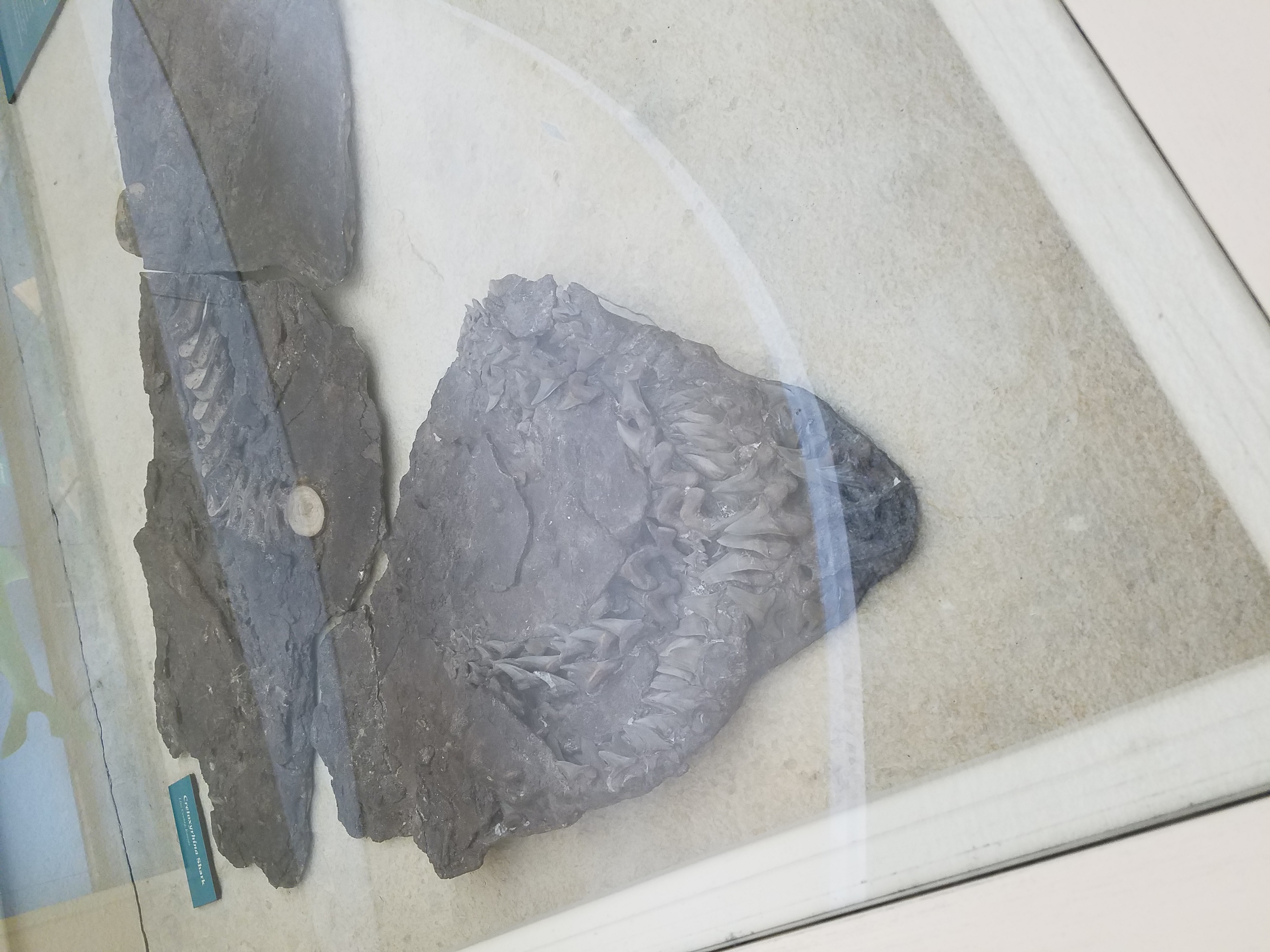
Cretoxyrhina mantelli, popularly known as the Ginsu shark, was one of the largest and most feared marine predators of the Late Cretaceous. It lived approximately 100 to 72 million years ago in the Western Interior Seaway, a vast body of water that divided North America. Up to 6.5 meters long with anatomy similar to modern mako sharks, it preyed on mosasaurs, plesiosaurs, sea turtles, and pterosaurs. Several near-complete skeletons have been found in the Cretaceous of Kansas, making it one of the best-documented extinct sharks in science.
Geological formation & environment
The Niobrara Formation, specifically the Smoky Hill Chalk Member, was deposited between 87 and 82 million years ago during the Coniacian, Santonian, and Campanian stages of the Late Cretaceous. Formed by the accumulation of coccoliths from microorganisms in the Western Interior Sea, the white chalk of Kansas is one of the world's richest fossil-bearing formations, preserving at least 117 vertebrate taxa. Cretoxyrhina mantelli is one of the most common and best-preserved vertebrates in the formation, with hundreds of teeth and several partial to complete skeletons known from western Kansas.
Image gallery


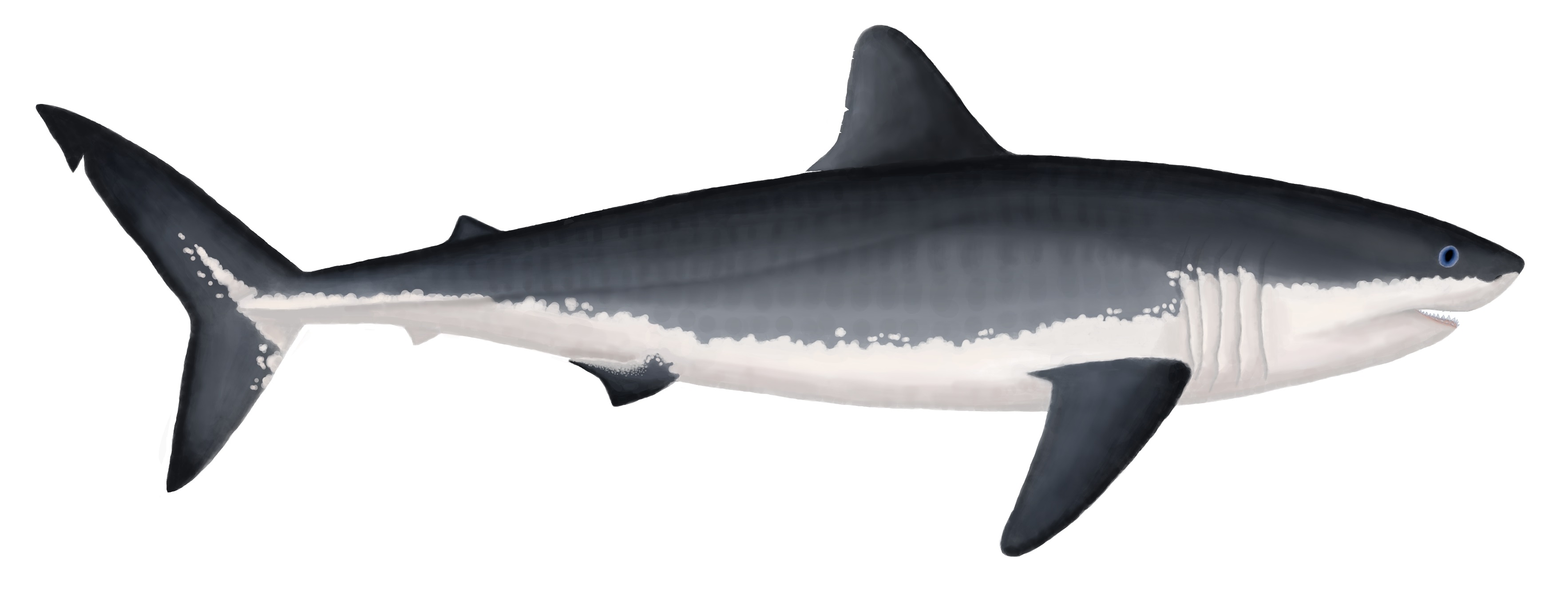
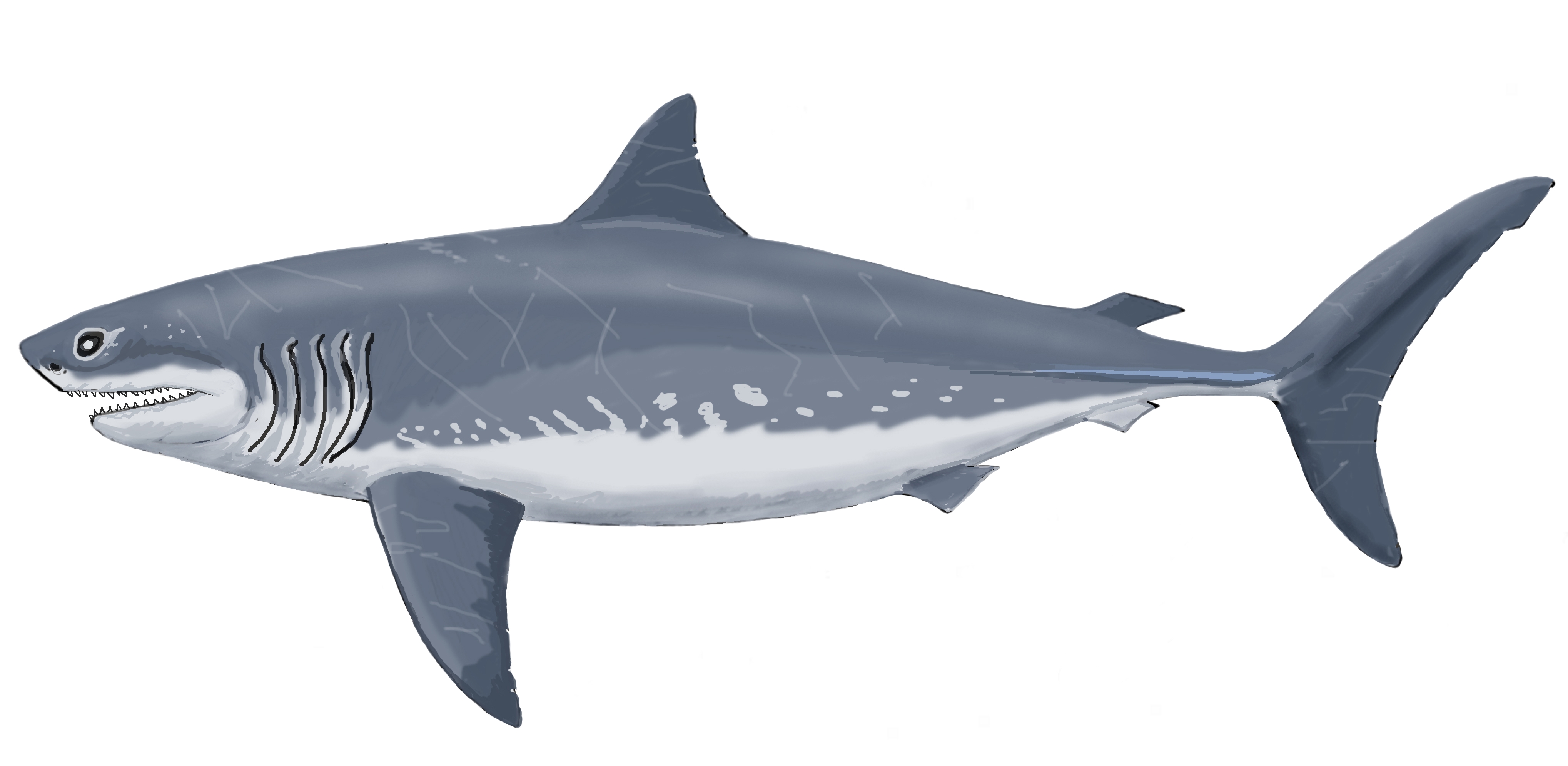


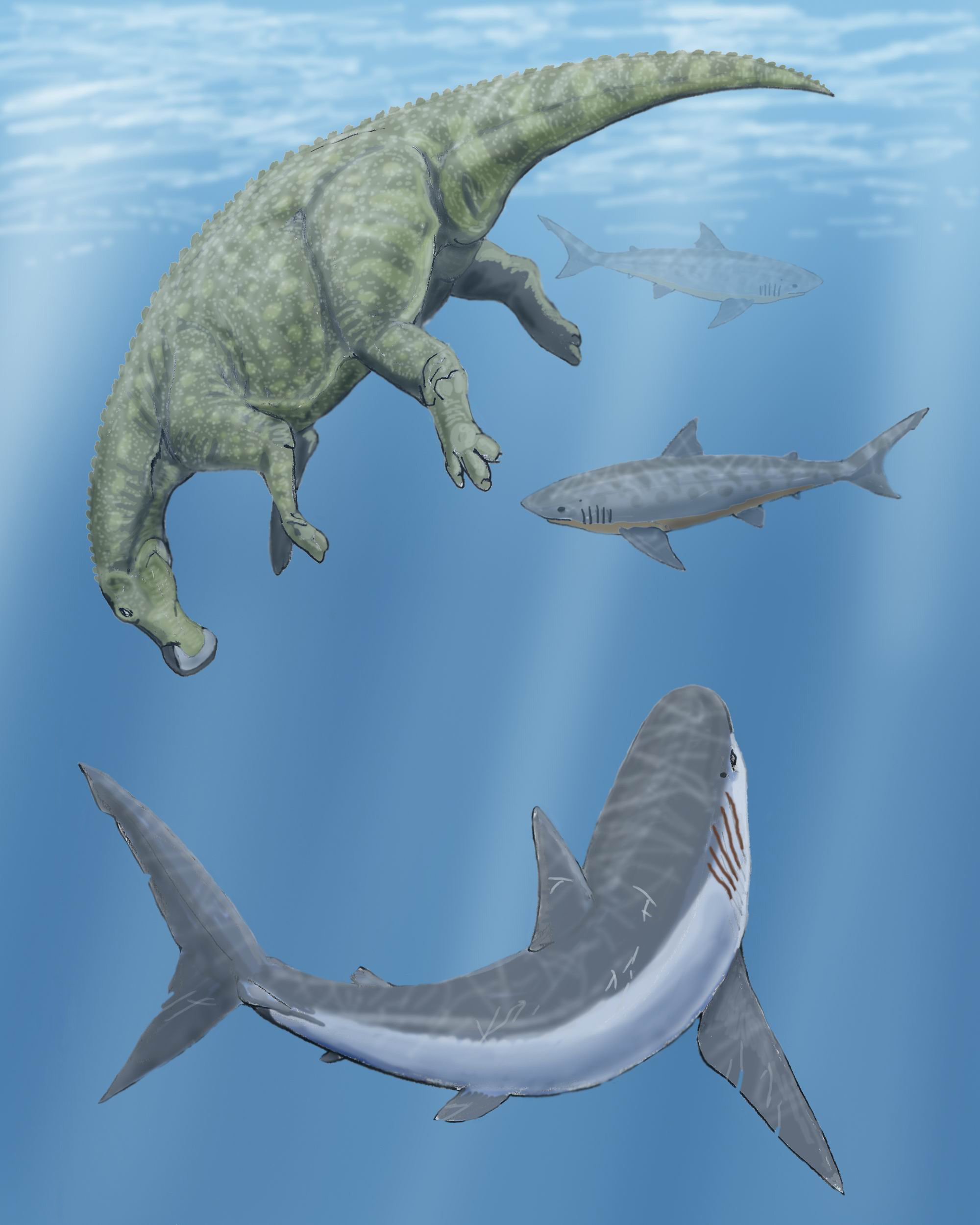


Reconstruction of Cretoxyrhina mantelli by Damouraptor (2022), showing the fusiform body morphology characteristic of a large lamniform, similar to the modern mako shark.
Damouraptor — CC BY-SA 4.0
Ecology and behavior
Habitat
Cretoxyrhina mantelli inhabited the Western Interior Seaway, a vast epicontinental waterway dividing North America from the Gulf of Mexico to the Hudson Strait during the Late Cretaceous, 100 to 72 million years ago. The water was slightly less saline than the open ocean, with subtropical to temperate temperatures. The sea had variable depth, with shallow areas rich in life and deeper zones with low bottom oxygen. Beyond North America, C. mantelli was cosmopolitan, occurring in the European Tethys Sea and possibly other tropical ocean regions.
Feeding
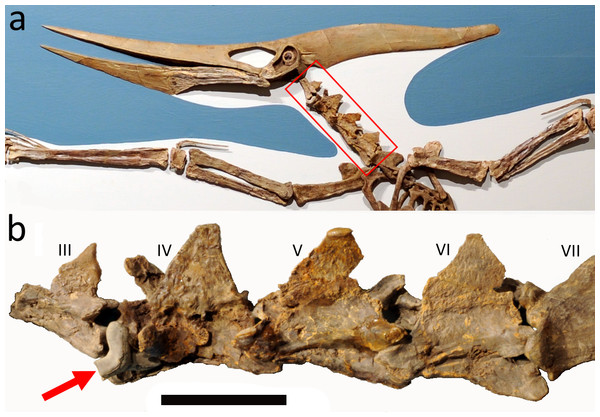
Cretoxyrhina mantelli was an active apex predator that attacked the largest available prey in the Western Interior Seaway. Bite mark evidence documents predation on several-meter mosasaurs, plesiosaurs, the giant fish Xiphactinus, sea turtles such as Protostega and Archelon, and pterosaurs like Pteranodon. The smooth, non-serrated teeth, similar to those of the mako shark, were adapted to pierce and hold actively struggling prey, not to saw like a great white shark. The attack mechanism likely involved high speed and multiple bites.
Behavior and senses
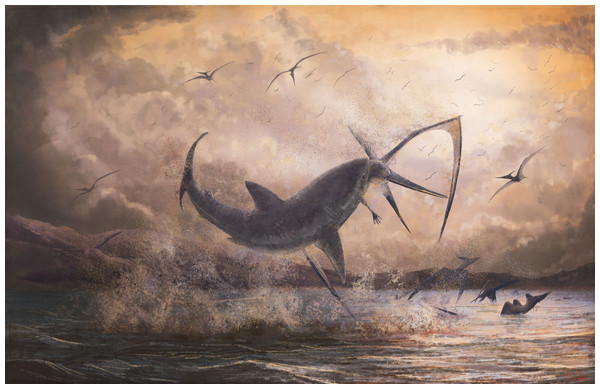
The body morphology of Cretoxyrhina mantelli, close to the modern mako shark, suggests it was a high-speed swimmer capable of burst speeds to capture agile prey. The ability to attack pterosaurs resting on the sea surface (documented by Hone et al. 2018) indicates opportunistic and versatile behavior. There is no evidence of social behavior, and the species was probably solitary. Production of offspring through ovoviviparity, as in most lamniformes, is likely but not directly confirmed in the fossil record.
Physiology and growth
Cretoxyrhina mantelli had a cartilaginous skeleton with densely calcified vertebrae, allowing growth ring analysis. Comparison with the modern mako shark suggests elevated metabolism for a chondrichthyan, possibly with some degree of regional endothermy as in the mako and great white shark. The estimated asymptotic length of 6.91 m and birth at 1.28 m suggest a relatively rapid growth rate. Placoid scales, preserved in at least one specimen, were of the smooth lisoric type, suitable for turbulence reduction during fast swimming.
Paleogeography
Continental configuration

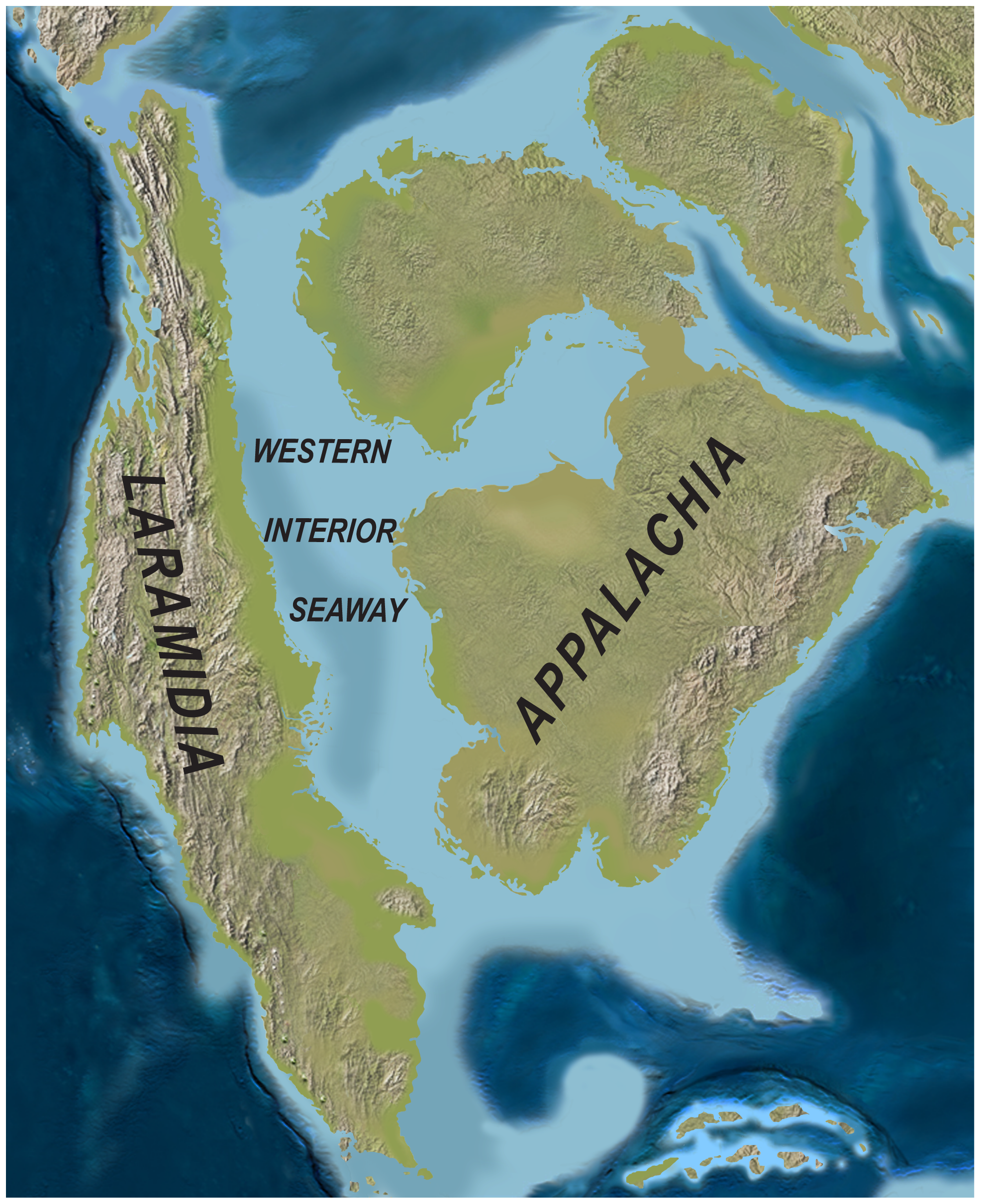
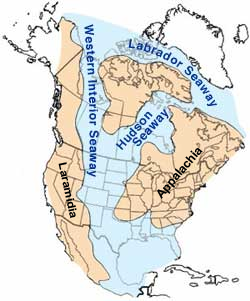
Scotese & Vérard · CC BY 4.0 · Cretaceous, ~105 Ma
Fossil sites
Sampson et al. 2010, PLOS ONE — CC BY 4.0
During the Cenomaniano-Campaniano (~100–72 Ma), Cretoxyrhina mantelli inhabited Laramidia, the western half of present-day North America, separated from the east by the Western Interior Seaway, a shallow sea dividing the continent. The continents were in very different positions: India was drifting toward Asia, Antarctica was still connected to Australia, and South America was an isolated island.
Bone Inventory
Several near-complete skeletons are known from the Cretaceous of Kansas. Specimen FHSM VP-2187 at the Sternberg Museum of Natural History, measuring 5 meters, is the most complete, preserving cartilaginous skull, articulated vertebrae, and scale impressions. KUVP 247 at the University of Kansas also preserves the cranial region and posterior skeleton.

Found elements
Inferred elements
Scientific Literature
15 papers in chronological order — from the original description to recent research.
Recherches sur les poissons fossiles. Quatrième livraison
Agassiz, L. · Petitpierre, Neuchâtel
Original description of Cretoxyrhina mantelli by Swiss naturalist Louis Agassiz, based on fossil teeth from the Cretaceous chalk of England, named in honor of geologist Gideon Mantell. Agassiz, in his monumental work on fossil fish, characterizes C. mantelli teeth as smooth, without serration on cutting edges, with a distinct bifurcated root and shiny enamel. The size of the teeth, which can exceed 5 cm in height, already indicates a large animal. The originally described species was later recognized as also occurring in the Western Interior Seaway of North America, where the best specimens would be found more than a century later. This work is the mandatory nomenclatural starting point for all literature on C. mantelli.


Dentition of the Late Cretaceous lamniform shark, Cretoxyrhina mantelli, from the Niobrara Chalk of Kansas
Shimada, K. · Journal of Vertebrate Paleontology
Detailed analysis of the dentition of Cretoxyrhina mantelli from the Niobrara Chalk of Kansas, by Kenshu Shimada. The work documents tooth morphology, dental formula, and ontogenetic variation. Shimada demonstrates that C. mantelli had up to 34 teeth in the upper row and 36 in the lower row, totaling multiple functional rows. Teeth increase gradually in size from the symphysis to the jaw angle, reaching up to 5 cm in the largest functional teeth. The study reveals morphological differences between anterior and lateroposterior teeth used to infer prey capture mechanism. This paper, along with the anatomical article of the same year, is the primary reference for identification of isolated C. mantelli teeth in fossil records.

Skeletal anatomy of the Late Cretaceous lamniform shark, Cretoxyrhina mantelli, from the Niobrara Chalk in Kansas
Shimada, K. · Journal of Vertebrate Paleontology
Comprehensive skeletal description of Cretoxyrhina mantelli based on the most complete known specimens from the Niobrara Chalk of Kansas. Shimada describes in detail the cartilaginous neurocranium, vertebral column (with a count of approximately 230 vertebrae), fin elements, and branchial elements. The work reveals that C. mantelli had anatomy consistent with placement within Lamniformes, with morphofunctional characteristics close to the modern mako shark (Isurus). This is the primary anatomical reference study for the species and established the framework for all subsequent morphological and phylogenetic analyses. The detailed description of the neurocranium, especially well preserved in specimen FHSM VP-2187, revealed data on the sensory capabilities of the Cretaceous predator.
Paleoecological relationships of the Late Cretaceous lamniform shark, Cretoxyrhina mantelli (Agassiz)
Shimada, K. · Journal of Paleontology
Analysis of the paleoecological relationships of Cretoxyrhina mantelli based on predation evidence preserved in fossil specimens from the Niobrara Chalk of Kansas. Shimada documents C. mantelli bite marks on mosasaurs, teleosts including Xiphactinus, and possibly plesiosaurs. The work demonstrates that C. mantelli occupied the top of the food chain in the Western Interior Seaway, competing with or preying on the largest marine vertebrates of the time. The study is fundamental for reconstructing the ecological interactions of the Cretaceous Kansas ecosystem and establishes C. mantelli as the apex predator of the Western Interior Seaway during the Coniacian-Campanian.
Periodic marker bands in vertebral centra of the Late Cretaceous lamniform shark, Cretoxyrhina mantelli
Shimada, K. · Copeia
First study of periodic growth increment bands in the vertebral centra of Cretoxyrhina mantelli, providing the first data on growth rates and life history parameters of this extinct lamniform shark. Shimada demonstrates that growth bands are comparable to those of modern lamniform sharks and uses them to estimate that 5-meter individuals would be between 20 and 30 years old. Length at birth is estimated at 1.28 m and asymptotic length at 6.91 m. This pioneering work opens the field of life history study of extinct sharks via vertebra analysis and establishes methodological protocols followed in subsequent studies of other extinct species.

Ontogenetic parameters and life history strategies of the late Cretaceous lamniform shark, Cretoxyrhina mantelli, based on vertebral growth increments
Shimada, K. · Journal of Vertebrate Paleontology
Quantitative analysis of the ontogenetic development and life history strategies of Cretoxyrhina mantelli based on the vertebral growth increment model. Shimada uses the von Bertalanffy growth function with parameters derived from vertebral bands to create detailed growth curves. Asymptotic length (L∞) is estimated at 6.91 m total length. The study demonstrates that C. mantelli grew rapidly in the first years of life, reaching more than half of maximum length by around 10 years, and that 5-meter individuals would have been probably 20-30 years old. These data are comparable to those of the great white shark and the mako shark, suggesting similar ecology and metabolism.
Paleoecological relationships of the Late Cretaceous lamniform shark, Cretoxyrhina mantelli (Agassiz): paleoecology from mosasaur remains
Shimada, K. · Journal of Vertebrate Paleontology
Analysis of mosasaur remains with bite marks attributed to Cretoxyrhina mantelli from the Niobrara Chalk of Kansas, providing direct evidence of predatory behavior. Shimada documents several mosasaur bones, including vertebrae and ribs, with bite marks characteristic of the cylindrical, smooth teeth of C. mantelli. Marks include deep incisions, teeth embedded in bones, and multiple bite patterns suggesting feeding by grasping. This work is fundamental for reconstructing the Western Interior Seaway food chains and documents for the first time directly that C. mantelli attacked and consumed mosasaurs.
Evidence for the Cretaceous shark Cretoxyrhina mantelli feeding on the pterosaur Pteranodon from the Niobrara Formation
Hone, D.W.E. & Witton, M.P. & Habib, M.B. · PeerJ
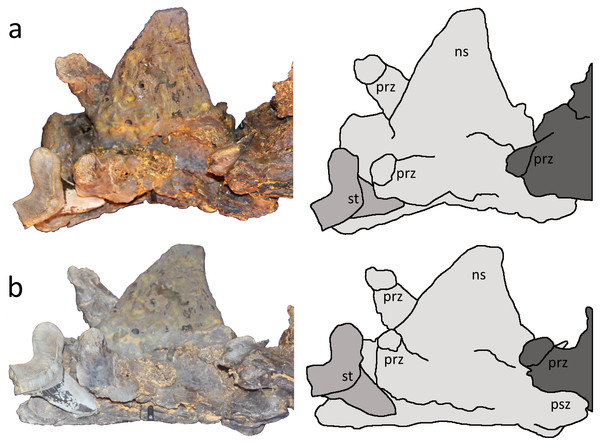
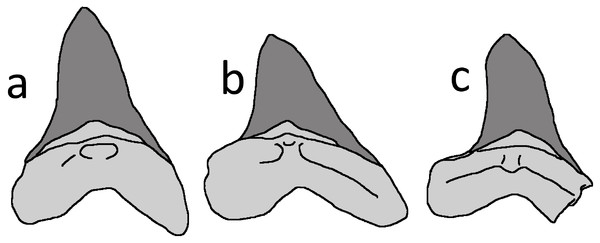
Study documenting the first evidence of Cretoxyrhina mantelli preying on pterosaurs, based on a Pteranodon specimen from the Niobrara Formation that preserves a C. mantelli tooth embedded in a bone and a vertebra with a bite mark. Hone, Witton and Habib reconstruct the predation scenario: a pteranodon probably resting on the sea surface was attacked by the shark from below. The work includes artistic illustration of the event by Mark Witton. The discovery expands C. mantelli's prey spectrum to include pterosaurs, demonstrating that this predator was not limited to strictly aquatic prey.
Large deadfalls of the 'ginsu' shark Cretoxyrhina mantelli (Agassiz, 1835) (Neoselachii, Lamniformes) from the Upper Cretaceous of northeastern Italy
Amalfitano, J. et al. · Cretaceous Research
Description of large Cretoxyrhina mantelli deadfalls from the Upper Cretaceous of northeastern Italy, extending the known range of the species to Europe and documenting the ecological role of C. mantelli carcasses in deep-sea ecosystems. Amalfitano and collaborators describe specimens preserving articulated vertebrae, teeth, and cranial fragments of large individuals. The study reveals that C. mantelli carcasses served as a substrate for communities of bottom-dwelling invertebrates, similar to what occurs with modern cetacean carcasses. This work significantly expands the known paleogeographic distribution of C. mantelli beyond the Western Interior Seaway.

Ontogeny and life history of a large lamniform shark from the Early Cretaceous of North America
Newbrey, M.G. et al. · Acta Palaeontologica Polonica
Analysis of vertebral growth in Late Cretaceous lamniform sharks including Cretoxyrhina mantelli, providing revised estimates of maximum body size and growth patterns across ontogeny. Newbrey and collaborators processed vertebral increment data from multiple C. mantelli specimens and produced size estimates incorporating greater specimen diversity than Shimada's earlier study (1997). Based on an especially large tooth, the maximum size estimate reaches 8 meters in length, although the typical length for adults is 5-7 m. The work also documents vertebral centra from three different localities in Kansas, demonstrating the abundance of C. mantelli in the Western Interior Seaway.
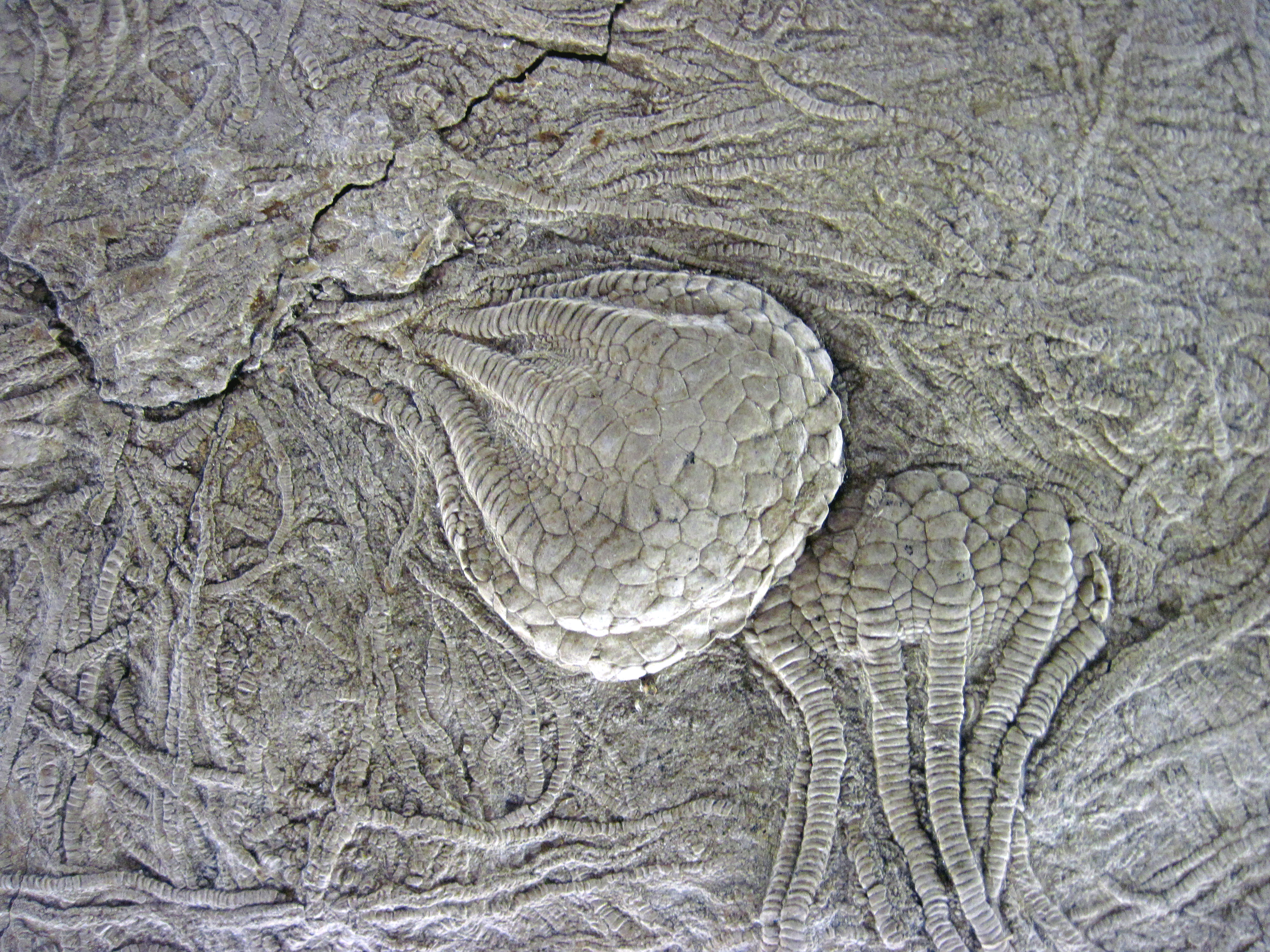

Analysis of an associated Cretoxyrhina mantelli dentition from the Late Cretaceous (Smoky Hill Chalk, Late Coniacian) of western Kansas
Bourdon, J. & Everhart, M.J. · Transactions of the Kansas Academy of Science
Analysis of an associated dentition of Cretoxyrhina mantelli from the Smoky Hill Chalk of western Kansas, documenting dental morphology and formula, and comparing with previously known material. Bourdon and Everhart describe a rare set of teeth associated in situ that allows precise reconstruction of the complete dental pattern of the species. The work reveals variations in tooth morphology along the rows that had not been fully documented by Shimada (1997). The analysis demonstrates that C. mantelli had greater dental variability than thought, which may reflect ontogenetic specialization of the dentition for different types of prey at different life stages.

Hypotodus verticalis (Agassiz, 1843), Hypotodus robustus (Leriche, 1921) and Hypotodus heinzelini (Casier, 1967), Chondrichthyes, Lamniformes, junior synonyms of Cretoxyrhina mantelli (Agassiz, 1835)
Ward, D.J. · Tertiary Research
Fundamental taxonomic revision demonstrating that several Cretaceous lamniform shark species previously placed in distinct genera are junior synonyms of Cretoxyrhina mantelli. Ward analyzes the type material of Hypotodus verticalis, H. robustus and H. heinzelini and concludes that all belong to C. mantelli, significantly simplifying the taxonomy of the group. This revision explains why European specimens were described as different species from Kansas forms and consolidates C. mantelli as a single species of cosmopolitan distribution. The taxonomic clarification is essential for correctly interpreting the paleogeographic distribution and biodiversity of Late Cretaceous lamniformes.

Late Cretaceous and Danian shark faunas of the Maastricht area
Siverson, M. · Beringeria
Analysis of Late Cretaceous and Danian shark faunas including Cretoxyrhina mantelli from Europe, providing biostratigraphic and paleoecological context for the species' final occurrence in the European record. Siverson documents that C. mantelli persisted in Europe until close to the end of the Cretaceous, with the last European records from the upper Campanian. The work provides data on the shark fauna composition in the European Late Cretaceous and helps understand the causes of C. mantelli's extinction at the K-Pg event. The biostratigraphic analysis allows correlation of the European and American records of the species.

Oceans of Kansas: A Natural History of the Western Interior Sea
Everhart, M.J. · Indiana University Press
Comprehensive natural history of the Western Interior Sea and its fauna, including detailed accounts of Cretoxyrhina mantelli based on decades of fieldwork in Kansas by Mike Everhart. The book documents hundreds of C. mantelli teeth collected in western Kansas and describes several predation events documented by bite marks in other fossils. Everhart collected and described evidence of C. mantelli preying on mosasaurs, plesiosaurs, and large fish. The work is the most accessible and comprehensive reference on the paleoecology of C. mantelli in the context of the complete Western Interior Sea ecosystem, and is widely cited in paleoichthyological and general paleontological literature.

Phylogeny of lamniform sharks (Chondrichthyes: Elasmobranchii) and the contribution of dental characters to lamniform systematics
Shimada, K. · Paleontological Research
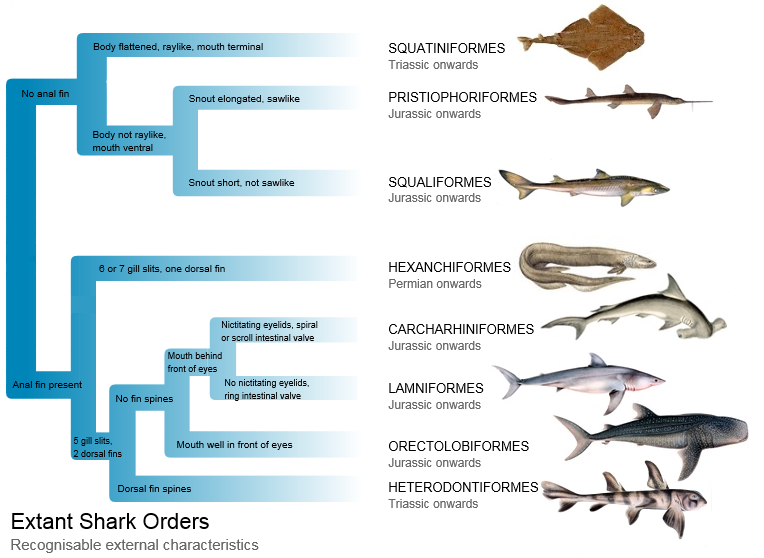
Shimada (2005) conducted a phylogenetic analysis of lamniform sharks including Cretoxyrhina mantelli, evaluating which dental characters are informative for group systematics. The study placed Cretoxyrhina within Lamnidae sensu lato, corroborating earlier analyses based on dental morphology, and demonstrated that the morphological convergence between modern white sharks and Cretoxyrhina results from parallel evolution rather than immediate common ancestry.


Famous museum specimens
FHSM VP-2187
Sternberg Museum of Natural History, Hays, Kansas, EUA
The most complete known specimen of Cretoxyrhina mantelli, measuring 5 meters in length. Preserves cartilaginous skull, articulated vertebrae, and scale impressions. It was collected from the lower Smoky Hill Chalk of Ellis, Kansas, and is the central study object of Shimada's (1997) works.
KUVP 247
University of Kansas Museum of Natural History, Lawrence, Kansas, EUA
Partial cartilaginous skeleton including well-preserved cranial region and posterior skeleton. Together with FHSM VP-2187, it is one of the two most studied specimens of C. mantelli and provided crucial data on the cranial anatomy of the species.
CMN 4096
Canadian Museum of Nature, Ottawa, Canada
The largest Cretoxyrhina mantelli specimen from North America, estimated between 6 and 7 meters in length based on teeth and vertebrae. This specimen is central to studies of the maximum size of the species.
In cinema and popular culture
Cretoxyrhina mantelli, the Ginsu shark, holds a special place in paleontology pop culture, not as a blockbuster star but as an icon of American paleoichthyology. Popularized by the Ginsu shark nickname in the 1990s, the species became a mandatory reference in any documentary about the Cretaceous oceans of North America. In Sea Monsters: A Walking with Dinosaurs Trilogy (2003), the Ginsu shark was shown to the global audience as the apex predator of the Western Interior Sea, attacking mosasaurs and other large marine vertebrates. Documentaries from National Geographic and Discovery Channel have re-featured C. mantelli multiple times, always emphasizing the contrast between its smooth non-serrated teeth and the serrated teeth of the modern great white shark. The 2018 discovery of evidence of predation on pterosaurs generated headlines across media worldwide, renewing scientific and popular interest in the species. Compared to the megalodon, C. mantelli is frequently described as the most efficient predator per kilogram of body mass of the Cretaceous.
Classification

Discovery
Fun fact
Cretoxyrhina mantelli earned the nickname 'Ginsu shark' because its smooth non-serrated teeth worked exactly like the famous Japanese Ginsu kitchen knife: they cut cleanly without tearing, leaving clean incisions in the bones of their victims. Paleontologists recognize C. mantelli marks in fossils for exactly this reason.
Last reviewed: April 24, 2026