Beipiaosaurus
Beipiaosaurus inexpectus
"Beipiao lizard, unexpected"
About this species
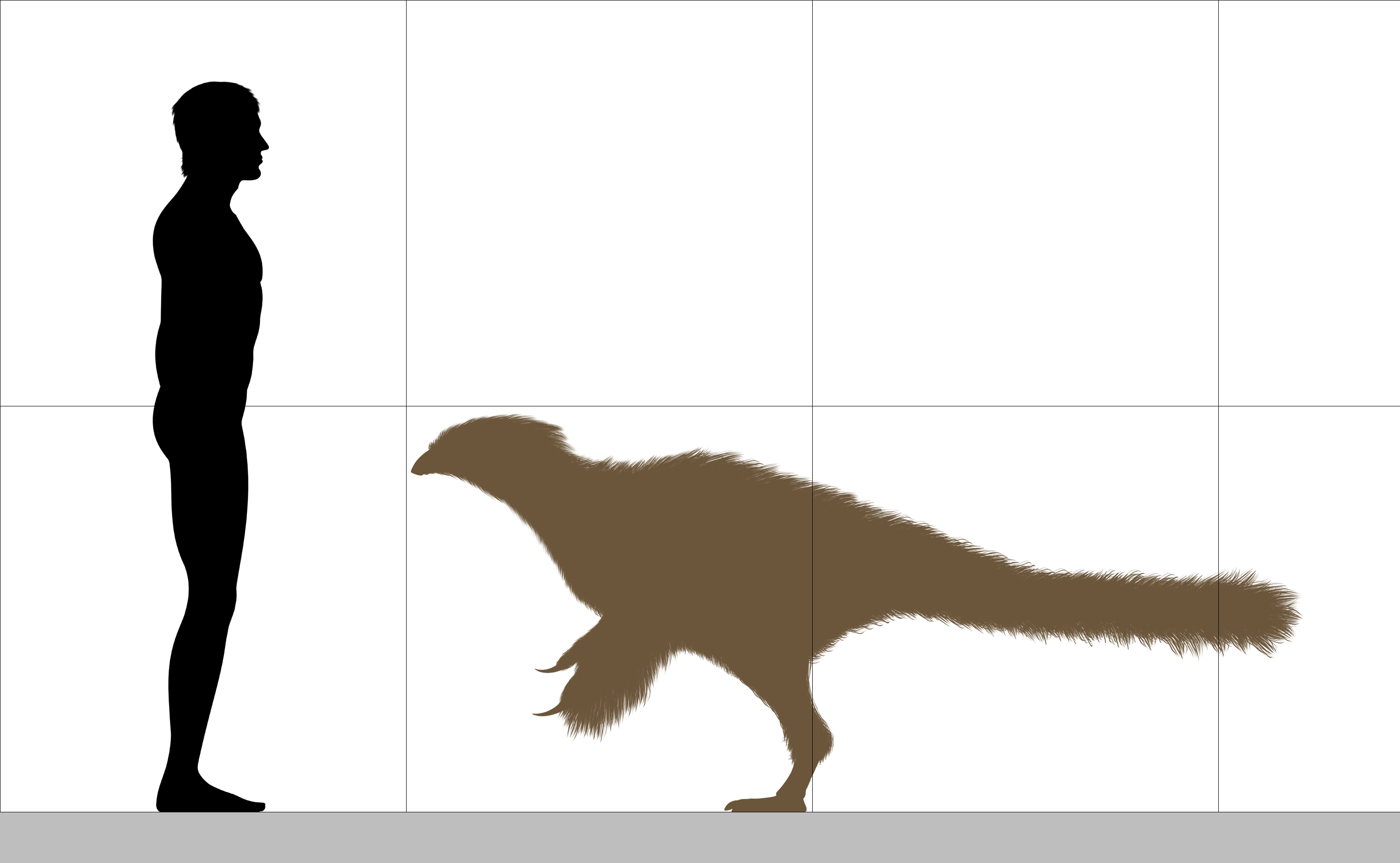
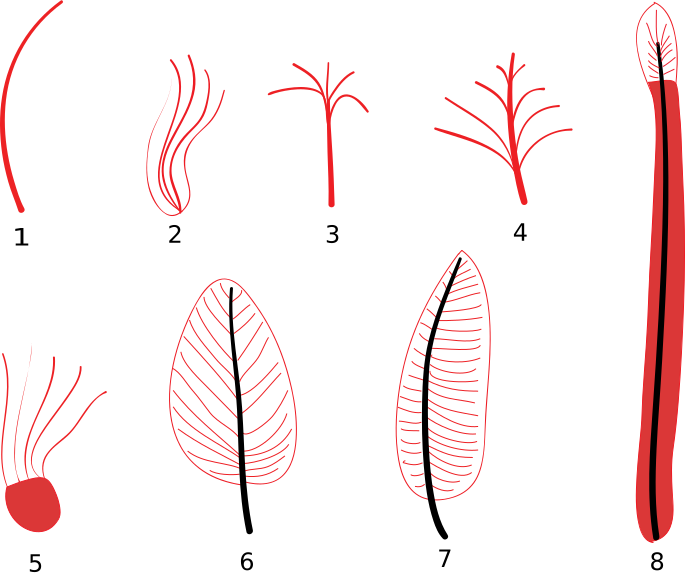
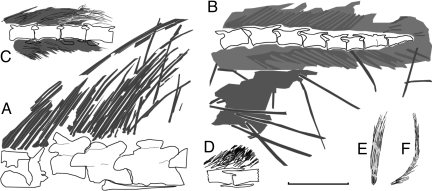
Beipiaosaurus inexpectus is a basal therizinosauroid from the Early Cretaceous (early Aptian, around 125 to 124 million years ago) Yixian Formation, Jianshangou Bed, near Sihetun (Beipiao, western Liaoning, China). It reached about 2.2 m in length and preserved two integumentary types: short slender filaments similar to those of Sinosauropteryx, and elongated broad filamentous feathers (EBFFs) 10 to 15 cm long, likely used for display. It was the first therizinosaur shown to bear a feather-like covering, confirming that the group, long interpreted as a late-surviving prosauropod relative, nests among maniraptoran coelurosaurs.
Geological formation & environment
Yixian Formation, Jehol Group, western Liaoning Province, northeastern China. Beipiaosaurus comes from the Jianshangou Bed, near Sihetun, in Beipiao County. Recent 40Ar/39Ar dates (Chang et al. 2017) constrain unit deposition between about 125.8 and 124.1 Ma, corresponding to the early Aptian stage of the Early Cretaceous. It is a volcanosedimentary succession with shallow lakes and tuff layers, producing a world-famous Konservat-Lagerstätte. The same unit yields feathered dinosaurs (Sinosauropteryx, Caudipteryx, Sinornithosaurus), early birds (Confuciusornis), mammals (Eomaia, Repenomamus), pterosaurs, fish, insects and the earliest aquatic angiosperms (Archaefructus).
Image gallery
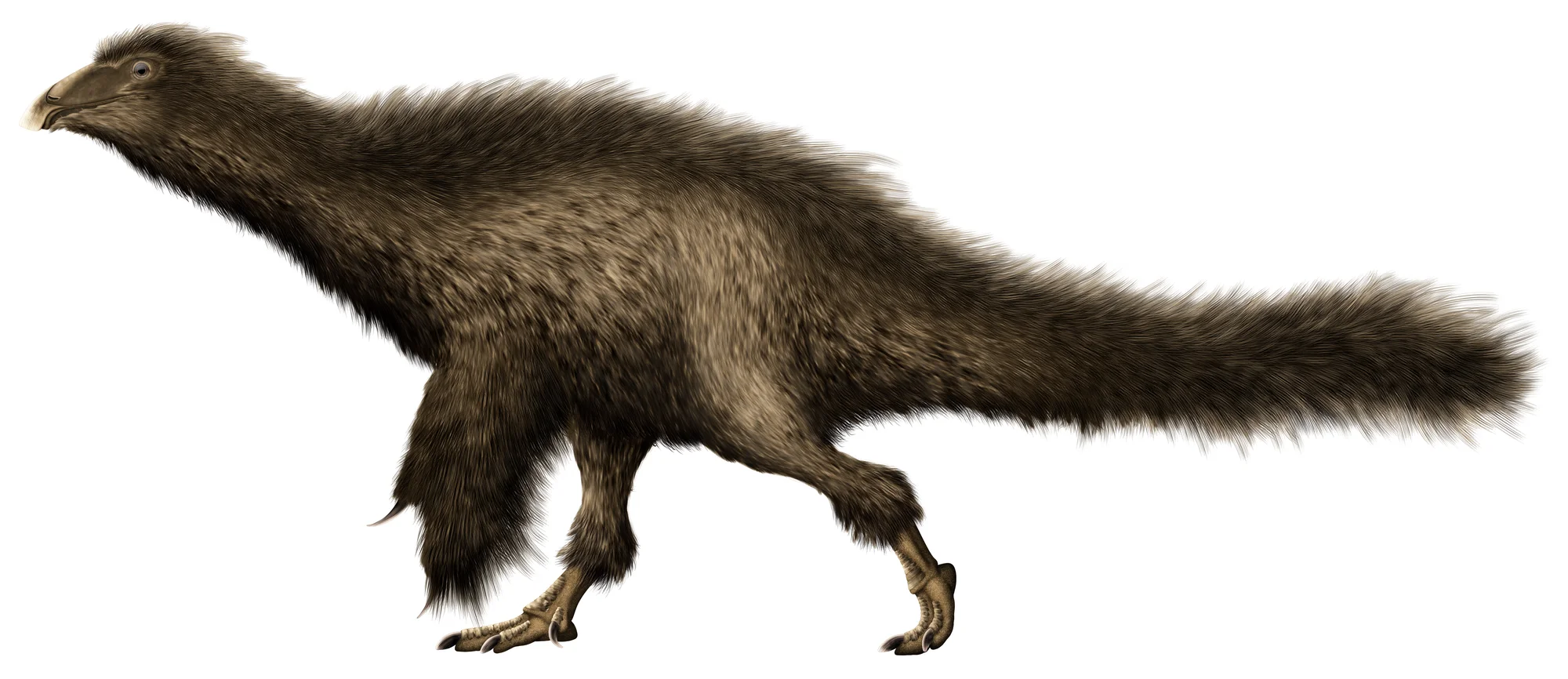






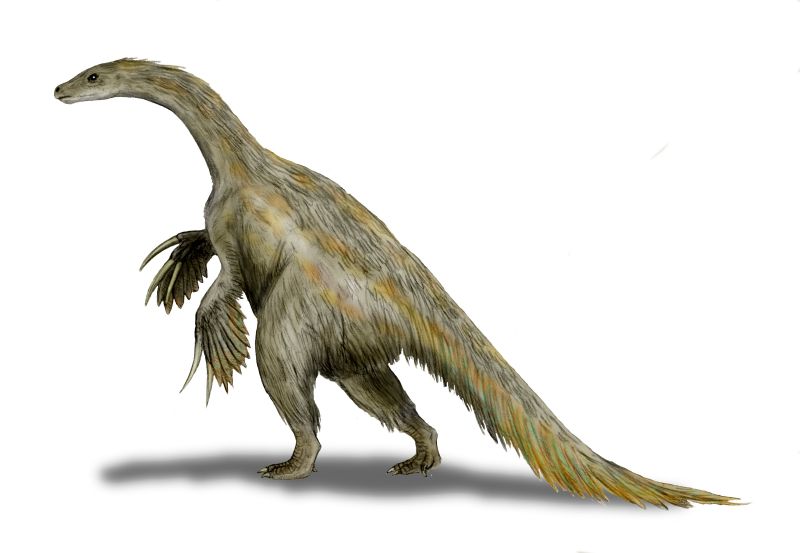
Life reconstruction of Beipiaosaurus inexpectus with filamentous cover and long EBFFs along the neck and back.
Wikimedia Commons (Emily Willoughby)
Ecology and behavior
Habitat
Margins of volcanic lakes in inland northeastern China, under a cool to cold-temperate climate with recurrent volcanic ash bursts that rapidly buried organisms and generated the Jehol Biota Lagerstätten. Vegetation was dominated by conifers, ginkgoaleans, cycadophytes and the earliest aquatic angiosperms of Archaefructus.
Feeding
Small to medium-sized herbivore. The small head, long neck and elongated manual claws suggest that it used its hands to pull branches and foliage, probably feeding on leaves, buds and cones of conifers and ginkgos. Small leaf-shaped teeth confirm a plant diet.
Behavior and senses
Likely bipedal, with upright posture and a tail used as a counterweight; less agile than more gracile maniraptorans. The long EBFFs on neck and back support a role in visual display, perhaps for intraspecific recognition or courtship.
Physiology and growth
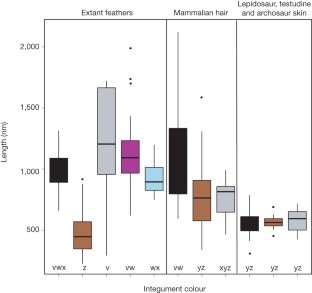
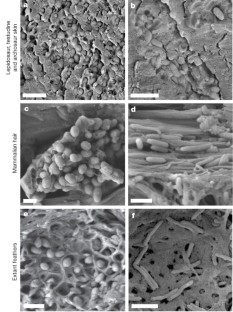
The double filamentous cover (short filaments plus EBFFs) is consistent with at least facultative endothermy and primarily with thermal insulation and display functions. The low-diversity preserved melanosomes indicate a relatively uniform brownish-red colouration.
Paleogeography
Continental configuration

Scotese & Vérard · CC BY 4.0 · Cretaceous, ~105 Ma
During the Aptiano (~125–124 Ma), Beipiaosaurus inexpectus inhabited Laramidia, the western half of present-day North America, separated from the east by the Western Interior Seaway, a shallow sea dividing the continent. The continents were in very different positions: India was drifting toward Asia, Antarctica was still connected to Australia, and South America was an isolated island.
Bone Inventory
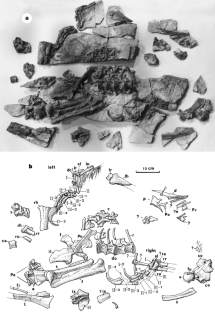
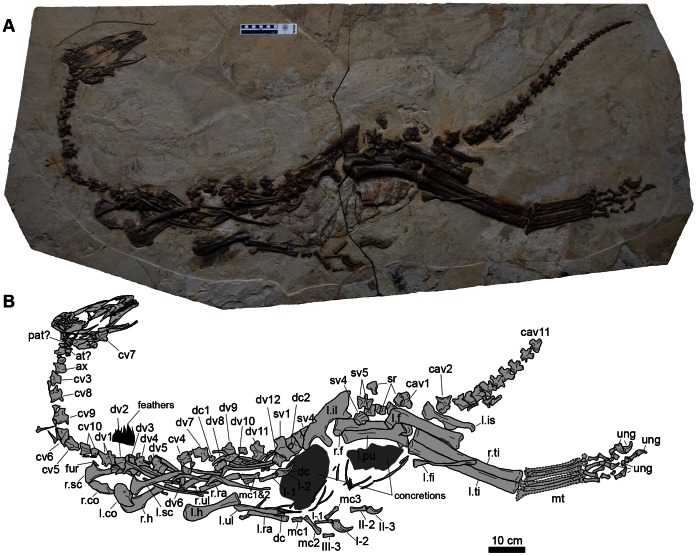
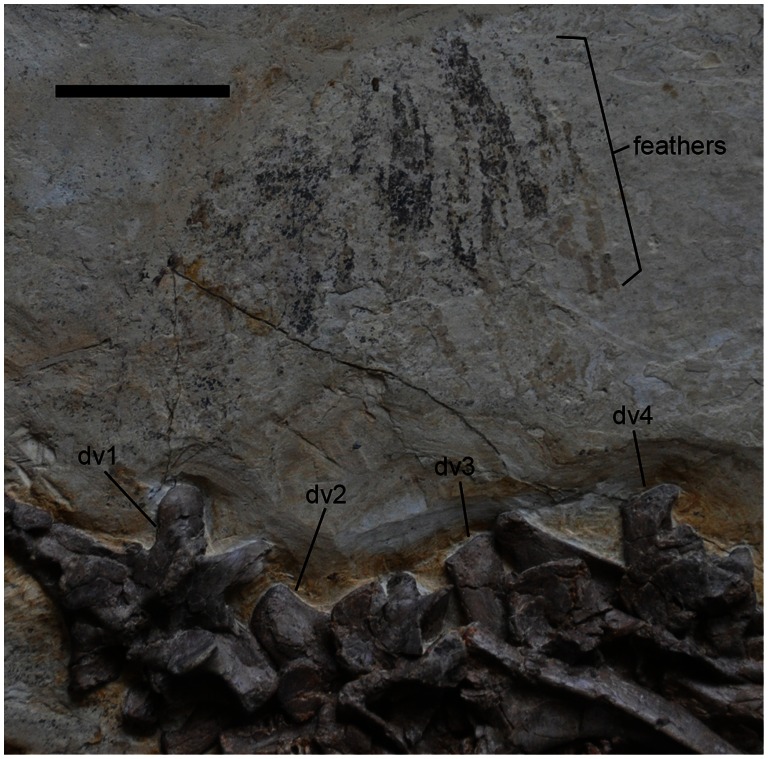
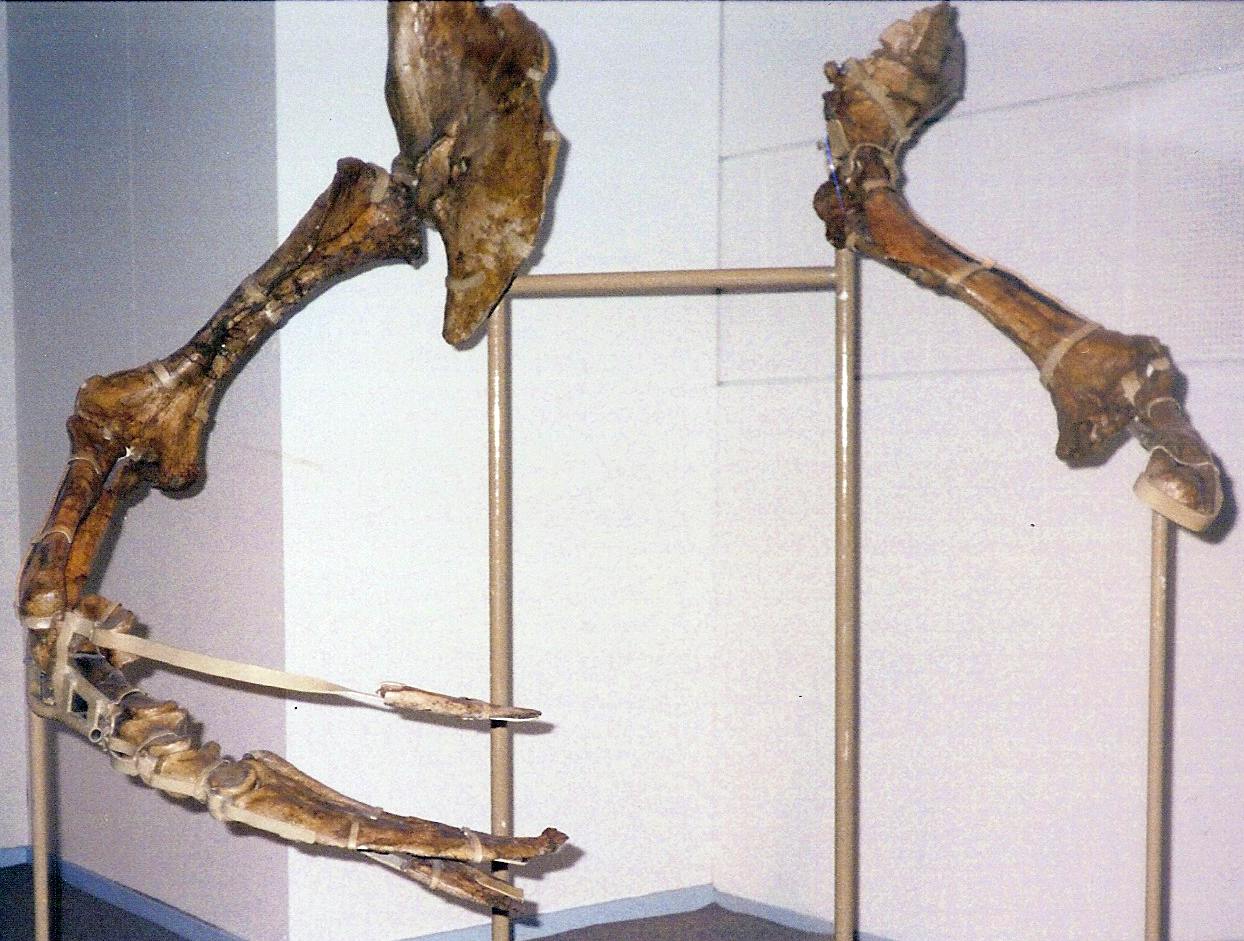
Holotype IVPP V11559 is a partial subadult skeleton with an incomplete skull, girdles, partial limbs and vertebrae preserved, plus integumentary filaments. Referred specimens STM 31-1 and BMNHC PH000911 add cranial material and, most importantly, extensive impressions of EBFF feathers on the neck and trunk. Together, the three specimens allow reconstruction of about 55% of the skeleton and most of the animal's filamentous cover.
Found elements
Inferred elements
Scientific Literature
15 papers in chronological order — from the original description to recent research.
The affinities of a new theropod from the Alxa Desert, Inner Mongolia, People's Republic of China
Russell, D.A. e Dong, Z.-M. · Canadian Journal of Earth Sciences 30(10), 2107-2127
Description of Alxasaurus elesitaiensis, an Early Cretaceous therizinosauroid from Inner Mongolia. It frames the group before the description of Beipiaosaurus and provides the comparative baseline that eventually places therizinosaurs among theropods.


A therizinosauroid dinosaur with integumentary structures from China
Xu, X., Tang, Z.-L. e Wang, X.-L. · Nature 399, 350-354
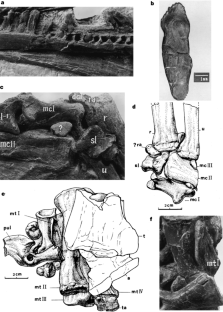
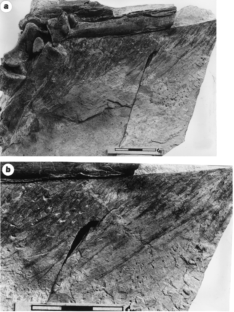
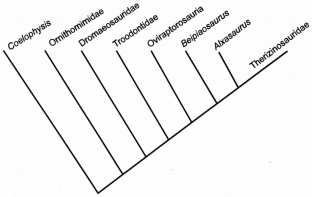
Original description of Beipiaosaurus inexpectus based on holotype IVPP V11559 collected at Sihetun (Yixian Formation). The paper documents integumentary filaments similar to those of Sinosauropteryx and provides the first direct evidence that therizinosauroids belong to Coelurosauria, radically repositioning the group.
First definitive therizinosaurid (Dinosauria; Theropoda) from North America
Kirkland, J.I. e Wolfe, D.G. · Journal of Vertebrate Paleontology 21(3), 410-414
Description of Nothronychus mckinleyi from the Late Cretaceous of New Mexico, the first unequivocal therizinosaurid outside Asia. It extends the group's range to North America and broadens the global context in which Beipiaosaurus, described two years earlier, is framed.

Pygostyle-like structure from Beipiaosaurus (Theropoda, Therizinosauroidea) from the Lower Cretaceous Yixian Formation of Liaoning, China
Xu, X., Cheng, Y.-N., Wang, X.-L. e Chang, C.-H. · Acta Geologica Sinica (English Edition) 77(3), 294-298
Reports five co-ossified distal caudals in a Beipiaosaurus specimen, forming a pygostyle-like structure. Documents filaments on the tail but no rectrices, suggesting that the pygostyle's ancestral function was not linked to specialised tail feathers.


A new look at the phylogeny of Coelurosauria (Dinosauria: Theropoda)
Senter, P. · Journal of Systematic Palaeontology 5(4), 429-463
Phylogenetic review of Coelurosauria that retains Therizinosauroidea as the total-group name for therizinosaurs, with Beipiaosaurus in a basal position. Sets one of the benchmark scenarios for the taxon's placement within Maniraptora in the late 2000s.


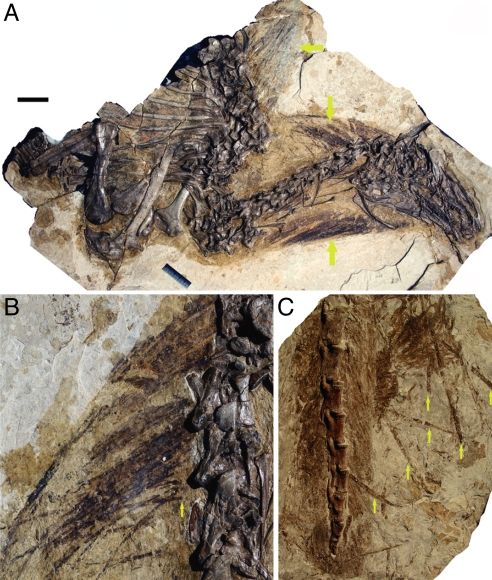
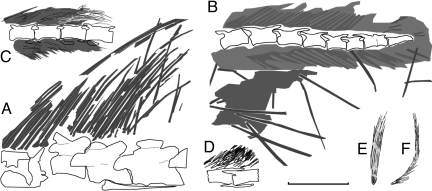
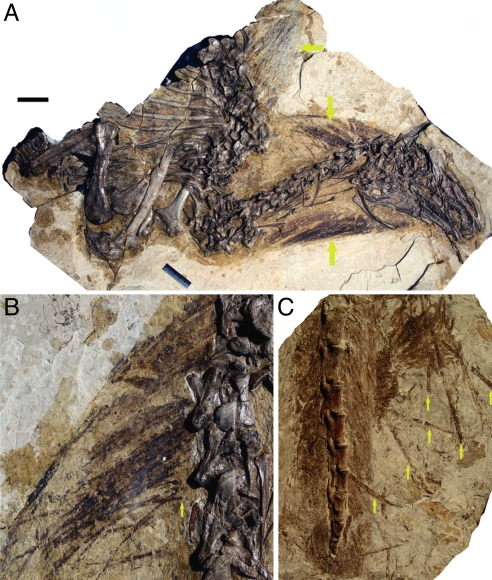
A new feather type in a nonavian theropod and the early evolution of feathers
Xu, X., Zheng, X.-T. e You, H.-L. · Proceedings of the National Academy of Sciences (PNAS) 106(3), 832-834
Describes two feather types in Beipiaosaurus: short slender filaments and EBFFs (elongated broad filamentous feathers), 10 to 15 cm long, single-filament structures consistent with stage I of the feather-evolution model. It strengthens a display function rather than a thermoregulatory one for these early structures.
A new North American therizinosaurid and the role of herbivory in 'predatory' dinosaur evolution
Zanno, L.E., Gillette, D.D., Albright, L.B. e Titus, A.L. · Proceedings of the Royal Society B 276(1672), 3505-3511
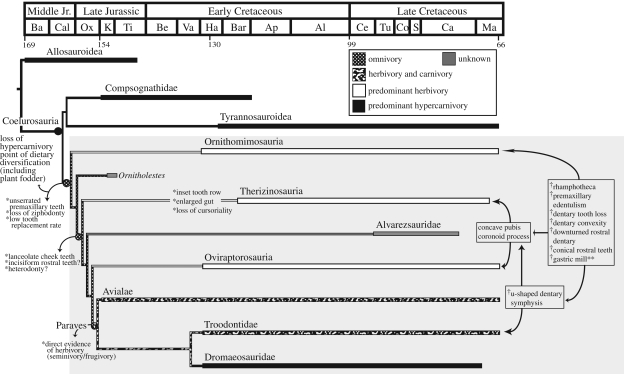
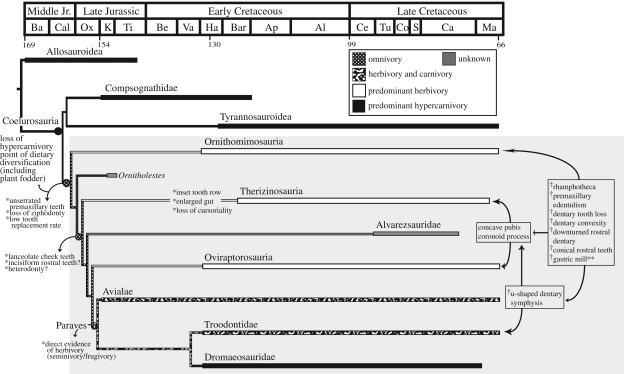
Description of Nothronychus graffami from the Late Cretaceous of Utah and phylogenetic reanalysis of Therizinosauria. The authors discuss herbivory as a recurrent phenomenon among maniraptoran theropods, with Beipiaosaurus representing one of the most basal and earliest records of this dietary shift.
A taxonomic and phylogenetic re-evaluation of Therizinosauria (Dinosauria: Maniraptora)
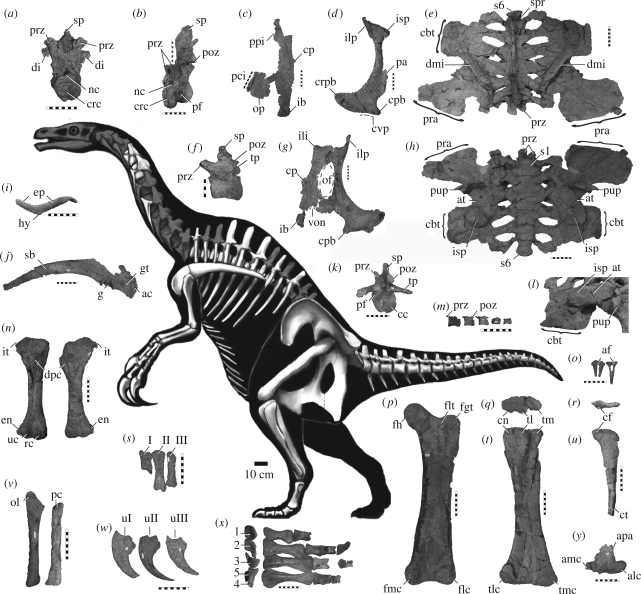
Zanno, L.E. · Journal of Systematic Palaeontology 8(4), 503-543
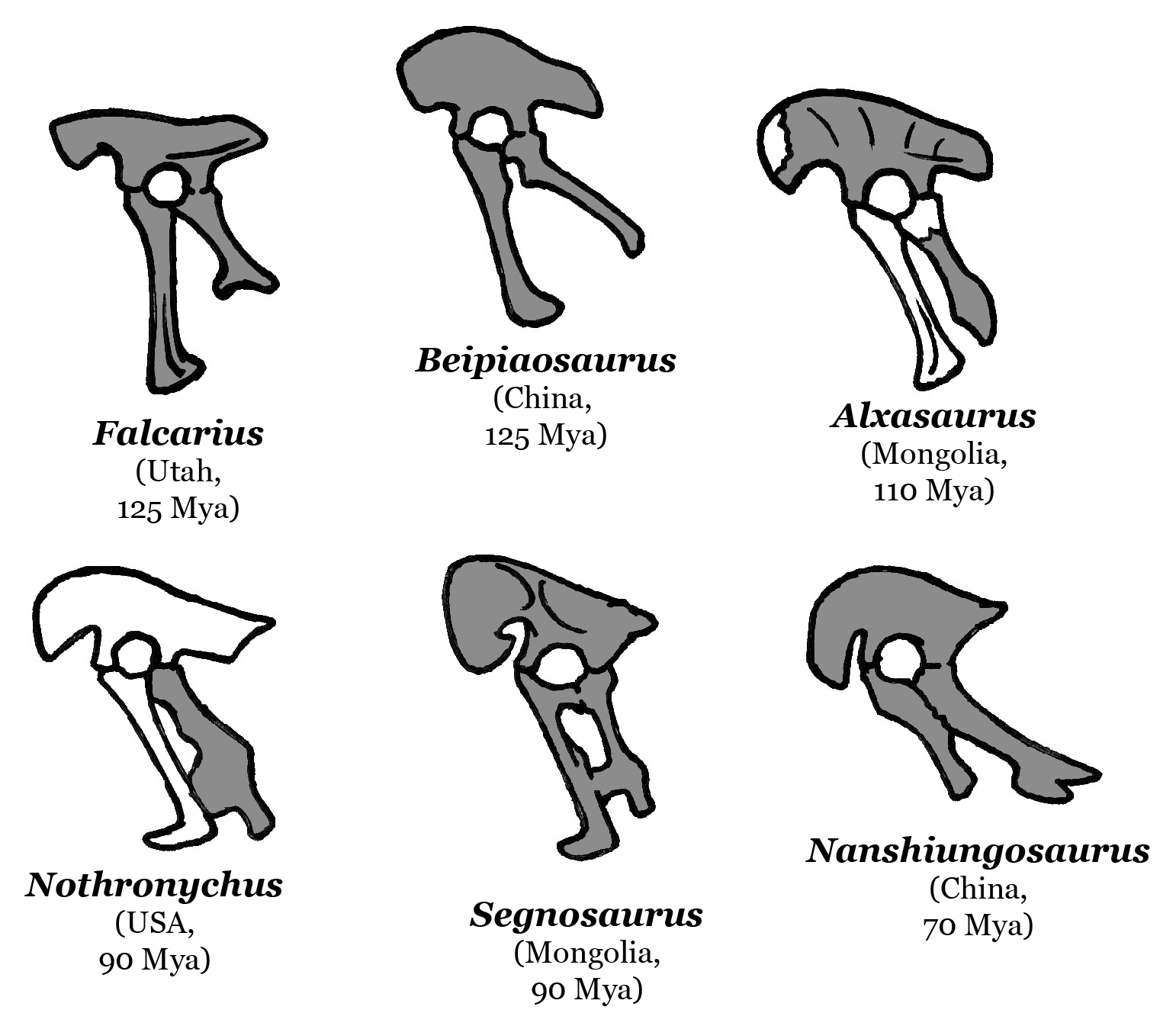
Comprehensive alpha-taxonomic and phylogenetic review of Therizinosauria, with formal redefinitions of Therizinosauria, Therizinosauroidea and Therizinosauridae. It confirms Beipiaosaurus as a basal therizinosauroid and a key branch for understanding the origin of the herbivorous lineage within Maniraptora.

Herbivorous ecomorphology and specialization patterns in theropod dinosaur evolution
Zanno, L.E. e Makovicky, P.J. · Proceedings of the National Academy of Sciences (PNAS) 108(1), 232-237
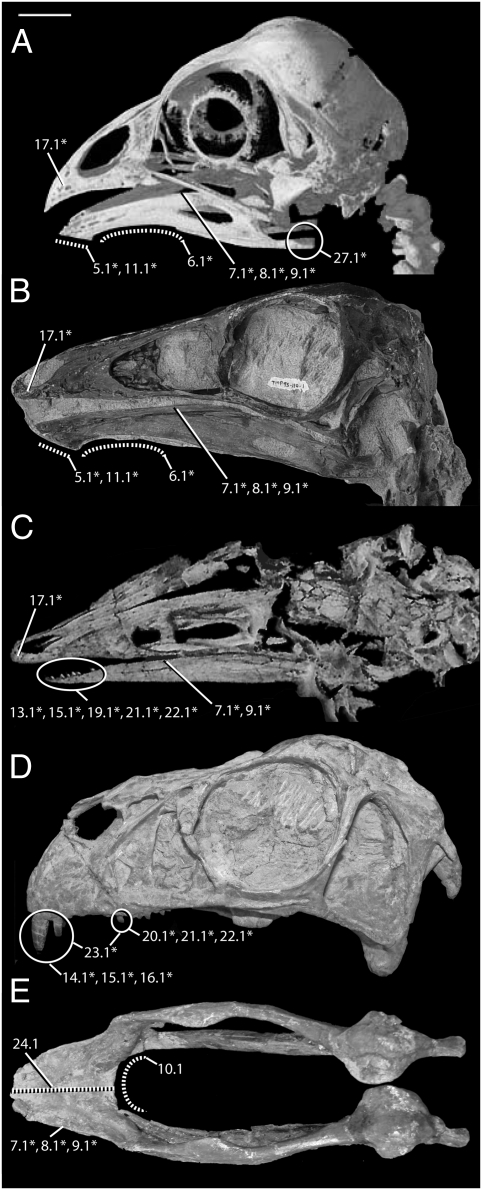
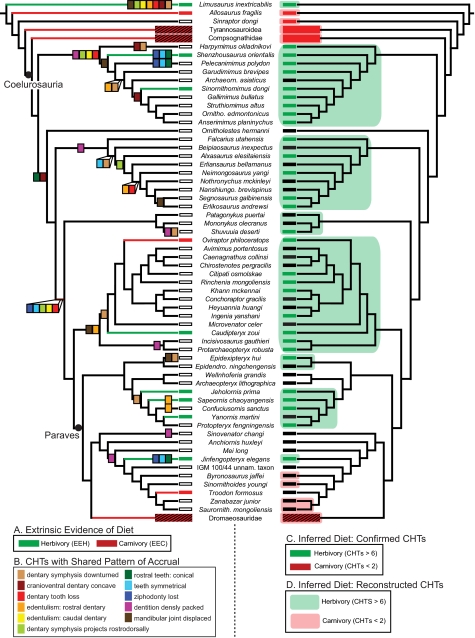
Quantitative analysis of herbivorous ecomorphology in theropods, with strong Therizinosauria representation. It demonstrates the independent acquisition of herbivory across multiple coelurosaur lineages and places Beipiaosaurus as a window into the onset of this process in the Early Cretaceous.

An unusual basal therizinosaur dinosaur with an ornithischian dental arrangement from northeastern China
Pu, H., Kobayashi, Y., Lü, J., Xu, L., Wu, Y., Chang, H., Zhang, J. e Jia, S. · PLOS ONE 8(5), e63423
Description of Jianchangosaurus yixianensis, a basal therizinosauroid from the Yixian Formation (Liaoning) nearly contemporaneous with Beipiaosaurus. It preserves an articulated skeleton and integumentary filaments, broadening the sample of early therizinosaurs. Some authors discuss whether it is a junior synonym of Beipiaosaurus.
Melanosome evolution indicates a key physiological shift within feathered dinosaurs
Li, Q., Clarke, J.A., Gao, K.-Q., Zhou, C.-F., Meng, Q., Li, D., D'Alba, L. e Shawkey, M.D. · Nature 507(7492), 350-353
A broad study of melanosomes preserved in fossils shows that Beipiaosaurus had low-diversity melanosomes consistent with uniform brownish-red tones. With the appearance of pennaceous feathers, melanosome diversity increases sharply, suggesting a physiological shift linked to the origin of flight.

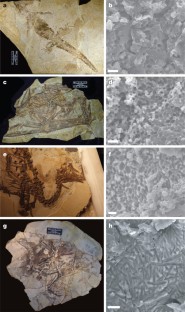
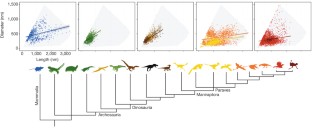
Functional niche partitioning in Therizinosauria provides new insights into the evolution of theropod herbivory
Lautenschlager, S. · Palaeontology 60(3), 375-387
Digital reconstruction and biomechanical modelling of therizinosaur mandibles show functional niche partitioning linked to herbivory. Beipiaosaurus occupies one end of the spectrum, with a less specialised jaw compatible with a mixed diet in a young forest environment.

New chronostratigraphic constraints on the Yixian Formation with implications for the Jehol Biota
Chang, S.-C., Gao, K.-Q., Zhou, C.-F. e Jourdan, F. · Palaeogeography, Palaeoclimatology, Palaeoecology 487, 399-406
New 40Ar/39Ar radiometric dates on the Yixian Formation constrain deposition to about 125.8 to 124.1 Ma, earliest Aptian. It provides the precise temporal frame in which Beipiaosaurus lived, near the onset of the Jehol volcanosedimentary cycle.

Cranial osteology of Beipiaosaurus inexpectus (Theropoda: Therizinosauria)
Liao, C.-C. e Xu, X. · Vertebrata PalAsiatica 57(2), 117-132
Detailed redescription of the skull preserved in IVPP V11559. Confirms Beipiaosaurus diagnostic characters, discusses the relatively long mandible compared with other therizinosaurs and provides characters for later phylogenetic analyses.

Postcranial osteology of Beipiaosaurus inexpectus (Theropoda: Therizinosauria)
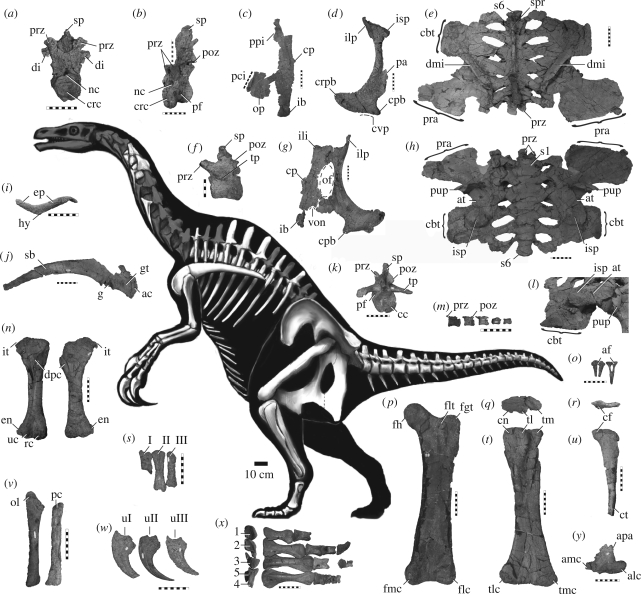
Liao, C.-C., Zanno, L.E., Wang, S. e Xu, X. · PLOS ONE 16(9), e0257913
Complete redescription of the postcranium of Beipiaosaurus holotype IVPP V11559, including two previously undescribed dorsal vertebrae. It provides the most robust postcranial character set for the taxon and reaffirms its position as a basal therizinosauroid.


Famous museum specimens
IVPP V11559 (holótipo)
Institute of Vertebrate Paleontology and Paleoanthropology (IVPP), Beijing, China
Holotype IVPP V11559 is the specimen that underpinned the original description by Xu, Tang and Wang in 1999 and the cranial redescription by Liao and Xu (2019) and postcranial redescription by Liao et al. (2021). It was collected in 1996 at Sihetun, Beipiao County, western Liaoning Province, and preserved fossil integumentary filaments that provided the first direct evidence of filamentous covering in a therizinosaur.
STM 31-1 (espécime referido)
Shandong Tianyu Museum of Nature (STM), Pingyi, Shandong, China
Beipiaosaurus specimen described by Xu, Zheng and You (2009, PNAS) as the basis for defining EBFFs, elongated broad filamentous feathers 10 to 15 cm long consistent with stage I of the feather-evolution model. It is today one of the central pieces of evidence in debates on the non-avian origin of feathers.
BMNHC PH000911 (espécime referido)
Beijing Museum of Natural History (BMNHC), Beijing, China
Material referred to Beipiaosaurus inexpectus that complements holotype IVPP V11559 and STM 31-1, particularly on the filamentous cover of the cervical region. It is on display at the Beijing Museum of Natural History.
Classification
Discovery
Fun fact
When Beipiaosaurus was described in 1999, it became the unexpected theropod in a very literal way: it bundled three things no one expected to see in the same box, a therizinosaur (a poorly understood group, previously compared to late prosauropod relatives), a herbivore (rare among theropods) and a feathered dinosaur already at 125 million years ago. Ten years later, in 2009, it was back in the headlines (via PNAS) with the discovery of EBFFs (elongated broad filamentous feathers), up to 15 cm long, consistent with stage 1 of the theoretical feather-evolution model, completing in the fossil record all the morphotypes predicted by developmental biologists.
Last reviewed: April 24, 2026